
New Tampa’s busiest road, whose most identifiable traits are usually cars and congestion, is catching some eyeballs with a new look at some of its busier intersections:
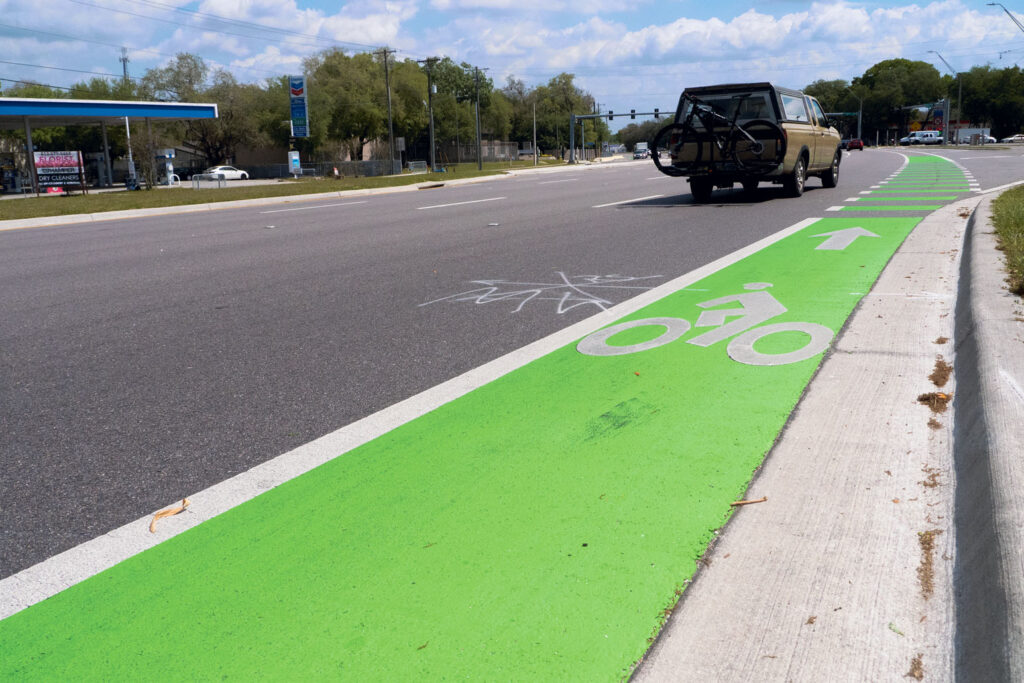
Some sections of the Bruce B. Downs (BBD) Blvd. bike lanes have been painted bright green.
The green bike lanes are noticeable at busy intersections with right turns on BBD. The bike lanes, usually marked with just a single white line, are bright green (with thermoplastic, as opposed to actual paint) as the intersections draw near, to indicate they are for bicycle use only.
Then, the solid green transitions into dashes, indicating that vehicles can cautiously move over to make a right turn, but cyclists should still have priority. The lanes then become solid green again.
The green bike lanes are tough to miss. And, that’s the whole idea.
“It sounds like it’s doing its job getting people’s attention,” says Josh Bellotti, Hillsborough County’s director of engineering and operations. “That’s what it is supposed to be doing, alerting drivers that there is a bike lane.”
BBD is among the first county roads to get the colorful lanes, although some similar bike lanes have been in existence in downtown Tampa for a while.
Bellotti says that when all of the painting is done, 94 intersections across the county will have the green bike boxes. There will be 19 total in New Tampa, and will also include some at busy intersections on Cross Creek Blvd., where bike lanes cross right turn lanes.
“We are trying to put them in areas where, when you’re approaching an intersection, there might be some potential conflict,” Bellotti says.
But, do they work?
Well, Teagan Myhre would tell you yes.
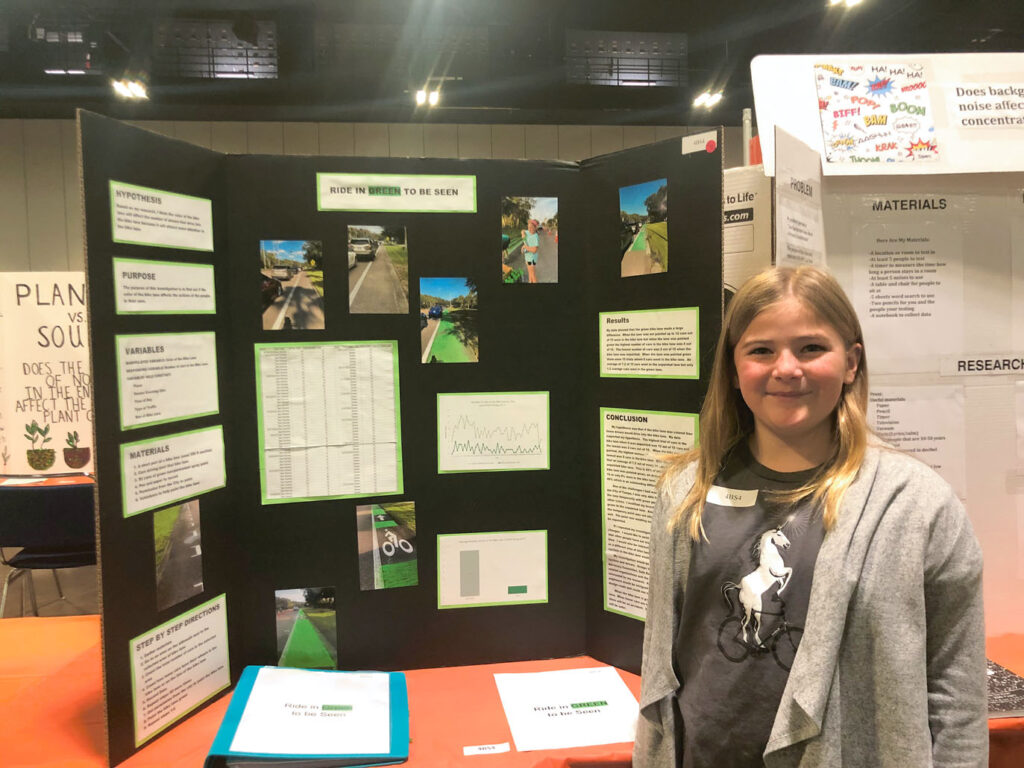
The Chiles Elementary fifth-grader did a science project last year on the effectiveness of painted bike lanes, called “Ride in Green to be Seen,” and discovered that, indeed, the green lanes do make an impact on drivers’ habits.
Teagan’s project earned the only Superior rating in the Behavioral Science category for fourth graders at the Hillsborough County STEM (Science, Technology, Engineering & Math) Fair, and was named Best of Fair for the 4th grade. The project also won a Creative Problem Solving Award, and a Science Award from the College of Behavioral & Community Sciences at USF.
Teagan, whose father Randy owns Oliver’s Cycle Sports in The Walk at Highwoods Preserve plaza and is an avid cyclist and bike safety activist, started with the hypothesis that motorists would be more likely to see the painted bike lane and give cyclists more room as a result.
So for one week, Teagan sat at the corner of Cypress Preserve Dr. and Tampa Palms Blvd. and watched cars drive by an unpainted bike lane. After 50 tests, she got permission from the City of Tampa and painted the same bike lane green (with old fashioned spray paint) and re-ran her tests.
When the lane wasn’t painted, Teagan found that 4.5 out of every 10 cars had a tire completely inside the bike line or on the white painted line.
With the green lane, that number was reduced to just 1 in 10.
Teagan’s project gained some momentum after the annual STEM Fair, and she was even asked to come present her project to the Metropolitan Planning Organization Hillsborough County Bicycle/Pedestrian Advisory Committee — which was once chaired by Tampa Mayor Jane Castor — before Covid hit and it had to be canceled.
Teagan’s project wasn’t the reason behind the new green lanes in New Tampa, but the two ideas did seem to cross paths at the same time. Randy is happy to see the portions of painted bike lanes, and says Teagan gets a kick out of seeing them on drives along BBD.
“She thinks it’s great,” Randy says, adding that all the feedback they have gotten has been positive.
And, some parents at Chiles admitted that they didn’t even realize there was a bike line in front of the school until it was painted green.
“That really validated Teagan’s thesis,” Randy says.
Bike safety continues to be an important issue in Tampa, and New Tampa, which has some bike-friendly areas like Flatwoods Park but isn’t generally considered to be very bike friendly overall. In recent years, Tampa-St. Petersburg has been named one of the most dangerous areas for bicyclists in the U.S. by a number of studies, including one by The Wall Street Journal.
Colored treatments on bicycle lanes have been growing in popularity the past decade all across the United States. According to the Florida Department of Transportation (FDOT), a number of studies have been conducted to determine the effectiveness of color-treated bicycle lanes in intersections and intersection-related areas, where 50%-70% of reported motor vehicle crashes with bicycles occur.
A study of the effectiveness of green lanes used in St. Petersburg, with the area observed and videotaped over multiple days, concluded that an increased percentage of motorists yielded to bicycles, and likewise, a higher percentage of bicyclists looked for vehicles and signaled their intention to turn right after the green-colored pavement had been installed.
According to most of the studies, the changes in both motorist and cyclist behavior and increased awareness have been the primary benefits of the green lanes.
While having a protected bike lane with some kind of physical barrier is widely considered the safest, the cost makes that solution a harder sell.
But, this is a start.
“While we look for long-term safety measures, this is something we can do quicker with what we have,” Bellotti says. “This will provide some additional safety.”