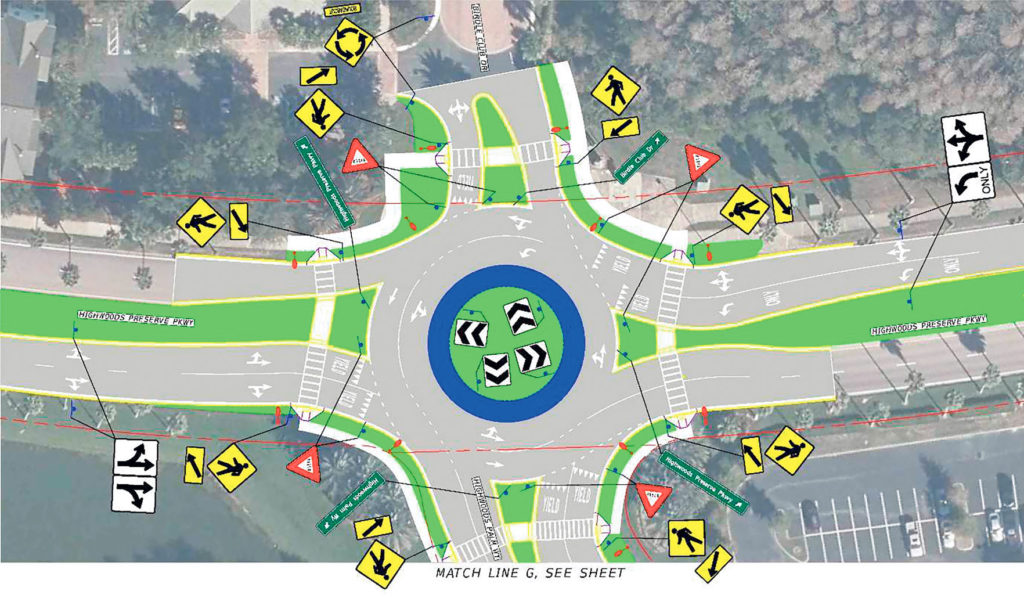
A new roundabout for Highwoods Preserve Pkwy., a new coat of paving for New Tampa Blvd. and a number of new enhancements for Tampa Palms Blvd. remain in the New Tampa/District 7 pipeline for Fiscal Year 2021, according to Tampa City Council member Luis Viera.
Issues like lawsuits and Covid-19 have slowed some of the projects down.
“They’re coming, though,” Viera says. “They’re coming.”
One project that likely already would have been done, or certainly would’ve been underway by now, are the long-awaited repaving and enhancements of New Tampa Blvd., from the New Tampa Gateway Bridge to Bruce B. Downs Blvd.
Long a prickly point with many West Meadows residents, the repaving was on the list of items that were supposed to be expedited after the All For Transportation (AFT) referendum passed in 2019, with 57 percent of voters agreeing to a one-cent sales tax increase to be used for transportation projects.
The New Tampa Blvd. project was slated to receive $1.3 million of the $280 million a year for 30 years the tax was expected to yield. However, Hillsborough County Commissioner Stacy White challenged the referendum language and it is now tied up in the Florida Supreme Court, which has yet to make a decision. A back-up plan for another referendum this fall has been postponed until 2022, as Covid-19 has taken precedence.
There is some good news — the New Tampa Blvd. project concept design is being funded by the City of Tampa.
“However, it can’t be completed without AFT funds, which really stinks,” says Viera, who pushed hard for New Tampa to receive some immediate improvements due to its support for the referendum, only to see it get tied up in litigation. “Moving forward with the design means they are married to the idea. So, if the AFT money doesn’t come through, it will still be funded. It’s just going to be on a longer timeline.”
The same goes for Tampa Palms Blvd., which had a total of $700,000 earmarked for Complete Streets programming, which is a Florida Department of Transportation (FDOT) plan for improving pedestrian and bicyclist safety and “building the right road in the right place for the right purpose.”
The Tampa Palms Blvd. project is supposed to include operational improvements to its two Compton Dr. intersections — namely potential roundabouts to replace four-way stops — as well as roadway improvements like enhanced crosswalks, sidewalks and bulb-outs (also called curb extensions) along the roadway’s 4-mile loop.
One project that won’t be held up by AFT funds is a roundabout currently being designed for the intersection of Highwoods Preserve Pkwy. and Highwoods Palm Way/Bridle Club Dr.
The roundabout will help calm traffic at the busy intersection that leads out of the Highwoods Preserve Corporate Campus (home to thousands of employees at MetLife, Syniverse and T-Mobile) and, on the other side of Highwoods Preserve Pkwy., the Equestrian Parc at Highwoods Preserve apartment complex.
The design is expected to be completed by the end of this year, with construction expected in 2021.
Although Hillsborough County is giving parents three choices for the upcoming fall semester, it really comes down to two choices — learn in a traditional classroom with other students, restoring the social interaction and face-to-face contact that are the stalwarts of education; or learn in a more isolated and individual-based online format at home that makes it easier to avoid contracting the virus and transmitting it to others.
However, there is a group of local parents considering something else — merging the classroom and online settings together in a unique collaboration that, they believe, will offer the best of both worlds.
Tampa Palms resident Jenni Wolgemuth, an Associate Professor of measurement and research at the USF College of Education and mother of a first- and fifth-grader, is helping to organize a group of 4-5 families whose children will learn online, but will learn together in a small “learning pod” overseen by a privately hired learning support specialist.
“A one-room school house,” Wolgemuth calls it. “It is an attempt to create a bubble around a group of families, all agreeing to similar standards of social distancing.”
That school house, or learning “pod,” that Wolgemuth has organized will have nine students in it. Four of the students are fifth graders, who would hopefully have the same teachers at the charter school they all attended last year.
The pod also will include two first-graders, a third grader, an eighth grader and a ninth-grader. The parents would rotate hosting and the kids would bring their lunches and eat together and have time for outdoor activities together, too.
Everyone would still be taught by their school’s teachers through the online platform and Zoom video classrooms used by their schools. However, the parents are already interviewing people to be a support specialist, who would monitor the pod from 8 a.m.-3 p.m. and help the students with technology issues, staying on task and doing their assignments.
“Basically what we would have been doing if we had been home,” Wolgemuth says.
The idea was Wolgemuth’s brainchild and she says she began thinking about the learning pod solution before the Hillsborough School District issued its choices for parents. She thought the District was too comfortable with the idea that everything would be fine by August. “I’m a planner,” she says. “This was my plan A.”
She mentioned the concept to friends, but the response, at first, was tepid. She continued, however, to bring it up in conversations.
When she had a Zoom call with other parents after the choices were revealed by the District, there was still some hesitation. During that call with other mothers, however, one of the husbands, a doctor who works with Covid-19 patients, overheard the plan.
“That is a really good idea,” he said, and the plan started to take root.
There are still hoops to jump through for Wolgemuth and her group, which includes a second Tampa Palms family, two families from Lutz and another from Carrollwood.
They will have to see how the pod works for the younger students, namely the two first graders. And, having nine or so computers using the same WiFi network could create issues that would need to be addressed.
Otherwise, Wolgemuth thinks the idea is the best fix for one semester, with the hopes that the coronavirus can be brought under control and that everyone can go back to their brick-and-mortar schools in January.
After I wrote about the aftermath of the George Floyd and Rayshard Brooks killings in our June 9 and July 7 Wesley Chapel issues and our June 23 New Tampa issue, I was very pleased at the number of emails/letters I received from both black and white reader — of, apparently, a number of different races, religions and political viewpoints — who appreciated my take on the current situation and offered words of advice and encouragement and something much more valuable to me than just the kind words. Many of those who wrote to me have offered to help start and/or get involved with a local grassroots movement that might help stem the tide of systemic racism and build better communication here.
And, even though not all of the response has been quite so positive, there seems to be plenty of people interested in trying to figure out what we can all do to help — even those who have very different viewpoints about whether or not systemic racism even exists in our country.
One of the New Tampa readers who responded to my email wrote:
“Your editorial is complete (bull____). I get it’s your opinion but I suggest you understand the definition of ‘systemic’ as you didn’t provide any instances of that.”
Well, silly me, I thought the fact that I had unknowingly tried to pass a counterfeit $100 bill at a bar and didn’t end up with anyone kneeling on my neck for 8:46, as George Floyd ended up for passing a counterfeit $20, was at least representative of the difference between how white and black people are treated in similar situations.
I guess my mistake was that I just didn’t think I needed to give examples of the proof that systemic racism exists in our country because I believe in my heart that it does — as, yes, I have seen a few examples of it throughout my life.
And, the important thing, to me, as the person who wrote the editorial, was that not only do I believe it exists, but also that I would like to somehow try to find a way to be part of the solution, even on a very small scale.
Plus, every time I put my opinions in writing and directly mail them to more than 120,000 of my closest friends, I fully expect some people to disagree with me — and I’m even OK with it if they are vehement in that disagreement. That’s the risk I take for having opinions and I’ve never wavered from being willing to take those risks for the last 26+ years and — because I live in the United States of America — I still always believe in everyone’s right to their own opinions, even when they differ from mine. That’s just who I am.
I am still looking for additional people who also want to help. At this point, I’m thinking about organizing a Zoom meeting for everyone interested in an open dialogue with people who may or may not share your viewpoint on the topic of racism. If you’re interested in being part of this initial attempt to try to find a better way, please email me at ads@ntneighborhoodnews.com. And please, if you already emailed me after reading last issue, you don’t have to mail or email me again to get involved. Everyone who already has sent me an email on this subject should have received an invitation to that Zoom meeting before this issue reached your mailbox. Thanks, and stay safe!
My Take On Masks Now
OK, I’ll admit it, I absolutely hate wearing a face mask out in public. But, unlike apparently too many people, I have been wearing masks in public places since just after St. Patrick’s Day.
When we first started wearing them, Jannah and I couldn’t find disposable masks anywhere, but we did find some nice homemade cloth masks being sold on the Wesley Chapel Community Facebook page, so that’s what we wore, although we sometimes just cut T-shirts to make our own masks when the others were being washed.
At that time, when most of Florida in general and Pasco in particular had very few cases of Covid-19, many people mocked me for wearing the cloth masks, saying that they have been proven to not stop the spread of the virus, etc.
All I knew was that cloth masks were all we had and I wanted to at least wear something when I walked into Publix or Walmart.
As Florida has been reopening the last several weeks (seemingly too quickly, however), and all kinds of face coverings have become much more readily available, the thing I have had trouble understanding is why so many people still have such a problem with wearing them — and no, I’m not calling you out if you have a true medical reason for not wearing one.
I have been told by more than one local resident that the pandemic is a hoax because they didn’t personally know anyone who had died from the virus, as well as many who have just said, “I’ll never wear one, no matter what.”
I hope that, with Florida setting new Covid-19 case records almost every day at our press time — and with bars in Florida not being allowed to serve alcohol on their premises since June 25 because so many of the new cases are younger people who still seem unconcerned about wearing masks or social distancing — more of us will be willing to adapt to this new “normal”…for quite a while still to come. For me, this is a public health issue, NOT a political one, so I wish more of us could stop politicizing it and do the right thing for all of us.
Schools are not just re-opening this fall, they have to re-open.
The President tweets it; the Governor repeats it.
With the rising and record number of positive Covid-19 cases and deaths in Florida seemingly finding no ceiling, that leaves parents with one of the toughest decisions — whether to send their children back to brick-and-mortar schools or have them learn online — many of them have ever had to make.
Jaclyn Lewis-Croswell, the parent of a fourth-grader at Turner/Bartels K-8 school, will be keeping her daughter home in the fall to learn online. It’s not ideal, she says, but for her, the risk of infection outweigh the benefits of social interaction and classroom learning.
She certainly understands anyone who chooses the opposite for their kids, sympathizing with those who trust the safety measures and some studies that say children aren’t as affected by the virus, while also worrying their children’s mental health may suffer in a detached, online setting.
But, when Jaclyn looked at the rising numbers, “I felt like there is a potential risk of losing my child,” she says. “And that’s not a chance I’m willing to take.”
If Covid-19 continues to rage at its current rate, there remains a chance that schools will not open by August or will be completely online, at least until January. But, as of now, school is moving forward with an expected start date of Aug. 24, with Hillsborough County’s schools offering three different options:
• Option A: A return to traditional, face-to-face, brick-and-mortar schooling, with special social distancing and enhanced disinfecting measures implemented, as well as requiring all students, teachers and staff to wear masks at all times.
• Option B: eLearning full-time through the students’ assigned schools. Students will participate in a distance learning program from home, taught by teachers at their school through Canvas, a new Learning Management System which will replace Edsby. Daily log-ins and attendance will be required.
• Option C: Hillsborough Virtual K-12, a web-based curriculum taught by teachers from Hillsborough County, but not the same as the eLearning program. For grades 6-12, Hillsborough Virtual K-12 and Florida Virtual School (FLVS) are the same, except Hillsborough Virtual K-12 will follow the District’s 2020-21 school calendar, meaning they have more stringent start-and-stop deadlines.
Earlier today, Hillsborough County Schools tweeted out declaration-of-intent results so far. With 115,001 responses tallied, 56,488 families have selected on-site learning, 48,410 have chosen eLearning and 10,103 have picked Hillsborough Virtual K-12.
The Neighborhood News spoke with multiple New Tampa families about their respective decisions. Here are three stories about how some of those parents made their decisions.
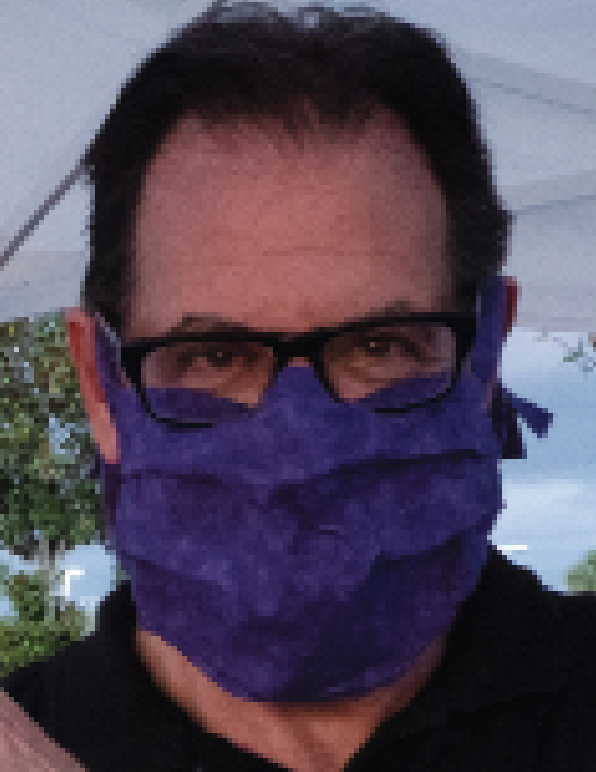
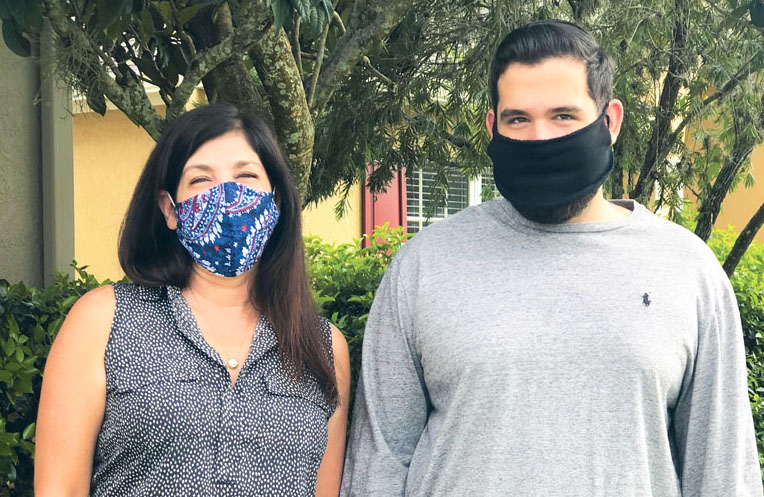
Cindy and Connor Kelly both feel the decision to stick with online learning is the safest way forward
Cindy Kelly – eLearning
When schools abruptly closed in March due to the coronavirus, teachers and students were thrown into an online system of learning that ended up receiving mixed reviews.
While some found the spring experience underwhelming and ineffective, others, like Wharton’s Connor Kelly, thrived in that environment.
So this fall, Connor plans to spend his senior year again learning outside of the classroom as he prepares for college.
“He had no desire go back to the bricks and mortar,” his mom Cindy says. “I was kind of surprised by it myself.”
Cindy says that if Connor had expressed a desire to return to school, the coronavirus would have definitely caused her some concern. In fact, Connor says a big part of his decision stems from his own concerns about passing anything onto his parents.
“It really does seem like people are really concerned about the virus and weighing it with the social aspect and the isolation (of online) learning,” Cindy says. “It’s a miserable, tough decision to make.”
Thankfully, Connor found the flexibility of online learning to his liking last spring, and looks forward to continuing it. He says, however, that a slight majority of friends in his social circles say they are returning to brick and mortar.
“They want to be able to have that social interaction,” he says, “although, the way it sounds, there probably won’t be too much social interacting allowed anyway.”
He regrets having to miss some, or, depending upon the virus, all of his senior year. He is serving as president of Rho Kappa, the social studies honor society, and isn’t sure he’ll get to make his induction speech, and says he also had roles in other clubs he will miss, as well as the other social benefits of his last year in high school.
“It kind of sucks,” Connor says. “I had a whole meticulous plan laid out for the last three years…I spent a lot of time designing my senior year, and then a rock was thrown through it. But that’s okay, it’s a life lesson.”
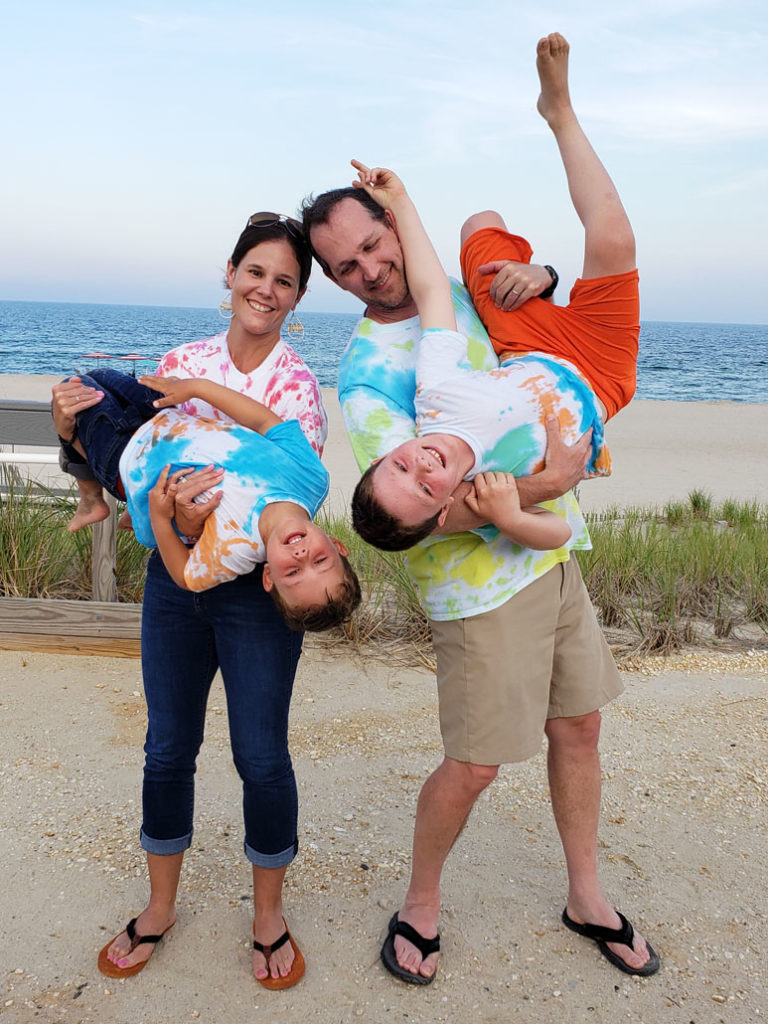
Lisa and Eric Ling, with their kids Elijah and Ethan, think its time to get kids back to school, with increased safety standards.
Lisa Ling — Traditional School
Lisa Ling is sending her kids back to school.
While the mother of a first- and fourth-grader at Hunter’s Green Elementary (HGE) understands the risks associated with the brick-and-mortar option this year, she also feels better about her decision now that masks are going to be required.
“Getting kids back to school is what needs to happen,” she says.
Ling and her husband Eric aren’t alone. A recent thread on Facebook she participated in showed more than a dozen parents who agreed with them, and she says many of her friends are following suit.
Ling says it wasn’t really that tough of a decision. “Well, I really did not consider Hillsborough Virtual K-12 or Florida Virtual, because we love our school and didn’t want to disconnect from it,” Ling says. “The (Covid) numbers are going up, but it’s a very low percentage of the population. We feel that there also is evidence coming out that young kids just don’t transmit it as much. Our whole family is healthy, no one has a compromised immune system or lives with an elderly grandparent. God forbid, if one of us gets it, we’ll be okay.”
Lisa has been a stay-at-home mom for nine years. When her children were forced to learn from home in the spring, she says she didn’t find it to be a fruitful experience.
Her third grader was fairly independent unless he would click on the wrong thing while working from his computer, and her youngest, who was in kindergarten, needed constant support.
She didn’t find the quality of the education to be what it should either, but understands it was a difficult, thrown-together situation for everyone.
“It wasn’t the same as being at school,” she says.
Lisa will no longer be a stay-at-home mom this fall. She is returning as a school psychologist at Benito Middle and Clark Elementary schools. She says her new job did not affect her decision.
“Even if I hadn’t taken that job, I was sending them back,” she says.
(l.-r.) Hector, Grayson and Laurie Gonzalez decided eLearning will work best for them this fall.
Laurie Gonzalez — eLearning
As a teacher, Laurie Gonzalez isn’t sure how she would keep her students safe from the spread of Covid-19, much less her son Grayson, who would be attending sixth grade at Benito Middle School on school choice this fall if she hadn’t decided to keep him home for eLearning.
“I made the choice to do eLearning for my child because I don’t think it is safe for anyone to return at this point,” says Laurie.
By choosing school-based eLearning through his assigned school, as opposed to the other online options, Grayson can keep his seat and if Covid-19 is ever brought under control, he can return after the fall semester.
“Of course I worry about social interaction, but at what cost?,” she says. “At least today, kids have video games and phones so they can keep in contact with their friends. It isn’t the same but, for now, it will have to do.”
Laurie has read the CDC guidelines and imagines what she and her co-workers’ classrooms would look like in the Covid-19 age. She doesn’t like what she sees.
“I know first-hand that it will be impossible to follow the CDC’s guidelines to keep kids safe from Covid, especially if we reopen schools at full capacity,” she says. “There is not enough room in most classrooms to space kids 3 feet apart for testing, so 6 feet is just not going to happen.”
A mask mandate is a great decision, Laurie says, “but I don’t believe it will be enough. As soon as we open schools, I anticipate the number of Covid cases will skyrocket.”
Laurie, who teaches at Turner/Bartels K-8 School, says she has an auto-immune disease, and is nervous about the impact Covid-19 would have on her if she were to get it.
With so many unknowns, Laurie and her husband Hector have no idea when it will be completely safe again to return to school — for her or her students. She feels fairly certain that August won’t be it.
“Yes, I am very confident that coronavirus will still be a problem in August,” she says. “We haven’t seen the numbers (of deaths) that will correlate with the 4th of July yet, but I don’t have much faith that they will be good.”
First Watch, the popular restaurant chain known for its healthy breakfast and lunch items featuring items like power wraps, avocado toast and quinoa bowls, is coming to the Village at Hunter’s Lake plaza in New Tampa.
“They have signed their lease,” says Mark Elias, the leasing agent for Regency Centers, the developer of the plaza, which will be anchored by a Sprouts Farmers Market that is opening Aug. 12. “They haven’t physically started swinging any hammers yet, but they have started the process (of permitting).”
Located right across Bruce B. Downs (BBD) Blvd. from the entrance to Hunter’s Green, and just a few miles south of the First Watch on BBD in Wesley Chapel that almost always, in pre-Covid times, had a waiting list, the New Tampa location will join a number of new restaurants in the Hunter’s Lake project. It will take over the 3,530-sq.ft. spot between Fresh Kitchen, which also is readying for construction in the spot on the northernmost end of the plaza, and Via Italia Woodfired Pizza & Bar, which is opening tomorrow at 11 a.m.
Headquartered in University Park, FL, First Watch serves breakfast, lunch and brunch at its more than 300 locations in 26 states.
For an area lacking in a true breakfast place for years, New Tampa will soon have two of Tampa Bay’s most highly-rated selections. The Brunchery, a long-time and popular breakfast staple in Valrico, expanded to New Tampa last December when it opened a new location in the old Boston Market space next to the Moe’s Southwest Grill on Preserve Walk Ln. at BBD.