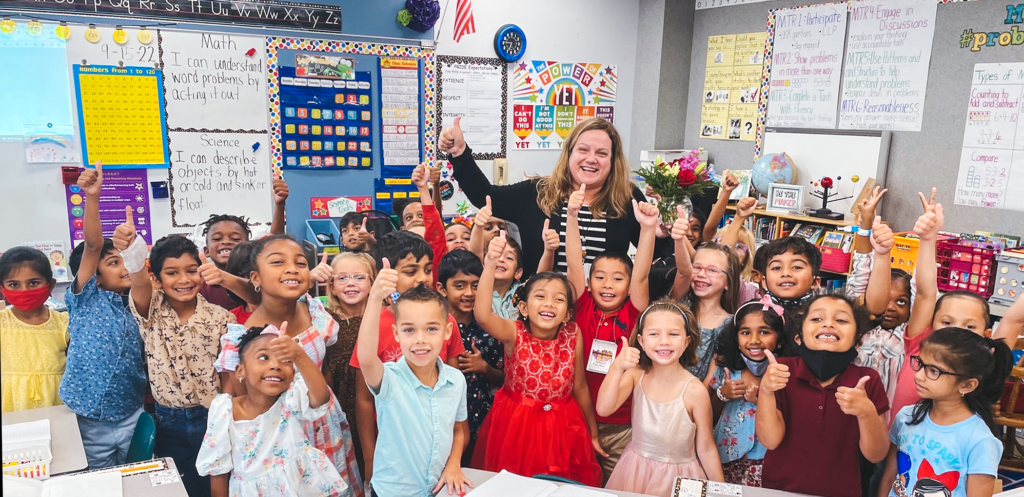
The 2023 Excellence in Education Awards, hosted by the Hillsborough Education Foundation in partnership with Hillsborough County Public Schools, recently recognized outstanding educators at the county’s public schools, including 11 in New Tampa.
Each school nominated one candidate for the each of the three county-wide awards — Teacher of the Year, Ida S. Baker Diversity Educator of the Year and Instructional Support Employee of the Year.
While none of the District winners were from New Tampa’s schools, it is an honor to be nominated for the many deserving teachers and support staff at all of our local schools.
Congratulations to the New Tampa nominees for Teacher of the Year (pictured on this page), and the Ida S. Baker Diversity Educators and Instructional Support Employees (not pictured).
Shanika Abdullah Math Wharton HighShelley Lambert English Turner/Bartels K-8 SchoolLaura Dodds Gromkov 5th Grade Tampa Palms ElementaryShannon Seavey-Simpkins 5th Grade Chiles ElementaryMegan Boghosian Language Arts Liberty Middle SchoolJulie Terry 3rd Grade Heritage ElementaryYvonne Vasquez 5th Grade Hunter’s Green ElementaryRebecca Santamaria English Freedom HighScott Owen Physical Education Clark ElementaryCarrie Frump Reading Benito Middle School
Local author Lois Lewandowski poses with most of her “vanity published” books, including The Ghost on Swann. (Photos by Charmaine George)
I recently read a novel by someone I’ve known indirectly for more than 20 years — Hunter’s Green resident Lois Lewandowski.
To be fair, despite knowing Lois’ husband (and local financial advisor) Chuck Lewandowski for that amount of time, I had only met her a handful of times and I honestly had no idea that the one-time IT rep for a Silicon Valley company who later worked in the jewelry department of Nordstrom’s was a published author.
So, when Lois (who writes her books as “L.A. Lewandowski”) contacted me by email about buying an ad for her most recent “vanity published” (she hates the term “self-published;” more on this below) novel — The Ghost on Swann — I told her that I would read the book first and be honest with her about whether or not I thought it would be worth buying ads to try to sell copies of it.
Well, quite truthfully, I was blown away by The Ghost. Each chapter of the book is told in first person by one of the four major characters — the ghost herself, Bertha “Posh” Swann, Posh’s friend Victor, Victor’s niece Tyrene and even a mannequin named Maude. The format, albeit a little confusing at first, does make you want to find out what happens next. Posh, who “haunts” the business now owned by her living friend Victor, was murdered in the same building many years earlier.
If you recognize the spelling of “Swann,” it’s because Posh’s family is supposedly the reason Swann Ave. in Tampa’s renowned Hyde Park Village neighborhood (where the entire story is set) was given that name.
For a book devoid of sex and violence (even the description of Posh’s murder was somewhat pedestrian), The Ghost on Swann is a true page-turner. I told Lois that, as I read it, I wondered if maybe Posh’s murder was more of a mystery than the reader is led to believe, but as it turns out, The Ghost is not a murder mystery. Instead, it’s simply a well-crafted story rooted in the fashion industry (as Lois herself has been) that likely will appeal more to women than to men but I wouldn’t discourage anyone from giving it the once-over.
“I’m very proud of The Ghost,” Lois says. “It took three rewrites to get it to where it is now.”
Lois On ‘Vanity’ Publishing
Speaking of rewrites, as I mentioned earlier, Lois isn’t a fan of the term “self-published,” because it indicates to many people that the books are likely less “professional” than those published by one of the remaining major publishing houses.
However, after reading The Ghost, it’s obvious that Lois’ work is not only professional, she takes a lot of pride in things like her editor (Stacy Juba), the design of the covers of her books, the spelling, grammar and punctuation of her stories and other things that many “self-published” authors don’t seem to sweat as she does.
“I prefer to call it ‘vanity publishing,’” she says. “Just because Viking, Penguin and other traditional publishers haven’t published my books, I care that if you read them, you won’t be able to distinguish it from a traditionally published book.”
She admits, however, that some self-publishers who don’t think they have to pay the same attention to detail, give the vanity publishing business a bad name. Many also don’t think you can make “real” money as a vanity publisher.
“But that just isn’t true,” Lois says. “I’m in a lot of online independent publishing groups and the word is that it takes as many as 15 books to really start making money. The Ghost on Swann is only my sixth book, but my brain is very active and I have at least three more that are close to being ready, so I feel like I’m on my way.”
On the other hand, Lois says that even though sites like Amazon do provide numbers of copies sold to authors, “I don’t really worry about sales. I write because I have stories in my head and I do regularly receive money for my book sales, too.”
Lois says it wasn’t always her dream to be a writer — “I wanted to be a lawyer, really…but it is my dream now.” She points to one vanity publisher who has written 35 or more books, putting out two a year, and has enough of a following that it is now his full-time job. “Amazon has an algorithm (for book sales) and you have to feed the algorithm, so I have to get another book out by October of this year to do that.”
She also says that a lot of people she meets tell her that they really want to write a book and she always encourages them to do so.“Stephen King calls it ‘BIC,” or ‘Butt in Chair,’ which is the only way to get it done.”
In addition, Lois wrote for a blog called “Indies Unlimited” and found out, “that a lot of self-published writers are too cheap to register their work with the Library of Congress to protect it. But, if you really think you have a story people would be interested in reading, why wouldn’t you want to protect it?”
She adds, “Writers’ ideas are not copyright-able, but the words themselves are. If you protect your work, and someone publishes something that’s really close to your words, you can go after them legally.”
Lois says she even has gone so far as to teach “Authors 101” courses at public libraries, where she teaches people who want to write how to get started. “After the Tampa Bay Times did an article on me several years ago, I had 25 or 30 people at my course at the Riverview library,” she says. “The information I gave out then is all old now because of the internet, but I found out that a lot of people definitely have stories they want to tell in a book. That’s why, when I did my Authors 101 course, I felt so good about encouraging other authors to become vanity publishers.”
She also notes that it’s harder than ever to get one of the big publishing houses to publish your book, as you have write query letters to literary agents because, “you can’t even submit a manuscript to the folks at Random House.”
But, Lois says, “If you want to be a writer, your goal should be to publish, not to make money. “I don’t keep track of my sales because my goal is to be proud of my work. If people love my books, the money will come.”
Before releasing The Ghost on Swann in 2022, Lois’ first book was Born to Die, The Montauk Murders (2011). That was followed by A Gourmet Demise, Murder in South Tampa (2014), which Lois says briefly hit #1 on Amazon for a while and may be her career best-seller. Between those murder mysteries was Gentleman Vampire: The Undead Have Style (2012). She also has published Bacon Aporkalypse, which is a collection of recipes paired with short stories in 2014. And, Lois says the ebook Thirty Days of Work from Home Style (2020), was how she navigated the pandemic. She says her next book, which she plans to have out by the end of this year, will be the sequel to Gentleman Vampire.
Parth Madabhushi gives 100 percent to everything he does, as evidenced by his acomplishments in dance, music and sport.(Photos: Courtesy of Madabhushi family)
Wesley Chapel teenager Parth Madabhushi doesn’t do anything half way.
When he took up karate, he put in all his effort and made it onto a national team that competed in other countries.
When he took up dance, he spent hours and hours practicing his craft and became the third generation in his family to learn the classical Indian dance Bharatanatyam.
And, when he took up music, he mastered the mridangam (the ancient classical drum of South India), recently completing his solo percussion recital, or arangetram, with renowned Indian musician Padma Shri A. Kanyakumari.
Whereas the majority of people may take a few years of karate or a few lessons in dance or compete in a couple of sports leagues, Parth has always set out to conquer everything he tries.
“I’m proud of myself for the accomplishment,” Parth says. “I don’t really get the appeal of doing something and stopping, unless it was just a hobby or something. Accomplishing all three things was important to me. My parents preached that if you’re not going to do something 100 percent, don’t do it.”
The most recent accomplishment on Parth impressice roster was completing his mridangam arangetram last year.
An arangetram (which means “ascending the stage”) ceremony is a rite of passage that is most similar to a recital or graduation, and is deeply rooted in Indian culture. The mridangam, the instrument Parth plays, is the.
All classical dancers and musicians participate in an arangetram at the end of their training with a guru, and it signifies their ascension from disciple to performer and even to teacher.
For his arangetram, Prahlad Madabhushi, Parth’s father, managed to arrange for his son to accompany violinist Padma Shri A. Kanyakumari, a recipient of the Padma Shri Award from the government of India for her devotion to the arts. Prahlad says it is rare that such a prominent artist would agree to play at an arangetram.
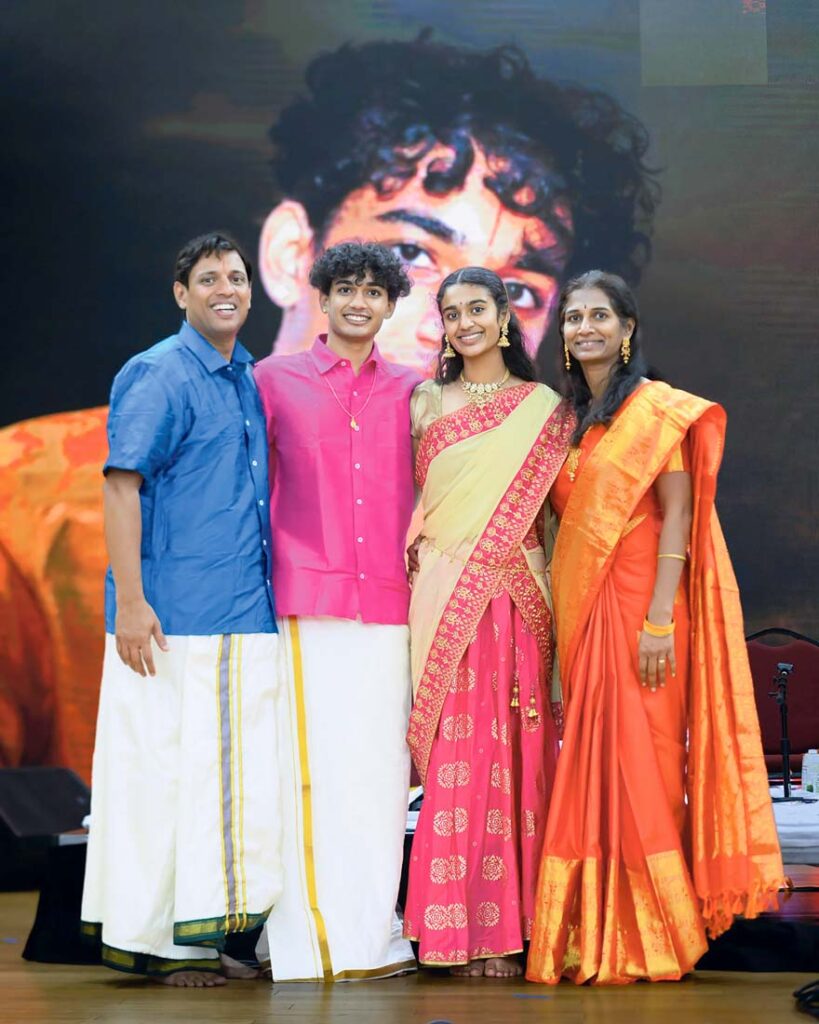
The Madabhushi family (l.-r.) dad Prahlad, Parth, sister Nitya and mother Sabrina.
“We had been in communication for 2-3 years, before Covid,” he said. “And, her calendar is packed. However, she sent us a message that she had a weekend open, and we were shocked. It was jaw dropping. But, we can see why she agreed. Parth is very very unique, and artists want to enrich upcoming brilliant kids.”
On October 29, 2022, Parth took the stage at USF and accompanied Padma Shri A. Kanyakumari in a three-hour performance that included a 10-minute solo. She changed pace often, playing at such a dizzying speed at times
it was hard to imagine Parth keeping up on his mridangam. However, he did.
“The speed she played at was crazy,” Parth said. “I enjoyed it, trying to see how fast I can play. She was challenging me, and now I know I can play that fast.”
Prahlad, who joined his son on stage, called it an impressive performance.
“It was exhilarating to see my son not only play well, but hang in there,” he said, “because it is very difficult when she plays the violin, because it’s not just at one speed, but 4-5 speeds. And she’s not like, “This is a newcomer, let me take it easy.’ Very, very seasoned musicians find it difficult to hang in with her, but Parth did.”
Completing the arangetram was just another step for Parth, who has already piled up a list of impressive accomplishments.
His father says that Parth represented Team USA at the World Karate Federation championships four times, winning four championships, and also has recently gained the title of Sensei in the martial arts form of Shitu-Ryu.
At his first arangetram in 2008 for dance — his mother Sabrina and grandmother Geetha Raaj are dance teachers — he became the first boy in Florida to complete a recital in the classical Indian dance Bharatanatyam.
Prahlad says that combination of accomplishments is “one-in-a-billion.”
So, what’s next for Parth? He’s not sure. A Carrollwood Day School graduate, he is currently a second-year Business student at the University of South Florida, and has taken an interesting in video editing. While school is a priority, and time-consuming as well, he has wondered what his next challenge might be.
“In my brain, I want to do something else,” he says. “I will figure it out. In my opinion, having something to accomplish, that’s what makes life fun.”
Lewis Brinson, the first principal at Benito Middle School.
Lewis Brinson had no idea where “New Tampa” was, but when he was handed the keys to Louis Benito Middle School 25 years ago, he couldn’t wait to find out. So, he decided to leave his West Tampa home and take a drive.
“I was driving and driving…and driving,” Brinson said, smiling. “When I got here, I said “Where’s the school?” All that was here was a trailer.”
Brinson, Benito’s first principal, shared the story in the school’s media center, at a celebration of Benito’s 25th anniversary, drawing plenty of head nods and laughter.
Every one of the school’s past principals attended — Barbara Hancock, Scott Fritz, Bobby Smith (who slipped in a “Benito Pride, Hard to Hide” slogan at the end of his speech) and John Sanders, who held the job the longest before retiring last year after 14 years at the school. Current principal Brent Williams, a host of teachers past and current, some Hillsborough County Schools administrators and three current School Board members joined in to mark the occasion in a small but upbeat ceremony.
(Above) Current Benito Middle School Principal Brent Williams (far left) with (l.-r.) bookkeeper Phyllis Thurman and teachers Michelle Nolan, Charmaine Jones and Barbara Lind, the staffers who have all been at the school all 25+ years it has been open, and assistant principal Kathleen LeClaire at the celebration of the school’s opening for the 1997-98 school year. (Photos by Charmaine George)
Included in the crowd and honored by Williams were Michelle Nolan, Charmaine Jones, Barbara Lind and bookkeeper Phyllis Thurman, all of whom have been at the school since Day One.
Nolan, a 6th grade math teacher, gave a heartfelt and tear-filled speech as she looked back at her 25 years.
“It’s been a joy to come to work,” Nolan said. “I’ve put my heart and soul into Benito. Tim (her husband) and I couldn’t have kids, so this became my baby.”
Jones, a 7th grade civics teacher, has worked in education for 40 years and Benito was her third job.
“I never felt the need to leave this place,” she said.
Lind, who followed Brinson from Eisenhower Middle School to Benito, said when she started, the principal gave her one piece of advice that may have saved her a few bucks: when you get to Cross Creek Blvd., set your cruise control for 30 mph or you will get a ticket (although, technically, the speed limit on Cross Creek Blvd. was, and still is, 45 mph).
Williams promised Thurman, the school’s forever bookkeeper, she wouldn’t have to give a speech, so he gave one for her, telling the crowd, “One thing I learned as an administrator is if you don’t have a good bookkeeper, you’re going to jail…well, I’m not going to jail.”
What’s In A Name?
All five of Benito Middle School’s principals since it opened were on hand for the celebration.
(L.-r.) Lewis Brinson, Barbara Hancock, Scott Fritz, Bobby Smith and John Sanders.
Benito opened in August 1997 for the 1997-98 school year, as New Tampa was beginning to explode. Although many locals had petitioned to have the new school be named New Tampa Middle School, it ended up being named after well-known Tampa advertising executive Louis Benito, who played a big role in establishing the University of South Florida (USF).
Brinson’s first year was a tough one, with problems still familiar to New Tampa residents. There were major traffic issues, an abundance of construction trucks on the roads and an overflowing student population. In fact, making use of some of its 29 portables, Benito actually housed the 5th graders from the adjacent Hunter’s Green Elementary due to that school’s overcrowding issues.
Benito was a blend of teachers from all over the county, neighborhood kids and those who took buses in from the USF area.
“It was just a matter of putting everyone together, and making them feel welcome,” Brinson said. “We tried to build a culture where everybody felt appreciated and, once we did that, everything fell into place.”
As for traffic, it was predictably a mess.
According to a St. Petersburg Times story, one parent stood at the corner of Kinnan St. and Cross Creek Blvd. for 25 minutes one morning and counted 79 heavy construction vehicles — like dump trucks, concrete mixers and semitrailer trucks — as well as 26 school buses, along with all of the cars that were dropping kids off.
Because there were no crossing guards provided for secondary schools, Brinson took on the job himself. Eventually, the Hillsborough County Sheriff’s Office, as a temporary measure and until the construction in the area was completed, supplied a guard.
The wildlife in the area also turned out to be a big surprise to Brinson and his staff, which included then-assistant principal and future principal Scott Fritz.
“When I interviewed, Mr. Brinson went through a list of things (asking if I could handle) lockers, schedules, working with parents,” Fritz said. “What he didn’t tell me was that I was going to catch two alligators on campus. He didn’t tell me I’d have to catch a host of walking catfish. He didn’t tell me about all the snakes…but I will tell you what, it was absolutely the defining leadership experience I had working here at Benito.”
A slide show at the 25th anniversary celebration highlighted some of the school’s notable graduates, like 1999 Scripps National Spelling Bee champion Nupur Lala, all-Ivy League volleyball player and Yale graduate Kathryn Attar, former University of Pennsylvania running back and current Team USA bobsledder Kyle Wilcox, Canadian Football League quarterback Chase Litton (who also has spent time on NFL team practice squads) and Michael O’Rourke, the founder and CEO of Tampa blockchain services startup Pocket Network, now valued at $1.5 billion.
However, those who spoke at the Benito gathering were quick to credit the teachers and administrators for creating a family-type atmosphere and making the middle school one of the best in Hillsborough County. This year was the 21st straight year Benito received an “A” grade from the Florida Department of Education.
That’s a big part of the reason Williams calls Benito a “destination” for county educators.
“You can definitely feel the sense of school community and it’s evident in the way they carry themselves in their conversations,” he said of his teachers. “They love being here and they love the kids. You can definitely feel the family vibe.”
After the speeches, folks mingled and shared stories and hugs while eating cake. Laughter filled the room. Fritz said it was like a family, and that made the celebration feel more like a family reunion.
“I knew that this community wouldn’t let this school fail,” Brinson said. “It felt good knowing that, and being able to come back and see that it is (still) thriving makes you feel proud. Sometimes you go to a place and you don’t want people to know that you used to be there. That’s not the case here.”
Jenna McLaughlin, a senior at Wharton High, is the 43rd recipient of the Stars & Stripes award in the state of Florida, and the 980th overall recipient in the 27-year history of the American Heritage Girls organization. (Photos: Karl Greeson)
Jenna McLaughlin recently became the first girl in the New Tampa and Wesley Chapel area to earn the highest award that can be achieved from American Heritage Girls (AHG), a faith-based, scouting type organization.
Jenna is an 18-year-old senior who will graduate from Wharton High this spring. She also attends dual enrollment classes full time at Hillsborough Community College.
She is just the 43rd recipient in the state of Florida, and the 980th recipient in the 27-year history of the organization, to win the Stars & Stripes award. To qualify for the award, girls are required to earn 16 specific life skills badges in categories such as outdoor skills, science and technology and personal well being. They also must hold a leadership position in their troop for a minimum of six months, write a resume and essay about their personal spiritual journey, present at least three letters of reference, pass a Board of Review, and plan, develop and lead others in a service project that requires a minimum of 100 hours and makes a lasting impact on the community.
For Jenna’s project, she built a large stone fire pit (see photo) at St. James United Methodist Church in Tampa Palms, which hosts her AHG troop. The fire pit was completed last fall and has already been used by different ministries both in and outside of the church for outdoor gatherings.
“I’m so grateful for all the support I received from my troop members, leaders and other volunteers,” says Jenna. “It was really rewarding to see it go from an idea in my head to an actual fire pit people can enjoy.”
Jenna’s mother Celeste is a troop coordinator and little sister Rylie is also in American Heritage Girls.
While the project represents one of the final steps to earn the award, Stars & Stripes is about much more than just the project. It is the pinnacle of the journey that aims to teach girls life skills, leadership, and a heart for service.
“I have had so many experiences that I wouldn’t have had if it wasn’t for AHG,” Jenna says. She recalls going on a trip to earn the snow skiing badge, and spending a week living on a sailboat off the coast of Maine, learning about sailing and helping with many of the on-board tasks, from steering the boat to pulling up the anchor and preparing meals.
American Heritage Girls was founded in 1995 by parents looking for an organization that would embrace Christian values and encourage family involvement.
Founder Patti Garibay today serves as the executive director of the organization, which currently has troops in all 50 states and more than 50,000 girl members.
“Jenna, you joined AHG in 2013 as a Tenderheart and now you have achieved the highest accomplishment in this program, the Stars & Stripes Award,” said Garibay in a congratulatory video that was shared with the audience at Jenna’s award ceremony on Jan. 23. “All of us at American Heritage Girls — the staff, the board, and the volunteers — are so very proud of you.”
Jenna is one of 40 girls in her troop, which was founded five years ago by a leadership team that includes her mom Celeste, who is a writer for the Neighborhood News. Girls range in age from six to 18.
For more information about American Heritage Girls, go to AmericanHeritageGirls.org. To connect with the New Tampa or Wesley Chapel AHG troops, use the “Find A Troop” button on that website.