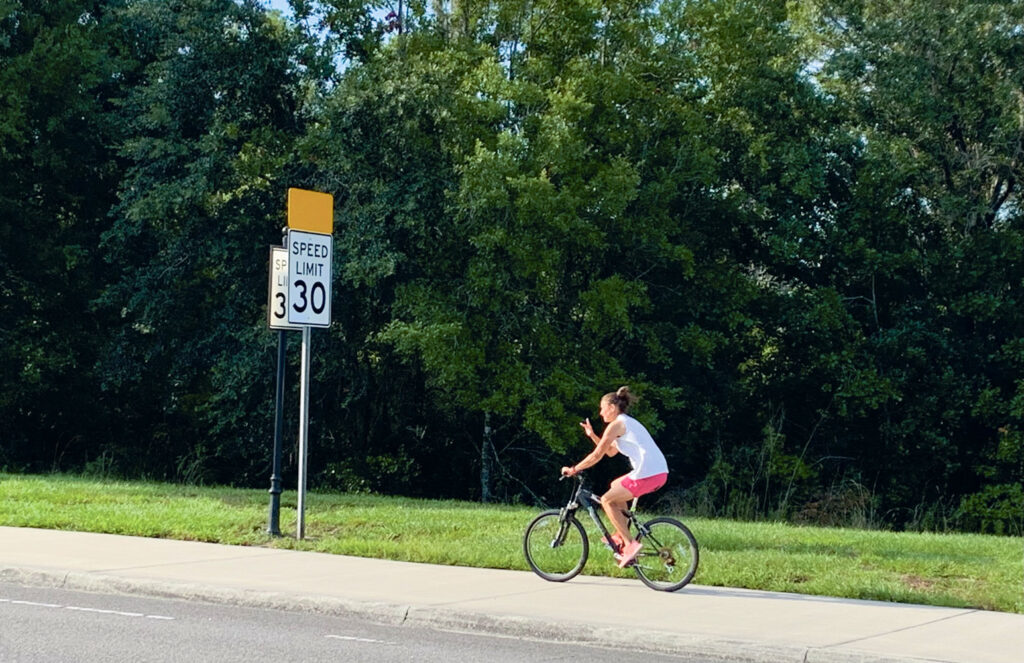
K-Bar Ranch Pkwy. Receiving Safety Upgrades

With more than 1,000 homes scheduled to be built in the coming years in the sprawling K-Bar Ranch development in New Tampa, District 7 Tampa City Council member Luis Viera has been keeping a close eye on the transportation issues already plaguing the community.

Whether it’s poorly marked roads, unsafe crosswalks or simply ways to get in and out of K-Bar Ranch, the infrastructure needs to keep pace.

By the end of this year, a number of improvements along K-Bar Ranch Pkwy. are expected to be completed.

The parkway itself is still under construction and less than half complete, but when completed, it will be the spine road of the growing community. At that point, it will run from the Kinnan St. entrance all the way east to Morris Bridge Rd., to an exit/entrance just a little north of the current entrance to the Easton Park subdivision.

Residents have complained about the lack of definitive striping on the completed portions of K-Bar Ranch Pkwy., resulting in some near-accidents. Two auto-related deaths, in 2012 and 2019, were both blamed on speeding.

Viera says he has experienced the concerns first-hand. After conducting one of his community meetings at K-Bar Ranch, Viera says a vehicle almost hit him on his way out.

“Me and my son were driving out on the same K-Bar Ranch Pkwy. residents had just been complaining about, and, lo and behold, I had to swerve out of the way of another car in what could have been a tragic accident,” Viera says.

Viera requested that the City of Tampa take immediate action. He also plans on holding a K-Bar Ranch workshop at a City Council meeting in September to address other issues related to public safety.

Improvements now planned for K-Bar Ranch Pkwy. include:

‱ Departing Kinnan St. eastbound, the existing 30-mph speed limit signs will be upgraded with enhanced and more visible panels above.

‱ Approaching Kinnan St. westbound, upgraded stop signs and bright sticks will be added.

‱ Departing Hawk Valley Dr (private road) eastbound, adding a two-way traffic warning sign.

‱ Departing Redwood Point Dr. east- and westbound, installing new 30-mph speed limit signs and with enhanced conspicuity panels above.

‱ The skipping yellow center line along the original section of K-Bar Ranch Pkwy. will be updated with a double yellow center line and raised pavement markers.

‱ Departing Laurel Vista Way (private road)/Wild Tamarind Dr. east- and westbound, new 30-mph speed limit signs and more visible panels above will be installed.

‱ Approaching Paddock View Dr. eastbound, end-of-road marking signage (red diamonds) and an advanced T-intersection warning sign will be added, as well as a refreshing of all markings as needed and adding raised pavement markers.

‱ Departing Paddock View Dr. westbound, new 30-mph speed limit signs will be installed with enhanced conspicuity panels above.

“It is pivotal that the City of Tampa and local governments invest in the requisite infrastructure, roads and public safety systems, as a community grows,” Viera says. “K-Bar Ranch is a growing community and needs this constant attention. Transportation is pivotal.”

CONNECTION COMING: Another primary improvement along K-Bar Ranch Pkwy. will be a connection to Meadow Pointe Blvd. into Wesley Chapel. However, the developer, MI Homes, has targeted Dec. 31 as a completion date, although there are still some permitting issues to resolve that could stretch that completion date into 2022.

The Meadow Pointe Blvd. connection will be the only northbound way out of K-Bar Ranch (other than Morris Bridge Rd.) when K-Bar Ranch Pkwy. is completed.

The Meadow Pointe Blvd. connection is the consolation prize for those who wanted to see Kinnan St. in K-Bar and Mansfield Blvd. in Meadow Pointe connected to give residents on both sides of the border easier access and to reduce congestion on BBD.

But, as we’ve reported previously, after years of negotiating with Hillsborough County, Pasco County commissioned a study that recommended connecting the roads only for emergency use, and instead agreed to connect K-Bar Ranch Pkwy. to Meadow Pointe Blvd. and Wyndfields Blvd. for vehicular traffic.

K-Bar Ranch Pkwy. is being constructed in segments, and once each road segment is completed, it will permit the developers to build more homes in that area. 

Segment C, starting at the Kinnan St. entrance, is currently completed. Segment D, which is partially completed, will connect to the Meadow Pointe Blvd. extension, which also is under construction right now.

Segment F also is under construction, and will take the parkway almost to the westernmost part of Easton Park.  

Completion is targeted for Dec. 31 for those segments.

The remaining segments to complete the parkway are pending permitting, meaning that completion will most likely not happen until 2022.

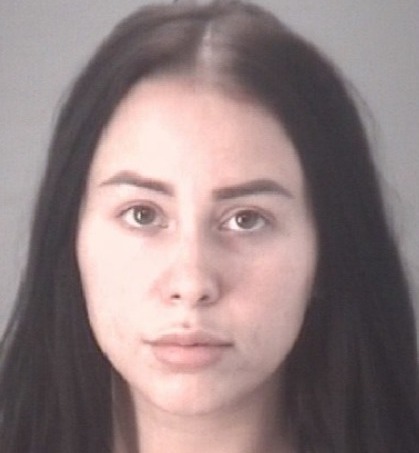
Suspect Arrested In Fatal Hit-And-Run

Nicole Marie Gennarini Cresswell

A Wesley Chapel woman was arrested Tuesday night after she struck and killed a 64-year-old woman in a mobility scooter who was checking her mail.

Nicole Marie Gennarini Cresswell, 24, was arrested just before midnight. She was found sitting in her gray 2019 Nissan Sentra in the driveway of a home on Shenandoah Run in Wesley Chapel. Gennarini Cresswell was arrested by Florida Highway Patrol (FHP) troopers and taken to the Pasco County Jail during the early morning hours on Wednesday, June 16, and charged with leaving the scene of a crash involving a death.

The FHP report says troopers were able to use vehicle parts found at the crash, as well as witness accounts, to assist in locating Gennarini Cresswell.

According to the FHP, Gennarini Cresswell was traveling westbound on Robin Roost Lane where she collided with the victim, who was retrieving her mail at the roadway edge at roughly 5:45 p.m.. She told troopers she had struck a deer earlier, but did not remember where.

Following the crash which caused damage to the front right portion of the vehicle, Gennarini Cresswell fled the scene as the victim suffered fatal injuries.

Pebble Creek Golf Course To Shut Down July 31

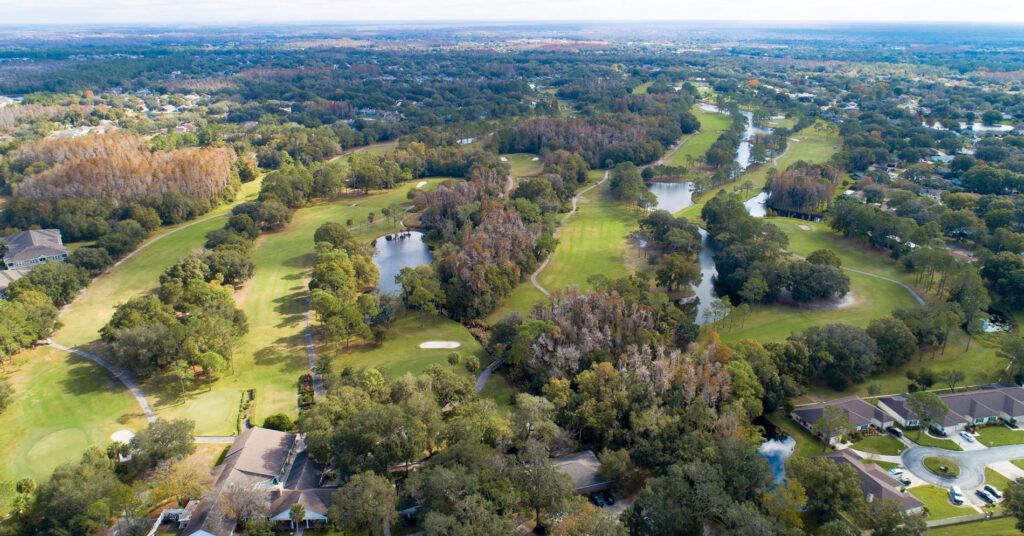
Pebble Creek Golf Club opened in 1967, long before New Tampa as we know it was developed.

The letters went out last weekend, but were probably not a surprise to anyone living in Pebble Creek.

The golf course, the oldest one in the area, is shutting down for good on July 31.

Pebble Creek Golf Club (PCGC) owner Bill Place, who has been trying for years to sell the 6,436-yard golf course he bought in 2005, says he can’t continue losing money on something with no future. After a few failed attempts to finalize a deal with developers the past few years, as well as unsuccessfully trying late last year to get a brownfield designation from the county that would have helped cover almost 3/4 of the cost to decontaminate the soil, Place says he was out of options.

The club, heading into what is usually its slowest time of the year from August through October, currently has only 13 full-time members. 

“Even though we had a little bit of a bump from Covid-19, I’ve already started to see it back off as people go back to work,” Place said. “We’re on a path to to repeat 2018 and 2019, when we lost money those years.”

Place also said merely maintaining the course had become financially untenable. Built in 1967, he says the course still has its original irrigation system and “it failed miserably during this recent drought.

“It was time.”

Place says he has quietly told brokers in the last six years he was looking to sell the golf course. After having his brownfield designation rejected in December 2020, Place has continued entertaining suitors.

DR Horton, one of the original interested buyers of the PCGC, had done preliminary testing two years ago and discovered contaminants on the golf course before withdrawing its interest. A brownfield site is a property that is contaminated, which hinders efforts to expand or redevelop it. But there are significant tax credits offered to help clean the property up. 

Without those tax credits, Place will likely foot the bill. He has paid $150,000 to have the site tested by an environmental testing firm, and expects results this week. A preliminary estimate, he says, indicated it would then take 6-9 months to decontaminate the soil. That could cost Place $1 million.

But he has potential developers lined up — he will choose one in the next two months — and says he is including the two Pebble Creek homeowners associations, who serve roughly 1,300 homeowners, in the process. Regardless, he expects a significant number of residents to protest when rezoning the 149-acre property gets underway.

“No matter what, we are trying every which way we can to work with the HOAs,” Place says. “I know they would rather have the golf course, but we are looking for the best possible solution.”

Ken Moser Leaving His Mark At Florida Aquarium

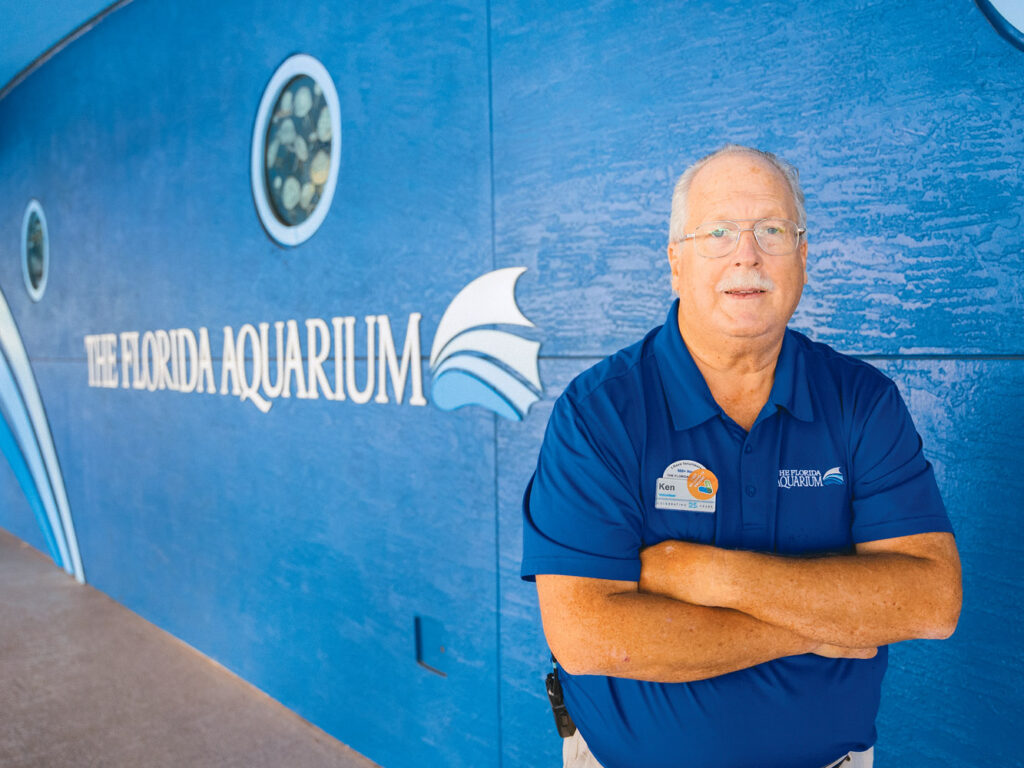
Wesley Chapel resident Ken Moser poses with one of his stained glass pieces near the Florida Aquarium entrance. (Photos: Charmaine George)

When Ken Moser moved to Wesley Chapel from Maryland in 2017, he and his wife Becky were retired and looking for a place to volunteer.

“We went to the (Tampa) zoo (at Lowry Park) in July and it was 95 degrees,” he says, adding that they immediately decided that the zoo was most definitely not the place for them.

Ken joined a fly fishing club, and says one of the members was always talking about the Florida Aquarium, so he eventually decided to give that a try.

In March 2019, Ken and Becky began training to volunteer together.

Over the last two years, and despite the Covid-19 pandemic, their efforts have made quite an impact.

So much so, that in April, Ken was named the Florida Aquarium’s Volunteer of the Year. This title earns him an honorary spot on the Aquarium’s Board of Directors for the year.

While he was chosen for his dedication — nearly 600 volunteer hours over the past two years (similar to Outstanding Service winner Edwin Rodriguez, whom we featured last issue) — and his infectious good attitude, he also was recognized for how another of his hobbies has enhanced the aquarium itself.

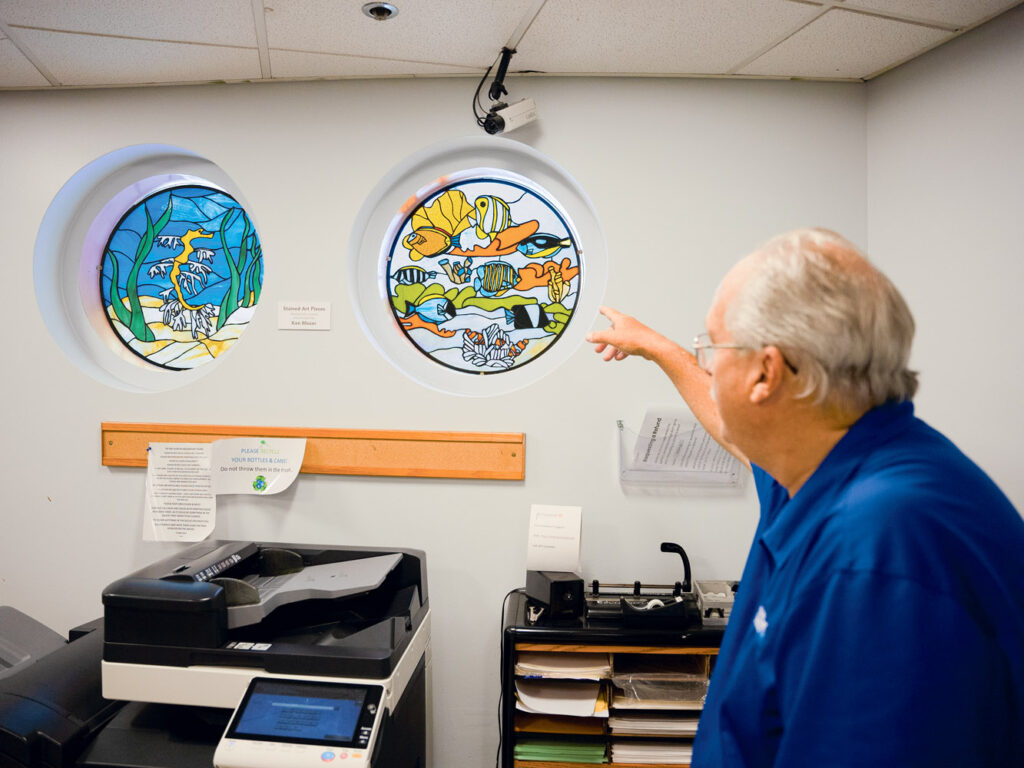
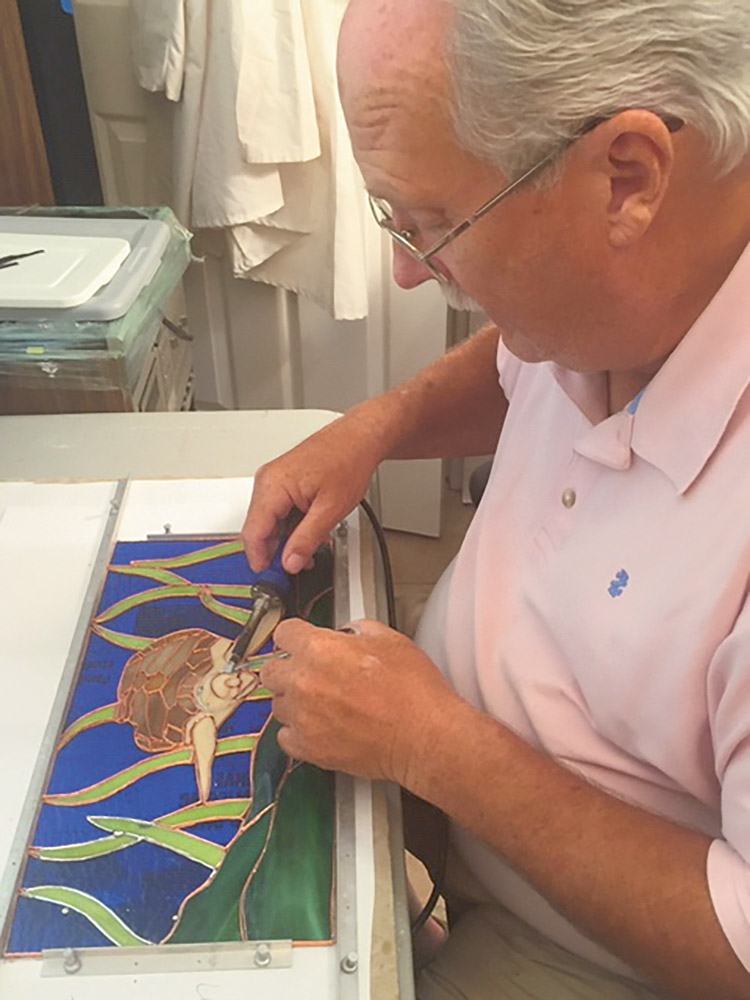
Ken created eight different stained glass windows that are now located throughout the aquarium. He says creating stained glass is one of many hobbies he’s taken up to keep busy during retirement.

“About eight years ago, my wife and I took a stained glass class at the community college,” Ken says. “I’ve been self-taught from there.”

The eight windows he’s created for the aquarium started when he noticed a two-foot window in the Madagascar section of the aquarium, where he thought he could mirror the bright colors of the exhibit with a brightly colored window.

After that, he says he was inspired to make a window of leafy sea dragons for the volunteer lunch room. Ken says they were so well-received that he was asked to make windows for the front of the aquarium and the CEO’s office.

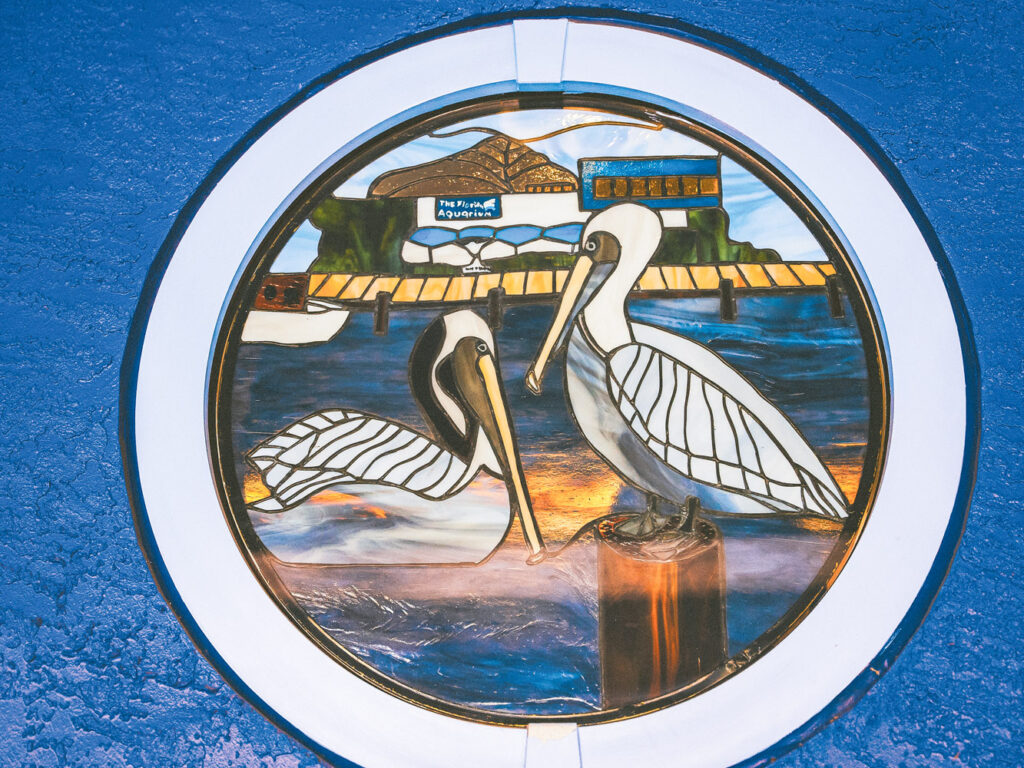
“Each one is specific to the aquarium,” he says. “The pelicans are Josh and Theo, the penguins are waddling through the wetlands exhibit, there are sea turtles, spoonbills and moon jellies (jellyfish). I tried to keep it to what people can see at the aquarium.”

Josh and Theo

Josh and Theo are brown pelicans who have been popular on the Florida Aquarium’s social media accounts, and moon jellies are jellyfish that can not only be seen, but also touched in the aquarium’s touch tank.

Ken says the more time he spends there, the more he gets to know the animals.

“If you take the time to watch each individual animal,” he says, “you’ll start to see their individual behaviors.”

When asked if he has a favorite marine animal, Ken doesn’t seem to be able to narrow it down.

“Every week seems to be a different one,” he says. “The jawfish is one of the most comical characters, and I like listening to the wood ducks talking back and forth to each other in the wetlands. And, the stingray tank has a little baby who is worth the price of admission just to see her.”

Ken and Becky both work in education, teaching guests about the aquarium’s many animals. They initially agreed to volunteer at least eight hours a month, but soon determined they had more time than that to spare.

“Once I got in the commissary,” Ken says, “I would go three times a week. It’s just a fun place to go.”

The commissary is where food is prepared for the aquarium’s 8,000 animals.

 â€œWe have menus for the various animals,” Ken explains. “Some require different fishes that have to be cut up different ways, for example, and birds have seeds and pellets.”

Ken hasn’t worked in the commissary since March 2020, before Covid-19 shut down the aquarium and no volunteers were allowed in.

When the aquarium reopened in May, a few volunteers helped in guest services and as “roaming disinfectors,” to make sure guests stayed on the pathways and wore masks.

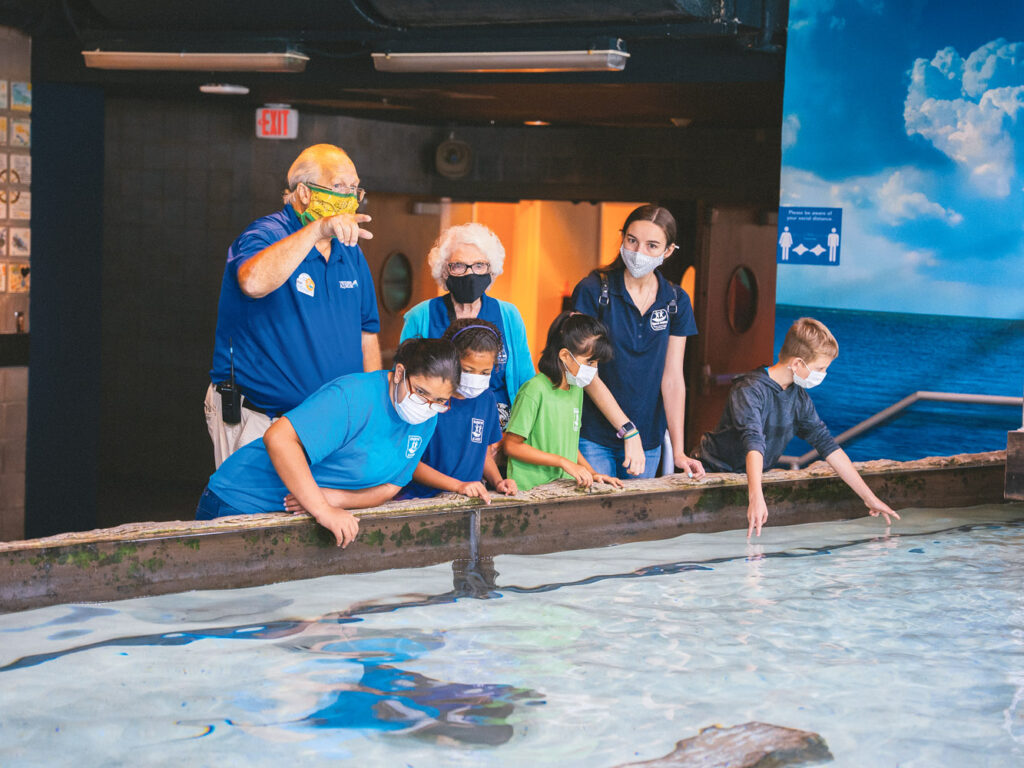
Now, Ken says, a limited number of volunteers are back in the education department manning the touch tanks during the day.

“As soon as volunteers were allowed,” he says, “I felt responsibility to come back and keep the program alive. At one time, they had 300 volunteers, but they were down to zero. If no one comes back, there’s no program.”

He says the aquarium is always staffed to provide necessary care to the animals, but although the aquarium functions without volunteers, he says, “everyone is happier with us there.”

Ken adds that the staff treats the volunteers like family, and that he and other volunteers feel enormously appreciated and grateful to be able to be part of the aquarium. 

He is impressed with how the aquarium has navigated its way through the pandemic, too.

Ken working at the stingray station.

In fact, Ken and Becky donated their first Covid stimulus checks to the aquarium.

“Being retired, we didn’t plan on that money, so we thought, ‘Who needs it more?,’” says Ken. “The aquarium lost all of its guests and still needed to feed the animals every day, so we thought the money was better used that way.”

Ken says he and Becky intend to continue volunteering at the aquarium as long as they possibly can.

“When they announced the award, there were several people who had reached the 25-year mark as volunteers at the aquarium,” Ken says. “There are some really dedicated people there. I might not get 25 years — I started a little late — but at least I left my mark there with the windows. They should be there long after I’m gone, so I will leave that behind.”

College Students Host ‘Zoomhall’ For New Tampa Study

New Tampa is at its best when it comes together to fight for important additions to the community, like the 2017 budget battle that led to an expansion of the New Tampa Rec Center.

Three Master of Social Work (MSW) students at Southeastern University in Lakeland hosted a New Tampa Town Hall meeting on Zoom, hoping to discuss the community’s potential for growth.

The final verdict? To grow, you need to connect.

During the 40-minute Zoom call on May 4, presenters Darlene Starrette, Kyrin Backlund and Melissa Rice (a 20-year resident of New Tampa and the only member of her group that lives here) discussed the opportunities that New Tampa could partake in to increase community engagement. In addition, they held an open forum to hear from the 17 attendees present, including District 7 Tampa City Council member Luis Viera.

“While New Tampa can feel like a disconnected place, residents have voices that matter and we would like to hear your voices,” Starrette said.  

The Zoom call was part of a final project in the course “Generalist Practice with Groups, Communities and Organizations.” The three students completed their first year in the Master’s program and are currently beginning their summer internships. Next year, the students will start their final clinical year to earn their MSW degrees.

Rice was the one who suggested focusing on New Tampa for their final project. She described herself not as a social butterfly, but as someone who was interested in hearing from the people of her community. 

“New Tampa just isn’t talked about much at all,” Rice said. “Living here, I was very interested in other people’s perceptions of the community.”

Luis Viera

One of the main issues discussed during the meeting was the lack of interaction between New Tampa neighborhoods. Viera, who has long argued the same thing, said that New Tampa needed a better collective community identity.

“We see ourselves as Tampa Palms, Hunter’s Green, Richmond Place, Cory Lake Isles, K-Bar Ranch, Grand Hampton, etc. and we don’t see ourselves as New Tampa collectively,” Viera said. 

During the Zoom call, a link was shared to a 42-page community engagement tool kit that covers the demographics of New Tampa, benefits of community engagement and survey results posted on the app Nextdoor. From the responses of 21 residents who took the survey, the lack of social and cultural events in New Tampa was highlighted as a priority. 

“In terms of its cohesiveness and community spirit, it’s not a town — it’s just a zip code,” said Priscilla Stephenson, a Tampa resident who participated in the meeting. 

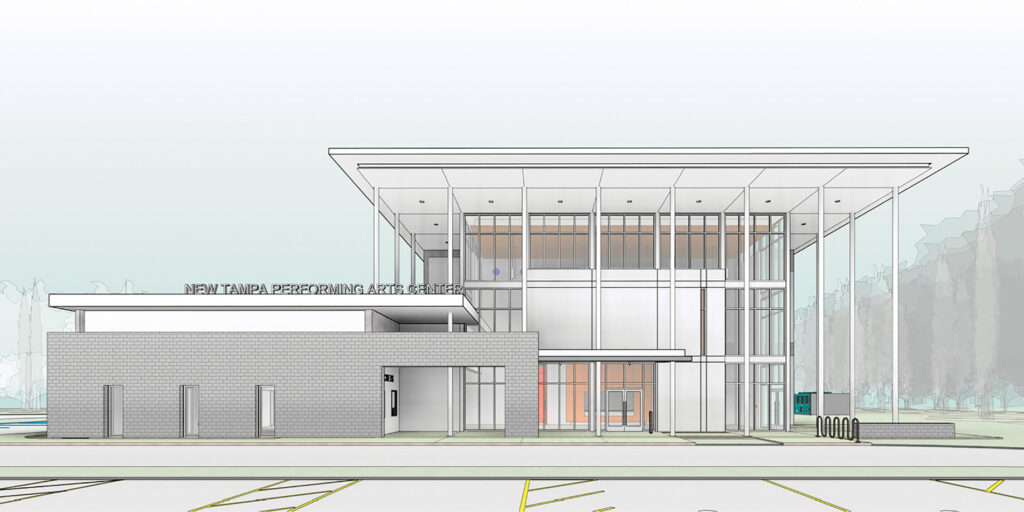
Rendering of the New Tampa Performing Arts Center.

The New Tampa Performing Arts Center (PAC), which has been 17 years in the making, also was a hot topic during the meeting. The team encouraged the Zoom call participants to email and voice their support for the vote occurring the next day. On May 5, the Hillsborough County Board of County Commissioners approved the construction contract of the PAC.

“In our research, we found that there are a lot of benefits to engaging the community,” Backlund said, “including overall health, sense of belonging and social connectedness.”

Rice talked about how some members of the community wanted better transportation and more affordable housing. From her notes, she recorded that New Tampa residents also wanted to fill some of the open store fronts, build cultural bridges and have more restaurants in the area. 

Although two of the three MSW students aren’t residents of New Tampa, each member has worked towards a common goal of establishing New Tampa’s sense of community. Backlund suggested creating a Facebook page for the New Tampa area to keep the community discussion going. 

While nearby Wesley Chapel has three robust community Facebook pages with nearly 60,000 total combined members, New Tampa’s busiest Facebook page, New Tampa Online Yardsale!, is mostly for selling household items.

“I’m just hoping that this isn’t the end,” Backlund said. “Our goal is to get people on board and start to actually make some significant changes.”

The three MSW students want the residents of New Tampa to take pride in their community and to keep engaging through community events.

“It’s really up to the community to decide that this is a good thing for them and it’s something that they really want to do,” Starrette said.