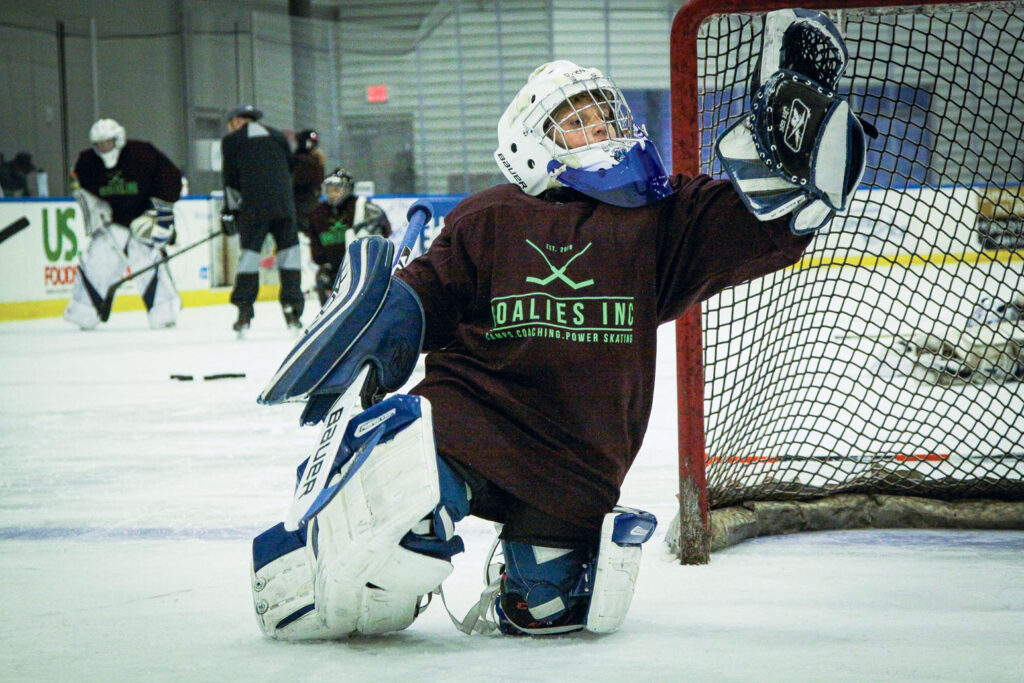
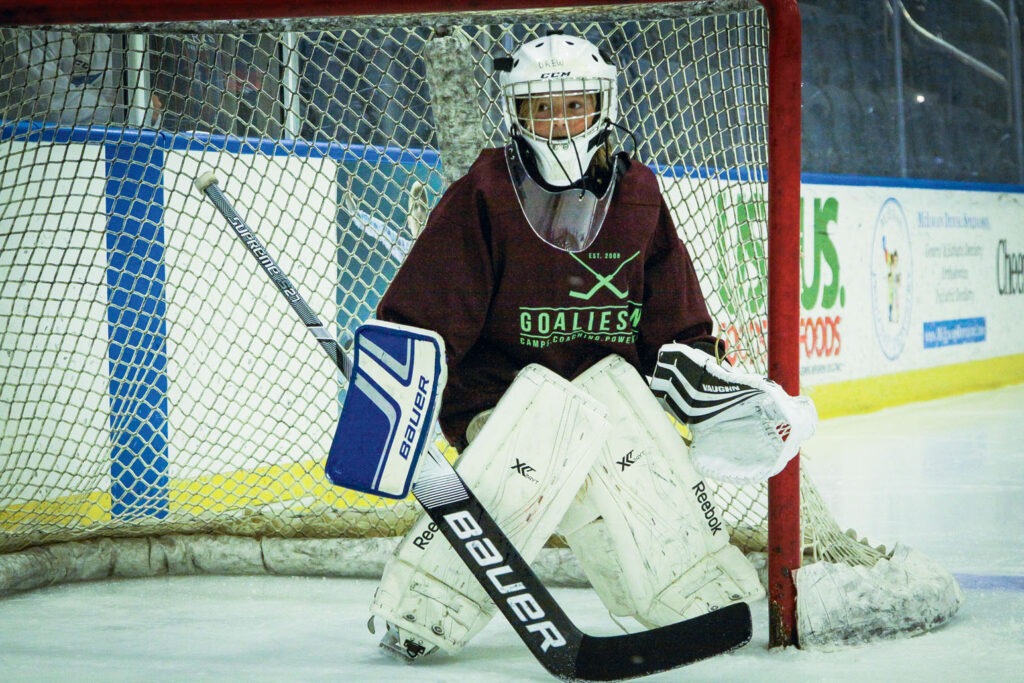
Tampa’s Nick Ryan lunges to try and stop a shot at the Goalies Inc. Performance Camp at AdventHealth Center Ice on Aug. 6. (Photos: Mike Camunas)
Nothing was going to stop these goalies from stopping pucks.
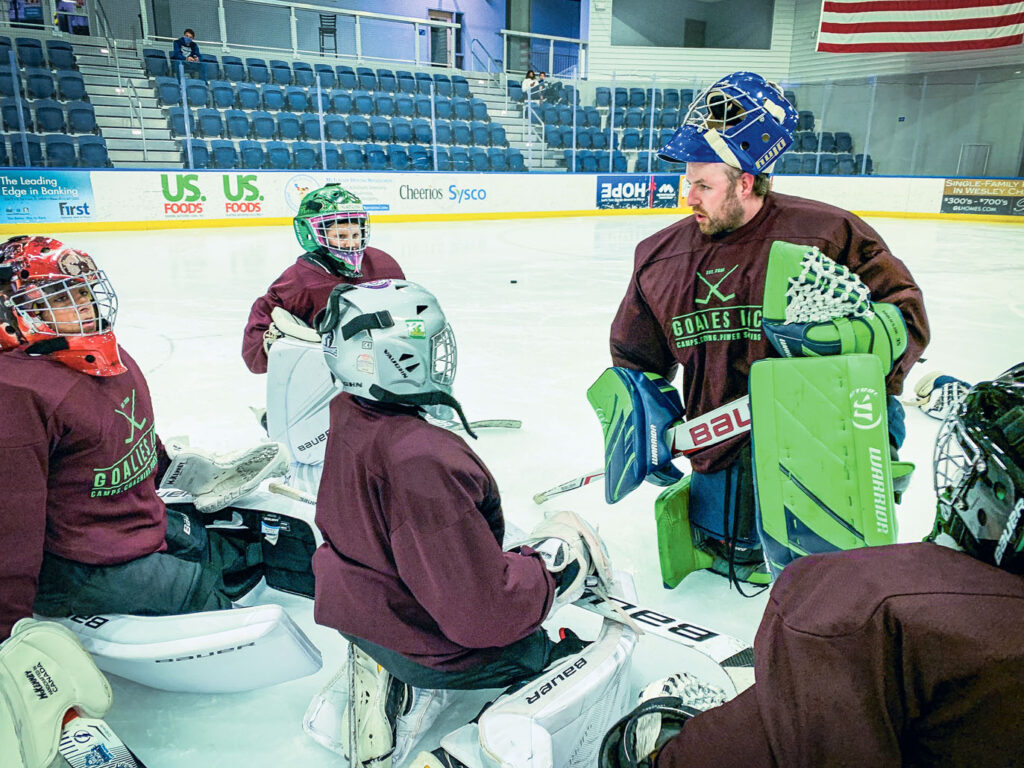
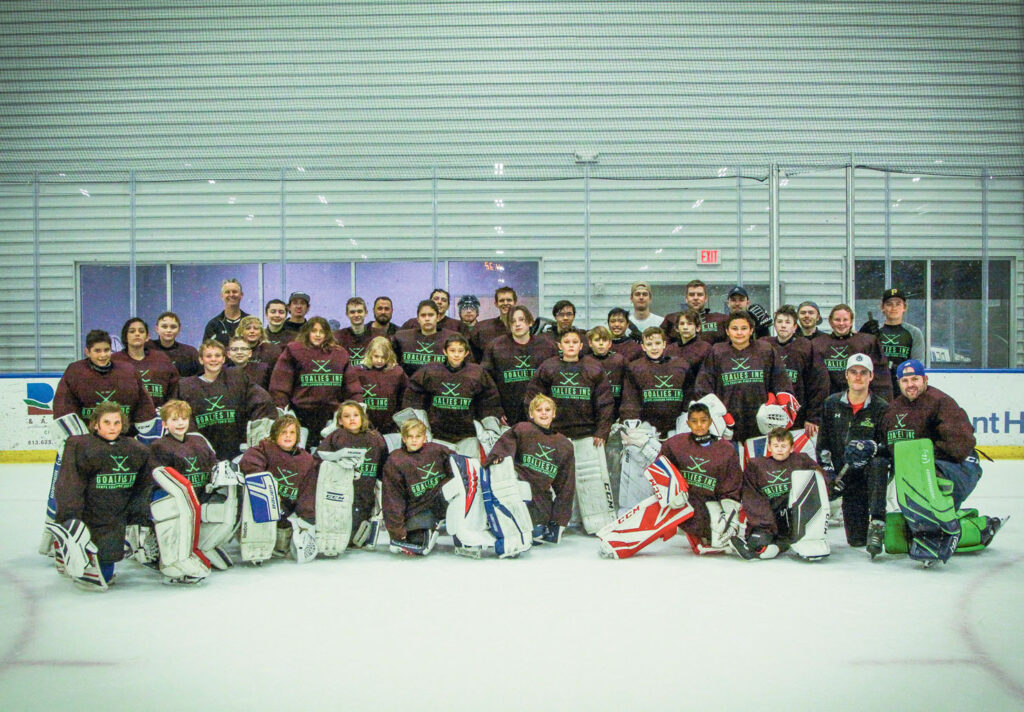
Despite the fact it had to be pushed back due to Covid-19, more than 40 youth ice hockey goalies recently were able to get in a training camp’s worth of goaltending work in two days (Aug. 5-6) at the Goalies, Inc., Performance Camp at AdventHealth Center Ice (AHCI) in Wesley Chapel.
Originally scheduled for March, Bernie Desrosiers, the executive director of Sunbelt Hockey Scouting and a long-time New Tampa-area hockey coach, says the camp was sold out well before the coronavirus shut down youth sports programs.
“We’ll have it again next year,” Desrosiers said. “This has been a great turnout and, so far, all the feedback we’ve gotten has been that everyone was happy to finally be able to come to this camp. “It’s been a great two days.”
Desrosiers added that of the 42 young goalies who participated, only one had to be sent home sick — not Covid-19 related — and that there were no injuries sustained. “Pretty remarkable, I’d say,” Desrosiers said.
Head instructor Jim Stanaway provides instruction to some of the 42 goalies in attendance.
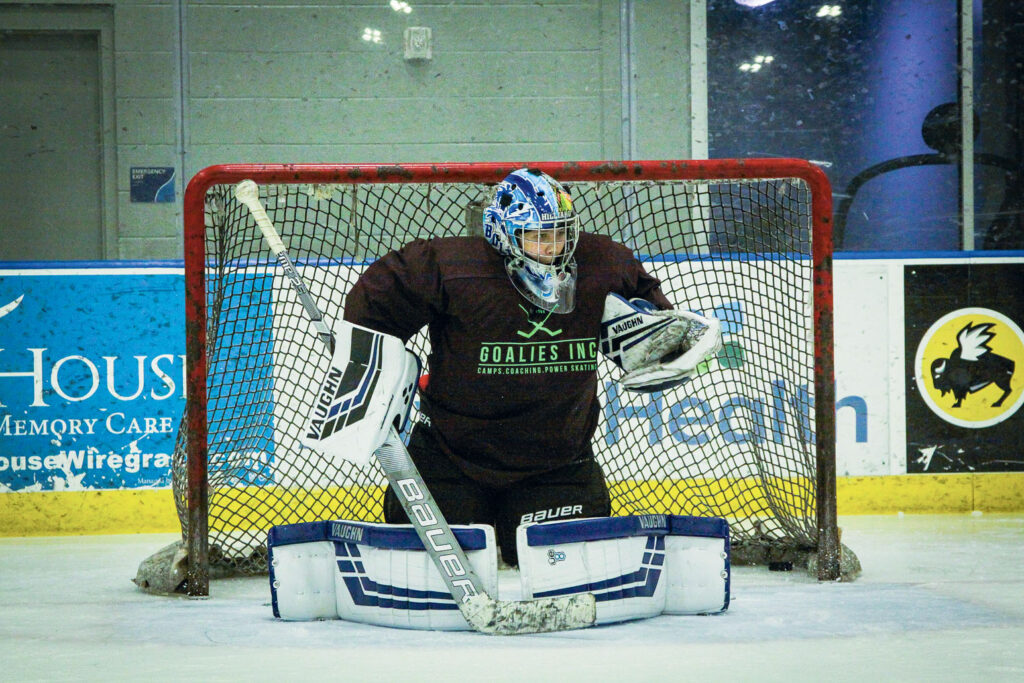
Led by Goalies, Inc. head instructor Jim Stanaway, boys and girls, teenagers and “tweens” went through various drills to hone their goaltending skills in the hopes of being the next Andrei Vasilevskiy (the Tampa Bay Lightning goalie) or Madeline Rooney (the starting goalie for the Olympic gold medal-winning 2018 USA women’s hockey team). The young goalies worked on glove and stick saves, rebound shots, skating backwards, diving for pucks and even how to hug the pipes to block shots.
Stanaway also preached a lot, not only about teamwork, sportsmanship and respect for the game, but also for the goalies’ fans (their families).
As he watched netminders of all sizes and ages scramble to grab pucks, the goalie instructor of nearly two decades was impressed by his first trip to the Tampa Bay area and its local talent.
“With an NHL team, and them doing very well, it’s nice to see (the high interest in hockey in a southern city or state),” he said. “A lot of these southern NHL teams invest in their communities a lot, but the enthusiasm (here) is quite amazing.”
For more info about Goalies, Inc., camps, visit GoaliesInc.com.
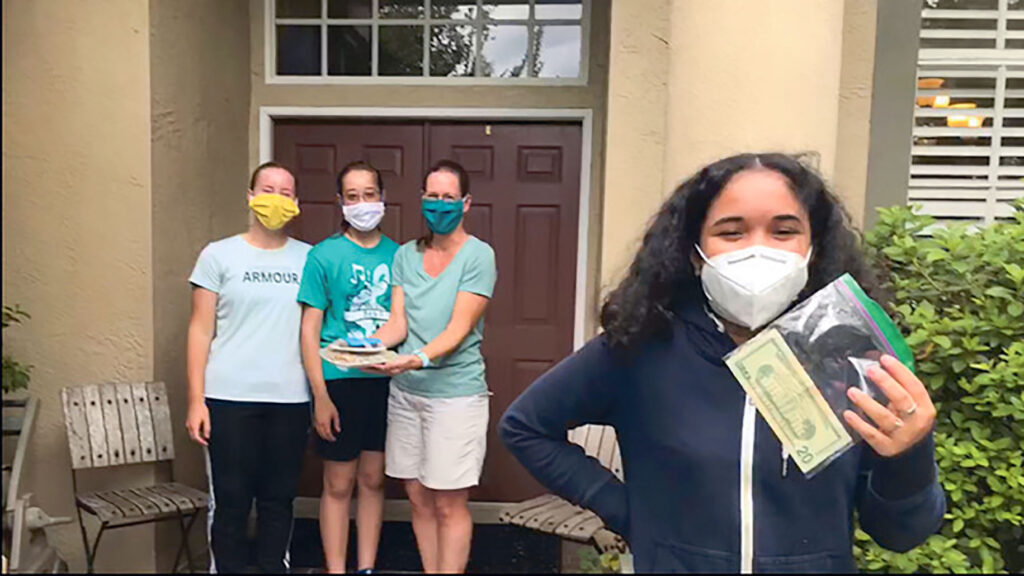
(L.-r.) Girl Scouts Amelia Beanland and Isabela DuBois present the “snuffle mats” they and their Troop 32801 made to Pasco County Animal Services, as part of their Silver Award project.
We’ve all had to do some adjusting since the Covid-19 pandemic started in the spring.
For a pair of eighth grade (now ninth grade) Girl Scouts, the pandemic meant that they faced obstacle after obstacle while trying to earn their Silver Awards, which is the highest award given by Girl Scouts to its Cadettes, who are girls in sixth through eighth grade.
Fortunately for Isabela DuBois, who lives in Cory Lake Isles, and her project partner, Amelia Beanland, who lives in Cross Creek, they learned how to be flexible, adapt and persevere when things don’t go as planned.
The girls earned their Silver Awards before bridging to Seniors at the end of July.
Isabela has been a member of Girl Scout Troop 32801, which typically meets at Benito Middle School, since Daisies, when she was just six years old. Amelia joined the troop when she was in sixth grade. Currently, Troop 32801 has been meeting through Skype.
That’s just one of the changes the girls faced in trying to complete their project.
“Our project is called ‘Don’t shop, adopt,’” Isabela says. “We came up with it because we both have a passion for dogs.”
She says they researched puppy mills and worked to educate people about what they learned. They made a flier and created Instagram and Facebook accounts to educate people about the importance of adopting a pet, rather than shopping for one.
Then, they put their research into action by partnering with Pasco County Animal Services to support its efforts to rescue and find homes for dogs in need.
The girls made “snuffle mats”, which are used to hide food or treats for dogs. “We raised the money, bought the supplies, made them, and donated them,” Isabela says.
However, that wasn’t their original plan.
Isabela’s mom, Crystal, who is the assistant leader for the troop, says she was impressed with the girls’ ability to adapt.
Crystal explains that the project originally included three girls and was going to focus on awareness of pre-teen and teen anxiety. When one of the girls was diagnosed with anxiety, they thought it was too sensitive and came up with the new idea, focusing on helping dogs. Then, the third girl chose to do a different project, and Isabela and Amelia moved forward without her.
They started by organizing a volunteer day at the Pasco County Animal Services shelter in Land O’Lakes when Covid-19 caused the shelter to close its doors to volunteers. The girls had to figure out what to do next.
They called the shelter, which recommended they make the snuffle mats. The girls then raised the money to get supplies by hosting a “virtual bake sale,” where they delivered goodies to people who bought them online.
Isabela and Amelia then bought the supplies for the snuffle mats, including fabric and rubber mats with holes in them, and a representative of the shelter taught the troop how to make the mats via a Zoom meeting.
“They kind of got hit up against a wall and figured out a different way around it,” says Crystal. “They learned some strategy skills.”
The girls were each required to contribute 50 hours to the project, and both Isabela and Amelia exceeded that requirement.
“This took a lot of work,” says Isabela. “We had to change our project from our original plan, then we also had Covid, and we had to change it again. It got harder at the end because we couldn’t meet to do stuff. It was very difficult and stressful.”
Isabela says she is happy to have received the award, given by the Girl Scouts of West Central Florida, but she is more proud of her efforts and says she learned a lot during the process. “I want people to know how to find a proper breeder, kind of like a background check, and how to adopt properly and make sure the pet they adopt is healthy,” she says. “And, if you don’t want a dog, you can still help. You can donate to shelters or volunteer at a shelter.”
Isabela says she and Amelia had money left over from their fund-raising efforts after they made the snuffle mats, so they asked the shelter what kind of food was used, then ordered it and had it delivered.
“People can do that, too,” Isabela says, “and it’s not super expensive.” She says her journey in Girl Scouts is far from over, as she plans to earn her Gold Award, too.
“We’ve done archery, camping, gone canoeing, paddleboarding, ziplining and horseback riding,” she says. “They teach you First-Aid and life skills you won’t learn anywhere else. And, you make friends. I’ve learned so many things that I never would have if it wasn’t for Girl Scouts.”
Search “Florida Girl Scouts against Puppy Mills” on Facebook and on Instagram at “Dont.Shop.Adopt.”
For the last few issues, I’ve been writing in this space about how I’ve personally felt about the state of race relations in this country. And now, I feel fortunate that I have found a way to do something about it — and several dozen of my readers in New Tampa and Wesley Chapel have agreed to see if we can do that something together.
And, even though I still have no idea what I hope this group can accomplish, I do know that the readers who have responded that they’re interested in participating are of all different racial, socioeconomic and religious backgrounds.
It’s the kind of group I hope to someday have a chance to meet with in person to have a beverage and/or a meal, or even a large-scale gathering in an open auditorium. But for now, it will begin with a Zoom meeting that originally had been scheduled for August 10 but has been postponed until a weeknight between August 19-August 26 that will be open to anyone who genuinely wants to be part of something that I hope will be helpful in some way.
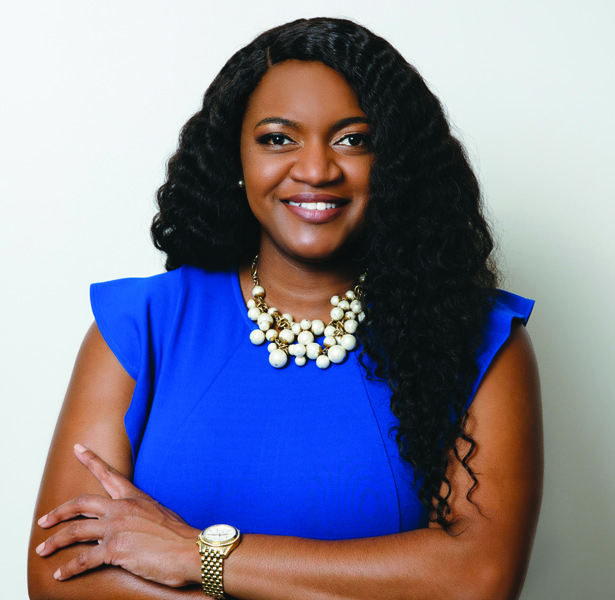
In my August 4 editorial in Wesley Chapel Issue #16-20, I said that because it will be a Zoom meeting, I plan to moderate the discussion that evening and I have asked someone I have a huge amount of respect for to co-moderate it with me — District 63 State Representative Fentrice Driskell — who has already re-won reelection to her seat because of having no opponent and who represents the New Tampa area in the Florida House of Representatives.
Rep. Driskell is originally from Tampa Bay and moved back home after law school to find meaningful ways to involve herself in the community. So, as my co-moderator, she is someone who is familiar with our local context. Rep. Driskell believes that, in order to address racism, and ultimately, to heal its wounds, our community must be willing to have tough, honest and sometimes uncomfortable conversations about race. She also is in conversation with multiple stakeholders around these issues to develop policy solutions to tackle institutional racism at the legislative level.
Rep. Driskell also is working with other elected officials and community leaders on a project in conjunction with the Equal Justice Initiative that will lead to more community conversations about race. Through the project, local officials will erect a marker that will honor and memorialize the lives lost to racial lynchings in Hillsborough County during the Jim Crow era. The goal of that project is both to educate our community about its past with respect to racially motivated violence and also to spark dialogue about how our shared past is relevant to the structural racism that we see today. She believes that this kind of dialogue, rooted in the factual truth of our common past, will help us develop solutions to build a future that is more fair, inclusive and expansive in opportunity for us all.
After mentioning Rep. Driskell in my Aug. 4 editorial, I also mentioned, in the last paragraph of that editorial, that, “As the moderator of the Zoom meeting, one thing I won’t be interested in discussing is the defunding of law enforcement, which has become a popular rallying cry in the wake of (George) Floyd’s death. I also will do everything I can to not allow finger-pointing or for the meeting to become about Red vs. Blue.
“As someone who grew up in New York and saw police officers running towards people who had just been shot as I tried to go in the opposite direction — away from the danger — no one can convince me that 1) most cops aren’t good public servants & 2) to improve law enforcement’s protection of us will mean additional training that will cost more money, not less.”
Once Rep. Driskell saw my editorial, however, she called me to discuss it and shared her sentiment that in order for the meeting to be as inclusive as possible, it would be important for us to welcome the perspectives of all participants. She also shared that, as an elected official, it is her job and duty to listen and to consider the opinions of all of her constituents.
I really felt badly when Rep. Driskell brought this to my attention and, after we spoke about it, I better understood why I received some negative emails because of that paragraph.
So, while we may have differing viewpoints on some issues, Rep. Driskell and I agree that we have a responsibility to not exclude anyone’s ideas that would be productive to the discussion.
In addition, even though I didn’t want to postpone the meeting, in light of how Rep. Driskell felt about my editorial — which I didn’t share with her prior to publishing it in that Aug. 4 issue — in the current scope of the discussion, I agreed it was the right thing to do.
I knew it wasn’t easy for her to have to call me about it, but even though all of the opinions expressed in all 600+ of my page 3 editorials I have published in the 26 years I have owned and been the editor of the Neighborhood News have always been mine alone, once I was introducing Rep. Driskell as my co-moderator, I should have at least run the column by her, which might have prevented us from having to postpone it.
Please send me an email at ads@ntneighborhoodnews.com to join this open dialogue with this diverse group of your neighbors in New Tampa and Wesley Chapel. Once the revised Zoom meeting date and time are set, I will again email everyone who signed up with a link to the meeting.
Tampa Mayor Jane Castor has presented her annual budget proposal to the Tampa City Council — via a socially distant video conference, naturally — and the news was mostly good for New Tampa.
The Fiscal Year 2021 budget didn’t raise property taxes, or cut any essential services, and there were no layoffs.
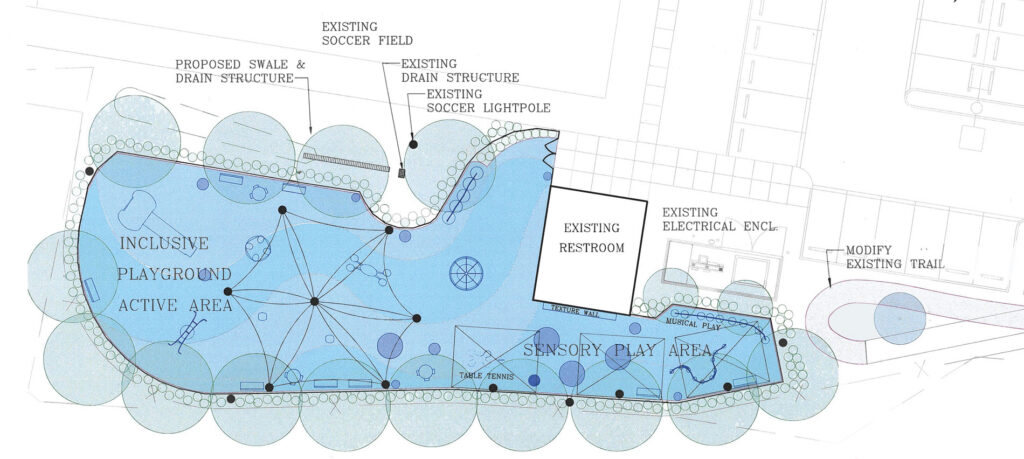
But, the $1.254 billion plan included a big surprise: Money for the New Tampa Sensory & Autism Friendly Park, or Inclusive Park, which Tampa City Council member Luis Viera had all but given up on a few months ago, due to the city’s anticipated financial shortfall due to Covid-19.
“I knew due to the economy there would be a scaling back of priorities, and there has been,” says Viera, whose District 7 includes most of New Tampa. “But I was pleasantly surprised to see it in there.”
The budget, Tampa’s biggest ever, includes $1.7 million to build the Inclusive Park just behind the New Tampa Recreation Center (see story on pg. 6). While Tampa has made a number of improvements in recent years, with playground equipment that makes the parks more accessible to children with autism, including the NTRC’s Community Park, this full-fledged autism/sensory park will be the first of its kind in the city.
Roughly $90,000, from the 2018 budget, was used to design the park, originally planned for the area behind BJ’s Wholesale Club, also in Tampa Palms.
“It’s a huge win for New Tampa kids with disabilities, as well for the city of Tampa,” says Viera, who made the autism park one of his first goals when he was elected in 2016. “I’m thrilled they didn’t put the brakes on the project. Under Mayor Castor’s administration, you can see they are trying to take a positive stand in regards to persons with special needs. It’s great to see.”
Castor says the pandemic has cost the city $24 million in revenues. She also says she has no plans to cut from the police budget, which is roughly $175 Castor, Tampa’s Police Chief from 2009-15, said her plan was to invest, not divest, even in the wake of nationwide demands that police spending is reevaluated and reduced following the death of George Floyd and the ensuing protests. Castor’s budget must be approved by the City Council by Oct. 1. — JCC
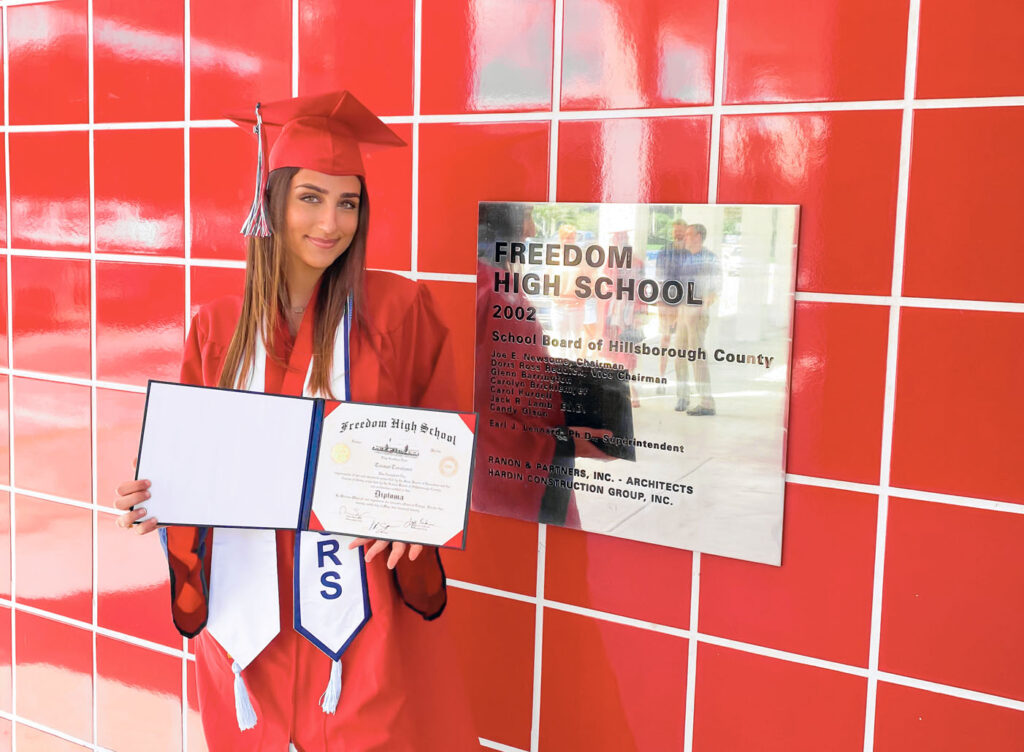
Taravat Tarahom didn’t get to bask in the glory of being Freedom High School’s Class of 2020 valedictorian, thanks to the outbreak of Covid-19 cutting short her senior year. Nor did she get to give her speech in front of a throng of her classmates in an arena, instead settling for a safe and socially distant recorded message.
What Taravat says she did get out of being Freedom’s valedictorian, however, was a life-altering accomplishment at the end of what, at times, was an extremely difficult journey.
“This has taught me to look at one goal, but not make (that goal) my entire life,” the 18-year-old says.
She was able to balance a huge school load, deal with the divorce of her parents and the death of her dog, as well as a diagnosis of Type 1 diabetes, all while unexpectedly rising to the top of her class.
Taravat walked away from Freedom with a greater appreciation of her relationships and health and with the piece of mind that comes from learning how to stay prioritized.
“The experience definitely changed me,” says Taravat, who finished with a 7.64 weighted grade-point-average.
Leyla Mohebbi, her mother, says she couldn’t be more proud. She says academics have always been a priority in her home, where bringing home a B meant you would be asked, “Why not an A?”
“I feel like Tara put the expectation onto herself that she did not want to be anything less than a valedictorian,” Leyla says. “I’m very happy. I knew that was her dream, and she made it happen.”
Taravat has followed in the footsteps of her sister Targol, who was Freedom’s valedictorian in 2015 and is now in medical school at Nova Southeastern University College of Osteopathic Medicine in Fort Lauderdale. Taravat says she felt the bar was “set impossibly high” before she even started high school. She faced a steady climb up the academic ladder, ranking only around No. 25 in her class after her sophomore year.
She remembers moving up in the class rankings after the first semester of her junior year, somewhere into the teens, and her determination to become the second valedictorian in the family was growing.
She mentioned to some of her classmates and her teacher in AP Biology that she was going to go for it, and they laughed, because she still had more than a dozen students to pass.
“That set something off in me,” Taravat admits.
A former cheerleader, she started her senior year ranked No. 7 in the class, but once her summer grades were input into the system — “I had a crazy workload that summer” — she had quietly risen to No. 3. But, she stayed under the radar, and continued to take a heavy load.
Taravat, who was co-president of the school’s Sierra Club, says a typical day in the fall of her senior year would entail waking up at 7 a.m. for six hours of school at Freedom, then coming home around lunchtime to eat and pack herself a dinner, and working for three hours as an online tutor, driving to the Hillsborough Community College (HCC) Ybor City campus for a three-hour English class and then heading over to the HCC campus on N. Dale Mabry Hwy. for physics lab.
In February, she found out it was official — she had quietly risen to the top of her class. She called Leyla. They cried.
Even More Challenges
The hard work did not come without a cost, however.
In December, she had lost 15 pounds and spent two days in the hospital, where she was diagnosed with Type 1 (juvenile) diabetes. “I was so wrapped up in school I didn’t even pay attention to my health,” Taravat says. “I was kind of mad at myself for not noticing.”
Her diagnosis has triggered an interest in endocrinology, which she hopes to study at the University of Florida. She plans on majoring in microbiology and cell sciences.
And while her valedictorian speech wasn’t delivered to a crowd of her classmates, it did come from the heart. Without the trials and tribulations of her senior year, it might have been a completely different speech.
“Remember this,” she told the Class of 2020. “If you fall: get back up. It’s cliché, I know, but get back up. Don’t allow setbacks to steer you off your natural path. Don’t let a single failure ruin those deep-rooted hopes and dreams. Because ultimately, rock bottom could be the solid foundation that you build the rest of your life on.”