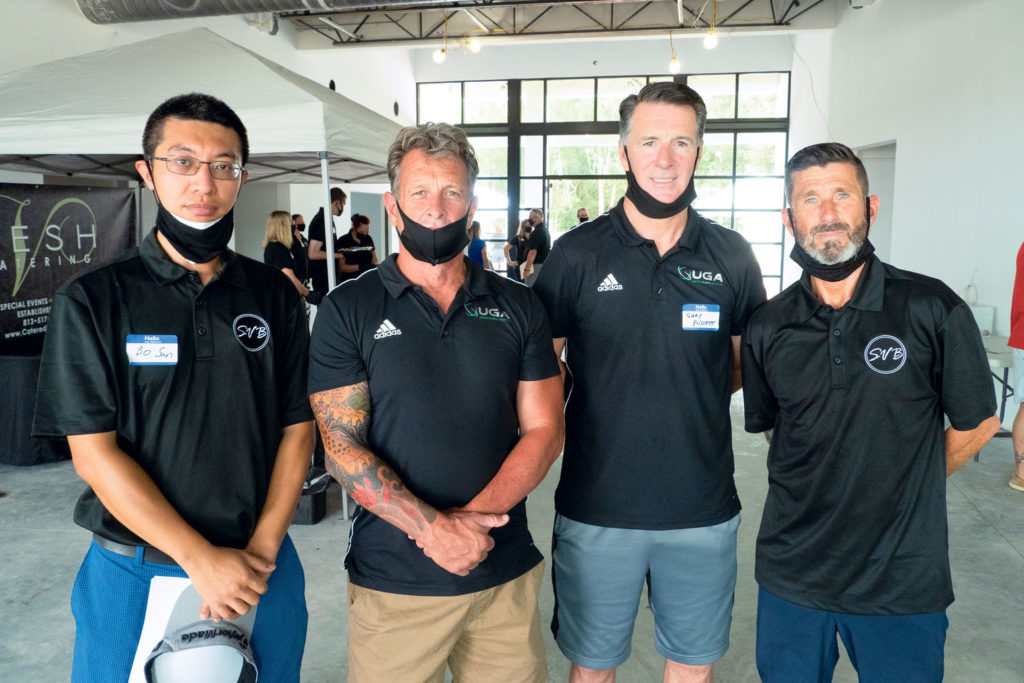
At the SVB Tennis Center VIP preview on June 27, (l.-r) Bo Sun, Mark Shepherd, Gary Blissett and CEO Pascal Collard were among those who greeted dozens of well-wishers.
Pascal Collard has been pitching an exciting vision for the Sarah Vande Berg (SVB) Tennis Center just outside of Wesley Chapel in Zephyrhills for some time, but on June 27, he was able to show some people how that vision is shaping up.
Collard and his staff hosted a VIP event, complete with beer, wine and hors d’oeuvres, to announce that Advent Health has come aboard as a major sponsor and to show off the new center, which he says should open in August.
While none of the rooms are filled just yet and the tennis, pickleball and padel courts haven’t yet been surfaced, Collard filled in the empty spots with his excitement.
And, with Covid-19 cases in Florida rising sharply in recent weeks, Collard promised one thing — it will be safe.
“I hate to say ‘most sanitized place in America,’ but that’s what we’re shooting for,” Collard said, adding that the center bought 1,000 face masks and put the staff through hours of classes and presentations to keep the facility virus-free.
The indoor portion of the facility will have plenty of space and feature an indoor restaurant focusing in healthy foods — think air-fried fries and bento boxes with edible flowers — with popular local Chef Mark Vesh of Vesh Catering designing the menu.
There also will be yoga, cryotherapy, a salt room, an exercise room and licensed massage tables. The all-around focus of the facility is on health, from exercise and playing tennis to recovery to refueling the body.
Collard also helped create a school — United Global Academy — offering an accredited curriculum for athletes training in tennis, golf, soccer and one of Collard’s own personal passions — skydiving.
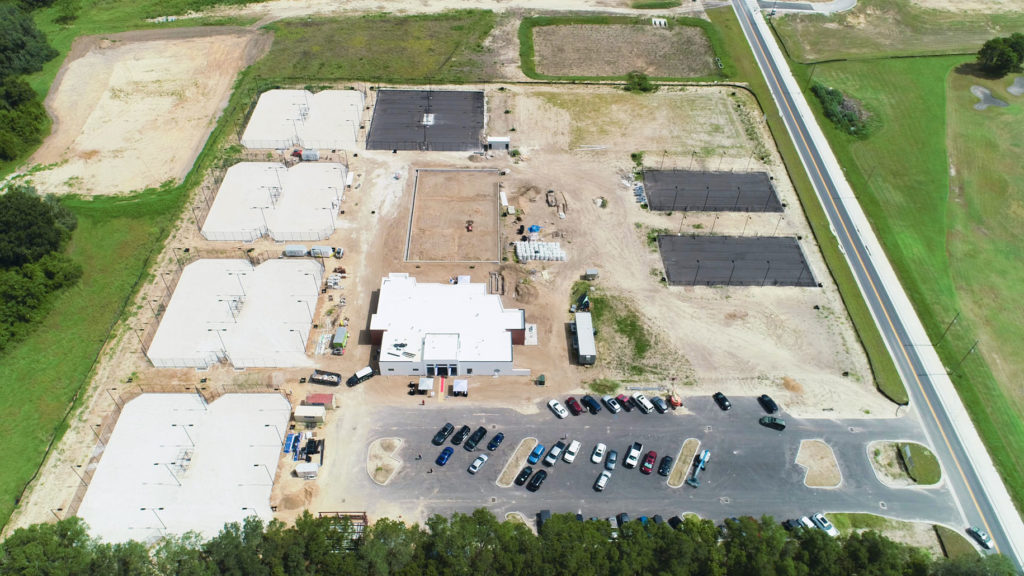
And of course, there will be plenty of racquet sports. The SVB Tennis Center will have four padel courts, eight pickleball courts, two hard tennis courts with U.S. Open surfaces, and eight Har-Tru tennis courts with underground irrigation. Collard says there also will be a grass court: “It’s like a little garden.”
A drone shot of the progress on the center, which has a planned Aug. 15 opening date. Photos by Charmaine George.
There will be a viewing court with seating up to 1,000, and able to expand for bigger tournaments to more than 3,500.
The 30,000-sq.-ft. indoor facility with have four tennis courts but can be converted to accommodate soccer, weddings and even concerts.
If everything goes as Collard hopes, the facility will open Aug. 15.
“It’s really starting to come to together, you can just see it,” Collard says. “We’re pretty excited about it.”
For more info SVB Tennis Center (6585 Simons Rd., Zephyrhills) memberships and how to join, please visit svbtenniscenter.com or call (813) 361-6660.
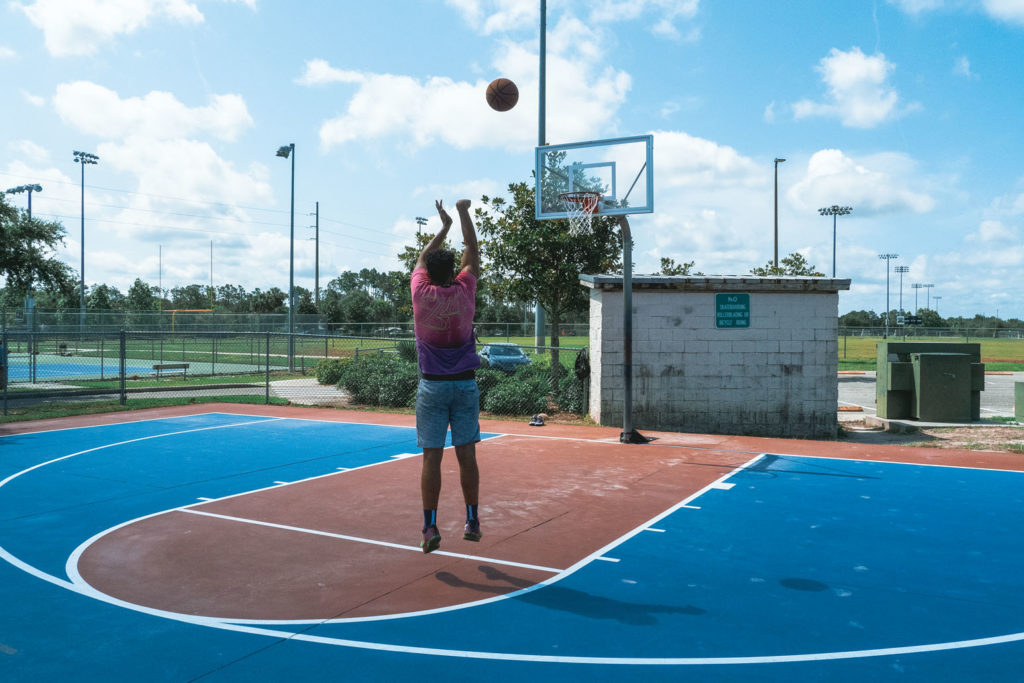
Gio Carillo shoots hoops at the Wesley Chapel District Park on Boyette Rd., which re-opened its courts recently and will be back to hosting its youth basketball leagues soon. (Photo: Charmaine George)
On June 1, roughly 20 kids showed up at a camp at Heritage Isles in New Tampa.
Two weeks later, a similarly-sized group was scheduled to begin camp at the Seven Oaks Community Club in Wesley Chapel.
PROtential Sports owner Nyree Bland could finally breathe again.
“I am grateful to be opened again. It’s good to be back,” says Bland who, along with her husband (and former Minnesota Vikings wide receiver) Tony, has been running sports camps locally for 17 years.
For a while, Bland was unsure if she would be able to host camps again in 2020. PROtential after-school camps were canceled when school was (back in March), and summer activities were in doubt right up until Gov. Ron DeSantis ended all restrictions on youth activities for the state on May 22.
“The data is pretty clear that, for whatever reason, kids don’t seem to get infected at the same rates that some other adults get infected,” DeSantis said when making the announcement.
Summer camps and sports leagues are ready to go. There will be strict new CDC guidelines to follow, such as cleaning and social distancing protocols.
How that works out, however, remains to be seen, as anyone who has ever coached a large group of 9-year-olds can attest.
Keith Wiley, the Pasco County director of Parks, Recreation and Natural Resources, says his department is working closely with the 30 or so co-sponsored groups they partner with to determine the best and safest way forward.
Although DeSantis specifically said the state would not “be instituting a lot of rules” and would “trust parents to be able to make decisions in conjunction with physicians,” Wiley says that all groups hosting youth sports leagues in Pasco County will be required to supply a safe play plan to the county that strictly adheres to CDC guidelines.
Although parks and fields are open for walk-up play by the general public, co-sponsored leagues can only return once those plans have been approved by the county.
According to the CDC, the “lowest risk” of Covid-19 spreading is during skill-building drills and conditioning, with team-based practices considered a “higher risk.”
Full competition between teams from the same local geographic area is considered “even more risk,” while full competition between teams from different geographic areas is considered the “highest risk.”
Equipment like bats, balls, pads and helmets will also require disinfecting they had probably not received in previous years. Counselors and coaches should wear masks, according to the CDC.
Requiring groups to ponder the new normal and submit a plan was a no-brainer.
“Until you start to think it through and visualize what practices or games will look like, it’s difficult,” Wiley says. “We didn’t want groups running out there and figuring it out on the fly.”
Considering that the public’s feelings on masks isn’t unanimous, Wiley is hoping the community can come together to follow the rules for the sake of the 5,000 or so children that typically participate in youth sports across Pasco County. Keeping parents from hovering at practices and games will be a challenge as well.
“It’s going to be extremely difficult to police and enforce,” Wiley says. “So far, however, we’ve had a few conversations with our 30 co-sponsored groups, and they have all been positive. We haven’t had to twist any arms.”
As for the popular county-sponsored summer camps at 11 locations, Wiley said they will be limited to 25 percent of typical capacity.
He says the county did a survey and 60 percent of the parents of previous participants said they had every intention of returning. The remaining 40 percent were a “mixed bag.”
Wiley notes that the Pasco camps usually fill up within three minutes of registration opening.
“My guess is there are going to be a lot of folks waiting to rush right in,” Wiley says, “and a percentage of families that plan on taking it slow.”
The Wesley Chapel Athletic Association (WCAA), which says it serves more than 3,500 area families, has made no official announcement yet about upcoming registrations.
The WCAA’s Board of Directors met on May 28 to discuss how to best implement its summer athletic programs, and what has to be done to make soccer, basketball and baseball safe for everyone.
Baseball, for example, had just begun its spring Babe Ruth League (which also includes Cal Ripken baseball) when Covid-19 hit. Spring ball would have ended in mid-May, with All-Star Districts and State play running during the summer.
All-stars, however, has been canceled for 2020, so Chad Erker, the director of WCAA Baseball, says the organization may resume the spring league to fill the calendar and get kids back on the fields.
“We’re working on it,” he says. “I think, first and foremost, we’d have to see who is willing to return, who can return, who wants to return. And, who feels safe in returning.”
That will be the same predicament facing every camp and every sports league trying to return to action over the next few months. Erker says entire rosters of teams may need to be shuffled so games can be scheduled. Many camps will have to run at a smaller capacity, due to the CDC guidelines, so the demand may still be there, but the numbers won’t.
Meanwhile, Bland says PROtential’s camps usually have 100-plus participants at each location, but will be limited to 25 percent of their usual capacity.
She has canceled the field trips that are usually a part of the PROtential Sports summer camp experience. Counselors will be taking temperatures daily. The groups will be kept smaller than usual, since some of the activities are held indoors.
“The parents we have talked to that are coming are super excited,” Bland says. “Some aren’t ready. I think it is about 50-50. So, we’ll be a lot smaller. But, it’s the new normal, and I’m embracing it.”
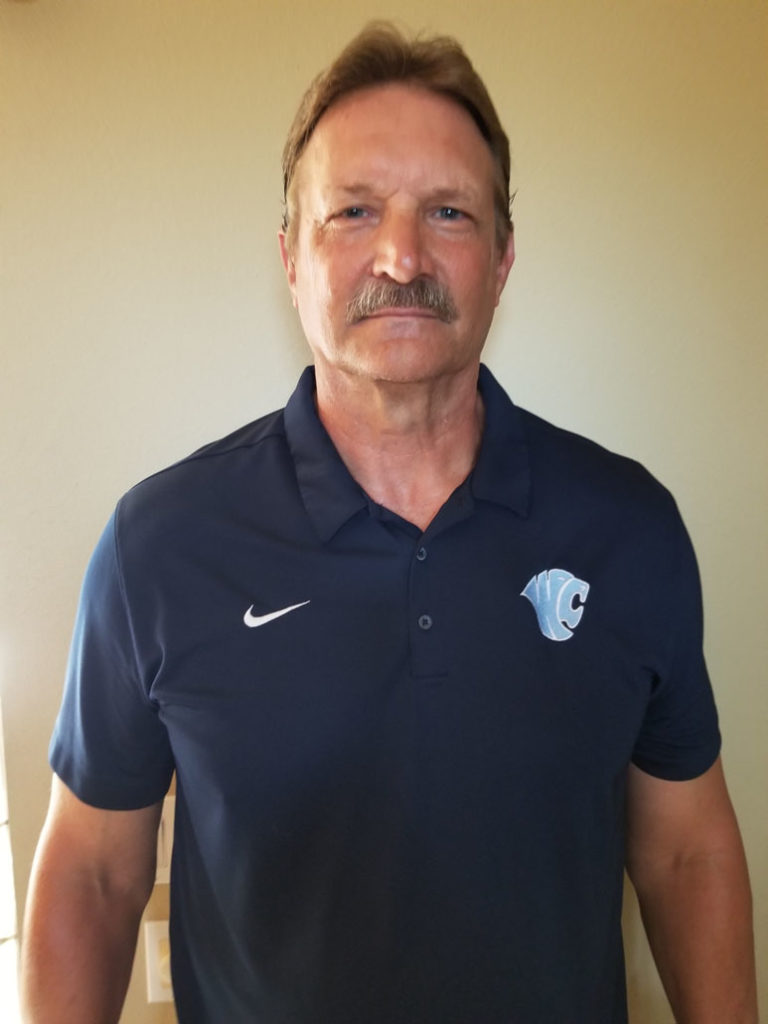
Doug Greseth is the all-time winningest coach at Wesley Chapel, with a 300-164 record leading the boys basketball team.
He removed the poster of the 1995-96 Chicago Bulls team that won 72 games. He packed up boxes of trinkets and papers accumulated over 36 years of teaching physical education and 34 years of coaching.
After 17 years at Wesley Chapel High (WCH), a tenure that included a 300-164 record — the most wins of any coach at the school in any sport — Wwildcats’ boys basketball coach Doug Greseth has officially hung up his coaching whistle.
He’s certainly earned it. Greseth has played and coached basketball for more than 50 years and, including his previous tenure at Tampa Jefferson (1999-2002) and Okeechobee (1983-96) high schools, his coaching record was 533-325 overall
Greseth and the Wildcats finished the shortened 2019-20 season with a 16-9 record. It was the 14th year his Wildcats finished with a winning record. His run also included nine playoff appearances.
“I think kids really like discipline,” Greseth said about the secret to his success. “I think they like leadership. I think they like organization. I don’t think there’s anything wrong with being demanding with kids.”
His best seasons at Wesley Chapel were back-to-back 24-5 records in 2011-12 and 2012-13, including a District championship and two Sunshine Athletic Conference Coach of the Year awards.
Forward Erik Thomas, the school’s all-time leading scorer (2,138 points) and rebounder (1,203) and the 2013 Class 4A Player of the Year, starred on both of those teams. Greseth, who also spent time as an assistant coach at the University of Tampa, said Thomas was the best he ever coached, and the two still stay in touch.
“Playing for Greseth in high school is what helped me grow into the player I am today,” says Thomas, who is currently playing professionally in Argentina. “He was an awesome coach that really cared about his players and it showed in our performance. The fact that he is always willing to welcome me with open arms says a lot about his character and, to this day, we still remain connected.”
Greseth, who remembers high school basketball when the 3-point line was taped on the court because it was experimental prior to 1987, also fondly recalled guard Chase Bussey, the leading scorer from his first Wildcats team, forward Greg Jenkins (who went on to play football for the Oakland Raiders) and forward Isaiah Ramsey, the leading scorer on his last four WCH teams.
Peter Livingston, 36, has coached the girls basketball team at Wesley Chapel for the past six seasons, and he says the school has big basketball shoes to fill, not only for Greseth’s on-court successes, but because of the intangible benefits the coach brought to WCH.
“The administration will be sad to see him go because you could always go to coach Greseth and he straightened things out,” Livingston says. “One of the kids got caught doing something and the administration said they weren’t going to give him a referral, but they were going to go tell coach Greseth, and the kid said, ‘No, no, please, give me the referral!’”
Known as a defensive-minded disciplinarian, the 63-year old son of an Air Force officer used his man-to-man defense to turn young boys into successful men.
More than 40 players Greseth coached went on to play basketball or football in college, including one in the NBA and three in the NFL.
What’s next?
“I’m not sure,” he said. “I’m going to take a vacation.”
Matt Sanchez stands inside his Heritage Isles home, 10.9 yards from his practice target (blue arrow). (Photo: John C. Cotey)
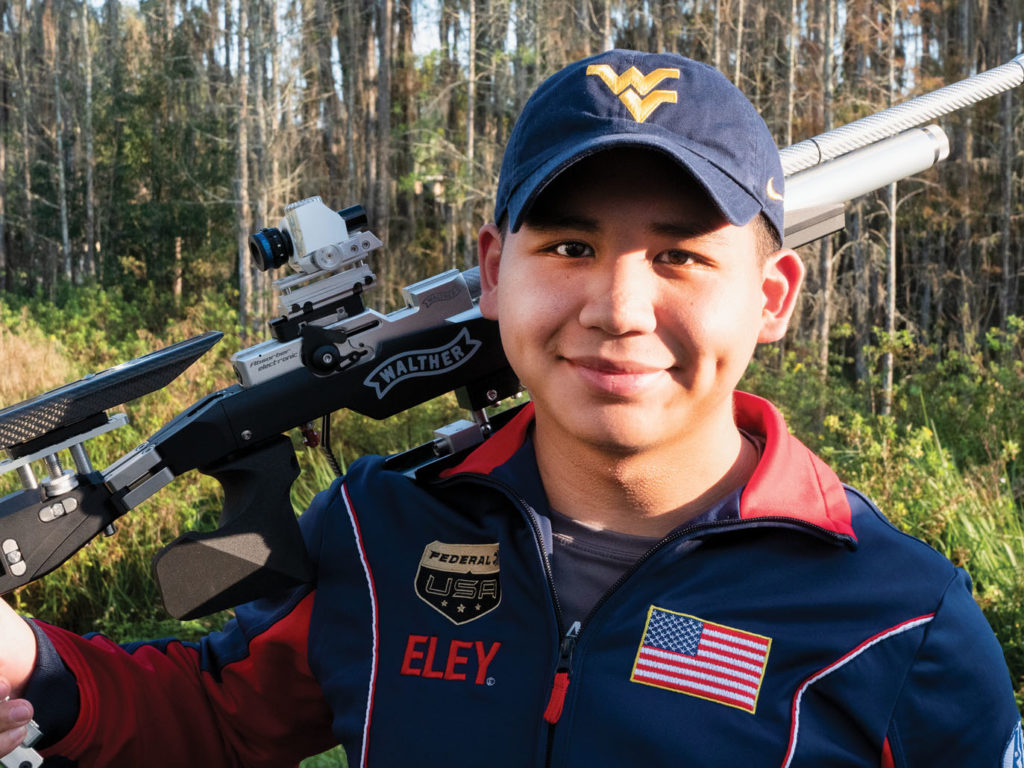
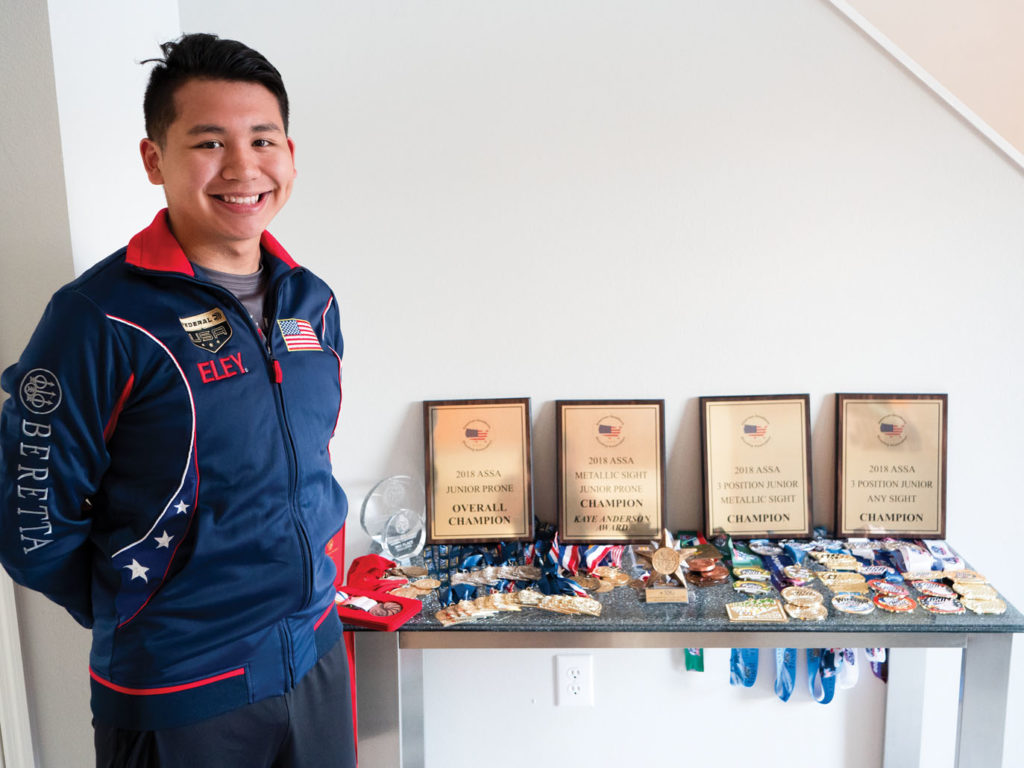
Wharton High senior Matt Sanchez has more than just Olympic dreams. Earlier this month, those dreams nearly came true.
Competing at the Air Rifle U.S. Olympic Trials Feb. 7-9 in Colorado Springs, CO, Sanchez battled against 16 of the sharpest shooters in the country, and briefly toyed with making the Olympic team, before falling four points short and settling for third place. He is instead the first alternate for the squad if either of the shooters who finished ahead of him can’t make the trip.
The top two finishers – 2016 Olympian Lucas Kozeniesky and University of Kentucky sophomore Will Shaner – will make up the U.S. Olympic Air Rifle team. As the first alternate, Sanchez will only go if either Kozeniesky or Shaner can’t make the trip to Tokyo for the Games, which run from July 24-Aug.9.
This Colorado Springs trip was the second part of the Olympic Trials. The first part was held last fall, and Sanchez actually entered the second part in seventh place.
“The top two people were way ahead of everyone, so it looked like they were pretty much going to make it,” Sanchez said.
However, the second-place shooter from Part I had a terrible first day, and Sanchez was excellent. Shooting at a target the size of a size 12-point font period from 10.94 yards away from a standing position, he scored a 627.5 (out of 654), and made a big move up to third-place overall. Sanchez made up four points on the first day, and needed to do it again the final day to possibly nab the second spot on the team.
“I didn’t expect to make the team, honestly,” Sanchez says. “But then, things got a little crunchy going into the second day. I thought if I shoot the same thing, I could make it into second place.”
Sanchez admits he may have been overthinking on Day Two, and he shot a 624.1, and finished four points behind second-place Shaner. Kozeniesky tied a world record on Day 2 with a 633.5.
“It was a little bittersweet, to be honest,” Sanchez says. “If it was a year ago, and I made third place, I’d be really happy — ‘Oh hey, I got third place at a national competition, I did really good’ — But, seeing that I was only four points away from making an Olympic team and getting to go is a little bittersweet.”
Being first alternate is still quite an accomplishment, especially for a 17-year-old balancing high-level national competition with graduating from high school. Sanchez already has signed a scholarship to attend college-shooting powerhouse West Virginia University in Morgantown in the fall.
Sanchez took his first shots at age 9 at a gun range in Las Vegas while visiting his grandmother. From those first eager moments, he has evolved into a finely-tuned technician. In most air rifle competitions, you fire 60 shots in a 75-minute time limit, not the steady rat-a-tat shooting at a range you might be more familiar with. It takes an amazing amount of precision and training.
Sometimes, your heartbeat or a vein is pumping enough to jostle your sights. Sometimes, Sanchez says you need to move the rifle off a vein, or shoot between heartbeats.
Boom…boom…click…boom.
“His biggest attributes are his patience and his attention to detail,” says Matt’s father Freddy. “He does everything at 100-percent maximum. He is a very patient individual. My patience gets tested just watching him.”
Sanchez, unlike much of his competition, doesn’t have the benefit of a college or Olympic facility at which to train. The nearest specialized facility is in Orlando, and he also travels to south Florida to train with his coach, 1996 and 2000 Olympic team member Jayme Shipley.
Otherwise, Matt’s training takes place at a makeshift and poorly lit set-up at his Heritage Isles home. His garage isn’t quite big enough, so while the target is set up on one of its walls, to get 10.9 yards away he has to open the door and shoot from inside the home’s foyer.
“It’s been a real blessing to see him progress to this level,” Freddy says. “To be able to shoot in the garage and get a spot as an Olympic alternate, I can’t ask for anything more. He has a college scholarship, pretty much a full ride, he’s a member of national teams, he travels the world – China, Korea, Germany, you name it.”
Freddy rubs his left forearm.
“I’m getting goosebumps just talking about it.”
Sanchez might be too cool for goosebumps, but he is now more homed in than ever on making the 2024 Olympic team.
By then, he’ll have had four more years of training, this time at top-notch facilities at WVU and the Olympic Training Center in Colorado Springs, and the memory of 2020 pushing him.
“I would have loved to make the Olympic team, but I’m happy with where I am right now,” Sanchez says. “This experience has really pushed me and given me a drive to be a really, really good shooter. I know I need to ensure that, at the next Olympic trials, I won’t miss making the team by a couple of points.”
Camille Albrecht, who teaches synchronized swimming at the New Tampa YMCA, embraces her former student Juliana Silva.
When Juliana Silva’s family first moved to New Tampa, she didn’t speak a word of English; all she understood was her love of the water.
“I’ve been in a pool since I was four,” says Juliana, now 17 and a former student at Benito Middle School and both Wharton and Wiregrass Ranch high schools.
Currently, Juliana lives in Moraga, CA, just outside of San Francisco, where she trains full-time with the U.S. Junior National Synchronized Swim Team.
After nine years on the Tampa YMCA Stingrays (TYS) competitive “synchro” team at the New Tampa facility, Juliana has her sights set on the ultimate prize: a 2024 Olympic gold medal.
“Juliana came to the Stingrays as an eager-to-learn, naturally athletic eight-year-old,” says TYS Head Coach Camille Albrecht, 30, who has sent several students to the national team.
Since Juliana didn’t understand English at the time, Albrecht would use hand motions to demonstrate the correct techniques.
“She picked up all the synchro words and English very quickly,” said Albrecht, who described Juliana as a “joy to coach, always cheering everyone else on.”
Although Juliana was born in Indianapolis, IN, her family (mother Susana Barrios, father Rafael Silva and brother Leo Silva) moved to Venezuela and Colombia shortly after, returning to the U.S. in 2011.
“I’d always heard that Tampa was a great city,” says Susana. “Before we moved here, I visited friends who lived right across the street from Hunter’s Green, and I totally fell in love with the area.”
Athleticism comes naturally to Juliana. Her brother, now 19, started soccer at five, and their father was a former amateur champion and professional tennis player.
All Juliana wanted to do at first was stay home, so her mother decided to get her out of the house by signing Juliana up for swim classes at the Y.
“She looked at me on the way to that first class and said, ‘Okay Mom, I’m going to try this once, but if I don’t like it, I’m not going to do it,’” Susana says.
A month later, Juliana began training with Albrecht, kickstarting her dreams of Olympic gold.
Building A Track Record Of Excellence
At age 14, Silva placed sixth in her very first Regional “zone” meet, qualifying her for the National meet. It took three attempts to make the junior national team, which she did by placing 16th in the nation.
“Before that, I was hard on myself,” Juliana says. “I told myself I’d never make it, that this was just for fun. But making it to Nationals was an eye-opener.”
Susana says she began saving money for the pricey gear required for her daughter’s national competitions, including single swimsuits that could cost $200 apiece. She served her daughter meals and did her laundry while Juliana powered through a grueling training schedule, before and after school and on weekends.
“My mom supports me to the max,” Juliana says. “She’s the one who’s always pushed me to do this — the reason I joined synchro in the first place is because she was tired of me being in bed, watching Netflix and getting fat!”
In California, Juliana trains from 7 a.m.-3 p.m. every day except Sunday and spends four hours each evening online for academic classes.
“It’s like a robot routine,” admits Juliana, who lives with two other teammates and a host family in California. “You wake up, eat breakfast, train, shower, do homework, eat dinner and repeat. If I lay in bed in the morning and think about it too much, I won’t get up.”
Juliana also says that if she hadn’t struggled to qualify for Nationals at first, she would never have made it this far.
“My numbers, and knowing I could do better, motivated me,” she says. “Just wanting this won’t get you anywhere. You have to put in the action.”
Juliana’s team will begin its Olympic training after the Junior World Championships in August, as the team members aim for Paris 2024.
Susana, who graduated law school at 22, encouraged her daughter to pursue her Olympic dreams and return to college later, reasoning that Juliana will still be plenty young when she “retires” from competitive swimming.
“I don’t want synchro to be my whole life, because when I retire, I want a career to back me up so I have somewhere to go,” says Juliana, a high school junior who’s interested in forensic science.
She says she misses everything about Tampa, especially her family and friends, her own bed, and the “heat and humid air,” which she says is easier on her eczema, a skin condition that she says is aggravated by swimming in chlorinated water.
“My kids are truly Floridians, and we all think of Tampa as home,” Susana says. “Everyone here was so supportive and friendly when we moved in; my kids were invited to sleepovers a week later.”
Susana says that she will always be grateful for the New Tampa community and particularly the New Tampa YMCA, which twice assisted Juliana via the Y’s Open Doors sliding scale program, without which lessons would have been unaffordable for the family.
When a spot on the national team opened up, Juliana’s family had one week to decide if she would take it.
“I told her it was her decision, and she told me, ‘Mom, I’m ready, I’m going,’” says Susana. “When I realized she’d be in a big city without me, I struggled, and of course, I miss her. We’re very close, she’s my baby. But I’m happy.”
Truly One Of Our Own!
Juliana says she is very excited about the possibility of one day representing New Tampa in the Olympics.
“When I got here it was unreal; it took me a while to realize that I’m actually here, that I made it, that this is my spot,” she says. “It feels amazing to know that you have a lot of people supporting you and even looking up to you.”
Susana says she remembers watching, along with Juliana and her grandmother, Michael Phelps’ family celebrate his victory in the 2016 Olympic Games.
“Juliana turned to her grandmother and asked her if she was ready, and my mother asked, ‘Ready for what?’ And Juliana said, ‘That’s gonna be you, I’m gonna take you to the Olympics!’”
“If my daughter says she’s going to the Olympics,” Susana continued, “she will be there.”
For more information about the Tampa YMCA Stingrays, visit TampaYMCA.org or call Camille Albrecht at (813) 785-7092.