
Protests Hit Close To Home For Some

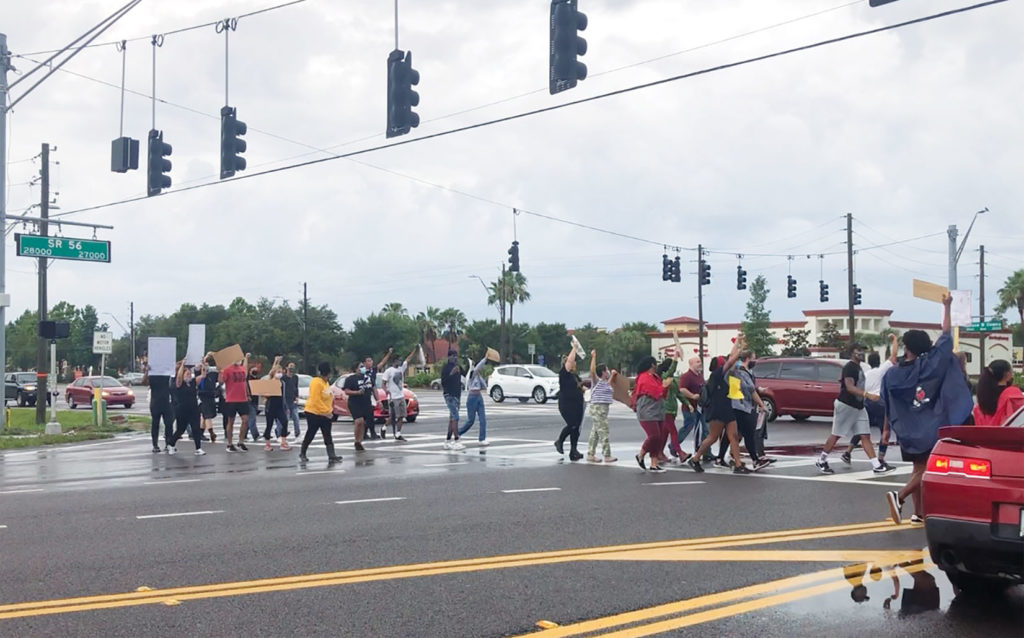
While there weren’t any protests in New Tampa, just a few miles up Bruce B. Downs Blvd. in Wesley Chapel, a hundred or so people gathered to make their voices heard. 
(Photo courtesy of Susan Boyle)

State Representative Fentrice Driskell says she has lived with racism her entire life, but not nearly as long as her parents Joel and Terry did growing up in the segregated south.

As the country continues to boil from the weeks of protests and marches following the death of George Floyd while in police custody on May 25, it is her parents’ optimism that fills Driskell, the State Rep. for District 63, which includes New Tampa, with high expectations for the future.

This time, she says, it feels different. It feels lasting. It feels productive.

“The hope and optimism they feel is wonderful,” Rep. Driskell says of her parents. “They are so excited that in their lifetime, they may actually see the realization of the dream that Martin Luther King was fighting for.”

While none of the local protests and marches took place in New Tampa, there was one a few miles north outside of the Shops at Wiregrass, as well as a few miles to the south, in the University of South Florida area along E. Fowler Ave.
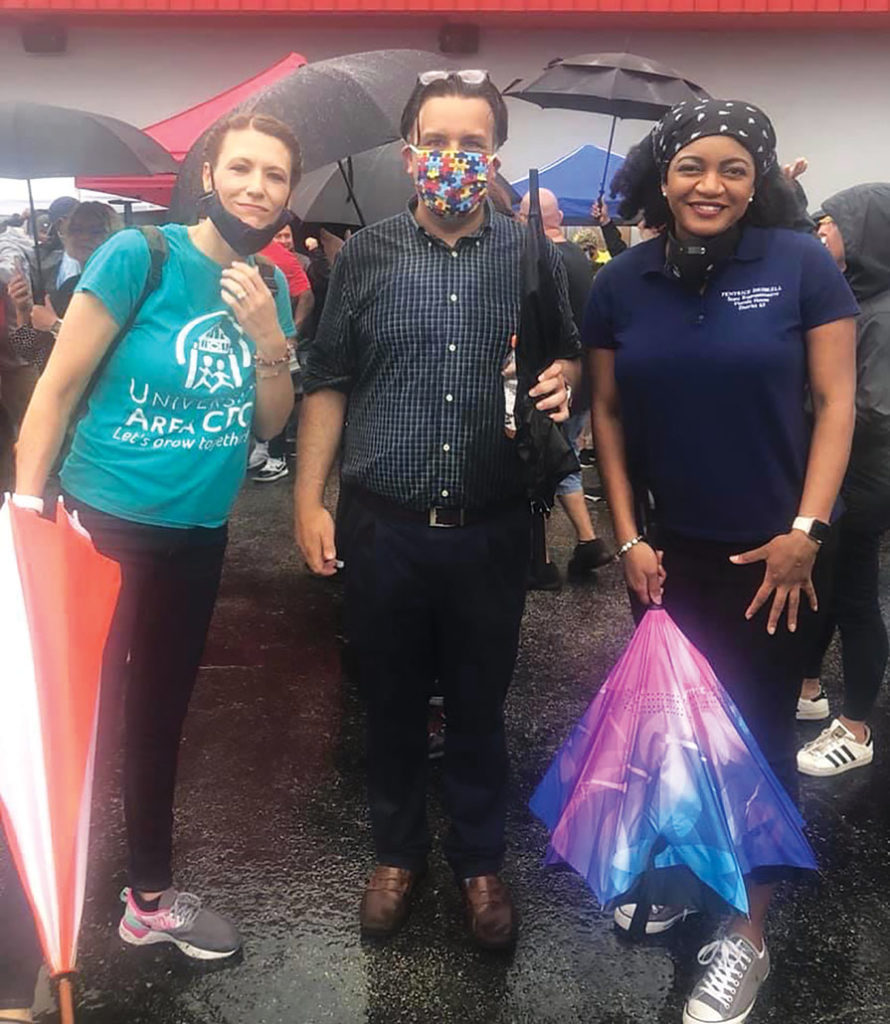
(l.-r.) Richmond Place resident and CEO of the University Area CDC Susan Combs, Tampa City Council member Luis Viera and State Rep. Fentrice Driskell participated in a prayer walk organized by the Crossover Church on Fowler Ave.

What started as a visceral reaction to the death of Floyd beneath the knee of a Minneapolis police officer has grown into a larger conversation on racial injustice in America.

 “This has gotten everyone’s attention,” Driskell says. “I think this is the greatest chance that we’ve had since the civil rights movement (of the 1960s) to make some positive changes.”

* * *

The rain poured down on Susan Boyle and her daughter Emma on June 6, but it did not deter them as they stood at the intersection of S.R. 56 and Bruce B. Downs Blvd. in Wesley Chapel, taking part in their first-ever protest together.

Like many in this country, Susan, a Meadow Pointe resident, was overcome by the images on television — the death of Floyd, the massive crowds that protested his death — and felt like she wanted to do something. 

“It was heartbreaking seeing Mr. Floyd killed on TV while I watched,” Susan said. “I wanted to be part of the group saying ‘Enough is enough.’” 

So, she and Emma, a junior at Wiregrass Ranch High, stood in the rain. They sang songs of protest. They moved from corner to corner at the intersection, along with 100 or so others, many waving homemade signs, others just waving their hands, and with everyone chanting various songs and slogans.

She said the experience was overwhelmingly positive from passers-by. One driver, stopped at a red light, even reached out to hand her an umbrella before speeding off.

The unpleasant weather did little to dampen their enthusiasm.

Susan is like many people in this country – aware there was a problem, but unsure of what if anything, she could do about it. But, she said we would go to another march if one was held nearby, and will get more involved.

While she has seen her fair share of arguments over the merits of going to a protest on social media, she said there is something almost spiritual about being amongst people of all different colors and ages fighting for the same thing, and for the right thing.

She can’t help but feel she is watching what she thinks might be a transformational moment in our nation’s history.

“There is a tipping point when you see that people are starting to get behind an actual movement, instead of just a few days of lip service and then on to the next disaster,” she says. “When it started gaining traction, it was heartening to me, but I’m also prepared to be devastated if nothing changes. If nothing changes, then this country can’t change.”

*** 

Dean Reule, the pastor at Cypress Point Church on Morris Bridge Rd., says the murder of Floyd “both breaks and awakens our soul.”

In a written statement, he urges people, particularly those who are white, to be humble, not defensive, and to be informed.

“Please do not look away,” he writes. “Don’t minimize racial stereotyping, racial bias and justice issues. Research and study and pray with an open mind and heart. Genuinely seek to learn, opening yourself to better understand the experiences of those different than you.”

That is something Tampa City Council member Luis Viera, whose District 7 includes New Tampa, has preached long before protests, marches and riots took over large swaths of the country.
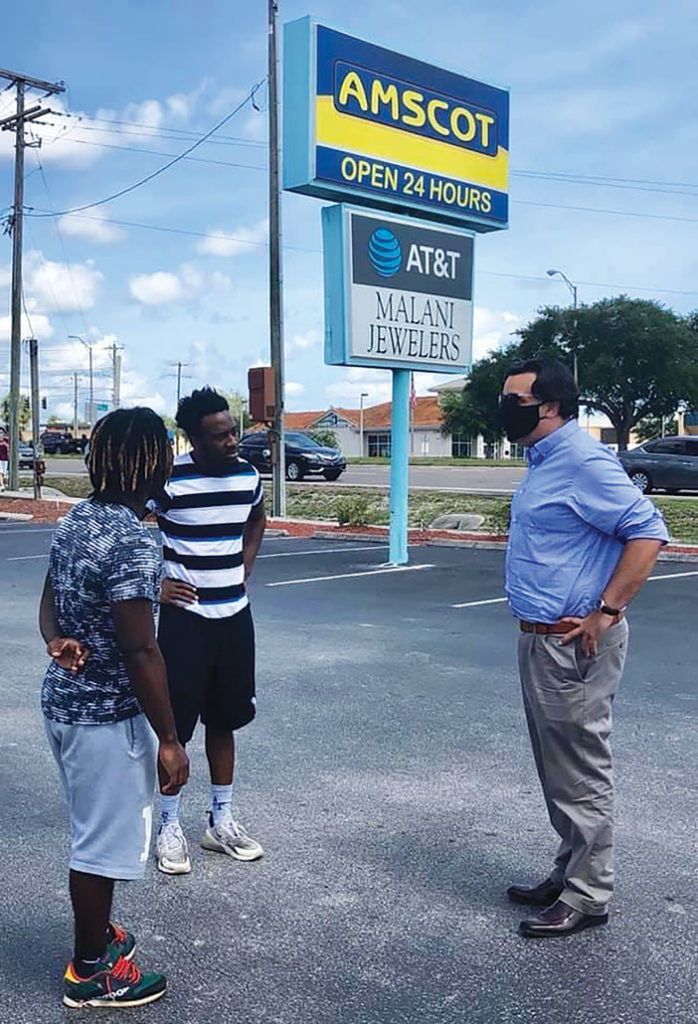
While the protests over Floyd’s death weren’t as acute in Tampa as they were in other bigger cities, Viera says it has still opened many wounds.

Viera (left) was critical of violent protesters and looters who hurt many of the local businesses along E. Fowler Ave. and Busch Blvd. – both areas in his district — on May 30, but praised the efforts the following day, when those who actually live in the community gathered to clean up. Viera was joined by Tampa Mayor Jane Castor in meeting with residents to listen to their concerns.

“I’d say this issue is a challenge to us all,” Viera says. “No matter where we live, we all have a duty to act. We need to build bridges and make historical wrongs right. I think you can feel a sense of urgency on the part of people.”

Viera and Driskell marched together on June 6 with congregants of Crossover Church on Fowler Ave. and community members to the site of some of the burned buildings to pray for racial justice and peace, as well as deliver gift baskets to the business owners hurt by the looting.

The two elected officials are are also working together on efforts to build a memorial for victims of lynching in Hillsborough County.

To find racial harmony, Rep. Driskell says it will require “uncomfortable conversations.”

And, for the first time in her lifetime, she feels both sides are ready to finally have them.

“I hope that everyone would know and feel and believe that they have something to add to the conversation,” Driskell says. “It really is going to take everybody in the community to come to the table and have those tough conversations. But, I am absolutely optimistic it can be done, and I feel activated and energized and proud that so many people are ready for it.”

New Tampa Mosque Town Hall Meeting Focuses On Big Issues

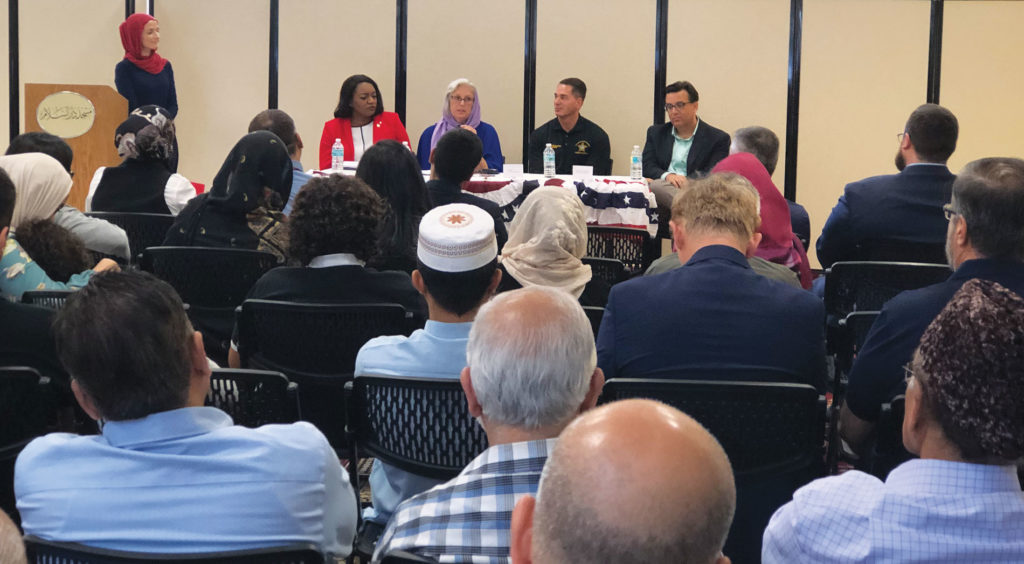
A town hall at the Daarus Salaam Mosque in New Tampa on Sept. 21 drew a crowd of roughly 100 people, with topics ranging from the need for a traffic light to healthcare and gun safety.

Luis Viera’s New Tampa town halls are generally hyper-local affairs.

The District 7 Tampa City Council member (and usually a guest or two) are asked about things like Kinnan-Mansfield, traffic along Bruce B. Downs, new additions to our local parks and everything from a pothole over there to a slow light over here.

On Sept. 21, however, Viera’s town hall, in conjunction with the Islamic Society of New Tampa, at the Daarus Salaam Mosque on Morris Bridge Rd., just north of Cross Creek Blvd., broadened the councilman’s normal town hall fare.

Along with a few questions about traffic safety near the bustling mosque, especially in the mornings where more than 100 children are headed to school near busy (and narrow) Morris Bridge Rd., the conversation circulated around such weighty topics as religious and social tolerance, affordable housing, gun violence, school funding and healthcare.

“I thought it went really well,” Viera said. “I thought there was a lot of energy and people seemed enthused to be there.”

The town hall, moderated by CAIRFlorida’s Aida Mackic, was Viera’s 14th in the North Tampa district he represents. It included a wide spectrum of guests, which likely prompted some of the larger-issue questions. Fentrice Driskell, the Florida House District 63 representative (which includes New Tampa), Hillsborough County District 7 (county-wide) Commissioner Kimberly Overman and Hillsborough County sheriff Chad Chronister all joined Viera on the panel.

“My heart is bursting with pride to be here,” Driskell told a crowd of about 100. “I’m so excited, but I’m trying to play it cool.”

It was a predominantly Muslim crowd, but Viera said those who worship at the mosque and live in the area are an important part of the community.

“Potholes hold no party or religious affiliation,” Viera said. “A pothole annoys the Southern Baptist as much as it annoys the Muslim.”

As you might expect from a predominantly Muslim crowd, there were concerns raised about Islamophobia, guns and the protection of the mosque. 

Dr. Adel Eldin, MD, a Brooksville cardiologist, laid out a laundry list of items mosque members would like to see from its elected officials — yellow lights to slow down traffic in the morning as children make their way to school, better fire rescue service and for the mosque, which has a Thonotosassa addressed in unincorporated Hillsborough County, to be incorporated into the City of Tampa so it could be on the city’s sewer system.

Along with the recent Islamic Society of New Tampa purchase of six acres of land adjacent to the mosque for expansion, Eldin said his list of requests were critical.

Safety From Violence

But, the safety of worshippers was on his mind as well. He thanked Sheriff Chronister for increasing patrols after shootings of Muslims earlier this year in New Zealand, but also said he would like to see a deputy on site in the morning when the children are vulnerable.

Chronister sympathized with many in attendance. 

“There are 4,000 members of the sheriff’s office that want to make sure no one has to live in fear,” he said. He drew one of the loudest ovations of the afternoon when he added, “You should be able to worship in peace, regardless of your faith.”

That led to a discussion about gun control, namely the dangers posed by access to assault rifles, as well as a 12-year-old in the crowd suggesting lawmakers focus on the mental health issues of students who suffer from harassment and fear of bullying in schools.

“This is a community concerned about tolerance and safety a bit more acutely than other folks,” Viera said.

Driskell tackled questions on the lack of education funding, one of her primary interests as a legislator. “I am ready…give me the ball!,” Driskell said when the first question about education was asked.

A product of local public schools (Lake Gibson in nearby Polk County) who went on to graduate from Harvard, Driskell said more help — both financially and in the classroom — needs to be provided to teachers across the state in order to retain them. She said she watched the joy of teaching fade from her mother after a 35-year career in the classroom.

Since being elected last November (beating incumbent Shawn Harrison), Driskell said that she has witnessed first-hand just how tough that fight for more funding for public schools can be. 

“I don’t like to make things partisan,” she said, “but I think 90 percent of the time in state legislature, we agree on most of the issues and most of the bills we vote on will pass through unanimously. But, for whatever reason, public education has become so highly politicized. It falls into two camps: those who favor public schools, and those on the side of charter schools and vouchers for private schools.”

Driskell said she is not necessarily against charter schools or vouchers, “but not at the expense of public schools.”

Overman and Hillsborough County District 3 School Board member Cindy Stuart, who was in attendance, also said more funding was central to fixing what ails schools and their teachers, but the answers may have to come from the community.

Chronister agreed. As the vice chair of the Citizen Oversight Committee for the education referendum that passed last year, Chronister touted many of the school projects that the $23 million raised by a the new one-cent sales tax that are making things better for students and teachers.

Affordable healthcare, affordable housing and building a stronger community also were touched on in the wide-ranging, two-hour forum, and at the end, Viera said it accomplished what he had hoped.

“I do it because I think it’s important,” Viera said. “There were a lot of legitimate concerns, not paranoia, raised, and addressing them and showing that their local politicians have their backs makes the community stronger and better off.”