

“Leadership Has A Cost…Your Own Self Interest. Rise Above It, Lead From The Front & Get Things Done.”
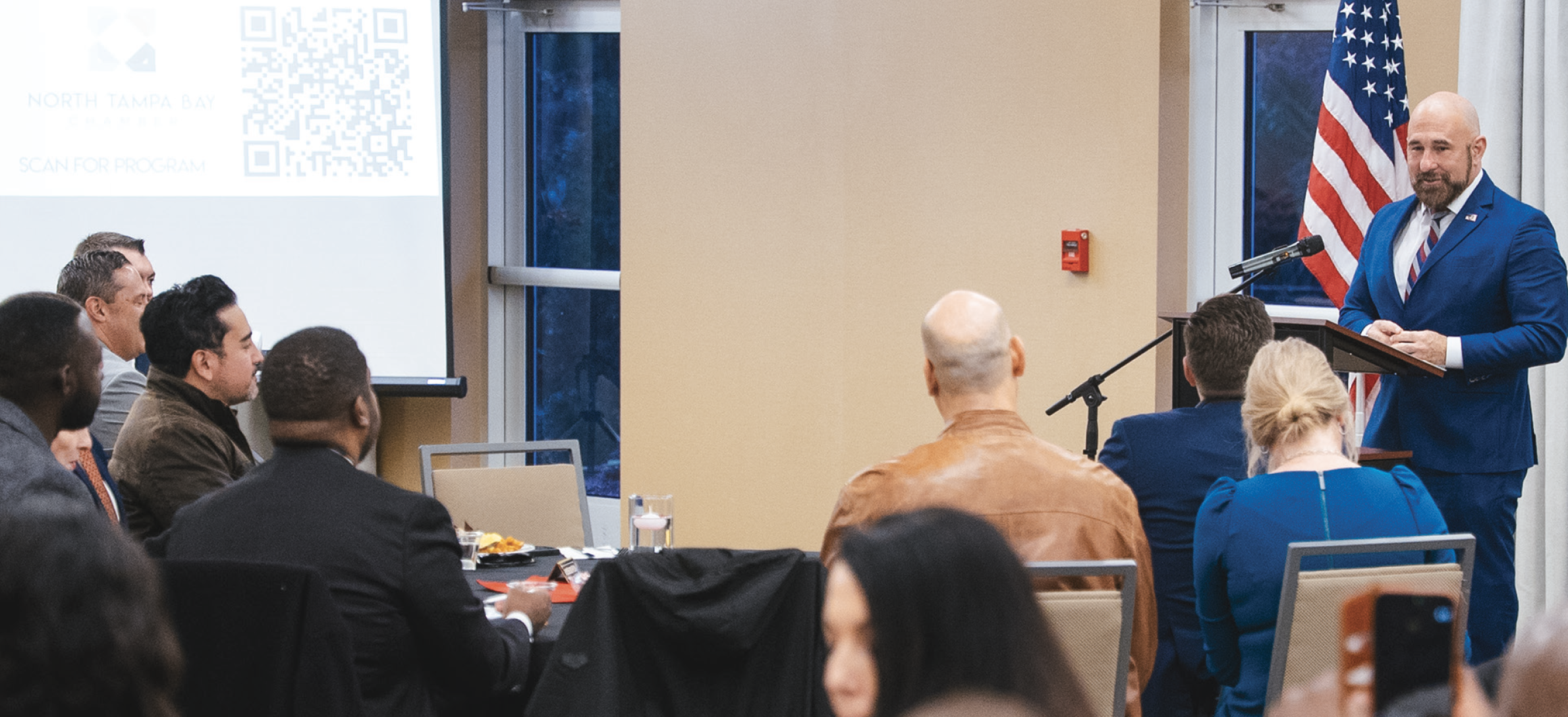
No matter which side of the political aisle you may be on, if you sit and listen to Florida’s 49-year-old Lieutenant Governor Jay Collins speak, you can’t help but be impressed with him. He has had a 23-year career in the U.S. Army and has served as a medic and parachutist in the Army’s elite Special Forces Green Berets corps twice — qualifying the second time after having his leg amputated.
He’s been shot, “which I do not recommend,” performed surgery on himself on the battlefield, has been awarded a Purple Heart, a Bronze Star and numerous other military medals and his story — and his life — could have ended with his military service, during which he met his wife Layla, who had a 20-year military career as a counterintelligence agent.
Instead, he entered Florida’s political scene four years ago, when he was elected to Florida Senate District 14, defeating the incumbent Democrat Janet Cruz for the seat.
The father of two boys ages 13 and 10 served for almost three years in the State Senate and passed 55 bills during that time. “I passed more bills in three years than many in the State Legislature do in eight,” he told an enthusiastic crowd of more than 100 North Tampa Bay Chamber (NTBC) members at the NTBC Business Breakfast on Feb. 3, at the Hilton Garden Inn Tampa-Wesley Chapel.
Then, in August 2025, Governor Ron DeSantis appointed him as Florida’s 21st Lieutenant Governor, replacing Jeanette Nuñez, who had resigned in May. Collins may not be the favorite to win the Republican nomination for Governor of Florida in the upcominh 2026 midterm elections — he currently trails far behind Rep. Byron Donalds (who recently received U.S. President Donald Trump’s endorsement) and Gov. DeSantis’ wife Casey (who has not yet declared she is running) — but with more than a third of registered Republicans still undecided (and more than half undecided if Casey DeSantis ends up choosing not to run), it’s still anyone’s race. But, whether he has a chance to win the nomination or not, Collins definitely captivated that room.
He spoke confidently about his plans to improve upon the record of DeSantis, who he said, “has led the nation. He has put a lot of things together. While other states have raised taxes, over-regulated businesses and chased jobs away, Florida has chosen a different path. He’s focused on freedom, responsibility and opportunity. Florida is now the strongest state economy in the country. We lead the nation in new business formation. Our workforce continues to grow. Families and employers are choosing Florida and that success is especially visible right here in this region. People want to be here because we have opportunity. You’ve got the government out of the way as much as possible.”
Even so, Collins acknowledged, “That doesn’t mean we’re exactly where we need to be, but we’re on the right path.”
He said he had recently attended the opening of a health care innovation lab in downtown Bradenton that is doing implants that get rid of metal and use absorbable material, “so it goes right in and grows bone — safe, not causing scabs or abscesses. That’s going to change people’s lives by eliminating the need for at least one surgery.
“The number one killer of people in health care is sepsis. The less you have to open somebody up, the less susceptible they are to sepsis. If we can stop that, we stop or lower health care costs, and some of the frivolous or excessive lawsuits at the back end, further dropping health care costs.”
Collins added that he shared that story, “because that was one person who had a dream to build something great, came here to Florida, started a business and will now inject hundreds of millions and, at some point, billions of dollars into our local economy.
“And that is what each and every one of you do every day. It just takes one moment for something to catch like wildfire and change how we do everything.”
He then moved on to one of this year’s most discussed proposals being considered by the state legislature — reducing or eliminating property taxes.
“Show of hands,” he said, “how many of you would like to have your homesteaded property free and clear of property tax?” (Everyone raised their hands.)
“But now,” he continued, “how many of you have concerns about how that would affect our education, our roads, our firefighters and our law enforcement?” (Again, most hands went up)
“Well, let me tell you something,” Collins said, “in this state, we are not going to put at risk our law enforcement or our firefighters. I would rather jump in front of a moving car than hurt the people who serve our communities. I would give my last full measure to protect our people. We will stand with our men and women of law enforcement and fire. We will not allow our cities or counties to underfund or cut that. It’s the same with roads and education.”
He noted that although people usually assume his kids go to private school, “My kids go to public school in Hillsborough County, just down the road from my house. A rising tide floats all boats.
“We have school choice in Florida because we understand that the money should follow the kids. It’s not the government’s money. It’s the people’s money being utilized to help provide something common to all — and we hold them accountable for those reasons. But, I also know that 85% of people will almost always go to public schools. And the right thing for my kids is that school just down the road, where they have their friends. I want my kids to be successful. I want them to have every opportunity to blow what I’ve done out of the water, to make my name irrelevant. That is what I dream on. So believe me, we’re going to protect those exact things.”
The Unknown Property Tax Fact
The thing Collins said that raised the most eyebrows was about just how much of Florida’s property tax revenue comes from homesteaded properties. “Less than 30% of the money that comes from property tax comes from homesteaded properties,” he said. “That’s a shockingly low number. Now, some counties are higher, some are significantly lower — and I’m sure you can probably formulate which ones go that way, but that’s manageable. It’s solvable.”
He then asked, “How many of you have seen your property value go up every year, from a tax standpoint? Has anybody had theirs go down repeatedly? I’ve never had anyone who said that and I’ve asked it a hundred times.
“How many of you have had millage rate increases as well?,” Collins added. “You’re getting hit twice. It’s getting wider, because you’re paying more, and it’s getting taller because of the millage increase.
“Now, ask yourself this simple question. Have you seen that exponential increase over the last ten years positively impact your education, roads, fire or law enforcement? Do they have more time, tools and training?
“If the answer is decidedly ‘no’ — which it has been everywhere I’ve gone — where did that money go?
“Friends, I am not here to pay more taxes. Lord knows, I put in time for what I get. I probably get about seven cents an hour as Lieutenant Governor — and I am grateful to do it. Please don’t think I’m whining. I’m just making fun of the system we’re in sometimes.
“It’s fascinating. We have to solve that — hold people accountable. What we’re doing with DOGE (the Dept. of Government Efficiency) in Florida is significant, but we have to lock that in and make sure the (city and county) governments follow through, that we’re holding them accountable.”
He also said that, “I’m frustrated that we have allowed the affordability conversation to focus just on saving our way to success.
“Friends, this is America, this is Florida. I expect us to lead, to dream boldly, to draw in more life-changing industry — to raise our salaries as part of that story. I don’t want my kids to make what I made someday. I want them to have so much more. We have to be dedicated to that.
“We can talk about property tax, but we have to draw in more businesses and get the government out of the way.”
Impact Fees & Permitting Issues
Collins was a little surprised that only a couple of people in the audience, including NTBC Board chair Tony Benge (see pg. 3) — who introduced Collins — were in real estate development.
“How many of you who are in development deal with impact fees? How about permitting? How many of you have bought or built homes and had a permitting crisis you had to deal with?
“There are two things right now that I believe we can lever and fix when it comes to home affordability. One is impact fees. They seem to just be levied left and right. Some counties are really great at it and some are less than stellar.
“Either way, it’s going right back to the consumer. We have to reward people and let those fees come back the appropriate way, but there’s got to be a lot of commonality and common sense.
“When it comes to permitting, I’ve gone through this as a business leader. I’ve gone through this personally when I built my home, but there has to be clarity and accountability in how that’s done.
“We have a building code that works. I worked in disaster management for many years. I was there everywhere lives were impacted by hurricanes and I would see a slab, a slab and then three homes almost completely unfazed by the same hurricane. [That means] our building code works, if we can get them there. We, as a state, have to do more from a resiliency, a power side, without spending ourselves into oblivion.
“Your individual amount that you owe to state debt is about $200. But, let’s compare that to the federal government, where it’s $126,000 per person. We have paid down 50% of our debt as a state over the last six years. We are balancing and lowering our budget every single year. Our reserves are maximized and yet, we’re still dropping them down more and more. That is what fiscal leadership and prudency looks like as a state. We have to maintain what we do.”
Before opening his appearance up to the floor for questions, Collins closed with, “In our state, I don’t believe the past is our best. I think the best lies ahead of us. I’m an optimist. I believe in our people. I believe in getting government out of the way so businesses can thrive and more opportunities can exist.”
And finally, Collins asked a question of his own: “Tell us what you see, what your problems are. The simple fact is that, as a leader, I can’t solve what I don’t know. I listen to Ronald Reagan a lot. I love how he spoke to the people and he solved problems. I love his approach.
“To paraphrase him, ‘If the government thinks they have a solution, you should be afraid…very afraid.’
“Please work with us. We need business leaders from the Chamber and from the community, to help us understand where the rubber meets the road. How that impacts lives and how we can solve [problems], to really create solutions.
“And, as a former legislator, I can tell you that, of the 55 bills I passed, probably three quarters of them came from the community in some way, shape or form, because we worked with them. We solved those functional problems on the ground and they improved. That’s good work. That’s good government. That’s how we work together.”
Answering Questions
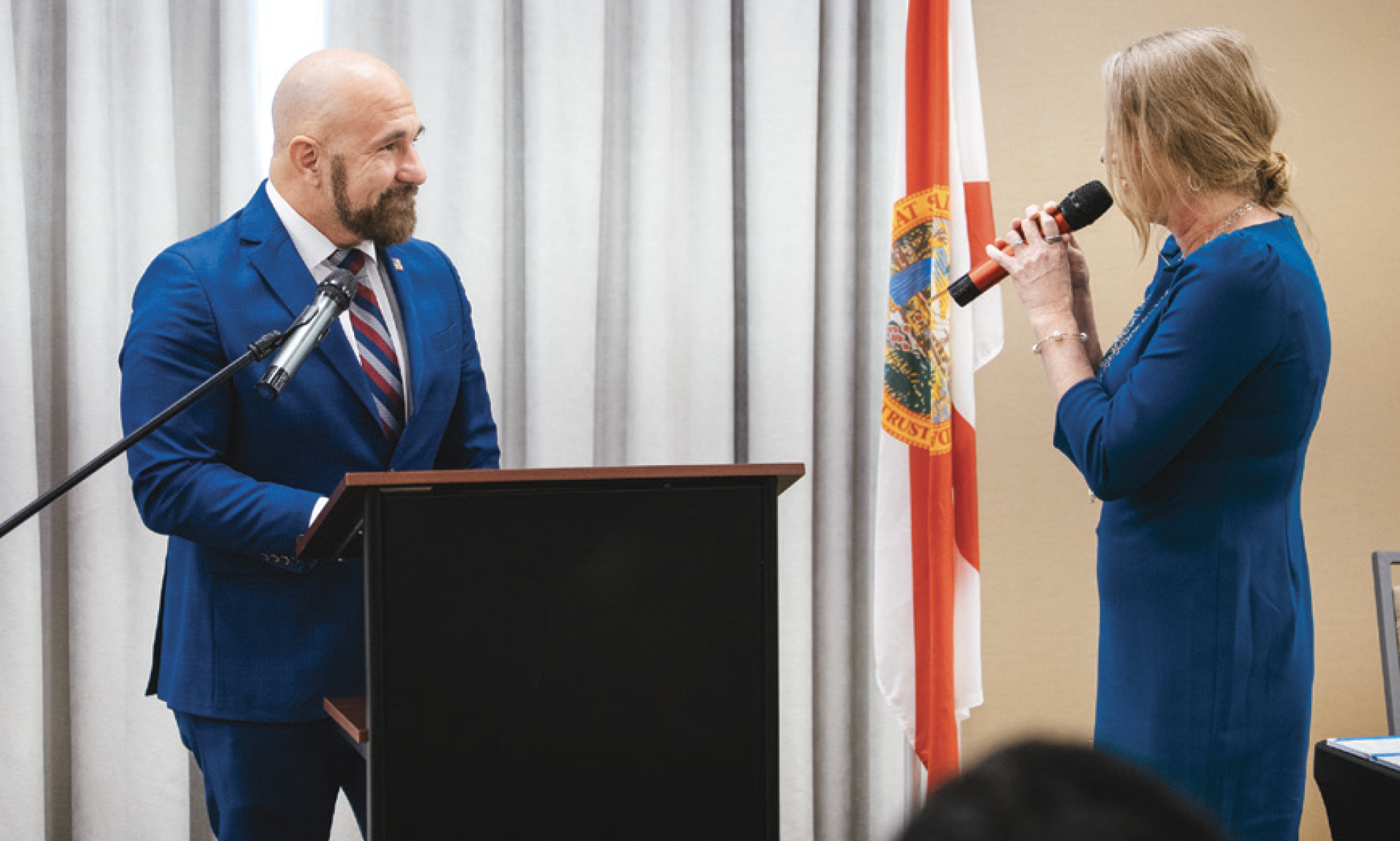
Collins then took a number of questions, the first from Ryan Quattlebaum, the CEO of AdventHealth Wesley Chapel, who asked, “As we continue to hire, recruit and retain doctors into the state of Florida, what do you see you can do to help us continue to attract and retain physicians to Florida?”
Collins responded that Florida, “needs more medical schools. I also know that every doctor we talk to says they are hemorrhaging people at the three-to-five-to-seven-year mark because they’re tired of litigation. They’re tired of the games. They’re tired of being told to write their SOAP (Subjective, Objective, Assessment, and Plan) notes in a specific way to fit into an insurance algorithm. Those are systemic issues we have to solve.”
Next up was NTBC Board member Jamie Hess, the owner of Computer Emergency Room, who told Collins that the Chamber was looking into incorporating Wesley Chapel as its own city, “but we put it on hold because of the property tax issue. What do you think, realistically, is the forecast to get the homestead property tax reduced or eliminated this year?”
Collins responded, “If I were Governor, I’ll tell you what I would do. I would call a Special Session so you have everybody there. I do think you can get full property tax relief for homestead properties [because] the math plays out.
“But, for those who may not know how the system works, you’ve got to pass identical bills — within a 98% margin — in both the House and the Senate, and then have the Governor sign it.
“And, because [incorporation] would have to be a constitutional amendment, it’s then got to go on the ballot and it’s got to get 60% of the people to vote for it.
“Friends, there are times when it’s hard to get people to agree that we should even have a 60% level. It’s going to cost, at a minimum, $15- $25 million of advertising to understand what its going to look like.
“But again, on property taxes, if there’s more than one thing on that property tax [bill], it’s 100% going to fail. But, I think it’s pretty likely that we get this, but where it ends up on the spectrum, that variability, I think you’ll know, probably within a month or so. But yes, it’s very doable, very manageable.
“I know the Governor pretty well and, when he lays out his plan, it will be very detailed. You have to get ahead of the system to make sure people don’t move the money, don’t revenue taxes, and don’t just create another bureaucracy, instead of solving a problem.
“I know pretty well where the Governor is at on this and I will not be part of anything that’s going to cut services. I will not do it.”
Collins also answered a question from Primrose School of Wesley Chapel owner Rob Fitzpatrick about Florida’s insurance crisis and one from yours truly about holding private schools that accept school vouchers to the same standards as public schools. He also addressed a question from Benge about the lack of accountability on the part of local governments regarding impact fees (see the Editorial on pg. 3 for more on this topic).
Very interesting stuff, Mr. Collins!