
New Tampa Will Help Decide City Council Runoffs Apr. 25!

Candidates on the April 25 City of Tampa City Council Runoff Election ballot include  (l.-r., above) Dr. Sonja P. Brookins vs. Alan Clendenin in District 1, Robin Lockett vs. Guido Maniscalco in District 2 and (below) Janet Cruz (left) vs. Lynn Hurtak (right) in District 3. 

In March, Tampa Mayor Jane Castor easily defeated a write-in opponent and New Tampa’s District 7 Tampa City Council member Luis Viera was re-elected without opposition to serve four more years, but that doesn’t mean that New Tampa residents have no reason to go to the polls for the City of Tampa Runoff Election on Tuesday, April 25. 

In fact, Viera says that much more important than who you vote for is that you need to get out and vote. He says that no matter how hard he is willing to fight on City Council to fulfill — and fund —New Tampa’s needs, our community’s usually lower-than-the-rest-of-the-city voter turnout makes it harder for him to get things done. 

“New Tampa has traditionally been considered somewhat apathetic when it comes to voting and that does make it harder for me to get other Council members to support the needs of this community.”

The numbers bear out Viera’s claims of voter apathy. In the 2019 Municipal Election, which included a hotly contested race for Mayor, the citywide turnout was 20.56%, but in New Tampa’s 17 precincts, it was only 16.8%. In the Runoff Election in Apr. 2019, which included the mayoral runoff won by Mayor Castor over David Straz, the turnout was even higher — 23.2% citywide and a reasonable 18.5% across New Tampa’s 17 precincts.

In this year’s Municipal Election, where Castor faced only write-in candidate (and New Tampa resident) Belinda Noah (whose name did not appear on the ballot), the citywide turnout was only 13.65%, but the turnout in New Tampa’s 21 precincts was less than half of that, at only 6.5%.

Viera says that despite the fact that there are only three citywide City Council seats — Districts 1, 2 and 3 (plus the District 6 runoff between current Dist. 2 Council member Charlie Miranda and Hoyt Prindle) — being contested at this year’s Runoff Election, he expects a citywide turnout of about 12%. 

Viera says it would be great if New Tampa could beat that percentage at the runoff, and he says everyone should check out the campaign websites and social media pages of each of the six candidates shown on this page and cast votes for those who seem to best align with their own political philosophies.

Here’s a quick rundown of the three races in which New Tampa is eligible to vote:

District 1 — Dr. Sonja P. Brookins vs. Alan Clendenin

Dr. Brookins, a long-time educator, has served two years as an elected supervisor with the Hillsborough Soil & Water Conservation District and has been endorsed by the Democratic Progressive Caucus of Tampa Bay. 

Clendenin, who has served in multiple positions for Democratic committees (including first vice chair of the Florida Democratic Party), was a long-time air traffic control professional. He has been endorsed by the Tampa Bay Times, La Gaceta and Creative Loafing newspapers, the Tampa Police Benevolent Assn. and Tampa Firefighters 754 union, New Tampa’s State Rep. Fentrice Driskell, the Sierra Club and LGBTQ Victory Fund.

District 2 — Robin Lockett vs. Guido Maniscalco

Lockett is the former president of the Hillsborough Democratic Black Caucus who has been a regular advocate for vulnerable people at City Council meetings, as well as an organizer with the Florida Rising progressive social advocacy group. She has been endorsed by Creative Loafing.

Maniscalco, the two-term Dist. 6 Council member (and current vice chair) who is running in Dist. 2 because of term limits, has been endorsed by the Tampa Bay Times, the Greater Tampa Realtors, Tampa Firefighters 754, the Sierra Club and Equality Florida.

City of Tampa City Council Runoff Election District 3 Candidates Janet Cruz (left) vs. Lynn Hurtak (right) in District 3.
District 3 — Janet Cruz vs. Lynn Hurtak

Cruz, the former State Sen. who lost a tough race to Jay Collins in Nov., has been endorsed by the Tampa Bay Times, Mayor Castor and former Mayor Bob Buckhorn.

Hurtak, the Dist. 3 incumbent, has been endorsed by Creative Loafing, La Gaceta, Florida LGBTQ+, Florida Rising, the Tampa Bay Progressive Caucus and Muslims for Democracy & Fairness.

Viera Takes It To The Streets To Address Concerns

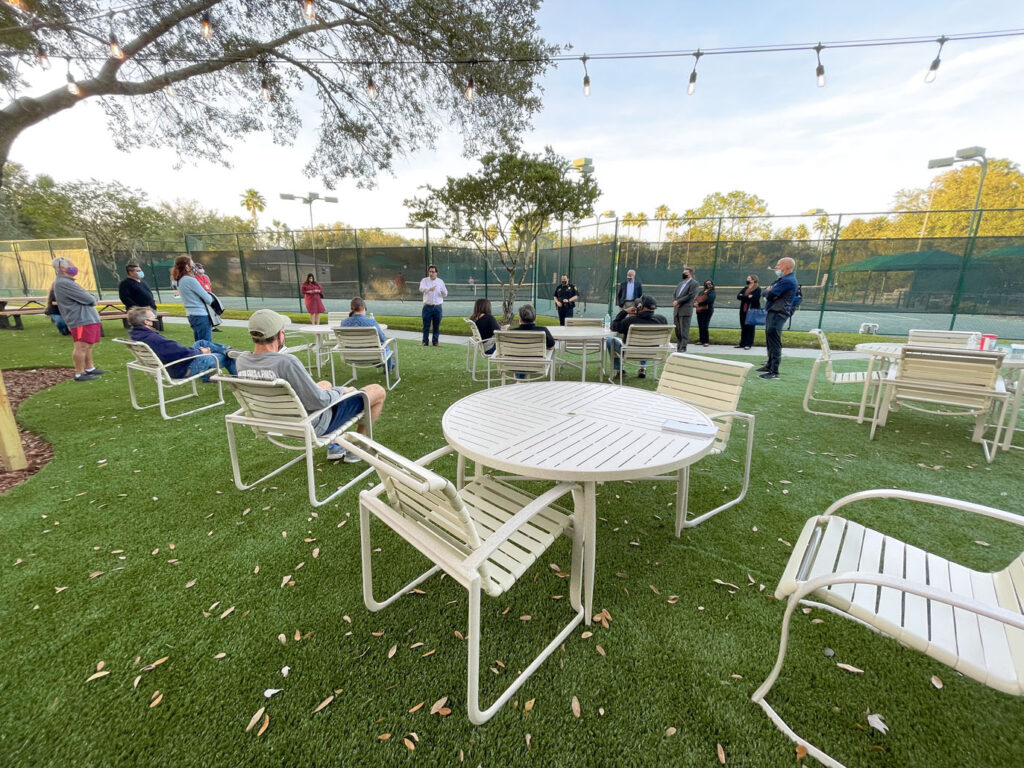
Luis Viera brought along four City of Tampa Water Department employees to Arbor Greene for a Jan. 20 meeting to discuss unusually high water bills. (Photo: John C. Cotey)

Tampa City Council member Luis Viera has always enjoyed scheduling community meetings in his District 7, which includes the City of Tampa communities in New Tampa.

Sometimes, Viera meets for a cup of coffee, or in a clubhouse meeting room or even at someone’s home. He says his favorite form has been the local townhall meeting, of which he has hosted a handful in New Tampa alone.

However, Covid-19 has changed all that, forcing Viera to, well, take it to the streets…or yard…or cul-de-sac.

His latest stop was to address the concerns of his constituents in Arbor Greene, where about a dozen residents met with Viera on a perfectly manicured patch of grass beneath strung lights behind the Community Clubhouse’s tennis courts.

Their primary complaint? Water bills they say that spike for a month for no reason and then return to normal.

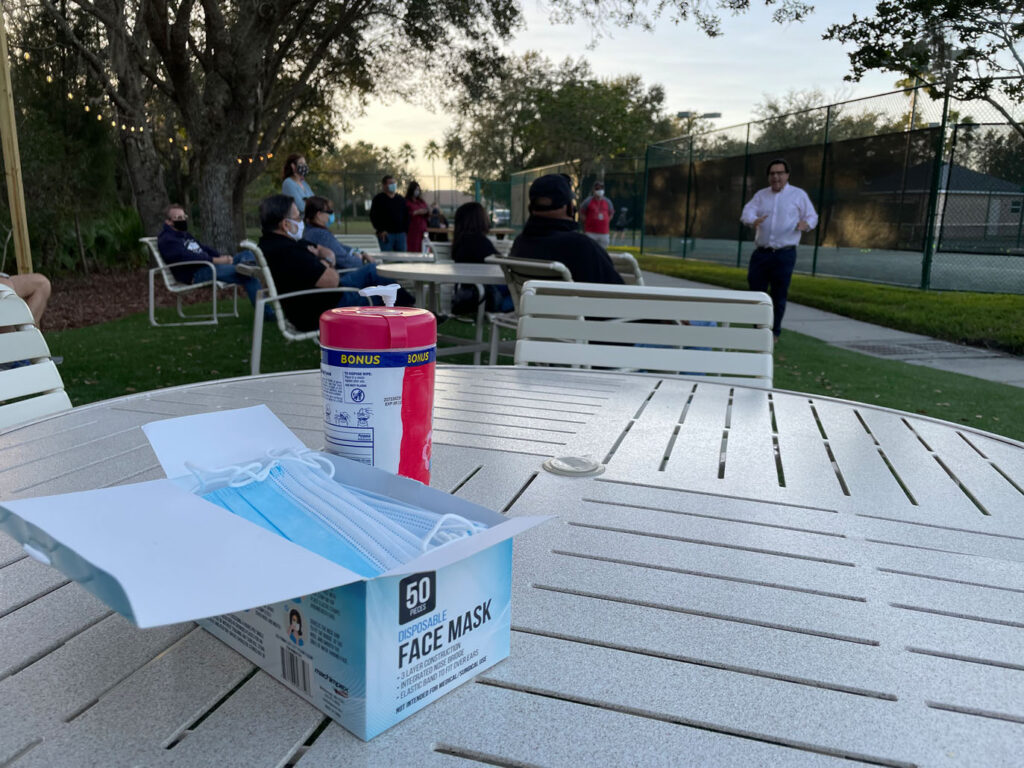
Viera also remembered to bring face masks & disinfecting wipes to his meeting outside the Arbor Greene Community Clubhouse. (Photo: John C. Cotey)

As he usually does when attending this new brand of community get-together, Viera brought with him a police officer — who thankfully had no salacious crime stories to share but reminded everyone to lock their car doors because some areas in New Tampa have seen a recent rash of burglaries — as well as four employees of the city’s water department.

“I’ve been hearing a lot about the water bills in Arbor Greene for a year now,  and it’s hard to say anything without doing an analysis of the bills,’’ Viera said. “So, I brought along some people who could. This meeting was about making those connections.”

None of the residents with a water bill beef got exactly the answers they wanted to questions like this one: 

“How was my water bill $307 in December when we weren’t even home for two weeks, and then back to $69 the following month?” (Not to mention the few days in early December the city had a water boil notice that kept the spigots at home mostly turned off).

Eli Franco, a spokesman for the City of Tampa Water Department, said mistakes are sometime made, but so rarely, the chances are that the bills reflect a leak somewhere, or an issue with a running toilet or an irrigation system.

“We read 140,000 meters a month,” Franco told the Arbor Greene residents, “and our error rate is less than one half of one percent.”

Franco said anything outside a normal meter reading is read a second time, and then a third time. Then, a picture is taken and sent to billing to see if there might be an explanation.

Franco said the city does work with residents if there is a problem with a running toilet or potential leak. He says the city has one of the most generous leak adjustment policies in the country.

“We want to make sure you’re getting a fair bill,” he said.

However, residents like Frank Burke, who has lived in Arbor Greene for 23 years, said leaks or running toilets don’t explain how his bill went from $68 to $160 before going back down, without any leak or toilet repairs at his home.

“It doesn’t make any sense,” he said.

Burke is one of dozens of Arbor Greene residents who have experienced what they say are unusually high water bills. Burke says his wife has seen plenty of complaints on Facebook, while others have taken to social media sites like NextDoor to complain. 

Viera said the goal of the meeting was to put Arbor Greene residents in touch with the right people to help and, to that end, his aide Brannon Lazo took names and handed out business cards to make sure the concerns were addressed by the right people.

 “We’re in the middle of a pandemic and a lot of people are frustrated,” Viera said. “As an elected official, we should be there to take the heat, catch the questions and find some answers.”

While he still prefers his townhalls, Viera started his outdoor tour in October, and the stops have included Forest Hills and the Busch Blvd. area of North Tampa, which also are in his district, a meeting in a cul-de-sac in the Tuscany community in Tampa Palms over concerns about new apartments, a meeting with residents of the Promenade Apartments in Tampa Palms about crime, and the Arbor Greene meeting.

Tampa City Council Approves Rezoning For 700 Homes In K-Bar Ranch

More homes have been approved for K-Bar Ranch, which is now completely rezoned and headed towards nearly 2,000 total homes and condos/townhomes in the next few years. (Photo: John C. Cotey)

After two readings and one continuance, the Tampa City Council has approved a rezoning that will pave the way for developer M/I homes to build 698 new homes in K-Bar Ranch.

The growth of the soon-to-be burgeoning community, located north of Cross Creek Blvd. in the northeasternmost part of New Tampa, has been a point of some public debate, due to the lack of infrastructure, namely roads, in the area.

But, only councilman Luis Viera, who represents District 7, which includes all of the neighborhoods within Tampa’s city limits in New Tampa — including K-Bar Ranch — was the only vote against the rezoning approved by the council (by a 6-1 vote on June 28) to allow the new homes to be built in K-Bar.

As it is with any zoning matters, Viera is not allowed to comment on the case for 30 days following the vote.

More homes means more cars, and currently, the only way in and out of K-Bar Ranch is Kinnan St., which runs north and south, or Basset Creek Dr., a two-lane road that runs past Pride Elementary before connecting to Kinnan.

Hillsborough County and the City of Tampa are still pursuing connections north into Pasco County at three different points to help relieve congestion, and K-Bar Ranch Pkwy., an east-west road which is connected to Kinnan St., is still under construction and will provide a path out via Morris Bridge Rd., but not until late 2019 at the earliest.

There was very little discussion amongst the City Council members before the vote, and no one from the public spoke.

Craig Margelowsky, the president of the Heron Preserve neighborhood in K-Bar Ranch and an opponent of adding more homes in his community without more roads, attended the May meeting but was unable to attend on June 28. He says he was disappointed with the decision, but not surprised.

Margelowsky says that he is concerned that by passing the rezoning request, the City of Tampa gave away any leverage it might have had in securing connections with Pasco County. If the rezoning was conditional upon new roads, government officials, as well M/I Homes, would be more pressed to find quicker solutions.
“This took away all the expediency,” Margelowsky says.

However, the City Council had little choice but to okay the rezoning, says Melanie Calloway, the senior transportation planning engineer for Tampa, in order to guarantee the connection of K-Bar Ranch Pkwy.

Calloway cited House Bill 7207, or the Community Planning Act, passed in 2011 and signed into law by Gov. Rick Scott, which handcuffed local governments from imposing what was once state-required concurrency for transportation, parks and schools. The bill allows developers to build without making improvements on over-capacity or failing roadways, which aren’t considered when performing traffic analyses.

Calloway says the City of Tampa can’t legally require M/I Homes to make the connections, but are encouraging them to work with Pasco County, which M/I Homes says it is continuing to do so.

“I think there is more interest in making those connections than there has been,” said K-Bar Ranch attorney Donna Feldman. “I think, in time, they will occur.”
Feldman also said that at the Wesley Chapel Roadways presentation on May 29, it was shown that the majority of those on the Pasco side wanted connections.
However, that “majority” was only true for two of three potential connections — at Meadow Pointe Blvd. & K-Bar Ranch Pkwy., and Wyndfields Blvd. at K-Bar Ranch Pkwy.

No indication has been given that there is enough support for the most convenient, controversial and contentious connection — between Kinnan St. and Mansfield Blvd. in Meadow Pointe. Pasco County District 2 commissioner Mike Moore, who represents the area, is on record as being adamantly opposed to it. He has suggested the Pasco Board of Commissioners (BOC) may not even vote on the connections until next year.

While Moore favors only two of the three connections, the City of Tampa feels that all three connections need to be made.

But, Margelowsky isn’t convinced the Tampa City Council will hold firm on that stance. “Without requiring roads (before passing the rezoning), now Pasco County can sit on this for five years,” he said. “I know that the Wyndfields and Meadow Pointe Blvd. connections will get done, but I don’t see anybody going and actually fighting for Kinnan-Mansfield.”

Connections or no connections, Feldman said the rezoning needed to be approved. The 2,280 acres of K-Bar Ranch was annexed into Tampa in 2002 to “grow the wealth, size and import of the City of Tampa, and the City of Tampa has done that,” she said.

She said the land-use entitlements allow for far more density than what was allowed for in a 2015 rezoning of the area.

The current rezoning is for a northwest portion of land adjacent to Kinnan St., and a northeast portion of K-Bar Ranch adjacent to Morris Bridge Rd. The rest, Feldman says, already has been rezoned.

Feldman told council members that M/I Homes has done its part. The financial impact of building K-Bar Ranch Pkwy is $18.8-million, and she said that M/I Homes also donated 60 acres of K-Bar Ranch land to the city for a park, which also was more than required.

“This project, as a whole, has been mitigated over and above what is necessary to accommodate this rezoning, which really started with the annexation of this project in the early 2000s,” Feldman said as she asked the council for approval.

K-Bar already has roughly 500 homes and townhomes already built, with another 700 or so approved in 2015 — despite similar protests from residents then about a lack infrastructure and roads — that currently are under construction. The new rezoning will add nearly 700 more homes to the community, bringing the total to nearly 1,900.

City Council Puts Hold On K-Bar Expansion

Craig Margelowsky says he is one of many residents of K-Bar Ranch that would prefer to see more roads built before allowing more homes.  The Tampa City Council agrees. (Photo: John C. Cotey)


Stop!

That’s the message from Tampa’s City Council, which is tapping the brakes – something quite familiar to New Tampa residents trying to get around our already congested roads — on allowing any more new homes to be built in K-Bar Ranch, at least until there is a way for the people that buy those homes to leave the community in their automobiles.

Ideally, the city says, connector roads into Pasco County would help reduce some of the transportation issues facing New Tampa.
At the City Council’s May 3 meeting in downtown Tampa, District 7’s Luis Viera led the charge have the Council postpone a decision to allow 698 more homes to be built in K-Bar Ranch, located in the northeast corner of New Tampa between Kinnan St. and Morris Bridge Rd.

A final vote is scheduled for Thursday, June 28.

Pasco has concluded it’s Wesley Chapel Roadway Connection study by then, which is expected to clarify some of Tampa’s issues.

That study, commissioned more than a year ago, is looking at three connections between Tampa and Wesley Chapel — at Kinnan St.-Mansfield Blvd., at K-Bar Ranch Pkwy. and Meadow Pointe Blvd., and at a two-way connection where Wyndfields Blvd. would connect to K-Bar Ranch Pkwy. as well as to Morris Bridge Rd.

Until they are agreed to, Viera says new homes will just exacerbate a major problem in the area, where residents currently only have one road (Kinnan St.) out of K-Bar Ranch.

Any connections are dependent upon the City of Tampa and Hillsborough County finding a solution to the decade-long standoff with Pasco County, which has been resistant to the idea of connecting Kinnan St. to Mansfield Blvd.

Negotiations have been, at times, very contentious.

“The way I see this is, we have a constant crisis in the New Tampa area and it’s not just the things we’ve heard today (about traffic),” Viera said at the May 3 meeting. “This is really a crisis of governments not really working together.”

Viera was the only council member who opposed the plan to build more homes in K-Bar Ranch when the first reading of the plan was held in April. But, between then and May 3, he gained an ally in District 2 councilman Charlie Miranda.

“Although I supported this the first reading, I was hoping between the first and second reading Pasco would come out of its coma,” Miranda said. “Evidently, it has not.”

Miranda lamented the speed of development in the current economic environment, without the sufficient infrastructure to support it. Those two things, he said, need to go hand in hand.

“It’s a problem for the whole area, the whole city, they whole county, the whole state, the whole country,” Miranda said. “When you do not invest in infrastructure, something is going to give….we can’t continue to have prosperity with no parking or transportation.”

The decision to delay any further development in K-Bar Ranch was greeted with a clap of the hands by Craig Margelowsky, the president of Heron Preserve in K-Bar Ranch.

“Nobody wants it,” he says of more development. “Not without the roads.”

K-Bar Ranch already has 700 homes built, with another 500 or so already approved and coming. If M/I Homes, the developer, is successful in gaining approval for another 700, more than 2,000 homes will complete K-Bar and add thousands of cars to New Tampa’s already congested roads.

A member of the New Tampa Council, Margelowsky has long been a proponent of making the connection between Kinnan St. and Mansfield Blvd., as well as pushing for speedier construction of K-Bar Ranch Pkwy., which will run from Kinnan St. east to Morris Bridge Rd. Because morning traffic currently only has one road out of K-Bar Ranch, it backs up to the point of taking residents 10-15 minutes just to get out of their neighborhoods.

An accident last month near Pride Elementary blocked traffic for 45 minutes. And last summer, Margelowsky said there were traffic jams during Hurricane Irma evacuations.

“There’s a choke point there,” he says. “There was nothing anyone could do.”

Margelowsky says he warned the city and developers last year that the roads in and around K-Bar Ranch cannot support any new homes. He told the Tampa City Council, “We can’t get out”, and asked that before issuing any more certificates of occupancy (COs), that K-Bar Ranch Pkwy. should first have to be completed out to Kinnan St.

COs, however, were issued in March of 2017 he says, but the parkway wasn’t completed to Kinnan until two months ago.

“We have 1,200 homes, and we still don’t have two exits out,” Margelowsky says. “We have Kinnan. What are we supposed to do?”

Connecting Kinnan St. and Mansfield Blvd. has been argued as one solution, but the City of Tampa is now demanding that all three connections be made.

If not, no more homes in K-Bar Ranch.

“We need to connect them all,” said Melanie Calloway, the senior transportation planning engineer for Tampa. She said the city is stipulating that if Meadow Pointe Blvd. is connected to K-Bar Ranch Pkwy — as they believe Pasco desires, — “then Kinnan gets done at the same time.”

If Pasco does not agree, then the Wyndfields Blvd. extension connections to K-Bar Ranch Pkwy. and Morris Bridge Rd. — connections that Pasco officials want to see built — will not be considered.

“We hope that it gets done,” Calloway said. “We can’t make another municipality connect to our roadways. But, we try our best to let them know we are open. All connections. Not just pick and choose. It is important for traffic distribution.”

No one on the Tampa side seems overly optimistic that all of the connections can be agreed to, but all fingers at the May 3 meeting pointed to Pasco County for being at fault.

Attorney Donna Feldman, who is representing M/I Homes, the developer, said the City of Tampa has gone out of its way to get the connections made, but Pasco “is really standing in the way.”

Feldman pointed out that the two counties were able to work together on a Sunlake Blvd. extension from Land O’Lakes in Pasco County into Hillsborough a few years ago, but can’t solve their current quandary.

“That was done cooperatively,” Feldman said. “Okay, Pasco, so what’s wrong with these? That’s the question.”

Hillsborough County Commissioner Ken Hagan, who says he has worked on connecting Kinnan-Mansfield for a decade, said that years ago, Pasco County commissioners agreed to make the Kinnan-Manfield connection.

He said at the time, he had stats showing that large numbers of Pasco County residents were flocking to New Tampa to use the recreation center, library and parks.

However, as Pasco County Dist. 2 commissioner Mike Moore has noted, the tide has turned. Because of the massive growth along the northern end of Mansfield Blvd., in Wiregrass Ranch and along S.R. 56, he doesn’t think Meadow Pointe’s residents desire or need the connection to be made anymore.

And despite the City of Tampa’s claims, he says it is Tampa that has declined to work with Pasco in the past, perhaps missing its chance.

Even at a time when metropolitan planning organizations and transportation boards in Hillsborough, Pasco and Pinellas counties seem to be urging regional cooperation and connectivity, the gap between Kinnan St. and Mansfield Blvd. continues to be more of a cavernous valley than the 30-foot patch of grass, dirt and trash that remains there.

New Tampa Rec Center, Fire Station Survive Budget Battle

A large contingent of New Tampa residents showed up in red shirts at both budget workshops to speak to the council about the importance of the New Tampa Recreation Center.

Despite a Tampa City Council meeting that started on a Thursday evening and ended on a Friday morning — and, at one point, had nearly every Council member throwing up their arms and/or staring off into space in frustration over a property tax stalemate, the final vote at 12:06 a.m. on Sept. 29 preserved the Fiscal 2018 City Budget what most of the people in New Tampa who attended the public hearing were hoping it would:

1) Money for the expansion of the New Tampa Recreation Center (NTRC) in Tampa Palms,

2) Funding for a new fire station on County Line Rd. near Grand Hampton and

3 Money to plan and design an autism Sensory Park in New Tampa.

“Last night was pretty good,’’ said District 7 (which includes all of New Tampa within the city limits) City Councilman Luis Viera.

The seven City Council members voted 4-3 to raise the city’s millage rate from $5.73 to $6.21 per $1,000 of assessed, taxable property value, the first time in 29 years that city property taxes have been raised.

Mayor Bob Buckhorn requested in his $972.4 million budget for Fiscal Year 2018 (which begins Oct. 1) an increase to $6.63 percent. The increase settled on by the Council means an increase of roughly $100 per year for a home in New Tampa, where the median price is about $260,000.

Buckhorn’s original request to raise the millage by 0.9 percent (and produce $15 million in revenue) was voted down to 0.6 percent at the first budget hearing (by a 4-3 vote) on Sept. 18. But, when the vote came up again at the second meeting on Sept. 28, the Council members voted against the 0.6 by a 4-3 vote, with Council Chair Yolie Capin (at-large District 3) changing her vote.

That set off hours of negotiations between the council members to find an acceptable millage increase. The arguments included angry volleys lobbed at Buckhorn about future deficits of more than $50 million that many of the council members said they were unaware of until recently. Almost every number between 0.3 and 0.6 was debated and defeated— including a motion by Dist. 1 (also at-large) Mike Suarez not to raise the millage rate at all, which would have resulted in massive budget cuts — until an increase of 0.475 passed with votes from Viera, Dist. 5’s Frank Reddick, Dist. 2 (at-large) Charlie Miranda and Dist, 4’s Harry Cohen.

“When Mike Suarez proposed scrapping everything and it lost by only one vote (4-3), I thought I better compromise fast,’’ Viera said, leading to the 0.475 percent increase that pulled Cohen, who had been denied three times after putting through a motion to make the increase .45 percent, to their side.

Because the millage rate increase is less than Buckhorn wanted, and therefore will bring in less revenue than expected, parks and recreation will still endure almost a $600,000 cut in operational costs. But, unlike past budgets that had money included for the NTRC only to see it pulled at the last minute, Viera said this budget was a winner locally, especially with potential lean times ahead due to a $50-million deficit the city is expected to be dealing with.

“We got 100 percent of what we wanted,’’ Viera said. “The cut to parks and rec is a small compromise we had to make. There’s no way we could get the rec center passed next year,; it probably would be a 5-6-year wait. This was the magic year.”

The now-$970 million budget includes $1.9 million for expanding the NTRC, which is one of only two facilities in the city that is home to the city’s highly touted dance, acrobatics and sports readiness program and has a waiting list of roughly 3,000, according to Tampa Palms resident Tracy Falkowitz.

Falkowitz also has said that the current building itself will not be expanded. Instead, a second building will be built on the property to accommodate more children.

An additional $1.4 million of 2018 Community Investment Taxes are budgeted to complete the construction of Fire Station No. 23, which will be located in the Grand Hampton/Grand Colony area off County Line Rd.

The station will house 39 firefighters, an engine company, a truck company and a rescue unit. No. 23 also will be home to a new District Fire Chief, who will coordinate responses between all four of New Tampa’s fire stations.

And, $90,000 is in the budget for study and design of a “sensory-friendly” park on the land behind BJs Wholesale Club, which will be developed in conjunction with the University of South Florida.

Falkowitz, the attorney who spearheaded the push to protect the money earmarked for New Tampa in the budget, sat through the entirety of both budget hearings. She said she wasn’t surprised the debate lasted into the early hours, based on her many discussions with multiple council members.

She said she was only worried twice that the panel might decide on a low enough millage rate that budget cuts would be required. In fact, she said that Miranda approached her during one break and told her “I don’t think you’ve got it”. And, when the .45 rate – which would have required cuts that could endanger the NTRC — came up for a vote.

“This never could have happened without all the community support,’’ Falkowitz said. “Without the New Tampa Council, the neighborhood associations, the rec center moms and dads and kids. That sea of red in front of the council and those that spoke up at those meetings was tremendous. Before this year, New Tampa was never heard and New Tampa was never really addressed. This time, we came together as a community and they heard us.”