
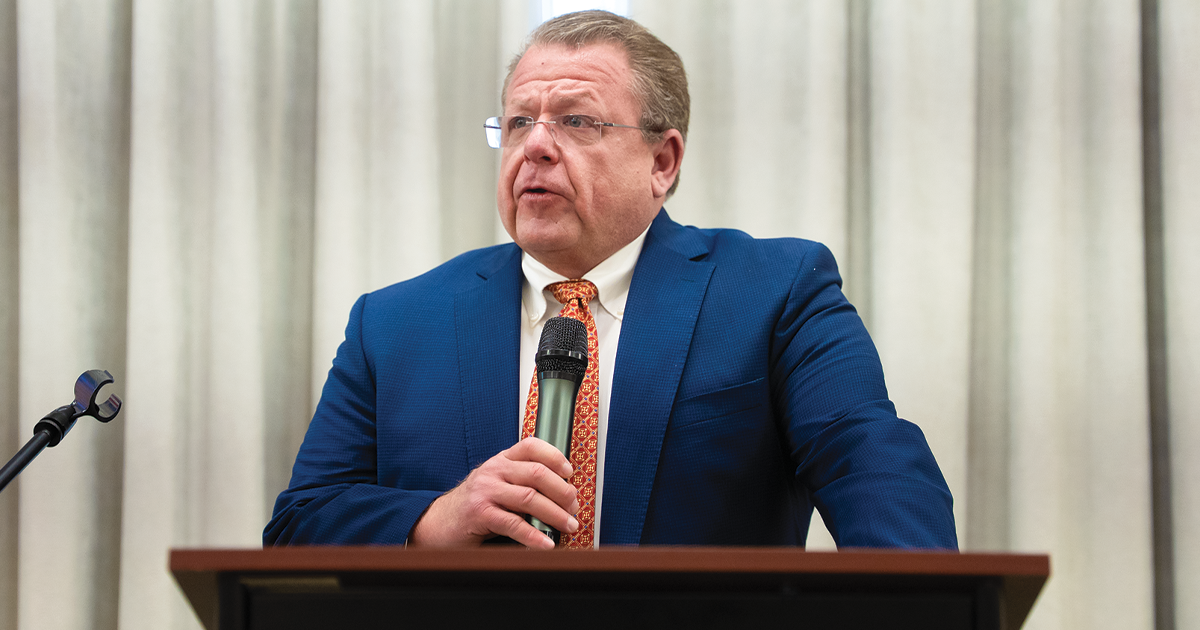
The first time I ever met new North Tampa Bay Chamber (NTBC) Board chair Tony Benge was at the NTBC’s annual meeting back in December, when he was sworn in with the rest of the NTBC’s 2026 Board of Directors and we were introduced to each other by NTBC president and CEO Hope Kennedy.
At that time, Mr. Benge and I agreed that we should sit down to discuss his vision for his tenure as the new Chamber Board chair, as well as his primary role as the president of Benge Development Corp., which has been based in Orlando since 1994, but also has one current development project in Pasco County and recently had its original Pasco development plan denied by the Board of County Commissioners.
Although neither of those projects is located in Wesley Chapel, the denied “Fletcher Project” (more on that below) was located at the intersection of S.R. 52 and U.S. Hwy. 41 in Land O’Lakes, immediately adjacent to the Moffitt Speros campus we told you about last issue.
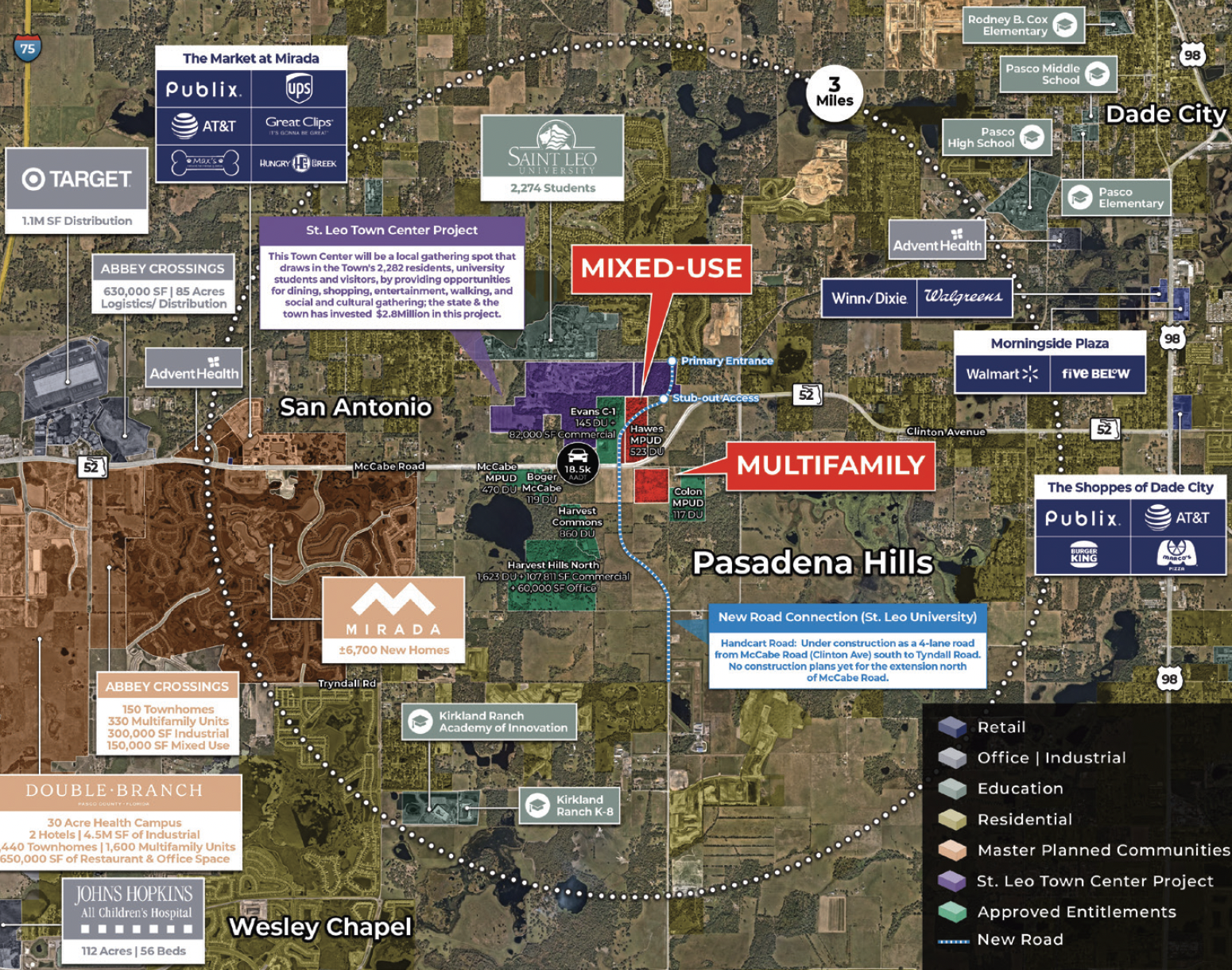
The other project, called the Hawes MPUD, which is moving forward, sits north of Wesley Chapel and east of the Mirada development. both north and south of S.R. 52, east of Handcart Rd. in San Antonio, and is approved for up to 523 multi-family units (see map below).
His Benge Development Corp. has developed more than 30 large-scale projects, mainly in Orlando and Apopka, FL.
Benge, who introduced Florida’s Lieutenant Governor Jay Collins at the NTBC Business Breakfast on Feb. 3 (see story on page 8), also asked Lt. Gov. Collins about mobility and school impact fees, subjects Benge knows a lot about because his company has to pay them every time he develops a new project.
“Impact fees have started to cripple a lot of the [development] industry,” he said to Collins. “For a typical residential unit, as an average, $30,000 per unit is now being levied. When they were originally passed, [these fees] were specifically to be limited to incremental new capacity for things like schools, roads, sewer and water treatment plants. But, we’ve paid into this now for a decade and there’s been no accountability. You can’t get any information from these counties, which seize the money, in essence. And yet, they have no new schools or anything else to point to. How do we get accountability for this?”
Collins responded, “It’s got to be statewide legislation. It can’t be executive action. It has to go through the legislature and it’s got to be codified into law. There has to be some form of accountability in that system.”
He added, however, “But, valid impact fees? I think we all agree that valid is a good word. We can do that, but the accountability has to be there. I don’t think DOGE ( (the Dept. of Government Efficiency) is something we should just do once and walk away from. I think sustained accountability and predictability for our people matters. We’re going to have to implement that.”
State Senator Danny Burgess, of course, presented a different solution when he was the guest speaker at an NTBC “Coffee & Connections” event two years ago, before DOGE even existed, saying that he wanted to see an audit of every county regarding impact fees.
Benge agreed that an audit showing how much impact fee money has been collected and what that money was spent on would be a good way to hold counties accountable for the impact fees they collect.
He says that although Pasco’s impact fees are among the highest in the state, “Osceola County’s are actually the highest. They’ve really become insane, literally. The night [Osceola] did the most recent increase, there were probably 20 developers in the audience, representing hundreds of millions of dollars in projects. I told them, ‘If you pass this, just throw our application in the trash.”
He added that for a typical 300-unit apartment complex, the developer has to pay $9 million in impact fees to get a building permit.
“I mean, we’re already building all of the roads, improvements… we’re having to do turn lanes, traffic signals, water, sewer, bus stops, all of that. And we still have to pay regular taxes and everything else.”
Benge also told me that impact fees first started back in 2000, with something called the “Martinez Doctrine,” which was named after former Orange County Chair and U.S. Sen. Mel Martinez, who served as Secretary of Housing & Urban Development under U.S. President George W. Bush. The Martinez Doctrine attempted to limit school overcrowding by requiring local developers to address school capacity issues before breaking ground.
“The idea was that growth should have to pay for itself, which makes sense,” Benge said, “But the trade-off was supposed to be that we will always have utilities and roads and services available to go along with this.
“So when these impact fees first started, I don’t know who came up with the numbers, but they’re so abominably disproportionate. We’ve actually tracked some of the apartment communities, which might have kids in only 20% of the complex’s units. So, on 300 units, I’d have maybe 60 units that have kids, I paid $6 million in impact fees for the construction of new schools, which is basically 1/3 of a whole [700-student) schoolhouse for 60 kids. And, I’m still paying taxes every year, too. These fees were supposed to only be used for new school construction, but they never gave me any data.”
Benge also said he decided to go about it a different way. “Let’s just track how many homes and apartments were built from, let’s say, 2015 through 2025. So, I made up a number, let’s say 100,000 units were built. Each one paid $14,000 per unit. Where’s that $1.4 billion? Or, list me out the new schools that’ve been built with that money, with the budget you spent on each one.
“A K-8 school right now costs $18-$20 million, a high school is upwards of $50 million, and that would house, in Orange County, up to 5,000 students. By our estimation, there should have been around 84 new schools built during that time — and they only have three.
“So, where’s all that money? [Counties aren’t] allowed to use it for [their] general funds. You can’t use it to pay more administrators. This money should be segregated out and if it’s not, this is a big issue.”
He added that many of the assumptions used by counties to set their school impact fees, “are horribly flawed. If I build a 300-unit apartment complex and a third of those units are one-bedroom units, how many kids live in one-bedroom apartments? Historical precedence says that only unless someone is building a house that isn’t ready yet, one-bedroom units don’t generate any kids, yet I still have to pay the same school impact fees for those units. It’s crazy.”
The Fletcher Project
Speaking of crazy, Benge said that his Fletcher Project — named for the family that owned the 100-acre property — was originally planned in Aug. 2024 for 350 multi-family units, about 160 townhomes and 25,000 sq. ft. of commercial uses and had been through more than a year of meetings and plans when Pasco’s commissioners voted last year to deny it.
“The big pushback was the private, never-permitted airstrip from the 1950s next door, which would have prevented us from building anything on 1/3 of the property. We agreed to not build on that portion, but we asked to have the same density on the rest of the property. So, we wouldn’t build as [many total units], and they turned us down. We started with Plan A and were up to Plan Q, and they still turned us down.”
Hawes MPUD
Despite that setback in Pasco, Benge Development is moving forward with its plan for the Hawes MPUD (marked in red on map below). The project will extend Handcart Rd. to the north, with 396 multi-family units on the south side and 127 townhomes on the north side and some neighborhood commercial (grocery store, etc.) entitlements. The Hawes project was approved in 2023, but Benge has not yet begun building at that site.
Jonathan’s Landing
Benge also is building Jonathan’s Landing, the first adult autistic facility in the U.S., in Lake Nona, FL. “It will have 5,000 beds and bring 5,000 jobs to that area,” Benge said. “My friend, Jason Eichenholz, has a son named Jonathan who is an adult with autism. This will help so many adults because state support for [developmentally disabled] people ends at age 18.”
Look for more info about Tony Benge and his vision for the NTBC in our next issue.



No comment yet, add your voice below!