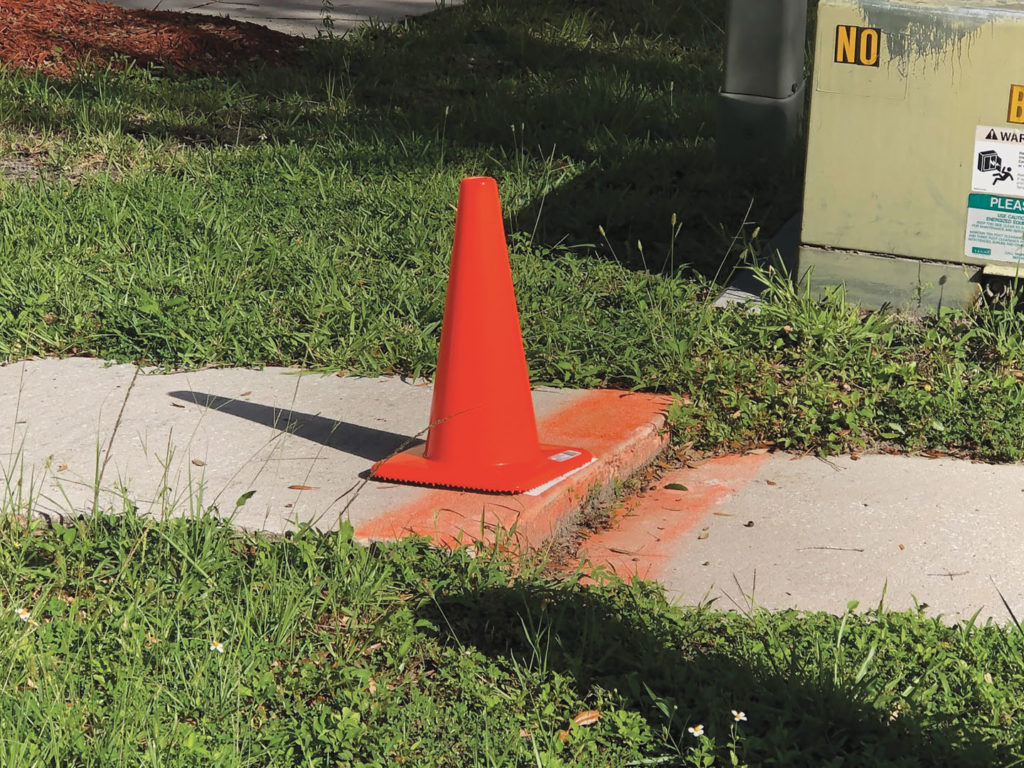
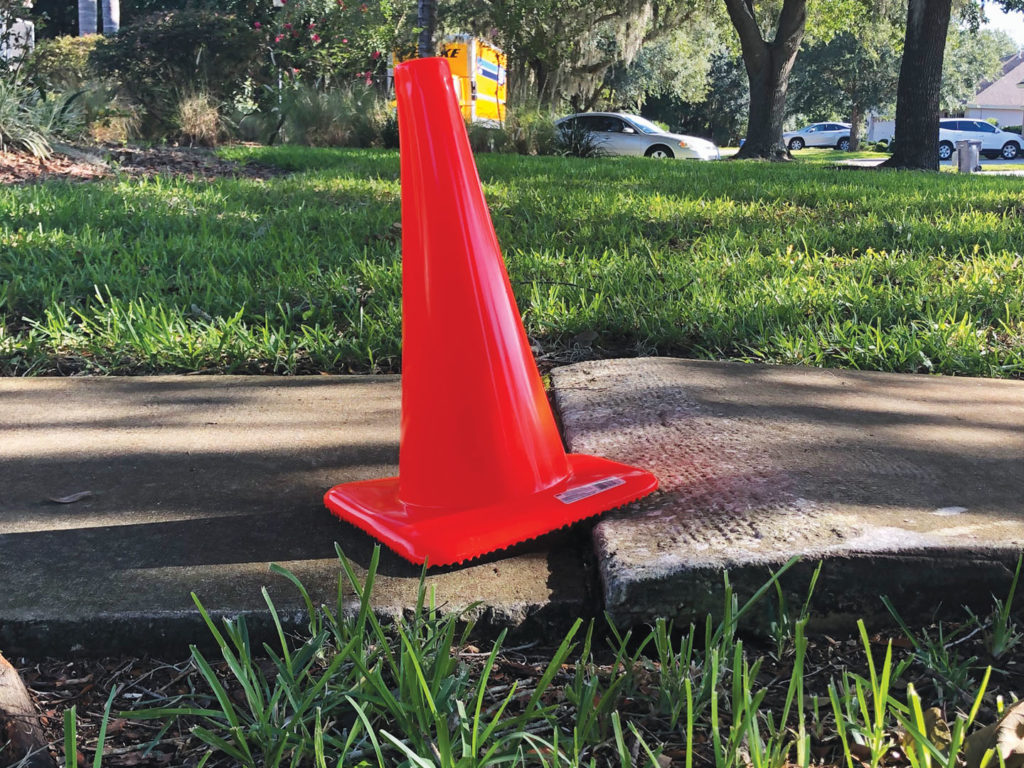
Some of the sidewalks in Magnolia Trace and Pinehurst (top right) are in need of repair, but Hillsborough County has a long backlog for sidewalk repairs. (Photos: John C. Cotey)
Dozens of orange safety cones and swatches of bright orange paint have been placed along sidewalks in at least two New Tampa neighborhoods, there as a warning — to watch your step.
Due to uneven sidewalks caused primarily by the roots of large oak trees planted years ago between the sidewalk and the road, those out for a walk or bike ride in the Magnolia Trace and Pinehurst communities off Brookron Dr. in Cross Creek are being cautioned, due to concerns raised by the homeowner’s association’s insurance company during an inspection.
How long will the orange cones adorn the neighborhood’s sidewalks?
That’s anyone’s guess.
Jo-Ann Pilawski of Pilawski Property Management, which manages the Cross Creek II Master Association, notified Hillsborough County’s Public Works department about the sidewalks, which indicated in an email that “a work request has been initiated and assigned to the West Service Unit for inspection, review, and response.”
The email stated an inventory of potential repairs will be conducted within a month, and afterwards, the county will “grind” all identified areas where the lift is less than two inches.
The areas raised more than two inches — and there are quite a few in both neighborhoods — “will be flagged with reflective tape and added to the county’s current backlog of sidewalk replacement requests.”
That backlog, according to Hannah Titrington, the program coordinator of the customer resolution unit at the county, who wrote the email to Pilawski, is approximately 24-36 months.
Prior to 2018, the county had minimal funding for sidewalk repairs, Titrington wrote, causing the backlog. But, in 2018, the Board of County Commissioners committed significantly more money to sidewalk repair after passing a 10-year, $800-million plan for transportation improvements.
“It’s a big county, so you can imagine how many sidewalks there are that need repairs,” Pilawski said. “Unfortunately, unless the association pays for repairs, we’re stuck. A few residents have called to complain, but as soon as I tell them it might make (their) fees go up, no one is interested anymore.”
Pilawski also said that doing so would also set a bad precedent, considering that the sidewalks are supposed to be maintained by the county.
Titrington did write that while the county is working on older requests first, repairs are grouped by proximity. So, an older request from a different area in New Tampa could expedite Pilawski’s request for repairs.
It was his last mass, but it felt like his first one.
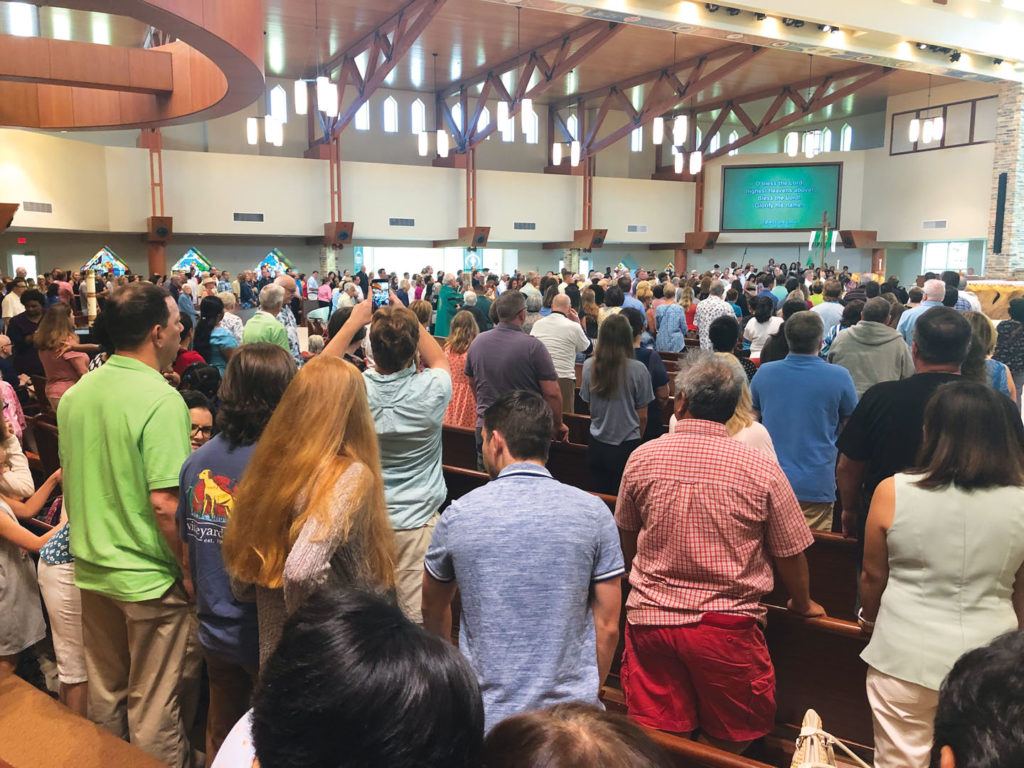
The pews at St. Mark the Evangelist Catholic Church were filled. Everyone was eager to hear what he was going to say. And, the nerves and emotions were almost overwhelming.
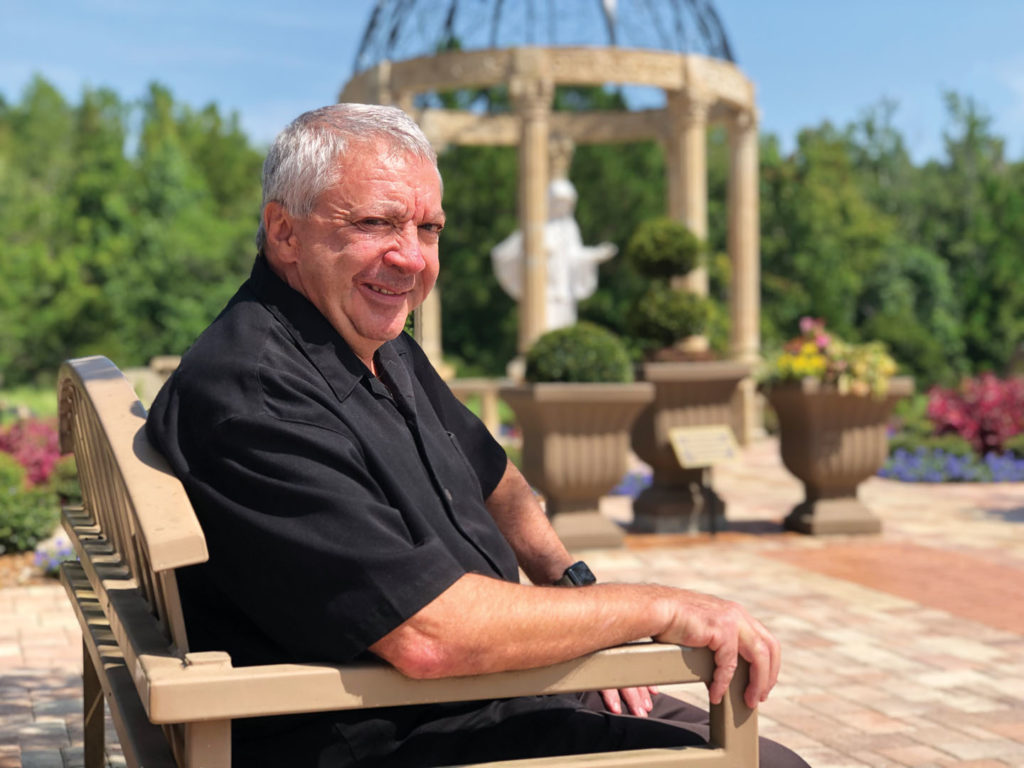
“It was pulling me in all kinds of different directions,’’ Father David DeJulio said.
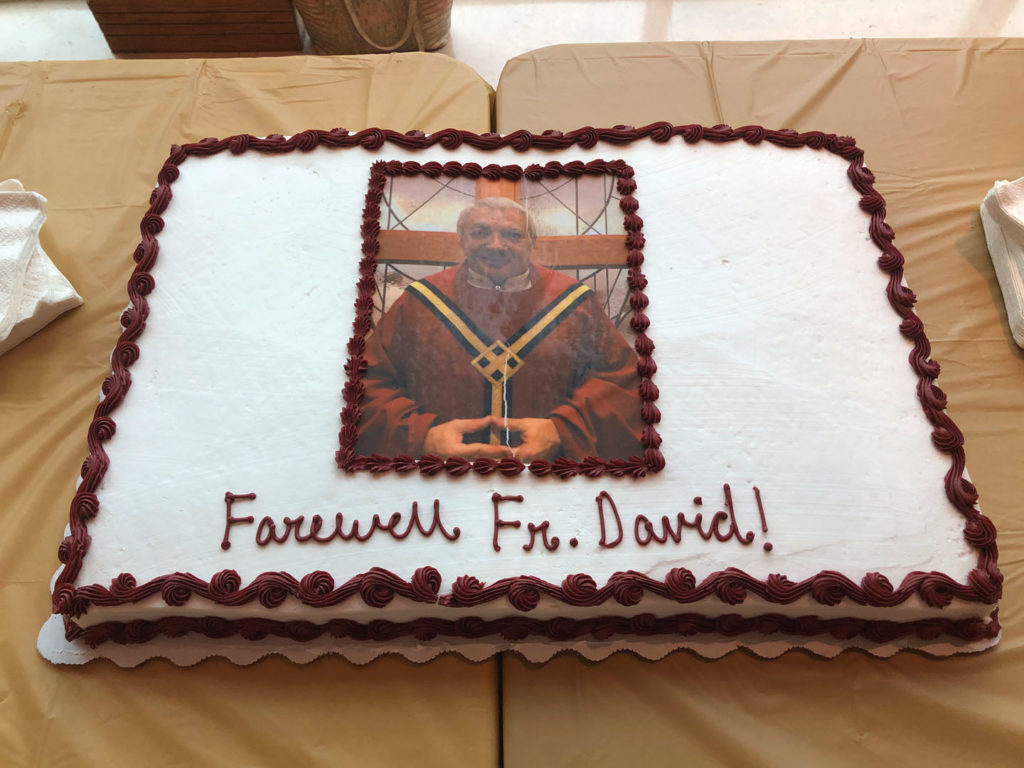
After 16 years of leading St. Mark’s through massive growth and the construction of a new church, making hundreds of friends in the community and helping even more families, Fr. David said goodbye on June 30 to a congregation that has grown from 2,100 families when he came to the church to more than 3,800 as he departs.
He was pleased with his homily, which challenged parishioners to hold steady as they follow Christ, despite the ever-growing plague of distractions. Towards the end of the eucharist prayer, as the end of his time at St. Mark’s drew nearer, he started fighting back those emotions.
Tampa City Council member Luis Viera presented Fr. David with a city commendation, leading to a rousing 45-second standing ovation. When Fr. David tried to bring the mass to a close, his staff
interrupted him and presented him with a plaque.
“I lost it there at the end,” Fr. David confessed.
After gathering himself, he followed a procession of altar boys and deacons and, for the last time as their priest, walked past rows of the adoring St. Mark congregants for the final time.
”I’m not really thrilled about leaving,” Fr. David said afterwards, “but when God tells you you gotta go, you gotta go.”
He is headed north (but not too far) to St. Frances Xavier of Cabrini in Spring Hill, only 15 minutes from where his twin brother Frankie’s family lives.
Fr. David will essentially trade parishes with Rev. Richard Jankowski, who has been at St. Frances of Cabrini for 13 years.
It’s the next stop on Fr. David’s journey, which began at the age of 5, when he says he first knew the church is where he wanted to be.
It wasn’t until he was 27, however, that he entered the seminary. He graduated with a finance degree from the University of South Florida, making the long drive to classes from his family’s home in Holiday, FL.
He took a job at a bank in St. Petersburg, a job he said he truly enjoyed. But, that feeling he got in church as a kid never went away.
“It kept haunting me,” he says.
His first year in the seminary, he wasn’t so sure he made the right choice. He thought about quitting after one semester. He had been living with his girlfriend in an apartment in St. Petersburg and was in control of his life. But, when he entered the seminary, he wasn’t.
“My first year was tough,” he says. “I just really didn’t like it.”
He knew he had faith, but wondered what kind. In the end, it turned out to be a determined, resilient and unbending faith, the same kind of faith he implores his parishioners to strive for every day.
It is Fr. David’s style, which is described as easy-going, funny but still somewhat stern, that made him a popular fixture in New Tampa.
Among the first families he met when he came to St. Mark’s were Richard and Nancy Larson. Nancy was the liturgist at St. Mark’s, and Frankie contacted her about planning a party for the installation of his brother, the new priest.
The party was held at Hunter’s Green Country Club, in the community where Fr. David has lived in a home the church uses as its rectory.
Richard and Fr. David became instant friends, as did dozens of others from Hunter’s Green who joined Fr. David’s Bible study group that would meet weekly at his home. Fr. David would teach, and afterwards, there would be wine and food and cigars.
“He built my faith and he made me a much stronger person,” Richard says. “He did that to our whole group.”
Many, Richard says, weren’t even members at St. Mark’s, but Fr. David still brought them home, too.
“He was so good at evangelizing and bringing people back to the church,” Richard says. “He was just a regular guy. I think that appealed to a lot of people.”
Fr. David golfed with the group — he says his handicap is currently a 13 — and the more time he spent with those who had stopped going to church, the more those people started going again.
When they found out Fr. David was leaving, the group pitched in and bought him a membership to Southern Hills Plantation in Brooksville, 10 miles from his new church, so he could continue to spread God’s word to new friends while working on that handicap.
After Fr. David’s final mass Sunday, he was greeted in the courtyard by Noel and Nellie Negron, whose eyes welled with tears as they thanked their longtime priest for bringing them back into the church.
Noel has been a member for 23 years, but hasn’t always been a regular churchgoer.
“I went when I felt like it,” he said. “When I met Fr. David, he brought me back. (Now) there isn’t a Sunday I miss. I love coming to church.”
Nellie recalled a story about the time her granddaughter Olivia saw Fr. David walking alone across the field next to the church, and asked if that was Jesus.
“I will always remember that story,” she said, smiling. “I love him. I am going to miss him.”
The Negrons have already been to his new church, and plan on stopping in for a mass here and there.
Richard says he will do the same, as, he suspects, many others who knew Fr. David also will do. He joked that he will definitely see Fr. David again, “because I made him promise he would do my funeral.”
Priests usually serve 12 years at one church, but Father David was given 16, so he could spend some time enjoying the church he helped to build.
Fr. David was named pastor at St. Mark’s in 2003, preaching from the Family Life Center the church flock was quickly outgrowing. He envisioned a spiritual center for New Tampa, a place for families to come together in prayer. A fund-raising campaign was started, and the although the economic downturn in 2008 forced a delay, on June 6, 2015, the $10.1-million, 35,000-sq.-ft. sanctuary was dedicated.
Today, the church is only $1.5 million from paying off a $5-million loan to finish it.
“It’s kind of a slip of the tongue to say it’s “my place,” but I feel connected here,” Fr. David says proudly. I spent half my priesthood here. It’s always going to have a special place in my heart, wherever I am.”
Father David will always be remembered for his stewardship over the sanctuary project, which he credits as a testament to the “tremendous sacrifices on the part of parishioners.”
But, it’s just a small part of the legacy he hopes he leaves behind.
“Obviously buildings are important, but what happened here is we created a place with a story,” he says.
He says he wants to be remembered not only for helping create a beautiful structure to worship in, but also for what has happened inside it. He is proud that St. Mark has been a place where families feel welcome, where you’re greeted by four or five people before you even got to your seat, where he challenged his parishioners’ faith and helped guide them through both happy and difficult times.
He fostered a community that did many good things, a community that he helped connect to God through his teachings.
At the end of the day, and 16 wonderful years, it was all that he could ask.
“I started to think about him not being here, and it was a very emotional thing,” Noel said. “When you have someone you can turn to for some encouragement and leadership and someone to guide us…and now he won’t be here. He was a good shepherd for us.”
Wiregrass Ranch High quarterback Hunter Helton is spending the summer prepping for his first season as the Bulls’ starter by playing 7-on-7 football. (Photo: Andy Warrener)
Traditionally, high school football players have generally filled their summers the only way they can — by throwing the ball around, studying the play book, keeping in shape and hitting the weight room.
They aren’t allowed to wear pads in the offseason, so there is no hitting or tackling, and as a result, nothing to play.
But, 7-on-7 football has changed all that. What began as a simple practice drill, ubiquitous from high school all the way up to the pro level, has evolved into a highly competitive sport of its own.
These days, the 7-on-7 “season” is red hot, offering a full-speed, no-contact (really, no more than light contact) way for athletes to hone their skills, build team camaraderie and even attract college recruiters. Increased participation has led to increased organization, and what began as a few local/regional tournaments here and there has evolved into a high-stakes competition that goes all the way to the national level.
.Promising Wesley Chapel High defensive back Jon’Tavius Anderson (left) goes up for an interception during a 7-on-7 game at Fivay High. (Photo: Andy Warrener)
Elite area 7-on-7 teams like Team Tampa compete in a national circuit of tournaments, and have a few national titles to show for it.
Wiregrass Ranch High (WRH) quarterback Hunter Helton, getting ready to enter his first year as the Bulls starter under center, led Team Tampa to a title at the Adidas East Coast Regional earlier this summer, and two weeks ago, Team Tampa made it to the elimination bracket at the national tournament held in Tampa before losing 17-14 in the first round.
Current NFL star Cam Newton, the quarterback for the Carolina Panthers, and NFL Hall of Fame defensive back Deion Sanders both coached teams in the event, which was crawling with analysts from recruiting websites. Some of the bigger events also receive cable television coverage.
What is 7-on-7?
The game of 7-on-7 football is exactly that — seven players against seven players. The offense is run by the quarterback, there’s usually a running back or two and then four or five receivers. On defense, 7-on-7 teams mixes usually mix in one or two linebackers and five or six defensive backs.
Quarterbacks have four seconds to unload the ball or it’s whistled as a sack. The teams play on a short field. The offense starts at the 40-yard line and can gain first downs at the 25-yard line and the 10-yard line. You either score, or you turn the ball over.
There are no running plays. Games are 21 minutes long and the clock runs continuously until the final minute. A player is considered downed or tackled by a simple one-hand touch, though it can get very physical during intense match-ups.
The origins of the sport can be traced back to a drill called, “Pass Skel,” or “Skelly,” as some former players recall it. Pass Skel (pass skeleton), aka 7-on-7, is a mainstay practice drill.
Many coaches eschew the 7-on-7 format, saying it invites bad habits and does little to mimic the actual game. Others have embraced it and say keeping their players active, competitive and together is a big payoff.
If you’re are working in a new quarterback for your high school team, the summer circuit of 7-on-7 can be invaluable.
“First, it allows you to practice with the football all year,” says Wesley Chapel High (WCH) head coach Tony Egan. “You develop chemistry between your quarterback and receivers and it helps you get your timing down.”
Egan and the Wildcats are hoping junior Owen Libby steps into the starting quarterback position in the fall of 2019, and they are getting him all the reps they can. The Wildcats played in the second annual King of Kings Tournament at One Buc Place, and currently field two teams in Pasco County’s summer 7-on-7 league held at Fivay High in Hudson.
The competition also allows coaches to add more dimensions and levels to both pass play packages and to their defensive schemes.
“The passing game in high school is 10 times more sophisticated now than when I played (in high school),” says former Tennessee Titans linebacker Ryan Fowler.
“Back then, if you faced a good quarterback, you might not have answers for him unless you had a good pass rush. The NFL has become more of a passing league, and college has followed that, so it’s natural for high school to follow it, too. (7-on-7) offers you months to work on things that you just don’t have time to work on in the fall.”
Coaches like Egan and WRH’s Mark Kantor have embraced the 7-on-7 game, and, with both their teams starting the fall with new starting quarterbacks, building that chemistry on offense will be a significant bonus.
But, they are quick to point out, it’s not “real” football and they often have to remind their players of that.
“The quarterback gets used to taking free drop backs,” Egan says. “We try to do things in practice to simulate pressure like have guys put their hands in the quarterback’s face or hit him with a blocking pad.”
Playing 7-on-7 also gets defensive backs conditioned into a pass-first mentality, and provides a test for linebackers, who often have to drop into pass coverage as well.
“It can take time to break that habit,” Fowler said. “I’ll sometimes make them (defenders) do up-downs after the ball is snapped to slow them down so that their drops are more accurate.”
Egan makes his defenders take a forward run-step before he allows them to drop into coverage.
Coaches have to be wary as well of not falling into a 7-on-7 trap of calling plays and running a defense completely different than they will in the fall.
“We try to run the same coverages we would run in a real game,” Egan said. “It might hurt us in 7-on-7 but we want our kids to know our coverages in the fall.”
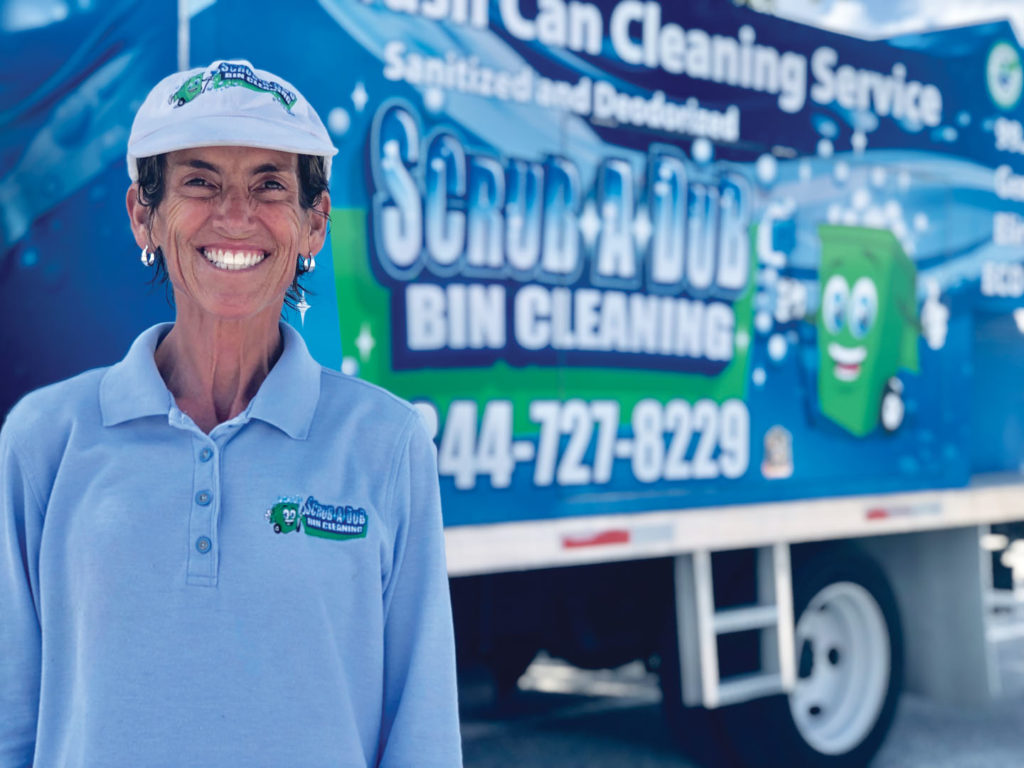
Jennifer Trudel says her unique service and fair prices are keeping her busy during the summer months, when your trash bins are at their stinkiest. (Photo: John C. Cotey)
When dumping your garbage into your trash bin, are you one of those people who open the lid quickly, flick the bag of trash into the bin, and let the lid slam shut as you turn away, hoping to avoid the waft of stink from years of trash bin neglect?
If so, Wesley Chapel resident Jennifer Trudel can help you. A simple phone call can remove the stink — as well as bugs, dried liquids, sticky substances and other left-over trash residue — out of your bins.
Scrub-A-Dub Bin Cleaning, started 18 months ago by Trudel, will come to your home and have your bins looking and smelling brand new. While a fresh trash bin may seem like an oxymoron to some, it actually makes perfect sense, Trudel says.
“With the summer and the heat and people having to keep their trash bins in their garage, bacteria love the warmth and they love moisture and that’s basically what you have in Florida,” she says. “The heat helps bacteria grow, and a lot of people will get maggots, viruses, mold and bacteria they can’t see even see.”
That may be why business has been booming for Trudel. One day last week, she was trying to figure out how she was going to get to all 40 homes on her schedule taken care of in one day. She is considering buying a second truck. And, she says, advertising in the Neighborhood News also has helped keep her busy.
“It’s been crazy,” she says.
How Does It Work?
Scrub-A-Dub Bin Cleaning comes to your home as often as you desire — from just four times per year to monthly — to make sure the trash and recycling bins you drag back into your garage are immaculately clean and fresh-smelling.
One of Jennifer’s first customers was Joshua Green, who lives in Seven Oaks.
“Our trash cans were always in the garage and smelling,” Green says. “It’s gross and no one wants to deal with it.”
He has been pleased with the results.
“They’re nice and clean and look brand new,” says Green, who has been a customer ever since.
Scrub-A-Dub customers leave their bins out on trash day, after the sanitation truck has picked up their trash and/or recycling. That’s when Jennifer comes by, opens the bin and uses a grabber to pull out any trash left behind, then loads the bins into her truck, and the “magic” begins.
The bins are raised above the truck and centered around a head that spins and blasts 200-degree water.
“Imagine a giant dishwasher for your bin,” she says.
For an initial cleaning, Jennifer will scrub using a biodegradable degreaser to clean the inside of the bin — she says that sometimes she even has to climb inside the bin — and then runs it through the truck’s process again.
She pressure-sprays the outside of the lid, wipes the handles and the inside and outside of the lid — anywhere your hands might touch. Then, she says the bin no longer has an odor, but she wants it to smell good, so she adds a deodorizer. Then, she wipes out any excess water.
“It’s overkill, but I do it because I’m a type-A person,” Jennifer laughs. “I want the bin to look beautiful, and every customer to be wowed.”
Jennifer says that some people might say, “It’s a garbage can. It’s supposed to be dirty,” and she says she can understand that, even though she disagrees.
“No one wants to deal with nasty garbage cans that smell, and maggots are a big problem with bins that aren’t cleaned regularly,” Jennifer says.
Environmentally Friendly, Too!
Jennifer says that all of the cleaning products she uses — including the degreaser, disinfectant and deodorizer — are biodegradable.
“Let’s say you use vinegar; that doesn’t kill bacteria,” she explains. “Bleach kills bacteria but it’s super toxic and bad for the lakes and ponds.”
With Scrub-A-Dub, all of the water for cleaning comes from a 525-gallon tank inside the truck, which is filled with fresh water. And, it’s heated to a temperature much higher than anything you would use to clean your home.
She says the dirty water that is rinsed out of the inside of your bins goes into the truck and is disposed of according to U.S. Environmental Protection Agency (EPA) guidelines.
Easy & Affordable
To sign up, visit ScrubADubBins.com. You will pay an annual fee up front, based upon how often you want your bins cleaned, and whether you have one or two bins.
The prices for the year for one bin are $65 (for quarterly cleanings), $85 (for bi-monthly cleanings) and $135 (for monthly cleanings).
For two bins — don’t forget that recycling bin, which probably gets as much stickiness if not more due to nearly-but-not-quite-finished cans and cartons of soda, juice and milk — the prices are $110 (for quarterly cleanings), $135 (for bi-monthly cleanings) and $240 (for monthly cleanings).
And, you’re never locked into a contract with Scrub-a-Dub — cancel at anytime and Jennifer will pro-rate your refund. If you get a single cleaning for $30 and decide to sign up for the year, she will apply the $30 to whatever deal you choose.
Jennifer always sends a reminder text the day before, giving customers the opportunity to confirm their appointment or to let her know if they need to postpone their service due to going out of town, or for any other reason.
“People pay for all kind of things, like mowing the grass or pulling weeds,” Green says. “It’s just stuff we honestly don’t want to do, and I think it’s worth it.”
Not Just A Job
Trudel has lived in the New Tampa/Wesley Chapel area since 1996. While serving the community as a pharmacist in Tampa, she dreamed of one day owning her own business.
When she says the stress of her previous job pushed her to consider early retirement, she started researching what she could do next.
An acquaintance in another part of Florida raved about Jennifer’s sparkling clean trash bins on social media, and Jennifer recognized the opportunity to create an innovative business that would be totally new to the Wesley Chapel and New Tampa areas — and the perfect fit for her admitted neat-freak personality.
“This is not just a job for me,” says Jennifer proudly. “It’s my life.”
She says that while she always loved serving her community as a pharmacist, being a business owner is different.
“I moved to Cross Creek in 1996 and then to Seven Oaks in 2003. I feel connected to the area and I’ve seen it explode. Now, I feel more a part of the community.” Jennifer also has been a regular exhibitor at the annual Taste of New Tampa & Wesley Chapel since it moved to AdventHealth (formerly Florida Hospital) Center Ice three years ago.
As a pharmacist, she says she used to sit in a room all day and, at the end of the day, she would leave the same four walls and experience the shock of being outside for the first time each day.
But now, she says she loves driving around Wesley Chapel and New Tampa, meeting people at their homes, and she especially loves driving the truck. “It’s so fun!” she says.
Jennifer’s husband Jeff now helps her with the business, while also working for a pharmaceutical company. Their grown children are now 27, 23, 20 and 19.
She says her best customers are those who spread the word about her service. That’s why she offers a free cleaning for every referral.
She says it is a unique business, and often the reaction she gets is “Wow, I didn’t even know this existed.” Considering they can sign up and pay for one cleaning before deciding to do more, she says her customers have nearly nothing to lose.
“It’s a personal service,” she says. “It’s not just some company that cleans your bins; it’s Jennifer from Scrub-A-Dub!”
To sign up for Scrub-A-Dub Bin Cleaning or for more information, visit ScrubADubBins.com. You can also call Scrub-A-Dub at its toll-free number, (844) 727-8229 (844-SCRUBBY).
Florida Medical Clinic will be the first of what is likely to be many businesses coming to the Promenade Business Centre.
Florida Medical Clinic (FMC) is set to be the first occupant of the long-planned Promenade Business Centre located at the Curley Rd. entrance to the WaterGrass community. But, it won’t be the last.
On June 19, Pasco’s Board of County Commissioners approved a large-scale comprehensive plan amendment, amending the Future Land Use designation for the property from TC (Town Center) to PD (Planned Development) on 77 acres at the northeast and southeast corners of the Curley Rd. intersection with Overpass Rd.
The Promenade Business Centre PD will consist of an employment center within the WaterGrass Master Planned Unit Development (MPUD). The business park concept, according to the background summary, “proposes mixed-use development that incorporates office, retail and multi-family/townhomes with a focus on Business Park uses that encourages target industry job creation.”
The Promenade Business Centre would add roughly 1.2 million square feet of corporate business park uses, including for such things as medical clinics, corporate headquarters, research and development facilities and business accessory retail (like food service within an office complex) uses.
The development may also feature multi-story buildings that would incorporate uses such as cafeterias, restaurants, banks, health or fitness facilities, meeting rooms, co-working spaces, off-street parking and on-site day care facilities, according to the summary.
The parcels proposed for the business center also would include two parks and Pasco Fire Rescue Station 38, a 10,843-sq.ft. facility which broke ground last year and is expected to open this fall.
A new charter school, next to Station 38, also is in the concept plans.
FMC’s Latest Foray Into WC
The Florida Medical Clinic WaterGrass Medical Building is set to begin construction later this year and will open in late 2020, says Barbara Kininmonth, VP of sales and marketing for Crown Community Development (also the primary developer of Seven Oaks).
The two-story, 30,000-sq.-ft. facility is needed in the quickly growing area, Kininmonth says. “There is going to be a variety of things at the front of WaterGrass,” she says. “Florida Medical Clinic really wanted to be at that location with all the new housing coming to the area. We thought there would be good support for that.”
FMC also has two major nearby complexes: 60,000 sq. ft. on S.R. 54 in Land O’Lakes and the newer, 85,00-sq.-ft. complex just south of AdventHealth Wesley Chapel on Bruce B. Downs Blvd.
Kininmonth also says that the rest of the Promenade Business Centre tenants will be market-driven.
The WaterGrass community recently held its Grand Opening for Phase III, the latest residential offering, with seven neighborhoods and builders Meritage Homes, D.R. Horton, Taylor Morrison and Vitale Homes.
Phase III will be the last single-family-home phase of the community, which currently has 800 residents, a number which will swell to 1,900 when WaterGrass is built out.
Promenade Park in Phase III, which sits on four acres and Kininmonth calls a “unique” amenity, also is close to opening.
“Everything is meant to be family-centric,” she says, adding that Phase III will be completely private and gated, and will include a resort-style pool, large splash pad, shaded picnic area, open playfield, two dog parks (one for large dogs, and another for smaller dogs), a playground and a pavilion with luxury seating and WiFi where parents can relax within view of the playground and splash pad.
“The market in Florida, in Wesley Chapel in particular, has been very very strong and growing,” Kininmonth says. “A lot of exciting things are happening in Pasco, and we’re glad to be here.”