Students Learning Virtually (For Now) At Excel Music

John and Sheri Thrasher opened Excel Music on Cross Creek Blvd. in 2006. They have adapted their business model to meet online student needs during the pandemic. 

For more than 14 years, Excel Music on Cross Creek Blvd. in New Tampa has been teaching private music lessons to students of all ages. But lately, something has been very different than “business as usual.”

Since March, all of Excel Music’s students have been taught exclusively virtually.

“The nature of in-person music lessons doesn’t permit social distancing,” says Excel Music owner John Thrasher, “so we’ve chosen to do virtual lessons.”

He says the school’s building, located in the Cory Lake Isles Professional Center on Cross Creek Blvd., has remained closed since the Covid-19 pandemic began in March. However, Excel Music’s 20 teachers and dozens of students are as active as always, teaching and learning from their homes.

John says all of Excel Music’s teachers are either university trained (many with Master of Music degrees) or they have at least 10 years of study and performing experience. 

The music school offers lessons in voice and practically every instrument, with piano, violin, guitar and drums being the most popular, according to John, and quite a few students learning brass and woodwind instruments, too, such as trumpet, tuba, saxophone and clarinet.

Students work with the same teacher week after week, so although their teachers are now only on a computer screen, the student still know them. 

“It provides some normalcy and routine in their lives, when a whole lot of normalcy and routines have been removed,” says John, who adds that the school has continued to add “a steady stream” of new students throughout the pandemic.

“Obviously, parents are just as interested in improving their children’s lives as they always have been,” John explains. “Music is still important, and virtual lessons are kind of the only way that you can do it right now.”

A Little Background Music…

John and his wife Sheri originally opened Excel Music in 2006, with the dream of providing the opportunity for young people to be trained for the kinds of careers and lives they once experienced themselves.

“We both had long careers in music, and were professional musicians who were able to make a living performing,” John says, adding that he was the drummer for country singer Mickey Gilley for many years, which gave him the opportunity to perform on TV, at the White House and for people all over the world.

In the 1990s, John and Sheri had success together with a band of their own in Japan called Tz, where he says they sold tens of thousands of CDs. They also found themselves immersed in a culture that revered teachers, which led them to start thinking about passing on the knowledge and experience they had gained to the next generation.

“We met tremendous people, saw great places, and made a living,” John says. “We started thinking, ‘What if some of the kids who come through our school can experience what we’ve experienced?’”

However, John says he and Sheri recognize that the vast majority of their students will not go on to have professional music careers. 

“Our teachers are good enough for that type of student, but most of our students will go on to have another career, such as a doctor or lawyer or something else,” he says. 

He adds that the goal at Excel Music is to provide students with an appreciation for music, plus provide the benefits of learning how to play and/or sing.

“There’s so much data about how great studying music is for your brain for spatial learning and big-picture thinking,” John explains. “There are always studies coming out saying that because music is a whole brain activity, when kids learn music, their math and other school skills improve, too.” 

Kristy Sargent, who lives in West Meadows, says her 10-year-old daughter Regan has been taking piano lessons for more than a year with Excel Music.

“Both the school and her teacher have been so amazing,” says Kristy. “They’ve been very flexible with being online. It hasn’t been easy to have everything change so much, but they’ve done a really, really good job.”

Kristy says one of her favorite things is how well the teachers communicate.  “It’s a fantastic school that feels very personal. It feels like they really care about you and your child.”

The Right Teachers, Too

John and Sheri want each one of their students to feel that way, so they carefully choose only the best instructors.

They ensure that every teacher they hire to work at Excel Music is background checked, has appropriate credentials, and truly knows both their instrument and how to teach it. John says that just because someone has a doctoral degree in music or some other accomplishment,that doesn’t mean they will relate well to teaching students.

“They have to know how to teach, which is a completely different set of skills,” explains John, who says that — over the last 14 years — he has tried to show New Tampa families that they can trust Excel Music to make great decisions about who to hire to teach for the school. 

He says two teachers have been with Excel Music since it opened in 2006, and a number of others have stayed with the Thrashers for five, six, or eight years. 

“We definitely have stability,” he says. “We’ve been doing this for a long time.”

Age Doesn’t Matter

And, while many of Excel Music’s students are kids, the opportunity to learn to sing or play an instrument is certainly not limited by your age.

“A lot of adults want lessons, too,” says John. “We get retired people who say they’ve wanted to play their whole lives, and now they’re finally going to do it.” He fondly recalls a man who came to Excel Music to learn how to play the trumpet at 86 years old!

Dylan and Diya Arun give a thumbs up to online learning with Excel Music.

John says the last few months have been extremely trying and that he and Sheri — like virtually all small business owners — are just trying day by day to make the best decisions they can for their company, their employees and their customers. However, at the end of the day, they feel really good about the nearly 15 years they’ve spent leading Excel Music in New Tampa.

“We’re putting music in people’s heads,” he says. “We’re not making widgets that end up in landfills; we’re doing this thing that’s good for our community and for the world in general.”

Excel Music, located at 10353 Cross Creek Blvd., Suite I, is open for virtual lessons only right now. For more information or visit ExcelMusic.org, call (813) 991-1177.


Organic Safe Lawns Keeps Your Lawn Both Green AND Healthy!

Nick Pipitone has used other lawn service companies, and even tried to keep his yard green and healthy himself, but he says he was looking for a safer, more environmentally sound option to keep his lawn, as well as his beloved English bulldog, chemical-free.

That’s why, about five years ago, Pipitone decided to hire Jim Schanstra and his Organic Safe Lawns to take care of his lawn.

“I gotta tell you, there is stuff out there, the stuff they (Organic Safe Lawns) uses, that greens up the grass real good,” says Pipitone, a Wesley Chapel resident. “You don’t need all the chemicals. That’s what I was looking for…and they have done a great job.”

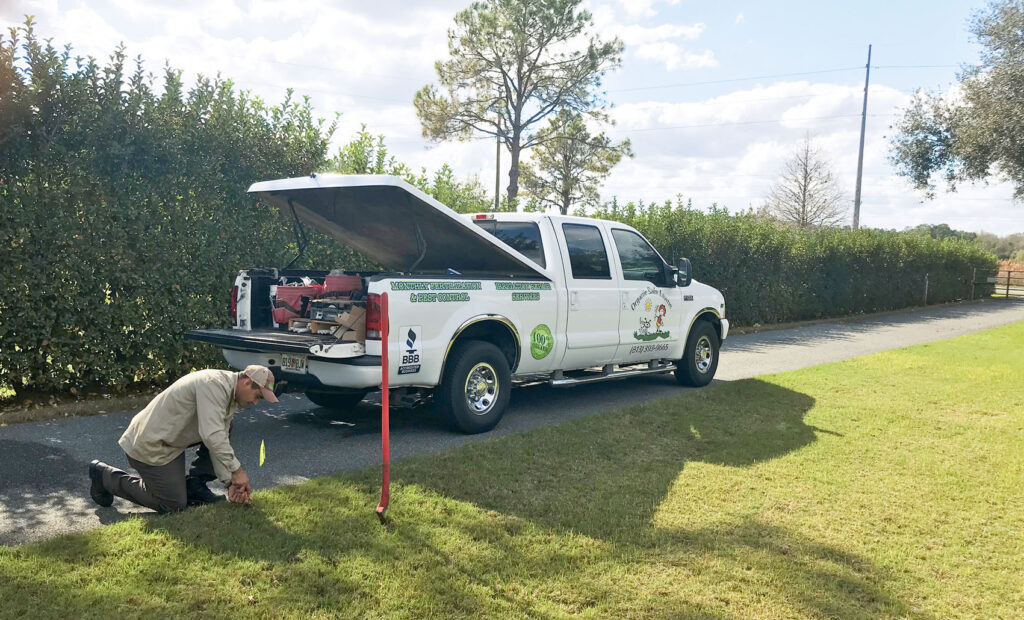
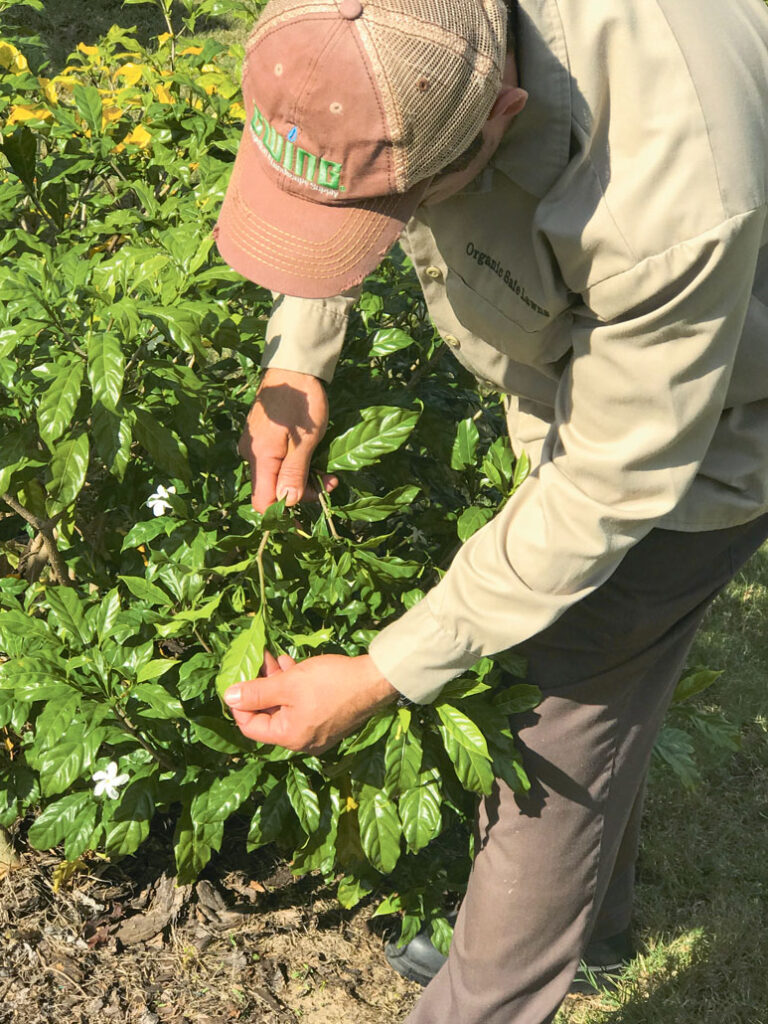
Keeping lawns green, free of pests and healthy is Organic Safe Lawns’ specialty. Whether it’s because your kids play in the grass or your pets like to run around in the yard, making sure they stay danger-free is a big deal for Schanstra.

In fact, he says it’s why he started his business in the first place. 

Schanstra suspects that exposure to DDT (Dichlorodiphenyltrichloroethane) as a youngster had something to do with his wife Julie developing non-Hodgkin’s large cell lymphoma cancer. DDT was used in the U.S. in agriculture as a pesticide and as a household insecticide in the 1940s and 1950s, only to be banned in 1973.

Julie won her fight with cancer, with help from the Mayo Clinic in Rochester, MN, but it was a constant reminder to Schanstra of the potential effects of chemicals used in the environment.

In 2006, just before a scheduled sales meeting with an organic fertilizer manufacturer, Schanstra says that one of the associates said that he’d read a recent news article that claimed Florida was using more chemical-based fertilizers and pesticides on residential properties than the rest of the United States combined.

“This statement hit me like a lightning bolt,” Schanstra says. “It was in that moment that I decided to do something about it. That was the conception of Organic Safe Lawns.”

In January of 2010, Organic Safe Lawns, Inc., became a Florida corporation.

“When I started out, that was my big, hard sell: how do I tell people we can really do it?,” he says. “If we can grow fruits and vegetables organically, why can’t we grow grass that way? That was the concept in my mind.”

Schanstra works closely with one of the top organic fertilizer manufacturers and pioneers of the industry. The products — fertilizers, pesticides and herbicides — used by Schanstra and Organic Safe Lawns are certified by the Organic Materials Review Institute or OMRI, an independent testing company that certifies organic products. He says the products use a proven technology that was originally designed for fruits and vegetables, although Organic Safe Lawns deals strictly with lawns and ornamental plants.

Organic Safe Lawns, Inc., has now designed and manufactured more than 30 different organic fertilizer products that are owned and trademarked by the corporation.

While most typical fertilizers are made up of synthesized chemicals, Schanstra says the products he uses are mostly mined from the shale level of the earth, where healthier and more acidic soil exists. There are richer supplies of micronutrients, enzymes and bacterias found in this soil.

“There’s no downside with our fertilizers,” Schanstra says.

Other lawn companies also use mined products, but they are converted into a granular form — those little balls you see in your grass after the lawn company has stopped by — by incorporating binders and fillers to keep their shape. That’s where Schanstra says carcinogens are often entered into the mixture.

“Once those little balls dissolve, those chemicals end up running off into our aquifers, which are sometimes only a foot or two deep below, and can get into our water, streams and ponds and cause algae blooms,” Schanstra says.

Typical fertilizers come in two types of encapsulation. The first is water-based, meaning the fertilizer is released by coming into contact with water. The second is a polymer, or plastic encapsulation. Its releasing agent is heat. 

Schanstra says those forms of release may be fine for more moderate northern climates. However, Florida’s famously erratic weather — sometimes too much rain and often too much heat — can sometimes cause the release of a month’s worth of fertilizer in a week or even a day.

Using chemical fertilizers and pesticides may lead to greener lawns — due to their higher concentrations of nitrogen — but it also can lead to the same typical lawn problems so common here in Florida. Lawn problems like fungus and disease, chinch bugs, webworms and mole crickets are often found in high-nitrogen soils.

“We found that by reducing the nitrogen level (in the products Organic Safe Lawns uses), we almost eliminate fungus and pests,” Schanstra says. “The cheapest way to get green grass is with high-nitrogen fertilizer.”

Schanstra also says that high-nitrogen fertilizers push top growth and weaken root structure. Over time, the lawn’s root system can’t sustain the foliage.

“A weakened root structure is like candy to bugs,” Schanstra says. “After using our treatment, you’ll see the bugs moving over into the neighbor’s yard.”

Chemical-based fertilizers are designed to be absorbed through the leaf (called foliar absorption). All of the organic fertilizers that Schanstra uses are absorbed through the roots. And, he adds, they are all water-soluble liquids that are safe for pets, wildlife and humans.

“When we apply organic fertilizers, I’m spraying that into the soil,” he says. “The only way the plant absorbs it is into the root system. My grass will grow a little bit slower, but my roots will be stronger.”

Top-coated lawns treated with synthetic pesticides and herbicides puts people and pets in danger. Why do you think people applying pesticides wear rubber boots? Because, Schanstra says, they don’t want to get any of the application on them.

In that case, he adds, why would you want you or your pet to track that into your house?

“The dog goes over into the neighbor’s yard to pee, and they’re chewing on their paws when they get back,” Schanstra says. “Kids crawl around and play on the grass and absorb it when they walk in it.”

The chemical herbicide Atrazine is still used widely across the U.S. and Florida to prevent pre- and post-emergence of broadleaf weeds, especially during the summer. It was found by the Agency for Toxic Substances and Diseases (ATSDR) to have adverse effects on the endocrine systems of mammals and that it likely also contribute to some birth defects.

“A lot of lawn companies will blanket your yard with Atrazine,” Schanstra says. “It costs five dollars for a 600-gallon mix. They use it because it’s cheap.”’

But, Organic Safe Lawns’ technicians offer a safe chemical solution for weed control, which is spot-treated throughout the year. It isn’t as cheap as Atrazine, he says, but generally, the stronger root system his lawns have developed lead to fewer weeds anyway.

“We are about the process and the materials,” Schanstra says, “as opposed to using harmful chemicals with regard to weed control.”

Schanstra says he recommends treatment every 30 days, and that it isn’t any more expensive than hiring the lawn care chains. He said he also works with his customers to ensure they are watering and mowing their lawns correctly — two extremely important ways to keep your lawn in tip-top shape that are often overlooked and under-appreciated.

Organic Safe Lawns services Tampa, New Tampa, Wesley Chapel and Land O’ Lakes. For more info, call (813) 393-9665, email organicsafelawns@verizon.net or visit OrganicSafeLawns.com. Existing customers can pay their invoices on the website, too! Prospective customers can fill out a contact form on the site to get a free estimate and $10 off their first treatment.

First-Ever Goalie Camp Draws A Big Crowd

Tampa’s Nick Ryan lunges to try and stop a shot at the Goalies Inc. Performance Camp at AdventHealth Center Ice on Aug. 6.  (Photos: Mike Camunas) 

Nothing was going to stop these goalies from stopping pucks.

Despite the fact it had to be pushed back due to Covid-19, more than 40 youth ice hockey goalies recently were able to get in a training camp’s worth of goaltending work in two days (Aug. 5-6) at the Goalies, Inc., Performance Camp at AdventHealth Center Ice (AHCI) in Wesley Chapel.

Originally scheduled for March, Bernie Desrosiers, the executive director of Sunbelt Hockey Scouting and a long-time New Tampa-area hockey coach, says the camp was sold out well before the coronavirus shut down youth sports programs.

“We’ll have it again next year,” Desrosiers said. “This has been a great turnout and, so far, all the feedback we’ve gotten has been that everyone was happy to finally be able to come to this camp. “It’s been a great two days.”

Desrosiers added that of the 42 young goalies who participated, only one had to be sent home sick — not Covid-19 related — and that there were no injuries sustained. “Pretty remarkable, I’d say,” Desrosiers said.

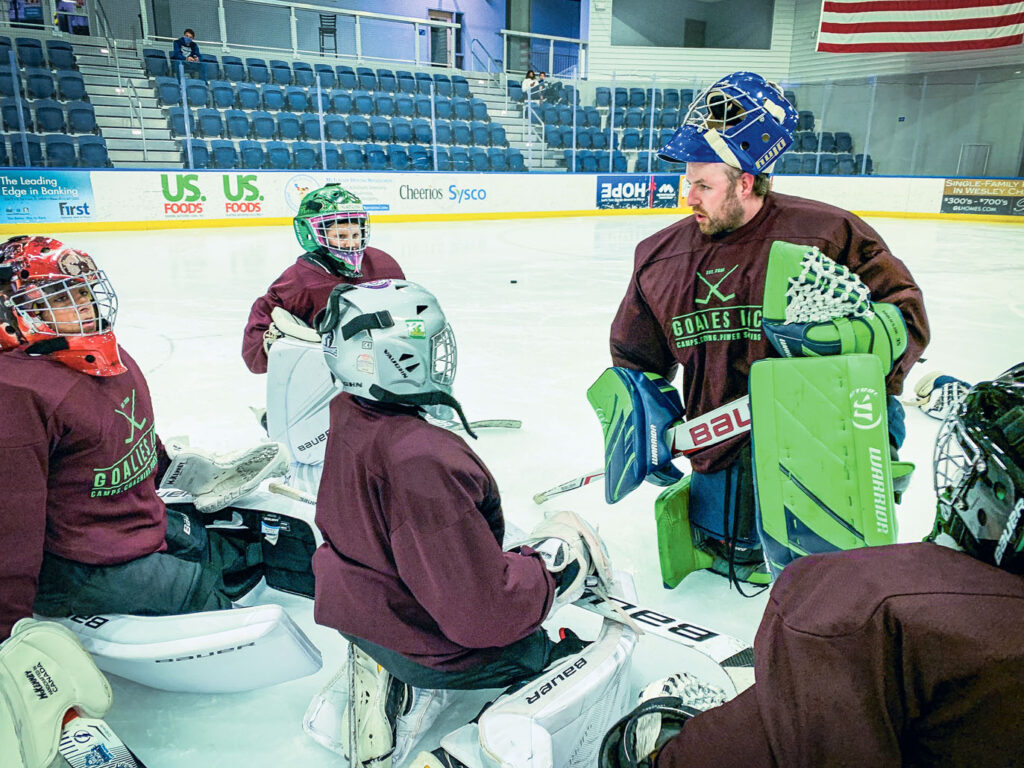
Head instructor Jim Stanaway provides instruction to some of the 42 goalies in attendance. 

Led by Goalies, Inc. head instructor Jim Stanaway, boys and girls, teenagers and “tweens” went through various drills to hone their goaltending skills in the hopes of being the next Andrei Vasilevskiy (the Tampa Bay Lightning goalie) or Madeline Rooney (the starting goalie for the Olympic gold medal-winning 2018 USA women’s hockey team). The young goalies worked on glove and stick saves, rebound shots, skating backwards, diving for pucks and even how to hug the pipes to block shots.

Stanaway also preached a lot, not only about teamwork, sportsmanship and respect for the game, but also for the goalies’ fans (their families). 

As he watched netminders of all sizes and ages scramble to grab pucks, the goalie instructor of nearly two decades was impressed by his first trip to the Tampa Bay area and its local talent.

“With an NHL team, and them doing very well, it’s nice to see (the high interest in hockey in a southern city or state),” he said. “A lot of these southern NHL teams invest in their communities a lot, but the enthusiasm (here) is quite amazing.”

For more info about Goalies, Inc., camps, visit GoaliesInc.com.

Local Girl Scouts Helping Dogs Despite Covid-19

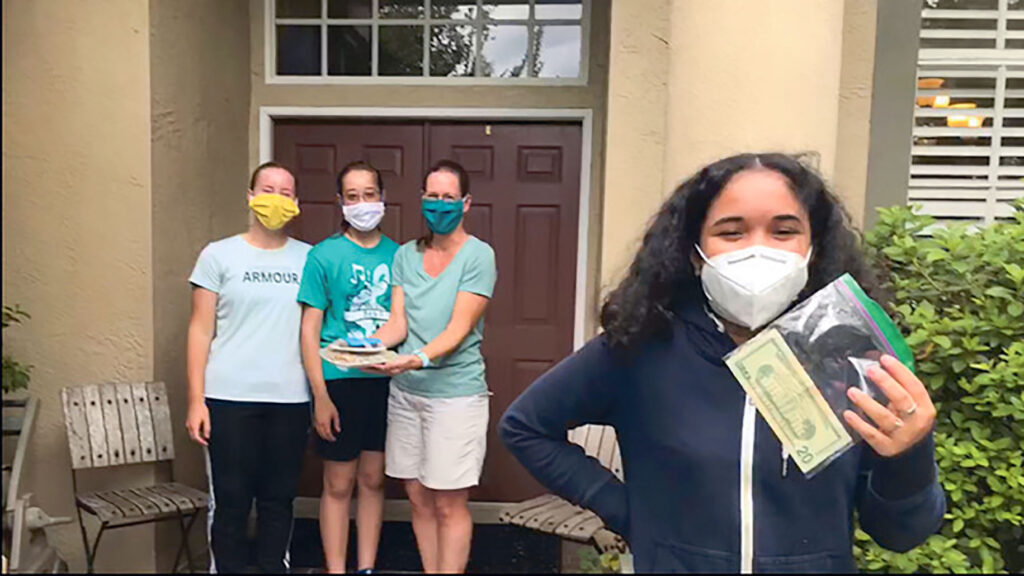
(L.-r.) Girl Scouts Amelia Beanland and Isabela DuBois present the “snuffle mats” they and their Troop 32801 made to Pasco County Animal Services, as part of their Silver Award project.

We’ve all had to do some adjusting since the Covid-19 pandemic started in the spring.

For a pair of eighth grade (now ninth grade) Girl Scouts, the pandemic meant that they faced obstacle after obstacle while trying to earn their Silver Awards, which is the highest award given by Girl Scouts to its Cadettes, who are girls in sixth through eighth grade. 

Fortunately for Isabela DuBois, who lives in Cory Lake Isles, and her project partner, Amelia Beanland, who lives in Cross Creek, they learned how to be flexible, adapt and persevere when things don’t go as planned.

The girls earned their Silver Awards before bridging to Seniors at the end of July.

Isabela has been a member of Girl Scout Troop 32801, which typically meets at Benito Middle School, since Daisies, when she was just six years old. Amelia joined the troop when she was in sixth grade. Currently, Troop 32801 has been meeting through Skype.

That’s just one of the changes the girls faced in trying to complete their project.

“Our project is called ‘Don’t shop, adopt,’” Isabela says. “We came up with it because we both have a passion for dogs.”

She says they researched puppy mills and worked to educate people about what they learned. They made a flier and created Instagram and Facebook accounts to educate people about the importance of adopting a pet, rather than shopping for one.

Then, they put their research into action by partnering with Pasco County Animal Services to support its efforts to rescue and find homes for dogs in need.

The girls made “snuffle mats”, which are used to hide food or treats for dogs. “We raised the money, bought the supplies, made them, and donated them,” Isabela says. 

However, that wasn’t their original plan.

Isabela’s mom, Crystal, who is the assistant leader for the troop, says she was impressed with the girls’ ability to adapt. 

Crystal explains that the project originally included three girls and was going to focus on awareness of pre-teen and teen anxiety. When one of the girls was diagnosed with anxiety, they thought it was too sensitive and came up with the new idea, focusing on helping dogs. Then, the third girl chose to do a different project, and Isabela and Amelia moved forward without her.

They started by organizing a volunteer day at the Pasco County Animal Services shelter in Land O’Lakes when Covid-19 caused the shelter to close its doors to volunteers. The girls had to figure out what to do next.

They called the shelter, which recommended they make the snuffle mats. The girls then raised the money to get supplies by hosting a “virtual bake sale,” where they delivered goodies to people who bought them online. 

Isabela and Amelia then bought the supplies for the snuffle mats, including fabric and rubber mats with holes in them, and a representative of the shelter taught the troop how to make the mats via a Zoom meeting.

“They kind of got hit up against a wall and figured out a different way around it,” says Crystal. “They learned some strategy skills.”

The girls were each required to contribute 50 hours to the project, and both Isabela and Amelia exceeded that requirement. 

“This took a lot of work,” says Isabela. “We had to change our project from our original plan, then we also had Covid, and we had to change it again. It got harder at the end because we couldn’t meet to do stuff. It was very difficult and stressful.”

Isabela says she is happy to have received the award, given by the Girl Scouts of West Central Florida, but she is more proud of her efforts and says she learned a lot during the process. “I want people to know how to find a proper breeder, kind of like a background check, and how to adopt properly and make sure the pet they adopt is healthy,” she says. “And, if you don’t want a dog, you can still help. You can donate to shelters or volunteer at a shelter.”

Isabela says she and Amelia had money left over from their fund-raising efforts after they made the snuffle mats, so they asked the shelter what kind of food was used, then ordered it and had it delivered.

“People can do that, too,” Isabela says, “and it’s not super expensive.” She says her journey in Girl Scouts is far from over, as she plans to earn her Gold Award, too.

“We’ve done archery, camping, gone canoeing, paddleboarding, ziplining and horseback riding,” she says. “They teach you First-Aid and life skills you won’t learn anywhere else. And, you make friends. I’ve learned so many things that I never would have if it wasn’t for Girl Scouts.”

Search “Florida Girl Scouts against Puppy Mills” on Facebook and on Instagram at “Dont.Shop.Adopt.”

Kiran Indian Grocery — Where You’ll Be Treated Like Family!

Kiran Indian Grocery, located on Cross Creek Blvd. in the Cross Creek Center plaza, has been a mainstay at this constantly-changing plaza since 2014. Before that, owner Kiran Vanthenapalli owned a store (from 2003-06; and an Indian restaurant, too) on E. Fowler Ave. and, from 2006-2010, her store was in the Pebble Creek Collection on Bruce B. Downs (BBD) Blvd.

That means that some of her beloved customers have known and trusted Kiran and her family and staff to provide their (predominantly) Indian and Pakistani spices, frozen foods, meats, snacks, sweets and even hair care and other cosmetic products (and so much more) for almost 18 years. 

And of course, Kiran is perhaps best known for her amazing selection of fresh produce, with some Indian specialty items I’ve never tasted (or even seen) before at prices that she says she knows, “no one can beat. I do my research — and no one beats my prices on produce.” 

But actually, saying that Kiran is best known for her produce isn’t 100-percent accurate. Kiran Indian Grocery is actually best-known for Kiran herself, something that no other store of any kind can boast.

Not only can Kiran tell you where each and every one of her thousands of available items are located, she also can tell you the prices for each — all off the top of her head. That’s kind of amazing because she has so many different items and many different brands of the same types of products — e.g., she has as many different “masala” seasonings and brands as most grocery stores have beers — crammed into a store that somehow seems both much bigger and much smaller than it actually is because it offers such an amazing variety of products. 

That’s not to say that Kiran’s staffers aren’t also knowledgeable. It just has to be impossible for anyone else to have memorized the price, size and exact location within the store of so many different items — many of which aren’t even marked with prices.

But, if Kiran tells you what the price is on any item, rest assured that when that item is rung up at the check-out counter, the exact price she quoted will pop up.

So Many Ways To Serve!

Serving her customers and their needs was of paramount importance to Kiran long before the Covid-19 pandemic hit. She always knows her army of regular customers not only by name (that’s too easy), but also by what they usually are looking for to stock their grocery carts. 

In fact, if she’s ever running low on an item she knows you always get, she’ll hold enough of that item for you, so you can stay stocked until she gets her next shipment of it. “If I only have three left, and I don’t know how soon I’ll get more, I’ll tell you to buy two of them,” she laughs.

And, if Kiran does somehow run out of one of your favorites, she’ll suggest an alternative that you can try that you might end up liking better. “I never want my customers going home unhappy,” she says.

In fact, even though a new, much larger Indian grocery store recently opened in New Tampa during the pandemic, Kiran says that while her customers may have checked out the new store to see what it has that she might not, “My customers are all still coming back because they say the new store (which also stocks a lot of Mediterranean items that she doesn’t carry) can’t match my prices or the service they receive here.” 

Kiran and I first met when we were both members of the Rotary Club of New Tampa Noon (which now meets Wednesdays at noon at Bayscape Bistro in Heritage Isles), and although neither of us currently belongs to that club (see page 34 for more info), we both are firm believers in Rotary International’s “Service Above Self” motto.

But, while service to the community is something I believe in and try to promote in these pages, Kiran and her husband Sudeer have always also served not only their community, but people — and even animals — in need around the world. 

Many of the service projects Kiran was  involved in — some of which she spearheaded — when she was in Rotary helped people in need in not only her native India, but also in other countries in Asia and Africa.

She also has been involved — at least since opening her store in Cross Creek — with the Tampa Bay chapter of the SPCA — the Society for the Prevention of Cruelty to Animals — and she has donated fresh produce, rice and really anything the local chapter has needed because she is such a strong believer that people need pets and that so many of the pets in shelters can and do help individuals and families who need the kind of companionship and love that only a dog or cat can provide.

“I love the SPCA,” Kiran says. “It feels good to help them because they help so many people…and animals.”

And, even though she says doing grocery packing for her customers who physically can’t or aren’t comfortable walking into any store right now, “Is very time-consuming and difficult, because of all the different items we have, I just feel like I have to do it for some of these customers. We all wear masks and keep everyone socially distant, especially at the checkout line, but some people still need that help and I am proud to do that for them.”  

Service To Other Businesses, Too?

When Covid-19 hit back in March and I started going through the issues I did with my printer, Kiran was probably the first (but thankfully, not the only) advertiser to call me and say, “What do you need? How can I help?” 

When I interviewed Kiran for this story, she told me that, “I thought you said in the paper that you were going out of business, Gary. I started crying. I told Sudeer, ‘We have to help our brother.’”

Even though I thankfully never got to that point and have no Indian heritage whatsoever, Kiran has called me her brother for years now. And, even though she seems to treat everyone who stops into the store like a member of her family, I refer to her as my sister, too. You just can’t fake her kind of genuine goodness and compassion for others.

But, it’s a big compliment to me because she does also have an amazing family of which she is equally proud. Husband Sudeer is a software engineer and their older son Satvik just graduated from medical school at USF and is focusing on Psychiatry, while younger son Sahit recently graduated from USF undergrad and is applying to med schools, too.

Another case in point about how Kiran treats everyone is that, in part also because of Covid-19, when people check out at her store, she or her cashier will put coupons from other local businesses in the customers’ shopping bags. She has helped most of the Indian restaurants and other businesses owned by people from India and Pakistan in our area this way and she says that she would be happy to do it for other businesses, too. “We’re all in this thing together,” she says.

And of course, whether you like or want to cook Indian food or not, if you’re a fan of delicious chocolate cookies or other sweet and/or salty treats, or you want the best prices in town on fresh produce, you owe it to yourself to visit my sister Kiran.    

Kiran Indian Grocery is located at 10042 Cross Creek Blvd. and its recently updated open hours are Monday-Sunday, 10 a.m.-8 p.m. For more info, call (813) 994-6202 or search “Kiran Indian Grocery” on Facebook!