

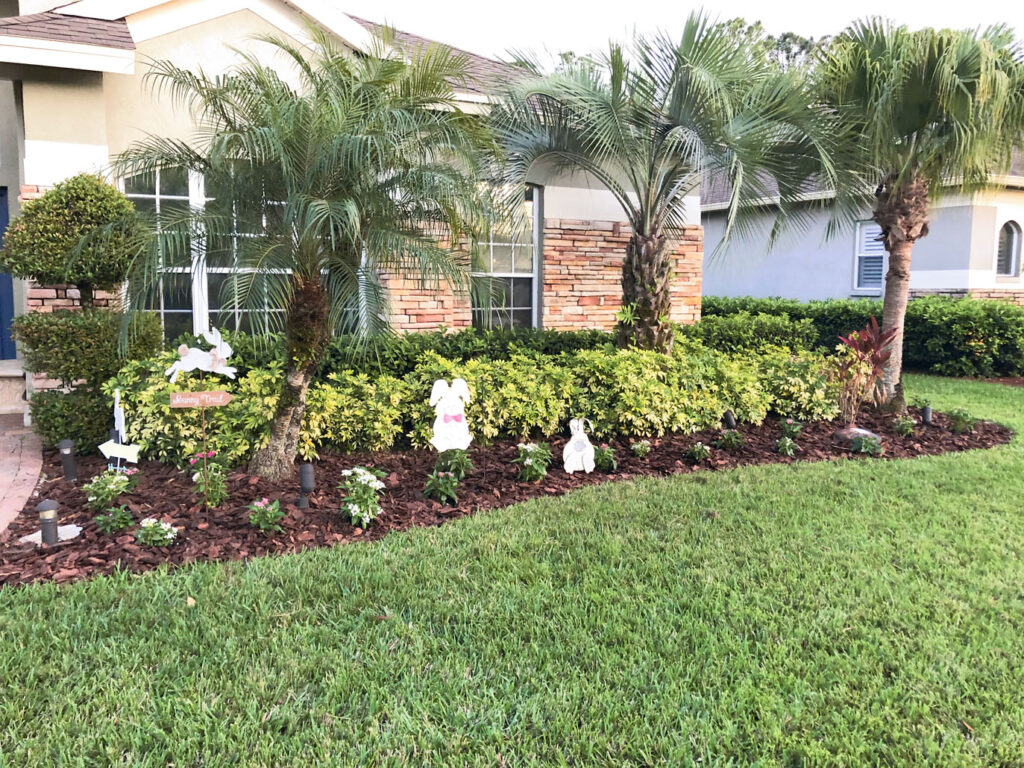
Nick Pipitone has used other lawn service companies, and even tried to keep his yard green and healthy himself, but he says he was looking for a safer, more environmentally sound option to keep his lawn, as well as his beloved English bulldog, chemical-free.
That’s why, about five years ago, Pipitone decided to hire Jim Schanstra and his Organic Safe Lawns to take care of his lawn.
“I gotta tell you, there is stuff out there, the stuff they (Organic Safe Lawns) uses, that greens up the grass real good,” says Pipitone, a Wesley Chapel resident. “You don’t need all the chemicals. That’s what I was looking for…and they have done a great job.”
Keeping lawns green, free of pests and healthy is Organic Safe Lawns’ specialty. Whether it’s because your kids play in the grass or your pets like to run around in the yard, making sure they stay danger-free is a big deal for Schanstra.
In fact, he says it’s why he started his business in the first place.
Schanstra suspects that exposure to DDT (Dichlorodiphenyltrichloroethane) as a youngster had something to do with his wife Julie developing non-Hodgkin’s large cell lymphoma cancer. DDT was used in the U.S. in agriculture as a pesticide and as a household insecticide in the 1940s and 1950s, only to be banned in 1973.
Julie won her fight with cancer, with help from the Mayo Clinic in Rochester, MN, but it was a constant reminder to Schanstra of the potential effects of chemicals used in the environment.
In 2006, just before a scheduled sales meeting with an organic fertilizer manufacturer, Schanstra says that one of the associates said that he’d read a recent news article that claimed Florida was using more chemical-based fertilizers and pesticides on residential properties than the rest of the United States combined.
“This statement hit me like a lightning bolt,” Schanstra says. “It was in that moment that I decided to do something about it. That was the conception of Organic Safe Lawns.”
In January of 2010, Organic Safe Lawns, Inc., became a Florida corporation.
“When I started out, that was my big, hard sell: how do I tell people we can really do it?,” he says. “If we can grow fruits and vegetables organically, why can’t we grow grass that way? That was the concept in my mind.”
Schanstra works closely with one of the top organic fertilizer manufacturers and pioneers of the industry. The products — fertilizers, pesticides and herbicides — used by Schanstra and Organic Safe Lawns are certified by the Organic Materials Review Institute or OMRI, an independent testing company that certifies organic products. He says the products use a proven technology that was originally designed for fruits and vegetables, although Organic Safe Lawns deals strictly with lawns and ornamental plants.
Organic Safe Lawns, Inc., has now designed and manufactured more than 30 different organic fertilizer products that are owned and trademarked by the corporation.
While most typical fertilizers are made up of synthesized chemicals, Schanstra says the products he uses are mostly mined from the shale level of the earth, where healthier and more acidic soil exists. There are richer supplies of micronutrients, enzymes and bacterias found in this soil.
“There’s no downside with our fertilizers,” Schanstra says.
Other lawn companies also use mined products, but they are converted into a granular form — those little balls you see in your grass after the lawn company has stopped by — by incorporating binders and fillers to keep their shape. That’s where Schanstra says carcinogens are often entered into the mixture.
“Once those little balls dissolve, those chemicals end up running off into our aquifers, which are sometimes only a foot or two deep below, and can get into our water, streams and ponds and cause algae blooms,” Schanstra says.
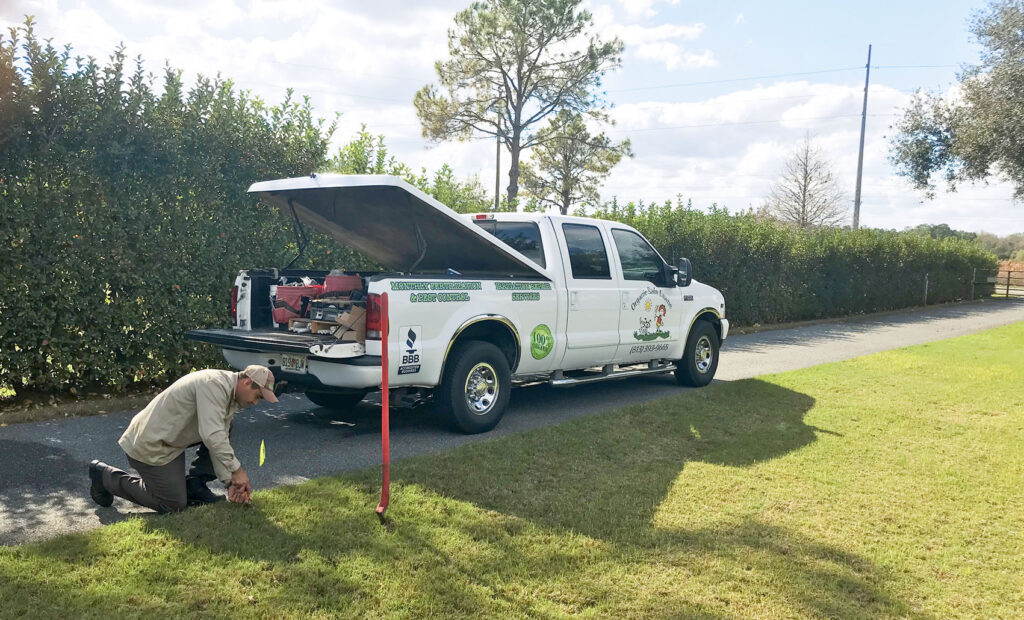
Typical fertilizers come in two types of encapsulation. The first is water-based, meaning the fertilizer is released by coming into contact with water. The second is a polymer, or plastic encapsulation. Its releasing agent is heat.
Schanstra says those forms of release may be fine for more moderate northern climates. However, Florida’s famously erratic weather — sometimes too much rain and often too much heat — can sometimes cause the release of a month’s worth of fertilizer in a week or even a day.
Using chemical fertilizers and pesticides may lead to greener lawns — due to their higher concentrations of nitrogen — but it also can lead to the same typical lawn problems so common here in Florida. Lawn problems like fungus and disease, chinch bugs, webworms and mole crickets are often found in high-nitrogen soils.
“We found that by reducing the nitrogen level (in the products Organic Safe Lawns uses), we almost eliminate fungus and pests,” Schanstra says. “The cheapest way to get green grass is with high-nitrogen fertilizer.”
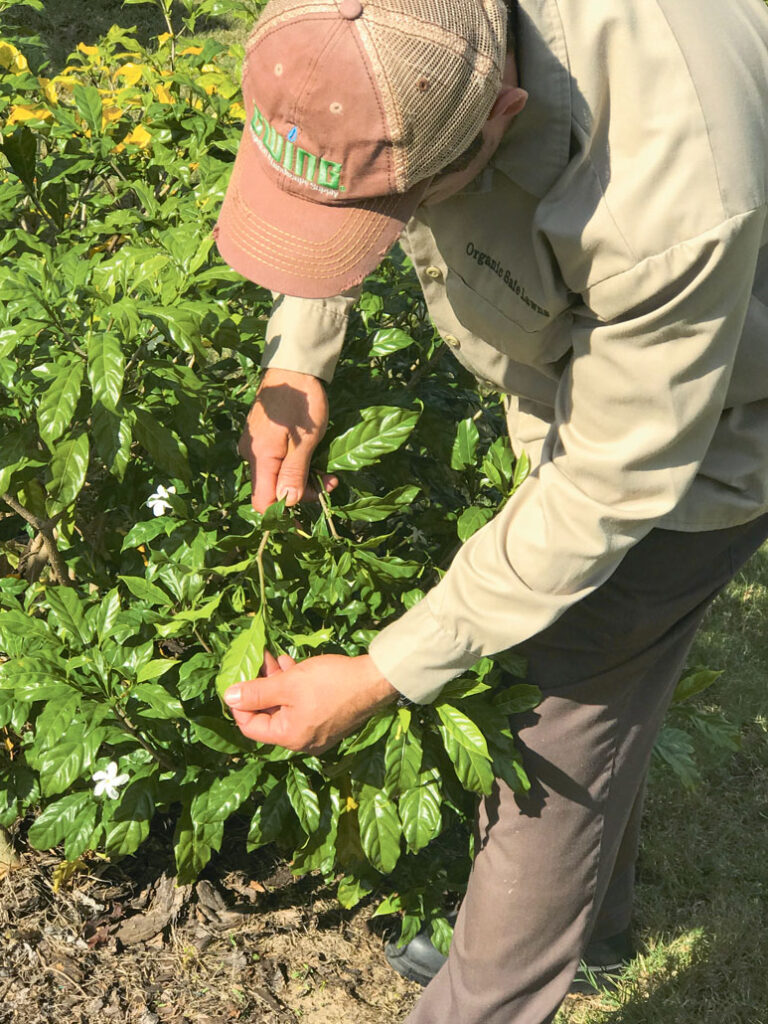
Schanstra also says that high-nitrogen fertilizers push top growth and weaken root structure. Over time, the lawn’s root system can’t sustain the foliage.
“A weakened root structure is like candy to bugs,” Schanstra says. “After using our treatment, you’ll see the bugs moving over into the neighbor’s yard.”
Chemical-based fertilizers are designed to be absorbed through the leaf (called foliar absorption). All of the organic fertilizers that Schanstra uses are absorbed through the roots. And, he adds, they are all water-soluble liquids that are safe for pets, wildlife and humans.
“When we apply organic fertilizers, I’m spraying that into the soil,” he says. “The only way the plant absorbs it is into the root system. My grass will grow a little bit slower, but my roots will be stronger.”
Top-coated lawns treated with synthetic pesticides and herbicides puts people and pets in danger. Why do you think people applying pesticides wear rubber boots? Because, Schanstra says, they don’t want to get any of the application on them.
In that case, he adds, why would you want you or your pet to track that into your house?
“The dog goes over into the neighbor’s yard to pee, and they’re chewing on their paws when they get back,” Schanstra says. “Kids crawl around and play on the grass and absorb it when they walk in it.”
The chemical herbicide Atrazine is still used widely across the U.S. and Florida to prevent pre- and post-emergence of broadleaf weeds, especially during the summer. It was found by the Agency for Toxic Substances and Diseases (ATSDR) to have adverse effects on the endocrine systems of mammals and that it likely also contribute to some birth defects.
“A lot of lawn companies will blanket your yard with Atrazine,” Schanstra says. “It costs five dollars for a 600-gallon mix. They use it because it’s cheap.”’
But, Organic Safe Lawns’ technicians offer a safe chemical solution for weed control, which is spot-treated throughout the year. It isn’t as cheap as Atrazine, he says, but generally, the stronger root system his lawns have developed lead to fewer weeds anyway.
“We are about the process and the materials,” Schanstra says, “as opposed to using harmful chemicals with regard to weed control.”
Schanstra says he recommends treatment every 30 days, and that it isn’t any more expensive than hiring the lawn care chains. He said he also works with his customers to ensure they are watering and mowing their lawns correctly — two extremely important ways to keep your lawn in tip-top shape that are often overlooked and under-appreciated.
Organic Safe Lawns services Tampa, New Tampa, Wesley Chapel and Land O’ Lakes. For more info, call (813) 393-9665, email organicsafelawns@verizon.net or visit OrganicSafeLawns.com. Existing customers can pay their invoices on the website, too! Prospective customers can fill out a contact form on the site to get a free estimate and $10 off their first treatment.