Teen’s Passion Is Making Old Typewriters New Again

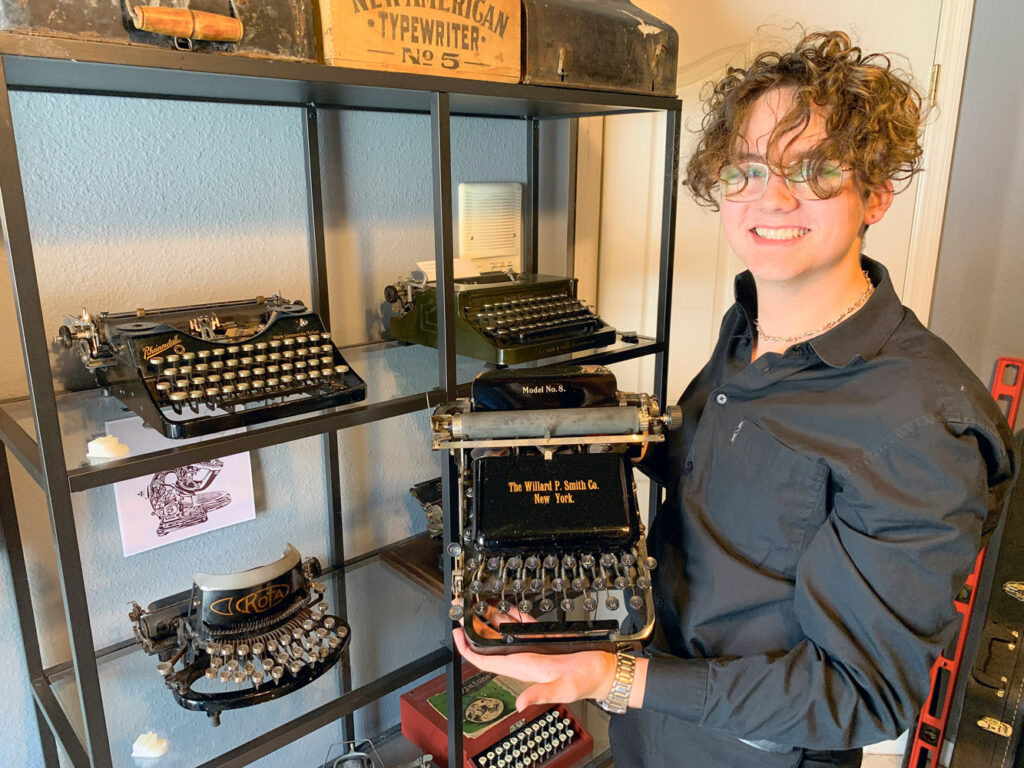
This 1914 Willard P. Smith Co. typewriter may only be worth $2,000, but Armstrong says it would take 500 times more than that for him to give it up, as it means the most to him. (Photo: John C. Cotey)

Like most kids his age, 16-year-old Jack Armstrong can sit in front of a keyboard for hours on end, expertly manipulating the keys with his fingers to get the desired result.

There is one major difference, however. Instead of doing so in front of a computer, Armstrong is sitting in front of an actual typewriter, which are sometimes 100 years older than he is.

Whether it’s an 1880s Caligraph 2, a 1907 Handler or a 1914 Annell, Armstrong takes great delight in dissecting these machines from another time and restoring them to their original working condition, which he then sells, trades or displays on a shelf in his bedroom.

“It’s a passion,” he says of his craftsmanship. “I just love it.”

Armstrong is a rarity in the world of typewriter collectors and repairs, due to his age, but he is far from alone. He estimates that there are roughly 5,000-6,000 typewriter enthusiasts across the country who gather at small conventions and actively collect, trade and sell machines that may be outdated, but still stoke a deep love and appreciation from their admirers.

Armstrong has loved typewriters since he was a young kid, when his mother Rebecca would drag him with her on her Saturday afternoon antiquing expeditions.

Always a mechanical sort with a knack for taking things apart to see how they work, Armstrong was always drawn to the old typewriters he would see, with so many gears and type bars. 

He was 12 when he asked for one for Christmas, and his parents bought him a 1949 Royal. It needed repairs, so he found some tips on YouTube and, an hour later, the Royal was back in service.

“I was able to take this old antique that didn’t work and make it like new,” Armstrong says. “I got addicted to that, and it’s been snowballing ever since.”

An online high school student who is practically on the computer 24/7, Armstrong says he finds the tactile experience and ability to disconnect while he types refreshing and necessary. He types and mails 3-4 letters a week to friends and other collectors.

And Armstrong has turned his passion into a business— the Tampa Typewriter Co. People from around the world now send him their typewriters, paying — and praying — for a miracle restoration.

He says he made $20 on his first repair job, though that same job would cost $100 now. His slogan: “I can repair any typewriter from 1880 to 1980.”

“It just clicked at that moment that I’ve tapped into a niche,” Armstrong says. “I can turn this into a genuine business.” 
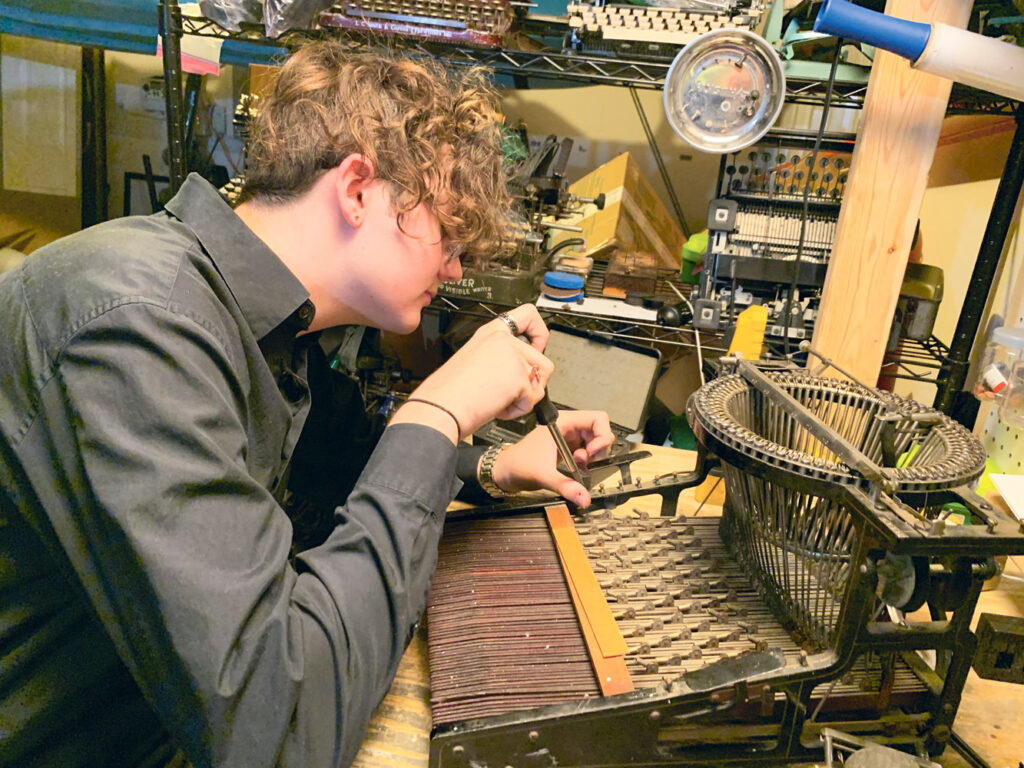
Jack Armstrong works on a typewriter in his garage workshop.

While others may just paint or spruce up older typewriters for customers who want a display piece, Armstrong says he tries to keep the original finish, even if that means a good helping of elbow grease. He will source the parts and replace things like the felt soundproofing, the rubber feet and everything in between.

“What I focus on is making them work,” he says. “I make them as nice as possible, and as new as possible.”

That means zero short cuts, which might include polishing a part of the typewriter that you will never see again. “I shine it up to a mirror finish, even though you won’t see it unless you take the machine apart.”

Armstrong’s latest effort was restoring an 1890 Caligraph No. 2  with a matching table. He put in more than 25 hours on the project, and has it listed for $2,000 on tampatypewriter.com. He wouldn’t hate keeping it as his own, either.

So Many Stories…

In his Wesley Chapel home, which includes a workshop in his garage, Armstrong has roughly 100 typewriters — 80 are his, and the other 20 he is repairing.

Typewriters that still work are rare. Of the 100 or so he says he has purchased via eBay over the years, only three arrived without needing anything more than a new ribbon.
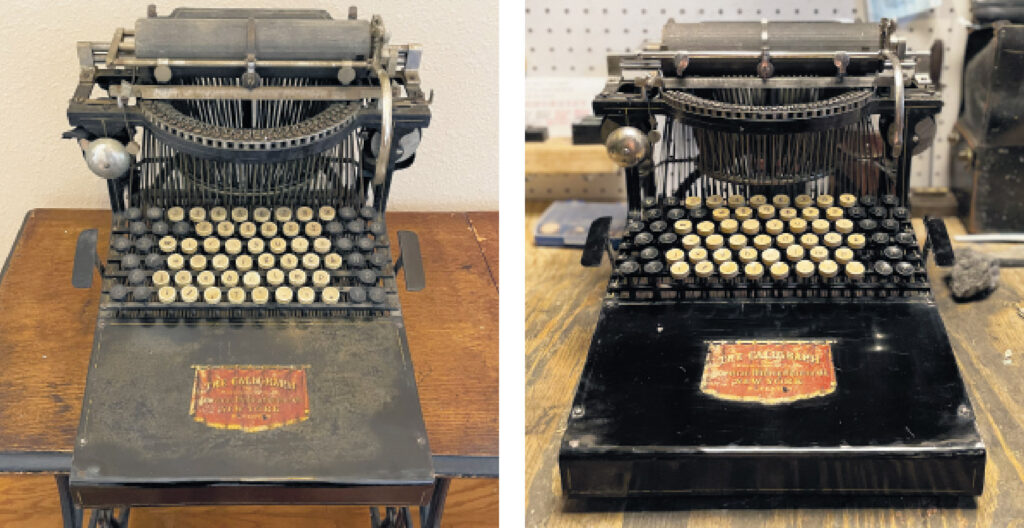
For Jack Armstrong (top) restoring typewriters like the 1890 Caligraph No. 2 (above) is a passion that he has turned into a successful business.

He’s always looking. The one typewriter he would like to own? A Commercial Visible 6, a sleek silver machine with a gold decal that uses a type wheel that can be switched with another to change the font. 

It originally sold for $50 in 1898. Armstrong says only 35 are known to still exist.

“It’s one of the most beautiful typewriters ever produced,” Armstrong says. 

His most valuable typewriter is a Willard P. Smith Co. Armstrong says everything he has can be had for a price, but the Willard P. Smith would require a hefty bounty.

He won the typewriter in an auction on eBay, bribing other bidders to bow out. It cost him $800 total.

“No typewriter has ever sold for over a million dollars. But, I would need over a million dollars (to sell the Willard P. Smith),” Armstrong says. “It’s just too special to me.”

Armstrong’s prized possession, however, is an Armstrong typewriter, which he wanted because of the shared name. There are only 14 in existence, and he owns two of them. 

“They are my obsession,” he says, and they share a shelf with the Willard P. Smith in his room, which he refers to as his own personal typewriter museum.

When it comes to actual museums, Armstrong will soon have some of his own handiwork on display in one. A few typewriters that he restored for collectors Mark and Christina Albrecht of Bradenton were bought as part of a larger collection for a soon-to-be-built museum in Dubai, “which is pretty cool,” Armstrong says.

Every typewriter in his room has a story, and Armstrong revels in telling them. There’s the Type-a-Tune, a 1949 machine used to teach typing that also plays music, and he was offered $800 just for the instructional book alone.

A Simplex typewriter has attracted offers of more than $5,000, and a Vogue Royal with a sans serif typeface will sell for roughly $3,500. A rusty Annell is one of only 11 known to exist and has a pharmaceutical keyboard, as well as a sans serif typeface, making it even rarer, while his Mignon Model 2B has a Blackletter typeface called Fraktur. The typewriter was produced during a time when the Fraktur typeface was obsolete and not used, he says.

Thanks to some recent media exposure, Tampa Typewriter Co. is growing. Armstrong has restored nearly 250 typewriters, and as word of his dedication and prowess spreads, more business keeps coming his way. He has made more than $50,000 in sales to date, and says he would one day like to open a physical location.

Typewriters themselves may be obsolete, but this Wesley Chapel teenager is working hard to keep them alive.

“I’m 16, and I think people like the idea of this young gun working on these old machines,” Armstrong says. “It’s an unmatched level of work, and I just have this insane passion for it that most people don’t.”

For typewriter repairs, refurbs and resales, or just to check out some of the many collectibles Armstrong has repaired, visit TampaTypewriter.com, send an email to Tampatypewriter@gmail.com or call (813) 992-9799.

Meadow Pointe Blvd. Connection To New Tampa On The Way

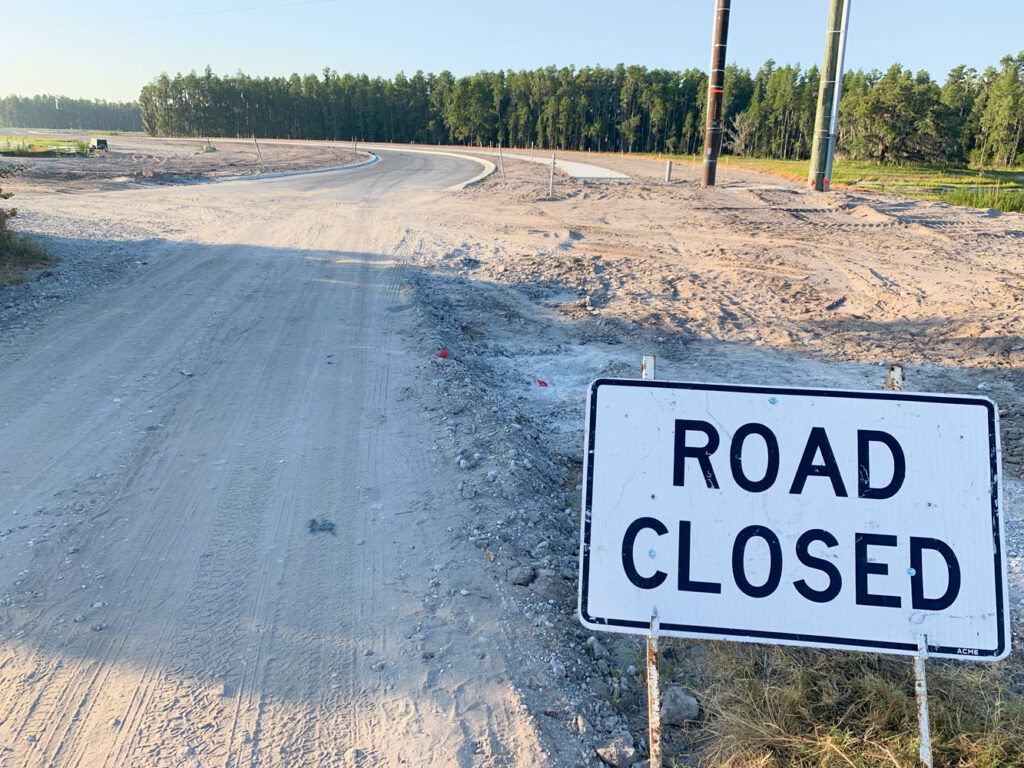
The connection between Meadow Pointe Blvd. and K-Bar Ranch Pkwy. is currently under construction and could be completed by the end of 2021. (Photo: John C. Cotey)

After years of debate over connecting Mansfield Blvd. in Wesley Chapel to Kinnan St. in New Tampa for through traffic, the consolation prize (for those who unsuccessfully fought for that connection) could be completed by the end of this year.

MI Homes, which is developing New Tampa’s K-Bar Ranch community, located directly to the south of Meadow Pointe, has targeted Dec. 31 as a completion date for the K-Bar Ranch Pkwy. connection to Meadow Pointe Blvd., opening up traffic in both directions.

Although the Pasco County side of the connection is completed, there are still some permitting issues to resolve that could stretch that completion date into 2022, but the goal is sometime this year. 

The Meadow Pointe Blvd. connection will be the only northbound way out of K-Bar Ranch or southbound way into K-Bar Ranch (other than Morris Bridge Rd.) when K-Bar Ranch Pkwy. is completed.

The roadway is currently under construction. About 100 feet of dirt road separate the southern end of Meadow Pointe Blvd. and the connector, which will lead to K-Bar Ranch Pkwy.

After the debate over Kinnan-Mansfield intensified in 2018, and after years of negotiating with Hillsborough County, Pasco County commissioned a study that recommended connecting those two roads for emergency use only. A gate that can only be accessed by emergency response vehicles is supposed to be keeping motorists from crossing the Pasco and Hillsborough county lines (although we reported in a previous issue vehicles have been bypassing the gate).

However, the study did recommend instead making a connection at the unfinished Meadow Pointe Blvd., as well as at Wyndfields Blvd. further to the east.

The Pasco County Metropolitan Planning Organization (MPO) also conducted a Connections Survey, and 67 percent of approximately 1,200 residents who voted made the connection to Meadow Pointe Blvd. the No. 1 choice.

One of the primary arguments against Kinnan-Mansfield, but for Meadow Pointe Blvd, made by District 2 Pasco County Commissioner Mike Moore and others, was the ability of each road to handle the additional traffic — the Roadways Report suggested it could add as many as 4,000 vehicles — from Hillsborough County.

Mansfield Blvd. is a two-lane road as is Meadow Pointe Blvd. (though in our last print edition we said it was four lanes, our apologies) and connecting to New Tampa via Meadow Pointe Blvd. instead of Mansfield Blvd. was the “most sensible choice,” according to District 5 commissioner Jack Mariano.

K-Bar Ranch Pkwy. is being constructed in segments and, once each road segment is completed, it will permit the developers to build more homes in that area. 

Segment C, starting at the Kinnan St. entrance, is currently completed. Segment D, which is partially completed, will connect to the Meadow Pointe Blvd. extension, which also is under construction.

Get Walk-In Covid Vaccines & Personal Service at Prime Rx Pharmacy

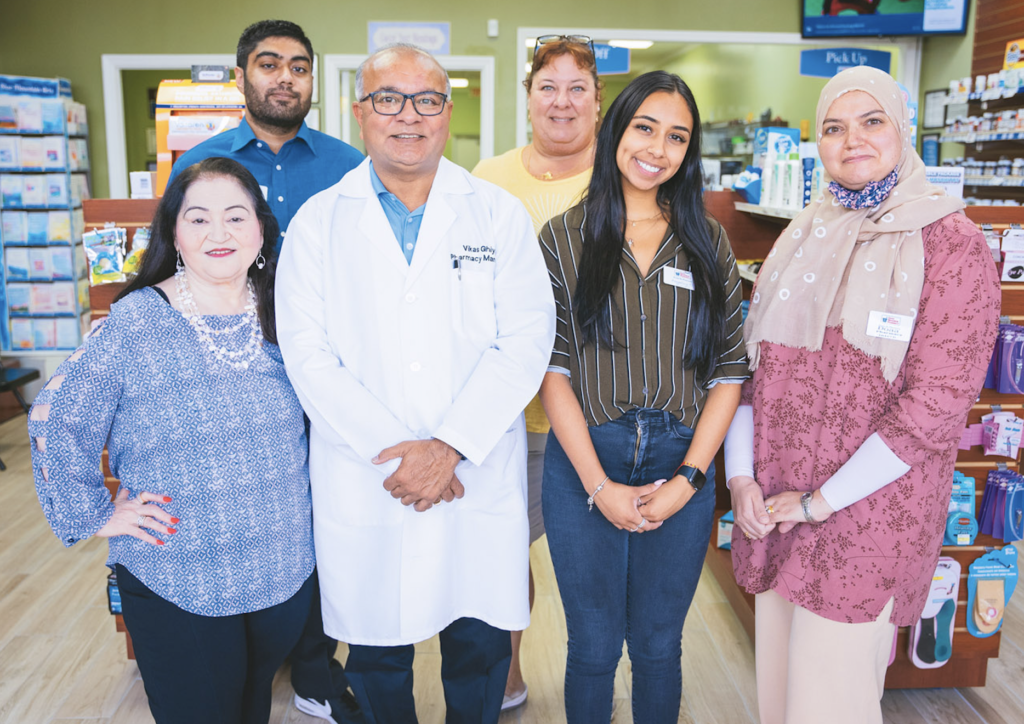
The staff at Prime RX Pharmacy on Cross Creek Blvd. includes (l.-r, front row): co-owner Harsha Ghiya, pharmacist & co-owner Vikas Ghiya, pharmacy tech Angelica Guinand & pharmacy intern Doaa Abd Alghafar. (Back row) Pharmacy techs Ayush Gandhi & Victoria Hart. (Photos by Charmaine George)

Prime Rx Pharmacy in the Cross Creek Center plaza on Cross Creek Blvd. (at Kinnan St.) is making it easy for adults, teens, and kids ages 12 and up to get a Covid-19 vaccine.

Vikas Ghiya, R.Ph. (Registered Pharmacist), says that’s the key to students being able to return to school safely this fall.

“If people are vaccinated, the chances are less to get sick or spread Covid,” says Vikas, who emphasizes that it is both convenient and free to get a vaccine. “There’s no cost for the vaccines and no charge for patients, whether they have insurance or not.”

The pharmacy offers all three currently available Covid-19 vaccines — the two-dose vaccines manufactured by Moderna and Pfizer and the single-dose Johnson & Johnson vaccine — and those who want them can just stop in at a convenient time.

If you prefer to make an appointment, you can do so by calling the pharmacy at (813) 955-7777 or by visiting mycovidshots.com/#!/form/PrimeRxPharmacy to make your appointment online.

For the past year, the pharmacy has been taking precautions to ensure that its customers and staff stay safe during the pandemic. Now, the precautions are routine.

For example, masks are worn at all times, chairs up front are separated for social distancing, shields are installed to separate staff from customers at the register, and additional cleaning measures are in place.

In addition to home delivery for anyone who is not comfortable coming into the store, Prime Rx now also offers curbside service.

The ease of getting a vaccine and having prescriptions delivered to your car or home are examples of the many ways Prime Rx Pharmacy puts its patients first and serves them in a personalized way.

Vikas, who is a long-time New Tampa resident, opened the Cross Creek location nearly two years ago, bringing his business to his home neighborhood from its previous location in Pinellas County.

He has worked as a pharmacist since 1992, first for Eckerd, then Publix. In 2009, he established Prime Rx Pharmacy in Seminole with partners who opened other Prime Rx pharmacies in St. Petersburg and Riverview.

When the partnership dissolved in 2012, Vikas kept his Seminole location open while he commuted from New Tampa. He says that when he had the opportunity to relocate, he decided to come all the way to New Tampa, cutting three hours out of his daily commute.

Vikas has been married to his wife, Harsha, for 32 years. Harsha manages the office and billing for the pharmacy, and also has a license as a pharmacy technician, so she can help her husband with that part of the business when needed.

Vikas says the entire staff prides itself on being both fast and accurate, plus going above and beyond what is typical at a corporate pharmacy or chain drug store.

“Here, customer service is a priority,” explains Vikas. “We often recognize our customers and welcome them by name.”

In fact, to be more accessible to patients, the pharmacy can now be reached by text message. “People can text us whenever we are open,” says pharmacy tech Angelica Guinand, “to ask questions or ask for refills.”

If you text after hours, a member of the pharmacy staff will reply when the office opens again.

Prime RX Pharmacy carries a wide selection of over-the-counter medications, vitamins and durable medical equipment (DME) for sale, with some items also for rent, such as wheelchairs and canes. 

In India, Vikas was educated in Ayurvedic medicine, which is a holistic healing system developed more than 3,000 years ago. He earned a doctorate degree and practiced Ayurveda in India until 1988, when he moved to the United States. He explains that in the U.S., his doctorate in Ayurveda is not recognized.

So, Vikas enrolled at St. John’s University in Queens, NY, and received his B.S. degree in Pharmacy in 1992. Then, he moved to Florida.

“Even back then, corporate pharmacy was looking at quantity, not quality,” he says. That’s why he chose to be an independent pharmacist, using both his pharmacological training and physiological training from India to spend more time with each patient.

Blister Pack Prescriptions…

Prime Rx Pharmacy offers customized pill packaging, with medications sorted by the day and time a patient should take each of them. This is especially helpful for people who are chronically ill and take several medications at different times throughout the day.

“Instead of opening three or four different bottles, patients just open one blister pack,” Ghiya explains. “It helps the patient not to miss any pills. We count and make sure they get the exact dosage they need.”

He says he’s had patients whose health has improved, thanks to the consistency of not missing doses of medication or taking extra doses.

…And More

In addition to prescriptions, the pharmacy also carries a wide selection of over-the-counter medications, vitamins, and durable medical equipment (DME) for sale, with some items also for rent, such as wheelchairs and canes. 

Vikas and his staff are happy to counsel patients about the best vitamins for them, especially when they are taking prescription medications. Prime Rx offers high-quality vitamins that he says work better and are absorbed better than those sold in typical chain drug stores.

Pete Radigan lives in Basset Creek in K-Bar Ranch. He switched from local chain drug stores to Prime Rx Pharmacy about a year ago.

“Vikas is great,” Pete says. “From the moment that I met him, he’s gone out of his way to make me feel like I’m part of a family. It’s little things, like dropping off a prescription because I didn’t make it up to the pharmacy before it closed and he knew my wife was sick.”

While prices are similar — or lower — than what Pete says he used to pay at the chains, the service is more personalized.

“Vikas looks at the customer as a whole person, at his family, at everything,” Pete says, “as opposed to just that transaction, that day.”

And, Pete says, the personalized service and family-like atmosphere is not only cultivated by the pharmacist. “It’s his whole staff. They’re as customer-centric as he is.”

Prime Rx Pharmacy is located at 10010 Cross Creek Blvd. It is open Monday–Friday, 9 a.m.–6 p.m. For more information, visit PrimeRxPharmacy.com or call (813) 955-7777.

Trust The Law Office Of Elizabeth Devolder For Estate Planning

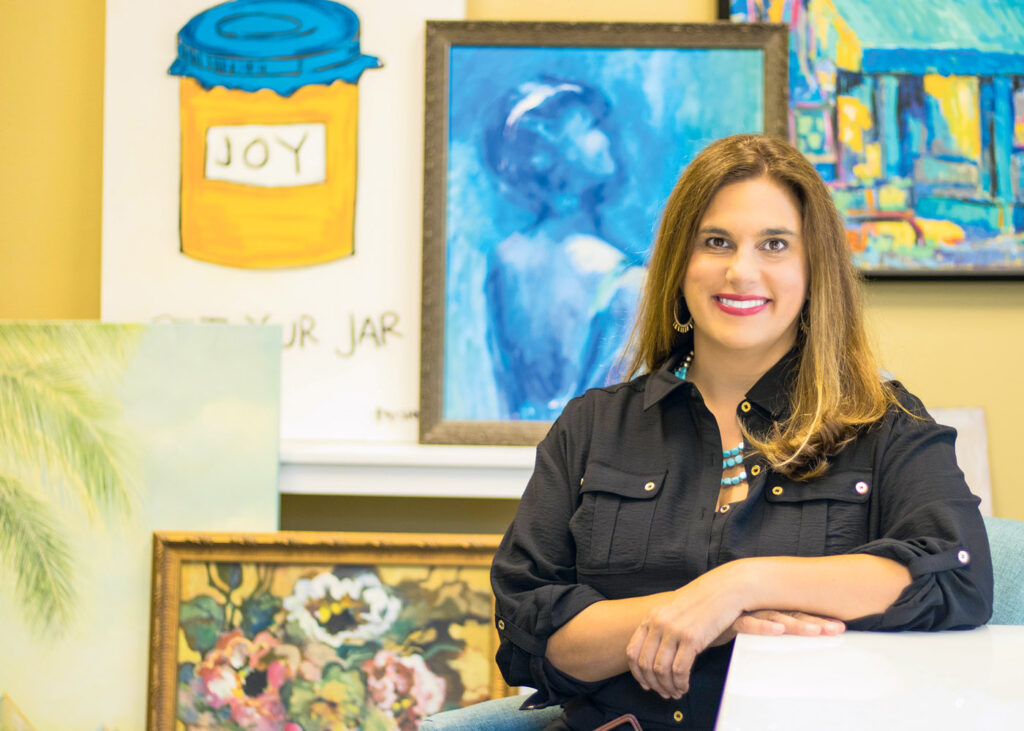
Attorney Elizabeth Devolder of the Law Firm of Elizabeth Devolder in Tampa Palms poses with art created by her client Mishou Sanchez and other pieces from her personal collection.  “Joy – Get Your Jar” appears prominently in the background, and was a recent acquisition from Mishou. (Photos: Susanna Martinez Photography)

It’s been six months since Elizabeth Devolder launched the Law Office of Elizabeth Devolder, a boutique firm located in the Tampa Palms Professional Center off the Bruce B. Downs (BBD) Blvd. exit of I-75 in New Tampa.

Her divorce from attorney Bryan Devolder, with whom she launched the Devolder Law Firm in 2016, was finalized in December, and Elizabeth began a new journey in her new solo practice in January 2021.

Elizabeth’s new firm handles estate planning and probate matters, the same areas of law she handled as a partner at the previous practice.

“Ultimately, we’re doing the same things,” she explains. “We’re just doing them separately.”

Elizabeth says her new practice has started strong. “I have been very well supported through referrals over the last six months from people in the community.”

Elizabeth earned her law degree at the Tampa campus of the Thomas M. Cooley Law School in Riverview in 2016 after a successful career in advertising and sales management. She had previously earned a Bachelor of Arts (B.A.) degree in Corporate Communications from the College of Charleston, in South Carolina, in 1997.

The Law Office of Elizabeth Devolder’s case manager is Rachael Alexander, who has worked with Elizabeth for the last four years and helped found the new firm. Rachael recently graduated from law school herself and passed the Florida bar exam.

“The firm is already growing,” Elizabeth explains. “With Rachael, you’ll get a very experienced case manager, and we’re currently expanding to also have a legal assistant.”

Elizabeth specializes in helping people get their affairs in order, whether they have recently moved to the state, have a child who just turned 18, need legal advice for long-term care, and many other situations.

She says her services are valuable for everyone.

“Everyone needs a Power of Attorney document to manage (their) financial and practical affairs if they’re ever incapacitated,” she says.

This even applies to young adults, who often think they don’t need estate planning because they don’t yet have an “estate” of their own.

“Even if you have nothing,” says Elizabeth, “you still want to make sure someone has the authority to care for you if something happens (to you).”

If a young adult becomes incapacitated, they need someone to be able to tell companies to stop withdrawing money from their account or stop billing them for services, for example. Companies have a responsibility to protect their customer’s privacy, so Power of Attorney documents are required. Records and decisions about medical care don’t automatically go to a parent once a child turns 18.

“It’s so much more expensive if you don’t have these documents in place,” says Elizabeth.

She also says she has loved living in Florida, since a corporate relocation brought her here in 2006. Her experience and eye for detail means she understands what families need to do to update their estate planning documents to respond to and take advantage of Florida laws.

Elizabeth also is developing a specialty helping artists to protect their legacies and collectors to protect their collections.

Elizabeth Devolder (left) opened her private firm in Tampa Palms this January.  

For example, she says, what happens if an artist puts art in a gallery and the gallery closes? Can the creditor take the artwork? Or, what happens if you collect art and antiques and leave them to someone who doesn’t recognize the value of these keepsakes? How do you protect the art from “walking off” during a period of incapacity? How do you maximize the value of it and make it more valuable?

“There are a lot of issues with art,” says Elizabeth, “but not a lot of art lawyers.”

Her thoughtful questions have led one of her clients, local artist Mishou Sanchez, to think about things she’s never considered and take actions to protect her body of work.

“I’ve been working with Elizabeth for years now,” says Mishou, “and she’s fantastic, charming, and knowledgeable about navigating this almost uncharted territory of art law.”

Mishou says her art is now included in her estate plan and Elizabeth has helped her to consider new and interesting ideas, especially related to ownership, copyright and social media.

“She’s really smart,” says Mishou, “It’s kind of fantastic to deal with an educated and knowledgeable woman in the industry.”

Elizabeth also helps artists and others understand their digital assets.

“I got interested in that because I have a client who is making a lot of money off of online instructional videos,” Elizabeth says. “The terms of service for the website say his account is cancelled at his death, but a new law was enacted in 2016 that would allow someone to override the terms, if those are written into his (or her) estate planning documents.”

She says this also could include online photos or statements that come to email.

“If you need to get into the iPhone of someone who has passed away, for example, you need special language in your power of attorney and in your will to give very specific authority for that,” she says. “The process has only been in existence since 2016, so if your will is from before 2016, you need to update it to include that language.”

Elizabeth wants the families she helps to be sure their heirs know what they have and how to get it. For electronic content, she says the family needs access to the catalog (or list) of emails, the content of those emails, and to their loved one’s device so they can get information during incapacity or after death.

She also helps clients with asset protection when they’re facing long-term care costs, and serves clients who have assets in bitcoin, cryptocurrencies, and non-fundable tokens (NFTs).

“There’s a whole new way to make money that we haven’t considered before,” she says, “and it’s important to consider those things in your estate.”

The Law Office of Elizabeth Devolder is located at 5383 Primrose Lake Circle, Suite C, in the Tampa Palms Professional Center. It’s open Mon.-Fri., 8:30 a.m.–6 p.m. For more information or to make an appointment, call (813) 319-4550 or visit ElizabethDevolderLaw.com.

Big USF Alzheimer’s Study Looking For Volunteers

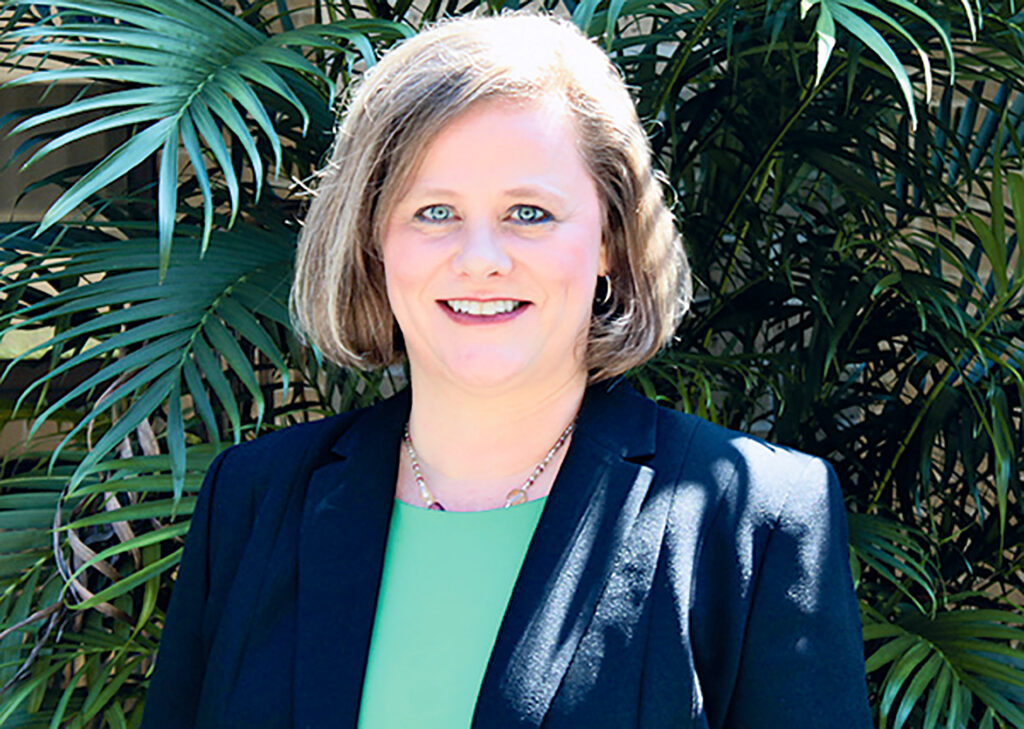
Jerri Edwards, Ph.D.

A team of professors at the University of South Florida (USF) has a new weapon to fight Alzheimer’s disease and dementia — a $44.3-million grant for the next five years to continue a study that has shown some positive results.

Jerri Edwards, Ph.D., a Professor in the Department of Psychiatry & Behavioral Neurosciences at the USF Health Morsani College of Medicine, is heading up the school’s Preventing Alzheimer’s with Cognitive Training (aka “PACT”) study. 

Dr. Edwards says the grant could help finally find a way to prevent Alzheimer’s and other forms of dementia, which are among the most expensive medical conditions to treat — along with heart disease, diabetes and cancer. These diseases also are becoming more and more common.

“Alzheimer’s disease and related dementia are an increasing public health crisis,” Dr. Edwards says. “One in every nine persons 65 and older have Alzheimer’s disease right now and the prevalence of the disease increases with age. It could be that as many as 33 percent of people 85-plus have dementia. We’re living longer so that means the prevalence of Alzheimer’s is increasing exponentially.”

Edwards and many of her colleagues have been investigating an intervention commonly known as brain training for the past decade. “It is the first intervention ever shown in a randomized clinical trial to reduce the risk of dementia,” she says. “So, we’re very excited.”

Brain training is basically using computerized programs to train the cognitive abilities of participants. The trial, called the Advanced Cognitive Training for Independent & Vital Elderly (ACTIVE), had more than 2,800 healthy older adults ages 65 and older participating.

The trial was essentially focused on the functional ability of older adults when it came to things like managing their finances, driving and going grocery shopping — essential tasks required to remain independent with age.

“Dementia essentially is diagnosed when you lose that functional ability,” Dr. Edwards says. 

That study, after 10 years, showed that participants had a 29-48 percent lower incidence of dementia than people who received no training.

The PACT study will be expanded to across the U.S. at five different sites and will be enrolling 7,600 older adults.

“We really believe this intervention can reduce people’s chances — reduce their risks — of Alzheimer’s disease,” Edwards says. “It’s a very exciting opportunity to be a leader in the field here at USF and engaging our Tampa Bay community area.”

Dr. Edwards encourages anyone healthy and age 65 and older in Wesley Chapel and New Tampa to participate in the PACT study. She says that one of the goals of the study is to have a diverse sample. She also says that blacks are twice as likely as other adults to get Alzheimer’s, and Hispanics are 1.5 times as likely, yet both are typically less willing to participate in clinical studies.

Participants will be screened and tested during their first two visits — at a choice of the Cognitive Aging Lab on USF’s Tampa campus off E. Fletcher Ave., the St. Petersburg campus, as well as at locations in Lakeland and Winter Haven in Polk County — and will be asked to continue the brain training for three years at home.

“We really need people who are interested in joining the fight against Alzheimer’s disease,” Dr. Edwards says. “We need healthy, older adults 65-plus willing to do that. It’s low burden — we’re asking for a three-year commitment.”

If you want to volunteer for the PACT study, call (813) 974-6703, or visit PACTStudy.org.