

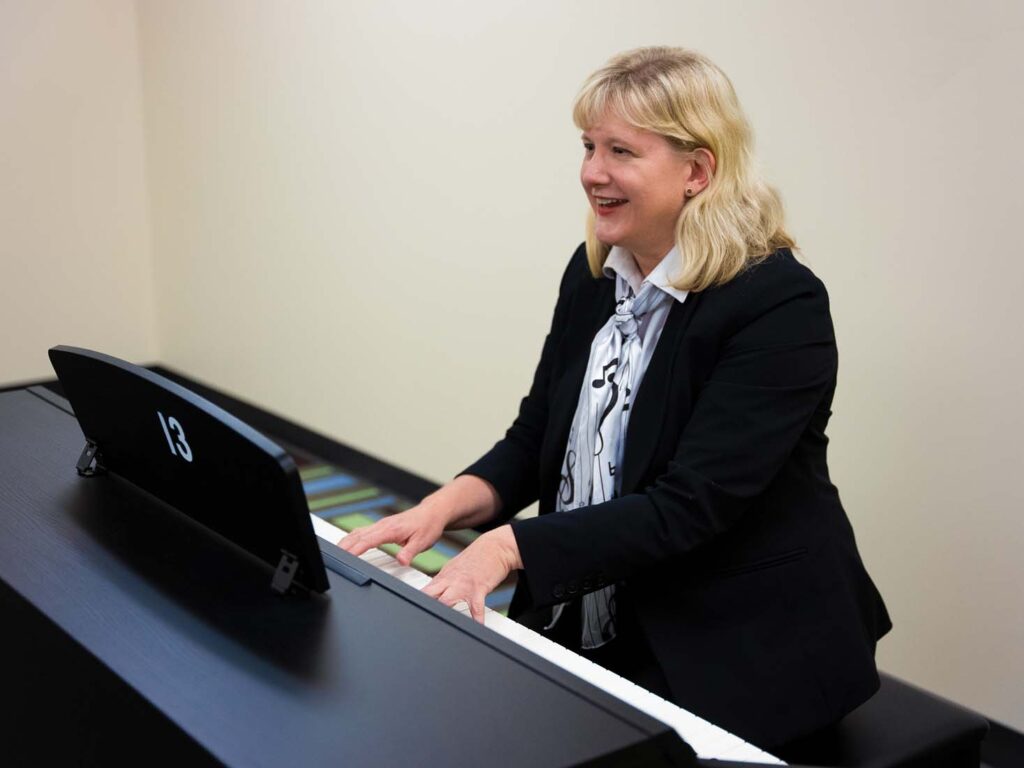
Music touches people creatively and socially, but it also deeply affects our brains.
Jennifer Bugos, Ph.D., first considered that idea when she was much younger, as a secondary caregiver for her grandparents. With her grandfather’s ability to speak declining to the point where he could barely utter a sentence, she would play the piano, and he would sing every word to “The Battle Hymn of the Republic.” Nearby, her grandmother was in a near vegetative state, but her toe would still tap along to the music.
These experiences led Dr. Bugos to her life’s work, studying, as she says, “what it is about music that is so special.”
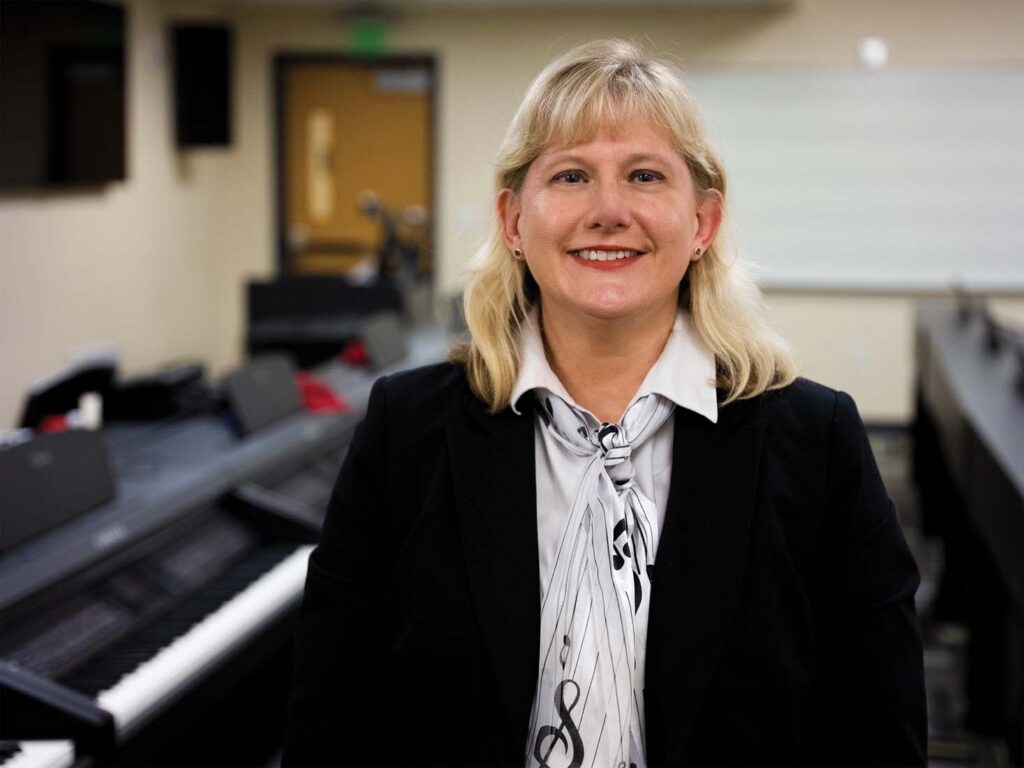
Her background in music education includes Doctor of Philosophy (Ph.D.), Master of Education and Bachelor of Arts degrees in Music Education, plus studies in gerontology and post-doctorate study in neuropsychology. She serves as Associate Professor of Music Education in the School of Music at the University of South Florida (USF), with two decades of research and a 22-page curriculum vitae detailing the research she has done to understand the connection between music and cognitive performance, among other accomplishments.
“Music is a powerful stimulus that we know can help to improve memory,” she says. “It’s a powerful way to exercise the brain.”
Last year, the National Endowment for the Arts chose USF as one of just six nationally designated research labs in the area of “the arts, creativity, cognition and learning.”
As principal investigator, Dr. Bugos will lead researchers who will study the effects of music training interventions — specifically, subjects will participate in music classes — on memory and motor function.
The study is called Cognition and Coordination Across the Lifespan in Music, or the acronym CALM. It is open to adults ages 18-25, as well as to adults over age 60, with plans to recruit children ages 8 to 12 in the future. Participants should have no or very little formal training in music.
“One of the key components of the study is that the task must be novel — or new – to participants,” explains Dr. Bugos. “We’re looking for people with three or less years of previous formal private musical training and not currently reading music and engaging in musical performance.”
She defines “previous formal private musical training” as one-on-one instruction. If someone has participated in a band or chorus in high school, or something similar, that would not disqualify them from participating in the study.
Those who do participate will be randomly assigned to a group for their music lessons. Because the groups are assigned at random, participants will not get to choose the type of music lessons they will receive. The classes will meet twice a week for 12 weeks and study participants are asked to also practice at home 30 minutes a day, or three hours a week. There are various classes available to accommodate different schedules.
Cognitive training interventions contain task novelty, progressive difficulty, practice components, social elements, and are “ecologically valid,” which means that individuals can use the new skill in everyday life.
“Many of our previous participants can play for their own enjoyment or report playing ‘Happy Birthday’ for their grandchildren. Dr. Bugos says. “Some even perform at church or just for their own enjoyment.”
She adds, “It’s a very rewarding experience. Music training contains all of the active ingredients of a cognitive training intervention.”

Because the programs are structured as cognitive training programs, Dr. Bugos says, “They are a bit more intense than a traditional music lesson.” She explains that it’s important for the lessons to be rigorous — and for participants to attend regularly and practice at home — so they can see gains.
She also notes that the programs are engaging and that people who participate will notice benefits in terms of cognitive performance. They also will make social connections. She says previous participants still sometimes get together for coffee, for example.
Lessons are offered free of charge, and participants will receive all materials and access to instruments for the duration of the program. In addition, they are required to participate in four research sessions, for which they will be compensated. USF parking passes also are provided.
“It’s a great program,” Dr. Bugos says. “There are cognitive benefits, motor system benefits, and learning a new skill that can last a lifetime.”
Additional studies are open for participants who are currently cancer patients or have experienced heart failure.
All studies require participants to follow Covid-19 procedures, including wearing masks during the lessons.
The first session begins in September, but new sessions will begin every four months, so those who are interested can feel free to reach out, even if their schedule doesn’t permit them to participate in the September sessions.
Partners include Kuumba Dancers and Drummers and the Patel Conservatory at the Straz Center for the Performing Arts. The Gasparilla Music Foundation also is a partner on a series of studies examining the effects of music training on coordination and cognition in children.
To see if you qualify to participate in the study, or for more information, contact Dr. Jennifer Bugos at (813) 974-2753 or email her at BugosJ@usf.edu.