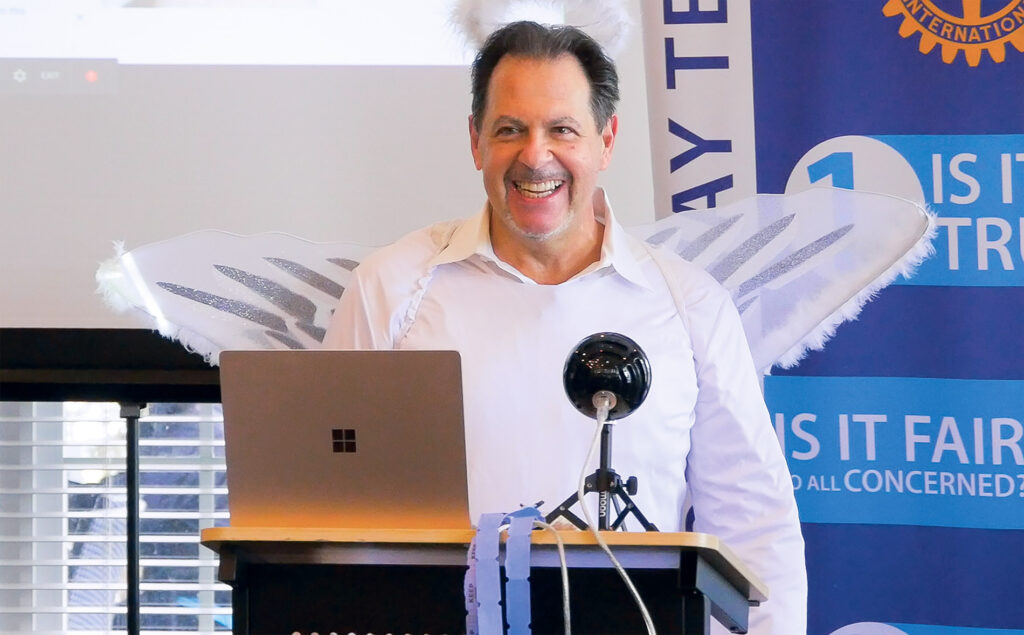
Gary gets ready to sing “Beauty School Dropout.” (Photo by Charmaine George)
When the musical “Grease” hit Broadway back in 1972, my best friend’s Doug’s dad, an investment banker, purchased 10% of the show and basically has been getting paid every time any of the songs from the smash hit show (and yes, even the 1979 movie with the same name, starring John Travolta and Olivia Newton-John) are performed.
The good news, for a certain young wannabe performer, was that Doug’s family took me to see that show at least six, seven or ten times before the summer camp I attended in upstate New York put on “Grease” as our summer production in 1974.
And, even though I didn’t get to star as Danny Zuko — the role created on Broadway by Barry Bostwick (later, the silver-haired mayor on the Michael J. Fox TV sitcom “Spin City) and reprised by Travolta in the film — despite being the only kid in camp who had memorized every word of every song, I did get to play both Teen Angel (played by Frankie Avalon in the movie) and Johnny Casino, with two solo songs (“Beauty School Dropout” and “Born to Hand Jive”).
Therefore, when I heard that the Rotary Club of Wesley Chapel (the club Jannah and I belong to, which meets for lunch at noon every Wednesday at Omari’s Grille in the Lexington Oaks Golf Club) was going to put on a free, socially distanced “Grease is the Word” Singalong event (on Saturday, March 13, 4:30 p.m.-8:30 p.m., at Land O’Lakes Heritage Park, 5401 Land O’Lakes Blvd.) — starring deputies from the Pasco County Sheriff’s Office against firefighters from the Pasco Fire Rescue department — I knew I had to get involved.
To kick off that involvement, I re-created my role as the Teen Angel (in full costume; photo) at a recent Wesley Chapel Rotary meeting, which was enough to get me an invitation to sing the song again at the “Grease” singalong” event.
I’m obviously pretty excited about the opportunity to be on hand as a part of my childhood is revisited once again, and I hope that at least some of you reading this also will attend — even though my Rotary Club is located in Wesley Chapel and the deputies and firefighters competing (for three prizes; I’m pretty sure I’m not eligible) are from Pasco County, because not only is “Grease” the word — it’s also a heckuva lot of fun!
And, speaking of fun, here are some fun trivia questions about one of my all-time favorite musicals:
1) How many Tony Awards did “Grease” win in 1972?
2) Who played Rizzo in the original Broadway cast and what TV show did she begin starring in 1972?
3) What hit song sung by John Travolta and Olivia Newton-John in the “Grease” movie was not in the original Broadway show?
Answers:
1) Zero. The original show, which held the record for longest-running Broadway hit (later broken by “A Chorus Line,” was nominated for seven Tony Awards, including Best Musical, but did not take home any hardware.
2) Adrienne Barbeau, who played Maude’s daughter Carol on “Maude.”
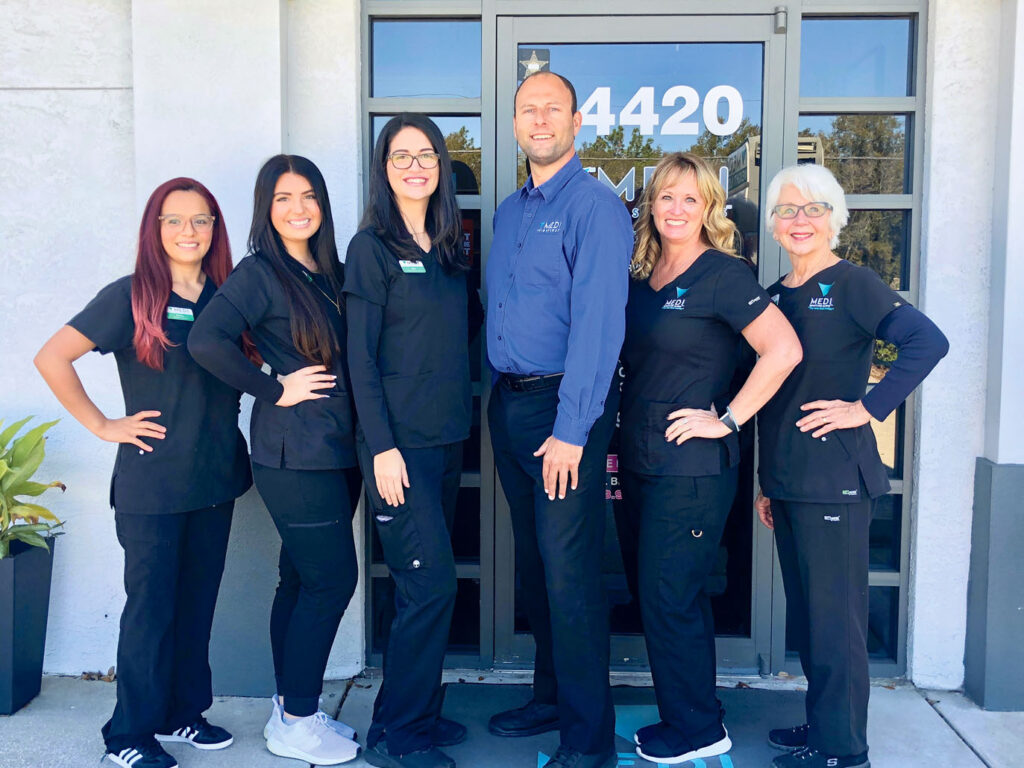
The caring, dedicated staff of Medi-Weightloss of Lutz includes (l.-r.) Karina Gonzalez, Raquel Sanford, Alex Pierantoni, Dr. Andrew Weitzman, Erin Jones & Patty Pinson.
Weight gain has been a common side effect of the Covid-19 pandemic, as exercise and other healthy habits have taken a back seat for many people.
Medi-Weightloss of Lutz owner Gerri Willett says the pandemic initially caused a lot of uncertainty for her small business, but ultimately has driven many new patients to the practice, located on S.R. 54, two miles west of where it meets S.R. 56 (near the Tampa Premium Outlets).
In the 15 years since it opened in 2006, Gerri says Medi-Weightloss of Lutz has helped patients lose nearly 130,000 pounds. It’s easy to get started, as completely free assessments are always offered.
Today, while there are 91 Medi-Weightloss locations nationwide, Gerri owns the locations in both Lutz and Brandon, operating the two as a local, family-owned business, which has been her passion for the past 15 years.
The success patients see when they try the Medi-Weightloss program is what continues to drive people to the practice.
“Our patients refer their friends because they know we do a really a good job,” Gerri says.
The Medi-Weightloss program is supervised by Andrew Weitzman, M.D., who is Board-certified in Internal Medicine. The program combines diet and exercise with supplements, managed by a doctor, to help people lose weight and keep it off.
Like most businesses, Medi-Weightloss has had to make adaptations because of the Covid pandemic, creating virtually touch-free visits, while keeping its doors open to better circulate fresh air, providing clean pens, taking temperature checks, having hand sanitizer available and other precautionary measures.
“We also offer telemedicine,” says Gerri. “We do whatever you feel comfortable with, whether that’s telemedicine, or coming in to be weighed when we’re otherwise closed to patients, so you’re the only one in the office, or driving through the parking lot to pick up a prescription.”
The staff is compassionate and understanding, cheering their patients on to reach their goals.
“It can be very difficult for people to step foot into a weight-loss clinic because, a lot of times, they have already tried so many different things,” says Gerri. “People beat themselves up horribly about their weight.”
Whether it’s newfound weight gain as your body changes due to age, weight that was lost in the past but has crept back on, or pounds put on during the pandemic, Gerri says, “We want people to know we’ll figure it out and we’ll get them to be successful.”
How It Works
During the first phase of the program — also known as the acute or weight-loss phase — clients come in once a week.
After an initial consultation with weight measurements, blood work and an electrocardiogram (EKG), patients receive a binder to store educational handouts, recapping the information shared at each session. They also receive recipes for delicious, healthy meals, with ingredients that are easy to find. Patients also start a detailed journal to log their eating, drinking and sleeping data. They also receive vitamin supplements, a food scale to help with portion control and ketone sticks to detect their level of ketosis.
(Note: Physiologic Ketosis is a normal response to low glucose availability, such as low-carbohydrate diets or fasting.)
Medi-Weightloss has many ways to help during the weight-loss phase, including injections of Methionine Inositol Choline (MIC Combo) to put B12 vitamins and amino acids into the bloodstream, both of which help with fat metabolism, liver function and fat excretion. Patients also receive Vitamin B6 and B1 injections, which help reduce water retention and keep your energy up, while battling food cravings.
Dr. Weitzman says the goal is always to reduce medications that patients may be taking. “One of my favorite things is getting someone off of blood pressure medications,” he says. “You lose 20 pounds and, all of a sudden, your blood pressure goes down.”
After the acute phase of the program ends (once ca client reaches his/her target weight), they check in less often during the maintenance and wellness phases.
But, if a client should re-gain weight after completing the program, Gerri says there’s no reason to worry.
“Life happens and we are here to help,” she says. “It doesn’t mean you failed. It means you had stress in your life, or something happened. Just pop back into the program! There is no restart fee.”
Caring, Helpful Staff
Medi-Weightloss of Lutz has a staff of caring professionals who truly understand what it’s like to be in their patient’s shoes. In fact, some are former patients.
Erin Jones had lost her husband in 2010 and then, she says, “I ate for a year.”
In 2011, she started the Medi-Weightloss program and lost 50 pounds.
After that, she joined the team. Erin is now a full-time medical assistant and the office manager at Medi-Weightloss of Lutz and Brandon.
“Patients can take comfort in knowing that we’ve been down their road before and that we can truly say we know what they’re going through,” Erin says.
Medical assistant Patty Pinson has been with Medi-Weightloss for a decade and is a retired Registered Nurse (RN). Other Certified Medical Assistants (CMAs) include Karina Gonzalez and Alex Pierantoni, while Raquel Sanford manages the front office.
Dr. Weitzman is a Board-certified Medical Doctor who earned his Doctor of Medicine degree from Tel Aviv University in Tel Aviv, Israel, and completed his residency at Nassau University Medical Center in Long Island, NY. He operated a primary care practice in New York, then moved to Manatee County, before coming on board at Medi-Weightloss more than four years ago.
He says there actually are many similarities between primary care and weight loss.
“The main difference is that with primary care, you’re already treating a patient’s disease. Here, we’re working strictly with prevention.”
He stresses all three legs of the weight-loss process: diet, exercise and appetite suppression. “You must do all three in order to succeed,” Dr. Weitzman says.
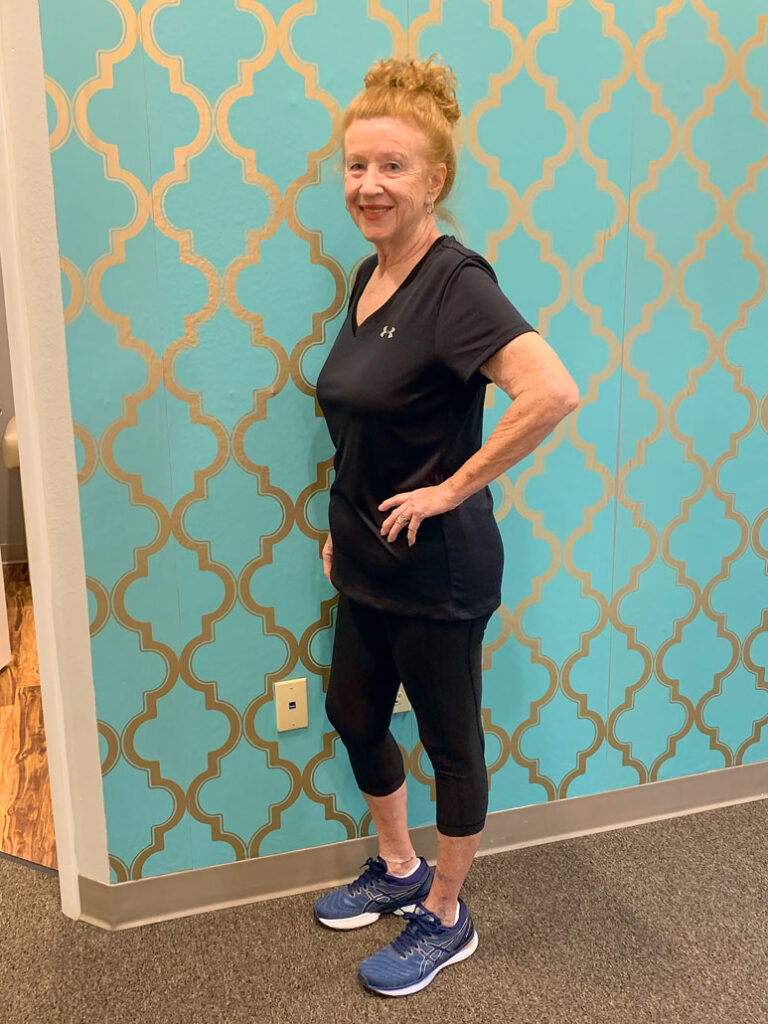
Sally Morrison, before and after.
Sally Morrison is a Medi-Weightloss patient who has found success. In the past nine months, she’s lost 90 pounds, just in time to celebrate her 70th birthday in early February.
Before Medi-Weightloss, Sally says she felt terrible. As a former nurse, she knew the consequences when she saw how bad her lab results were after a checkup, so she decided to make a change.
A friend had success with Medi-Weightloss, so Sally decided to try it, too.
“When I was in my 30s, I was an operating room nurse in the Army. I ran every day back then,” she says, “and I feel almost as good now as I did then.”
She says she had tried a different program about 10 years ago, but the weight crept back on. And, the clinic she went to had closed, which left her feeling abandoned.
This time around, Sally is confident she has the support and resources she needs to keep the weight off. “They’ve been my cheerleaders and my mentors,” she says. “I’ve had long talks with the doctor and he’s fabulous. They all are. I highly recommend people go there.”
To schedule a free assessment at Medi-Weighloss of Lutz (24420 S.R. 54, Lutz), call (813) 909-1700. The office is open five days a week: 6:30 a.m.-1 p.m. on Mon.; 9 a.m.-6 p.m. on Tues., 6:30 a.m.-1 p.m. on Wed; 1 p.m.-7 p.m. on Thur.; and 6:30 a.m.-1 p.m on Fri. More information is available at MediWeightloss.com/locations/lutz/.
State Rep. Fentrice Driskell (top row, second from the left) picked the brains of some Wharton High students to formulate an environmental bill to try to pass at the upcoming state legislative session, which begins March 2.
If a bill gets passed during this upcoming State of Florida legislative session that helps eliminate food waste and, in the process, provides the Sunshine State with environmental benefits, you might just have some Wharton High students to thank for it.
During a Zoom class on Jan. 28 moderated by District 63 State Rep. Fentrice Driskell, the Wharton students were asked to debate three potential bills they had been given, and whichever one they found to be the most preferable, Rep. Driskell would take with her to Tallahassee when the 60-day legislative session begins March 2 and work to get it passed.
“This is a new initiative for me,” Rep. Driskell said. “I have heard of other members doing this, but I wanted to put my own spin on it.”
Each of the bills debated had a strong climate change component to them, something near to Driskell’s heart — before attending Harvard University and Georgetown Law School, she was an officer in the environment club at Lake Gibson High in Lakeland.
“We were setting out to save the world,” she told the class. “Never doubt that young people can save the world, and part of the reason we are having real conversation around climate change is because the younger generation is pushing us to do so.”
The students in the class of Mary Johnson (AP Environmental Science) and Chad Reed (AP U.S. Government) chose a version of the Rhode Island Refuse Disposal Act, which ensures that the organic-waste materials generated by educational facilities are recycled at an authorized composting facility or anaerobic digestion facility.
“There is a lot of food waste,” said Sarai Guzman, a senior, who added that since she moved to Tampa she has noticed excessive waste, especially in schools. “We need to help those who don’t get as much food.”
Zoe Craig, a junior, agreed. She said she has volunteered a lot in a local food pantry, and sees the need for food in the community.
Sonya Patel, also a junior, also voted for the food waste bill, stressing its environmental benefits.
“It would lead to less going to the landfill, and the less landfill, the less we burn, which (means) less greenhouse gas,” she said. “There is a whole chain of reactions involved with that.”
Senior Mark Johnson agreed that the gashouse effect of less waste would provide a large benefit to society.
The other bills presented for discussion included one dealing with testing for and eliminating lead in the water of schools and child daycare centers, and another focused on an energy security and disaster resilience pilot program to create solar energy storage systems at certain facilities which could provide needed power following natural disasters.
The Lead-Safe Schools and Daycares Act also was a popular choice of the class. Kylie Lewis said she thought the transparency of the bill — requiring testing results to be made available to district leaders and parents — was great, while senior Vlada Pitner said the safety issue was important.
“There have been a lot of problems in the district in Hillsborough County with lead being in the water,” Pitner said. “It’s a big issue and I feel like a lot of people overlook it. And, it affects the next generation, who we want to be healthy.”
Senior Jonathan Arms cast his vote for the solar energy bill, primarily because of the possibilities it could open up.
“If we could prove to the other states that solar energy is viable and can properly be used as a back up, then there is no real excuse it can’t be used as a primary source,” Arms said. “Maybe we can start using solar energy for big projects, maybe we start making, I don’t know, solar-powered cars. That would be kind of cool. I kind of like (what this bill could mean for the future).”
In a non-Covid world, Driskell says she would have liked to break off into groups for further debate. Instead, she put it to a vote, with 47 percent of the class picking the food waste bill. She called the experience a success.
“It went better than I expected,” Driskell said. “The kids were so impressive to me. They were engaged the whole time. I couldn’t have asked for it to go any better.”
Driskell said the class was the first of many she would like to do in New Tampa, and that she will approach other schools in the future. She chose Wharton for this one because of her relationship with principal Mike Rowan, whom she met in 2018 shortly after being elected for the first time.
She will now take the bill, rework the language in it, and work on getting it sponsored. It would then go into committee and, if deemed favorable by the House committee and by a House vote, it would be sent to the Senate floor for a final yes or no vote.
Driskell joked that she will tell the Senators that there would be some angry high school students calling them if the bill doesn’t pass, telling the Wharton students to be ready to go.
“I didn’t grow up knowing elected officials,” she said. “I had no sense of how accessible government is on the local and state level. I hope this sparks curiosity in the minds of these students. Maybe it gets them engaged at this level, at an early age, and they will want to stay engaged for the rest of their lives.”
The much-anticipated and long-awaited expansion of the New Tampa Recreation Center (NTRC) in Tampa Palms, which dates all the way back to the day the facility debuted in 2008 with a waiting list of more than 1,000 kids, has finally come to fruition.
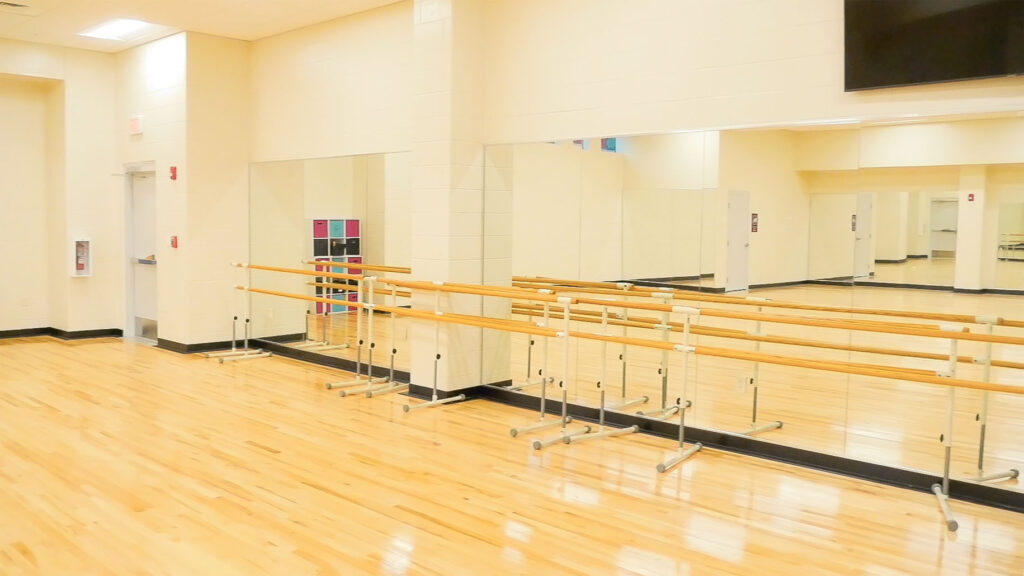
Today at 3:30 p.m., almost two years to the day of the expansion’s groundbreaking on April 12, 2019, the NTRC will host a ribbon-cutting ceremony and reopen with 7,300 square feet of extra space, featuring three new rooms (convertible to five, with partitions) that will provide new space for gymnastics and dance instruction, community meetings, adult and senior fitness classes and athletic training.
The expansion cost roughly $2.6-million, after years of budget battles that saw the long-planned project get passed over in 2012 and again in 2016.
“It’s been a long time coming,” said Tampa City Council member Luis Viera, who as the District 7 Council member, helped rally New Tampa residents, led by Tampa Palms attorney Tracy Falkowitz, to show up at the budget deliberations in 2017 and implore the Council to keep the money in the budget for the project.
The end result will expand not only the NTRC’s profile, but also its reach.
“We’re known for gymnastics and dance classes, but the expansion makes us more than that,” said Heather Wolf-Erickson, the athletics, aquatics and special facilities manager for the City of Tampa’s Parks & Recreation Department, who took us on a tour of the new add-on prior to the March 3 opening. “Kids are one aspect of a family, but we also wanted to give the parents that sit here during the practices an opportunity to do some fitness classes and other things, too.”
Wolf-Erickson also is excited about offering classes for older residents, as well as space for community gatherings and meetings. All of that will be available in the first multi-purpose room you pass upon entering the expanded facility, which has a partition to give it more flexibility to host two classes at once.
“We can get a little more creative with what we can offer (now),” Wolf-Erickson says.
The “fun” room
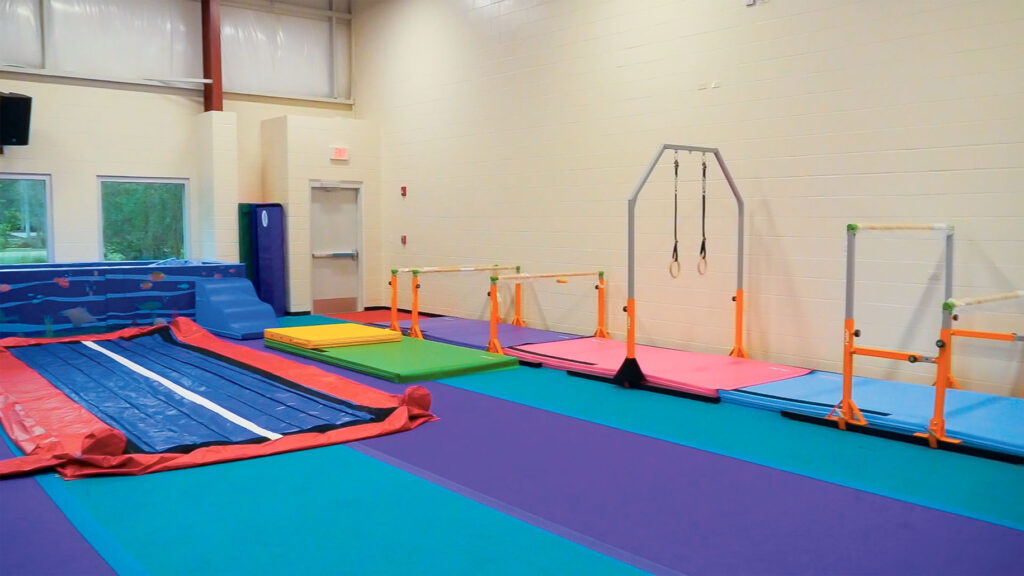
Next to that room is what Wolf-Erickson calls the “fun” room — a new mini-gym for those just starting out in gymnastics, typically ages 5-and-below.
The space was designed for “the littles” who, until now, had to share space with the bigger kids in the NTRC’s large 12,500-sq.-ft. main gymnasium. Now, instead of being lost in a forest of taller gymnasts, the younger kids have a great new space of their own.
“It’s easy to get distracted (in the main gymnastics area),” said Linda Hall, Site Supervisor II for the City of Tampa. “When the big kids are in there, they’re doing big kid (moves) and it’s easy (for the younger kids) to get distracted.”
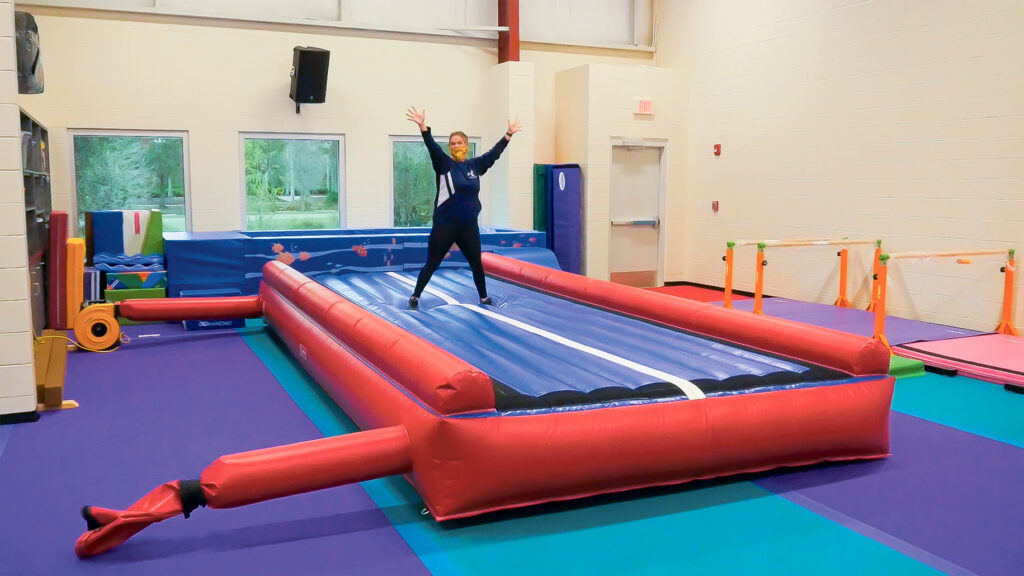
Also making the new room unique is the equipment itself, like the rings and parallel bars, which are smaller to fit smaller hands. And, an inflatable trampoline and foam ball pit are used for practicing jumping and flipping.
“Everything is catered to them,” Wolf-Erickson says of the new room. “We’re not teaching them any big gymnastic moves in here, we’re working on upper-body strength, hand-eye coordination and patience. When kids have fun learning and doing physical things, they’re more apt to come back.”
Adjustable Batting Cage, Too
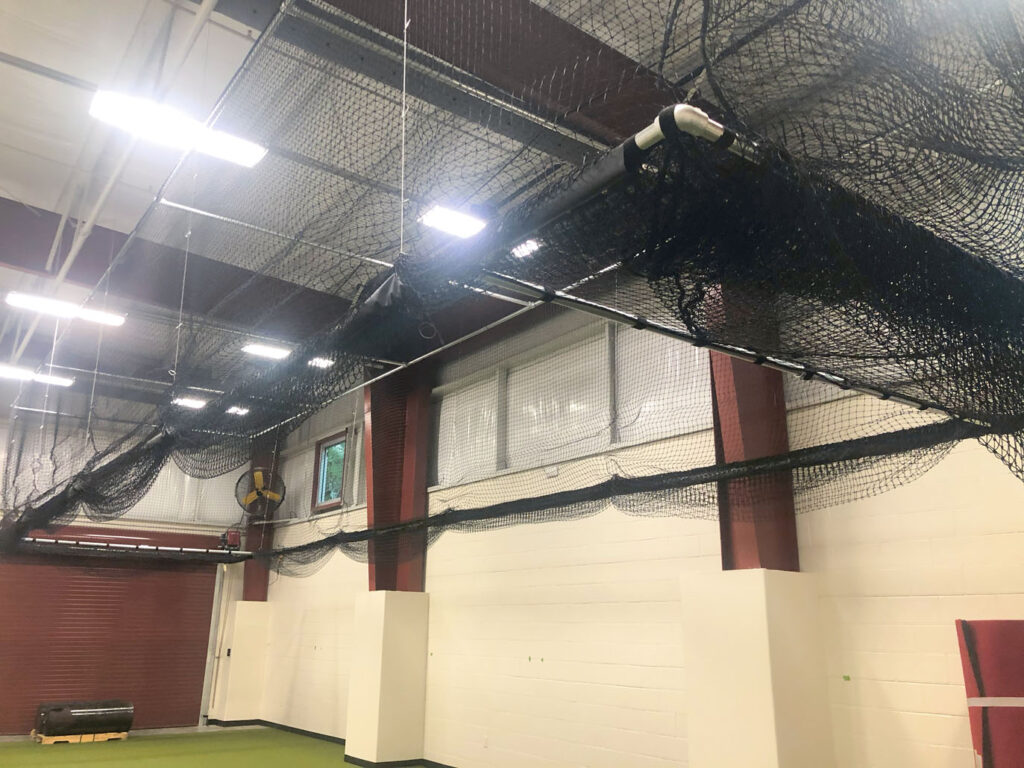
Wolf-Erickson says her favorite room is the 1,760-sq.-ft. rectangular training “box,” which resembles popular, more rustic training facilities that look like warehouses, with large fans, a garage door that opens and even a batting cage that is stored above the floor and can be lowered with the press of a button.
Baseball and softball athletes will be the obvious beneficiaries of the batting cage, but when the cage is suspended above the floor, the area can be used for almost any kind of training, from football to soccer to any kind of fitness and weight training. It also will come in handy on rainy days.
“This space is going to get used and used and used,” Wolf-Erickson said. “When designing it, they asked, ‘What are you going to do there?’ We said we’ll show you. It’s just a little bit more different than what we’ve done here. (This room) will be more open to the community.”
While technically part of the NTRC expansion, the training box is practically its own separate space. It has its own climate control, separate from the rest of the facility, and the door leading in from the rest of the expanded spaces can be locked down, with a door leading outside (and inside, monitored by a keypad) for those who are training later than regular building hours.
“We can have this open 24/7 without impacting the staffing requirement,” Wolf-Erickson said. “It is its own space, with its own restroom. It was pretty well thought out.”
In fact, all three of the new spaces have their own restrooms, and there will be another bathroom that can be accessed from the playground, a touch sure to be appreciated by parents.
The two rooms with dance and gymnastics also have multiple large windows for parents to watch their children, similar to the rooms in the main building.
After years of having to turn folks away, or at least put them on a waiting list that had as many as 1,800 kids on it, Wolf-Erickson hopes the new space gets children off the waiting lists and helps free up more room for more students to sign up. Pre-Covid, the NTRC had more than 4,000 class slots programmed each week, and saw nearly 8,000 gymnasts and dancers receive training every year at the popular facility.
Wolf-Erickson said she wants to see the community, from beginners all the way to seniors, utilize the facility for exercise, training and other events. While all those things may be offered at other places in the area, Wolf-Erickson says the plans for the pricing and community memberships at the NTRC are still being finalized, “But we believe it should be affordable, and we won’t be out-priced here,” she says.
For more info, call (813) 975-2794 or visit Tampa.Gov/parks-and-recreation/activities-recreation/gym-and-dance/new-tampa-center.
Kim Balfe can tell you all about how great the classes are at the F45 Training at The Grove studio that she owns with her husband Bob, or how wonderful their instructors are, how the members have raved about the workouts or even how successful the fitness facility has been since opening in the middle of the pandemic last summer. And she does.
But nowadays, she starts with this instead: F45 Training at The Grove is clean and safe.
Really, really clean and safe.
In today’s world, where Covid-19 has wreaked havoc on local businesses and hit gyms harder than most others — even delaying the opening of Wesley Chapel’s F45 Training a few months last spring — that’s pretty big news.
“Cleaning is always a priority, especially in a gym,” Kim says. “We feel we have a responsibility when it comes to the safety of our members. We want people to see that we take it seriously.”
When you’re done at one station at F45 Training, it’s time to sanitize your equipment before moving on to the next one.
How seriously? Kim completed a rigorous course, which she likened to getting a Ph.D, in order for F45 Training to receive facility accreditation from the Global Biorisk Advisory Council (GBAC), which helps organizations and businesses respond to biological threats and biohazard situations through education and training.
A sticker will be displayed on the gym front window affirming their accreditation, and Pasco County reimbursed the cost of earning the designation. Getting the accreditation involved studying pages and pages of documents and learning all of the policies and procedures required to have a clean gym. Kim also says she attended a 10-hour class.
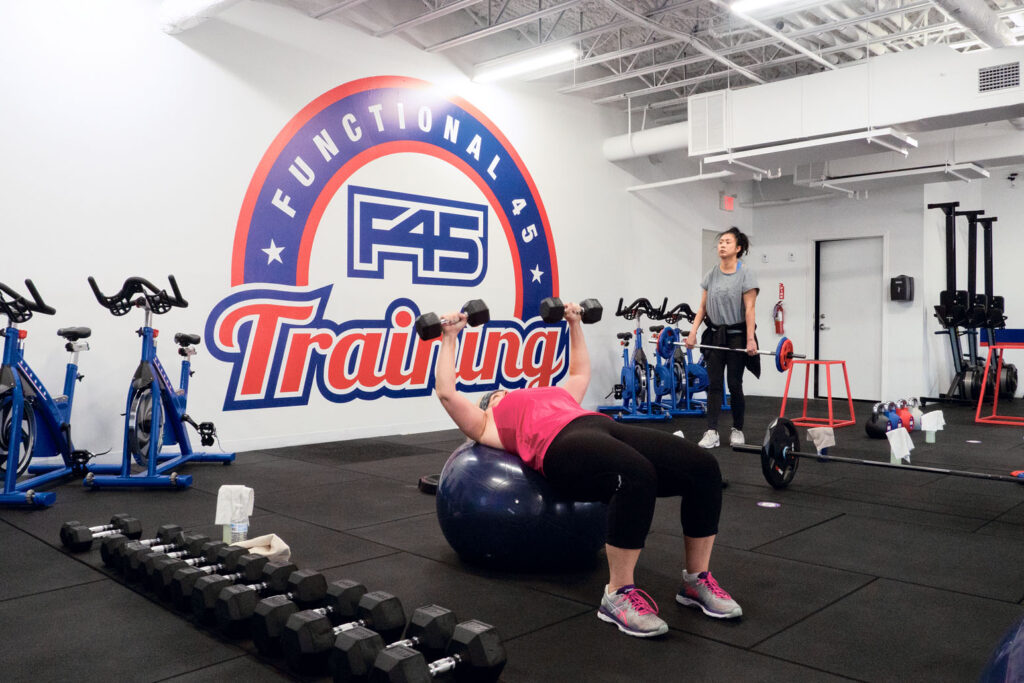
While cleanliness is much more at the forefront of most people’s minds these days — 20 percent of potential new members ask about the safety of returning to the gym — F45 has combined that with socially-distant classes that add to the safety measures. While some classes are more crowded for those that prefer it, a number of offerings, like the one we attended on a recent Thursday morning, had a surprising amount of room between participants. No one rotated stations before first disinfecting the equipment they had just used.
“We have one of the bigger F45s in the area,’’ Kim says of the 3,300-sq.-ft. facility, which also has showers. “There’s plenty of room.”
The cleanliness helped convince Kim Shephard to get back in the gym. The gym she usually works out at where she lives in New Tampa has been closed, and after almost a year off, it was time to get back to work. Shepard admits she starting putting on some weight during the pandemic, but it’s currently coming off and she says she has dropped five percent body fat since joining F45.
“It’s been a life changer for me,” says the 36-year-old Shephard. “I love it. I like the small classes, the trainers get to know you on a personal level and it really is a community. And the gym is super-duper clean.”
The F in F45 stands for Functional Training, which focuses on strengthening muscles you use for everyday activities and emphasizes core strength and stability. The 45 is how many minutes (almost) every workout lasts.
There are 2,700 different exercises and 36 different workouts as members move from station to station, with Mondays, Wednesdays and Fridays focusing on cardio, and Tuesday and Thursdays for resistance training.
“Every single day is a totally different workout,” says Bob who (as does Kim) also partakes in many of the classes.
The classes all have names, like 22, Bears, Moon Hopper and All-Star. And, the classes also are universal. If you are doing the Angry Bird at The Grove location, then so are fitness members at F45s in Sacramento, San Antonio and Sydney, Australia (where the company was founded in 2011 by equities trader Rob Deutsch).
The only class that is longer than 45 minutes is Saturday’s class, which is an hour-long hybrid, called Hollywood, which F45 calls its pinnacle showcase, and is sometimes accompanied by a live DJ.
“Saturday is the big fun day,” Kim says. “It’s my favorite day.”
F45 remains one of the hottest fitness franchises in the world, with more than 1,750 studios in 45 countries, including more than 650 in the U.S. It is part of a trend towards high-tech fitness boutiques which offer more personalized care than the traditional big-box gyms.
As an example, an experienced fitness participant can take part in the same class as a newcomer, and the trainers take special care to make sure the experience is enjoyable for both, by offering those who can’t physically perform certain exercises a less-challenging alternative option.
“Sometimes people come in and know nothing and have never been in a gym before,“ says head trainer Zach Johnston. “We’re here to guide and help them. F45 is very scalable. There are some advanced movements, but they can all be regressed down.”
There’s plenty of room for social distancing at F45 Training at The Grove. To the far right, head trainer Zach Johnston helps a client work on the proper form during a recent class.
Large television monitors show how to do every move, and Zach and his team will help if any of the exercises are too much for you.
Zach, who has a Bachelor of Science in Biological Health Science and a Master of Science degree in Exercise Science from the University of South Florida, is beyond qualified to train people, and says he chose F45 because he loves the concept of functional workouts, as well as the community that the fitness facility is building.
“I feel like people love coming in,” he says, “and I don’t think they even think about Covid. I think people see the certification and know it’s safe here.”
F45 Wesley Chapel also has recurring challenges, nutritional coaching and meal plans via F45’s app and other perks — to further differentiate itself from the fitness pack. It’s another community-building benefit that F45 Training at The Grove strives to achieve.
Bob and Kim say they love the social aspect of F45. The company has a slick website, highly-active Facebook and Instagram pages — which can be a good place to find specials — and stays in touch with its members via text. Doing so helps build camaraderie amongst those trying to get and stay in shape, and also offers the kind of accountability that is difficult for many to have working out on their own.
“For a lot of people, this is all about being healthy and staying in shape, to strengthen their immune systems and their mental health,” Kim says. “And, for many of them, this is their getaway. We’re glad we can be that for them.”
Best of all, you can give it a try for free. F45 Training offers one free week of classes for prospective members.
F45 Training at The Grove (6207 Wesley Grove Blvd., Suite 102) offers classes at 5, 6, 7 and 9 a.m. weekday mornings, and at 5:30 and 6:30 p.m. weekday evenings. Saturday classes are at 7, 8:15 and 9:30 a.m., and Sunday classes are at 8 and 9 a.m. For more info, call (813) 683-5222, or visit F45Ttraining.com/TheGroveAtWesleyChapel/home.