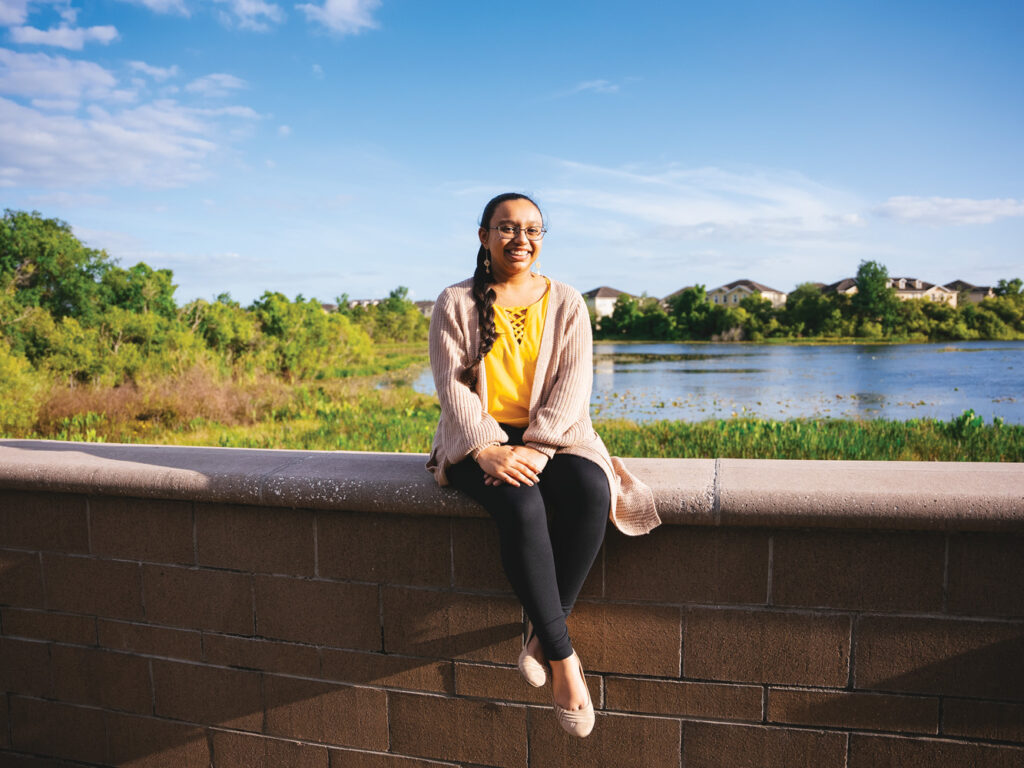
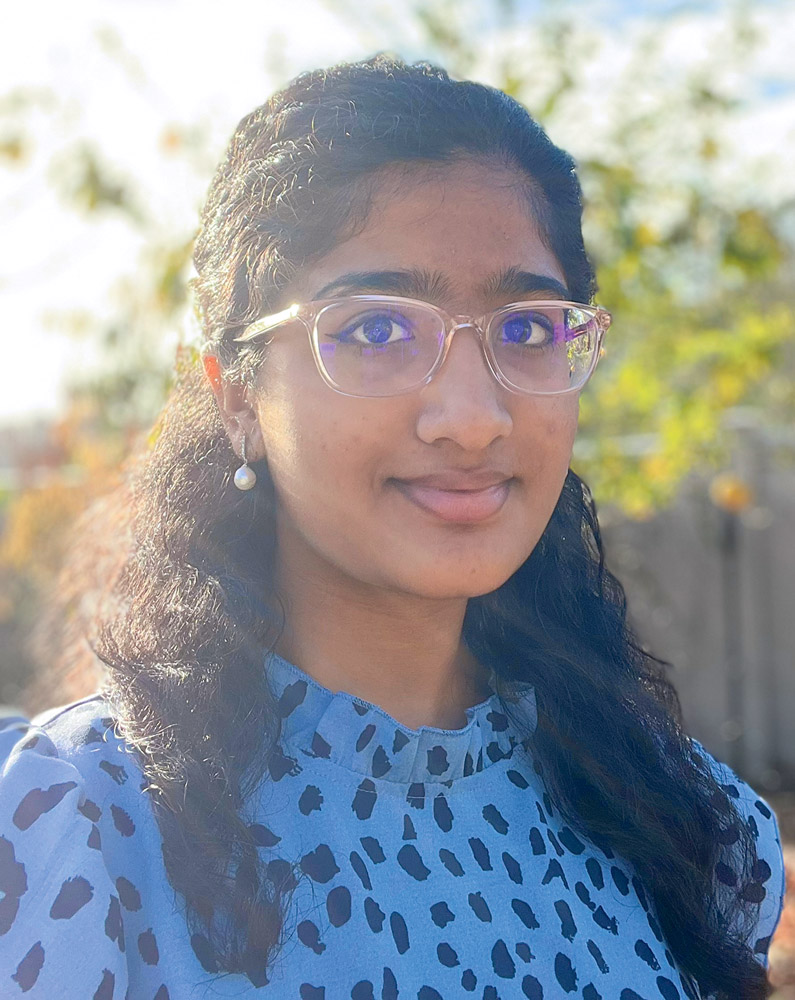
When Sonya Patel walks across the stage as Wharton High’s Class of 2022 valedictorian during the school’s graduation ceremony on May 25, she will do so with its highest-ever GPA — 9.40.
Sonya didn’t set out to break any records. In fact, being valedictorian wasn’t even her goal.
“But,” she says, “I did want to push myself to do my very best.”
She wanted to learn as much as she could and take advantage of every opportunity placed in front of her. Her incredible work ethic led her to set that new high mark for future Wharton students to aspire to beat.
Sonya spent all of her school years in New Tampa, starting at Pride Elementary and going to Benito Middle School before attending Wharton.
When she graduates, she’ll stay close to home. She plans to attend the University of South Florida in Tampa and major in biomedical sciences on her way to a career as a doctor.
“I plan to apply to medical school in the future,” Sonya says. “I currently have fields that interest me but I’m keeping an open mind about what I actually want to do in the medical field.”
When she started high school, Sonya wasn’t sure she wanted to be a doctor. She signed up for dual enrollment (DE) classes at Hillsborough Community College that sounded interesting, and the more classes she took in the medical field, the more she became sure she wanted to one day help people in that way.
While those dual enrollment classes helped her solidify her future plans, along with a lot of Advanced Placement (AP) classes, they also helped her earn that sky-high GPA.
“I counted at least 15 science classes that she’s taken, and it blew me away,” says Christi Atkinson, who is Sonya’s Marine Science teacher this year. “She takes on so many activities and is capable of managing her time and getting everything done. It’s amazing.”
Knowing it’s a long journey through med school and residency, Sonya’s AP and DE classes will help her get her undergraduate requirements out of the way, and because she’s a high school student, the classes have been free.
“It seemed a great way to work on my future goals,” she says, earning credits toward her undergraduate degree while learning about what she calls “cool subjects.”
While she’s worked hard in school, she enjoys spending her free time painting, doing henna body art and cooking. She says her most fun class has been orchestra, where she plays the cello.
Her orchestra teacher, Elise Prather, says, “She has been a dream student. She is respectful, kind, communicates effectively, is a great team player, gives 110% on everything, and is very helpful to me and other students.”
While Sonya was accepted to several schools, she decided USF was the most convenient and least expensive choice.
“And it has great opportunities, so I’m not missing out,” she says.
When she graduates from high school, Sonya will have earned 62 credit hours from Hillsborough Community College, plus many hours from her AP classes, which will help her fulfill her college general education credits. She hopes to finish her Bachelor of Science degree at USF within two years.
She says she loves volunteering, especially at the local Bay Chapel food pantry, because she appreciates that her community has a local food pantry to help those who need some help.
In addition to her difficult academics, orchestra and volunteering, she also serves as co-president of Wharton’s Mu Alpha Theta National Math Honor Society club, secretary of the Science National Honor Society and orchestra clubs, and is a member of the school’s National Beta Club and National Honor Society.
“She’s just a really good kid,” Atkinson says. “She’s someone you can rely on and depend on.”
And while Sonya and her peers dealt with a lot of adversity due to Covid-19, Atkinson adds, “she adapted very well and rose above the challenges.”
That’s what Sonya intends to do in the future, too. She’ll keep setting goals, working hard, making practical decisions, and taking the next step forward.
As she moves from one chapter of her life to the next, she says, “I’m looking forward to new experiences, whatever they may be.”
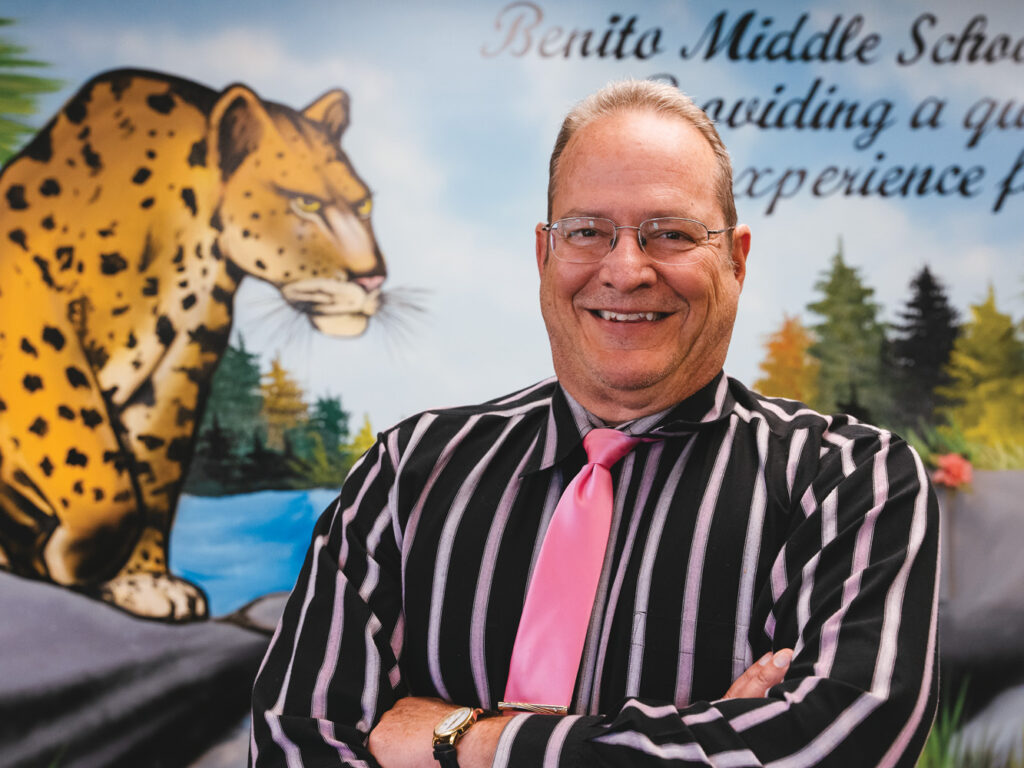
After 14 years as principal at Benito Middle School and 38 years in education, John Sanders is ready to retire.
For more than three decades, John Sanders has worked as an educator, starting as a teacher and then becoming one of New Tampa’s most beloved and respected principals. His career was almost everything he loved — helping guide students and teachers alike to set high expectations and meet them, while building relationships to make his school the pride of the community.
However, there are other things Sanders loves, as well. Like spending time with his son Jackson, fishing, playing bridge, tending to his yard and reading.
So, after a 38-year career, including the last 14 as the principal at Benito Middle School, Sanders, 60, is packing up his office and picking up his fishing pole.
“When am I going to enjoy those things?” he asks. “I’m not guaranteed tomorrow, so maybe now I can do some of the things I always thought I might enjoy.”
When the bell rings at the end of the last day of school this year, it will mark the end of an era at Benito. For the students who currently attend the school, and most of their older siblings, he’s the only principal they’ve ever known. Many from his staff, faculty, and even the PTSA say they’re not sure they’re ready to let him go.
They credit Sanders with sustaining a culture that has helped Benito maintain a straight “A” school grade going all the way back to 2002, while some other schools in the area have struggled, such as feeder school Hunter’s Green Elementary and Wharton High, where Benito students are zoned to attend.
But, the reason the school is so successful — with high test scores and low disciplinary problems compared with other schools throughout the District —goes much deeper than its letter grade.
His staff says it’s because of his unique style as a principal. He says it’s because of the people who surround him.
“We have a great student body and a great community, followed up by a fabulous faculty that is, for the most part, stable and successful. They get the best out of the kids,” Sanders says. “You put those together and it just works.”
While he never moved to New Tampa, he brought his only son, Jackson, to spend his middle school years at Benito. He says he tried to treat every child the way he would treat his own.
When his wife, Rhonda, passed away in 2016, Sanders was surrounded by the faculty and staff, who showed up in force at her memorial service, which he says was planned in part by volunteers from the school’s PTSA.
While he can hardly imagine stepping away from his Benito family, he says he thinks now is the time to move on to the next chapter.
But, he says it’s going to be hard, especially leaving the people who have become his family, like the group he brought with him when he was named principal at Benito. In the first 11 years since the school opened in 1997, it had four principals. Sanders has been there longer than those four combined.
He began his career as a math teacher at Plant High in 1983, then taught at Turkey Creek Middle School, where he was promoted to assistant principal. He then went to Young Middle School as an assistant principal before being named principal at Benito in 2008.
Language arts teacher Chris Ellis was hired by Sanders 24 years ago at Young. After 11 years together there, when Sanders moved to Benito, Ellis was one of many who followed and one of several who still teaches at Benito all these years later.
“He has had a very profound effect on my life,” Ellis says.
Ellis drove 24 miles each way to get to Benito, so, three years ago, he took a position teaching at a school closer to his home, only to return.
“I knew the minute I had walked out the door of Benito that I had made a terrible mistake,” Ellis says. His new school was welcoming, but he missed Sanders and his hands-off management style.
Like Ellis, math teacher Kelly Broadbelt — who has been honored multiple times as the school’s Teacher of the Year, including this year — also was hired by Sanders at Young.
She says Sanders, as a former math teacher himself, has influenced her tremendously, and that he still pops into her classroom occasionally to give the students a mini-lesson, which they love.
“For sure, he has made me who I am as a teacher,” she says. “I’ve never taught without him, and because he was a math teacher he could be very influential in my classroom, because he knows exactly what I’m doing and how to fix it.”
Both Ellis and Broadbelt have been under Sanders’ guidance their entire careers. They say that while they’re trying to be optimistic, they’re also nervous about the big transition they expect when he leaves.
“The reason so many people love working for John is that many times in education, they treat the teachers like kids,” Ellis says. “But, he treats you like an adult, and allows you the autonomy to go above and beyond.”
Sanders says that it’s always been important to him to remember what it’s like to be a teacher.
“I have tried to create a family environment and I think we have it,” he says. “I’ve tried to see the good in my teachers and not focus on the imperfections too much, except when sometimes you have to do that as the boss.”
Principal John Sanders has left his mark after 14 years at Benito Middle School. (Photos: Charmaine George)
Sanders half-jokes that the school is successful in spite of him, saying, “all I had to do is let the teachers teach and let the families come here.”
Sharon Hineline was PTSA president at Benito when her kids attended and says she was convinced by Sanders to work at the school — first in the front office and now as his secretary.
“Sharon has single-handedly convinced dozens of families who were on the fence about going somewhere else to come here,” Sanders says.
Creating A Unique Atmosphere
Meanwhile, Hineline says that she does so because of the atmosphere Sanders has created. “If you come to Benito and say you need something, he’s going to help you,” she says. “He has created a culture where it’s a partnership and the staff is empowered to resolve problems.”
Sanders is quick to return phone calls from parents who are upset about something they heard happened at the school, or to direct a teacher to call a parent to resolve a misunderstanding. He has a unique touch that helps calm down heated emotions, whether he’s talking with parents or students.
Hineline says Sanders recently had two girls in his office who hated each other so much that they had gotten into a physical fight. He spent time talking with each individually, then brought them together to discuss their choices, and they not only resolved their issues but are now the best of friends. One of the two went from failing all of her classes to passing them. The care Sanders demonstrated changed the girls’ trajectory at the school.
That same calm demeanor has talked many families out of leaving the school, instead resolving a problem that was accommodated by switching a class or another relatively simple solution, recognizing that at many schools, those resolutions are not always offered because they are more difficult on staff or teachers.
Sanders says has always focused on keeping what he calls “great families” connected to his school.
“That’s the mindset that I think a good administrator has to have,” he says. “You make their kids happy, you make them happy, and everyone wins. If I send you out the door unhappy, I’m asking for trouble. People are looking at alternatives.”
While he knows what it’s like to turn a school around –—Young was an F school when he arrived, and went up to an A — Sanders says Benito never needed that. It was a great school when he arrived. But, he has navigated some significant challenges, such as the population of students receiving free and reduced lunch — an indicator of socioeconomic factors that statistically align with school success — going from 22 percent to 62 percent.
He says Benito makes sure the kids know the expectations and the rules, and the entire staff “gets out and enforces it.”
Broadbelt, Ellis, and Hineline are just a few of the many who have bought into his philosophy.
“He’s just a good person, a good educator, and a good boss,” Broadbelt says. “He’s willing to do anything to help us.”
While Sanders deflects the praise, he says the community, the staff, and the students will continue to be family to him.
“This is my life and my world, and I’m sure I’m going to miss being the principal at Benito.”
Did you know that kids who are involved in music are more likely to score higher on standardized tests? It’s true — papers from respected journals, such as The Journal of Educational Psychology and The British Journal of Psychology have done extensive research on this matter. So, why aren’t our local public school orchestra programs supported by our public school districts?
Mahi Nooka
Unfortunately, not many adults involve themselves with youth orchestra programs, or even bother to learn about them. But, I believe that absolutely needs to change.
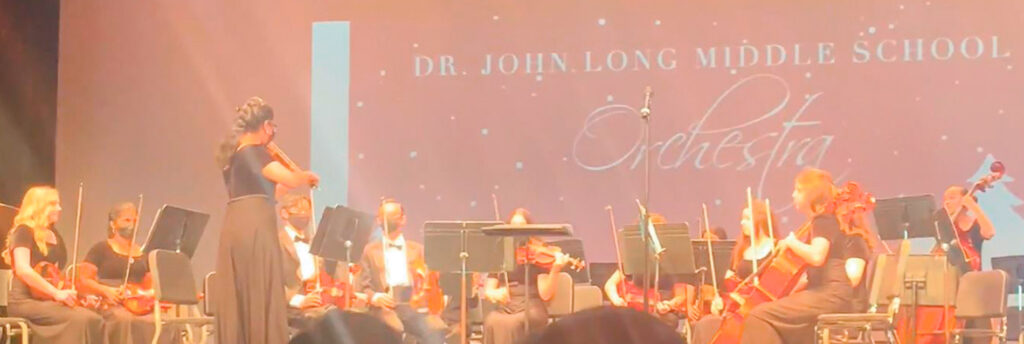
My name is Mahi Nooka. I’m 14 years old and I’m an eighth grader at Dr. John Long Middle School. I have been playing the violin for four years and I was invited to give my opinion on this subject by Neighborhood News editor Gary Nager because of a disturbing pattern I’ve noticed: our local youth orchestras are not being supported by the Pasco County School District or the local community.
You see, school orchestra programs in this area aren’t well-known or funded properly. I’m in both my school orchestra at Dr. John Long and in an outside program called the Tampa Metropolitan Youth Orchestra (or TMYO). It’s well known that the arts historically have had a low priority in Florida’s public schools, especially compared to sports and other money-making activities and I don’t think that’s fair or just.
But, even within the arts, there is a hierarchy; specifically, within school music programs. Orchestra programs are almost always given a lower priority than band programs in the amount and quality of resources provided. I’ve seen bands (especially high school marching bands) get larger classrooms, uniforms, and spots on the school’s website, while the orchestra programs are stuck using the same equipment for the past sixteen years or more.
It doesn’t make sense to me, though. I know that music has the ability to change kids’ lives — it has changed mine drastically. I started in orchestra in the 6th grade (although I’ve been taking private lessons since the 4th grade) and came to love it.
In the 7th grade, my private teacher recommended that I join an outside program to supplement my school experiences, and we found TMYO, a youth orchestra program located in Hillsborough County. I auditioned for one of the four groups they had that matched my skill level best, and I loved it so much that I auditioned again this year, for the next higher group. Currently, I’m proud to say that I am sitting fourth chair in the second violin section at TMYO.
One thing I can tell you through my experience is that orchestra is like a family. It teaches teamwork and lets us form incredible bonds. I’m more confident and passionate because of it, and my fellow musicians and I are comparable to siblings. Orchestra gave me that, and I’m hoping that if orchestra programs are better nourished, other kids can have that, too.
However, whether orchestra programs can thrive or not doesn’t depend upon us as musicians. The success of these programs depends heavily upon public participation — on people like you knowing about our programs and taking the initiative to support us.
That brings us to the real question: How can you support us?
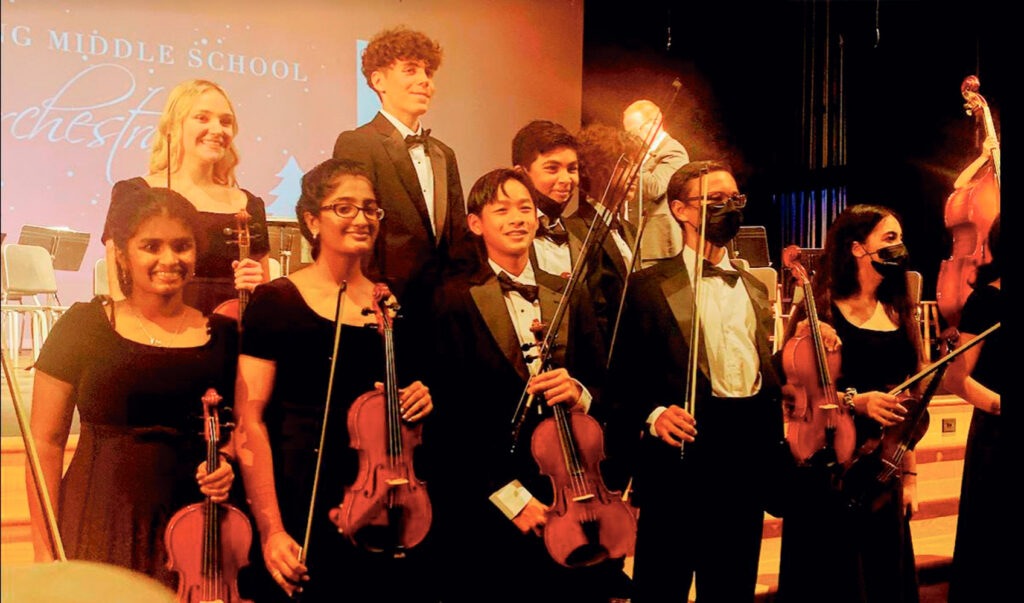
Mahi Nooka (2nd from left in front row) is a violinist in both the Long Middle School orchestra and the Tampa Metropolitan Youth Orchestra who would like to see more public support for youth orchestra programs.
Attending an orchestra concert is a great way to help. By attending, you’re showing that the kids’ hard work is not for nothing, and that someone cares. This is vital to developing confidence and allows us to practice performing in front of an audience (two essential skills for musicians).
Trust me, it doesn’t feel good when your auditorium is half-full and you’re performing for barely fifty people. This may seem like a lot of people to some of you, but think of how many people go to sporting events, especially football games.
And honestly, if nothing else, concerts are just a great way to spend time and involve yourself with the community. Though I’m not sure about other programs and schools, the concert for Dr. John Long is on Wednesday, May 4, at the Center for the Arts at Wesley Chapel, and the next concert for TMYO is on Saturday, May 14, at the USF School of Music in Tampa. The general public is invited to attend both of these events.
In addition to simply attending an orchestra concert, many local nonprofit programs have options for donations on their website. I know TMYO does (tmyo.org/make-a-donation) and so do many others in the area: the Florida Youth Orchestra (floridayouthorchestra.org/donate), and the Florida Symphony Youth Orchestra (fsyo.org/support-fsyo). Donating lets our orchestras continue to exist and allows young musicians continue to express themselves creatively.
If you’re not interested in donating or attending, you can still help by spreading the word. Discussing the benefits of orchestra programs can help stir up interest in the programs, and some parents might even check out orchestra programs for their own kids. It may seem like a little thing, but it can help a lot.
And so, I’ve made my case. The youth orchestra programs need to be supported, and I’ve done my part to ensure that happens by having this article published in the Neighborhood News. I will keep advocating in the background because of my love for orchestra, but there is only so much I can do. I hope I have inspired you to take action. This is your chance to give back and make an impact — one that will be appreciated by young orchestral musicians in our community.
Submissions by 11 New Tampa teenagers were chosen as award winners in the 2022 Hillsborough Region Scholastic Art & Writing Awards Exhibition. Of more than 1,200 entries, judges chose 231 art awards and 95 writing awards.
Wharton High senior Brianna Lee picked up three photography awards, including Three Bodies (right) being chosen as one of just five American Visions Nominees. The nominees are chosen from among all Gold Key winners, and one of the five will be selected the overall winner by a national panel. Brianna won a second Gold Key award for Caked On Disguise, and Faultless was chosen as a Silver Key winner.
Brianna describes their artwork as inspired by Aphrodite, the Greek goddess of love, lust and beauty.
“There are only two models in this picture: one model with a beautiful full figure with well-defined curves and the other with a tall, slim frame,” she says. “By overlapping the two photos of the two different body types creates a semi-distorted, unusually small body in the middle. This is also another body type that some people strive to change themselves to. I hope this work can show that there really is no perfect body type and that it will constantly change time and time again, and no one should feel the need to change along with it.”
Gold Key winners will be submitted to the Alliance for Young Artists & Writers in New York City, where they could be selected as national winners and recognized in a ceremony this summer.
Several other Wharton students also were recognized:
• Sabrina Valencia won a Gold Key award for the digital art piece Body Water, which also won a Judges’ Award, and a Silver Key award for Dyssoconnected.
The Vulnerability of Black Men by Terance Eady
We Eat the Mushroom The Mushroom Eats Us by TAylor Vanderpuyl
• Taylor Vanderpuyl won a Gold Key award for the photograph We Eat the Mushroom The Mushroom Eats Us which also won a Judges’ Award, and an Honorable Mention for Megan.
• Terance Eady won a Gold Key award for the photograph The Vulnerability of Black Men.
Honorable Mentions were awarded to Isabella Ancheta for the photograph Reflections and to Pranshu Modi for the painting Tokyo.
These students are all taught by Wharton art teacher Curt Steckel.
Honorable Mentions also were awarded to Benito Middle School students in the drawing and illustration category.
• Ananya Dongre won for The one who makes me smile and Frances McKoen won for Medieval Battle.
These students are taught by art teacher Cheyenne Causby.
Freedom High had three writing award winners, all taught by English teacher Robert Counts.
Frankie Vilsaint won a Silver Key award for his dramatic script The Egg Thief.
In the science fiction and fantasy category, two students were awarded an Honorable Mention, Haileigh Mereness for Beating Hearts and Jayden Mujica for Dark World.
The Scholastic Art & Writing Awards, established in 1923, is the longest-running, most prestigious recognition program for creative teens in the United States and claims to be the largest source of scholarships for young artists and writers. Previous winners include Stephen King and Andy Warhol.
This is the eighth year that the Hillsborough County Public Schools and the Hillsborough Education Foundation are serving as the regional affiliate for the national award program.
The Hillsborough Region Scholastic Arts & Writing Awards virtual awards ceremony is available online at EducationFoundation.com/2022ScholasticArtandWritingAwards. These and other award-winning works are on display at the University of Tampa’s Scarfone/Hartley Gallery (310 North Blvd., Tampa) through Friday, March 25. The gallery is open Mon.-Sat., 10 a.m.-6 p.m.
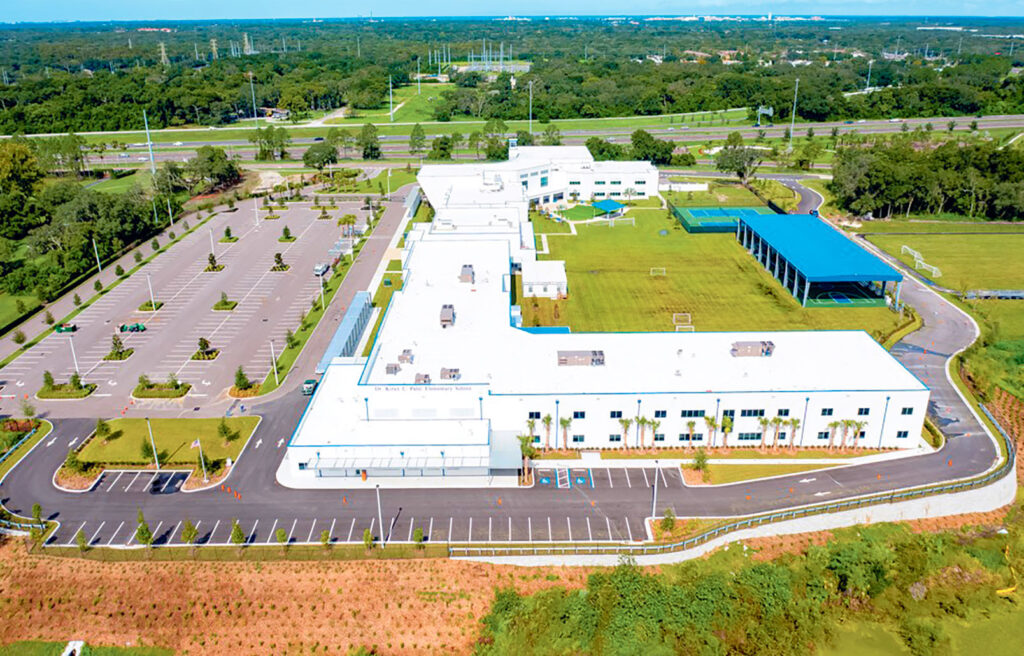
When Dr. Kiran C. Patel Elementary School opens this fall, it will complete the campus that currently houses Patel High School for students in grades 9-12 and Terrace Community Middle School for students in grades 6-8.
The 32-acre campus is located on Raulerson Ranch Rd. and is visible from I-75 near E. Fowler Ave, just 15 minutes south of New Tampa.
Patel High opened its doors for the 2019-20 school year and has continued to increase in popularity, with 450 students already signed up with hopes of being chosen by lottery to fill one of the 150 available slots at the school for the 2022-23 school year.
Terrace Community Middle School has been operating for more than 20 years and moved onto the Patel campus at the beginning of the 2021-22 school year in August.
After establishing the high school and working to bring the middle school onto the campus, Dr. Kiran C. Patel has turned his attention to younger students with the latest campus expansion.
“I think education in the formative years is what will create the future for anybody,” says Dr. Patel, a local entrepreneur and philanthropist who is both the founder and financier of the school. “Here we have an educational institution that focuses on a well-rounded person who has qualities of being a better human being. We don’t just focus on the grade of the school. There’s no question we want students to achieve a high standard of measurable goals, but there’s a lot more to education than that.”
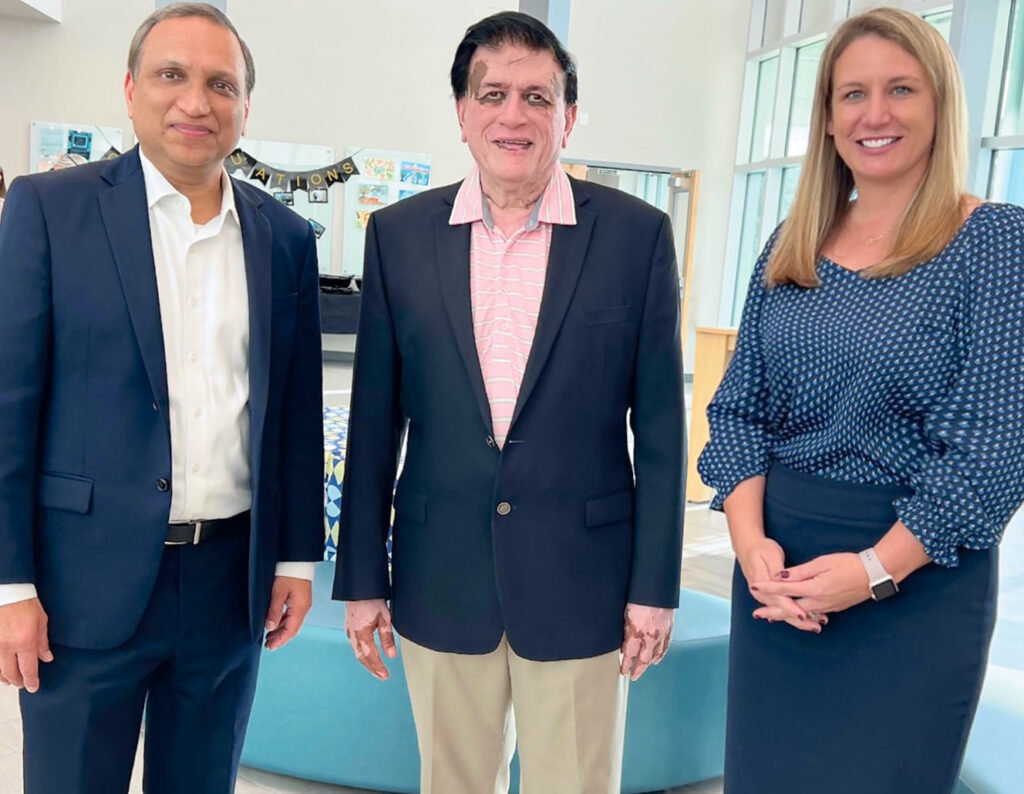
(L.-r.) Co-founder Ashok Bagdy, Dr. Kiran C. Patel and former Chiles Elementary assistant principal Ashley Galfond are the driving forces behind Dr. Kiran C. Patel Elementary, which opens Aug. 2022.
After initially committing $20 million to launch the high school, Dr. Kiran has spent another $20 million to build the elementary school and has spent an additional $5 million on upgrades to the campus, such as adding a covered outdoor court and restrooms by the sports fields. The Tampa resident’s business enterprises include luxury real estate development, medical software, healthcare solutions and commercial property acquisition and management. The success of these businesses allows him to make impactful contributions on a global scale, which he has done through the establishment of schools, colleges and hospitals on three continents.
“Construction on the elementary school was completed this summer,” says Ash Bagdy, who is a co-founder of the school, along with his wife, Kavita Jain, and Sonali Judd, who is Dr. Patel’s daughter.
Bagdy explains that the 84,000-sq.-ft. building is L-shaped. The elementary school is housed in one half and the middle school in the other. The two schools are completely separated with no interaction and TCMS remains a completely independent charter school.
Bagdy also says the campus was built with security in mind. Classrooms have key card entries, there are security cameras, a school security officer, and the school can be locked down in an emergency, with “one click to lock all doors.”
About The Elementary School
New Tampa’s Ashley Galfond has been hired as the first-ever principal of Patel Elementary.
Galfond was most recently the assistant principal at Chiles Elementary in Tampa Palms. She taught elementary school since her graduation from USF in 1998 until she moved into school administration seven years ago.
While she says it was not an easy decision to leave Chiles, she is extremely excited about the smaller focus at Patel.
“I like that everything within the organization is focused on the kids of Patel Elementary,” she says. “Here, everyone who has any stake in the school is just focused on our students.”
In fall 2022, the school will open with students in just three grades — kindergarten, first and second grade.
“Each year, as those children move to the next grade,” Galfond says, “we will add that grade until — four years from now — we will have K through five.”
Patel Elementary will open with a total of 270 students. There will be five classes in each of the three grades.
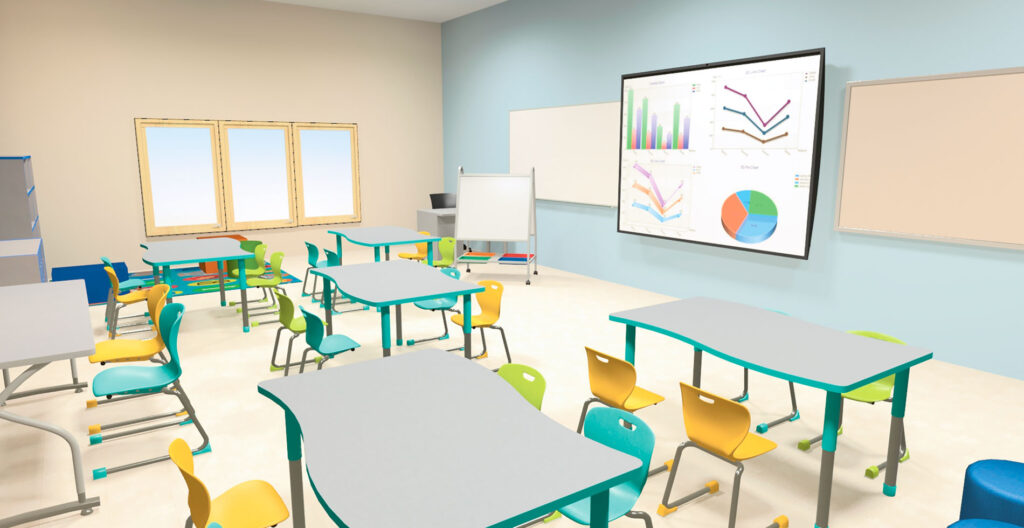
Each class will be limited to just 18 students. Although the physical size of each of the classrooms was expanded just before construction, it was to allow kids to spread out more for physical distancing because of Covid, not to make space for more kids in each classroom.
The Three ‘Pillars’
Galfond says that faculty members explain to parents and students that there are three crucial “pillars” at Patel Elementary.
“First,” she says, “we will focus on the whole child, including mental, physical and academic health and growth, with great outdoor learning opportunities as well as in the classroom.”
The second pillar, she says, is social emotional learning, which will be woven into the academic curriculum every day. Galfond explains that this includes teaching children to support one another, helping them to learn to express their own opinions and views, and figure out ways to calm themselves when they become upset. She adds that teacher training is a crucial part of the program.
The third pillar, according to Galfond, is project-based learning.
“It is inquiry-based,” she says. “We start with a question to engage students – something that affects the community in some way — and then, all disciplines are tied in to solve the problem, from reading to science to math.”
Dr. Patel notes that while academic achievement will be emphasized, it is not the only measure of success for the students who attend Patel Elementary.
“We will have a holistic approach and the goal of producing a student who is going to be an asset to the community,” explains Dr. Patel. “The purpose of education should not be to become a CEO. That should not be the primary goal, but to say that I will be a better human being and leave the earth better than I found it.”
Students Chosen By Lottery
Parents whose students will be entering kindergarten through second grade for the 2022-23 school year and are interested in attending Patel Elementary must apply online at PatelElementary.org. Students are chosen to attend the school through a random lottery process.
“This is the year with the best chance to get in,” explains Galfond. “It’s the most spots we will ever have.”
Every Tuesday in January, at 6 p.m., the school will host a new applicant Open House where families can meet the principal, with food and drinks provided.
“I am excited that everything materialized,” says Dr. Patel. “It was a big, big endeavor. I am very happy and proud to provide this option to the community.”
Patel Elementary is located at 10739 Raulerson Ranch Rd. in Tampa. To apply online for a spot for the 2022-23 school year, visit PatelElementary.org. For more information, call (813) 444-0660 or see the ad on page 21.