Tyriq Outen Is Chasing An NHL Dream!

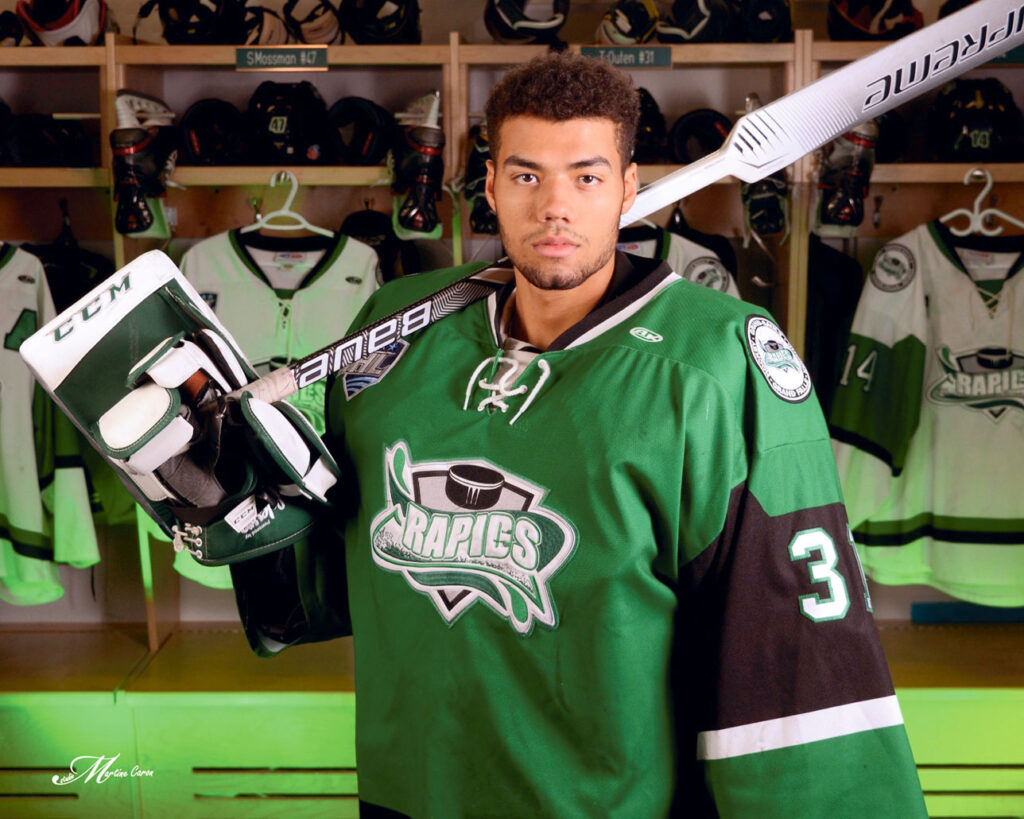
Tyriq Outen honed his hockey skills while living in New Tampa, and is riding high after an MVP performance in a major invitational tournament this summer has him a little closer to his dream of playing goalie in the NHL. (Photo courtesy of the Outen family).

The first time Tyriq Outen skated on ice at the Brandon’s Ice Sports Forum, he was 4 years old and decided immediately he wanted to be a goalie. 

A few weeks later, during his first lesson, his promising ice hockey career began…with his pads on backwards.

“Then, he fell behind the net and got his helmet caught in the net,” recalls his father, Ronnie. “It was a comedy of errors.”

That imperfect start, however, soon gave way to success at nearly every level at which “Ty,” as his family calls him, has played since. He went from being entangled in the nets to starring in them, and from being a junior standout to a legitimate NHL draft prospect with a bright future ahead of him.

“I feel like this is where I belong,” he says. “I fell in love with it right away.”

Tyriq grew up in New Tampa, and attended Turner Bartels Middle School. While his friends played Little League baseball and basketball and soccer at the New Tampa YMCA, Tyriq was part of a small but budding hockey community. 

He played for one of the best youth hockey teams in Florida, comprised of players from all over the state, but that meant lots of travel. He traveled by plane 2-3 times a month for big tournaments in the northeast and Canada, but mostly spent lots of time in the car with Ronnie driving all over the southeast.

Ronnie, the basketball director at the new Wiregrass Ranch Sports Campus of Pasco County, understood the lifestyle and demands for a high-caliber youth athlete. A former college basketball player who played professionally overseas, Ronnie understood it was all about exposure and training. When it was time to choose a high school, Ronnie and Tyriq moved to hockey-hotbed Boston and lived in an apartment.

“When we were in Boston, he was literally on the ice 5-6 days a week,” he says. “No knock on Florida, but there was a rink in every neighborhood. Imagine if Hunter’s Green had one, and Arbor Greene and Live Oak had one, if you had 5-6 rinks in this area, think of the pool of talent you’d have to draw from. That’s how it is up there. That is why the competition was so good.”

First Stop – Foxboro

Tyriq hooked up with the South Shore Kings in Foxboro, MA, and began to take off as a player. He had a 3.08 goals-against average (GAA) and a 90% save percentage in his two seasons.

At the age of 17, Tyriq made it onto the coveted NHL Central Scouting list as No. 19 among all North American goalie prospects. His athleticism, Ronnie says, is off the charts — he can roll out of bed and dunk a basketball — and his skating and stick skills are exceptional. Tyriq’s vision and game management continue to improve.

Toronto Maple Leafs development camp, June 30, 2018. Mark Blinch/Toronto Maple Leafs

Once a growth spurt got him to 6-feet, 3-inches, it completed the package, making him an enticing prospect at a position where taller, athletic goaltenders — like the Tampa Bay Lightning’s Andre Vasilevskiy, who also is 6’-3” —seem to be the future.

In Boston, NHL scouts were watching every game. “It definitely got the heart pumping,” Tyriq says.

Although Ronnie had spent most of his life playing and coaching basketball, he had married Heather, a native Canadian, who came from a family of goalies.

Tyriq was born in Miramichi, New Brunswick, where his grandfather Hugh Moar — Tyriq called him Grampy — was in the town’s Hall of Fame and his uncles were accomplished junior goaltenders.

Ronnie jokes that basketball never had a chance. Which, he adds, was fine by him.

“It wasn’t a disappointment at all,” he says. “I didn’t want him growing up with anyone comparing him to me or anything like that. I was just happy that every time he came off the ice, whether after practice or a game, he had a smile, and five minutes into the drive home, he wanted to talk about the game.”

Dealing With Adversity

After graduating high school in Boston, Tyriq had to choose between pursuing a Division I college career, or signing with a major junior hockey team, which would end his amateur status.
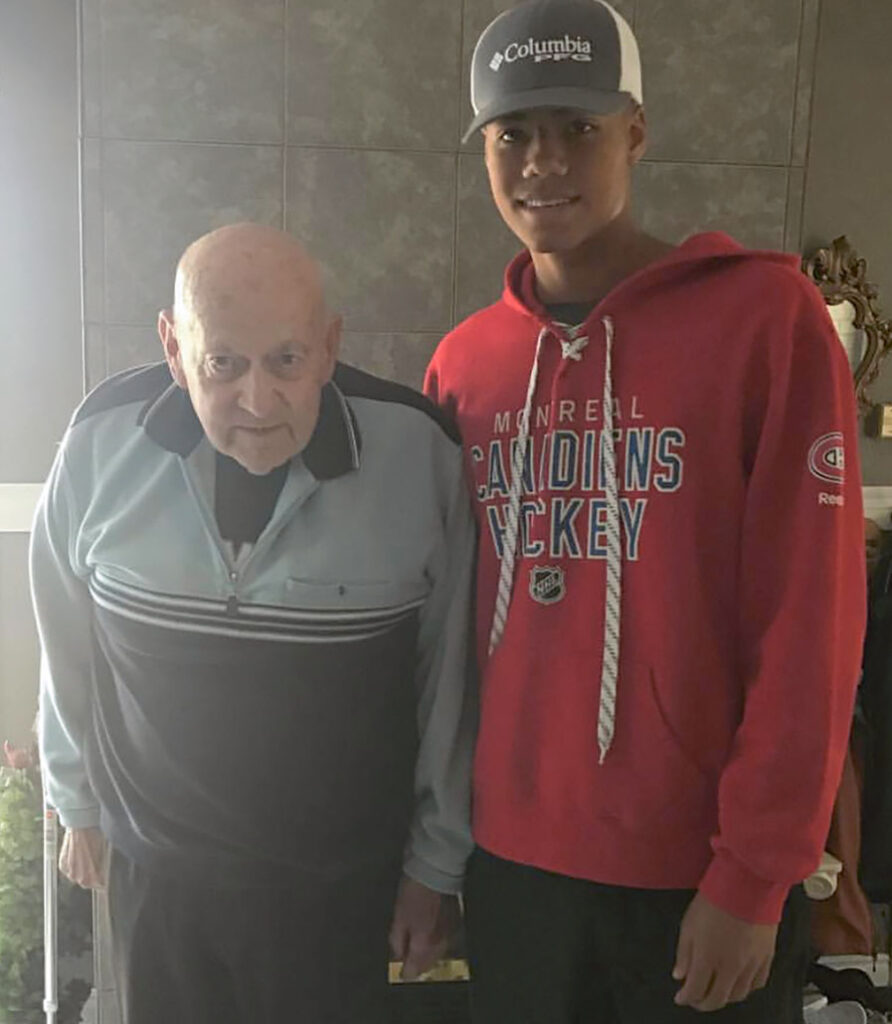
Tyriq with “Grampy”, Hugh Moar.

With a chance to sign with the Acadie-Bathurst Titan of the Quebec Major Junior Hockey League (QMJHL), the former team of NHL stars like Mario Lemieux, Mike Bossy and Roberto Luongo, and just an hour north from his birthplace, where his goalkeeping family had built a following, how could he resist?

It turned out to be the first speed bump in Tyriq’s career.

The QMJHL is one of three major junior ice hockey leagues that make up the Canadian Hockey League, along with the Ontario Hockey League (OHL) and Western Hockey League (WHL). Acadie-Bathurst had loaded up the previous season to win the QMJHL President’s Cup, and they captured the Memorial Cup against the winners from the OHL and WHL.

Tyriq says many of the players acquired to win the title in 2017-18 departed after that season. His new team won just eight games in 2018-19, and he finished with an 0-20 record, a 5.89 goals against average and faced nearly 1,000 shots in only 1,364 minutes. After a coaching change, Tyriq was released.

“The fact that it was (so close to Miramichi) made it even worse,” Ronnie says. “The whole town was hurrah hurrah, the hometown boy is coming, everybody was happy for that to happen. So, it made it double the monkey on his back.”

Ronnie worried about how Tyriq would handle his first-ever adversity. “I would be lying and he wouldn’t be human if I said it didn’t get him down.” 

Ronnie says he reached out to Tampa Bay Lightning goalkeeping coach Frantz Jean for some guidance, concerned his son might retire his pads. Jean, however, reassured Ronnie that Tyriq was still highly regarded, and that NHL scouts will be watching to see how he reacted to his adversity.

“The ones that are successful come out the other side stronger,” Ronnie remembers being told.

Getting Back In The Pads

Tyriq got back to work. Determined to come back even stronger, rather than give up, he doubled down on his efforts. When he was tired, he thought about Bathurst. When he didn’t want to work out, he thought about Bathurst. 

“I’m already up,” Tyriq would say as his dad walked into his room to wake him up early in the morning.

“That showed me just how tough he really is,” Ronnie says.

The Outen family — (l.-r) Tyriq, Kiana, Heather and Ronnie — has lived in Live Oak Preserve in New Tampa since 2006. 

Tyriq’s bounceback started in Grand Falls, New Brunswick, in the Maritime Hockey League, a league below major junior. If playing near his hometown made the Bathurst experience more painful, then his first appearance at the Miramichi Civic Centre, against the hometown Timberwolves, offered some redemption — he stopped 34 of 35 shots in a 6-1 win.

He went on to beat the Timberwolves two more times at the Civic Centre, and stopped 145 of 156 shots the hometown team fired at him over five games.

Covid-19 ended the 2019-20 season early, so Tyriq returned to New Tampa. He worked out with the Lightning before the team entered the bubble en route to the Stanley Cup. Tyriq continued to grind, ready for his next challenge, which came when he was chosen to play at the prestigious invite-only Beantown Summer Classic in August in Exeter, NH, where NHL scouts handle the coaching duties.

“He was so proud of having some of the Lightning players’ phone numbers in his phone,” Ronnie says. “That was pretty cool for him.”

The NextGen MVP!

Tyriq was the only goalie invited to play for an all-minority team — NextGen AAA Foundation, a nonprofit that offers mentoring to hockey programs in underserved communities.

NextGen, which is coached by NHL players Bryce Salvador and Mike Grier, steamrolled the competition at the annual Beantown Classic in Boston, and went undefeated to win the title. Tyriq was 4-0, and even added five assists — a shockingly high number for a goalie but a tribute to his stick skills — and was named the tournament’s MVP.

“That was a big deal for me,” Tyriq says. “I feel like I’m ready to do bigger things. It was  a great experience.”

Tyriq can’t return to Canada right now due to Covid, but was approached by a Calgary Flames scout at the Beantown Classic, who hooked him up the Maine Nordiques of the North American Hockey League. He left New Tampa last month to begin training, and the season began earlier this month.

In three games so far with Maine, Tyriq is 2-1 with a 2.94 goals-against-average and a .924 percent save percentage.

“He was in a bad situation before, but he’s recalibrated now,” Ronnie says. “This is a good situation for him. It’s going to be a good year. He is totally happy — you can hear it in his voice. And, that’s the best thing.”

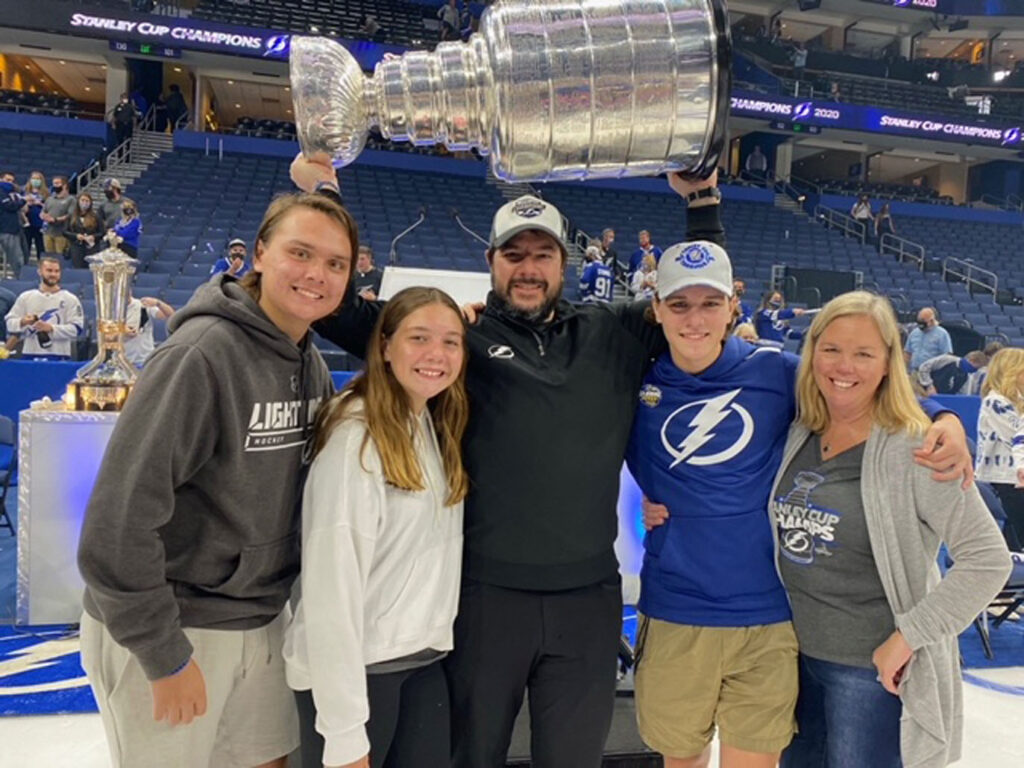
Locals Help The Bolts Bring Home The Cup!

Tampa Bay Lightning head trainer Tom Mulligan & chiropractor Tim Bain may not have laced ‘em up, but they did contribute to the second Stanley Cup in team history!

Tampa Bay Lightning head trainer Tom Mulligan (holding the Stanley Cup) and his family (l.-r., Tyler, Abby, Zachary & Kellie) finally got to celebrate Tom’s second Cup win with the Bolts on Sept. 30. (Photo provided by Tom Mulligan)

The first Tampa Bay Lightning game of the NHL postseason went to one overtime, then two, three, four and five.

In between periods, Arbor Greene resident Tom Mulligan, the team’s head trainer, scrambled to tend to cramps and injuries, keep the players hydrated and their energy levels up with grilled chicken, slices of pizza and bananas.

“It was controlled chaos in between periods,” Mulligan says.

And, unbridled joy afterwards. When Brayden Point scored the game-winning goal to give the Lightning the 3-2, five-overtime win over Columbus, it set off a raucous celebration and catapulted Tampa Bay on a run that would eventually lead to the team’s second Stanley Cup championship.

“That night, I felt this could be something special,” Mulligan says. “It was six hours, and just to see the controlled chaos in between periods was something. It really was all hands on deck. We still needed 15 more wins after that, but if that would have turned out differently, who knows what happens?”

The Lightning ended up getting those 15 wins. After dropping the first game of the Stanley Cup finals to Dallas, the Lightning won the next four, including a 2-0 shutout pitched by goaltender Andrei Vasilevskiy to clinch the title.

For many, including Mulligan — one of the few staffers remaining from the 2004 crew that took home the team’s first Cup — it was a long time coming. There have been a series of close calls in recent years, including a conference finals loss in 2018 and mostly noticeably, a devastating sweep by Columbus in the first round last year after the team tied an NHL record with 62 wins.

“We won it in my second year in the NHL, and I thought, ‘This isn’t so bad,’” Mulligan says, chuckling. “We had most of the team back, we’re going to have more chances. Then the years start ticking by, players come and go, and you realize: it’s not that easy.”

Mulligan is still coming down off the high of his second cup. There are few things like hockey celebrations, and Mulligan says Tampa outdid itself with the homecoming boat parade along the Hillsborough River and subsequent party held at Raymond James Stadium.

The most recognizable trophy in sports, Mulligan says he is hoping to be able to bring the Stanley Cup to New Tampa. It is a tradition that each member of the organization gets to spend at least a day with the trophy. In 2004, he took the Cup to Massachusetts to share with his parents. 

While he is not sure of the parameters this year, due to Covid-19, he and wife Kelly have some ideas for a New Tampa celebration.

“That’s the plan,” he says.

But first, some family time is in order. Mulligan spent 65 days in the NHL bubble, first in Toronto and then in Edmonton.

Counting a few days of quarantining before he left Tampa, he was away from wife Kellie and their three children for a total of more than 70 days.

In 2004, only son Tyler had been born; he was 14 months old when the Lightning won the cup. Tyler is now 17-years old and a senior at Wharton, and since, brother Zachary, 15, and sister Abby, 13 have joined the family.

“It was really special coming home with the Cup and seeing them,” Tom says. He laments the sports and school events he has had to miss because of his job, and the bubble isolation made that even more difficult.

“They have had to make a lot of sacrifices over the course of their lives,” he says, but adds that they are all old enough now to truly appreciate what dad does and the significance of winning the Stanley Cup.

And, he was able to return home in time for Abby’s 13th birthday on Oct. 5. He told her before he left Edmonton he was bringing her a special present. 

“She probably won’t ever get another gift like it,” he says. — JCC

Dr. Tim Bain hoists the Stanley Cup.
(Photo provided by Dr. Tim Bain)

Bain Helps Victorious Bolts Deal With Aches & Pains

Wesley Chapel resident Tim Bain, D.C. (Doctor of Chiropractic), who has been the Lightning’s official team chiropractic physician since 2009, says he actually has been treating Lightning players since a year or two before the Bolts won their first Stanley Cup in 2004.

“I had just moved to the area and was living in West Meadows, along with a number of Lightning players, including Marty St. Louis, Nikolai Khabibulin and Fredrik Modin,” Bain says, “and Tom Mulligan, who was already the team’s trainer, started sending some of the players my way.”

Fast forward to the unique season of 2019-20, and both Mulligan and Bain were among the 52 players, coaches and staff sent by the Bolts to live in the NHL’s “bubble” in Toronto for this year’s no-fans, two-bubble (the other was in Edmonton) playoff format. And, when the Lightning emerged victorious 65 days after first entering the Toronto bubble, Dr. Bain was among those celebrating with the new Cup champs.

“There’s no doubt that hockey players are among the toughest of all professional athletes,” says Bain, whose office is in the Cory Lake Professional Center on Cross Creek Blvd. “They don’t like to come off the ice or complain about their aches and pains. But, once the team started to embrace the idea of chiropractic care, they could see that they could recover from injuries faster and get back on the ice even faster.” 

Bain adds that with the even-quicker-than-usual turnaround times between games (because of not having to travel) in this year’s playoff format, he was even busier caring for the players than usual. He also was the person responsible for conducting concussion protocols for the players who sustained head injuries. 

One of the Bolts’ players who attracted the most attention for his ongoing injury woes was, of course, team captain Steven Stamkos. Although the nature of his injury was never revealed, Bain says no one worked harder to get himself back into playing shape than Stammer.

“Even though he only played 2:47 in one game (Game 3 of the Cup final series against Dallas) of the entire playoffs,” Bain says, “I think the goal he scored while he was in there got the entire team as excited as the moment we won the Cup. Even though he ended up not seeing the ice again, he gave the whole team such a huge lift.”

Bain agrees with Mulligan that the hardest thing about their time in the bubble for all of the Lightning players and staff was being separated from their families for so long.

“I have a tendency to get homesick anyway, even just on road trips,” Bain says. “But, having to spend 70 days away from my wife and children was even harder. Especially when we shifted to the Edmonton bubble (for the last two playoff series), there was literally nothing for us to do. Being able to come home and celebrate winning the Cup with our families and the fans was so amazing.” 

And, Bain adds, the goal now is to “bring the Cup home again next year. It can’t be more challenging than this year has been.” 

He says that he plans to be on hand when next year’s team has to recover from injuries and everyday aches and pains. “I definitely hope to be part of another celebration!” — GN

LIFE IN THE BUBBLE

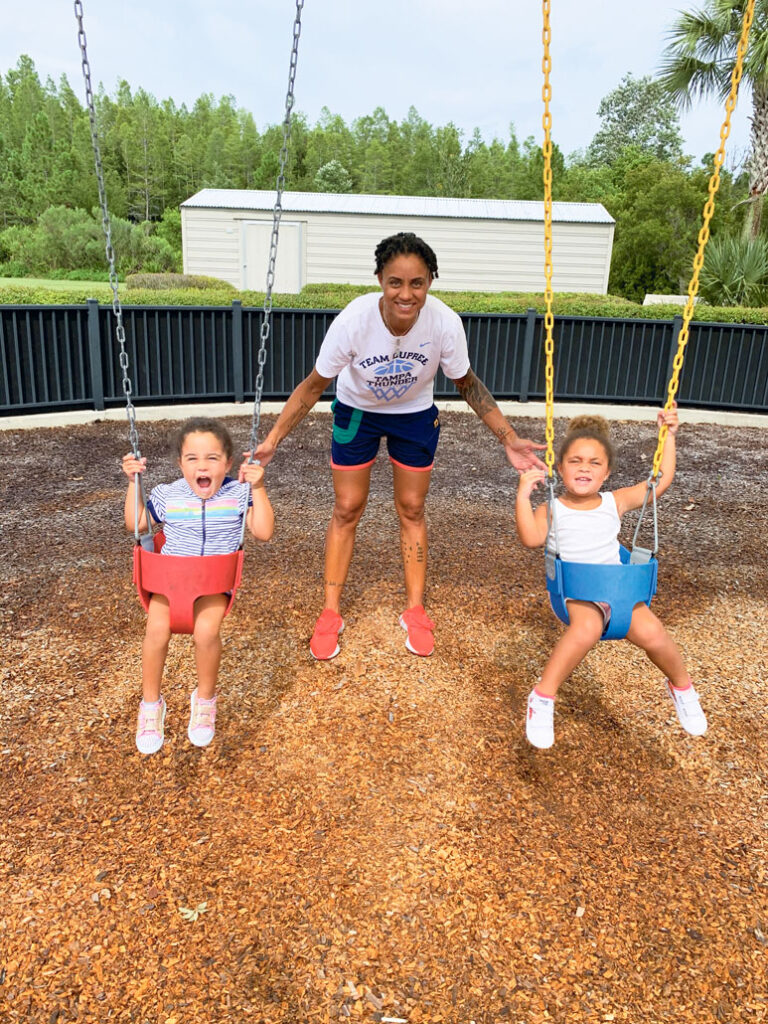
Candice Dupree pushes her 3-year-old twins Cali and Demi on swings near their home in The Ridge at Wiregrass Ranch.

Her 15th WNBA season is over for former Wharton High star Candice Dupree, and while she wishes her summer also included the WNBA playoffs, she says she couldn’t be happier. 

It was time to head home to be reunited with her three-year-old twins, Cali and Demi.

“I told my mom, whenever that last game is, I need you here the next morning to get me out of here,” Dupree said from Bradenton, where she wrapped up the season with her Indiana Fever teammates in the WNBA bubble at the IMG Academy on Sept. 12. “I want to get home.”

Home is Wesley Chapel, just up the road from Wharton, where Dupree remains the school’s all-time leading scorer.

Today, she says, her greatest accomplishments are raising the twins with wife DeWanna Bonner, a job she is eager to resume full time.

Photo by Ned Dishman/NBAE via Getty Images

Because Dupree and Bonner are both WNBA players, it is often no easy task. They play for different teams, have different schedules and because most women’s basketball players make more money playing overseas — before coronavirus and this summer’s WNBA season, Dupree was playing in Hungary, DeWanna in China — they have a hectic travel schedule and few days off.

While some WNBA players brought their children into the bubble — basically an isolation zone to keep the players coronavirus-free so the season could be played — Dupree was able to rely on mom Patty and Dupree’s twin sister Crystal, who she jokes enlisted as the nanny the day Bonner gave birth to the twins.

“We didn’t really know what we’d be getting ourselves into inside the bubble,” Dupree says. “At home, they have school, they play outside and in the pool. They wouldn’t have been able to do that (in Bradenton).”

The bubble was an experience Dupree says she won’t forget. She was playing in Hungary when President Donald Trump enacted a travel ban from Europe because of coronavirus, and, the very next day, she was hustling to get back to Florida. 

Photo by Ned Dishman/NBAE via Getty Images

When she entered the bubble in June for the WNBA’s 22-game schedule, the league was at the forefront of the social justice movement (photo on next page) in the wake of the death of George Floyd and nationwide protests. 

Dupree was active in the league’s initiatives and personally met with the League of Women Voters in hopes of becoming more involved with the voting community.

With the season over, Dupree is eager to spend time with the girls. 

“My girls are to the point where, when we talk, they are like, “Momma, come home, when are you coming home?,” Dupree says. “Initially, they were not like that. But, they are starting to miss their parents.”

Dupree is not looking to return to Europe to play hoops anytime soon and, at the age of 36, her WNBA career is finally winding down.

She will be a free agent. Her stats this year were in line with her career numbers of 14.4 points and 6.6 rebounds a game, and she is in great shape physically. She could play another two years, she says.

“But if a different job opportunity comes my way, I wouldn’t hesitate to take it,” she added. Opportunities she is interested in exploring include coaching at the professional level.

Do You Remember When…

Dupree was a silky smooth forward for the Wildcats, becoming the school’s all-time leading scorer and winning the Dottie McGahagin Award as Hillsborough County’s best girls player in 2001-02 (to go with a 4.8 GPA). She went on to be an All-American at Temple University, playing for three-time Olympic gold medalist Dawn Staley, and was the No. 6 pick by Chicago in the WNBA draft in 2006.

One thing she never imagined while making buckets at Wharton is that she would one day be where she is today — a 15-year WNBA veteran, a seven-time All-Star, a 2014 WNBA champion and one of the best players the women’s league has ever seen. 

“I never wanted to play in WNBA,” Dupree says. “I’m not going to lie. I didn’t even know what it was. I was so busy competing in so many different sports I never even watched pro sports on TV. I was just excited to be recruited and get a full ride somewhere.”

While it has been her consistency and steadiness that has defined her — she has never averaged less than double figures in points — Dupree is fifth all-time in WNBA career scoring, having put up more points than women’s basketball legends like Lisa Leslie, Sue Bird and Tina Charles.

In fact, for someone who never imagined playing professionally, Dupree is all over the WNBA career record book: second behind all-time leading scorer Diana Taurasi in field goals made, fourth in minutes played, and seventh in rebounding and games played.

In 2010, she put together one of the best WNBA seasons ever, averaging 15.7 points, 7.6 rebounds, shooting a blistering (and league-leading) 66.4 percent from the floor, and was second from the free throw line at 93.6 percent.

“I put together a pretty good resume,” Dupree says. “I’m on some lists with some very elite company. At some point, when I have I have time to sit back and reflect, I’ll say that was one helluva career. But, right now, I’m still wrapped up in it, playing and trying to win games, so I don’t pay it too much attention.”

Now that she’s home, Dupree plans to relax. She may check out the new Wiregrass Sports Campus of Pasco County near her home in The Ridge at Wiregrass, which recently hosted the seventh annual Candice Dupree Invitational, a girls basketball tournament for college hoops hopefuls. Dupree has sponsored teams for the tournament organizers, the East Tampa Youth Basketball Association, for years by buying them shoes and uniforms.

“It sounds great, we’ve needed something like that in that area for years,” Dupree says. She says one of her daughters may be interesting in the Sports Campus’ cheerleading program; the other, she laughs, leans more towards playing football.

And while she takes her kids on walks and plays with them in the pool, she’ll contemplate her next move.

“I’m not really in a rush,” Dupree admits. “I usually leave for Europe after Christmas but who knows if that will be happening. I just want to spend time with the girls and hang out for the time being. Then, we’ll see what happens.”

One Former New Tampa Standout Is Chasing Big-Time Soccer Dreams

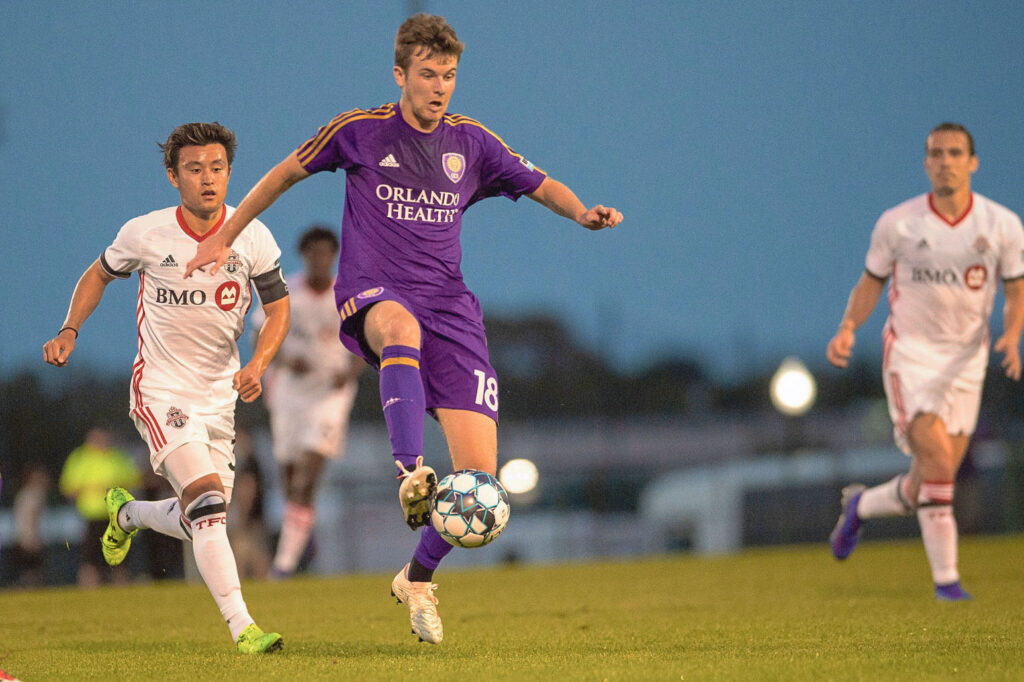
Former New Tampa youth soccer standout Austin Amer (in purple) started 26 matches last season for Orlando City B of the United Soccer League.

Austin Amer has lofty goals. The 20-year-old native of New Tampa is now in his second season as a professional soccer player with Orlando City B, which is in the second tier United Soccer League. 

Eventually, Amer says he would like to move on to play overseas, where the passion for soccer, as well as the paychecks, are higher. 

For now, like all of us, Amer is in his own little bubble. His world revolves around getting up early, driving to the training facility, filling out a coronavirus questionnaire, training before the midday heat becomes unbearable and heading back to his apartment for the rest of the day. 

His short-term goals during the pandemic are much smaller: “Going to Publix is the big highlight of the day,’’ Amer says. 

If he’s going to be in a bubble, it might as well be a soccer bubble. 

Amer grew up in Hunter’s Green, where there was always a soccer ball at his feet. By the time he was four, he was playing rec league soccer for the New Tampa Comets. One of the league’s directors noticed Amer’s talent and suggested to his father, Fred, that Austin practice with a group of seven-year-old club players. 

By the time Austin was seven, he could juggle a ball with his feet more than 3,000 times. There is a video on his twitter page (@austinamer) showing him juggling a roll of toilet paper. 

“Ever since I could walk I’ve been around a soccer ball,’’ Amer says. “My dad and I would always go up to the fields at Hunter’s Green and we would work on technical stuff. I’ve always been around soccer. It’s the only sport I’ve ever enjoyed playing.’’

Fred Amer, who introduced his son to the game, can vouch for that.

“He always had his ball with him,’’ he says. “It was in his blood.’’

Austin Amer as a six-year-old playing in New Tampa.

By the time Amer was playing U-9 club soccer, he moved from the New Tampa league to the more competitive Hillsborough United, which is now Tampa Bay United. He stood out so much that the family, which also includes his mom, Jan, and his younger sister, Alexi, decided it would be best for Amer to play on an elite U-12 club in Orlando when he was in the sixth grade. 

During that year, Amer attended Benito Middle School. On most days, he and his father would drive to Orlando right after school and not return home until 11 p.m. By the seventh grade, Amer started virtual school. His day consisted of morning workouts by himself in Hunter’s Green, school work, then practice in Orlando. 

By the second year, he was spending a few nights in Orlando with a fellow club player to ease the travel. 

“After that first year, it was just too much,’’ Amer says. 

“We’ve gone through quite a few cars,’’ Fred Amer adds. 

Austin’s travels were just beginning.

Before his senior year, when he was 17, he had a chance to play for the Barca Residency Academy in Casa Grande, AZ. The brand new academy was partially run by FC Barcelona, an elite club in the top-level “La Liga” in Spain. Think IMG Academy in Bradenton, except strictly for soccer.

After a tryout, he was given a full scholarship to play for Barca’s U-18 team. Leaving home was another sacrifice in chasing his soccer dream. 

Amer, a midfielder, thrived on both the U-18 and U-19 teams in his year-plus with the club. During a showcase in the winter in Lakewood Ranch, he was spotted by some Orlando City scouts. Ironically, the scouts didn’t realize that just two years earlier, Amer’s club team was affiliated with Orlando City. They wanted him to join their B team, which was one step down from Orlando City of Major League Soccer. 

He decided to leave his Barca team during the season, when Amer became the first Barca player to sign a professional contract. 

“He’s chasing the dream that he has,’’ his dad says. “If he really wanted to go through with the sport, he had to follow this path.’’

The Amers were able to see Austin play last season. He played in 26 matches as a 19-year-old and was impressive enough for Orlando City to bring him back this season. 

The 2020 season hasn’t gone exactly as planned. The only way the Amers can see him play is via livestream. Earlier in the year, Amer suffered a shoulder injury that kept him out of a few games. Also, an inconclusive Covid-19 test forced him to sit out a bit longer until he got two straight negative tests. 

However, he’s back on the field now and doing the thing he loves to do. The season runs until late October. After that, Amer’s contract will be up and he could move on yet again. 

“My goal in the future is to play in Europe at some point,’’ he says. 

High School Fall Sports Season To Be ‘Challenging’

At our press time, Freedom High was expected to open its 2020 football season on Sept. 11, hosting its New Tampa neighbor and archrival Wharton High, but the toughest opponent for both teams to combat that night likely wasn’t each other.

It was Covid-19.

And, that doesn’t just go for football. Avoiding the virus is arguably the biggest challenge facing teams across Hillsborough County (and the country), as high school athletes, their coaches and administrators try their best to remain socially distant and safe in what is certain to be the strangest prep sports season ever.

“It’s going to be very…what’s the word I’m looking for? Intensive,” says Wharton athletic director Eddie Henderson “It’s going to be a lot of work.”

The county is following all CDC guidelines for sports and also has issued its own 18-page guide, which covers everything from daily cleaning and sanitizing to quarantining and tracing those who become infected. The rules, which include the difficult-to-enforce ban on handshakes and high fives, seek to prevent a major outbreak of the virus.

Social distancing will be the key to keeping crowds at athletic events from spreading the virus.

One of the rules that will make football feel very different is that the bands and cheerleaders will not be permitted to travel to away games. That means that when the Wharton Social Distancers traveled to take on the Freedom Social Distancers, they had to leave behind some of their loudest and most ardent supporters, not to mention a group that is woven into the very fabric of the Friday night football experience.

The crowds will be smaller. A limited number of fans will be allowed into sporting events like football and volleyball this fall — players (and band members) are allowed to choose only four spectators, but they have to be registered on a list at least a day before each game, so they can be issued electronic tickets. Each player’s foursome will be a “spectator pod” and will be required to sit together.

Fans, who must wear masks in the stands, will find seats clearly marked off in groups of four, socially distant from other pods.

The biggest hurdle, however, will be keeping the athletes healthy. If an athlete tests positive, he/she and anyone in close contact with them will be quarantined for 14 days. That can wipe out any team’s roster in a hurry.

Football will be a huge challenge, due to the unavoidable closer quarters presented by bus transportation and the sheer number of players (often ranging anywhere from 50 to 80 or so) cramming into small locker rooms.

The football teams at Hillsborough and Jefferson high schools have already had infected players and, as a result, may not be able to play the first two weeks of the season.

“I’m holding my breath, and the reason is that, when we’re putting this many people together, you just don’t know,” Henderson says.

While football is the biggest concern, every sport will present its own set of issues. 

For example, cross country will have to stagger its starts to avoid large gatherings of runners from multiple schools. Volleyball players will be expected to avoid the traditional high-five after every point, and swim meets with multiple teams may be hard to find. In fact, Wharton’s usual “home” pool at the New Tampa YMCA is not permitting the Wildcats to host any meets there.

Provided that high school sports can make it all work under such unique and demanding circumstances, middle school sports will not begin until the second quarter, with track starting first on Oct. 12, followed by flag football and volleyball on Oct. 19.

“Everything is so uncertain,” Henderson says. “Are we gonna be able to push through or will there be a setback? I hope we can push through — I want to see the kids play. They have suffered enough the last six months with (the 2019-20 school year) getting cut short, and the makeshift way of doing school. I hope we push through.”