A Former (Mediocre) Male Swimmer’s Take On The Transgendered Swimmer

Gary Nager Editorial

When I saw on the news and the uproar on Facebook that transgendered swimmer Lia Thomas had won the NCAA Women’s 500-yard championship, beating out Sarasota native Emma Weyant by 1.75 seconds, I couldn’t help but think about my own mediocre career as a distance freestyle and butterfly swimmer.

I didn’t want to be a swimmer as a kid, but all of my closest friends joined the Hewlett (Long Island) High swim team in 9th grade. At that age, I wasn’t big/tall or good enough to play high school football or basketball, so I accepted that swimming was it for me.

All of my friends were better than I was as a swimmer, especially in sprint events. But, I did enjoy being part of a really good team (we always had guys advance to the State Championship meets and some of them even won their events at the County level and at least made it to the finals in their respective events at States). Two of my closest friends were even good enough to swim for the Ivy League University of Pennsylvania.

Meanwhile, I worked to the best of my ability for four years, doing well enough to earn a varsity letter my junior and senior years, based on my results in dual meets during those seasons. I even made it to the County meet my senior year in the 100-yard fly and 500 free, but did not crack the top-20 in either event, despite swimming PRs (personal records) in both. I believe my 500-free time at the County meet was 5:18, but that was nowhere near my goal of breaking 5 minutes.

Even so, I was in the best shape of my life, so I continued swimming to stay in shape in my two years at SUNY Albany, and I even decided to join Albany State’s team my sophomore year. I was relegated to the events none of the other swimmers wanted to compete in — the 200 fly, 500-, 1,000- and 1,650-yard freestyle — but I only qualified for the Division III State Championship meet in the 1,650. I had put on at least 10-15 lbs. of muscle since high school and swam my P.R. in the 1,650 at State — somewhere over 18 minutes — and also recorded my fastest-ever times in the 200, 500 (5:07) and 1,000 en route to finishing 18th at that meet.

Three months or so later, I transferred to the University of Florida, a long-time swimming powerhouse, and decided to see if I could walk on the men’s team. After the first 200 yards of warmups, I realized I was completely outclassed and got out of the water cursing at myself. The famous then-Gators coach, Randy Reese, put his arm around me and said he could tell I was a competitive swimmer, and that I could stay with the team as the equipment manager and possibly even a meet-day fill-in if I could handle the thousands and thousands of yards per day and still get the kickboards and hand paddles put away at the end of each session. 

Not only did I decline, I joked that I clearly wasn’t even good enough to make the school’s women’s team — and he agreed.

Little did I know, 40+ years later, that anyone would actually attempt such a switch. The former William “Will” Thomas, who says she began feeling transgendered while still in high school, joined the University of Pennsylvania’s men’s team as a freshman in 2017 and finished in the top-seven in the same events I swam (500-, 1,000- and 1,650-yard free) at the 2018 Ivy League Championships (for the same Penn team my friends swam for), although Will Thomas did not make the finals in any of those events at the NCAA Championships that year or in 2019, the Texas native’s last year competing as a man.

At the end of 2019, Will Thomas told his coaches that he was transgendered and began undergoing hormone replacement therapy to transition to female that year.

Between Covid and transitioning to female, Lia Thomas (right in picture) didn’t swim as a woman at the 2020 or 2021 NCAA Championships, but resurfaced as one of the favorites in multiple events at this year’s NCAA Women’s meet. Lia not only won the 500-yard final (in a time 13+ second slower than Will Thomas’ PR of 4:20.5), she also finished 5th in the 200 free and 8th in the 100 free.

Now, after previously having met and written stories for the former Bruce (now Caitlyn) Jenner and his Better Health & Living magazine in the 1980s, I do believe it’s possible for adults to realize that the gender they were born into was somehow a mistake, and I wish Lia Thomas the best of luck in life.  

What I don’t believe is that someone who was born a man should be allowed to compete as a woman at any level of competitive sports. I’m no doctor or geneticist, but I don’t believe suppressing a male’s natural hormones is enough to not give that genetic man an unfair strength and endurance advantage when competing against genetic women.

Like Florida Gov. Ron DeSantis, I believe that Weyant should have won the 500-free title, although I blame the NCAA for allowing Thomas — or anyone born a man — to compete as a woman at all.

A Gated Community At Last? 

A long-running saga at Heritage Isles has come to an end after more than 20 years and repeated efforts by many residents to activate the entrance gates at the front of their community.

Heritage Isles residents voted in favor of asking the City of Tampa to transfer ownership of the community’s roads to its Community Development District (CDD), which will lead to the security gates once again becoming functional.

The resolution needed two-thirds, or 66 percent of the homeowners who voted, to pass; it got 77 percent “yes” votes.

“The vote cemented what the residents want, which I feel really good about,” said CDD chairman Dan Barravecchio, who spearheaded the effort. “This was really about being able to take care of our own assets
and we can maintain a higher standard for our roads (than what the city can provide).”

The resolution is now in the hands of the City of Tampa which, after conducting its due diligence, will vote on it sometime in the coming months.

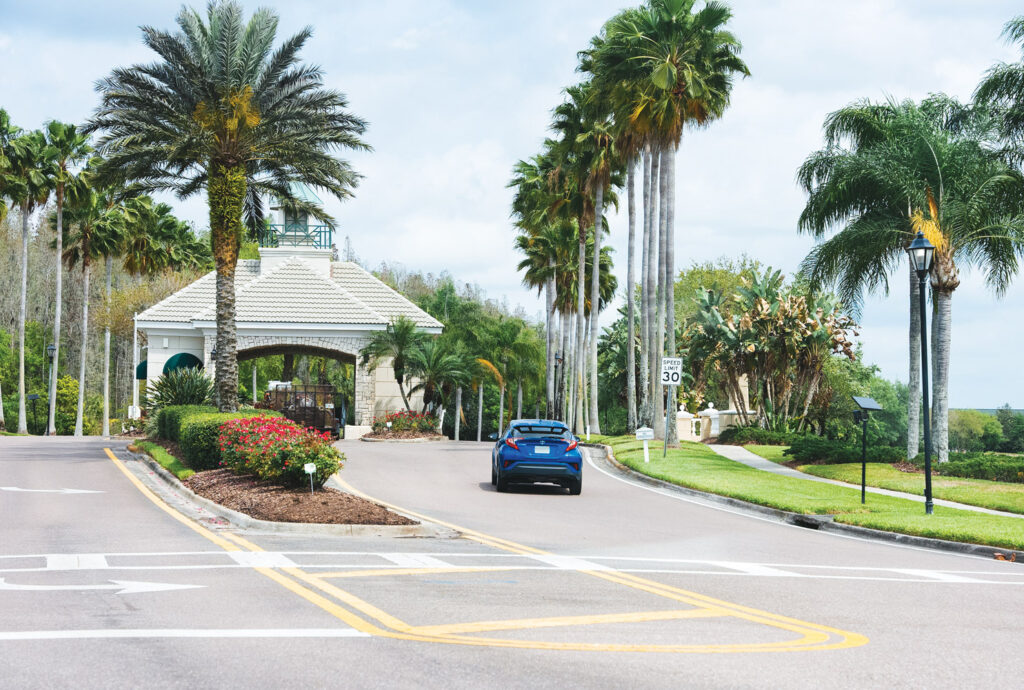
If it passes, which appears likely, the Heritage Isles CDD intends to install a new system to put the gates at its Grand Isle Dr. and Sandy Point Dr. entrances off of Cross Creek Blvd. back in working order for the first time since 2003.

The gates haven’t been used because the developer, Lennar Homes, conveyed the Heritage Isles infrastructure to the City of Tampa, which said that made the eight miles of roads within the community public. 

The city prohibited the gate attendant from denying entry to any vehicle, requiring “unimpeded access” to vehicles turning off of Cross Creek Blvd. into Heritage Isles.

The CDD decided to eliminate the guard service, for which it was paying $77,000 a year, and the gatehouse has remained vacant ever since.

“If we couldn’t secure the gate, and we couldn’t check identifications, then why were we paying $77,000 a year for someone that couldn’t do anything but flip a switch?,” Barravecchio asked.

Multiple attempts to get control of the community’s roads were denied. There was no legal mechanism in place to transfer the roads to a CDD, only to a homeowners association (HOA), and that required a 100% vote by homeowners.

According to Barravecchio, the city also was hesitant, due to the community’s outstanding bond debt.

Once that debt was paid off early in 2019, the CDD and its lawyers set out to have a state law written that allowed the conveyance of the roads in a community to a CDD with a 66% vote, as opposed to the 100% vote required by Tampa just to transfer it to an HOA.

“You had a better chance of winning the lottery than getting 100 percent,” says Mark Vega, the CDD district manager since 2014. In fact, Vega said he could only remember one case more than a decade ago where a community succeeded with a 100% vote, and it was actually two cases — the Huntington (42 homes) and Westover (61) villages in Tampa Palms. 

Heritage Isles hired a lobbyist and began the work of having the law crafted. Piggybacking on House Bill 57, a transportation bill, Heritage Isles was able to get Senate Bill 1194 included, which authorized “governing bodies of municipalities and counties to abandon and convey their interests in certain roads and rights-of-way dedicated in a recorded residential subdivision plat to community development districts under specified conditions.”

It was signed into law by Gov. Ron DeSantis on June 29 of last year.

“This is groundbreaking, this is pioneer stuff,” Vegas says. “I already know of two CDDs that are excited to jump on the bandwagon, but this (Heritage Isles) is a first for the state of Florida.”

The CDD rallied support within Heritage Isles for the vote, which was held on March 18. Of the 1,020 homeowners in Heritage Isles, a total of 373 voted, with 286 voting “yes” for the community to gain ownership of its roads.

The CDD held a number of community meetings to explain their plans, conducted all the required road studies and has stockpiled more than $650,000 in its reserve funds for future road work.

Once the city approves the transfer, Heritage Isles plans to install a state-of-the-art virtual guard system at its two entrance/exit kiosks, similar to the one used by the Live Oak Preserve community off Bruce B. Downs Blvd., hopefully bringing the gate saga to an official end.

Vega says a lot of homeowners in Heritage Isles “were misled” into thinking they were buying into a gated community. Now, Heritage Isles finally can deliver on that promise.

“There isn’t a year that has gone by that the gate issue hasn’t come up,” says Barravecchio, who has lived in Heritage Isles since 2002 and has been on the CDD board since 2005. He says the effort was fueled by many of the early residents.

“The more long-time residents, they felt it was something that was taken away from them, so they had a much more personal interest in having it restored,” he says. “Those are the people that when they drive down my block and I’m out washing my car, they stop and say ‘Thank you.’”

Wiregrass Ranch High Health Fair Draws A Crowd

When Phoebe Taylor put on the drunk goggles and attempted to walk the guided pathway, she thought it would be easy. Instead, the Wiregrass Ranch High freshman was shocked to find herself stumbling throughout and sometimes off the course. 

Like Taylor, students at her school are learning the consequences of drinking and driving, the dangers of not wearing their seatbelts and the importance of mental health. 

“It’s easy for us to just go and do something dumb and regret it later,” Taylor says. “If that actually happened it could be very dangerous.”

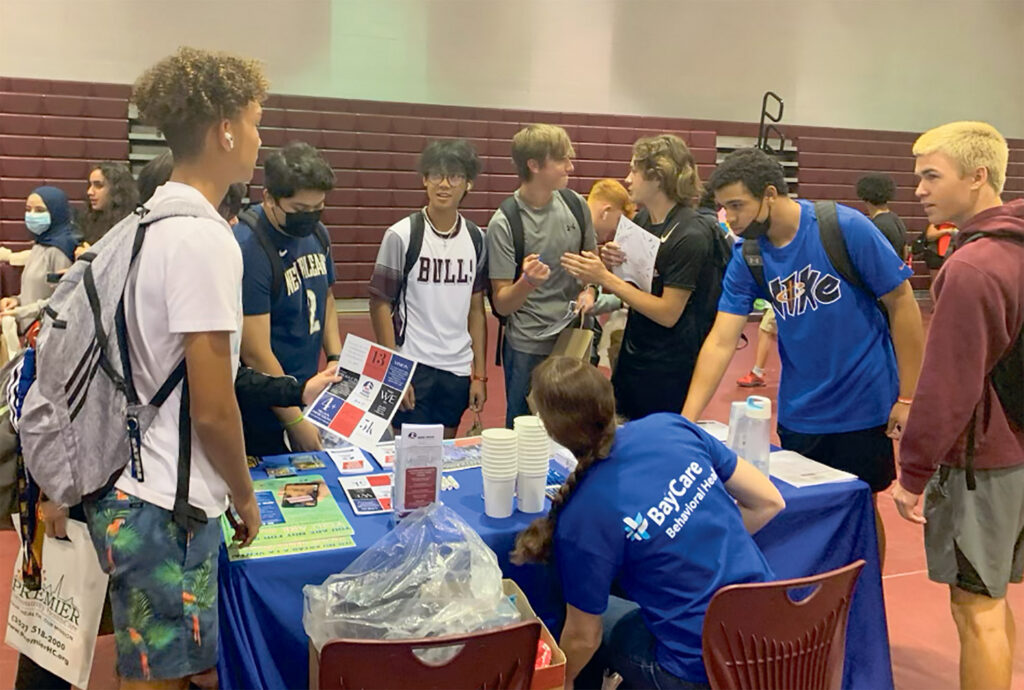
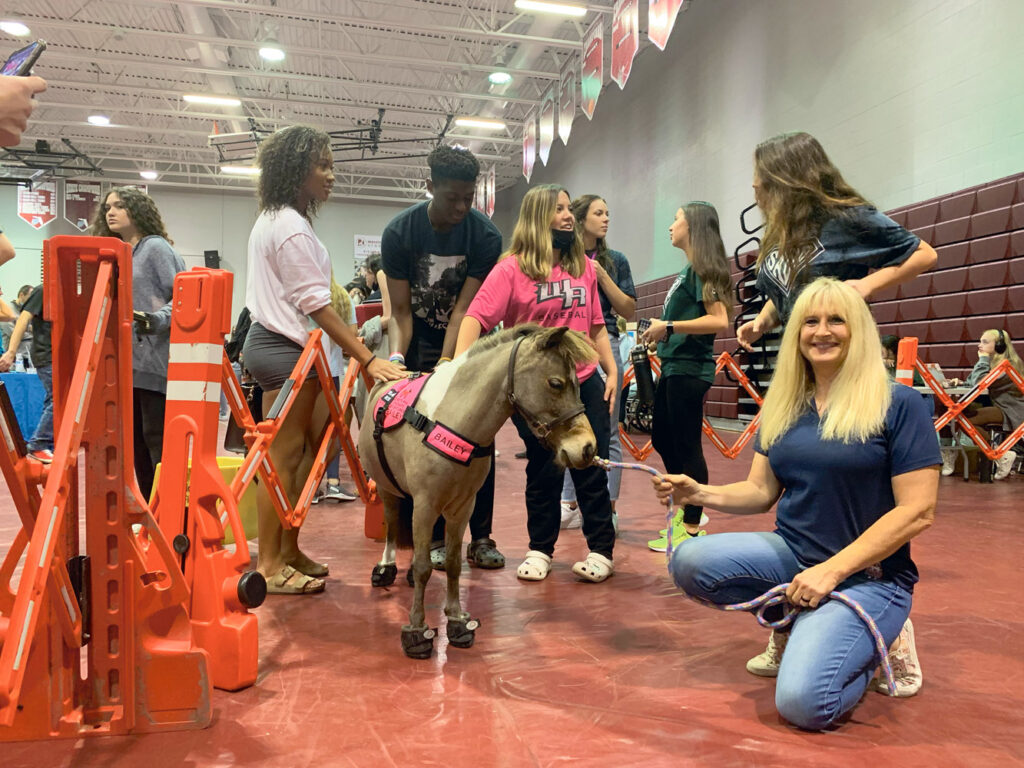
The largest-ever Wiregrass Ranch Wellness & Safety Fair was hosted on March 9 by the school’s Students Against Destructive Decisions (SADD) chapter to bring awareness to mental health and promote a healthier and safer lifestyle. 

The event brought about 35 community leaders and the Pasco County Sheriff’s Office (PCSO) to talk to students and demonstrate the dangers of these acts.

Shaina Finkel, the president of the school’s SADD chapter and the national SADD president for the 2021-22 school year, oversaw the event. Her main goal was to have students talk to these organizations and understand the messages they are spreading.

“It’s not just going in and getting education,” Finkel said. “It’s meeting people and finding things that you might be passionate about that you didn’t know you were passionate about. It’s bringing safety and education and health to our school and it’s just allowing the students to learn.”

Finkel says there have been instances where these messages have not been reached by students; she hopes that through these fairs, students will rethink some of their previous and future decisions.

Ashley Boyles, Wiregrass Ranch High’s assistant principal, also oversaw the Wellness & Safety Fair. She says the fair is eye-opening to students and impacts them for a long time. The last time the fair occurred was two years ago, because of the pandemic, but she says students still remember and talk about it to this day. 

“We’re again trying to make sure that our students are safe not only at school, but out in the community, out on the roads,” she says. “We always say to be college-, career- and life-ready and I think this is something to be life-ready.”

Students watched as a rolling car simulator demonstrated the dangers of drinking and driving and not wearing a seatbelt in a car crash. As the car spun, dummies inside not wearing a seatbelt flew out. Florida Highway Patrol spokesperson Steve Gaskin said he still gets people coming up to him and saying they remember the visual impact, and it is one of the reasons why they buckle up today.

“If I can make an impact on each one of these kids, then that’s one crash I won’t have to work and it’s one family I won’t have to go talk to and say, ‘Hey, your child’s not coming home tonight,’” he says.

Kelsey Strigler, the vice president of Wiregrass Ranch’s SADD chapter, says the car simulator is likely the most effective demonstration to show students the importance of wearing their seatbelts. 

“Looking at it, I would be terrified,” she says. “I already do wear my seatbelt, but If I was a student who didn’t, that would really drive the point across that like you really need to wear that or you’re going to end up like the dummy on the floor.”

Among the booths was the American Foundation of Suicide’s Tampa Bay chapter run by board member Teresa Daniels. She is spreading her son Tristan Daniels’ story in hopes of saving another student’s life. 

“There is hope out there,” she said. “They could be lifesavers. They can help anyone in need.”

Gabriella Nieddialek, a SADD member, recognized the importance of this booth and is glad to now be learning about these tools. 

“A lot of teens don’t really like to come forward about mental health, and it’s definitely something that I’m glad the school introduces and is comfortable talking about,” Nieddialek said. “Definitely encouraging us to talk to people and get help.”

Wiregrass Ranch’s SADD chapter advisor Gregory Finkel is proud of how the event turned out. He watched how students interacted with community members as they talked to each other about what they learned. He says that is what the event is all about. 

“You don’t really get these opportunities too often,” Gregory Finkel said. “If we can hit one of them, just one kid right, make a difference in their lives, the better.”

Weekend Closure A Sign DDI Getting Closer

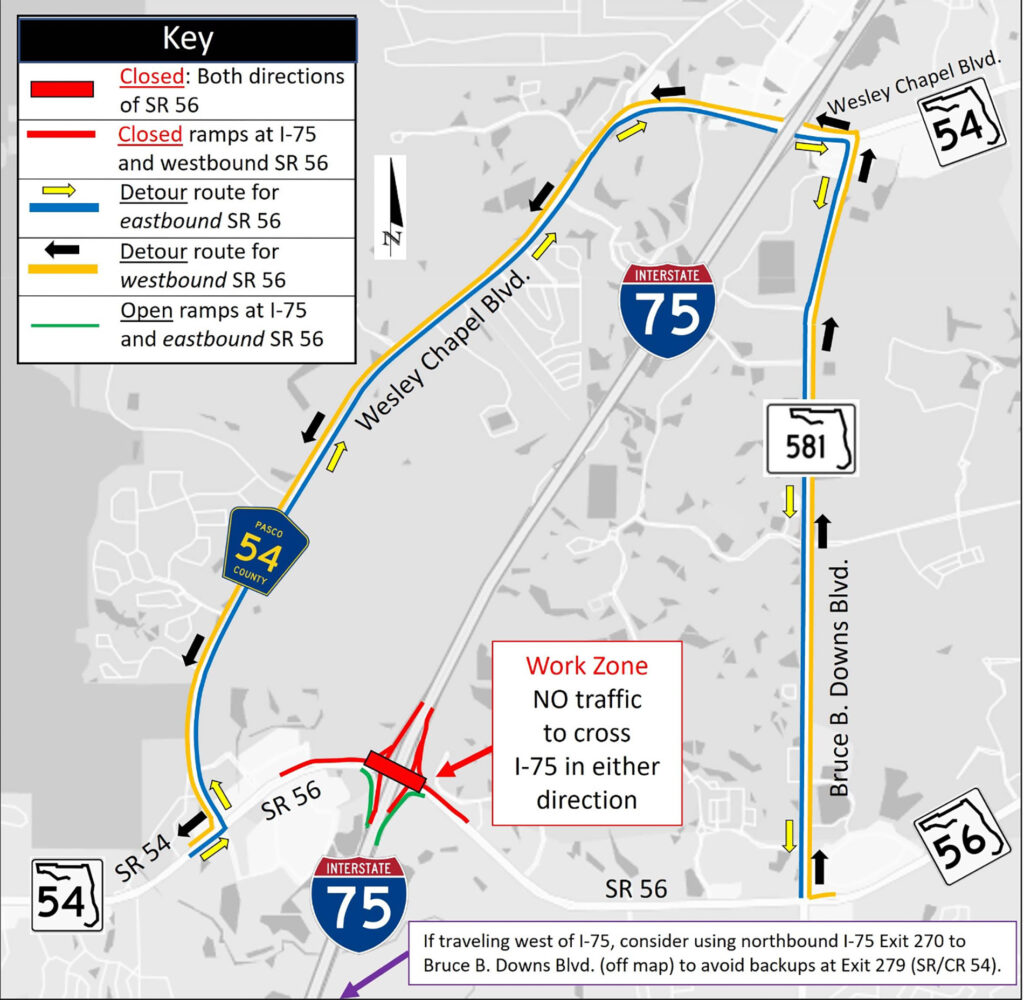
The Diverging Diamond Interchange (DDI) is nearing completion and, as a result, S.R. 56 will be closed to all traffic at I-75 from approximately 11 p.m. on Friday, April 1, to sometime during the day on Sunday, April 3.

No traffic will be permitted to travel through the work zone across I-75, according to the Florida Department of Transportation (FDOT). S.R. 56 is being closed to switch the roadway to the DDI traffic pattern. 

S.R. 56 traffic will be detoured using S.R. 56, Bruce B. Downs (BBD) Blvd. (S.R. 581) and S.R. 54/C.R. 54 (Wesley Chapel Blvd.) as shown on the map above.

FODT says the DDI will not be at full capacity until closer to the expected project completion this summer. The contractor, Superior Construction Company Southeast, LLC, has more work to do to open an additional lane on both eastbound and westbound S.R. 56, and another turn lane from the northbound I-275/I-75 exit ramp onto westbound S.R. 56.

While S.R. 56 is closed, two ramps will be available to use at the I-75/SR 56 interchange — the eastbound S.R. 56 entrance ramp onto southbound I-75, and the northbound I-275/I-75 exit ramps onto eastbound S.R. 56. All other traffic will be directed via detour signs to use the I-75 interchange at S.R. 54/C.R. 54.

You can access detour descriptions and a full-size map are available on the project web page at www.fdottampabay.com/project/262/430573-1-52-01.

Dempsey Family Sells Historic Saddlebrook Resort for $15 million

Saddlebrook Resort, the first centerpiece of Wesley Chapel and a forerunner of all the development happening today in the area, has been sold.

But, it’s not going anywhere, says longtime owner Thomas L. Dempsey, who told the Neighborhood News that the sale just marks a new chapter in the resort’s long and fabled history.

“I’m very pleased; it has a long way to go,” said Dempsey.  “A great group of people bought it and intend to expand it in the future and we’ll be working with them in the future.”

The iconic conference center, vacation resort and athletic getaway was purchased by Mast Capital and Amzak Capital Management for $15,009,000 according to Pasco County Property Appraiser website.

Dempsey was the Chairman and CEO of Penton Publishing, a subsidiary of the Fortune 500 Pittway Corporation, when he helped develop Saddlebrook Resort after Pittway purchased the 480-acre property in 1979. Saddlebrook Resort opened in 1981, and Dempsey purchased the resort from Pittway in 1988 and has been Chairman and CEO — as well as a full-time resident — ever since.

Saddlebrook Resort, tucked away south of S.R. 54 and east of Bruce B. Downs (BBD) Blvd., is a 500-unit condo and hotel property, featuring restaurants, gift shops and other amenities, including more than 100,000 square feet of conference space. 

It is often the choice of visitors with plans to stay in the area for a long time. For example, in 2018, the U.S. Women’s Hockey Team stayed at Saddlebrook while training at nearby AdventHealth Center Ice for the Winter Olympics, before they won gold at PyeongChang, South Korea.

The Olympic hockey team is just one of many high-profile athletes that have been associated with Saddlebrook. 

Both of the 18-hole golf courses were designed by PGA legend Arnold Palmer, but the most famous athletes the resort has hosted and trained have been professional tennis players.

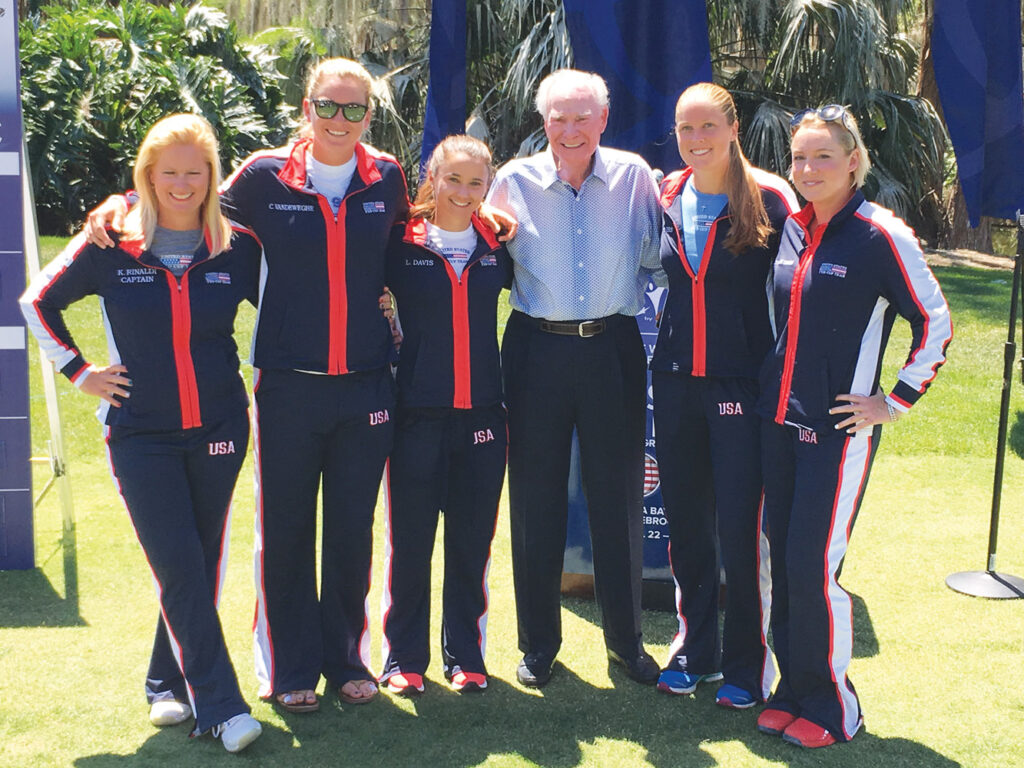
Thomas L. Dempsey, Saddlebrook Resorts owner, Chairman and CEO since 1988, poses with the U.S. Fed Cup tennis team in 2017. Saddlebrook hosted the semifinals, which the U.S. won, defeating the Czech Republic. (Photo: John C. Cotey)

Saddlebrook has been well-known for being a training ground for players like Jim Courier, Jennifer Capriati (also a long-time resident), John Isner, Martina Hingis and Andy Roddick, as well as many others. It hosts many tennis tournaments, most recently (and notably) the Women’s Fed Cup finals between the U.S. and the Czech Republic in 2017.

The property also is home to nationally-renowned tennis and golf training academies, which are part of Saddlebrook Prep, a fully accredited college-preparatory school (grades 3 through 12) with roughly 100 students from more than 25 different countries attending the school while getting world-class training in their respective sports.

The gated resort, however, had begun to show its age in recent years. Mast Capital CEO Camilo Miguel told the Tampa Bay Business Journal (TBBJ) that the property will receive a major renovation, and may even add residential and commercial space in the future.

“I think there’s a lot of opportunity in elevating the property and bringing back some of its luster,” Miguel said. “There hasn’t been much investment in the property in decades, so that’s the low-hanging fruit.”

Miguel also told the TBBJ he has already hired HEI Hotels & Resorts to manage the resort, and instead of bringing in a different flagship hotel to the property, feels that the Saddlebrook name still carries enough weight to make it a desired destination.

Mast Capital also announced earlier this week that Troon, the world’s largest golf management company providing services at 630-plus locations around the globe, was hired to manage the resort. In addition to golf, Troon specializes in homeowner association management, private residence clubs, estate management and associated hospitality venues. 

Dempsey, 97, declined to talk about the sale or why he sold the resort after all these years, but did say he was proud of what his family accomplished with one of the first big-ticket locations in the area north of Busch Gardens.

“From the time we arrived some 40 years ago, there was very little here, practically nothing,” Dempsey said. “It grew to be a prominent part of Florida. and one of the fastest-growing areas. And, we were very much a part of all that, and will continue (to be) for the future.”

Dempsey thinks the outlook for Saddlebrook is promising. He said the new owners have plans to expand and improve it, making them an attractive buyer.

As for what he will remember the most from his stewardship of Saddlebrook Resort, Dempsey says there are too many things to mention.

“It’s been a long series of very good things,” he said. “We had a lot of help along the way with the people here, and also the county and all of that. They were there to work with us and will continue to do so.”

For Mast Capital, a Miami real estate investor/developer, it is the second major purchase it has made in Wesley Chapel in the last six months.

In November 2021, in a joint venture with private equity firm Rockpoint Group, it acquired roughly 16 acres of land located at 5101 Bruce B. Downs Blvd. for $4.5 million with plans to build a 248-unit luxury apartment community later this year.