District 7 Tampa City Council member and New Tampa resident Luis Viera says he hasn’t made a decision yet, but he is looking at either a State House of Representatives or Hillsborough County Commission run in 2026, before his current City Council term expires in March of 2027.
While introducing Viera, who was the guest speaker at North Tampa Bay Chamber of Commerce’ (NTBC)’s monthly Business Breakfast on Feb. 4, NTBC president & CEO Hope Kennedy mentioned that she had heard Viera might be considering a run for Mayor of Tampa, but Viera said he was more interested in a run for the District 67 State House seat currently occupied by House Minority Leader Fentrice Driskell, who will reach her term limit with the Nov. 2026 election.
Since that Feb. 4 meeting, Viera says he has been approached by multiple media outlets about his plans going forward. He says he is mulling over the possibility of running not only for Driskell’s Dist. 67 State House seat, but also for one of the County Commission seats up for election in 2026. “I haven’t made a decision yet,” Viera says. “But, once I announce which of those offices I will choose to run for, I will have to give up my City Council seat before my term ends.”
Even though he is a registered Democrat (City of Tampa elections are all nonpartisan), the 47-year-old Viera also discussed his ability to work with other political office holders — including reaching across the political aisle — in Hillsborough and Pasco counties, as well as with Rep. Driskell, Dist. 20 State Senator Danny Burgess and with Dist. 15 U.S. Congresswoman Laurel Lee. He also talked about New Tampa’s status as the “Alaska” of the City of Tampa, was well as zip code 33647’s cultural diversity, as well as what he has accomplished in the nine years since first winning election — by 65 votes in the two-candidate Special Election runoff in Nov. 2016 — in his first election over fellow New Tampa resident Dr. Jim Davison.
Look for a full recap of Councilman Viera’s Chamber breakfast chat, and more information about his political plans, in the March 4 New Tampa Neighborhood News Issue #5-25.
Tampa City Council Denies Proposal To Allow New Development On The East Side Of Morris Bridge Rd.
Research by Joel Provenzano
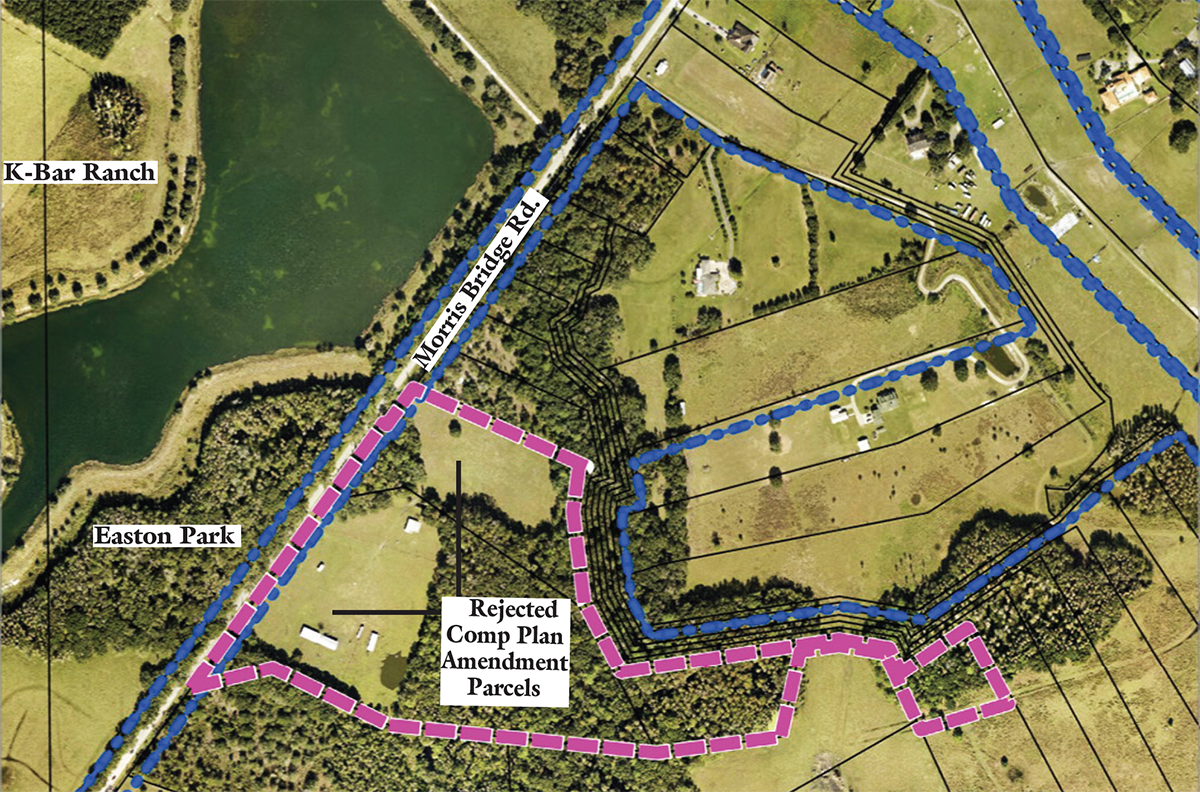
The blue outline above represents the city limits of the City of Tampa. The portion outlined in purple is the property that was proposed for new development that was unanimously voted down by the Tampa City Council on Nov. 30. (Map Source: City of Tampa; modified by Neighborhood News)
When Cory Lake Isles first began developing in the late 1980s, the only entrance to that now-built-out community was off Morris Bridge Rd. — at that time a little-known, little-used, two-lane arterial roadway that connected to Fletcher Ave. and I-75, four miles south of the Bruce B. Downs (BBD) Blvd. exit off I-75, which turned north towards (and continuing past) the Pasco County line.
It wasn’t until several years later, when Cory Lake Isles developer Gene Thomason was able to get a new entrance to his fledgling community off Cross Creek Blvd., that home sales in Cory Lake Isles really began in earnest. Until then, Morris Bridge Rd. was — pun intended — a bridge too far for most of the people who wanted to move into the suddenly burgeoning community that first began being called “New Tampa” in the mid-1990s.
But, while it took about another decade for any significant new development along Morris Bridge Rd. to take hold, the huge K-Bar Ranch development started with the Easton Park subdivision just north of Pride Elementary. Today, K-Bar/Easton Park is the only community in the entire City of Tampa experiencing significant growth.
To that end, on Nov. 30, District 7 Tampa City Councilman Luis Viera and his fellow City Council members unanimously voted down a proposed comprehensive plan amendment for 28.36 total acres in two parcels (see map) on the east side of Morris Bridge Rd. (property that was annexed into the city in 2007), that would have allowed for up to 43 new single-family homes (and more) to be built across Morris Bridge Rd. from an undeveloped portion of the Easton Park subdivision.
“My constituents who live in K-Bar Ranch, Easton Park and Cory Lake Isles all tell me that Tampa shouldn’t allow any additional development along Morris Bridge Road,” Viera told me after the Nov. 30 public hearing. “They all say, ‘Morris Bridge is full,’ and I definitely agree with that.”
Since the City of Tampa annexed (in 2007), for the first time ever, property previously located in unincorporated Hillsborough County, east of Morris Bridge Rd., no property owners in that area had ever requested to build new residential units or commercial buildings in that area.
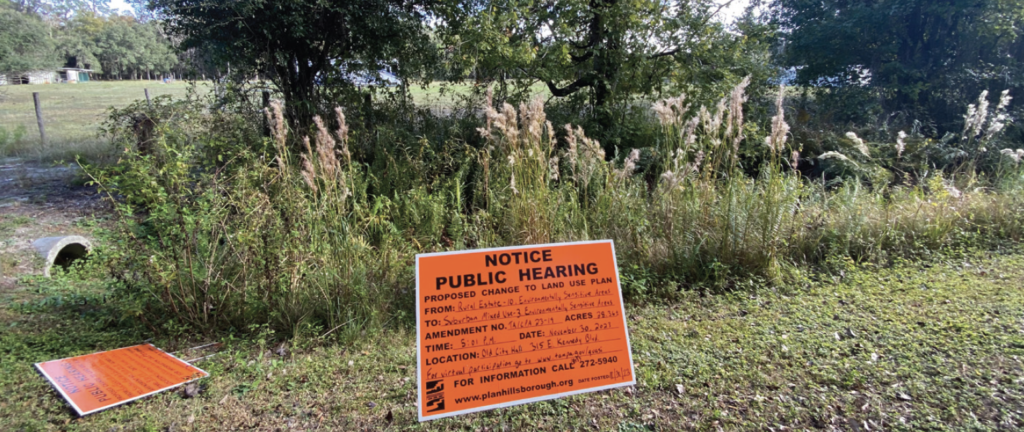
That changed on Nov. 30, when representatives for Ike and Yvonne Okeke, who own two parcels totalling 28.36 acres on the east side of Morris Bridge Rd. (across from a currently undeveloped portion of the Easton Park subdivision of K-Bar Ranch), requested Amendment #TA/CPA 23-19) to the City of Tampa’s Comprehensive Plan that, if approved, would have allowed the property to change from its Rural Estate-10 & Environmentally Sensitive Areas (ESA) Adopted Future Land Use designation to Suburban Mixed Use-3 (which allows for up to three dwelling units per acre) and ESA.
Considering that there are only about 14.36 acres of developable land on the site, without the Plan Amendment, the property owners can only build one dwelling unit — or 40,000 sq. ft. of non-residential uses — on the site.
If the change had been approved, however, the property owners could have built up to 43 single-family detached and multi-family dwelling units or 156,380 total sq. ft. of both residential and non-residential uses.
All of the property on the east side of Morris Bridge Rd. included in the 2007 annexation was originally designated as Rural Estate-5, meaning that only one dwelling unit per acre would be allowed.
However, in 2008, according to staff planner Jennifer Malone of the Hillsborough County City-County Planning Commission staff, who appeared at the Nov. 30 public hearing, the Comprehensive Plan was amended to further reduce the number of possible dwelling units per acre on the east side of Morris Bridge Rd. from 1 dwelling unit per 5 acres to just 1 unit per 10 acres.
This is the property on Morris Bridge Rd. that was requested to receive a Comprehensive Land Use Plan amendment that was rejected by the Tampa City Council on Nov. 30.
Malone confirmed that this Comprehensive Plan land use designation is the lowest future land use category in the entire City of Tampa and, in fact, the Rural Estate-10 designation was actually created by the City for these annexed properties.
According to Malone, the land, which, to the east, is near Hillsborough River State Park and the Lower Hillsborough Wildlife Management area, is uniquely environmentally sensitive.
In fact, Malone said, “The State Department of Community Affairs (DCA) commented that the annexed property is so unique that RE-5 wasn’t rural enough for this area,” which helped the city decide to create the RE-10 designation specifically for this area. The DCA also wanted the land use for the city property to match the one dwelling unit per 10 acres designation of the adjacent Hillsborough County property.
Prior to the Nov. 30 hearing, the proposal to change the land use designation was first rejected by the Planning Commission staff for being “inconsistent with the Tampa Comprehensive Plan,” a conclusion shared by the City of Tampa’s own staff — due to the lack of utilities and city services within the area and lack of similar land uses on the east side of Morris Bridge Rd. — even though the property in the undeveloped portion of Easton Park directly across Morris Bridge Rd. already has the Suburban Mixed Use-3 designation that these property owners were seeking for their land.
Malone pointed out, however, that there are “no Suburban Mixed Use-3 land uses on the east side of Morris Bridge, which has a significantly different development pattern than the west side.”
Tampa’s Transportation Planning Organization also noted that there are no roadway capacity improvements, transportation projects or transit services planned for the area (more on this below).
Evan Johnson with the City’s planning department, corroborated Malone’s claims:
1) He said Morris Bridge Rd. can’t handle any additional capacity and isn’t programmed to get any larger or to offer any type of mass transit.
2) He said the property is too environmentally sensitive and too close to Hillsborough’s rural service area to allow the change.
3) And, “The property owners are not required to connect to city utilities but, depending upon what they end up wanting to build, they could be required to do so.”
Also, Johnson said, “The closest possible hook-up for water would be 1,700- 2,000 feet away, in the new portion of K-Bar Ranch. And, the nearest wastewater hookup is a manhole in Easton Park that would be about a 1/4-mile from this site, and those are significant distances and could cost from several hundred thousand to a million dollars or more to build these facilities.”
Because of all of these factors, and the significant increase in proposed density of the site, Johnson said, “We object to the change in the character (of the property) because the jump is so large.”
David Wright, who spoke on behalf of the property owners, said that the density request was reduced from their original proposal, adding that, “We know where the wetlands are” and that the proposal took those into account. Wright claimed that the 14-1/2 acres fronting Morris Bridge Rd. “is ready for development, so all we’re really asking for is a continuation and expansion of the same Morris Bridge land use (on the west side).” Wright also acknowledged that the property owner would be responsible for making the utility connection to the site.
Turning It Down
District 7 City Councilman Luis Viera, whose district includes all of the city portions of New Tampa, made the motion to deny the plan amendment. The proposed change was unanimously (7-0) voted down by the Council members, after Viera said he had, “A lot of high hurdles with this proposal, including across-the-board negative comments from both the Planning Commission and City staff.”
Viera also noted that even though the property on both sides of Morris Bridge Rd. in this area is city property, the roadway itself is a county road, “and my understanding is that it can’t be expanded, because of its environmental designation…and it is just packed at the seams right now, which is one of the top things I hear from my constituents.”
He added that another big issue he has are the emergency response times by Tampa Fire Rescue in K-Bar Ranch, as well as, “the mosque, the church and the Sikh house of worship, all on Morris Bridge Rd. I see this as a size-36 waist trying on size-32 pants and I can’t see supporting this proposal.”
But, What About Two Rivers?
Even though the east side of Morris Bridge Rd. is clearly environmentally sensitive, a little to the north of the Pasco County line, the road is currently being widened to accommodate the new 3,405-acre Two Rivers development, which is planned to include 6,400 new residential units, 1.3-million-sq.-ft. of office and industrial space and 630,000 sq.- ft. of retail space, plus three new schools, a golf course and numerous other amenities.
The second phase of Two Rivers actually extends south of the Pasco County line and the development is certain to bring much more traffic to Morris Bridge Rd., so the hope here is that something can be done to widen Morris Bridge Rd. south of the county line, too.
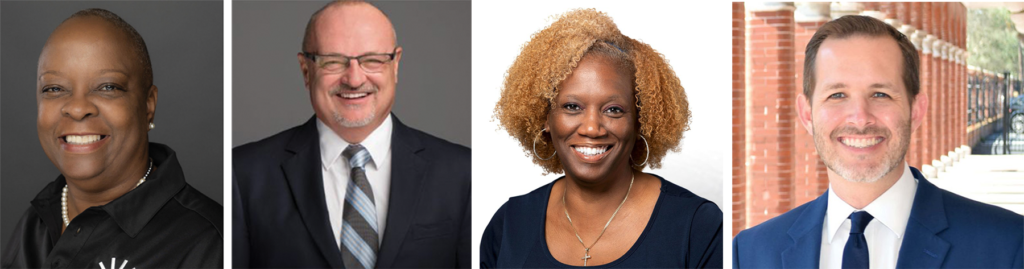
Candidates on the April 25 City of Tampa City Council Runoff Election ballot include (l.-r., above) Dr. Sonja P. Brookins vs. Alan Clendenin in District 1, Robin Lockett vs. Guido Maniscalco in District 2 and (below) Janet Cruz (left) vs. Lynn Hurtak (right) in District 3.
In March, Tampa Mayor Jane Castor easily defeated a write-in opponent and New Tampa’s District 7 Tampa City Council member Luis Viera was re-elected without opposition to serve four more years, but that doesn’t mean that New Tampa residents have no reason to go to the polls for the City of Tampa Runoff Election on Tuesday, April 25.
In fact, Viera says that much more important than who you vote for is that you need to get out and vote. He says that no matter how hard he is willing to fight on City Council to fulfill — and fund —New Tampa’s needs, our community’s usually lower-than-the-rest-of-the-city voter turnout makes it harder for him to get things done.
“New Tampa has traditionally been considered somewhat apathetic when it comes to voting and that does make it harder for me to get other Council members to support the needs of this community.”
The numbers bear out Viera’s claims of voter apathy. In the 2019 Municipal Election, which included a hotly contested race for Mayor, the citywide turnout was 20.56%, but in New Tampa’s 17 precincts, it was only 16.8%. In the Runoff Election in Apr. 2019, which included the mayoral runoff won by Mayor Castor over David Straz, the turnout was even higher — 23.2% citywide and a reasonable 18.5% across New Tampa’s 17 precincts.
In this year’s Municipal Election, where Castor faced only write-in candidate (and New Tampa resident) Belinda Noah (whose name did not appear on the ballot), the citywide turnout was only 13.65%, but the turnout in New Tampa’s 21 precincts was less than half of that, at only 6.5%.
Viera says that despite the fact that there are only three citywide City Council seats — Districts 1, 2 and 3 (plus the District 6 runoff between current Dist. 2 Council member Charlie Miranda and Hoyt Prindle) — being contested at this year’s Runoff Election, he expects a citywide turnout of about 12%.
Viera says it would be great if New Tampa could beat that percentage at the runoff, and he says everyone should check out the campaign websites and social media pages of each of the six candidates shown on this page and cast votes for those who seem to best align with their own political philosophies.
Here’s a quick rundown of the three races in which New Tampa is eligible to vote:
District 1 — Dr. Sonja P. Brookins vs. Alan Clendenin
Dr. Brookins, a long-time educator, has served two years as an elected supervisor with the Hillsborough Soil & Water Conservation District and has been endorsed by the Democratic Progressive Caucus of Tampa Bay.
Clendenin, who has served in multiple positions for Democratic committees (including first vice chair of the Florida Democratic Party), was a long-time air traffic control professional. He has been endorsed by the Tampa Bay Times, La Gaceta and Creative Loafing newspapers, the Tampa Police Benevolent Assn. and Tampa Firefighters 754 union, New Tampa’s State Rep. Fentrice Driskell, the Sierra Club and LGBTQ Victory Fund.
District 2 — Robin Lockett vs. Guido Maniscalco
Lockett is the former president of the Hillsborough Democratic Black Caucus who has been a regular advocate for vulnerable people at City Council meetings, as well as an organizer with the Florida Rising progressive social advocacy group. She has been endorsed by Creative Loafing.
Maniscalco, the two-term Dist. 6 Council member (and current vice chair) who is running in Dist. 2 because of term limits, has been endorsed by the Tampa Bay Times, the Greater Tampa Realtors, Tampa Firefighters 754, the Sierra Club and Equality Florida.
City of Tampa City Council Runoff Election District 3 Candidates Janet Cruz (left) vs. Lynn Hurtak (right) in District 3.
District 3 — Janet Cruz vs. Lynn Hurtak
Cruz, the former State Sen. who lost a tough race to Jay Collins in Nov., has been endorsed by the Tampa Bay Times, Mayor Castor and former Mayor Bob Buckhorn.
Hurtak, the Dist. 3 incumbent, has been endorsed by Creative Loafing, La Gaceta, Florida LGBTQ+, Florida Rising, the Tampa Bay Progressive Caucus and Muslims for Democracy & Fairness.
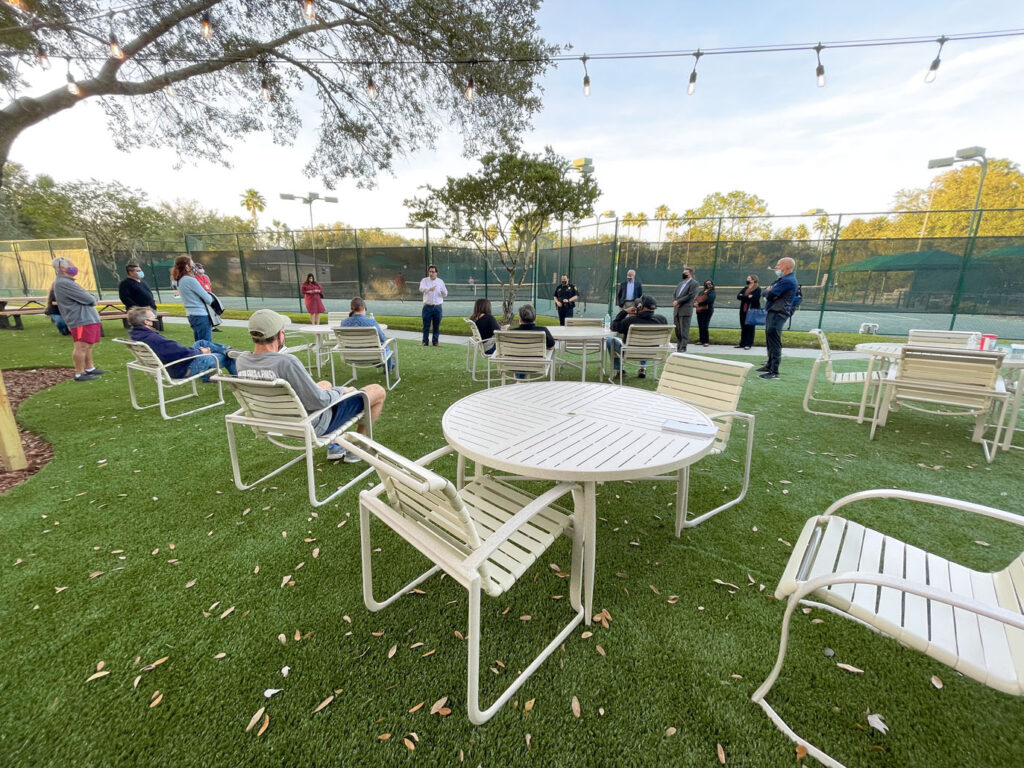
Luis Viera brought along four City of Tampa Water Department employees to Arbor Greene for a Jan. 20 meeting to discuss unusually high water bills. (Photo: John C. Cotey)
Tampa City Council member Luis Viera has always enjoyed scheduling community meetings in his District 7, which includes the City of Tampa communities in New Tampa.
Sometimes, Viera meets for a cup of coffee, or in a clubhouse meeting room or even at someone’s home. He says his favorite form has been the local townhall meeting, of which he has hosted a handful in New Tampa alone.
However, Covid-19 has changed all that, forcing Viera to, well, take it to the streets…or yard…or cul-de-sac.
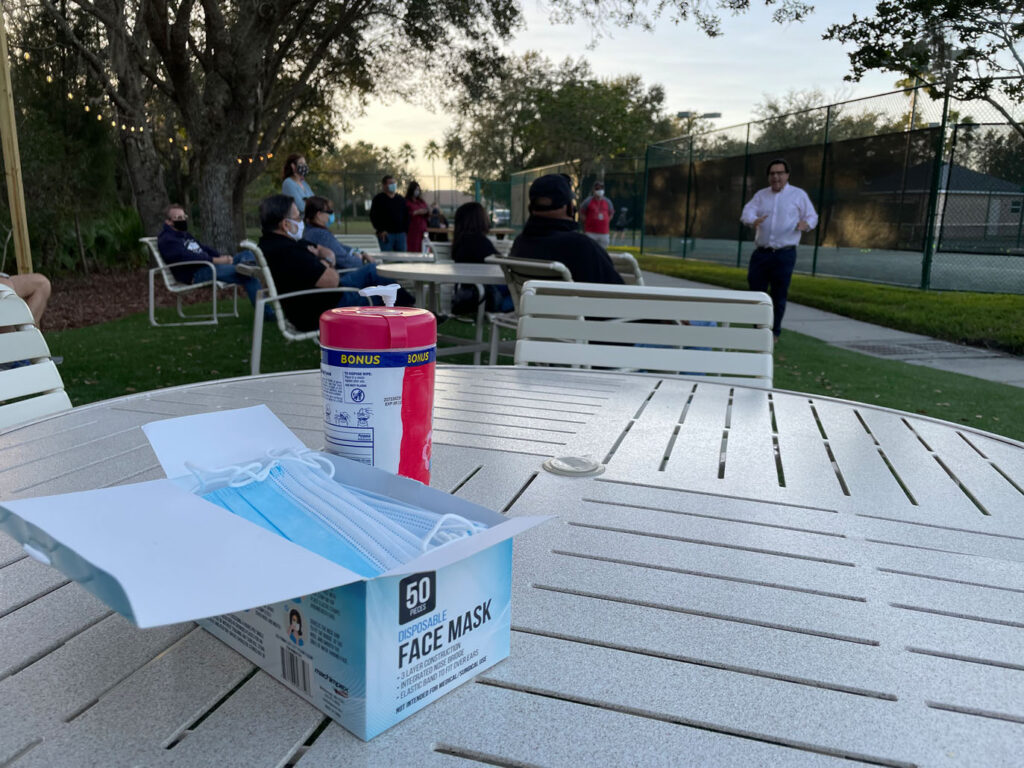
His latest stop was to address the concerns of his constituents in Arbor Greene, where about a dozen residents met with Viera on a perfectly manicured patch of grass beneath strung lights behind the Community Clubhouse’s tennis courts.
Their primary complaint? Water bills they say that spike for a month for no reason and then return to normal.
Viera also remembered to bring face masks & disinfecting wipes to his meeting outside the Arbor Greene Community Clubhouse. (Photo: John C. Cotey)
As he usually does when attending this new brand of community get-together, Viera brought with him a police officer — who thankfully had no salacious crime stories to share but reminded everyone to lock their car doors because some areas in New Tampa have seen a recent rash of burglaries — as well as four employees of the city’s water department.
“I’ve been hearing a lot about the water bills in Arbor Greene for a year now, and it’s hard to say anything without doing an analysis of the bills,’’ Viera said. “So, I brought along some people who could. This meeting was about making those connections.”
None of the residents with a water bill beef got exactly the answers they wanted to questions like this one:
“How was my water bill $307 in December when we weren’t even home for two weeks, and then back to $69 the following month?” (Not to mention the few days in early December the city had a water boil notice that kept the spigots at home mostly turned off).
Eli Franco, a spokesman for the City of Tampa Water Department, said mistakes are sometime made, but so rarely, the chances are that the bills reflect a leak somewhere, or an issue with a running toilet or an irrigation system.
“We read 140,000 meters a month,” Franco told the Arbor Greene residents, “and our error rate is less than one half of one percent.”
Franco said anything outside a normal meter reading is read a second time, and then a third time. Then, a picture is taken and sent to billing to see if there might be an explanation.
Franco said the city does work with residents if there is a problem with a running toilet or potential leak. He says the city has one of the most generous leak adjustment policies in the country.
“We want to make sure you’re getting a fair bill,” he said.
However, residents like Frank Burke, who has lived in Arbor Greene for 23 years, said leaks or running toilets don’t explain how his bill went from $68 to $160 before going back down, without any leak or toilet repairs at his home.
“It doesn’t make any sense,” he said.
Burke is one of dozens of Arbor Greene residents who have experienced what they say are unusually high water bills. Burke says his wife has seen plenty of complaints on Facebook, while others have taken to social media sites like NextDoor to complain.
Viera said the goal of the meeting was to put Arbor Greene residents in touch with the right people to help and, to that end, his aide Brannon Lazo took names and handed out business cards to make sure the concerns were addressed by the right people.
“We’re in the middle of a pandemic and a lot of people are frustrated,” Viera said. “As an elected official, we should be there to take the heat, catch the questions and find some answers.”
While he still prefers his townhalls, Viera started his outdoor tour in October, and the stops have included Forest Hills and the Busch Blvd. area of North Tampa, which also are in his district, a meeting in a cul-de-sac in the Tuscany community in Tampa Palms over concerns about new apartments, a meeting with residents of the Promenade Apartments in Tampa Palms about crime, and the Arbor Greene meeting.
More homes have been approved for K-Bar Ranch, which is now completely rezoned and headed towards nearly 2,000 total homes and condos/townhomes in the next few years. (Photo: John C. Cotey)
After two readings and one continuance, the Tampa City Council has approved a rezoning that will pave the way for developer M/I homes to build 698 new homes in K-Bar Ranch.
The growth of the soon-to-be burgeoning community, located north of Cross Creek Blvd. in the northeasternmost part of New Tampa, has been a point of some public debate, due to the lack of infrastructure, namely roads, in the area.
But, only councilman Luis Viera, who represents District 7, which includes all of the neighborhoods within Tampa’s city limits in New Tampa — including K-Bar Ranch — was the only vote against the rezoning approved by the council (by a 6-1 vote on June 28) to allow the new homes to be built in K-Bar.
As it is with any zoning matters, Viera is not allowed to comment on the case for 30 days following the vote.
More homes means more cars, and currently, the only way in and out of K-Bar Ranch is Kinnan St., which runs north and south, or Basset Creek Dr., a two-lane road that runs past Pride Elementary before connecting to Kinnan.
Hillsborough County and the City of Tampa are still pursuing connections north into Pasco County at three different points to help relieve congestion, and K-Bar Ranch Pkwy., an east-west road which is connected to Kinnan St., is still under construction and will provide a path out via Morris Bridge Rd., but not until late 2019 at the earliest.
There was very little discussion amongst the City Council members before the vote, and no one from the public spoke.
Craig Margelowsky, the president of the Heron Preserve neighborhood in K-Bar Ranch and an opponent of adding more homes in his community without more roads, attended the May meeting but was unable to attend on June 28. He says he was disappointed with the decision, but not surprised.
Margelowsky says that he is concerned that by passing the rezoning request, the City of Tampa gave away any leverage it might have had in securing connections with Pasco County. If the rezoning was conditional upon new roads, government officials, as well M/I Homes, would be more pressed to find quicker solutions.
“This took away all the expediency,” Margelowsky says.
However, the City Council had little choice but to okay the rezoning, says Melanie Calloway, the senior transportation planning engineer for Tampa, in order to guarantee the connection of K-Bar Ranch Pkwy.
Calloway cited House Bill 7207, or the Community Planning Act, passed in 2011 and signed into law by Gov. Rick Scott, which handcuffed local governments from imposing what was once state-required concurrency for transportation, parks and schools. The bill allows developers to build without making improvements on over-capacity or failing roadways, which aren’t considered when performing traffic analyses.
Calloway says the City of Tampa can’t legally require M/I Homes to make the connections, but are encouraging them to work with Pasco County, which M/I Homes says it is continuing to do so.
“I think there is more interest in making those connections than there has been,” said K-Bar Ranch attorney Donna Feldman. “I think, in time, they will occur.”
Feldman also said that at the Wesley Chapel Roadways presentation on May 29, it was shown that the majority of those on the Pasco side wanted connections.
However, that “majority” was only true for two of three potential connections — at Meadow Pointe Blvd. & K-Bar Ranch Pkwy., and Wyndfields Blvd. at K-Bar Ranch Pkwy.
No indication has been given that there is enough support for the most convenient, controversial and contentious connection — between Kinnan St. and Mansfield Blvd. in Meadow Pointe. Pasco County District 2 commissioner Mike Moore, who represents the area, is on record as being adamantly opposed to it. He has suggested the Pasco Board of Commissioners (BOC) may not even vote on the connections until next year.
While Moore favors only two of the three connections, the City of Tampa feels that all three connections need to be made.
But, Margelowsky isn’t convinced the Tampa City Council will hold firm on that stance. “Without requiring roads (before passing the rezoning), now Pasco County can sit on this for five years,” he said. “I know that the Wyndfields and Meadow Pointe Blvd. connections will get done, but I don’t see anybody going and actually fighting for Kinnan-Mansfield.”
Connections or no connections, Feldman said the rezoning needed to be approved. The 2,280 acres of K-Bar Ranch was annexed into Tampa in 2002 to “grow the wealth, size and import of the City of Tampa, and the City of Tampa has done that,” she said.
She said the land-use entitlements allow for far more density than what was allowed for in a 2015 rezoning of the area.
The current rezoning is for a northwest portion of land adjacent to Kinnan St., and a northeast portion of K-Bar Ranch adjacent to Morris Bridge Rd. The rest, Feldman says, already has been rezoned.
Feldman told council members that M/I Homes has done its part. The financial impact of building K-Bar Ranch Pkwy is $18.8-million, and she said that M/I Homes also donated 60 acres of K-Bar Ranch land to the city for a park, which also was more than required.
“This project, as a whole, has been mitigated over and above what is necessary to accommodate this rezoning, which really started with the annexation of this project in the early 2000s,” Feldman said as she asked the council for approval.
K-Bar already has roughly 500 homes and townhomes already built, with another 700 or so approved in 2015 — despite similar protests from residents then about a lack infrastructure and roads — that currently are under construction. The new rezoning will add nearly 700 more homes to the community, bringing the total to nearly 1,900.