Bulls making a name for themselves

Avery Walker began last school year as the head coach for the Wiregrass Ranch High (WRH) boys soccer junior varsity team, and finished it as the coach of two teams when he stepped in and took over the girls varsity soccer team midway through the season.

But, when it came to choosing which squad to coach this season, it was an easy call for Walker.

“The girls won me over,” he says.

Walker split the girls duties last year with boys varsity coach Dave Smith after Edwin Acosta resigned for personal reasons following a 6-1-1 start. Walker remembers his first game against River Ridge, when he had former player Ysa Novak make out the lineup. Walker jokes that he just kind of watched as he became familiar with his new players. 

The Bulls won that game 4-3, and then won the next 13, including the Class 6A, District 5 championship and a first-round Regional playoff game before falling to St. Petersburg on penalty kicks.

Overall, not a bad debut. And the girls, who finished with a school-record 19-2-1 record last season, were happy to welcome him back.

“It was definitely a shock in the beginning (when Costa resigned),” says junior co-captain Kayla Ojeda. “But, I felt like we adjusted really well. Coach Walker came in and did a great job coaching us and helping us make it to Regionals. I was hoping he would sign up for the job and was really excited when he got it.”

Ojeda, a defender, is one of the keys if the Bulls are going to repeat the success of last season. While the team loses its top two scorers in Avery Damjanovic (34 goals, 11 assists) and Kylee Ehmann (12 goals, 20 assists), Ojeda heads up a defense that is stout. Walker, who played defense in college at Division III Bridgewater College in Virginia, loves what he sees.

Freshman Lola Vargas, sophomore Ashtyn Warner and seniors Taylor Pryor and Savannah Yoder comprise a group that Walker says is “extremely” good. If you happen to sneak by the Wiregrass wall, then co-captain and starting keeper Ella McGahey will be waiting.

“I think our backline is going to be really solid this year and, as a goalkeeper, it’s something you always want to have confidence in,” McGahey says. “Our goal is to concede fewer than 10 goals this season.”

That would appear to be a reasonable goal, since the Bulls allowed only 12 last year, as McGahey set a school record by allowing just 0.372 goals per game. The Bulls are 3-0-1 so far this season and haven’t allowed a goal.

Offensively, Walker feels he can fill the holes with junior midfielders Ellie Klem, who missed last season with an injury, and Natalia Kaminski, a newcomer.

The Bulls also return junior forwards Rylee Humphries, the leading returning scorer with 11 goals and nine assists, and Aiya Harrell (eight goals last season). Junior McKayla Battle scored six goals last year and picked up four in an 8-0 win over Anclote, and sophomore Emily Erker scored the only goals in 1-0 wins this season over Mitchell (which is now coached by Costa) is the season opener and their last game against Berkeley Prep.

Newcomer Bella Maldonado, who scored twice in the win over Anclote, also is expected to make an impact at midfield this season as well.

After back-to-back 19-win seasons, the sky may be the limit for the Bulls in 2020-21. Always in the shadow of a boys soccer program that is regarded as a state title contender every year, the girls look ready to step out this season.

“I definitely think we’re making a name for ourselves,” Ojeda says. “I think we’re going to keep it going this year.”

Cypress Creek High girls soccer coach Jessica Herzek is high on her freshmen and sophomores this season, and why not? Allison Souers, one of those freshmen Herzek is happy about, scored five goals in her first-ever high school game, an 11-0 season-opening win over South Sumter.

The still-young Coyotes, coming off a 9-7-1 season, have only one senior on their roster. 

Youngsters like junior Hailey Canady (two goals in the season-opening win), sophomore Hannah Fulpo (a goal and two assists) and sophomore keeper Alex Capocy (1.16 goals-against-average) will lead the way.

“I have numerous girls who, if they choose, could go on to play at the collegiate level,” Herzek says. “I feel this will be an amazing season, but the next few years will get better and better.”

The Coyotes are 1-0-1, with a 2-2 tie against rival Wesley Chapel.

Since taking over in 2017, Wesley Chapel High coach Mark Leonard has set a school record for wins every year, including last year’s 20-4 mark, and won three straight District 4A-6 titles.

Keeping that going will be the goal for this season, though the Wildcats were outscored 22-1 in their first three games before earning a draw with the Coyotes.

Leonard says returning seniors Sydney Bauer, Kaylei Koschman (11 goals last year) and keeper Madison Holcombe, as well as junior Maddy Golka (nine goals) comprise the team’s core, and he expects newcomer Tatum Moore and sophomores Kiera McFeron and Kacey Snead to have breakout seasons on offense.


Corley Says 2020 Vote Smoother Than Hoped


In an election season defined by partisan vitriol and hate, Danny Burgess tries a little kissing (of his wife Courtney, of course) to woo a voter or two. 

Despite worries nationwide about the voting process in 2020, due to taking place in the middle of a pandemic and concerns raised by President Trump about the validity of mail-in votes, Pasco’s Supervisor of Elections Brian Corley said the county’s efforts this past election were about as smooth as could be.

“Overall, it exceeded my wildest expectations,” Corley said. 

Roughly 304,000 votes were cast in Pasco County, including 302,621 votes for president. President Donald Trump received 179,621 votes, or 59.4 percent, while President-elect Joe Biden received 119,073, or 39.4 percent.

Nationally, however, Biden defeated Trump by more than six million votes and in the Electoral College 306-232.

The 304,000 votes cast in Pasco represented 78 percent of the eligible voters, far exceeding 2016’s totals of 244,950 ballots cast and a 73-percent turnout.

Despite the record-setting numbers, Corley said the ability to secure six gymnasiums countywide for early voting and the influx of mail-in votes prevented some of the 3-4 hour long waits in line he feared beforehand.

In fact, only 65,000 votes (21% of all ballots cast) were cast on Nov. 3. Twice that number, 113,000, were cast during early voting, and more than 121,000 were mail-in votes, compared to 68,178 in 2016.

“The mail-in votes were a great safety valve and allowed for the in-person voting to be less crowded,” Corley said.

Corley added that mail-in voting has been growing in popularity since Florida started it in 2002, “but this year it was on steroids because of the pandemic.”

Despite President Trump’s disinformation campaign against mail-in voting (except in Florida, where he said it was okay), Corley thinks the mail-in numbers will only grow in the future.

“It got politicized, and that is very unfortunate,” he said. 

Not surprisingly, Pasco County remained red, as Republican candidates went 9-0 in the vote, including Gus Bilirakis (U.S. Rep., Cong. Dist. 12), Danny Burgess (State Sen. Dist. 20), Randy Maggard (State Rep. Dist. 38), Superintendent of Schools Kurt Browning and County Commissioners Jack Mariano and Kathryn Starkey.

For complete Pasco County 2020 General Election results, visit PascoVotes.org. — JCC

Diverging Diamond Delay

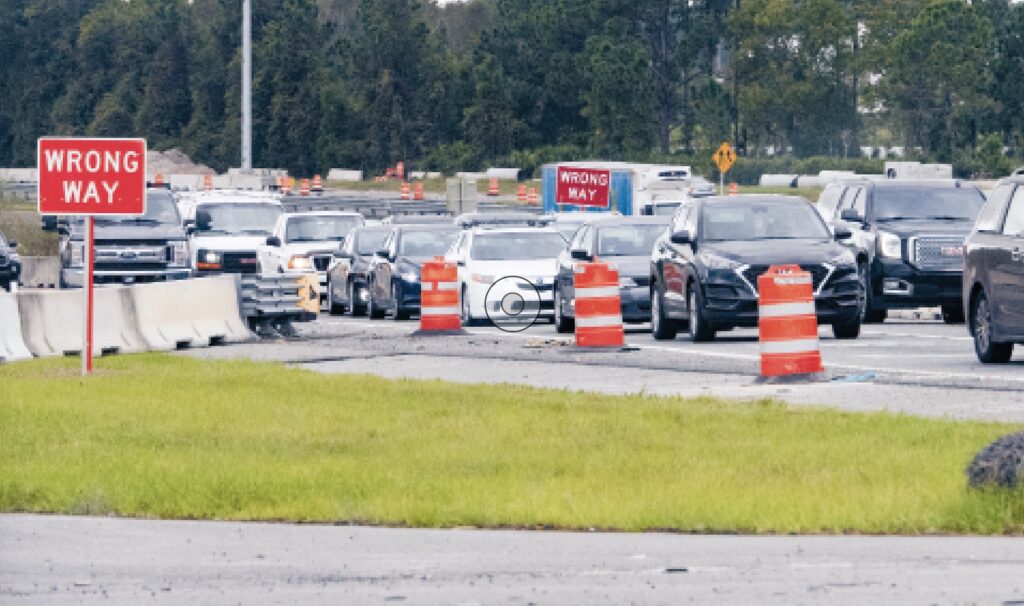
The Diverging Diamond Interchange now under construction at the junction of S.R. 56 and I-75 is expected to alleviate the traffic issues at arguably Wesley Chapel’s most congested point. (Photo: Charmaine George)

Pasco County Board of County Commissioners (BCC) chairman Mike Moore has always taken great pride in his efforts to expedite the construction of the Diverging Diamond Interchange (DDI) at the busy junction of I-75 and S.R. 56.

With help from state legislators, what was originally scheduled for a 2024 completion was moved up and expected to be finished by the fall of 2021.

However, that date is now very much in question, which has riled Moore, who represents District 2, which includes most of Wesley Chapel.

“It’s very, very disappointing,” he says.

Armed with letters from constituents and his own daily experience driving through the congestion at the under-construction interchange, Moore is disappointed to hear that the project — originally expected to cost $18.5 million but now carrying a $33-million price tag — could now drag on until the spring of 2022 or even later.

Which is why, when Moore drives by the project now and sees workers, well, not working, it makes him seethe.

His frustration was on full display at a BCC meeting last month, when Moore delivered a blistering attack on the company, D.A.B. Constructors, Inc., in charge of the project.

Moore said he recently drove through the interchange and took pictures of the general malaise happening. He said he saw two workers standing next to a truck doing nothing, and a second group of construction workers standing on a hill.

“On a project of that magnitude, those are the only people I saw working on a Monday, a sunny Monday, at 1:30 in the afternoon,” Moore said. “I think that’s insane, that’s ridiculous, that’s embarrassing.”

More than 100,000 vehicles pass through the interchange on a daily basis. The eagerly-anticipated DDI is designed to create fewer conflict points at the interchange, and despite looking like a confusing, diamond-shaped jumble of roads in pictures, Florida’s first Diverging Diamond Interchange (at Exit 210 of I-75, in Sarasota) has been lauded for being safer and more efficient than your traditional junctions. 

Businesses Are Unhappy, Too

The Wesley Chapel DDI will be Florida’s second, and Moore isn’t the only one disappointed that it is so far behind schedule. 

In September, the Cypress Creek Town Center Property Owners Association (POA) — which includes the Tampa Premium Outlets, Costco and more than 20 other businesses located west of the interchange, sent a letter to Moore and District 3 Commissioner Kathryn Starkey expressing concern about the progress of the interchange.

The POA, which said it has spent $25 million over the last 15 years “reconstructing and widening miles 

of highway in the State Road 54/56 corridor” to offset the additional traffic the Town Center attracts, said it reached out to the Florida Department of Transportation when it was becoming clear that the project was falling behind schedule.

It asked FDOT to accelerate the DDI during Covid-19, due to the reduction of traffic, but were told material deliveries had hindered the project and that D.A.B. Constructors “did not feel any substantial gains could be made.”

The POA wrote to Moore and Starkey that they were told the project was at least 200 days behind schedule — pushing the completion date to late summer of 2022.

“It’s very unfortunate that this is happening,” said Comm. Starkey, “but at least FDOT is doing as much as they can to push it along.”

Pasco County has no control over state road projects like the DDI, but Moore and Starkey both reached out to David Gwynn, the FDOT secretary for District 7, after receiving the letter from that group of angry businesses.

FDOT has taken efforts to remedy the situation, and could impose more penalties. Gwynn wrote back to Moore telling him if D.A.B. Constructors can’t meet the contracted end date, “liquidated damages, of $9,837 a day, will be assessed for every day that the contractor is late in completing the project.”

That means that for every month they are behind schedule, D.A.B. Constructors would incur a $300,000 fine.

Pasco’s BCC chair Mike Moore says D.A.B. Constructors “can’t handle it” when it comes to finishing the diverging diamond project on time.

The DDI construction kicked off in early 2019, and had an original schedule of 800 days, resulting in a finish date of April 2021. That did account for delays due to rain and holidays (though not for something like Covid-19, which did cause delays for materials for many area projects).

Gwynn wrote that in roughly 20 months, D.A.B. Constructors had been granted 99 days for weather, 34 days of holiday time and 30 days for unforeseen conditions. All told, that added 163 days to the contract, changing the end date to August 26, 2021.

“Ninety-nine rain days? I don’t how that is, but okay, I guess?,” Moore said. “I guess if it sprinkles outside they don’t work?”

Moore also found 34 days off for holidays “extreme.”

Moore wants to see FDOT come down hard on D.A.B. Constructors, including fines and heavy pressure. He went as far as to suggest D.A.B. “sub out every little piece of the project going forward…cut their losses, and get out.”

He doesn’t want the company used on any more projects in Pasco County, where it is currently working on 10 other projects, including the widening of State Roads 54 and 52.

“They have so many projects going on right now they can’t handle it,” Moore says.

Starkey worried that any further delays could impact the traffic for yet another holiday season in 2021, further hurting businesses in the S.R. 56 corridor.

Snowcat Ridge is open!

Snowcat Ridge Alpine Snow Park in Dade City, Florida’s first snow park and only a 20-30 minute drive for many in the Wesley Chapel and New Tampa area, is officially open.

Located at 27839 St. Joe Rd., Snowcat Ridge opened Friday afternoon. The park is seasonal and will only be open through March.

Tickets are on sale at SnowCatRidge.com (you also can sign up there to get on an email notification list), and the prices range from $24.95 to $39.95, depending upon which days you choose to go. All tickets are $5 more if you buy them at the box office.

A general admission ticket includes a two-hour snow tubing session on Snowy Slopes, a 60-foot-high hill that is 400 feet long. A Magic Carpet ride (conveyor belt) will take you to the top of the hill.

It also includes all-day access to the 10,000-sq.-ft. Arctic Igloo, which will have plenty of man-made snow for making snowmen and forts, as well as a bunny slope designed for children ages 3 and under; and Alpine Village, which will feature vendors, seating and food and drink.

KAP Medical Group’s Direct Primary Care Eliminates Insurance Headaches!

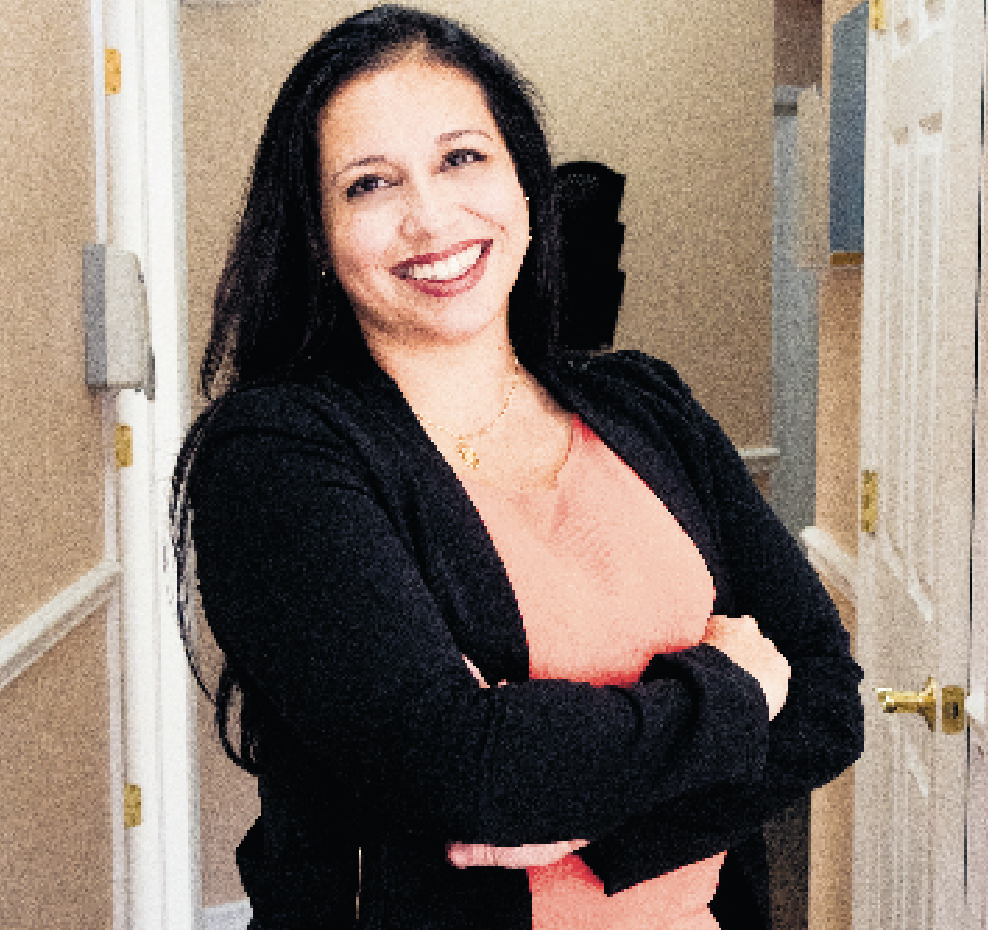
Dr. Karina Azank Parilo offers direct primary care at her KAP Medical Group office off BBD Blvd. in Wesley Chapel, which promises shorter wait times & fewer insurance headaches than traditional primary care medical offices. (Photos: Charmaine George)

If you’re frustrated with long wait times at your doctor’s office, not being able to get in to see your physician, or constantly being surprised with how much you pay out-of-pocket for medical expenses — even with health insurance — you might want to consider direct primary care. 

Karina Azank Parilo, M.D., of KAP Medical Group, offers direct primary care, which changes the way patients and their doctor relate to one another by removing dealing with insurance companies altogether.

KAP Medical Group, which is open to all ages, is located in the Windfair Professional Park in Wesley Chapel, behind the retail plaza on Bruce B. Downs (BBD) Blvd. that includes Dickey’s BBQ and The Hungry Greek restaurants.

Instead of collecting payment from insurance companies, patients (or “members”) pay a monthly fee, which covers unlimited office visits and virtual visits via phone or video, in-office tests, well checks, sick visits, weight management and management of chronic medical conditions such as hypertension, diabetes, high cholesterol, asthma, arthritis and more.

Dr. Parilo is originally from Tampa. She earned her Bachelor of Science (B.S.) degree in Biology from Duke University in Durham, NC, then earned her Doctor of Medicine (M.D.) degree from the University of South Florida in 2005. She completed a residency in family medicine at the University of Massachusetts Family Residency Program in Worcester in 2010.

After working in a large private practice in Wesley Chapel for eight years, Dr. Parilo opened KAP Medical Group in early 2018, bringing along Michelle Diaz, who is now KAP Medical Group’s Certified Medical Assistant (CMA) and office manager. The two have worked together since 2010.

Dr. Parilo and her husband Dane live in Seven Oaks and have a blended family of three grown children and three granddaughters. They met through the Rotary Club of Wesley Chapel Noon in 2012 and both have remained active in the club.

How Direct Primary Care Works

Dr. Parilo says the monthly fee is a transparent, controlled expense, which is affordable for most people. “It’s $54 to $66 per month for an individual,” Dr. Parilo explains, “which is a lot cheaper than most cell phone and cable bills.”

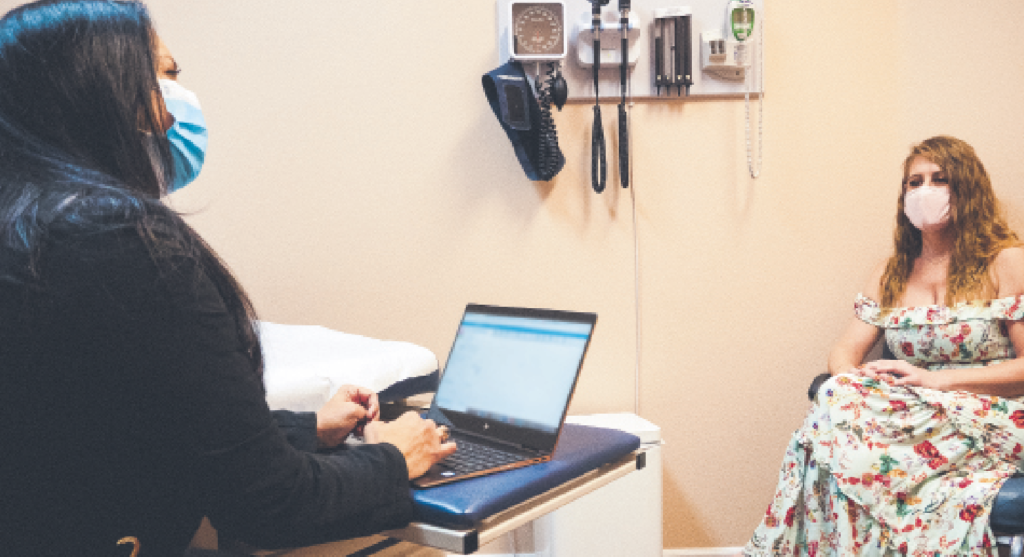
Dr. Parilo still sees patients in her office, but says that telehealth has become popular during the Covid-19 pandemic. (Photo: Charmaine George)

She recommends patients still carry health insurance because the monthly fee doesn’t cover expenses outside of routine care, including hospitalizations, surgical procedures, visits to specialists and lab work. However, some in-office procedures are included in the monthly cost, with just a small supply fee charged, and Dr. Parilo says she has negotiated prices with labs, so that you may pay much less for your lab work than you would pay out-of-pocket if you used your insurance with a high deductible.

“We recommend our patients have catastrophic insurance or a high deductible plan or something they can fall back on to cap their cost, which is how insurance was originally meant to be,” she explains. “Originally, health insurance was like car insurance. You don’t use your car insurance to get your oil changed or replace your tires.”

At KAP Medical Group, you will never be one of thousands of your doctor’s patients, which Dr. Parilo says is common at some large practices. In fact, at her previous practice, Dr. Parilo says she had 2,700 active patients, and was expected to take on even more.

But, in the direct primary care model, your monthly fee allows your doctor to limit the number of patients he or she will see.“We will close the practice when we hit a certain number of patients,” she says.

That way, you always have access to your doctor in the way that works best for you, whether it’s a same-day or next-day office visit, or a quick text, phone call or video chat.

KAP Medical Group uses an app that maintains patient privacy and connects directly with each patient’s electronic medical record.

Covid Care & Precautions

Dr. Parilo says that her direct primary care model was an advantage when the office had to shut down at the outset of the Covid-19 pandemic. Where some practices had to close their doors altogether, KAP Medical Group had a seamless transition to virtual patient care.

While the practice has experienced a couple of positive Covid-19 tests, Dr. Parilo says everyone has recovered well, and that KAP Medical Group continues to follow strict guidelines to keep all of its patients safe.

“We have frail patients and don’t want anyone getting hurt,” she says.

Now, as the pandemic continues to play out, Dr. Parilo and Michelle are in the office three days a week, and doing telehealth the other days.

“We have a warm and fuzzy practice, with a coffee machine and a couch,” says Dr. Parilo. “We try not to have you wait, but if you have to wait, it’s a comfy place. But, no one has sat on our couch in seven months, so it’s been different.”

The Patients Love It, Too!

Connie Ceparano, who lives in New Tampa, is a long-time patient who originally began seeing Dr. Parilo when her sons, now 27 and 22, were in elementary school.

“I chose her to begin with because she saw adults and children,” Ceparano says, “so our family wouldn’t have to go to two different doctors.”

Back then, though, when Dr. Parilo was with a larger practice, Ceparano says she was often frustrated with the office staff and the way things are generally done at most other doctor’s offices. If someone in her family was sick, they would offer her an appointment several days down the road. Sometimes, she would have to sit in the waiting room an hour or more. Sometimes, there’s even more wait time to see the doctor once you actually get into a room.

“I’m not bashing the practice she was with,” says Ceparano, “because they’re all like that.”

But, the hassle was worth it, because Ceparano says Dr. Parilo is an excellent doctor who truly cares about her patients, and is extremely thorough and detailed.

She also says that when Dr. Parilo started her own practice, she would have followed the doctor anywhere, but she had no idea what to expect from the direct primary care model. As it turns out, she has been very pleased.

“I love this new way of practicing,” Ceparano says. “It really comes down to being very personal. I don’t ever have to worry about seeing a physician’s assistant instead of the doctor herself. Not only do I get in the same day, I always get to see her.”

The transition from insurance-based fees to the monthly fees has been a benefit to Ceparano’s family, too. “It’s so well worth it,” she says. “I feel like it pays for itself. If you need to, you can go in 10 times in a month and you’re not paying a $30 or $40 copay each time.”

Ceparano adds that she and her husband and her sons won’t go to any other doctor for primary care.

“My son’s job takes him out of town a lot, but he doesn’t have to worry about finding a doctor. If he’s in California, for example, he has the app on his phone and he can call, text, or video chat. It really is a great benefit.”

KAP Medical Group Direct Primary Care & Family Medicine is located at 2615 Windguard Cir., Suite 101, across Bruce B. Downs (BBD) Blvd. from AdventHealth Wesley Chapel. The practice is currently open by appointment only. For more information or to make an appointment, visit KAPMedicalGroup.com or call (813) 536-0050.