While it may be a lot to ask for the new Village at Hunter’s Lake project to single-handedly save the sleepy restaurant scene in New Tampa, it sure seems like the developers are trying.
Fresh Kitchen, a south Tampa favorite with locations on S. Howard Ave. and W. Kennedy Blvd., is the latest restaurant to be announced as coming to the new development on Bruce B. Downs (BBD) Blvd., right across New Tampa’s main thoroughfare from the entrance to Hunter’s Green.
Regency Centers senior leasing agent Marc Elias broke the news to a collection of local business leaders last month at the North Tampa Bay Chamber of Commerce (NTBC)’s Economic Development Briefing at Hunter’s Green Country Club on June.
Fresh Kitchen is owned by the Ciccio Restaurant Group, which also owns such notable restaurants as Taco Dirty, Green Lemon, betterBYRD and Ciccio Cali, which has a popular location in Tampa Palms.
Like Ciccio Cali, Fresh Kitchen focuses on healthy bowls, where patrons choose their base, protein, vegetable and any extras. Elias’ announcement drew a round of positive chatter during the NTBC briefing.
Elias also said that Regency Centers has a BBQ concept coming, as well as a sub-and-wrap concept, although he didn’t name those restaurants.
Regency Centers senior leasing agent Marc Elias.
Along with the previously announced Via Italia Wood Fired Pizza, Poke Island Plus and Grain & Berry, that would mean six new restaurants (plus Starbucks) could be open by April of 2020 in New Tampa.
The Village at Hunter’s Lake also is likely to provide a boost to the social scene in New Tampa.
“We certainly hope so,” said Elias. “We feel like we are responding to the needs of the area, which is really convenience. Hopefully, we’re able to attract the foot traffic over there, and they can hang out with their dogs at the dog parks, go to Starbucks, take a yoga class. That’s the goal, getting them to hang out at the center.”
While Sprouts, the first green grocer to enter the New Tampa market, is the anchor of the retail strip, other occupants previously reported by the Neighborhood News are Banfield Pet Hospital, The Coder School, Hair Cuttery, Heartland Dental, Nationwide Vision Center, Pink & White Nails, Pure Beauty Salon and T-Mobile.
Elias added that a running store and a “yoga concept” also have signed leases.
Elias says the shell buildings should be completed by November, barring a persistent rainy season. Tenants can open whenever they are ready, though Elias suspects that most will open sometime around April 2020, when Sprouts is expected to be completed.
The Village at Hunter’s Lake will have a total of 71,397 sq. ft. of commercial space. The project also will include a 30,000-sq.-ft. New Tampa Cultural Center — which is expected to break ground next year and open sometime in 2021 — two dog parks and a four-story, 241-unit multi-family complex to be called The Haven at Hunter’s Lake
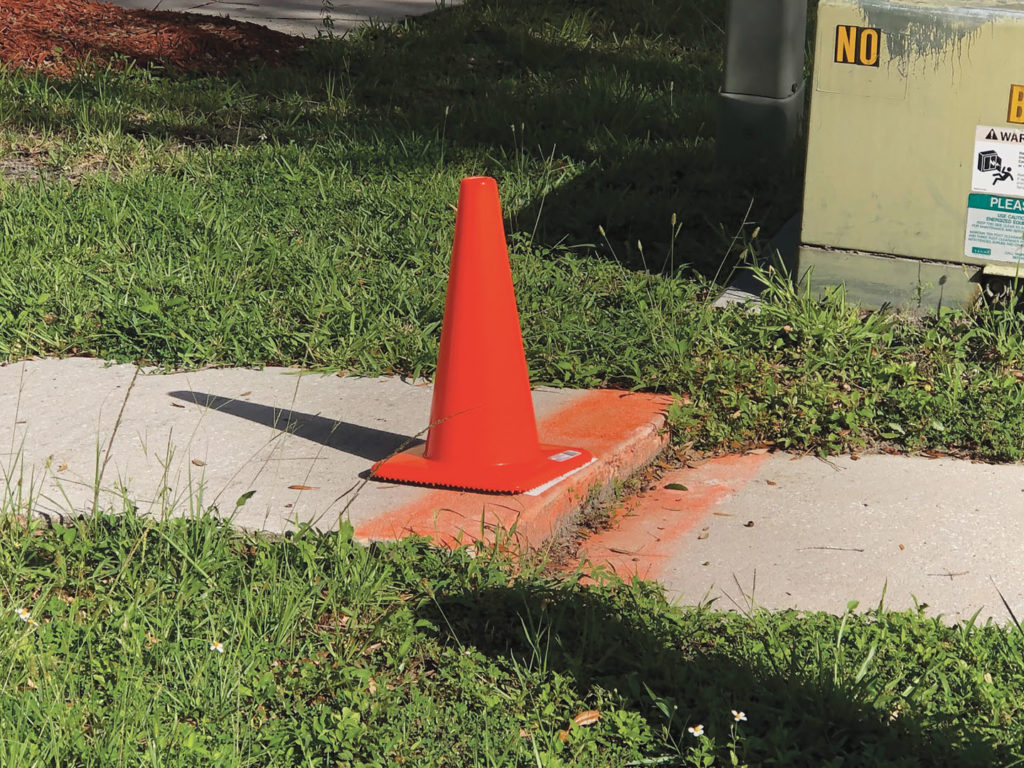
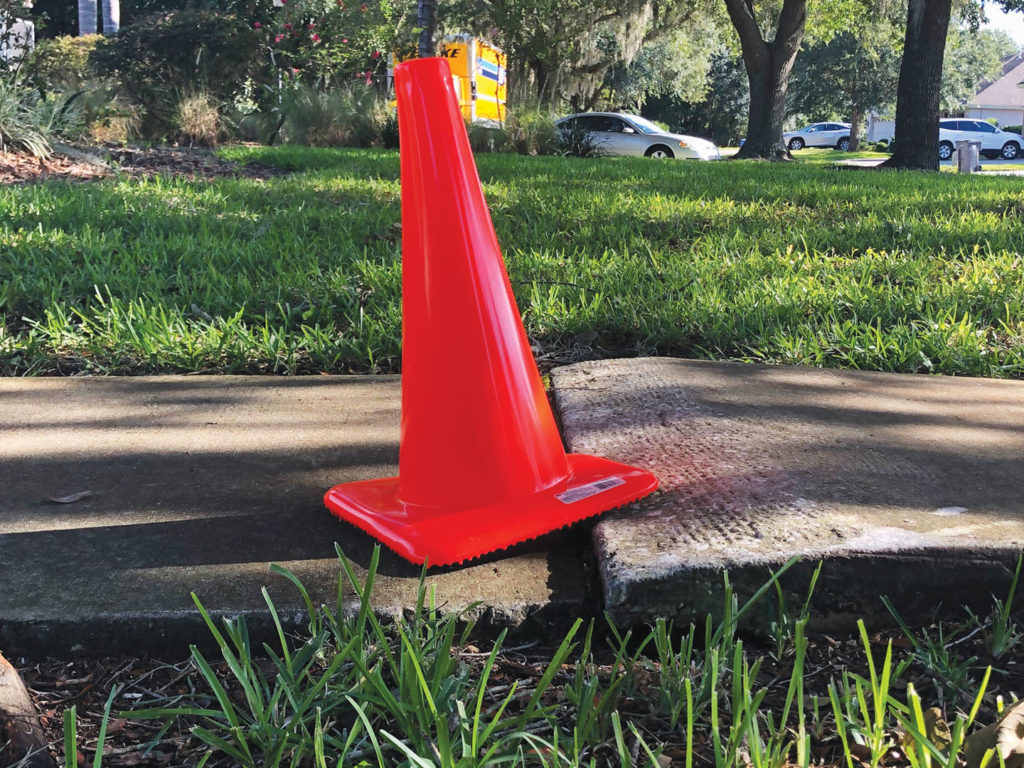
Some of the sidewalks in Magnolia Trace and Pinehurst (top right) are in need of repair, but Hillsborough County has a long backlog for sidewalk repairs. (Photos: John C. Cotey)
Dozens of orange safety cones and swatches of bright orange paint have been placed along sidewalks in at least two New Tampa neighborhoods, there as a warning — to watch your step.
Due to uneven sidewalks caused primarily by the roots of large oak trees planted years ago between the sidewalk and the road, those out for a walk or bike ride in the Magnolia Trace and Pinehurst communities off Brookron Dr. in Cross Creek are being cautioned, due to concerns raised by the homeowner’s association’s insurance company during an inspection.
How long will the orange cones adorn the neighborhood’s sidewalks?
That’s anyone’s guess.
Jo-Ann Pilawski of Pilawski Property Management, which manages the Cross Creek II Master Association, notified Hillsborough County’s Public Works department about the sidewalks, which indicated in an email that “a work request has been initiated and assigned to the West Service Unit for inspection, review, and response.”
The email stated an inventory of potential repairs will be conducted within a month, and afterwards, the county will “grind” all identified areas where the lift is less than two inches.
The areas raised more than two inches — and there are quite a few in both neighborhoods — “will be flagged with reflective tape and added to the county’s current backlog of sidewalk replacement requests.”
That backlog, according to Hannah Titrington, the program coordinator of the customer resolution unit at the county, who wrote the email to Pilawski, is approximately 24-36 months.
Prior to 2018, the county had minimal funding for sidewalk repairs, Titrington wrote, causing the backlog. But, in 2018, the Board of County Commissioners committed significantly more money to sidewalk repair after passing a 10-year, $800-million plan for transportation improvements.
“It’s a big county, so you can imagine how many sidewalks there are that need repairs,” Pilawski said. “Unfortunately, unless the association pays for repairs, we’re stuck. A few residents have called to complain, but as soon as I tell them it might make (their) fees go up, no one is interested anymore.”
Pilawski also said that doing so would also set a bad precedent, considering that the sidewalks are supposed to be maintained by the county.
Titrington did write that while the county is working on older requests first, repairs are grouped by proximity. So, an older request from a different area in New Tampa could expedite Pilawski’s request for repairs.
It was his last mass, but it felt like his first one.
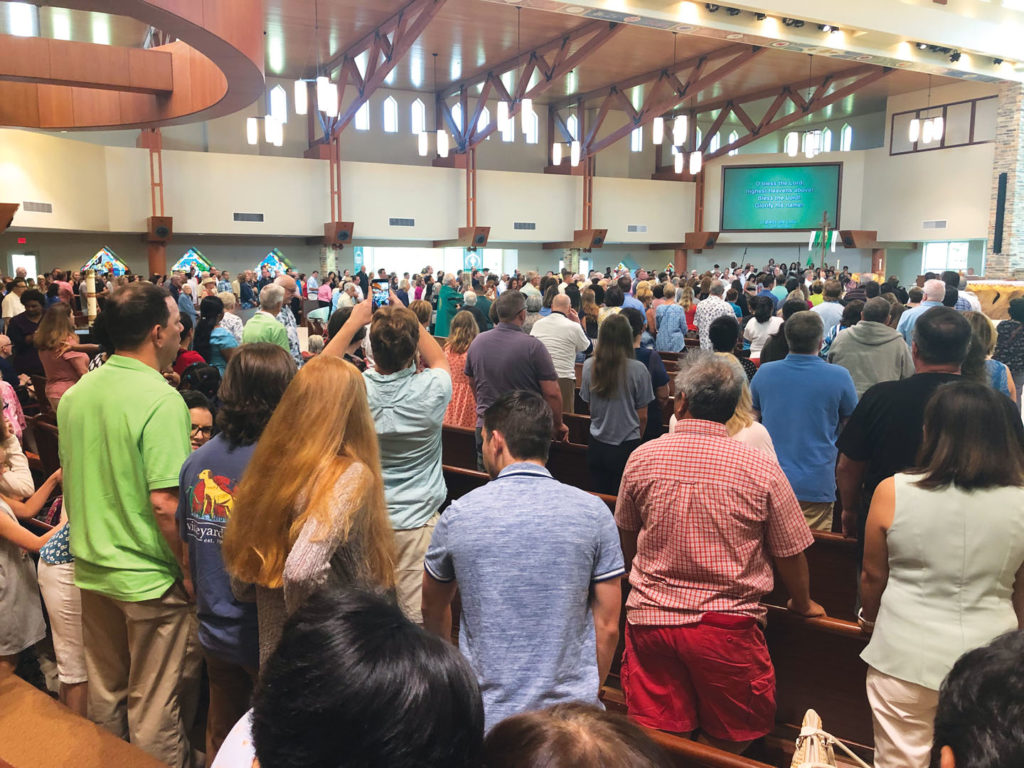
The pews at St. Mark the Evangelist Catholic Church were filled. Everyone was eager to hear what he was going to say. And, the nerves and emotions were almost overwhelming.
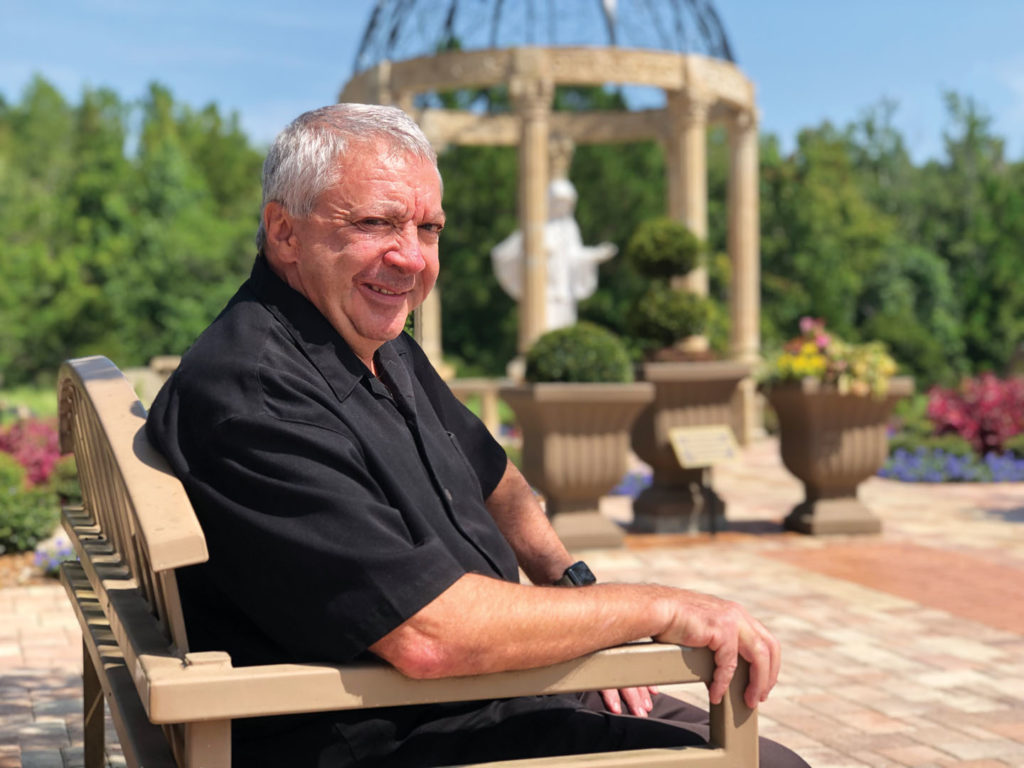
“It was pulling me in all kinds of different directions,’’ Father David DeJulio said.
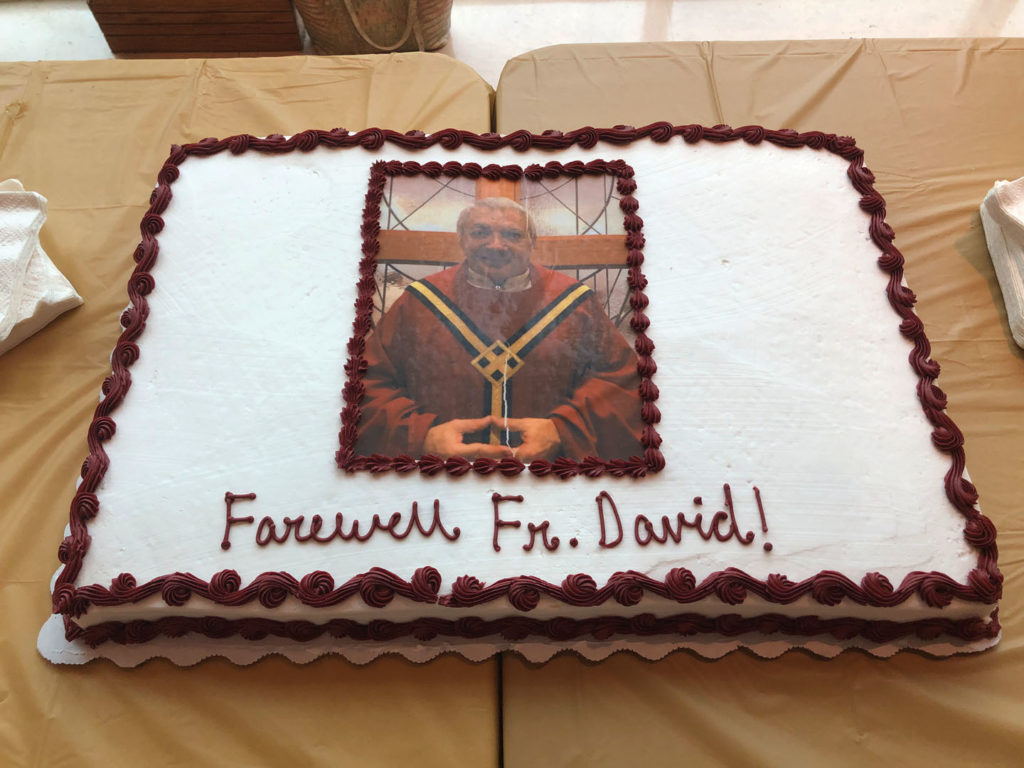
After 16 years of leading St. Mark’s through massive growth and the construction of a new church, making hundreds of friends in the community and helping even more families, Fr. David said goodbye on June 30 to a congregation that has grown from 2,100 families when he came to the church to more than 3,800 as he departs.
He was pleased with his homily, which challenged parishioners to hold steady as they follow Christ, despite the ever-growing plague of distractions. Towards the end of the eucharist prayer, as the end of his time at St. Mark’s drew nearer, he started fighting back those emotions.
Tampa City Council member Luis Viera presented Fr. David with a city commendation, leading to a rousing 45-second standing ovation. When Fr. David tried to bring the mass to a close, his staff
interrupted him and presented him with a plaque.
“I lost it there at the end,” Fr. David confessed.
After gathering himself, he followed a procession of altar boys and deacons and, for the last time as their priest, walked past rows of the adoring St. Mark congregants for the final time.
”I’m not really thrilled about leaving,” Fr. David said afterwards, “but when God tells you you gotta go, you gotta go.”
He is headed north (but not too far) to St. Frances Xavier of Cabrini in Spring Hill, only 15 minutes from where his twin brother Frankie’s family lives.
Fr. David will essentially trade parishes with Rev. Richard Jankowski, who has been at St. Frances of Cabrini for 13 years.
It’s the next stop on Fr. David’s journey, which began at the age of 5, when he says he first knew the church is where he wanted to be.
It wasn’t until he was 27, however, that he entered the seminary. He graduated with a finance degree from the University of South Florida, making the long drive to classes from his family’s home in Holiday, FL.
He took a job at a bank in St. Petersburg, a job he said he truly enjoyed. But, that feeling he got in church as a kid never went away.
“It kept haunting me,” he says.
His first year in the seminary, he wasn’t so sure he made the right choice. He thought about quitting after one semester. He had been living with his girlfriend in an apartment in St. Petersburg and was in control of his life. But, when he entered the seminary, he wasn’t.
“My first year was tough,” he says. “I just really didn’t like it.”
He knew he had faith, but wondered what kind. In the end, it turned out to be a determined, resilient and unbending faith, the same kind of faith he implores his parishioners to strive for every day.
It is Fr. David’s style, which is described as easy-going, funny but still somewhat stern, that made him a popular fixture in New Tampa.
Among the first families he met when he came to St. Mark’s were Richard and Nancy Larson. Nancy was the liturgist at St. Mark’s, and Frankie contacted her about planning a party for the installation of his brother, the new priest.
The party was held at Hunter’s Green Country Club, in the community where Fr. David has lived in a home the church uses as its rectory.
Richard and Fr. David became instant friends, as did dozens of others from Hunter’s Green who joined Fr. David’s Bible study group that would meet weekly at his home. Fr. David would teach, and afterwards, there would be wine and food and cigars.
“He built my faith and he made me a much stronger person,” Richard says. “He did that to our whole group.”
Many, Richard says, weren’t even members at St. Mark’s, but Fr. David still brought them home, too.
“He was so good at evangelizing and bringing people back to the church,” Richard says. “He was just a regular guy. I think that appealed to a lot of people.”
Fr. David golfed with the group — he says his handicap is currently a 13 — and the more time he spent with those who had stopped going to church, the more those people started going again.
When they found out Fr. David was leaving, the group pitched in and bought him a membership to Southern Hills Plantation in Brooksville, 10 miles from his new church, so he could continue to spread God’s word to new friends while working on that handicap.
After Fr. David’s final mass Sunday, he was greeted in the courtyard by Noel and Nellie Negron, whose eyes welled with tears as they thanked their longtime priest for bringing them back into the church.
Noel has been a member for 23 years, but hasn’t always been a regular churchgoer.
“I went when I felt like it,” he said. “When I met Fr. David, he brought me back. (Now) there isn’t a Sunday I miss. I love coming to church.”
Nellie recalled a story about the time her granddaughter Olivia saw Fr. David walking alone across the field next to the church, and asked if that was Jesus.
“I will always remember that story,” she said, smiling. “I love him. I am going to miss him.”
The Negrons have already been to his new church, and plan on stopping in for a mass here and there.
Richard says he will do the same, as, he suspects, many others who knew Fr. David also will do. He joked that he will definitely see Fr. David again, “because I made him promise he would do my funeral.”
Priests usually serve 12 years at one church, but Father David was given 16, so he could spend some time enjoying the church he helped to build.
Fr. David was named pastor at St. Mark’s in 2003, preaching from the Family Life Center the church flock was quickly outgrowing. He envisioned a spiritual center for New Tampa, a place for families to come together in prayer. A fund-raising campaign was started, and the although the economic downturn in 2008 forced a delay, on June 6, 2015, the $10.1-million, 35,000-sq.-ft. sanctuary was dedicated.
Today, the church is only $1.5 million from paying off a $5-million loan to finish it.
“It’s kind of a slip of the tongue to say it’s “my place,” but I feel connected here,” Fr. David says proudly. I spent half my priesthood here. It’s always going to have a special place in my heart, wherever I am.”
Father David will always be remembered for his stewardship over the sanctuary project, which he credits as a testament to the “tremendous sacrifices on the part of parishioners.”
But, it’s just a small part of the legacy he hopes he leaves behind.
“Obviously buildings are important, but what happened here is we created a place with a story,” he says.
He says he wants to be remembered not only for helping create a beautiful structure to worship in, but also for what has happened inside it. He is proud that St. Mark has been a place where families feel welcome, where you’re greeted by four or five people before you even got to your seat, where he challenged his parishioners’ faith and helped guide them through both happy and difficult times.
He fostered a community that did many good things, a community that he helped connect to God through his teachings.
At the end of the day, and 16 wonderful years, it was all that he could ask.
“I started to think about him not being here, and it was a very emotional thing,” Noel said. “When you have someone you can turn to for some encouragement and leadership and someone to guide us…and now he won’t be here. He was a good shepherd for us.”
Florida Medical Clinic will be the first of what is likely to be many businesses coming to the Promenade Business Centre.
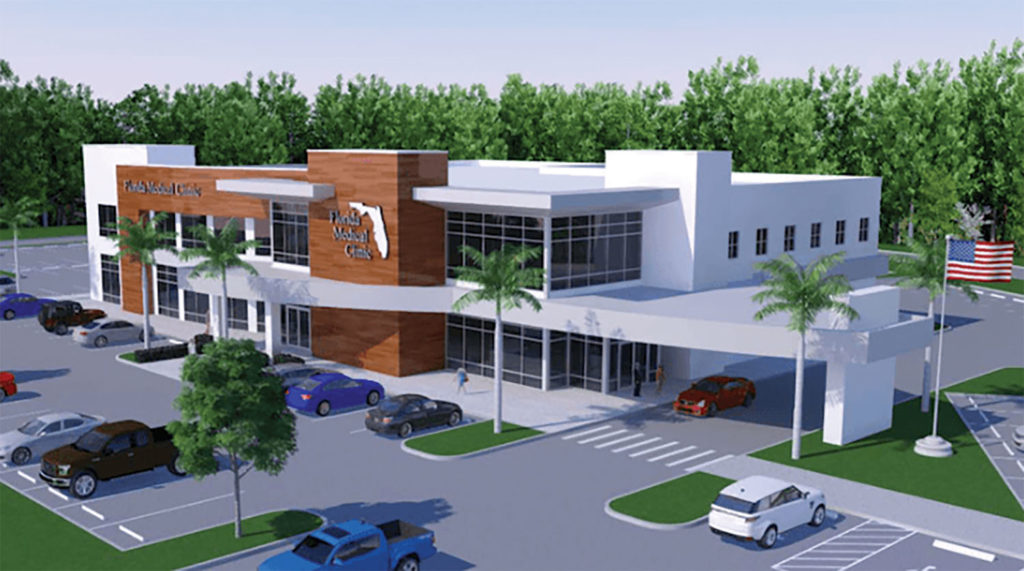
Florida Medical Clinic (FMC) is set to be the first occupant of the long-planned Promenade Business Centre located at the Curley Rd. entrance to the WaterGrass community. But, it won’t be the last.
On June 19, Pasco’s Board of County Commissioners approved a large-scale comprehensive plan amendment, amending the Future Land Use designation for the property from TC (Town Center) to PD (Planned Development) on 77 acres at the northeast and southeast corners of the Curley Rd. intersection with Overpass Rd.
The Promenade Business Centre PD will consist of an employment center within the WaterGrass Master Planned Unit Development (MPUD). The business park concept, according to the background summary, “proposes mixed-use development that incorporates office, retail and multi-family/townhomes with a focus on Business Park uses that encourages target industry job creation.”
The Promenade Business Centre would add roughly 1.2 million square feet of corporate business park uses, including for such things as medical clinics, corporate headquarters, research and development facilities and business accessory retail (like food service within an office complex) uses.
The development may also feature multi-story buildings that would incorporate uses such as cafeterias, restaurants, banks, health or fitness facilities, meeting rooms, co-working spaces, off-street parking and on-site day care facilities, according to the summary.
The parcels proposed for the business center also would include two parks and Pasco Fire Rescue Station 38, a 10,843-sq.ft. facility which broke ground last year and is expected to open this fall.
A new charter school, next to Station 38, also is in the concept plans.
FMC’s Latest Foray Into WC
The Florida Medical Clinic WaterGrass Medical Building is set to begin construction later this year and will open in late 2020, says Barbara Kininmonth, VP of sales and marketing for Crown Community Development (also the primary developer of Seven Oaks).
The two-story, 30,000-sq.-ft. facility is needed in the quickly growing area, Kininmonth says. “There is going to be a variety of things at the front of WaterGrass,” she says. “Florida Medical Clinic really wanted to be at that location with all the new housing coming to the area. We thought there would be good support for that.”
FMC also has two major nearby complexes: 60,000 sq. ft. on S.R. 54 in Land O’Lakes and the newer, 85,00-sq.-ft. complex just south of AdventHealth Wesley Chapel on Bruce B. Downs Blvd.
Kininmonth also says that the rest of the Promenade Business Centre tenants will be market-driven.
The WaterGrass community recently held its Grand Opening for Phase III, the latest residential offering, with seven neighborhoods and builders Meritage Homes, D.R. Horton, Taylor Morrison and Vitale Homes.
Phase III will be the last single-family-home phase of the community, which currently has 800 residents, a number which will swell to 1,900 when WaterGrass is built out.
Promenade Park in Phase III, which sits on four acres and Kininmonth calls a “unique” amenity, also is close to opening.
“Everything is meant to be family-centric,” she says, adding that Phase III will be completely private and gated, and will include a resort-style pool, large splash pad, shaded picnic area, open playfield, two dog parks (one for large dogs, and another for smaller dogs), a playground and a pavilion with luxury seating and WiFi where parents can relax within view of the playground and splash pad.
“The market in Florida, in Wesley Chapel in particular, has been very very strong and growing,” Kininmonth says. “A lot of exciting things are happening in Pasco, and we’re glad to be here.”
Those blue bins still have Pasco County District 2 commissioner Mike Moore seeing red.
Moore is renewing an old fight against donation bins that seem to be a breeding ground for mini-junkyards, as a recent spate of trash dumpings have pushed him to ask for stiffer rules and harsher penalties.
Moore, who originally pushed to enact an ordinance passed in 2016 making it harder to leave unmanned bins scattered around the county, is rolling his sleeves back up. The Seven Oaks resident’s district serves most of Wesley Chapel, and one recurrent dumping ground on S.R. 56 just east of I-75 has him particularly unhappy.
“When we did that (ordinance in 2016), a bunch of them did go away,” says Moore. “It wasn’t as bad. But now that the dust has settled, they have been starting to reappear all over the place.”
That may not be much of a surprise. The 2016 ordinance required that those operating the donation bins apply for a permit, which entailed producing a site plan and receiving written permission from the landowner, as well as a regular pick-up schedule to be followed.
And how many bin operators have applied for a permit since then?
“Zero,” says Moore.
Three of the dumping locations — there are many all across the county, Moore says — that have gained a lot of attention among Neighborhood News readers the past month are in Wesley Chapel, including one near his home.
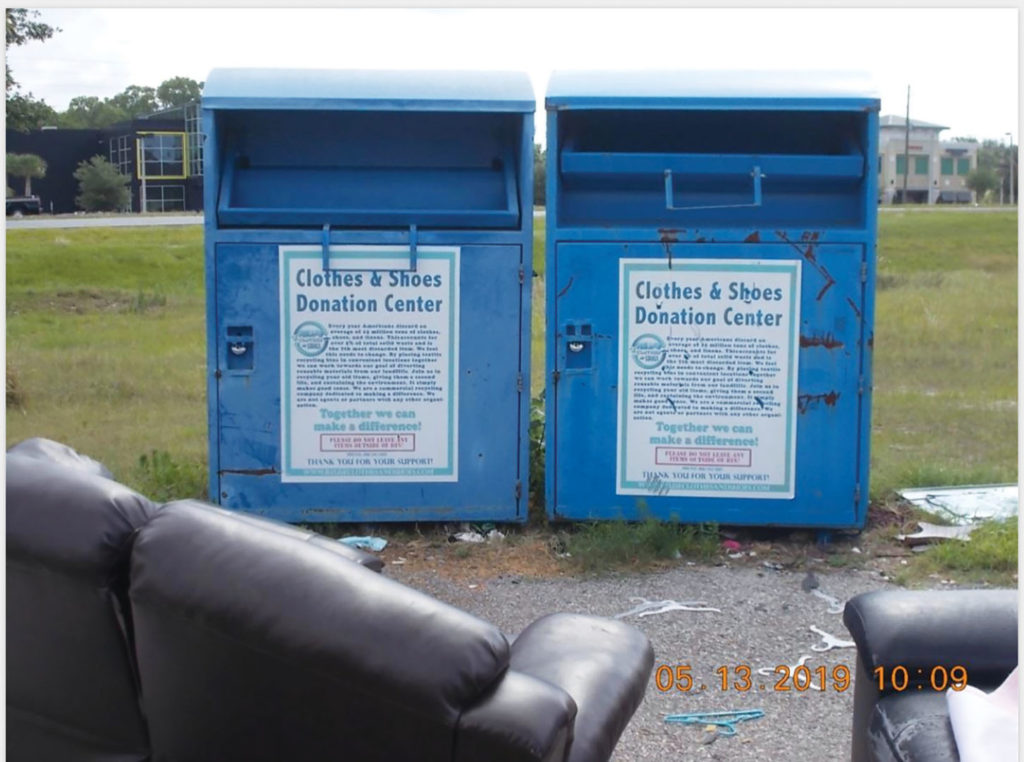
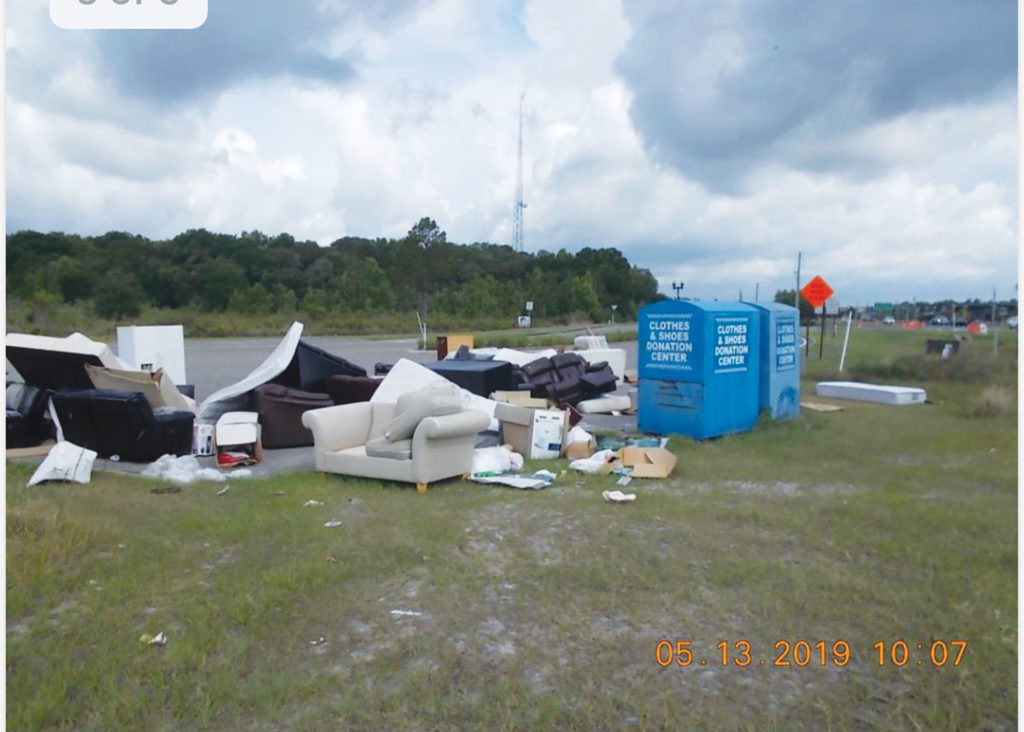
A pair of bins placed across the street from the Wesley Chapel Mini car dealership near the Texas Roadhouse restaurant, and another near the Sam’s Club (also on S.R. 56) have been attracting items not intended as donations.
Photo: Dan Ballman (Facebook)
Resident Dan Ballman posted the photo above on the Wesley Chapel Community Facebook page on June 9 pleading for an answer to the illegal dumping problem, with a two pictures of the dumping site between Texas Roadhouse and TD Bank.
One picture, he wrote, was taken on May 26, and the second was taken two weeks later, after the junk pile had doubled in size.
A dresser, at least five couches, six mattresses, a television set and what appears to be a dishwasher can be seen in the pictures. it looked as if enough items were dropped off to fully furnish a one-bedroom apartment.
Facebook page members have called the dumpers “lazy,” “horrible” and “disgusting,” while suggesting that the county install cameras in certain hot spots to catch the lawbreakers in the act.
Moore says the county already has asked code enforcement and the Pasco Sheriff’s Office to investigate, and said cameras have been placed at other locations he cannot reveal.
Moore said some bins have been seized as evidence for potential criminal proceedings. Although the bins are labeled for charitable donations, the commissioner thinks they are full-fledged businesses cashing in.
“Companies are collecting textiles to be reimbursed for it, to sell it,” Moore says. “Some say they give a portion of the funds to charity. We can’t confirm or deny that, because when you call the number on the bin, there’s no answer.”
While the bins themselves — which are not picked up in a timely fashion and are often overflowing — are a problem, District 1 commissioner Ron Oakley pointed out that those dumping items with no intention of putting anything in a bin also are an issue.
Commissioner Moore, however, said it is the bins themselves that begin the process of sites turning into junkyards. Commissioner Kathryn Starkey called the bins “magnets” for junk haulers to unload their stuff.
Moore said he suspects some of the junk dumpers are professionals who get paid to haul away large items but then decide to unload it somewhere other than the nearest junkyard — the Pasco County Transfer Station (PCTS) at 9626 Handcart Rd. in Dade City — to avoid paying a fee.
The PCTS charges $2.96 for every 100 pounds dumped.
When the county has to clean up these eyesores, it is at the taxpayers’ expense, Moore says.
On May 21 at a Board of County Commissioners meeting in New Port Richey, Moore suggested that the county ban unmanned collection bins altogether, which would affect legitimate collection bins like those used for recycling and those used by churches. County assistant attorney Kristi Sims said that the county would “quite definitely” be sued.
“I cannot stand up here and tell you we will win,” Sims said.
What the county has done is that it has begun monitoring various sites and seizing bins, and some sites that have been cleared out have since been repopulated with more bins — or more junk.
The county also sent 40 letters to property owners where the bins are being placed, asking if they had given permission; 15 of those letters involved bins from one company.
About 20 have responded, “and not a single one has said they gave permission,” Moore said.
Those who haven’t replied have until July 1 to do so.
Sims suggested that Moore hold off on pushing for a ban and allow for renewed enforcement efforts this summer to take hold. “Let’s see how this shakes out,” she said.
Moore said the county needs to end the problem as soon as possible. He is promoting strict enforcement of the ordinance and stiff penalties — including third-degree felony charges for dumping more than 500 pounds (or 100 cubic feet in volume), which carries with it up to five years in prison.
“I’m frustrated,” Moore said, “That’s why we’re taking it to next level. Now, we’re going to go out, and we’re going to catch them. We’re going to prosecute (them). We need to catch a few of them, and if they meet the criteria for a felony, they are going to be in bad shape.”