New Tampa Will Help Decide City Council Runoffs Apr. 25!

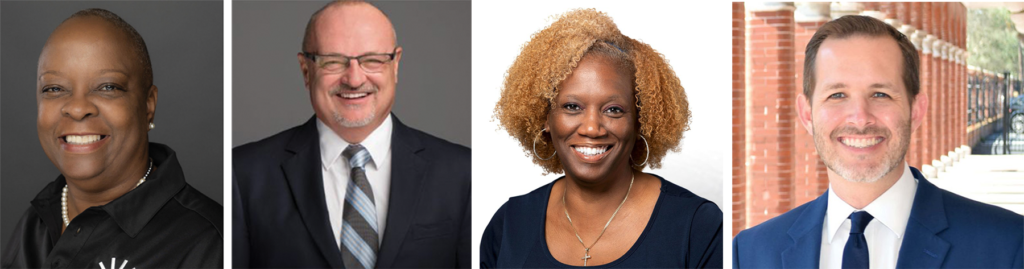
Candidates on the April 25 City of Tampa City Council Runoff Election ballot include  (l.-r., above) Dr. Sonja P. Brookins vs. Alan Clendenin in District 1, Robin Lockett vs. Guido Maniscalco in District 2 and (below) Janet Cruz (left) vs. Lynn Hurtak (right) in District 3. 

In March, Tampa Mayor Jane Castor easily defeated a write-in opponent and New Tampa’s District 7 Tampa City Council member Luis Viera was re-elected without opposition to serve four more years, but that doesn’t mean that New Tampa residents have no reason to go to the polls for the City of Tampa Runoff Election on Tuesday, April 25. 

In fact, Viera says that much more important than who you vote for is that you need to get out and vote. He says that no matter how hard he is willing to fight on City Council to fulfill — and fund —New Tampa’s needs, our community’s usually lower-than-the-rest-of-the-city voter turnout makes it harder for him to get things done. 

“New Tampa has traditionally been considered somewhat apathetic when it comes to voting and that does make it harder for me to get other Council members to support the needs of this community.”

The numbers bear out Viera’s claims of voter apathy. In the 2019 Municipal Election, which included a hotly contested race for Mayor, the citywide turnout was 20.56%, but in New Tampa’s 17 precincts, it was only 16.8%. In the Runoff Election in Apr. 2019, which included the mayoral runoff won by Mayor Castor over David Straz, the turnout was even higher — 23.2% citywide and a reasonable 18.5% across New Tampa’s 17 precincts.

In this year’s Municipal Election, where Castor faced only write-in candidate (and New Tampa resident) Belinda Noah (whose name did not appear on the ballot), the citywide turnout was only 13.65%, but the turnout in New Tampa’s 21 precincts was less than half of that, at only 6.5%.

Viera says that despite the fact that there are only three citywide City Council seats — Districts 1, 2 and 3 (plus the District 6 runoff between current Dist. 2 Council member Charlie Miranda and Hoyt Prindle) — being contested at this year’s Runoff Election, he expects a citywide turnout of about 12%. 

Viera says it would be great if New Tampa could beat that percentage at the runoff, and he says everyone should check out the campaign websites and social media pages of each of the six candidates shown on this page and cast votes for those who seem to best align with their own political philosophies.

Here’s a quick rundown of the three races in which New Tampa is eligible to vote:

District 1 — Dr. Sonja P. Brookins vs. Alan Clendenin

Dr. Brookins, a long-time educator, has served two years as an elected supervisor with the Hillsborough Soil & Water Conservation District and has been endorsed by the Democratic Progressive Caucus of Tampa Bay. 

Clendenin, who has served in multiple positions for Democratic committees (including first vice chair of the Florida Democratic Party), was a long-time air traffic control professional. He has been endorsed by the Tampa Bay Times, La Gaceta and Creative Loafing newspapers, the Tampa Police Benevolent Assn. and Tampa Firefighters 754 union, New Tampa’s State Rep. Fentrice Driskell, the Sierra Club and LGBTQ Victory Fund.

District 2 — Robin Lockett vs. Guido Maniscalco

Lockett is the former president of the Hillsborough Democratic Black Caucus who has been a regular advocate for vulnerable people at City Council meetings, as well as an organizer with the Florida Rising progressive social advocacy group. She has been endorsed by Creative Loafing.

Maniscalco, the two-term Dist. 6 Council member (and current vice chair) who is running in Dist. 2 because of term limits, has been endorsed by the Tampa Bay Times, the Greater Tampa Realtors, Tampa Firefighters 754, the Sierra Club and Equality Florida.
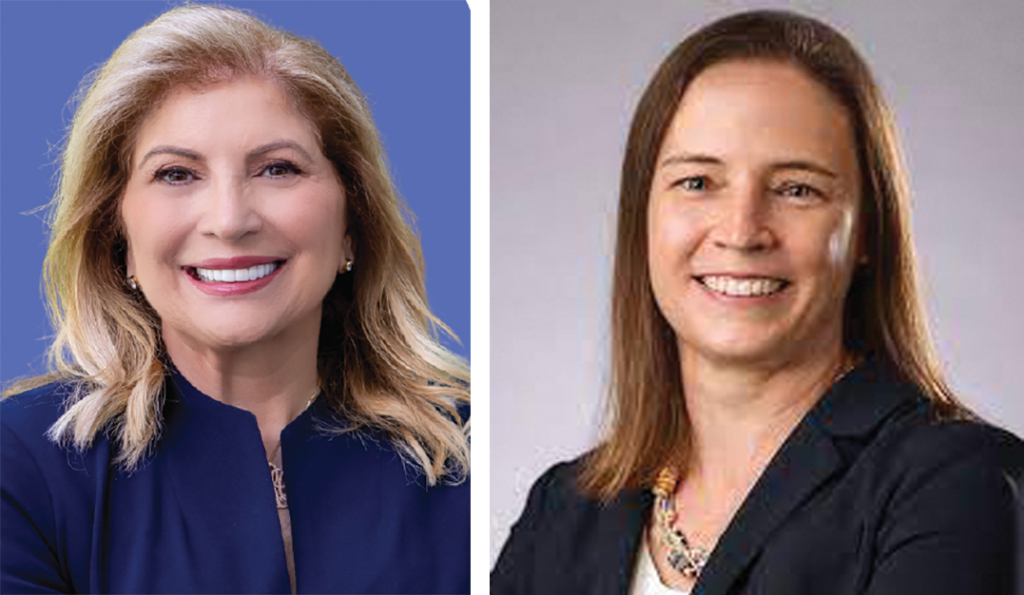
City of Tampa City Council Runoff Election District 3 Candidates Janet Cruz (left) vs. Lynn Hurtak (right) in District 3.
District 3 — Janet Cruz vs. Lynn Hurtak

Cruz, the former State Sen. who lost a tough race to Jay Collins in Nov., has been endorsed by the Tampa Bay Times, Mayor Castor and former Mayor Bob Buckhorn.

Hurtak, the Dist. 3 incumbent, has been endorsed by Creative Loafing, La Gaceta, Florida LGBTQ+, Florida Rising, the Tampa Bay Progressive Caucus and Muslims for Democracy & Fairness.

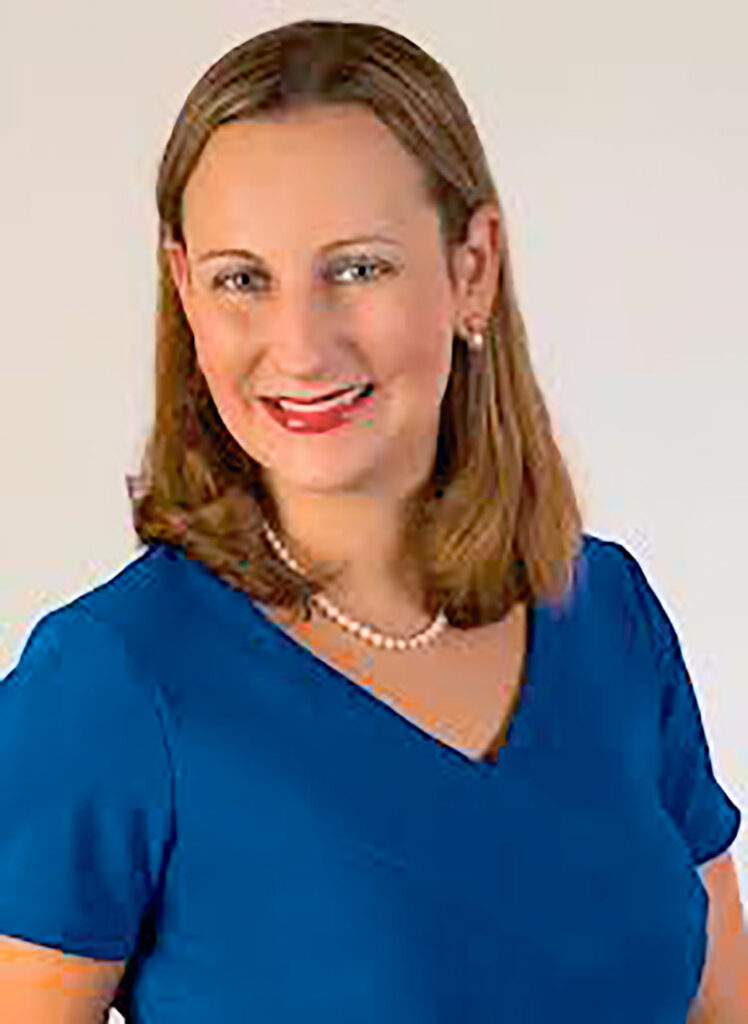
Ivanov Stresses Integrity & Impartiality In Her Circuit Court Bid

Ashley Ivanov

Integrity. Impartiality. Service.

These are more than words to non-partisan judicial candidate Ashley Willis Ivanov, who is running to become the next Group 19 judge of Florida’s 13th Circuit Court.

To her, they hold value when they are lived out. Professionally and personally, Ivanov says she lives out these ideals.

Ivanov, an attorney who lives in Lithia, has handled a diverse range of cases, including litigated and non-litigated matters, representing both plaintiffs and defendants. She presently focuses her practice on probate and estate planning.

“Integrity in the practice of law is important for the rule of law to be effectively carried out,” she says.

Born in Charleston, SC, Ivanov graduated magna cum laude with honors from The George Washington University in Washington, D.C., and cum laude from Vermont Law School in South Royalton.

She previously clerked for the federal government, interned at the U.S. Department of Justice and later worked for large, mid-size and small law firms in Washington D.C., Maryland and Hillsborough County, where she started her own law firm in early 2018.

A member of the Hillsborough County Bar Association, Ivanov zealously advocates for her clients, giving them straightforward feedback. Sometimes, this may mean informing a prospective client that he or she does not have much of a case or that the legal fees in the matter could be higher than what the client may have initially anticipated. “Transparency is part of being ethical,” she says.

The public testimonies of Ivanov’s clients attest to her professionalism.

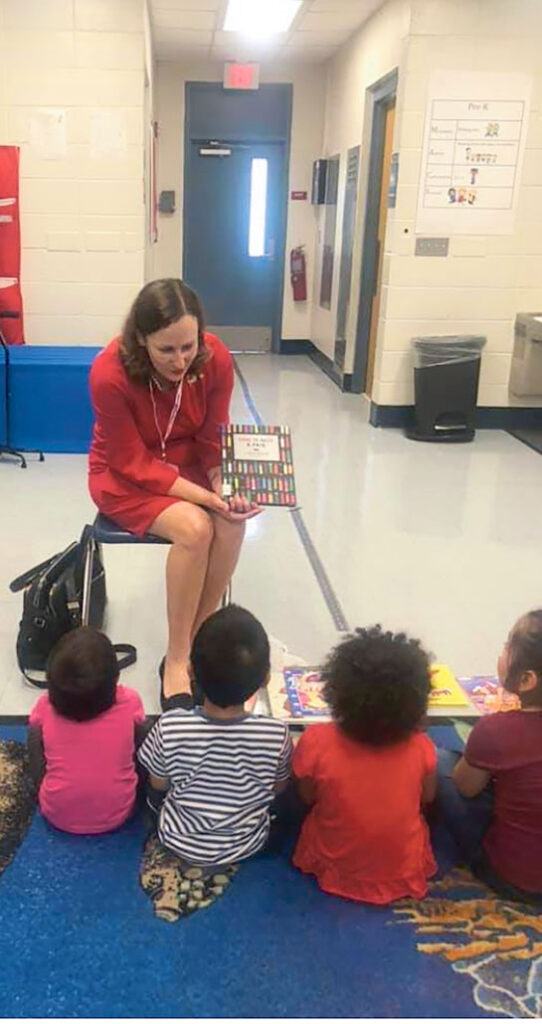
Reading to children in the Head Start Program with her fellow Rotarians (above) is one of the ways Ashley Ivanov, a candidate for Circuit Court judge, gives back. (Photo: Ashley Ivanov campaign)

“My clients’ matters are more than pieces of paper filed in court with case numbers,” she says. “These are real people with real stories that matter.”

In her personal life, Ivanov says she stays busy volunteering with her church and taking her daughter to Girl Scout events.

“I try to lead by example and integrity is at the center of this,” she says, adding that impartiality is a cornerstone of a judge’s responsibilities in administering justice.

“We need more people to run for public office who are going to do what is fair and right and, for the judiciary, uphold impartiality,” Ivanov says. “It is not the judge’s role to legislate from the bench, but to apply the law as it is, as created by the legislature.”

Service also is a regular part of Ivanov’s life, and she would not have it any other way. She serves with the FishHawk-Riverview Rotary and says she enjoys reading to children in the HeadStart Program with her fellow Rotarians.

As a member of the Hillsborough County Bar Association’s Community Services Committee, Ivanov has participated in Wills for Heroes, where she prepared complimentary estate planning documents for First Responders.

For more information about Ashley Ivanov’s campaign for District 13 Circuit Court Judge, Group 19, visit VoteAshleyIvanov.com.

Mike Moore Running On His Record

If you’re looking for a reason to vote for Mike Moore, he can give you many.

But, where he starts is pretty simple – his last campaign.

When the Seven Oaks resident first ran for the then-open District 2 seat on the Pasco County Board of County Commissioners (BCC) in 2014, he promised that he would 1) fight for increased funding for law enforcement to keep citizens and schools safe and secure, 2) he would promote industry and jobs, and 3) he would focus on transportation.

“We’ve accomplished all those things,” he says, proudly.

Moore, a Republican who is looking to retain his seat against Democrat Kelly Smith in the General Election on Tuesday, November 6, has represented almost all of Wesley Chapel on the BCC during its most tumultuous and expansive time. The area has continued to transform itself since he was elected, and he said he is proud of his role in promoting the things that he says make Wesley Chapel a desirable place to live, work and play.

“Before I ran for office, I was just like anyone else — a small business owner who lived in the community, raising a family,” says Moore, who lives in Seven Oaks with his wife Lauren and their three children. “I think a few of the things that were important to me were important to the citizens, and continue to be important to the citizens in 2018.”

Active in the community – he still coaches flag football at the Wesley Chapel District Park (WCDP) and rarely misses a public event or ribbon cutting in our area —Moore said what has made his tenure on the BCC an effective one is listening.

He has supported small projects, like helping local cricket enthusiasts find a place to play or pushing for traffic signals in neighborhoods, to big projects like the “connected city” project that has led to the country’s first-ever Crystal Lagoons® amenity in Epperson, or the Wiregrass Sports Complex that is currently under construction.

“There’s nothing too big or too small,” Moore says. “We’re a very diverse community. What’s important to one person may not be to the next person, but they’re all important issues.”

Topping the list, according to Moore, is public safety, and he stands by his — and the current commission’s — record of supporting first-responder needs in Pasco County.

“Public safety is definitely number one,” Moore says. “People want to be safe and secure.”

To fulfill that need, the Pasco County BCC last month approved a Fiscal Year 2019 budget that allocates 25.7 percent of total expenditures to public safety. That amounts to $232,689,204 out of $905,109,906 in total expenditures, making public safety the single largest expenditure in the FY 2019 budget.

Last October, Moore was endorsed by Pasco Sheriff Chris Nocco.

Born in St. Petersburg, Moore grew up in Winter Haven before graduating with a Bachelor of Arts degree in Radio & Television from the University of Central Florida in Orlando. He started a homecare agency that provided home healthcare to seniors and the disabled in 2004, before selling it in 2011, and he owned a business brokerage and mergers and acquisition firm before selling that in 2015.

It was his time as a small business owner that Moore says began to spark his interest in politics. “When I was doing that, I realized how much government affected our day-to-day lives,” Moore says, referring to regulations he says can suffocate small business owners. “When I started having children, you really realize how much government affects your everyday life.”

Moore became more engaged with the local community, he says, supporting candidates and volunteering for campaigns, most notably for Republican Will Weatherford, the former Speaker of the Florida House of Representatives.

“My interest in politics was gradual, but you don’t just jump in because, ‘Hey, I want to run for office,’” Moore says. “There has to be a message, a thought that you can make a difference. Then, you need to get involved in the community, and truly spend time there so you can understand the issues and what you can do to make things better before you can run.”

And, Moore says he did just that, building relationships and listening to fellow members at the former Wesley Chapel Chamber of Commerce (now the North Tampa Bay Chamber) and Rotary Club of Wesley Chapel, and being active in the community. He won his first election in 2014 with 58.9 percent of the vote.

“I got a lot of support in Wesley Chapel (where he received 55 percent of votes cast),” Moore says. “I was grateful for that.”

Moore cites a number of projects that the county has undergone since he’s been on the BCC — a blight ordinance, which has helped clean up Pasco County; a host of flooding issues on the west coast; the whirlwind growth in Wesley Chapel; and a number of traffic issues (like the widening of S.R. 56, the diverging diamond interchange at the S.R. 56 exit off I-75 and the proposed I-75 interchange at Overpass Rd.) – and his stalwart stance that Mansfield Blvd. in Meadow Pointe II should not be connected to Kinnan St. in New Tampa.

Moore, who has to make decisions that affect all of Pasco County, not just Wesley Chapel, thinks his resume the last four years fulfills what he promised to voters. And, he says those who decide to vote for him again can expect more of the same.

“I’m proud of what we’ve accomplished the last four years,” Moore says. “I think I’ve done a great job of listening to citizens. In fact, a lot of the things I bring to (the BCC) come from the citizens. I think we’ve accomplished a lot.”

He says the most challenging part of his job is finding a balance between being a commissioner and his family, which can be difficult with all the events and meetings Moore attends.

He still manages to get his family away for vacations, often camping and fishing trips, in the family’s motor home. His daughter’s horse shows and competitions keep him busy, as does coaching flag football.

When it’s time for work, though, he operates on a simple premise.

“In the end, you have to make decisions that you feel are best for everyone,” Moore says. “Do what you think will be best as a whole, now and 20 years down the road.”


Pebble Creek’s Karen Perez Is Running For Hillsborough School Board Dist. 6

The difference that a good learning environment can make to a child is a lesson Karen Perez says she learned when her family moved to Tampa from Brooklyn, NY, so she could attend a safer high school (King High, on N. 56th St. in Tampa).

As one of two candidates in the run-off for the Hillsborough County School Board District 6 county-wide race, the Pebble Creek resident, who has been endorsed by previous HCSB District 6 seat holder April Griffin, says that ensuring today’s students have that same opportunity to get a good education without distractions, such as school violence, is what she wants to achieve as a School Board member.

“I was able to go to high school here in Tampa and I was able to focus on my education and not have to worry about the crime. What is ironic is, what I experienced at 16 in New York, is now something that students nationwide are experiencing.”

What also has changed, according to Perez, is the nature of some problems, like bullying, that have been around for decades, but which have taken on new meaning in the Digital Age, where rumors and gossip can spread far and wide very quickly.

“Before, it was between you and the bully,” Perez says. “But now, because of social media, it’s cyberbullying.”

Perez adds that signs of the need for mental health support in schools include that fact that more and younger children are committing suicide, rather than dealing with the challenges that life presents to them.

“The mental health piece in these children’s lives is at a critical point,” she says. “We need to address this with our children.”

Perez has insight to issues related to mental health. She followed up her graduation from King High by earning her Bachelor of Social Work (BSW) and Master of Social Work (MSW) degrees from the University of South Florida and building her private Tampa practice, the Embracing Changes Center for Mental Wellness.

She also is a primary social worker at the James A. Haley Veterans Hospital.

Perez says her 17 years of experience as a mental health professional will bring a new and much-needed perspective to the School Board, which is responsible for ensuring the success and safety of more than 200,000 students in 250-plus schools in the eighth-largest school district in the U.S., while dealing with issues ranging from broken air conditioners to finding enough bus drivers.

“When you have an education board that has members on it with the same mindset, everybody’s looking through the same lens and everybody’s coming toward a problem with the same tools, everybody’s going to come up with the same conclusion,” Perez says. “When you have someone that’s thinking outside the box…you get a different viewpoint.”

Another way Perez, who unsuccessfully ran for a seat on the School Board in 2006, wants to bring diverse perspectives to the school district’s operations and possibly stretch resources, is by working with people and businesses who want to be involved in helping to educate the community’s children.

“There is so much collaboration we could be doing,” says Perez, who has lived in New Tampa for 18 years and has raised two daughters and a son, all of whom are now either working in or pursuing professions of their own.

After nearly two decades living in the local community, Perez has become known to her neighbors, like Ann Green, who says Perez is accessible and committed to supporting others in achieving their goals.

“Karen is a great listener,” Green says. “Her ears and heart are always turning to help people and when she says she’s willing to do something, she’ll do it no matter what.”

Opposing Perez in the General Election on Tuesday is Henry “Shake” Washington, a retired Hillsborough School District educator who touts his 42 years of experience with the school district.

Washington began his career with the district as an instructional assistant and came up through the system to work as a teacher, principal and area superintendent for Hillsborough County schools.

Among the positions Washington’s campaign promotes on its website (ShakeforSchoolBoard.com) are strong oversight and accountability of the School District’s finances and putting more emphasis on learning skills and course content in the classroom, instead of standardized test preparation. The District 6 at-large seat is currently held by April Griffin, who decided not to run for reelection. Griffin has endorsed Perez to succeed her.

Perez ran for State House in 2006, winning her primary with 62 percent of the vote before falling in the General election to Ed Homan.


So Many Amendments…Do We Really Know How To Vote On Them?

Even though Florida has a hotly contested race for both Governor and the U.S. Senate coming up in the General Election tomorrow, I honestly can’t imagine that too many of us are actually looking forward to casting ballots this time around.

Why?

Well, mid-term elections are always a hit-and-miss proposition, but for the residents of New Tampa — who will pick three new Hillsborough County commissioners and a new School Board member — I have to think that, like me, some of you are so confused by all of the constitutional amendments on the ballot that you may choose to stay home instead of trying to really figure out how you should vote on some, if not most, of them.

Even though I have a four-year college degree from the University of Florida and I’ve been a professional writer and editor for more than 35 years, it seems to me that the wording of all proposed amendments to our state constitution are designed to confuse us, which makes filling in those “No” spaces hard to resist.

So, here’s a look at just a few of the 12 amendments on the ballot — because I personally may not get very far before I just start voting no on all of them. I mean, should it really take me a half hour or more, not including waiting on line time, just to vote?

Let’s start with Amendment 1 — Increased Homestead Property Tax Assessment, which grants an additional $25,000 homestead exemption for homes valued over $125,000. Owners of homes worth more than $100,000 would also receive an increase in their exemption.

If that’s the case, why don’t they just say it’s an additional exemption for homes worth more than $100,000?

On the surface, this seems like a no-brainer. After all, who wouldn’t want an additional homestead exemption?

On the other hand, groups like Florida Tax Watch, the League of Women Voters (LOWV) and others oppose it because it would take about $700 million a year out of the pockets of Florida’s cities, counties and other taxing authorities (although it wouldn’t affect school districts), starting in 2019, according to the Florida Association of Counties.

The LOWV says the likely result will be cuts in services or higher local tax rates to make up for the revenue losses, or possibly both.

OK, so how about Amendment 2 — Limitations on Property Tax Assessments?

In 2008, Florida voters amended the state Constitution to provide a 10-percent cap on annual property value increases for non-homestead property. This includes vacation homes, apartment buildings, vacant land, shopping centers and office buildings. The amendment excluded limits on assessments for school taxes.

However, the 2008 amendment on non-homestead property value limits is scheduled to automatically repeal on Jan. 1, 2019. Amendment 2, placed on the ballot by the Florida Legislature, would make the 10-percent limit on property value permanent (a legislative analysis of the proposal is here).

Like the 2008 amendment, Amendment 2 would exclude local school district taxes from the property value limits. The limits also do not apply if the property changes hands or if it undergoes substantial improvements. In other words, if a store is built on a piece of vacant land, the property value increase would not be protected by the 10-percent limit.

Florida Tax Watch supports this amendment but the LOWV is opposed to it.

Amendment 3 — Voter Control of Gambling In Florida — is an interesting one created by a citizen initiative, that would require approval of any new casino gambling through a citizen-initiative constitutional amendment, effectively barring the Legislature (as well as the Constitutional Review Commission, or CRC) from making those gambling decisions by passing laws. The interesting thing is that the new law would not affect the state’s ability to negotiate with Native American-owned casinos (like the Seminole Hard Rock here in Tampa) or dog- or horse-racing or the state lottery.

Because it puts the decision-making power for new casinos into the hands of Florida’s residents, both Tax Watch and the LOWV support Amendment 3, although a spate of recent TV ads would tell you that it wouldn’t actually help the average Florida resident much, if at all.

Another one that has gotten a lot of attention is Amendment 4 — Voting Restoration. This amendment would restore the voting rights of convicted felons (excluding those convicted of murder and felony sex crimes) who have served their time and paid their restitution without the current 5-7-year waiting period.

Again, this seems like a fair law, especially in light of statistics quoted by the LOWV (which helped write the amendment) that the recidivism rate for those who have had their voting rights restored goes down by 30 percent.

It seems to me that those who have served time for felonies may have more important things on their plate — like finding a job, getting back to normalcy with their families, etc. — than whether or not they should vote, but this one at least seems to make sense.

I also think that constitutional amendments are important enough that legislators shouldn’t be able to tack unrelated issues onto them. For example, is Amendment 6 about the rights of crime victims or the retirement age of judges? And how are those two things related?

Yeesh.