
Hey Everyone, Welcome Back To School…Feeling Cooler?

Workers were putting the finishing touches on the improved A/C system at local high schools right up to today’s first day.

You may or may not have felt a pinch so far this year, with the new ½-cent sales tax increase to support Hillsborough County’s public schools, but the Hillsborough County School District certainly has felt the benefit.

As of July 22, the district already had received $40.4 million since the tax went into effect on January 1.

Of that money, officials say they have already spent $17,902,401.49, and some of that money has gone (and will continue to go) directly into New Tampa’s schools.

Work is well under way at Benito Middle School, where crews are installing a new air conditioning system. The A/C project is expected to be completed before the 2019-20 school year starts on Monday, August 12.

“It will be huge for the students and the faculty to not have to deal with the air going in and out,” says Sharon Hineline, who now works at the front desk at Benito and was formerly the PTSA president at the school.

She says that the response from the district has typically been good when the air has not been working, and it’s usually been limited to one area or another, but the new system should mean a more reliable system throughout the entire school at all times.

“It certainly will help to minimize the disruption of moving classrooms or having doors open,” Sharon says.

“Not having air in Florida makes people not be able to think straight,” she continues, “and we need kids to be able to think straight.”

Hillsborough County Schools spokesperson Tanya Arja says work also is under way this summer to install a new air conditioning system replacement at Clark Elementary.

Wharton High’s air conditioning system also is being overhauled. 

“Work this summer is to install two new chillers of the school’s three, because the third one is only a couple of years old,” says principal Mike Rowan, who adds that there also has been pipework done at Wharton over the summer.

“Next summer, they will be replacing a couple of other things that are needed, including ductwork,” he says. “That should help a lot to balance out the air flow into the classrooms.”

The air conditioning has been an issue at the school, for both teachers and students, for many years. Rowan says he hopes the improvements will eliminate those problems.

Arja says Wharton will be getting a new roof, too, as will Hunter’s Green Elementary. Work on those projects is expected to start soon — construction on Hunter’s Green’s new roof is expected to begin sometime this month.

“With the roofs, they work on them at night and on weekends,” Arja explains. “It’s cooler for the crews that way and it doesn’t disturb activity at the schools.”

Playgrounds, Tracks & More

Tampa Palms Elementary (TPE) already has received separate new playgrounds for grades kindergarten through second, and grades 3-5. While the students saw the installation happening towards the end of the last school year, when school starts this fall, it will be the first time TPE students have gotten to play on the new equipment.

Arja also says that by the end of this school year, funds from the half-penny sales tax will be used to replace 50 playgrounds, tracks and athletic courts countywide, as well as complete 31 painting and carpeting projects, and invest more than $1 million in school security improvements.

Over the next 10 years, the district also plans to overhaul or replace air conditioning systems at 203 schools. Each summer, school officials expect to complete about 20 major school air conditioning projects as the funds are generated by sales across the county.

More than 1,700 total projects are planned over the next 10 years, including 63 aging roof replacements, $23 million in safety and security improvements, $25 million in classroom technology upgrades, and four new schools will be built to relieve overcrowding, although none are slated to be built in New Tampa.

More than 1.3 billion will be invested into schools over the next 10 years, with at least $500,000 invested in each school. 

“This is all thanks to Hillsborough County taxpayers who supported the education referendum back in November of 2018,” Arja says.

USF’s New Tampa Business Climate Study Begins With Packed Meeting

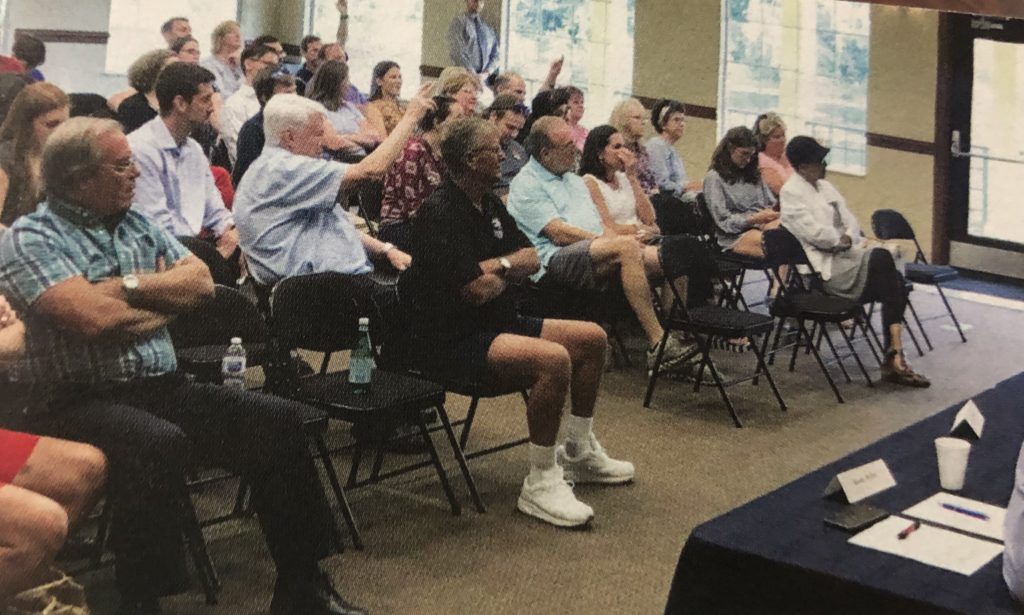
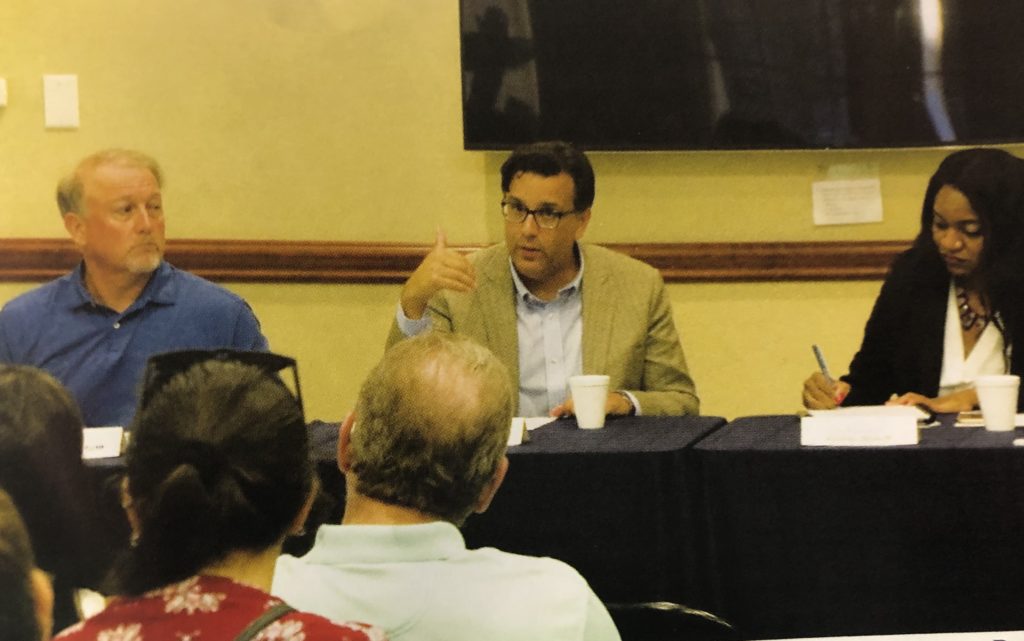
Compton Park at Tampa Palms was packed for the first “New Tampa Business Climate” meeting organized by Master’s degree candidates at USF, where (l.-r.) Hillsborough county commissioner Ken Hagan, Tampa city councilman Luis Viera & State Rep. Fentrice Driskell were among those on the panel. Photos by Andy Warrener & Ricky Rodriguez.

In order to begin a study by students in Master’s degree programs at the University of South Florida as to why so many businesses have exited New Tampa the last few years, USF helped organize a unique meeting on July 16, featuring a panel of elected officials and local business owners.

The meeting was Phase 1 of the USF group’s efforts to study New Tampa’s faltering business climate as the students endeavor to figure out what, if anything, can be done to stem the business red tide.

A panel that consisted of the director of the USF School of Public Affairs (where the Master’s degree candidates are studying) Ron Sanders, Rotary Cub of New Tampa past president Karen Frashier, Oliver’s Cycle Sports owner Randy Myhre and three local elected officials (see below) was greeted by a packed house of spectators (who were mainly New Tampa residents; see photo on next page) at the meeting, which was held at Compton Park in Tampa Palms.

Hillsborough County District 2 commissioner Ken Hagan, District 7 Tampa City Council member Luis Viera and newly elected District 63 State Rep. Fentrice Driskell agreed to be on the panel because all of them share concerns about why major companies and mom-and-pop businesses alike are having so much trouble surviving, much less thriving, in zip code 33647. 

Sanders said that the study is being conducted by USF students seeking their Master of Public Administration (MPA) degrees in either Urban & Regional Planning or Public Affairs, after then-mayoral candidate (now Tampa Mayor) Jane Castor campaigned in New Tampa.

Castor said many local residents asked her why the business climate in zip code 33647 seemed so poor, especially when compared with the booming economy in Wesley Chapel, just to New Tampa’s north, on Bruce B. Downs (BBD) Blvd. and S.R. 56. 

One of those Castor was talking to just happened to be Sam Becker, a graduate assistant in the School of Public Affairs, and she asked Becker to look into what, if anything, USF could do to help her figure out what could be done to help New Tampa’s businesses. By the time Castor was elected in March, the wheels were already in motion.

“This meeting is the kickoff to Phase 1 of the study — to meet with the community,” Sanders said at the meeting. “Phase 2 will be individual interviews with community staples — elected officials, business owners and residents — such as those in this room. In Phase 3, the students will look at the literature (facts and figures) and the (business) practices going on in the area. For example, is (New Tampa’s situation) just part of a national phenomenon or are there local factors” causing our area’s economic gloom (or both)?

Although Hagan, Viera and Driskell all agreed that the meeting was important, there didn’t seem to be too much help for the USF students coming out of this first get-together.

Among the factors pointed to as to why so many businesses have closed in New Tampa were the high rents, the lack of tax incentives to open major businesses, and even some things brought up by Frashier and Myhre.

Frashier, who also is the co-chair of the Taste of New Tampa & Wesley Chapel, mentioned that New Tampa doesn’t have a large enough gathering place for major events, such as the Wiregrass Wobble 5K road race her club hosts (at the Shops at Wiregrass) every year on Thanksgiving morning, or the Taste (held at AdventHealth CenterIce), “So, we have no choice but to put on these events in Wesley Chapel.”

Hagan and Viera both touted the new Village at Hunter’s Lake development that will be home to a 20,000-sq.-ft. New Tampa Cultural Center, as well as several unique restaurants and retailers (as we reported last issue), but that those are all coming online in 2020 or even 2021.   

Myhre said he thinks that bicycle paths connecting the subdivisions in New Tampa would make getting to and from local businesses easier, without having to drive a car, but Hagan said, “Connecting communities is great, but have you seen how hard it is to get even one road connected between communities?” — an obvious jab at the whole Kinnan St.-Mansfield Blvd. flap between Hillsborough and Pasco counties.

Residents at the meeting also brought up how long the widening of BBD in New Tampa took, which affected local businesses, while one noted that S.R. 56, where so much of Wesley Chapel’s growth is taking place, currently has very few residences directly off of it. No one came up with any reason why this helped or how it has affected the economy in the Wesley Chapel.

For New Tampa’s businesses, the hope is that more answers will come out of Phases 2 & 3 of the study.

Wesley Chapel School Grades

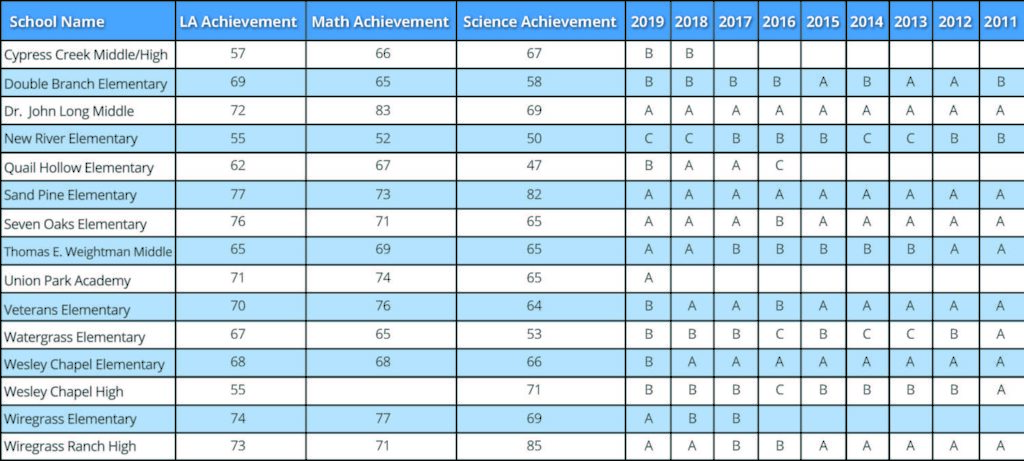
Once again, every school in Wesley Chapel but one received either an A or B grade from the state, including John Long Middle School (an A school for the 13th consecutive year, and Sand Pine Elementary (an A school for the 19th time in 21 years). Also, Wiregrass Elem. earned its first-ever A & the Union Park Academy charter school has received an A after its first full school year.

The USF Federal Credit Union Celebrates 60 Years Of Helping!

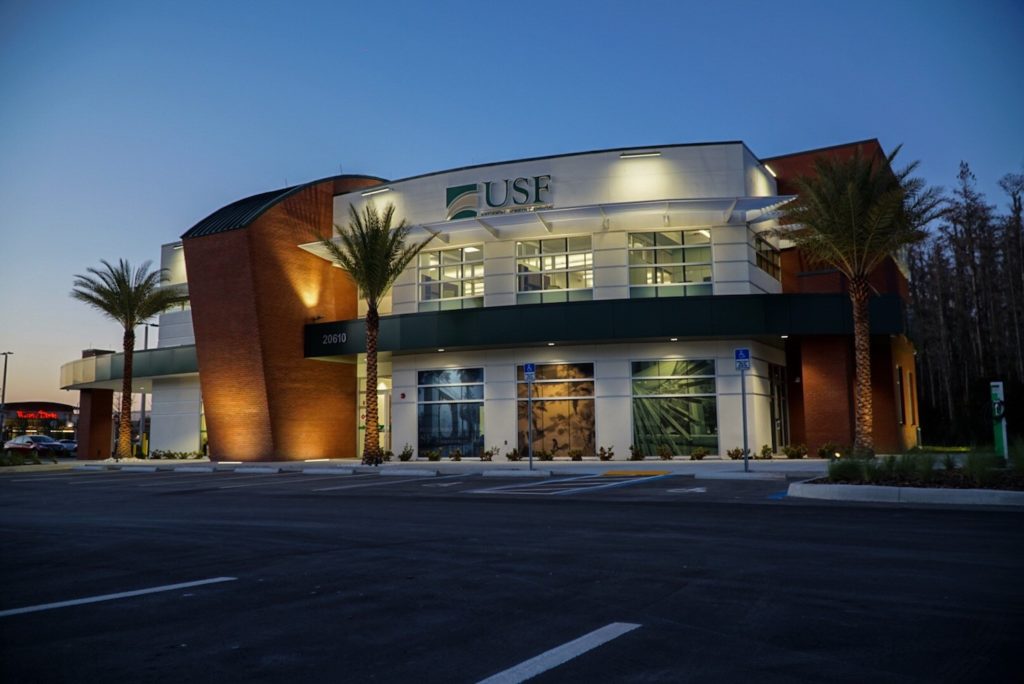
The freestanding New Tampa branch of the USF Federal Credit Union on BBD Blvd., just south of the Pasco County line, is a model for new branches being built in other areas.

The year 2019 already has been a year of celebration for the USF Federal Credit Union (USF FCU). It’s the organization’s 60th anniversary, marking six decades since it was founded in 1959 and its continued growth and service to its members ever since.

The credit union’s growth is evidenced by the brand-new branch that now serves New Tampa and Wesley Chapel, located at the northwest corner of Bruce B. Downs (BBD) Blvd. and Imperial Oak Blvd., in the Trout Creek area in front of Winn-Dixie, just south of County Line Rd.

The New Tampa branch opened last fall, celebrating its Grand Opening on November 15. When it opened, it was the USF FCU’s first stand-alone, off-campus branch. In the next 18 months or so, the credit union will open two more branches modeled after the one in New Tampa – one on E. Fletcher Ave. in Tampa and one in Sarasota.

The credit union’s growth also is evidenced by its ever-expanding membership.

When it was founded in 1959, the USF FCU started with 16 members — all of whom were members of the academic faculty or staff at the University of South Florida — and had total assets of $505.

“Now, we have more than 60,000 members and $680 million in assets,” says Bill Steiger, brand and promotions manager for USF FCU.

While USF FCU originally served only faculty and staff, current USF students and alumni are eligible to be members, along with employees of certain companies that have business partnerships with USF, such as Tampa General Hospital, Moffitt Cancer Center, and even Darden Restaurants, due to a merger with that company’s credit union back in 2015.

A complete list of 42 affiliated companies is available at usffcu.com/eligibility#affiliates.

“If you graduate from USF,” says Steiger, “you can bank with us your whole life.”

Many people do. In fact, Steiger says that about 2,500 members live in and around New Tampa and Wesley Chapel. To find out if you’re eligible to bank at USF FCU, visit usffcu.com/eligibility.

Typical? Hardly!

The USF FCU offers typical personal banking services — from checking and savings accounts, to money market accounts and CDs (certificates of deposit), auto loans, home loans, personal loans and more.

But, Steiger says, those services are not offered in a typical way.

“We are member-focused,” he explains. “Our members are our number one priority, and providing service to them is job one.”

Myresha Daniel is one of those members who says she appreciates the difference. Myresha says she opened her first account at USF FCU when she was a college student more than 20 years ago. She says she uses the credit union for all of her banking needs, including checking and savings accounts, CDs, a car loan, credit card, and previously had a personal loan that she paid off. 

“You hear about astronomical fees from the big banks,” she says, like her friends who have to keep a minimum balance of $500 and get charged a fee if they fall below that. “My account minimum is $5.”

She says other perks include having a free consultation with a financial advisor who helped her better understand her 401(k), and a personalized car-buying program where she not only got the lowest rate out there, but also an assigned representative to meet her at the dealership and walk her through all the paperwork. 

“They even send you a card on your birthday,” she says. “The representatives at the call center are great. I like the fact that they know my nickname, they recognize my voice, and we have built a relationship over time.”

In addition to calling the credit union, the USF FCU offers robust online and mobile banking services that allow their members to bank digitally from anywhere at any time. Plus, anyone in New Tampa and Wesley Chapel can easily access the local branch for face-to-face services.

“The branch in New Tampa is state-of-the-art,” says Steiger. “We offer all of our services there. You can walk in and talk with someone about getting a mortgage or auto loan, or anything else you need.”

Steiger says the credit union provides many auto loans for its members. Personal loans also are popular.

“When people want to consolidate their bills,” he says, “they come to us to get a low rate and achieve some savings.”

He says the rates for USF FCU loans are extremely competitive, which lowers the amount of money members pay in the long run. “I would encourage any readers who want to refinance or buy a new home, talk with us first,” he says. “We are currently offering great rates and special programs, including some loan programs that have no closing costs to close on the loan.”

Diane Dwornik is an Arbor Greene (in New Tampa) resident who became a member of the credit union when her husband Julian began working at USF in 1970.

“Our experience over the years has been phenomenal,” she says. “I’ve never had loans anywhere else.”

Although Julian has since passed away, he was a founding member of the USF medical school and went on to become dean of admissions for the school.

“When you’re a member, you’re a family member,” says Dwornik, explaining that she’s never felt like she’s just a customer of a bank.

“You get personal treatment,” she says, “I’ve always been treated so well and anyone I’ve recommended to the credit union has thanked me over and over again.”

While USF FCU offers the latest in digital banking technology, that personal touch means someone like her — who has no interest in online or mobile banking — can call and ask for help with all of her banking needs.

“At the end of the month,” Diane says, “I call them and they help me pay my mortgage and other bills.”

“We’re all treated just like family,” she adds. “That is so rare today.”

The New Tampa branch of the USF Federal Credit Union is located at 20610 BBD Blvd. The lobby is open Monday, Tuesday & Thursday, 9 a.m.–5 p.m., 10 a.m.–5 p.m. on Wednesday, 9 a.m.–6 p.m. on Friday and 9 a.m.–1 p.m on Saturday. The drive-through opens at 8 a.m. weekdays. For additional information, visit USFFCU.org or call (813) 569-2000.

No Pads? No Problem, As 7-On-7 Helps Prep Teams For Fall!

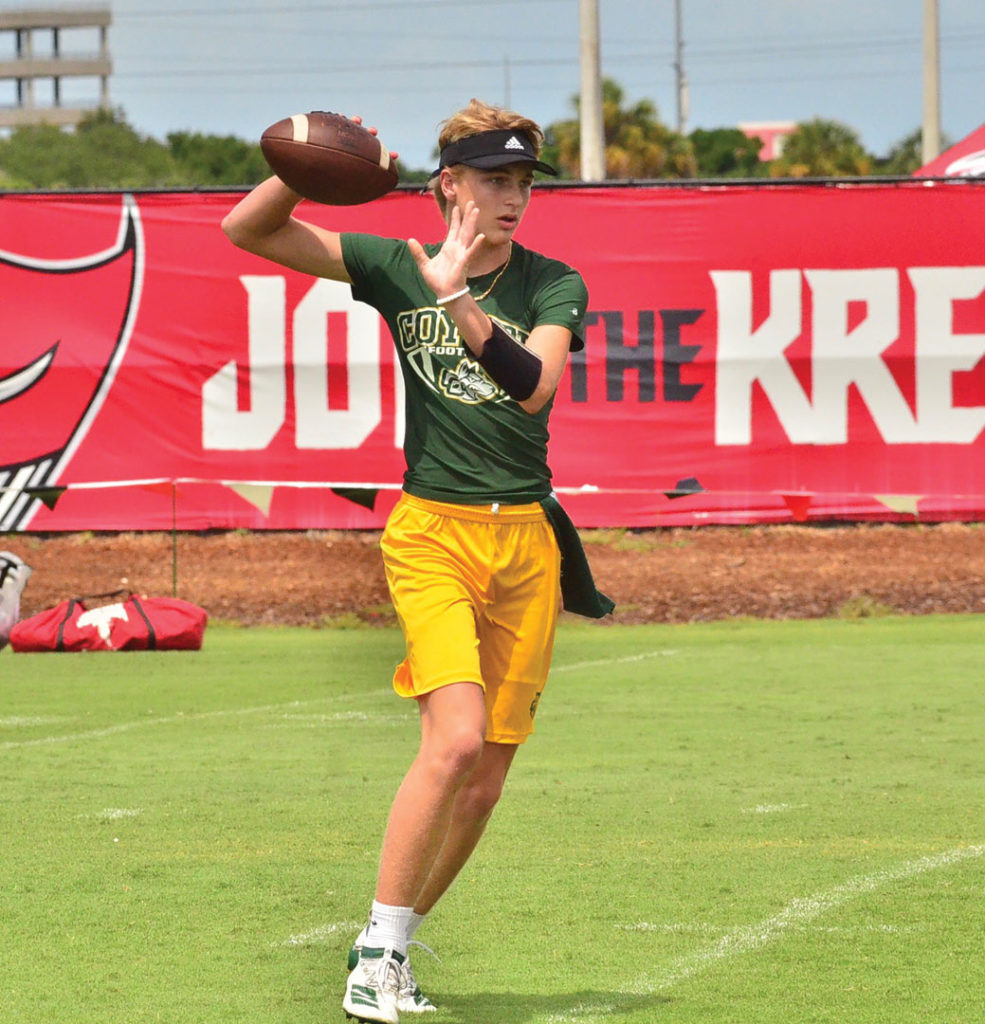
Wiregrass Ranch High quarterback Hunter Helton is spending the summer prepping for his first season as the Bulls’ starter by playing 7-on-7 football. (Photo: Andy Warrener)

Traditionally, high school football players have generally filled their summers the only way they can — by throwing the ball around, studying the play book, keeping in shape and hitting the weight room.

They aren’t allowed to wear pads in the offseason, so there is no hitting or tackling, and as a result, nothing to play.

But, 7-on-7 football has changed all that. What began as a simple practice drill, ubiquitous from high school all the way up to the pro level, has evolved into a highly competitive sport of its own. 

These days, the 7-on-7 “season” is red hot, offering a full-speed, no-contact (really, no more than light contact) way for athletes to hone their skills, build team camaraderie and even attract college recruiters. Increased participation has led to increased organization, and what began as a few local/regional tournaments here and there has evolved into a high-stakes competition that goes all the way to the national level.

.Promising Wesley Chapel High defensive back Jon’Tavius Anderson (left) goes up for an interception during a 7-on-7 game at Fivay High. (Photo: Andy Warrener)

Elite area 7-on-7 teams like Team Tampa compete in a national circuit of tournaments, and have a few national titles to show for it. 

Wiregrass Ranch High (WRH) quarterback Hunter Helton, getting ready to enter his first year as the Bulls starter under center, led Team Tampa to a title at the Adidas East Coast Regional earlier this summer, and two weeks ago, Team Tampa made it to the elimination bracket at the national tournament held in Tampa before losing 17-14 in the first round. 

Current NFL star Cam Newton, the quarterback for the Carolina Panthers, and NFL Hall of Fame defensive back Deion Sanders both coached teams in the event, which was crawling with analysts from recruiting websites. Some of the bigger events also receive cable television coverage.

What is 7-on-7?

The game of 7-on-7 football is exactly that — seven players against seven players. The offense is run by the quarterback, there’s usually a running back or two and then four or five receivers. On defense, 7-on-7 teams mixes usually mix in one or two linebackers and five or six defensive backs.

Quarterbacks have four seconds to unload the ball or it’s whistled as a sack. The teams play on a short field. The offense starts at the 40-yard line and can gain first downs at the 25-yard line and the 10-yard line. You either score, or you turn the ball over.

There are no running plays. Games are 21 minutes long and the clock runs continuously until the final minute. A player is considered downed or tackled by a simple one-hand touch, though it can get very physical during intense match-ups. 

The origins of the sport can be traced back to a drill called, “Pass Skel,” or “Skelly,” as some former players recall it. Pass Skel (pass skeleton), aka 7-on-7, is a mainstay practice drill.

Many coaches eschew the 7-on-7 format, saying it invites bad habits and does little to mimic the actual game. Others have embraced it and say keeping their players active, competitive and together is a big payoff.

If you’re are working in a new quarterback for your high school team, the summer circuit of 7-on-7 can be invaluable. 

“First, it allows you to practice with the football all year,” says Wesley Chapel High (WCH) head coach Tony Egan. “You develop chemistry between your quarterback and receivers and it helps you get your timing down.”

Egan and the Wildcats are hoping junior Owen Libby steps into the starting quarterback position in the fall of 2019, and they are getting him all the reps they can. The Wildcats played in the second annual King of Kings Tournament at One Buc Place, and currently field two teams in Pasco County’s summer 7-on-7 league held at Fivay High in Hudson. 

The competition also allows coaches to add more dimensions and levels to both pass play packages and to their defensive schemes. 

“The passing game in high school is 10 times more sophisticated now than when I played (in high school),” says former Tennessee Titans linebacker Ryan Fowler.

“Back then, if you faced a good quarterback, you might not have answers for him unless you had a good pass rush. The NFL has become more of a passing league, and college has followed that, so it’s natural for high school to follow it, too. (7-on-7) offers you months to work on things that you just don’t have time to work on in the fall.”

Coaches like Egan and WRH’s Mark Kantor have embraced the 7-on-7 game, and, with both their teams starting the fall with new starting quarterbacks, building that chemistry on offense will be a significant bonus.

But, they are quick to point out, it’s not “real” football and they often have to remind their players of that.

“The quarterback gets used to taking free drop backs,” Egan says. “We try to do things in practice to simulate pressure like have guys put their hands in the quarterback’s face or hit him with a blocking pad.”

Playing 7-on-7 also gets defensive backs conditioned into a pass-first mentality, and provides a test for linebackers, who often have to drop into pass coverage as well. 

“It can take time to break that habit,” Fowler said. “I’ll sometimes make them (defenders) do up-downs after the ball is snapped to slow them down so that their drops are more accurate.”

Egan makes his defenders take a forward run-step before he allows them to drop into coverage. 

Coaches have to be wary as well of not falling into a 7-on-7 trap of calling plays and running a defense completely different than they will in the fall.

“We try to run the same coverages we would run in a real game,” Egan said. “It might hurt us in 7-on-7 but we want our kids to know our coverages in the fall.”