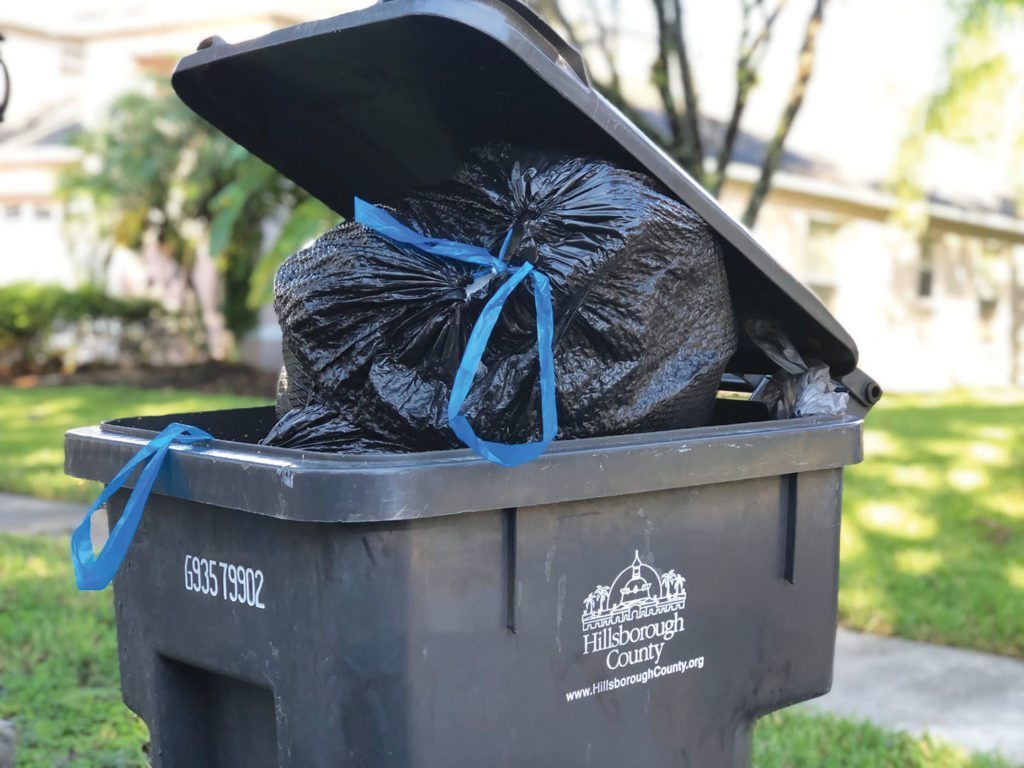
Hillsborough County will be entertaining waste management options that will possibly reduce garbage pickup in New Tampa’s city and county communities from two days per week to only one.
That stinks, say many.
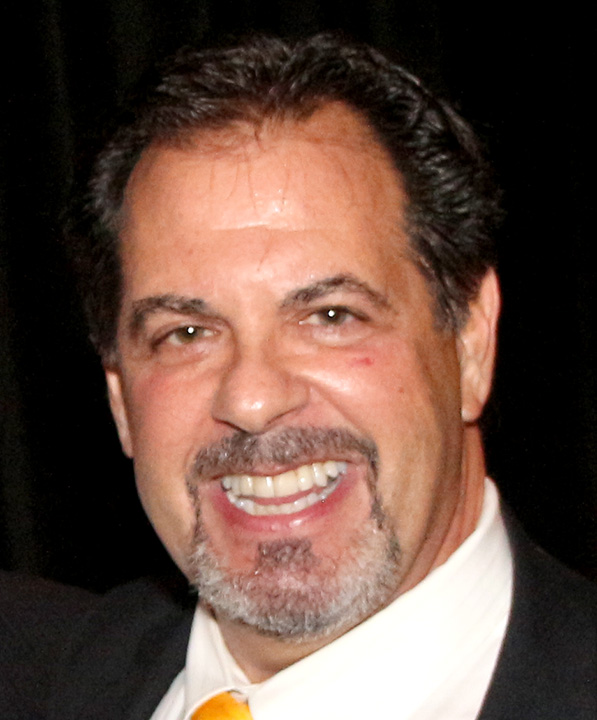
“I have not talked to one person that likes this idea,” says Mike Jacobson, the president of the Pebble Creek Homeowners Association. “I can’t even believe they’re considering it.”
Hillsborough County solid waste director Kim Byer says the decision isn’t based on how much trash is collected or how many residents actually leave their bins out on both days of pickups, but is purely a financial one that could produce savings for the county of up to 30 percent.
If those savings were significant, they could be passed on to customers, Byer says.
Currently, three companies —Republic Services of Florida, Waste Connections and Waste Management — together handle a $188-million contract to collect garbage, recyclables and yard clippings in Hillsborough County.
The County Commission will review new proposals this fall, and will vote on contractors for a new contract sometime before the end of November (which would go into effect in September 2020, Byer says).
“We say it’s the same garbage, just being picked up one day versus two,” she says.
Part of the process will include the results of an online poll that ended on August 5, which asked participants what they wanted from their waste management services.
More than 13,000 people had taken part in the survey at our press time. Byer says the majority were opposed to cutting weekly trash pickups in half.
District 2 County Commissioner Ken Hagan, who represents the New Tampa area, says it is far more than a majority of residents who are opposed, according to the emails his office has received.
“It’s 98 percent, maybe 99 percent, in support of maintaining twice a week pickups,” Hagan says, adding that he is not in favor of any options that include only once-a-week pickups.
“While once a week collection is definitely cheaper,” Hagan says, “I certainly do not believe it’s in the best interest of our residents and our neighborhoods.”
Because New Tampa is so community-oriented, with Homeowners Associations requiring that trash bins be kept from public view, meaning most likely in your garage.
And, with Florida’s blistering heat, the idea of trash being stored in those conditions for seven days isn’t appealing to most people.
“The concern I have is with no makeup day, and with the disproportionate number of (pickup) days falling on Mondays which are holidays, you could go 2-3 weeks between trash pickups,” says Scott Darby, the Arbor Greene HOA president.
Darby is so concerned that he says he has reached out to all seven commissioners, and only one response — from Hagan — has reflected steadfast opposition. He fears the decision already has been made.
Hagan is more positive, having been through this process three times.
“We’ll look at various proposals,” Hagan says, “and at the end of day, I’m confident we’ll remain with twice-a-week pickup.”
Over the course of the past several months, we’ve received quite a few calls from long-time, avid readers who said they’ve always received the Neighborhood News in their mailboxes in the past, but suddenly stopped receiving them.
As the guy who has to write the checks to the post office to mail our publications in both of our markets to every residence and business in every postal carrier route we serve, I knew I had to investigate.
But somehow, even though I first started taking a look at our recent distribution numbers when we received the first phone call, I’ll admit that other things always seemed to take precedence — e.g., I got married in March, celebrated my 25 years of Neighborhood News in April and have been redoubling my efforts to use the funding we have received from the Google News Initiative to continue to expand our video and online content.
Towards that end, we also recently finally changed our website’s address — to NeighborhoodNewsOnline.net (see below) — and our primary YouTube channel is now “Neighborhood News Online,” instead of the old WCNT-tv.
In other words, we’ve been busy, but not too busy for me to finally sit down with the online Every Door Direct Mail service offered through the U.S. Postal Service (USPS.com) and figure out how people who always got our publications — especially the Wesley Chapel edition — suddenly stopped receiving it.
I also had another hint that something was up because our distribution number in fast-growing Wesley Chapel had actually gone down since late 2018 — even though we were still paying to mail to every home and every business in all of our carrier routes.
Just as an explanation, our communities are all on what the post office calls “rural” (and a few “contract”) carrier routes, where we don’t have to address each individual piece that gets mailed, as you have to do with “city” carrier routes, like in South Tampa. All of our large, master-planned communities have multiple carrier routes serving them, and we always try to make sure we distribute to all of the carrier routes serving all of the largest (and some of the smaller) communities in zip codes 33543, 33544 & 33545.
The problem is that Wesley Chapel continues to grow so fast that even we — and the post office (like your GPS, right?) — have had trouble keeping up with all of that growth.
What happens is that when a new community — like, says, Estancia at Wiregrass or Epperson — first starts building, the USPS simply adds those homes to an existing carrier route, usually a route that is geographically near the new development.
But, once that community reaches a certain threshhold, the post office will usually create a new carrier route, with all of that new community’s homes and businesses. And no, the USPS doesn’t tell us when they take this type of action — it’s up to us to update our count every 30 to no more than 90 days.
In the case of Wesley Chapel, several hundred addresses were taken off a few existing carrier routes to create new routes. If we didn’t immediately add those new routes, not only did those new communities not receive our editions, there were even some older, more established communities (like WaterGrass) that may have been taken off one route and added to one of the new routes, to “fill them out” with more “drops” for the carriers handling those new routes.
So, after I did my research, I found that in late 2018, the carrier routes we delivered to included more than 23,000 “drops” total. As of April of this year, however, those same carrier routes had closer to 22,000 total drops. I knew that there had to be new routes that absorbed some of the drops from our existing routes, but it took me a while to figure out which routes I had to add in order to serve all of the homes and businesses in all of the communities we choose to send issues to by direct mail.
So, welcome back all of Epperson, all of WaterGrass, all of the homes in Wiregrass, and welcome Union Park and a couple of the newer sections of Meadow Pointe. In all, our new all-direct-mail distribution in Wesley Chapel is now more than 25,400 residences and businesses (and nearly 60,000 people) — and we might still add one or two more routes to that total.
So, go ahead — ask any other local publisher how many homes and businesses receive their publications in the mail — and ask to see their postal receipts. I’ll gladly share mine if they share theirs with you.
NeighborhoodNewsOnline.net
As I mentioned earlier, we have now officially changed over our website to NeighborhoodNewsOnline.net. If you’ve already been visiting our website to keep up on all of the latest local news of New Tampa and Wesley Chapel — with new news stories added every weekday — you can still find us at our old web address, but now, you will be redirected to our new site.
However, if you’ve normally been accessing our website through our “Neighborhood News” Facebook page, the change to the new web address won’t affect you at all.
Whether you’re trying to watch one of our ever-increasing stockpile of new videos or just want to read a story that may or may not have appeared in your print edition of the Neighborhood News, you can still click through to our new website from any of our Facebook posts.
We also recently changed over our YouTube channel from the former WCNT-tv (Wesley Chapel & New Tampa Television) to “Neighborhood News Online” on YouTube and yes, our videos continue to attract a lot of attention — and we are still adding more advertisers buying our Video & Online Subscriptions.
I will update you about our impressive viewership stats next issue. For more info about Neighborhood News print and Video/Online advertising, call (813) 910-2575!
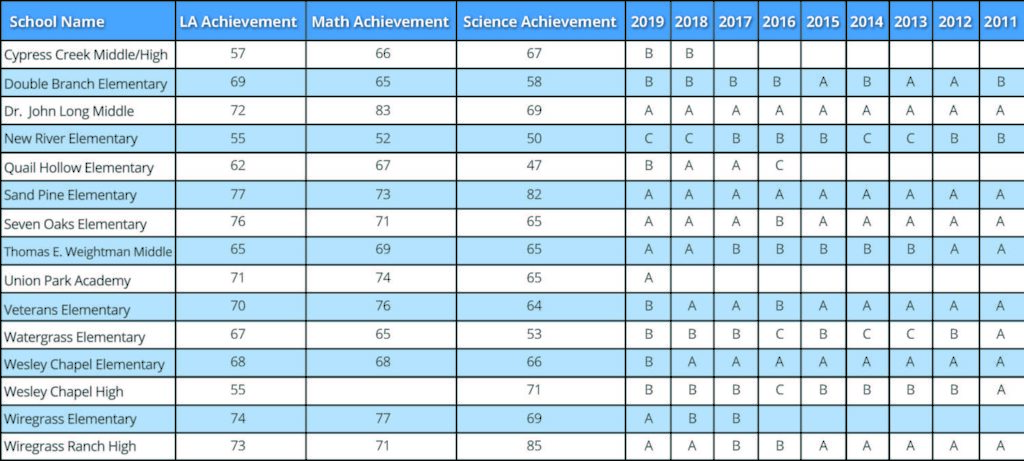
Once again, every school in Wesley Chapel but one received either an A or B grade from the state, including John Long Middle School (an A school for the 13th consecutive year, and Sand Pine Elementary (an A school for the 19th time in 21 years). Also, Wiregrass Elem. earned its first-ever A & the Union Park Academy charter school has received an A after its first full school year.
For the second time this year, Wesley Chapel will soon be celebrating the Grand Opening of a newly-equipped fire rescue station, bringing the total to three stations that are currently serving one of the county’s fastest-growing areas.
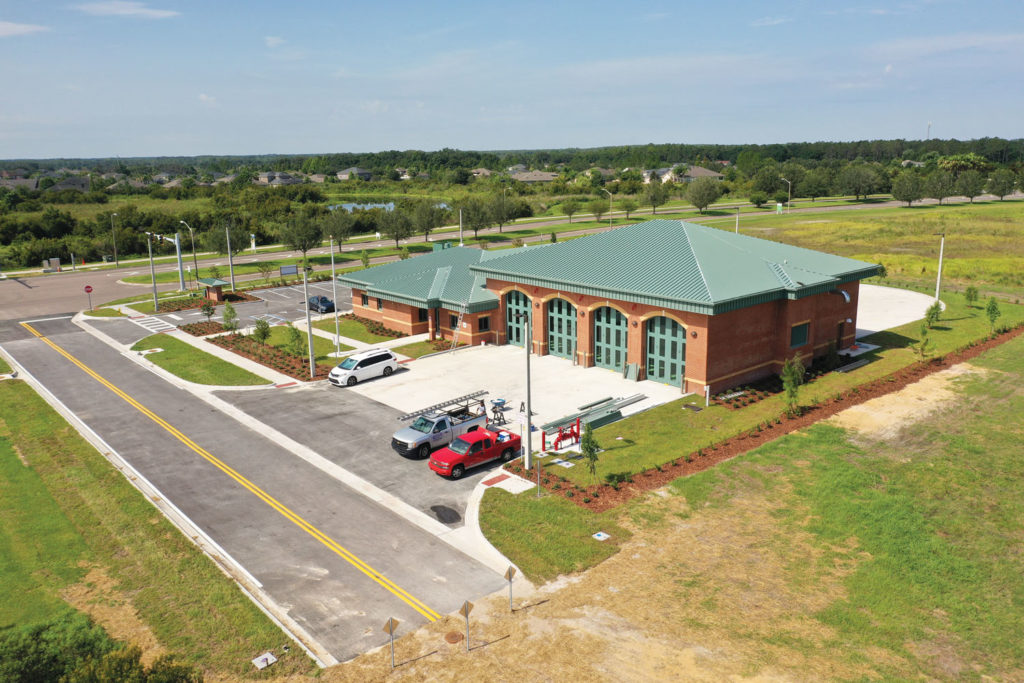
Although Pasco County Fire Rescue (PFR) Station No. 38, located in WaterGrass (west of Curley Rd.), has been staffed and operational since last week, the official ribbon cutting is expected to take place in early August, heralding the arrival of one of the largest and most high-tech Pasco fire stations around.
“We have a group of citizens that live in that area and have followed this project for the last five years,” said Pasco fire chief Scott Cassin. “I’m sure they are very excited to see the station open — as are we.”
Station No. 38 will join No. 26, which is located on Aronwood Dr. in Meadow Pointe, and No. 13, which is located off of Old Pasco Rd. The all-new Station 13 opened after an extensive expansion, renovation and relocation earlier this year.
Fire Station 38 is a 10,843-sq.-ft. facility, with four drive-through bays, versus the standard two or three bays that most other PFR stations have.
The size of the station will help it expand to meet the needs of existing communities like WaterGrass and Epperson, as they continue to add thousands of new homes to the area.
On day one, Station 38 opened with a fire engine truck, as well as one of only two air trucks — or light and air units, which provide supplemental lighting and SBCA air bottles at the scene of emergencies — in the county (there is another one that serves the west side of Pasco).
The new station also will house an EMS unit and (by December) an ambulance crew will be stationed there as well, or maybe a ladder truck, special operations team or even a hazmat team.
“We’ve built the building with that expandable capacity in mind,” Chief Cassin says. “(Wesley Chapel) is going to continue to grow, and we’ve built a facility big enough that we can expand in the future and meet those future needs.”
A new PURVIS alert system has been integrated into the new building to help speed up response times. The current analog system, which sends out loud signals from dispatch via bell or alert tones, is being replaced with a digital system that Cassin says will produce better results.
The well-known, loud screeching sounds will be replaced by a series of tones that gradually increase in volume, “Which is really nice at 3 in the morning when you are asleep and you get a call,” Chief Cassin says, chuckling. “Now you have to peel me off the ceiling because it’s so loud it scares you. This is much more gentle on the cardio vascular system.”
Alerts also can be targeted toward only the firefighters needed for a particular call, and not the entire station.
Lights will help alert firefighters about how much time has elapsed. They are expected to be out of the station within 60 seconds, and the lights will change colors as time passes.
There also are display monitors that firefighters can use as a guide, and in the bay is a “rip and run,” which is a back-up printout of the call, in case the computer in the truck goes down.”
Another nice addition to the new system — it can alert all of the necessary fire stations at the same time. Currently, on calls that require more than one apparatus, the dispatch center has to call each individual station, in order of their proximity to the call or they type of equipment they have.
“With the new system, one push of the button will alert all the stations at the same time,” Cassin says. “It will shave off time. Even if it’s only 10 seconds, it’s still 10 seconds. It can make the difference.”
Those working in the station will be beneficiaries of a new Plymovent diesel exhaust capture system. Long yellow tubes will be connected to the exhaust pipes of the fire vehicles, so that when the vehicle is started in the bay, the discharge of diesel exhaust (carbon monoxide and the carcinogen Benzene) is collected into the system and evacuated to outside air.
When the truck leaves, the tubes, connected by a system of magnets, detach at a certain point.
“We’re going to have very very clean air at that station (and reduce the cancer risk),” Cassin says. “We’re working on a plan to retrofit the rest of our stations with that system.”
The new station at WaterGrass helps fulfill PFR’s goal of having a station within five miles of every structure. Until No. 38 came along, those in WaterGrass and the surrounding area were outside that range — more than 8 miles from No. 13 and 10 miles from No. 26.
Cassin says not only does the station provide safety benefits, but homeowners should receive a premium reduction if they alert their homeowners insurance companies that a new station has opened close to their homes.
Station No. 38 won’t be the last fire station for Wesley Chapel, which continues to grow unabated. Cassin says a station already is funded for the north end of Meadow Pointe at S.R. 54 — the land still needs to be purchased — with plans to build in 2022. And, Cassin says, the I-75 and S.R. 56 area currently is being studied as a future site as well.
In the more than three decades since the New River Branch Library was built on S.R. 54 in Wesley Chapel, the only improvement the library had seen — until now — was just a little paint.
That will change in a dramatic way when the branch closes in October 2019 for about six months to receive a complete overhaul.
While the structure of the building won’t change, a spokesperson for Pasco County Libraries says the improvements within the walls of the library will be significant.
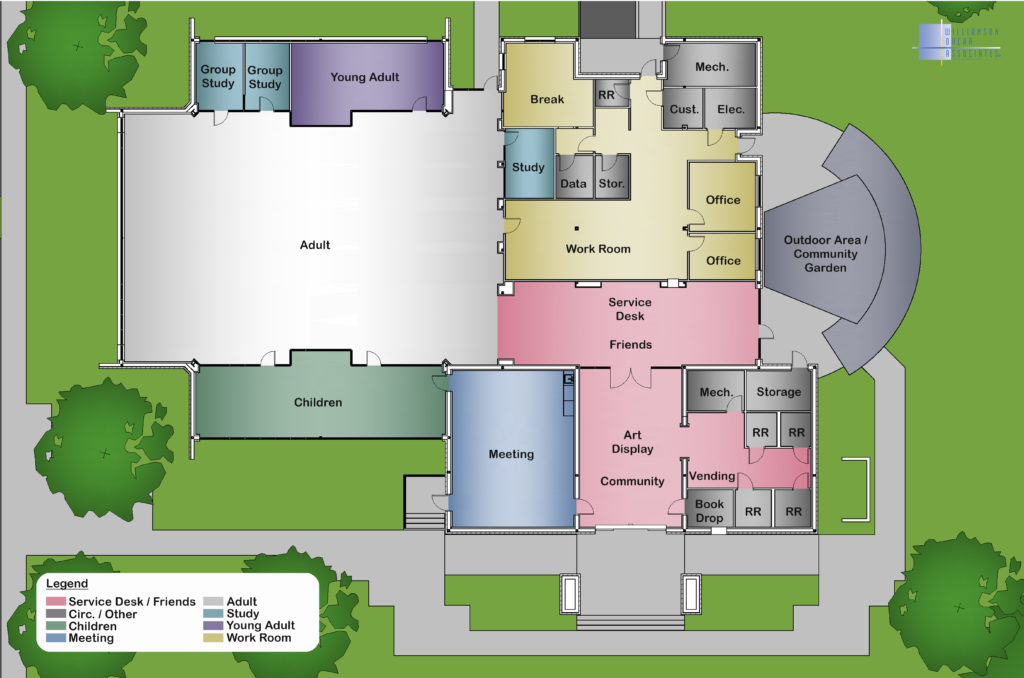
The children’s area will be enclosed with safety glass, so that children can make noise inside and not bother the rest of the patrons.
“Parents will be more comfortable,” says Angelo Liranzo, regional manager for Pasco Libraries. “We get a lot of requests from parents who feel embarrassed when their children make noise.”
A teen area also will be closed off with safety glass walls.
“With the glass walls, staff can see in,” he explains. “If teens are in there working on crafts or projects, we can go in there and help them, or we can bring out activities and make sure they have the books they need.”
Another big change will be to the restrooms. There will no longer be large restrooms with multiple stalls, but instead the restrooms will be for individual use and family use. This allows more accessibility for those with disabilities and helps parents who may be pushing a stroller or need to take small children to the restroom.
The library’s meeting room also will be enlarged, by about five (linear) feet, to provide more space.
A vending area also will be added to provide snacks and drinks for library patrons.
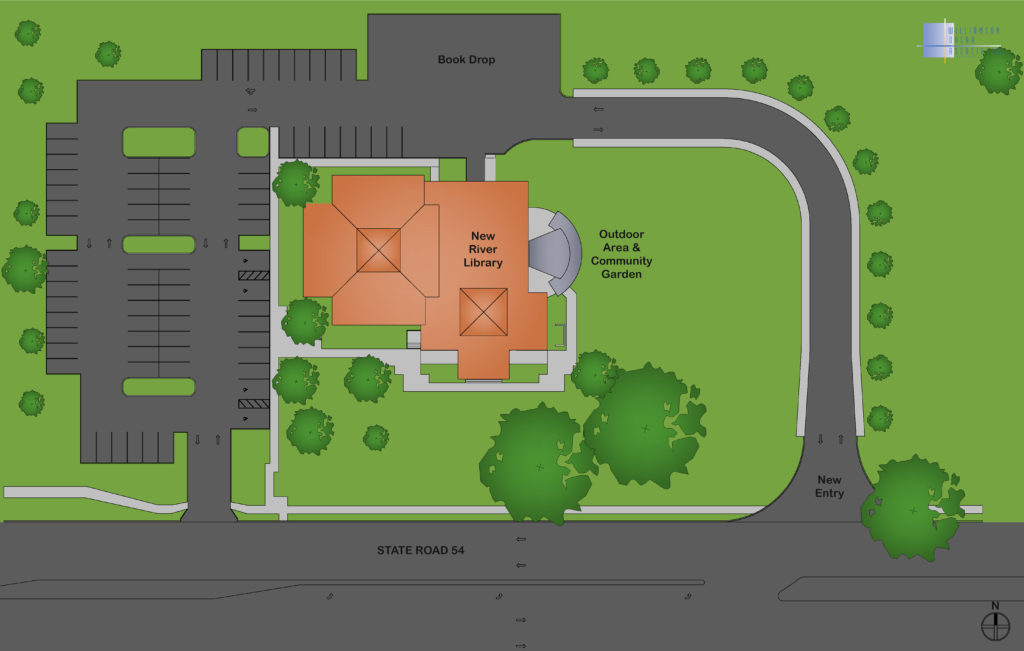
Outside, a new drive-up book drop will allow patrons to return books without getting out of their cars, a convenience for when it’s raining or when the library is closed.
The main area of the library also will be reconfigured to be more open and inviting, with new furniture that moves easily to create a more flexible and more comfortable space.
“Everything is being redesigned,” explains Liranzo. “The staff area will get a little bit smaller to make more room for the public.”
Changes Outdoors, Too
The New River Branch Library already has a community garden, where people can be assigned their own plant bed to raise vegetables, fruits or flowers. At certain times of the year, library staffers will bring out plastic “children’s beds” to fill with dirt and help the library’s youngest patrons learn how to grow their own plants, as well.
The remodel expands the library’s outdoor offerings by adding a learning space. This covered area will provide a place for any activities that are messy or difficult to do indoors, such as playing with sand or making slime, or something like shooting rockets, which can be taught on the patio and moved out from under the roof when it’s time to see the rockets in action.
Liranzo says he expects new plant beds will be added with the remodel, as well. Currently, there is one that is raised for anyone who can’t bend all the way to the ground to garden; he expects additional raised beds will be added, allowing more people the opportunity to garden at the library.
“It really is a community experience,” he explains. “People reserve the beds for as long as they want to use them. They can come anytime for their individual use, or can also come when we have an activity, such as a master gardener talking about different plants or soils.”
Because the community garden is such an important part of the library, it will be reflected indoors, as well, with a “green wall” and greenery added inside the library interior.
Programs To Go Mobile?
While the library is being remodeled, its programs will still continue.
“We’re going on the road with our programs while the branch is closed,” explains Danielle Lee, the New River branch manager.
Library staff will provide programs and services by working with community partners who are local and easy to find, to continue activities such as book clubs for adults and story times for young children and a drop-off location to return books.
“We’re not leaving the community, just because the building is closing,” says Liranzo. “We invite everybody to join us.”
Some programs are already held off-site, such as a digital book club for adults held at the Zephyrhills Brewing Co. in downtown Zephyrhills one Tuesday a month at 7 p.m.
But others, such as a ukulele jam held the first Saturday of each month, will look for a new home during the construction. Lee and Liranzo think it could be a win-win for a business to bring some new faces into its establishment and for the library to reach people who don’t typically visit the branch.
“For example, we host a “Vets Healing Vets” program, where we use crafts from Healing Vets of America to help veterans with whatever they’re dealing with and take their minds off things,” explains Lee. “We have been facilitating that in the building, and we would like to take it somewhere to reach more veterans, such as a community partner that attract veterans anyway.”
Liranzo and Lee say they are currently looking for locations to hold all the library’s programs during the construction time. If a local business is open to hosting a library program, please call the branch at (813) 788-6375 and ask for Danielle Lee.
How It’s Being Funded
The renovations have been made possible through funding approved by voters last November, through the “Go 4 Pasco” bond initiative.
“The library remodeling passed with overwhelming support,” explains Liranzo. “Now, we are set out on a mission from the taxpayers to get the remodels going.”
New River is one of the first two branches to receive improvements. The other is the Centennial Park branch in Holiday.
New River is still Wesley Chapel’s only library branch. While Liranzo says he continues to hear from more and more residents who want another Wesley Chapel location, he wants to make sure the residents understand that the planning for that second library is not part of this project.
The New River Branch Library will be closed beginning on October 1 and should reopen in May, of 2020.
“This is a major, major remodeling,” says Liranzo.