Eight Turn Crêpe Brings Unique Japanese Street Food To Wesley Chapel

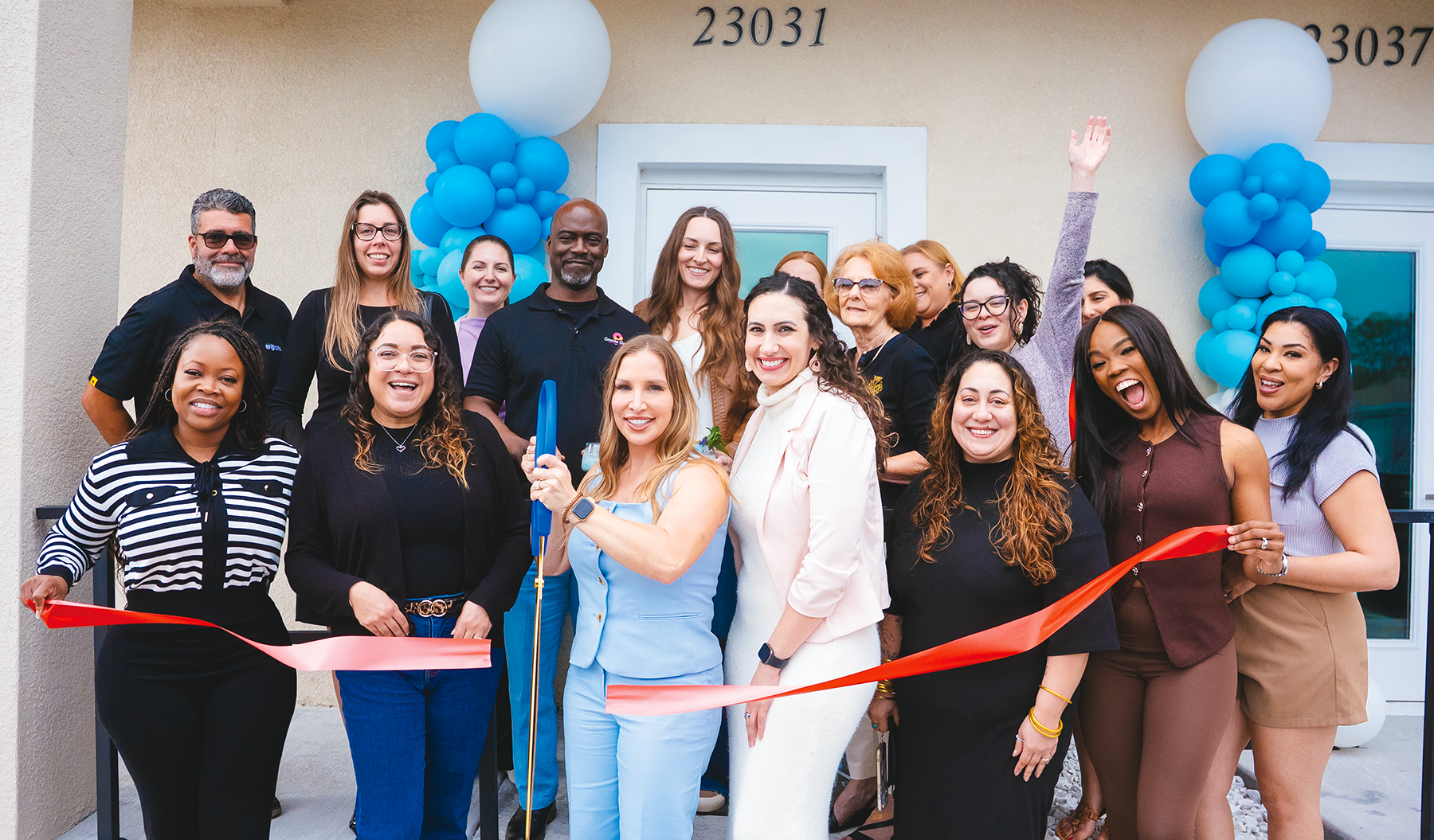
If you’ve been wanting to try something truly different from the norm in our area — whether you want a delicious hand-held savory crêpe filled with crispy pork belly, chicken teriyaki or even smoked salmon and cream cheese, or a sumptuous dessert crêpe with Dubai chocolate or lychee, raspberry and almonds, you probably should go check out the new Eight Turn Crêpe, which celebrated its Grand Opening (photo above) at 2653 Bruce B. Downs (BBD) Blvd., Suite 116, on Jan. 31. 

This location was previously occupied by 35 Below ice cream, in the same plaza as Dickey’s BBQ, Umu Japanese & Thai and Sorbo coffee — which is interesting because Eight Turn Crêpe is an homage to Japanese street food, but offers items that are completely different from anything served at either Umu or Sorbo. 

Let’s start with the company itself, which began with a single location in New York City’s Soho district in 2013 and is now up to about a dozen locations in New York, California, Texas, Idaho, Washington state and Virginia. The BBD location is the first to open in Florida and the chain’s VP of franchising Steve Kogan was on hand (left in top photo) for the opening of franchise owner Lien Nguyen’s (center in same photo) Wesley Chapel location. 


The former ice cream shop is small but attractive, with only a few tables inside and a few more outside, but the stars of the show are the super-tasty, naturally gluten-free, rice flour crêpes themselves. You can order them in either the classic Japanese cone shape (right photo above) or rolled and sliced sushi-style, like the crispy Tokyo pork belly crêpe Charmaine and I shared (left) — an amazing mix of flavors, with kimchi, avocado, lettuce, crispy shallots, sesame seeds and Japanese mayo. 

In addition to the options I mentioned above, there’s also Thai chicken, bacon, egg & cheese and Philly cheesesteak savory options and all of the sweet crêpes are layered with different flavors of custard cream — and most of them are stuffed with fresh fruits, including strawberries, bananas, raspberries, blueberries, mango and lychee, with pistachios, almonds, walnuts, peanuts, hazelnuts, crunchy flakes, granola and more. 

I incorrectly assumed that the sweet crêpes also would include gelato, but even though only two of the sweet crêpes on the menu include a scoop of vanilla gelato, there are a number of other gelato flavors you can add to any sweet crêpe on the menu. Best of all, you also can design your own sweet or savory crêpe, using any of the aforementioned ingredients. 

Eight Turn Crêpe also has a large variety of bubble and fresh fruit teas, “super food” smoothies and creamy Japanese milk shakes. Charmaine and I loved the cherry blossom milkshake we shared — it was bursting with real cherry flavor. 

I’m hoping our readers will find and frequent Eight Turn Crêpe. It’s truly different from anything else in our area — and totally tasty. 

For info, call (813) 867-6413 or visit EightTurnCrepe.com. — GN, all photos by Charmaine George 

Mater Academy — The (Charter) School You (Probably) Didn’t Know You Were Getting!

If you happened to be driving down County Line Rd. a few weeks ago, just past Grand Hampton, you might have done a double take. We sure did. There, seemingly out of nowhere, was a brand-new traffic signal (photo below) going in at Dunham Station Dr. Curious enough on its own — but what really caught our attention was why it was being installed…especially since it didn’t appear anywhere on Pasco County’s latest comprehensive transportation projects map. 

As it turns out, the signal isn’t random at all. It’s there to serve a huge, previously-under-the-radar K-12 public charter school quietly rising (top photo) at the south end of Wesley Chapel, about a mile west of Northwood. 

And when we say “quietly,” we actually mean very quietly. 

The school is called Mater Academy at Northwood, a tuition-free K-12 public charter school slated to open in August 2026. Until recently, most residents — including us — had no idea it was coming. Its Facebook page has had just nine followers since November, and there’s been almost no public chatter about it online. 

Honestly, if it weren’t for that new traffic signal on County Line Rd., we might not have even known about the Mater Academy until it opened its doors. 

The site is impressively hidden. When we drove back there out of sheer curiosity (and, of course, our ongoing commitment to nosy neighborhood journalism), we fully expected to find yet another three-story, climate-controlled self-storage facility being built. 

Instead? Thankfully…a school. In Wesley Chapel. Actual, real-deal education infrastructure. 

Though to be fair, that spot would have been the perfect place for self-storage. No one would have ever seen it back there. 

Mater Academy at Northwood is being built on a 15-acre site at the northern end of Dunham Station Dr., tucked behind the Woodside Trace townhomes, just north of County Line Rd. It’s barely visible from the main road. 

That detail matters, because Dunham Station Dr. also serves as the second, residents-only entrance and exit for Grand Hampton. This means many Grand Hampton residents are probably thrilled about the new signal — especially since it’s just 0.3 miles west of Grand Hampton’s main entrance signal, which only first went live in July 2024. 

Yes, two signals. Less than a third of a mile apart. On already-packed County Line Rd. 

If this sounds familiar, it should. This story is very much a sequel to our 2024 “Cheers & Jeers” story about the new Grand Hampton entrance traffic signal. Back then, residents were split — some cheering a long-overdue safety improvement, others grumbling about backups and timing issues. 

That article also pointed out what long-time locals already know: Two-lane County Line Rd. may still feel rural, but it hasn’t been truly rural for a long time. With growing neighborhoods, schools, townhomes and commercial development, traffic volumes — and turning movement times — have steadily increased. 

The new Dunham Station Dr. signal continues that trend. And unlike the Grand Hampton signal, this one comes with a new westbound right turn lane (from the Pasco side) and full pedestrian crosswalks, clearly designed to manage the traffic that a large school inevitably brings. 

But, will County Line Rd. ever get proper, full- length arterial sidewalks? That’s still to be determined— maybe when (or if) it ever gets widened to four lanes. But, with the North Tampa Christian Academy and a brand new Primrose School (as we reported last issue) already adding traffic on this two-lane roadway, there’s no doubt that another 700-2,500 students is not going to make traveling on County Line Rd. any easier. 

Big. Like, really big. (See rendering right) 

According to construction plans dated September 2025, the school will be built in seven total phases: 

• Phase 1 includes a 3-story, 38,000-sq-ft classroom building at the entrance, currently under construction 

• Phases 2-4 will add three more 3-story standalone classroom buildings and a gym, bringing the total to five buildings and 139,000 sq. ft. overall 

• Phase 5 adds outdoor basketball courts and playgrounds 

• Phase 6 adds a full-size sports field and an additional baseball diamond 

• Phase 7 includes the 12,000-sq-ft, one-story gymnasium at the rear of the site 

In total, the school is planned to serve up to a maximum of 2,500 students — 1,200 elementary, 600 middle and 700 high school. 

Each student body will have 30-minute staggered start and end times. Current plans show: 

• Elementary starting first at 7:30 a.m. 

• High school ending last at 3:30 p.m. 

Those details will likely evolve as construction progresses and subsequent phases get built-out. 

The site includes 269 parking spaces and a three-lane-wide car drop-off and pick-up loop for most of the property, narrowing to two lanes at the end. If it operates like other charter schools, don’t be surprised if that triple-wide drop-off doubles as overflow parking during events. 

It’s still unclear how many students will be accommodated in Phase 1 — although the building’s size indicates a likely maximum of 700 students in that Phase 1 building. 

We also couldn’t reach anyone who could tell us whether or not all grade levels will open immediately. However, the school’s online “Student Interest Form” already lists all grades as options in the pull-down menu. 

Mater Academy is a Miami-based charter school network that, according to its website — MaterAcademy.org — serves 29,000+ students in 44 charter schools in Florida, Nevada and Ohio. The company’s mission statement reads: 

“Mater provides a safe learning environment where academics are facilitated by teachers, administrators, parents and the community which enables students to become confident, self-directed learners in a technologically-rich, college preparatory environment through rigor, relevance and relationships.” 

So yes — the new traffic signal on County Line Rd. is about traffic. But, it’s also the first visible sign of a major new educational development quietly taking shape just out of sight in Wesley Chapel. 

Motorists should also expect another new signal to start taking shape soon— two miles to the west at Cypress Creek Rd., as this one is shown in the county’s work plan for 2026. 

So, between these new signals, growing communities, and now a massive K-12 charter campus, one thing is clear: County Line Rd. is continuing its slow transformation from “sleepy connector” to full-blown growth corridor. 

And apparently, sometimes the traffic light really is the source of the news. 

Parents interested in learning more about the new Mater Academy can find some information, as well as the “Student Interest Form” at MaterNorthwood.org. We did not know at our press time about any application deadline for the 2026-27 school year.

Talking Impact Fees With New North Tampa Bay Chamber Chair Tony Benge

NTBC Board chair Tony Benge

The first time I ever met new North Tampa Bay Chamber (NTBC) Board chair Tony Benge was at the NTBC’s annual meeting back in December, when he was sworn in with the rest of the NTBC’s 2026 Board of Directors and we were introduced to each other by NTBC president and CEO Hope Kennedy. 

At that time, Mr. Benge and I agreed that we should sit down to discuss his vision for his tenure as the new Chamber Board chair, as well as his primary role as the president of Benge Development Corp., which has been based in Orlando since 1994, but also has one current development project in Pasco County and recently had its original Pasco development plan denied by the Board of County Commissioners. 

Although neither of those projects is located in Wesley Chapel, the denied “Fletcher Project” (more on that below) was located at the intersection of S.R. 52 and U.S. Hwy. 41 in Land O’Lakes, immediately adjacent to the Moffitt Speros campus we told you about last issue. 

The other project, called the Hawes MPUD, which is moving forward, sits north of Wesley Chapel and east of the Mirada development. both north and south of S.R. 52, east of Handcart Rd. in San Antonio, and is approved for up to 523 multi-family units (see map below). 

His Benge Development Corp. has developed more than 30 large-scale projects, mainly in Orlando and Apopka, FL. 

Benge, who introduced Florida’s Lieutenant Governor Jay Collins at the NTBC Business Breakfast on Feb. 3 (see story on page 8), also asked Lt. Gov. Collins about mobility and school impact fees, subjects Benge knows a lot about because his company has to pay them every time he develops a new project. 

“Impact fees have started to cripple a lot of the [development] industry,” he said to Collins. “For a typical residential unit, as an average, $30,000 per unit is now being levied. When they were originally passed, [these fees] were specifically to be limited to incremental new capacity for things like schools, roads, sewer and water treatment plants. But, we’ve paid into this now for a decade and there’s been no accountability. You can’t get any information from these counties, which seize the money, in essence. And yet, they have no new schools or anything else to point to. How do we get accountability for this?” 

Collins responded, “It’s got to be statewide legislation. It can’t be executive action. It has to go through the legislature and it’s got to be codified into law. There has to be some form of accountability in that system.” 

He added, however, “But, valid impact fees? I think we all agree that valid is a good word. We can do that, but the accountability has to be there. I don’t think DOGE ( (the Dept. of Government Efficiency) is something we should just do once and walk away from. I think sustained accountability and predictability for our people matters. We’re going to have to implement that.” 

State Senator Danny Burgess, of course, presented a different solution when he was the guest speaker at an NTBC “Coffee & Connections” event two years ago, before DOGE even existed, saying that he wanted to see an audit of every county regarding impact fees. 

Benge agreed that an audit showing how much impact fee money has been collected and what that money was spent on would be a good way to hold counties accountable for the impact fees they collect. 

He says that although Pasco’s impact fees are among the highest in the state, “Osceola County’s are actually the highest. They’ve really become insane, literally. The night [Osceola] did the most recent increase, there were probably 20 developers in the audience, representing hundreds of millions of dollars in projects. I told them, ‘If you pass this, just throw our application in the trash.” 

He added that for a typical 300-unit apartment complex, the developer has to pay $9 million in impact fees to get a building permit. 

“I mean, we’re already building all of the roads, improvements… we’re having to do turn lanes, traffic signals, water, sewer, bus stops, all of that. And we still have to pay regular taxes and everything else.” 

Benge also told me that impact fees first started back in 2000, with something called the “Martinez Doctrine,” which was named after former Orange County Chair and U.S. Sen. Mel Martinez, who served as Secretary of Housing & Urban Development under U.S. President George W. Bush. The Martinez Doctrine attempted to limit school overcrowding by requiring local developers to address school capacity issues before breaking ground. 

“The idea was that growth should have to pay for itself, which makes sense,” Benge said, “But the trade-off was supposed to be that we will always have utilities and roads and services available to go along with this. 

“So when these impact fees first started, I don’t know who came up with the numbers, but they’re so abominably disproportionate. We’ve actually tracked some of the apartment communities, which might have kids in only 20% of the complex’s units. So, on 300 units, I’d have maybe 60 units that have kids, I paid $6 million in impact fees for the construction of new schools, which is basically 1/3 of a whole [700-student) schoolhouse for 60 kids. And, I’m still paying taxes every year, too. These fees were supposed to only be used for new school construction, but they never gave me any data.” 

Benge also said he decided to go about it a different way. “Let’s just track how many homes and apartments were built from, let’s say, 2015 through 2025. So, I made up a number, let’s say 100,000 units were built. Each one paid $14,000 per unit. Where’s that $1.4 billion? Or, list me out the new schools that’ve been built with that money, with the budget you spent on each one. 

“A K-8 school right now costs $18-$20 million, a high school is upwards of $50 million, and that would house, in Orange County, up to 5,000 students. By our estimation, there should have been around 84 new schools built during that time — and they only have three. 

“So, where’s all that money? [Counties aren’t] allowed to use it for [their] general funds. You can’t use it to pay more administrators. This money should be segregated out and if it’s not, this is a big issue.” 

He added that many of the assumptions used by counties to set their school impact fees, “are horribly flawed. If I build a 300-unit apartment complex and a third of those units are one-bedroom units, how many kids live in one-bedroom apartments? Historical precedence says that only unless someone is building a house that isn’t ready yet, one-bedroom units don’t generate any kids, yet I still have to pay the same school impact fees for those units. It’s crazy.” 

Speaking of crazy, Benge said that his Fletcher Project — named for the family that owned the 100-acre property — was originally planned in Aug. 2024 for 350 multi-family units, about 160 townhomes and 25,000 sq. ft. of commercial uses and had been through more than a year of meetings and plans when Pasco’s commissioners voted last year to deny it. 

“The big pushback was the private, never-permitted airstrip from the 1950s next door, which would have prevented us from building anything on 1/3 of the property. We agreed to not build on that portion, but we asked to have the same density on the rest of the property. So, we wouldn’t build as [many total units], and they turned us down. We started with Plan A and were up to Plan Q, and they still turned us down.” 

Despite that setback in Pasco, Benge Development is moving forward with its plan for the Hawes MPUD (marked in red on map below). The project will extend Handcart Rd. to the north, with 396 multi-family units on the south side and 127 townhomes on the north side and some neighborhood commercial (grocery store, etc.) entitlements. The Hawes project was approved in 2023, but Benge has not yet begun building at that site. 

Benge also is building Jonathan’s Landing, the first adult autistic facility in the U.S., in Lake Nona, FL. “It will have 5,000 beds and bring 5,000 jobs to that area,” Benge said. “My friend, Jason Eichenholz, has a son named Jonathan who is an adult with autism. This will help so many adults because state support for [developmentally disabled] people ends at age 18.” 

Look for more info about Tony Benge and his vision for the NTBC in our next issue. 

Bahama Breeze Also Going To Close

All of the remaining links in the Bahama Breeze Island Grille chain are either completely shutting down or will be converted to other Darden Restaurants brands — including the Bahama Breeze located at 25830 Sierra Center Blvd. (across S.R. 56 from the Tampa Premium Outlets) (photo). 

All 28 remaining Bahama Breeze locations across the U.S. are closing, according to a Feb. 3 Darden news release, after previously shuttering a third of its locations in 2025. 

As mentioned above, half of those remaining Bahama Breeze locations — including the one in Lutz/Wesley Chapel — will be converted to other Darden eateries (see below), although it was not disclosed in the press release which locations would be converted into which brands. 

The other 14 Bahama Breezes will close permanently on April 5. The 14 that are remaining open — including ten of the 14 in Florida, where the brand first opened in the 1990s — will remain open for the next 12-18 months, although there will likely be some temporary closures along the way, as needed for the locations to be converted. 

The list of the Darden brands still operating include a number of more upscale eateries that many locals — after first reading about this news on social media — are hopeful will find a home at the location on S.R. 56. 

Here is that list of possible Darden brands that our Bahama Breeze could become: 

• Eddie V’s Prime Seafood 

• Ruth’s Chris Steak House 

• The Capital Grille 

• Seasons 52 

• Yard House 

• Olive Garden Italian Kitchen 

• Cheddar’s Scratch Kitchen 

• Longhorn Steakhouse 

• Chuy’s 

Of course, Cheddars, Longhorn and Chuy’s all already have locations on S.R. 56 and a previously undeveloped parcel on Wesley Chapel Blvd. to the east of Chick’n Fun is now under construction and may include Olive Garden, although we were unable to get official confirmation as to whether or not Olive Garden is still coming to 27391 Centerline Dr., just west of Gateway Blvd. — the plans for which were apparently submitted way back in Aug. 2025 — or whether that location would preclude another Olive Garden being opened in the former Bahama Breeze spot. 

Obviously, the first four or five (as most people would probably also be OK with Yard House) Darden brands on the list would be the most desirable to locals, but we will keep you posted on any such announcements. — GN 

Señor Tequila Keeps Upgrading Its Authentic Mexican Menu!

If it’s been a while since you last ate at Señor Tequila, located on Bruce B. Downs (BBD) Blvd., in the Shoppes at New Tampa of Wesley Chapel plaza just south of S.R. 56, I suggest you try it again. 

When I told assistant manager Samantha Lopez that Jannah and I noticed a definite increase in quality the last couple of times we ate at Señor Tequila, Samantha said, “The owner, Alvaro Mellado, brought in a new general manager, Norma Mellado (yes, they’re related) and a new chef and they have been working on the quality.” 

It shows. Although I’ve never eaten at any of the other Señor Tequila locations (in Westchase, on N. Dale Mabry Hwy. in Carrollwood and in Winter Springs), I have been sampling the Wesley Chapel location since it first opened in 2021 and everything — from existing items like the sizzling chicken fajitas (top photo) and molcajete (left) to new menu additions, like the esquites (spicy, creamy, “street” corn off the cob, below right), tostones Mexicanos (bottom right), birria tacos (below left) and the Señor Tequila’s Favorite skirt steak (bottom right) — are all quality. 

Samantha says the fajitas are still Señor Tequila’s top-sellers. Jannah and I often do a steak and chicken Fajitas Mexicanas combo (there’s also a Texas Fajitas combo with beef, chicken and shrimp), but since we were sampling some other beef dishes, we opted for all chicken this time. The chicken came out tasty and tender and the sizzling onions, bell peppers and tomatoes were all spot-on. 

Samantha says she prefers the new esquites to the restaurant’s still-available street corn on the cob — and we agreed the large order of it was delicious, with mayo, cotija cheese, lime, tajin and cilantro. 

Although I can’t eat shrimp, Charmaine said the tostones with ceviche-style shrimp, topped with pico de gallo, queso fresco, homemade chipotle sauce and guacamole may have been her favorite dish of the day. 

And, although we all found the molcajete — another popular sizzling dish served in a lava rock bowl “heaped with beef strips, chicken, pork, chorizo sausage and shrimp (which we had them serve on the side for Charmaine) and topped with cheese, grilled cactus, avocado, peppers and onions — was too many different flavors in one dish for our taste, Samantha says that traditional Mexican lovers say it’s among their favorites. Like the fajitas, the molcajete is served with rice, creamy refried beans, lettuce, guacamole, pico de gallo, sour cream and flour tortillas — so it’s more than a meal just by itself. 

Jannah’s favorite new dish was the trio of birria tacos, which feature tender shredded beef, onions and cilantro in obviously homemade corn tortillas shells and served with a savory beef broth consommé. 

Charmaine and I both preferred the Señor Tequila’s Favorite steak, which also was extremely tender and topped with a zesty house-made chimichurri sauce and served with a side of perfectly grilled mixed veggies and Mexican rice. 

So good! 

And of course, Señor Tequila also has a popular queso dip, fresh guacamole (not made tableside), a sampler appetizer with beef nachos, chicken quesadilla, chicken flautas and stuffed jalapeños, plus favorites like burritos, chimichangas, chiles rellenos and enchiladas, as well as steak Monterrey (served with a poblano pepper stuffed with shrimp, peppers, onions and mushroom, topped with a creamy habanero pesto sauce), chicken & steak brochetas and much more. 

If you check out the ad below, you’ll see that Señor Tequila offers a number of different drink specials, including Margarita Tuesday, when regular 16-oz. house margaritas cost only $5, Thirsty Thursday, when a 28-oz. sangria or sangrita (which has a bottom layer of frozen lime margarita topped with a layer of homemade sangria) for only $9. There’s also a great Happy Hour every Monday-Friday, 3 p.m.-6 p.m., with draft beers, house wines and house margaritas all 2-for-1. 

In the photo above, the 16-oz. house margarita is on the left, the 28-oz. sangrita is in the middle and the rosarita, with Three Olives rosé vodka, instead of tequila) is on the right. Jannah also sampled a “skinny” margarita, which may have been her favorite of all the drinks. 

Señor Tequila also has a huge assortment of upscale tequilas, mezcals, Mexican and domestic beers on draught and in bottles, and a gorgeous, full premium liquor bar. 

And yes, there’s also a $10.99 kids menu, with everything from one cheese quesadilla, taco, burrito or enchilada (with rice or rice and beans), or chicken fingers or a cheeseburger (with French fries). All kids’ menu items also include a soft drink. 

Señor Tequila is located at 1640 Bruce B. Downs Blvd. It is open Mon.-Thur., 11 a.m.-10 p.m., 11 a.m.-11 p.m. on Fri. & Sat. & 11 a.m.-9 p.m. on Sun. For more info, call (813) 428-5411, visit TheSenorTequila.com