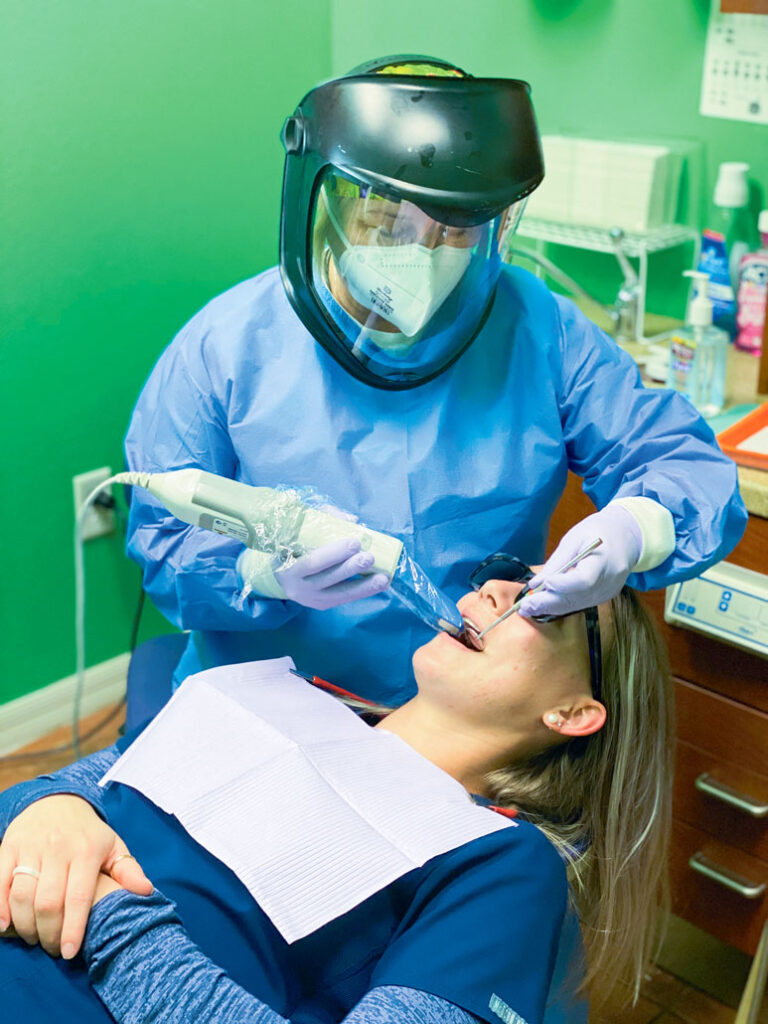
Covid Changes Plans For the Better at Pediatric Dentistry

Although she specializes in children ages 1-18, Dr. Marta has been known to help out an adult patient here and there, too.

Pediatric Dentistry of New Tampa has been in its Tampa Palms Professional Center location since 2008. Over the years, pediatric dentist Marta Rivera, D.M.D., has seen thousands of patients. But, like all of us, she says she has never seen a time like the one we are currently experiencing.

When the world went into quarantine due to Covid-19 last March, Dr. Marta (as her young patients call her) and her staff needed to adjust. Because they were deemed an essential business, the practice could stay open but only for emergency and urgent services. They were only open a few hours per day to service the patients most in need. 

That’s how it was from March until May, when restrictions on medical offices in Florida were lifted. Prior to May, Dr. Marta says the pandemic allowed the staff to prepare the office for a post-Covid world. The whole place was sanitized. Fans and ionizers were installed to purify the air. 

The layout also was changed, so that there was only one entrance door and one exit door. Arrows on the floor made sure patients weren’t running into each other. Exam rooms are cleaned thoroughly after each procedure. And, of course, all of the staff members and patients have been required to wear masks.

“People feel safer,’’ Dr. Marta says. “There were a lot of changes but we got through it. Everybody has been safe, thank goodness. Now we are waiting for everyone (staff and some patients and their parents) to get the (Covid) vaccines. We are going to continue to wear masks and probably will for a couple of years. We deal with children and children can’t get vaccinated. We have to continue with the mask mandate. We are a medical facility.’’

Dr. Marta has been practicing dentistry since 1988. She is a native of Brooklyn, NY, but moved to Puerto Rico with her family when she was 10 years old. She graduated from the University of Puerto Rico in San Juan with a Bachelor of Science degree in Biology and then earned her D.M.D. degree from the university’s School of Dental Medicine.

Dr. Marta had her own dentistry practice for seven years in Puerto Rico. She moved to Florida in 1997 and, after passing the Florida Dental Board, worked in dental offices in Lakeland and Plant City before opening her own practice in Hunter’s Green in 2003. Five years later, she moved to her current location. 

“It’s a developing area, it’s the suburbs, lots of families and their children are here and I love the area,’’ she says. 

While Dr. Marta almost exclusively works on children ages 1-18, she says that she does have a few patients in their early 20s. However, the practice is very much catered to children. Dr. Marta calls them the “stars of the show.’’ 

Getting Down To Basics

One of the cool amenities at Pediatric Dentistry of New Tampa is that there are televisions in the ceilings of the exam/treatment rooms so kids can watch TV while they are in the dental chairs, which cuts down significantly on their nervous fidgeting.

Dr. Marta recommends a cleaning and first dental exam when children turn age one. She offers digital, low-dose X-rays, offers both sedation dentistry and conscious sedation with nitrous oxide, mercury-free restorations and custom made mouth guards and treats periodontal disease. Her cosmetic services include bleaching of teeth for teenagers.  
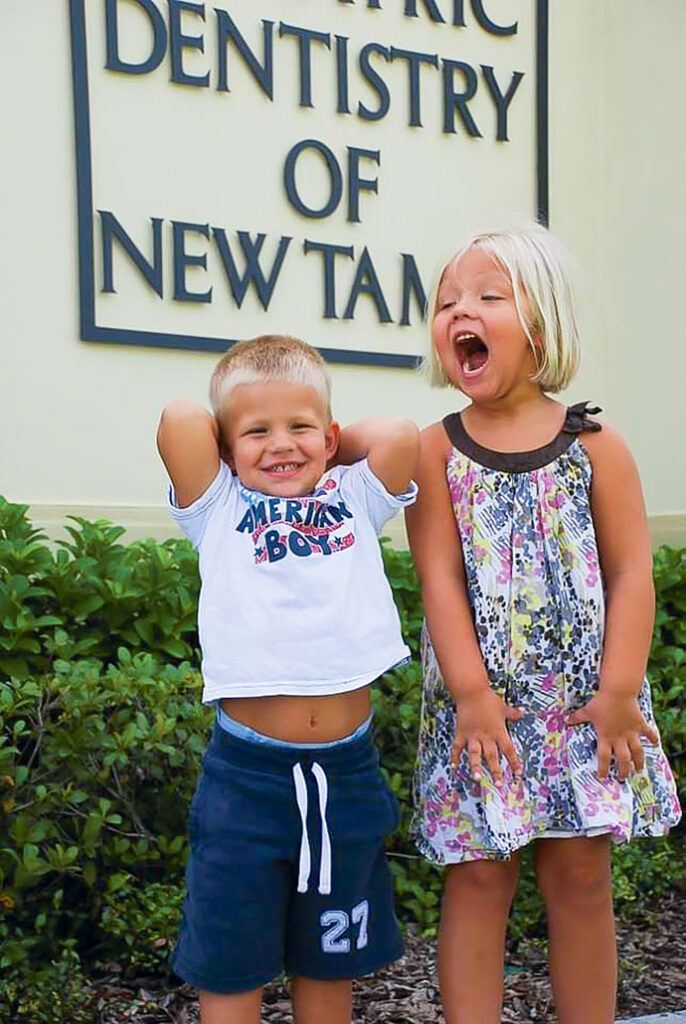
Dr. Marta Rivera continues to put happy smiles on the faces of her patients at her Pediatric Dentistry of New Tampa in Tampa Palms. (Photo courtesy of Pediatric Dentistry)

Dr. Marta says she was the first provider in Florida to offer Myobrace, a type of “myofunctional” (meaning it deals with the muscle function of the mouth) orthodontics. Myobrace is often an ideal treatment to eliminate habits such as thumb sucking or tongue thrust that cause teeth to become misaligned. With Myobrace, a child can correct those habits before beginning traditional orthodontics, or sometimes eliminate the need for traditional orthodontics altogether.

Although Dr. Marta is not an orthodontist, because she was trained in her residency to do orthodontics, it is another service available at her office — although she says she only provides it to patients she knows she can help and refers more complicated cases to orthodontic specialists.

Felix Ramirez has four children, ranging in age from four- to 14-years-old. After dissatisfaction with other dentists, it was suggested that he check out Dr. Marta. That was more than seven years ago.

His oldest child already has gone through a braces program. He expects his next two oldest children to get braces as well. Additionally, Ramirez uses Invisalign on his own teeth, also thanks to  Dr. Marta. 

“It’s really been a blessing,’’ Ramirez says. “To be able to trust a dentist fully like we trust Dr. Marta really gives you peace of mind. And, she is an amazing professional. Put it this way, my kids aren’t afraid to go to the dentist. They actually like to go. That’s saying something.’’

As an added bonus, Dr. Marta also is fluent in Spanish. 

Adapting To The Pandemic

Due to the changes brought on by Covid-19, Dr. Marta also has added tele-dentistry to her menu of options. While she obviously isn’t able to physically work on a tele-dentistry patient’s teeth, she can answer parents’ questions and look at abscesses, for example, and suggest options if those patients require further treatment.

“It was helpful in giving peace of mind to the parents,’’ Dr. Marta says. 

Once medical facilities were allowed to see more patients, she says she wasn’t sure if they would return, since Covid-19 is still a threat. She said she was surprised when the office was full again by May.

Part of the reason may be due to what she calls “Quarantine Cavities.’’ 

Dr. Marta focuses a lot of her attention on preventive care, especially when it comes to cavities. Many of those problems can come as a result of bad diets or bad habits. In this case, being stuck inside the house for a year now has contributed to both.

“There has been an uptick in cavities,’’ Dr. Marta says. “(People) are quarantined and there is eating and drinking when you are home. The snacking went up. Unfortunately, part of why we are so busy now is because of that.”

Pediatric Dentistry of New Tampa is located at 5326 Primrose Lake Cir. and is open Monday-Thursday, 8:30 a.m.-5 p.m. The office accepts many insurance policies, primarily PPOs. For additional information, call (813) 374-0388 or visit TampaHappySmiles.com.

Eye-Catching Green Lanes Providing Bike Safety On BBD

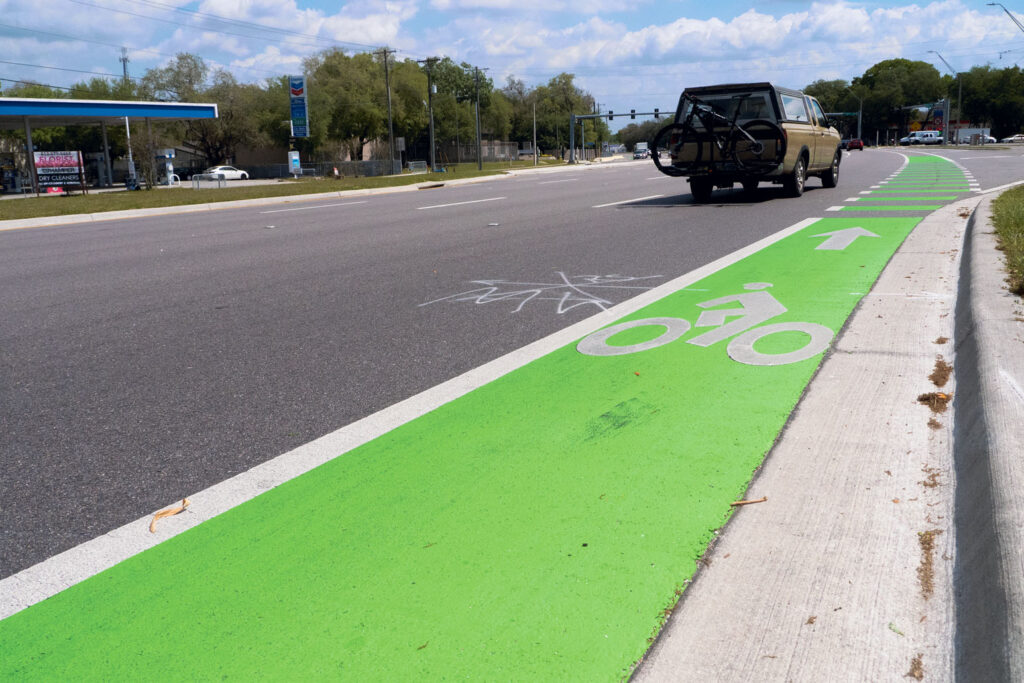
Some bicycle lanes at and near intersections on Bruce B. Downs Blvd. have been painted green to help make cycling on New Tampa’s busiest major roadway safer. (Photos: Charmaine George.)

New Tampa’s busiest road, whose most identifiable traits are usually cars and congestion, is catching some eyeballs with a new look at some of its busier intersections:

Some sections of the Bruce B. Downs (BBD) Blvd. bike lanes have been painted bright green.

The green bike lanes are noticeable at busy intersections with right turns on BBD. The bike lanes, usually marked with just a single white line, are bright green (with thermoplastic, as opposed to actual paint) as the intersections draw near, to indicate they are for bicycle use only. 

Then, the solid green transitions into dashes, indicating that vehicles can cautiously move over to make a right turn, but cyclists should still have priority. The lanes then become solid green again.

The green bike lanes are tough to miss. And, that’s the whole idea.

“It sounds like it’s doing its job getting people’s attention,” says Josh Bellotti, Hillsborough County’s director of engineering and operations. “That’s what it is supposed to be doing, alerting drivers that there is a bike lane.”

BBD is among the first county roads to get the colorful lanes, although some similar bike lanes have been in existence in downtown Tampa for a while.

Bellotti says that when all of the painting is done, 94 intersections across the county will have the green bike boxes. There will be 19 total in New Tampa, and will also include some at busy intersections on Cross Creek Blvd., where bike lanes cross right turn lanes.

“We are trying to put them in areas where, when you’re approaching an intersection, there might be some potential conflict,” Bellotti says.

But, do they work?

Well, Teagan Myhre would tell you yes.

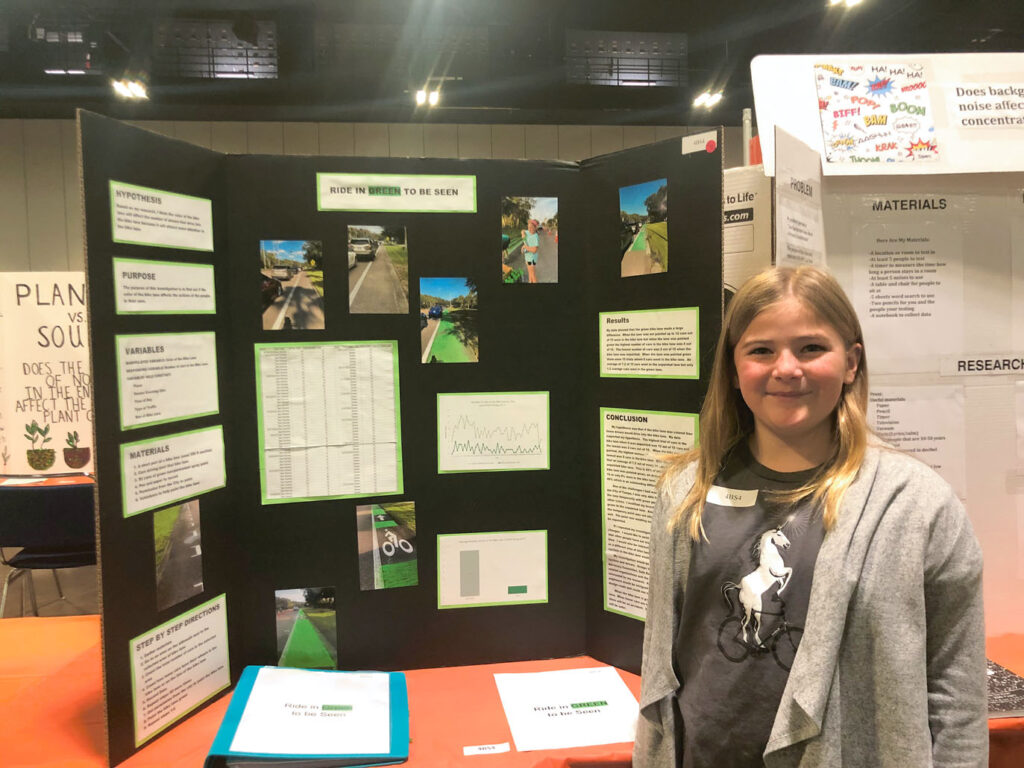
The Chiles Elementary fifth-grader did a science project last year on the effectiveness of painted bike lanes, called “Ride in Green to be Seen,” and discovered that, indeed, the green lanes do make an impact on drivers’ habits.

Teagan’s project earned the only Superior rating in the Behavioral Science category for fourth graders at the Hillsborough County STEM (Science, Technology, Engineering & Math) Fair, and was named Best of Fair for the 4th grade. The project also won a Creative Problem Solving Award, and a Science Award from the College of Behavioral & Community Sciences at USF.

Teagan, whose father Randy owns Oliver’s Cycle Sports in The Walk at Highwoods Preserve plaza and is an avid cyclist and bike safety activist, started with the hypothesis that motorists would be more likely to see the painted bike lane and give cyclists more room as a result.

So for one week, Teagan sat at the corner of Cypress Preserve Dr. and Tampa Palms Blvd. and watched cars drive by an unpainted bike lane. After 50 tests, she got permission from the City of Tampa and painted the same bike lane green (with old fashioned spray paint) and re-ran her tests.

When the lane wasn’t painted, Teagan found that 4.5 out of every 10 cars had a tire completely inside the bike line or on the white painted line.

With the green lane, that number was reduced to just 1 in 10.

Teagan Myhre won “Best of Fair” and other awards at the 2020 Hillsborough County STEM Fair for her “Ride in Green to be Seen” science project. Even though her project may not be the reason it was done, Teagan is happy that Hillsborough County has painted intersections on BBD green.

Teagan’s project gained some momentum after the annual STEM Fair, and she was even asked to come present her project to the Metropolitan Planning Organization Hillsborough County Bicycle/Pedestrian Advisory Committee — which was once chaired by Tampa Mayor Jane Castor — before Covid hit and it had to be canceled.

Teagan’s project wasn’t the reason behind the new green lanes in New Tampa, but the two ideas did seem to cross paths at the same time. Randy is happy to see the portions of painted bike lanes, and says Teagan gets a kick out of seeing them on drives along BBD. 

“She thinks it’s great,” Randy says, adding that all the feedback they have gotten has been positive.

And, some parents at Chiles admitted that they didn’t even realize there was a bike line in front of the school until it was painted green.

“That really validated Teagan’s thesis,” Randy says.

Bike safety continues to be an important issue in Tampa, and New Tampa, which has some bike-friendly areas like Flatwoods Park but isn’t generally considered to be very bike friendly overall. In recent years, Tampa-St. Petersburg has been named one of the most dangerous areas for bicyclists in the U.S. by a number of studies, including one by The Wall Street Journal.

Colored treatments on bicycle lanes have been growing in popularity the past decade all across the United States. According to the Florida Department of Transportation (FDOT), a number of studies have been conducted to determine the effectiveness of color-treated bicycle lanes in intersections and intersection-related areas, where 50%-70% of reported motor vehicle crashes with bicycles occur.

A study of the effectiveness of green lanes used in St. Petersburg, with the area observed and videotaped over multiple days, concluded that an increased percentage of motorists yielded to bicycles, and likewise, a higher percentage of bicyclists looked for vehicles and signaled their intention to turn right after the green-colored pavement had been installed. 

According to most of the studies, the changes in both motorist and cyclist behavior and increased awareness have been the primary benefits of the green lanes.

While having a protected bike lane with some kind of physical barrier is widely considered the safest, the cost makes that solution a harder sell.

But, this is a start.

“While we look for long-term safety measures, this is something we can do quicker with what we have,” Bellotti says. “This will provide some additional safety.”

Diverging Diamond Detours Upcoming

Northbound I-275 / I-75 exit to SR 56 to be closed at night

The northbound I-275 (Exit 59) and northbound I-75 (Exit 275) exit ramps to S.R. 56 may be closed from 9 p.m. to 5 a.m. Sunday through Wednesday (April 4 – 7) nights. Traffic will be detoured to I-75 Exit 279 as described below.

Detour to S.R. 56, east of I-75: Continue north past S.R. 56 and use I-75 Exit 279 to S.R. 54/CR 54. At the bottom of the ramp, turn right and go east on S.R. 54. Turn right onto S.R. 581 (Bruce B. Downs Boulevard) and go south to SR 56.

Detour to S.R. 54/S.R. 56, west of I-75: Continue north past S.R. 56 and use I-75 Exit 279 to S.R. 54/C.R. 54. At the bottom of the ramp, turn left and go southwest on Wesley Chapel Boulevard/C.R. 54 to S.R. 56 and S.R. 54.

Court Ruling Puts Kink In New Tampa Plans

Tampa City Council member Luis Viera recently hosted a Q-n-A session with transportation and engineering officials to discuss needed road improvements in Tampa Palms and other areas of New Tampa.

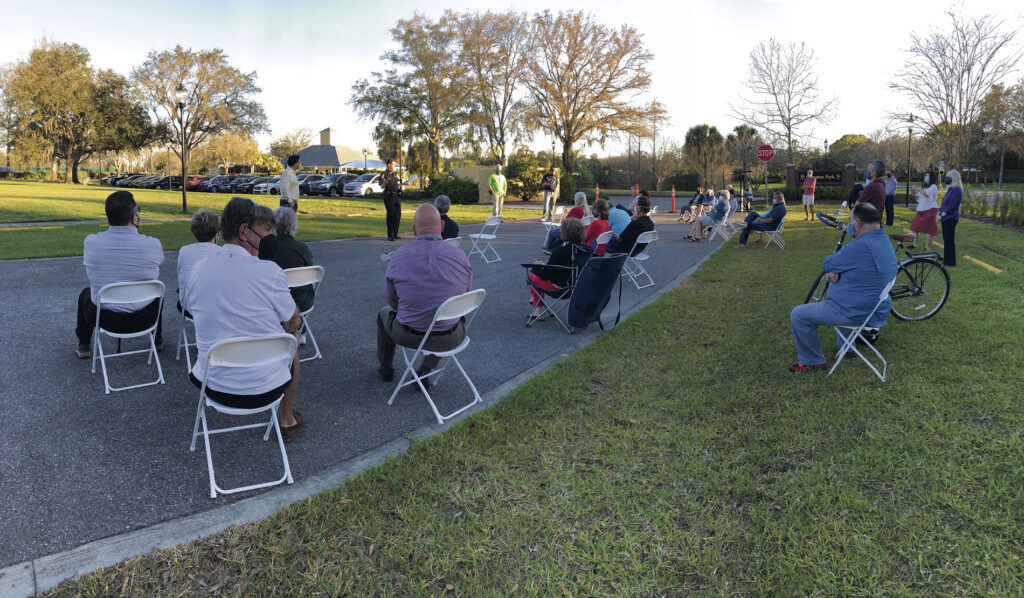
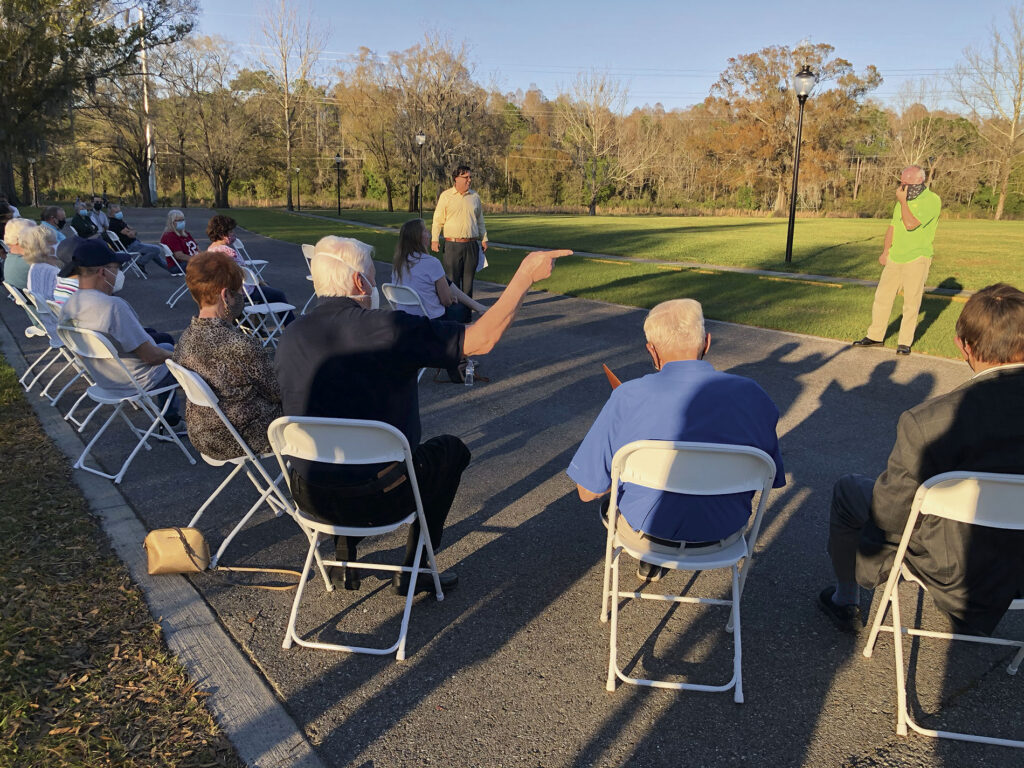
A gathering of roughly 30 mostly Tampa Palms residents showed up at Compton Park on Feb. 24 for an outdoor meeting with City of Tampa officials to discuss speeding along Tampa Palms Blvd., but the conversation turned to plans to repave the road and add some traffic-calming measures — perhaps two roundabouts or some traffic lights — with money collected from a 1-cent tax amendment passed in 2018.

Most of those in attendance seemed pleased with the plans for safety improvements for Tampa Palms Blvd.

But, before their coffee even had time to cool off the following morning, those plans had come to a screeching halt because the money to pay for them is now in limbo.

On Feb. 25, the Florida Supreme Court voted 4-1 that the 1-cent transportation tax amendment, which passed with 57% of voter support, was unconstitutional because it restricted where and how the money could be spent. District 4 Hillsborough County Commissioner Stacy White, who filed the lawsuit, argued that All For Transportation (AFT), the group that led the fight to pass the amendment, dictated how local governments could spend the money, usurping the authority of the county commission.

The transportation tax already has raised $500 million intended to fix many of Hillsborough’s transportation woes, as well as improve the City of Tampa’s bus service.

More than $50 million of that amount was earmarked for City of Tampa projects, including the Tampa Palms Blvd. improvements, as well as enhancements like the much-needed repaving of New Tampa Blvd. in West Meadows.

“The ruling is a big hit to our community,” said District 7 Tampa City Council member Luis Viera. “When it comes to the most pressing issue of traffic and congestion, we are running so far behind. This is just devastating.”

Viera says he will support putting a replacement tax on the ballot in 2022. He has also scheduled a town hall with Tampa Mayor Jane Castor for April 21 from 6-7 p.m. at the New Tampa Recreation Center, for those who want to ask what’s next for the needed roaded improvements in New Tampa.

Cal Hardie, a transportation engineer for the City of Tampa, told the Compton Park gathering that the design of the changes for Tampa Palms Blvd., which cost $600,000, was already paid for and under way. But, the actual construction, which would cost $3-$4 million and include restoration of the road’s surface from the Wellington subdivision to Bruce B. Downs Blvd., bike lanes, safer crosswalks and traffic-calming mechanisms, was reliant on the transportation tax monies.

Similar work would be completed on New Tampa Blvd. as well, perhaps at the same time, Hardie added.

Without that money, Hardie said the City of Tampa would have to look into finding federal funds, which can take longer, or multi-modal transportation impact fees, but suggested “the coffers are pretty dry.”

Hardie said the traffic calming on Tampa Palms Blvd. could come in the form of two roundabouts at the north intersection of Tampa Palms Blvd. and Compton Dr., with another roundabout another closer to Tampa Palms Elementary. 

The cost of a roundabout is roughly $450,000-$500,000, Hardie said, which is not that much more than the price tag for a traffic signal, which is around $350,000.

“A roundabout reduces accidents 60 percent more than a traffic light,” Hardie said. “It also reduced accidents 80 percent more than a stop sign.”

But, that is up to the designers and the public, who will get their say in public meetings once the plans are completed.

And by then, maybe the money to complete the construction will materialize.

Viera assured everyone at the meeting that if the Supreme Court knocked down the tax, he would pursue other funding. 

Brooke Reif Laying The Groundwork For More School Records

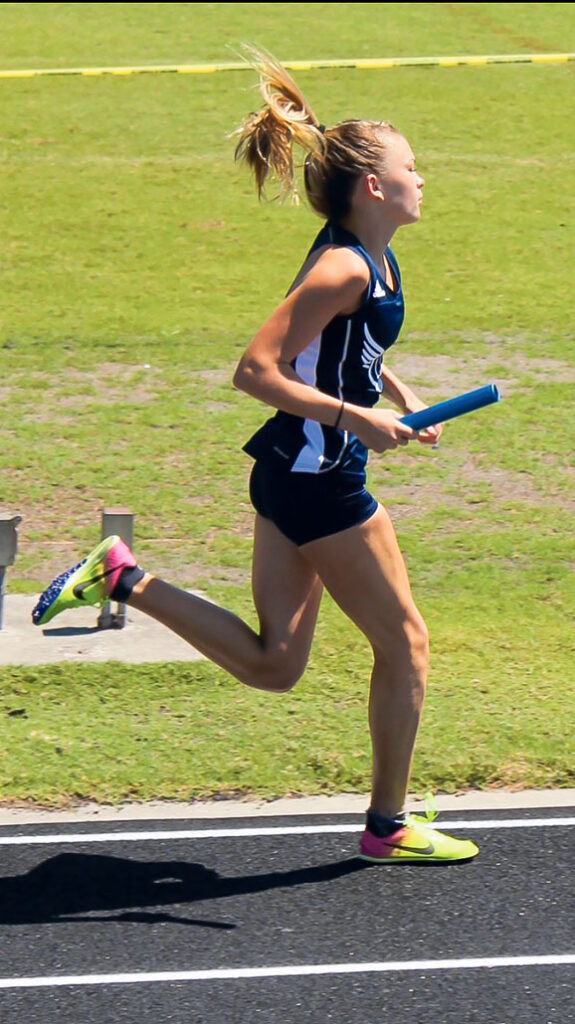
Brooke Reif has already set one Wharton High record this track season, but two others are within her reach. 

Brooke Reif is in her third year as a member of Wharton’s track & field team. During her first two seasons, she established herself as a formidable runner in the 800-meter (metric half-mile) and 1600m (metric mile) races. 

Then she decided to step out of her comfort zone.

Reif, who also runs cross country in the fall, added the 3200m (two-mile) race in a preseason meet prior to the 2021 season. She ran it in 11 minutes, 19 seconds, which was just tenths of a second better than the school record. It wasn’t official but, just a few weeks later, that changed.

At the Ram Invitational in Sarasota on Feb. 27, Reif ran the 3200m race in 11:09.82. That broke the previous Wharton record, set by Katrina Skinner in 2008, by 10 seconds. It was Reif’s first official 3200m race at Wharton, and it put her in the school’s record book. Then, on Mar. 19, she lowered that mark to 11:01.

“I thought I could maybe do it next year,’’ Reif said. “I knew I was getting closer but I didn’t think I was going to be getting that soon.’’

That’s because Reif doesn’t run the 3200m very often. In fact, she will likely run it only once or twice during the regular season and not at all in the postseason. She will focus on the 800 and 1600m races as well as the school’s 4x800m relay team. 

Adding the two-mile race this season has made Reif a better overall runner, according to Wharton track & field coach Kyle LoJacono.

“She’s not just trying to run as fast as she can and outrun people,’’ LoJacono said. “She’s racing people now. She’s following the race plan. She’s being smart. She’s using her mind as much as she’s using her physical gifts. Take the (3200m) race at the Ram Invitational. She was literally only in first place for about the last 10 meters. She was probably about 50 meters behind. But, she has a kick because she is a middle distance runner.’’

Reif had a sort of epiphany prior to her junior year. She said she found out that running is about 80% mental. She knows she has the physical talent, but that crossing the finish line ahead of everybody else takes brains as well. 

“I mostly liked the 800 when I was a freshman and a sophomore because they were two-lap races,’’ Reif said. “But, we’ve been doing a lot more miles lately and I just figured out that the 3200 is actually an easier race. You can strategize while you’re still running. It’s not something that you have to go all out in. You can plan it out as you are running and fix any mistakes you make.’’

The state record in the 3200m is 10:10.39, set earlier this month by Winter Springs junior Carolina Wells, so Reif will have to improve her personal best by more than 50 seconds to break that mark. 

For Reif, running is in the family. Both of her parents were runners in college. Her mother Dena also was an assistant track coach and cross country head coach at the University of South Florida. 

Reif said her parents never forced her into any sport, including running. But, by the time she got to middle school and tried out for cross country, she knew that’s where her talent was.

“It wasn’t something I was forced into,’’ Reif said. “By sixth grade, I joined the cross country team and went out on a time trial and finished in second behind an eighth grader. So, I knew it was something I was interested in. The reason I came to Wharton was so that I could join this team.’’

She has certainly made an impact in her time with the ‘Cats. Her sophomore track season was cut short due to Covid-19. However, she continued to train during the quarantine and stayed in shape for the cross country season. She finished 31st in the Class 4A State meet in Tallahassee with a time of 20:04.2 in the 5-kilometer (3.1 mile) race. 

With no seniors on the cross country team, it is Reif’s hope that the whole Wharton squad qualifies for the cross country state meet next season. But, for now, her focus is on qualifying in what will likely be her three events — the 800m, 1600m and 4x800m relay — for the State track & field championship meet, which will be held May 14-15. 

She also has her sights set on yet another school record, as she is just three seconds off of Skinner’s mile/1600m record of 5:00.63. 

“I’m hoping I can get that one pretty soon,’’ Reif said. “If not this year then I’ll definitely try for it next year.’’

The 800m record — which is 2:10.51, set by Bryanna Rivers in 2017 — could also be within Reif’s reach. Her best time is seven seconds off that pace, so she is shooting for it next season. 

While Reif will almost certainly qualify for the State track meet as an individual, she said it would be more special if her 4×800 relay team — which also includes sophomores Serenity Brazell and Olivia Hammill and junior Alex Frye — could join her.

While the relay team hasn’t run together this season, based on their individual times, it could be the Wildcats’ best shot at a Class 4A State championship.

That would be especially satisfying for Reif. One of her favorite things about cross country is the team atmosphere. She said that track can be a bit lonely sometimes, focusing mainly on individual races. The relay team allows her to feel like a team player.

“I like it because you get to work with your team, it’s not just you on your own,’’ she said. “You’re able to cheer on everyone else. I like when you’re running for your team.’’