Parents Have Tough School Choices To Make

Schools are not just re-opening this fall, they have to re-open.

The President tweets it; the Governor repeats it. 

With the rising and record number of positive Covid-19 cases and deaths in Florida seemingly finding no ceiling, that leaves parents with one of the toughest decisions — whether to send their children back to brick-and-mortar schools or have them learn online — many of them have ever had to make.

Jaclyn Lewis-Croswell, the parent of a fourth-grader at Turner/Bartels K-8 school, will be keeping her daughter home in the fall to learn online. It’s not ideal, she says, but for her, the risk of infection outweigh the benefits of social interaction and classroom learning.

She certainly understands anyone who chooses the opposite for their kids, sympathizing with those who trust the safety measures and some studies that say children aren’t as affected by the virus, while also worrying their children’s mental health may suffer in a detached, online setting.

But, when Jaclyn looked at the rising numbers, “I felt like there is a potential risk of losing my child,” she says. “And that’s not a chance I’m willing to take.”

If Covid-19 continues to rage at its current rate, there remains a chance that schools will not open by August or will be completely online, at least until January. But, as of now, school is moving forward with an expected start date of Aug. 24, with Hillsborough County’s schools offering three different options:

• Option A: A return to traditional, face-to-face, brick-and-mortar schooling, with special social distancing and enhanced disinfecting measures implemented, as well as requiring all students, teachers and staff to wear masks at all times.

• Option B: eLearning full-time through the students’ assigned schools. Students will participate in a distance learning program from home, taught by teachers at their school through Canvas, a new Learning Management System which will replace Edsby. Daily log-ins and attendance will be required.

• Option C: Hillsborough Virtual K-12, a web-based curriculum taught by teachers from Hillsborough County, but not the same as the eLearning program. For grades 6-12, Hillsborough Virtual K-12 and Florida Virtual School (FLVS) are the same, except Hillsborough Virtual K-12 will follow the District’s 2020-21 school calendar, meaning they have more stringent start-and-stop deadlines.

Earlier today, Hillsborough County Schools tweeted out declaration-of-intent results so far. With 115,001 responses tallied, 56,488 families have selected on-site learning, 48,410 have chosen eLearning and 10,103 have picked Hillsborough Virtual K-12.

The Neighborhood News spoke with multiple New Tampa families about their respective decisions. Here are three stories about how some of those parents made their decisions.
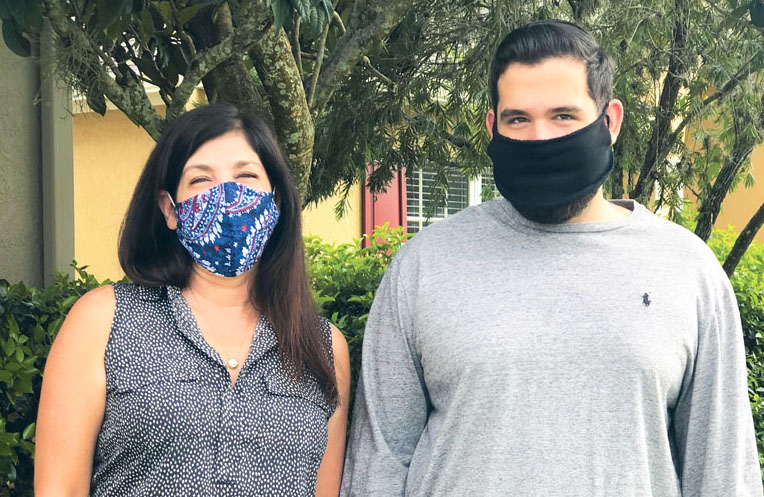
Cindy and Connor Kelly both feel the decision to stick with online learning is the safest way forward

Cindy Kelly – eLearning

When schools abruptly closed in March due to the coronavirus, teachers and students were thrown into an online system of learning that ended up receiving mixed reviews. 

While some found the spring experience underwhelming and ineffective, others, like Wharton’s Connor Kelly, thrived in that environment.

So this fall, Connor plans to spend his senior year again learning outside of the classroom as he prepares for college.

“He had no desire go back to the bricks and mortar,” his mom Cindy says. “I was kind of surprised by it myself.”

Cindy says that if Connor had expressed a desire to return to school, the coronavirus would have definitely caused her some concern. In fact, Connor says a big part of his decision stems from his own concerns about passing anything onto his parents. 

“It really does seem like people are really concerned about the virus and weighing it with the social aspect and the isolation (of online) learning,” Cindy says. “It’s a miserable, tough decision to make.”

Thankfully, Connor found the flexibility of online learning to his liking last spring, and looks forward to continuing it. He says, however, that a slight majority of friends in his social circles say they are returning to brick and mortar.

“They want to be able to have that social interaction,” he says, “although, the way it sounds, there probably won’t be too much social interacting allowed anyway.”

He regrets having to miss some, or, depending upon the virus, all of his senior year. He is serving as president of Rho Kappa, the social studies honor society, and isn’t sure he’ll get to make his induction speech, and says he also had roles in other clubs he will miss, as well as the other social benefits of his last year in high school.

“It kind of sucks,” Connor says. “I had a whole meticulous plan laid out for the last three years…I spent a lot of time designing my senior year, and then a rock was thrown through it. But that’s okay, it’s a life lesson.”
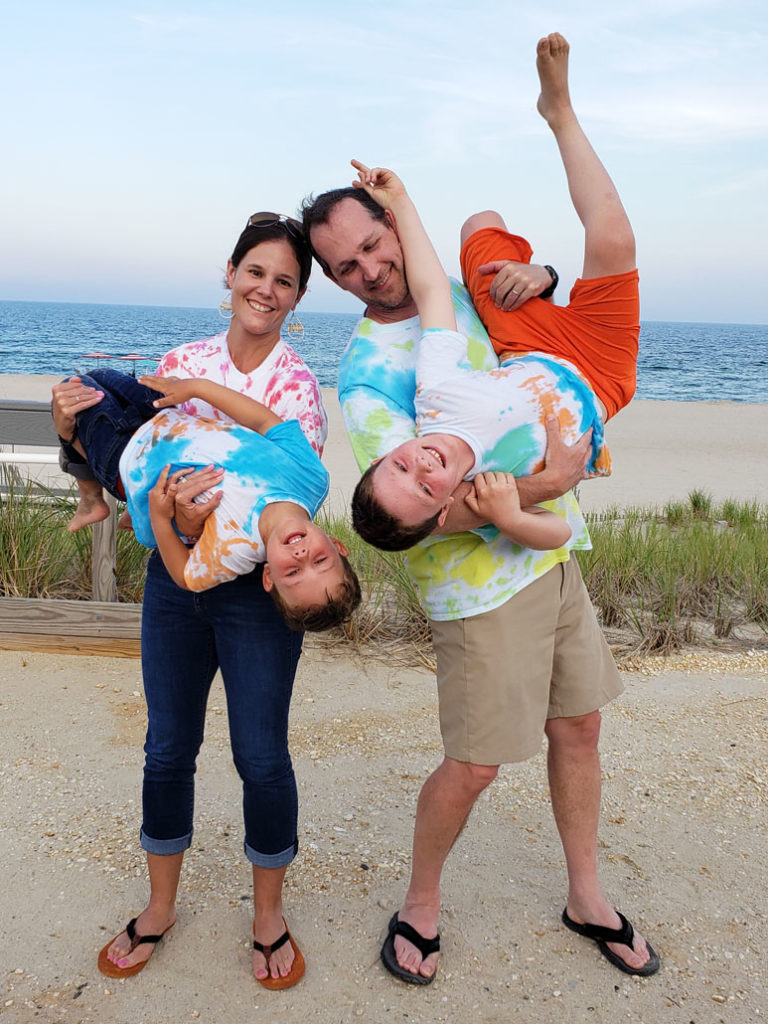
Lisa and Eric Ling, with their kids Elijah and Ethan, think its time to get kids back to school, with increased safety standards.

Lisa Ling — Traditional School

Lisa Ling is sending her kids back to school.

While the mother of a first- and fourth-grader at Hunter’s Green Elementary (HGE) understands the risks associated with the brick-and-mortar option this year, she also feels better about her decision now that masks are going to be required.

“Getting kids back to school is what needs to happen,” she says.

Ling and her husband Eric aren’t alone. A recent thread on Facebook she participated in showed more than a dozen parents who agreed with them, and she says many of her friends are following suit.

Ling says it wasn’t really that tough of a decision. “Well, I really did not consider Hillsborough Virtual K-12 or Florida Virtual, because we love our school and didn’t want to disconnect from it,” Ling says. “The (Covid) numbers are going up, but it’s a very low percentage of the population. We feel that there also is evidence coming out that young kids just don’t transmit it as much. Our whole family is healthy, no one has a compromised immune system or lives with an elderly grandparent. God forbid, if one of us gets it, we’ll be okay.”

Lisa has been a stay-at-home mom for nine years. When her children were forced to learn from home in the spring, she says she didn’t find it to be a fruitful experience.

Her third grader was fairly independent unless he would click on the wrong thing while working from his computer, and her youngest, who was in kindergarten, needed constant support. 

She didn’t find the quality of the education to be what it should either, but understands it was a difficult, thrown-together situation for everyone.

“It wasn’t the same as being at school,” she says.

Lisa will no longer be a stay-at-home mom this fall. She is returning as a school psychologist at Benito Middle and Clark Elementary schools. She says her new job did not affect her decision.

“Even if I hadn’t taken that job, I was sending them back,” she says.
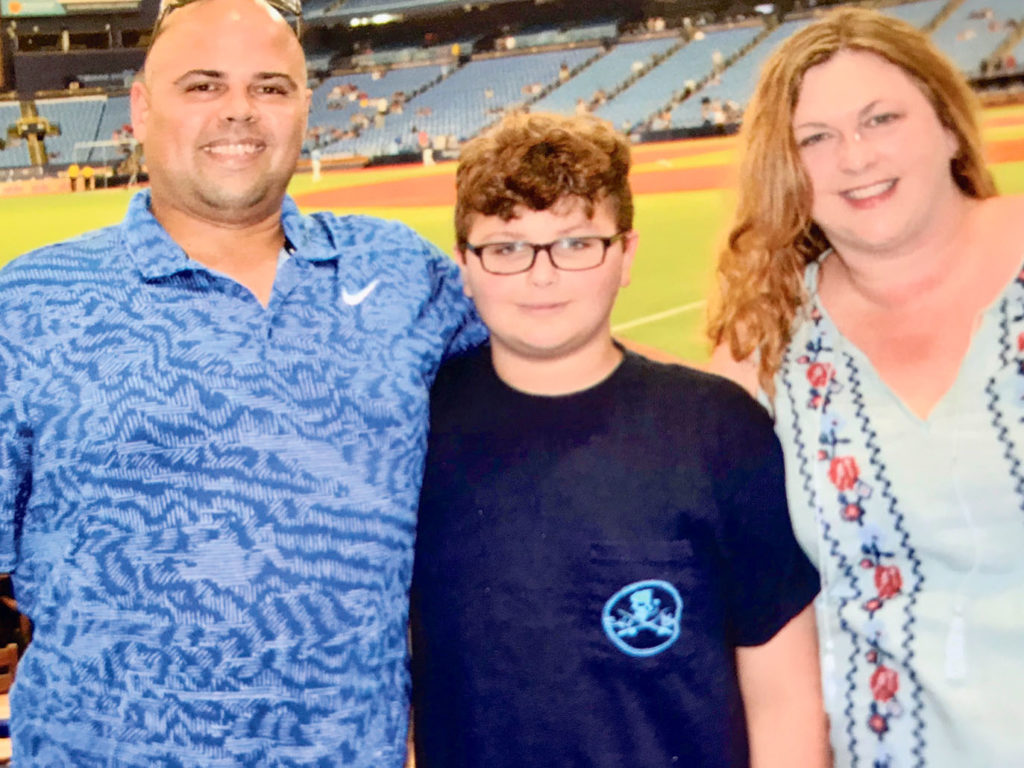
(l.-r.) Hector, Grayson and Laurie Gonzalez decided   eLearning will work best for them this fall.

Laurie Gonzalez eLearning

As a teacher, Laurie Gonzalez isn’t sure how she would keep her students safe from the spread of Covid-19, much less her son Grayson, who would be attending sixth grade at Benito Middle School on school choice this fall if she hadn’t decided to keep him home for eLearning.

“I made the choice to do eLearning for my child because I don’t think it is safe for anyone to return at this point,” says Laurie.

By choosing school-based eLearning through his assigned school, as opposed to the other online options, Grayson can keep his seat and if Covid-19 is ever brought under control, he can return after the fall semester. 

“Of course I worry about social interaction, but at what cost?,” she says. “At least today, kids have video games and phones so they can keep in contact with their friends. It isn’t the same but, for now, it will have to do.”

Laurie has read the CDC guidelines and imagines what she and her co-workers’ classrooms would look like in the Covid-19 age. She doesn’t like what she sees.

“I know first-hand that it will be impossible to follow the CDC’s guidelines to keep kids safe from Covid, especially if we reopen schools at full capacity,” she says. “There is not enough room in most classrooms to space kids 3 feet apart for testing, so 6 feet is just not going to happen.”

A mask mandate is a great decision, Laurie says, “but I don’t believe it will be enough.  As soon as we open schools, I anticipate the number of Covid cases will skyrocket.”

Laurie, who teaches at Turner/Bartels K-8 School, says she has an auto-immune disease, and is nervous about the impact Covid-19 would have on her if she were to get it.

With so many unknowns, Laurie and her husband Hector have no idea when it will be completely safe again to return to school — for her or her students. She feels fairly certain that August won’t be it.

“Yes, I am very confident that coronavirus will still be a problem in August,” she says. “We haven’t seen the numbers (of deaths) that will correlate with the 4th of July yet, but I don’t have much faith that they will be good.”

Tough Choices For Wesley Chapel Parents

School is returning this fall, one way or another, and area parents have some tough choices to make. Those decisions only get harder with each passing day.

On June 18, Pasco County schools announced that parents will have three choices when classes resume in August. The deadline to choose had been July 1, but it was extended to Wednesday, July 8, the day after this issue reached your mailbox. 

The three choices are as follows:

* A return to traditional, brick-and-mortar schooling, with special social distancing and enhanced disinfecting measures implemented, as well as mask requirements.

* Pasco eSchool, a franchise of Florida Virtual School (FLVS), which writes the courses that are taught by Pasco County teachers. Students work on assignments during non-traditional hours, with contact with teachers and classmates during web-based class sessions and other technology.

* A hybrid version of traditional & virtual school, being called “mySchool, for students not yet comfortable returning to campus, but who want to remain connected to their schools. 

Students will attend scheduled classes every day via their computers, with synchronous class meetings. Students will have access to teachers during regular school hours, and attendance is taken daily. 

As parents wrestled with these difficult decisions, the number of Florida’s positive Covid-19 tests skyrocketed, raising new concerns and doubts, resulting in the deadline extension. 

Superintendent of Schools Kurt Browning, who announced the Pasco Schools plan, revealed just a few days later that he had tested positive for Covid-19. And, the coronavirus-related death of a 17-year-old Wesley Chapel High rising junior was being investigated by the Medical Examiner’s Office.

The Neighborhood News spoke with three parents, each of whom made different choices prior to today’s deadline. Each parent we spoke with stressed that they would reassess their choice as the pandemic played out, but they were each ready to move forward with what they felt worked best for their respective families. 

The Willis family (l.-r.: Ethan, Chloe Alicia & Will) chose the “mySchool” hybrid option for their family for the 2020-21 school year. (Photos: Charmaine George)

Alicia Willis – mySchool

Alicia Willis considers herself an optimist when it comes to Covid-19. She’d like to think the virus will die out or become more manageable before schools re-open in August, or that a vaccine will be found.

But until then, she’s not quite ready to send either of her kids, a rising first grader and a rising fifth grader, back to Sand Pine Elementary.

Instead, she chose the mySchool option for her children, which will allow them to attend school remotely and still follow the standard school schedule and bell times.

Alicia also strongly considered Pasco eSchool, where students work on their own schedules with different teachers than they ones they had in traditional school.

“Going back to brick and mortar was eliminated (for us) immediately,” she said. “I do think they did a great job with the choices.”

Unlike Pasco eSchool. Alicia’s kids still will be learning along with their usual classmates and teachers.

“It was important to me that they get to have the teachers they are familiar with,” she said, adding that she thinks mySchool will make the transition back to regular school, should it come in January, much easier.

Alicia says her kids adapted well to online schooling this spring, and she didn’t mind doing the teaching. But, she also says that her kids asked often about their friends and teachers at school. 

Even before the three choices for the fall were put forward by Pasco County Schools, Alicia had decided her kids would be staying home this fall. 

And, she said, the rising number of positive Covid-19 cases in late June, just before the July 8 deadline, made her more confident in her decision.

“I believe it will make some parents think twice and possibly reevaluate their decisions,” Alicia said. “Parents going back to work may not have another choice. I’m blessed to have the choice that I have.”

Kelly McDowell, with daughters Avery (left) and Audrey (right), has chosen the traditional brick-and-mortar school option for the 2020-21 school year.

Kelly McDowell – Traditional School

Kelly McDowell started online learning at her house at 8 a.m. every day. She says her third and fifth graders were expected to be up and ready to work. It took only a few hours each day for them to complete their assignments. Sometimes, they would work a little extra so they could have Friday off. 

An accountant who is happy she is fortunate enough to have a flexible schedule, Kelly enjoyed her extra time with her kids.

But, Kelly said it could never replicate the benefits of a classroom at a brick-and-mortar school. When it came to making her choice, Kelly chose a traditional setting for her children, and plans to send them back to New River Elementary in August.

“I really feel the social aspect, and face-to-face interaction, is really valuable for them,” Kelly said. “They need structure if school is going to be beneficial (for them).”

Kelly says her job is flexible enough that she could continue to work at home. So, she did seriously consider the online options, and while she says that mySchool may not be feasible for her family, Pasco eSchool (see next column) “might still be in the back of my mind,” due to its more structured format.

But, Kelly’s kids like their mom’s choice. It was what they wanted.

“The kids were very, ‘I wanna go back to school,’” Kelly says. “I told them they would have to wear masks, be extra vigilant and worry not about just themselves, but others, too. They were very adamant about going back.”

With the potential for school openings still more than a month away, and Covid-19 unfortunately dominating the recent news headlines in the Sunshine State, Kelly says she reserves the right to change her mind. 

“If Florida becomes the new New York,” she says, “then that decision is going to change.”

When it came to deciding what to do for the 2020-21 school year, Samantha Billington (left, with daughter Alanah and son Travis), chose online options.

Samantha Billington – Pasco eSchool

Samantha Billington didn’t have just one decision to make, she had two.

Her son, 11-year-old Travis, enjoyed his online learning experience last spring when he could no longer attend Union Park Academy.

Her daughter, 15-year-old Alanah, not so much.

As a high schooler at Wesley Chapel High (WCH), Alanah was eager to get back to school to be with her friends. Initially, Samantha thought she would keep Travis home, and let her daughter return to traditional school.

But, the news on Covid-19 just got worse.

“As time went on and we not only had a rise in cases but also a tragic loss of a boy that went to the same school as (Alanah), we decided it was best to postpone the traditional school setting,” Samantha said. “My kids going to school, being in a building with thousands of people five days a week just doesn’t make me feel comfortable.”

That was “heartbreaking” for Alanah, who will do mySchool this fall, with the hopes of returning to the WCH campus in January. But, Travis will do Pasco eSchool, and Samantha said he already has decided he wants to do that for the whole school year.

“We chose FLVS (Florida Virtual School) because we wanted a wider range of options,” Samantha said. “It is all winging it at this point, and we will adjust as needed.”

 Samantha is able to work from home, so it made sense for the kids to learn at home. She is confident her children can still have normal social lives via technology and with friends in the neighborhood. 

“This virus is not going to just disappear,” Samantha said. “It will be around for a long time and until we have trusted environments, like enforced social distancing and regular sanitizing, or a medical solution, then I feel very confident it will remain an issue.”

Superintendent Browning Tests Positive For Covid-19

Kurt Browning

Pasco School Superintendent Kurt Browning has tested positive for Covid-19.

Browning notified Pasco County school employees today. He is now in isolation at home.

In a statement from Pasco County Schools, Browning has experienced relatively minor symptoms (fever, chills, general achiness) since Friday, prompting him to get tested. On Sunday, the results indicated he had tested positive.

“My symptoms are relatively minor, but I’m not taking this lightly,’’ Browning, 61, said on Monday. “I’m looking forward to get back to work full strength as soon as the medical experts say I can.”

Browning has mostly been working from home during the coronavirus crisis, but has spent some time in his office in recent weeks. However, he was informed that his interactions do not amount to close contact and do not require self isolation or testing for those he came in contact with.

Last week, Browning unveiled the plans to re-open schools in August, giving parents three choices for their children’s education this fall. The deadline to make a choice is July 1 by filling out the form HERE.

Wesley Chapel Slides Out Of The Fast Lane

Teachers and administrators hand out breakfast and lunch for the week at Quail Hollow Elementary. (Photo: Charmaine George)

For years, the Wesley Chapel story has been one of growth and expansion, where new businesses and communities popped up on what seemed like a weekly basis, where roads were crowded, schools were filled to capacity and business was booming. 

Appears to be time for a new chapter.

The next one written will be about the recovery from a deadly virus, COVID-19, that has shut almost everything across the country and the world down, stripped people of their jobs and the roads of its automobiles and people of their sense of safety and well-being.

“It came so fast,” says Pasco County commissioner Mike Moore. “These are unprecedented times and I don’t think anybody, no matter your age, unless you lived through the Great Depression, has gone through anything like this.”

On April 2, Florida Gov. Ron DeSantis, after weeks of harsh criticism for his inaction, shut the state down for 30 days with a stay-at-home order.

While essential businesses were allowed to stay open, everyone else was encouraged to stay home. Healthcare providers, grocery stores, gas stations, laundry service providers, office supply stores, the media and restaurants – take-out and delivery only – are all considered essential services.

DeSantis also included religious services at church.

When we went to press with our New Tampa issue on March 20th, the number of positive cases of coronavirus in Florida had just passed 500, and there had been 10 deaths.

Two weeks later as we wrapped up our current issue on April 3, there were 9,585 cases (including 74 in Pasco County) and 163 deaths (only two here at our press time).

While there have been glimmers of hope as the number of cases slows down and the flattening of the curve begins, local officials are still hard at work prepping for whatever the future holds.

Locally, Moore and other Pasco County officials have been scrambling to prepare the area with countless meetings and teleconferences, as business and schools and families have started full-fledged adjustments to life with coronavirus concerns.

Schools appear unlikely to open again this academic year. There has been no word on whether high school graduation ceremonies in Pasco County, scheduled for June 3-7, will actually take place.

Area schools have transitioned to online teaching/distance learning, and have been praised for the early results of those efforts.

“Saying that the last 2-3 weeks have been anything short of different would be an understatement,” said Pasco School District superintendent Kurt Browning. “It really has turned the school district on its heels…but a tip of the hat to the teachers and administrators for stepping up and digging in to find out how this works.”

Not only did schools hand out roughly 15,000 devices to accommodate students for distance learning, it also already has distributed more than 110,000 meals for students.

Originally a daily distribution, the district is now providing breakfast and lunch meals for the whole week on Tuesdays. The day of the first Tuesday distribution — on March 31— 80,680 meals were provided to families via drive-through lanes of 25 schools, including New River and Quail Hollow elementary schools.

Tuesday food service will continue through April.

The Tampa Premium Outlets have been temporarily closed since mid-March.

Local businesses, however, are finding survival to be much more difficult, especially those who don’t have a business that can transition to offer its services online.

Social distancing is currently the best defense against coronavirus, according to medical experts, but it’s also the antithesis to small business success, especially for those in the service industry like hair and nail salons, small stores or studios and restaurants. 

“It’s pretty stressful,” said James Serrano, who owns Pinot’s Palette in Wesley Chapel, a small art-and-wine studio that specializes in group painting events.

Those that can’t remain open can only hope that the stay-at-home order expires in 30 days.

However, no business owners we talked believed that 30 days was a realistic timeline, and most are readying to hunker down for a month or two longer.

“The best-case scenario from what I understand is May 8,” says Brass Tap owner Jeff Martin. “But, I don’t think that’s going to happen.”

Social distancing is the norm in Wawa and pretty much everywhere. (Photo: Charmaine George)

Because Wesley Chapel is an area with a high concentration of small businesses — many of which have been experiencing boom times over the past few years due to the area’s tremendous growth — coronavirus fears are likely to strike a harsher blow.

But, no one really seems to know where this headed, except for uncharted territory.

“There are a lot of unknowns, and that is really the scary part,” says Hope Kennedy, the CEO of the 700-member North Tampa Bay Chamber of Commerce. “I’m not sure we’ve gotten to the (worst) of this. Once we do, we can get into recovery mode.”

Living On The Other Side Of The Curve

Ciara Cotey is a Wesley Chapel native and University of South Florida graduate and the daughter of Neighborhood News managing editor John C. Cotey. She has lived and worked in Seoul, South Korea, since 2012, and has been living through the coronavirus outbreak since January.

South Korea sends out detailed emergency messages when someone is identified as having COVID-19, and includes a list of all the places they had been while infected.

I first heard about COVID-19 (which Koreans just call “corona”) around the end of January, when it was becoming more widespread in China. It was the weekend of the Lunar New Year, so lots of people were traveling abroad and gathering with their families. 

I wasn’t too worried about it, and it didn’t stop any of my Korean friends or coworkers from taking a weekend trip to Hong Kong or Shanghai over the vacation. I took a short trip to Daegu, which would become the epicenter of the spread in Korea, and we casually chatted about how we hoped the coronavirus would stay in China.

I teach English to some of the board members of the Central Bank of Korea, and one day when I arrived, they had a thermal camera set up outside the elevators. They informed me that I couldn’t get into the building without wearing a mask. Luckily, I had a few at home to deal with the fine dust, but when I went to buy some later, I learned that masks were sold out everywhere — both in stores and online.

No one here was taking it too seriously until the last week of February, when infections quadrupled in a matter of days, due to one patient who refused a test and attended several “church” events while she was sick. This led to the entire city of Daegu shutting down, and the rapid spread of the virus north into the South Korean capital of Seoul caused people to take it more seriously.

Soon, masks and hand sanitizers were quickly bought up, and the government started the warning system.

The Korean government sends out detailed national warning messages every time a new patient is discovered, and you can see the list of all the places they had been while infected.

If anyone receiving the messages had been near any of those places, there is a hotline phone number and the health department will tell you to self-quarantine. And, if you show symptoms, they will come to your house to test you.

Korea did a really good job of containing the virus when it was only China that had most of the cases. Daegu got pretty much shut down. After that, cases started popping up all over Seoul, but most of the cases still remain related to this “church.”

All of the registered members were tested and, after that, coronavirus testing became mandatory for people who might have come in contact with infected people. 

I’m not really scared of catching the virus, because I’m healthy and the healthcare system in Korea is excellent, so I know I would recover. The testing and treatment of covid-19 is paid for by the government, so I also didn’t have any fear of going broke if I caught it. However, I would be worried about spreading it to other people, like my adult students and their families, or my boyfriend and his parents. 

Lots of working moms have had to take unpaid leave to take care of their children, as the school year continues to be postponed, currently until mid-April.

It’s surprising to me that Americans are treating this as a vacation when the health system and response to the virus has been so abysmal. On Facebook, I see my friends back home going to the beach, going to concerts and taking advantage of the cheap flights to take a trip, and I can’t imagine that happening here.

Social distancing is so important when there’s no way to even follow the trail of infections. Americans here are all glad we stayed because if we had gone home out of fear, we wouldn’t have had the same access to the health care and testing we have here.

As for the whole toilet paper thing, Koreans are literally laughing at Americans because they don’t understand why toilet paper is sold out.

The only shortages I have seen have been hand sanitizer, thermometers and face masks, which are rationed by National Health Insurance. You can get 2 masks on the designated days. On Thursdays, for example, if your birth year ends with 5 or 9, you can stand in line at the pharmacy to get your masks. Luckily, my boyfriend had the foresight to order 200 masks in January, just in case.

If anything, this pandemic has created a huge demand for ordering groceries online, and people aren’t stocking up or going to the grocery store because they can get whatever they want delivered whenever they want.

In general, people are still pretty worried, but some people are still living their lives the way they did before. My friends still go out and drink with their friends on the weekends, I still see restaurants packed with people.

But, everyone wears a mask in the subway and if you cough, all heads turn towards you. At the start of the issue, several foreigners here just up and left on the soonest flight to get away from the virus, I guess not knowing that it would eventually spread to their home countries as well. My close friends in Daegu are all confined to their homes because the situation in Daegu is much more stressful than it is here in Seoul. 

“My whole family communicates by calling and video chatting now,” my friend Eunyoung Kim tells me. “None of the restaurants in the neighborhood are open except for delivery, and they just leave it outside your door after you pay electronically so there’s no physical contact. It’s hard not being able to share a meal with your family members for fear of getting sick.”

In a family-oriented culture like Korea, people are feeling very isolated compared to before.

At the moment, Korea is only showing about 75 or so new cases per day, with recovery rates surpassing the new cases, so it looks like it’s slowing down so far. People coming in from Europe are now forced into quarantine, so if this method works, Korea should have it fully contained within the next few months. 

Stay safe, everyone. Hopefully, the U.S. response to the pandemic will continue to get better over time.