

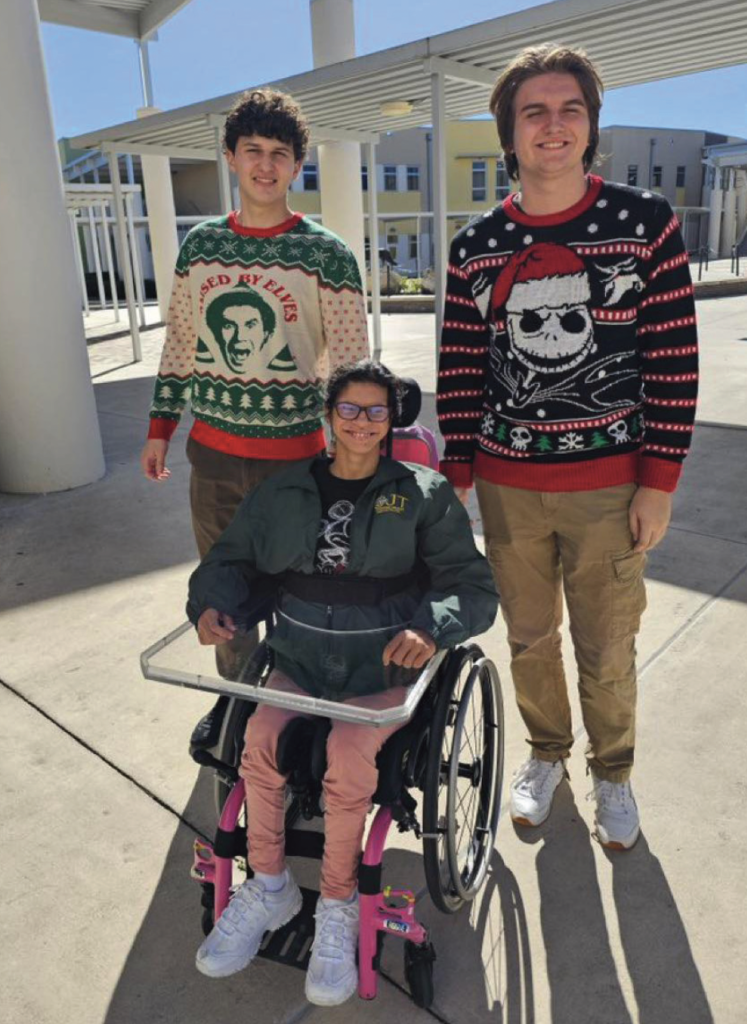
“Pily” has some really strong arms.
They’ve gotten that way because the 20-year-old has always used them to push her manual wheelchair wherever she needed to go.
But one thing those arms can’t do is be useful for a separate task while she’s pushing the wheelchair.
Pily is a student in Cypress Creek High’s on-the-job training (OJT) program for students with disabilities who have deferred their high school diploma and not yet graduated, although they are between 18 and 21 years old. They are learning skills and tasks that will prepare them for opportunities in the workforce when they turn 22 and public school is no longer an option.
John Sousa is the OJT educator who teaches Pily, whose real name is Liz Velisse Bermudez-Ortiz.
John says OJT, “is a transition program where we help to answer the question for parents, ‘What am I going to do with my child when there is no longer free public school for them?’”
The 12 students currently in his class work in the cafeterias at Cypress Creek High and Middle School, and some of them travel to Publix. Without a tray, and while pushing her wheelchair with her arms, Pily was unable to participate in the work that the other students were doing.
“I looked at this problem I have,” says John, “and I realized that I have engineering students next door. So I walked in and said, ‘Mr. Baker, can you give me two hotshots who are really into figuring out solutions to problems?’”
“Oh, I’ve got lots of those,” John says Nathan Baker, the engineering instructor, told him. John says he gladly accepted help from seniors Liam Dzanan and Gabriel Linck. They are part of Cypress Creek High’s “pack leader” program and, in the engineering department, which means they have the opportunity to work on special projects.
“I have a refrigerator with snacks,” John says he told them. “And you guys could give this young lady arms. You could give her the ability to pick things up and hold things.”
John says they took the task to heart.

Liam and Gabriel set out to fabricate a tray that would fit on Pily’s wheelchair, allowing her to carry trays in the cafeteria, boxes and other items, helping her to contribute to the work she and her peers are assigned to do.
They came up with a thick acrylic tray and the idea to trim it with a lip, so things wouldn’t roll off it. They also had to take precautions so it wouldn’t crack during fabrication or while Pily is using it.
Liam and Gabriel previously had plenty of opportunities to learn engineering skills in the classroom, but this project was the first time that their work was not just hypothetical.
A previous project, for example, was to create a boot that would help someone with cerebral palsy to walk. The students came up with a great solution, but it didn’t actually help a real person.
The fact that Pily would be counting on them to solve her problem made this project exceptionally different.
“We felt like we couldn’t mess this up,” Liam said. “And like all of our prior practice and hypotheticals all led up to this. Only a real engineer could finish the project to help Pily.”
Gabriel agrees.
“It’s kind of intimidating because if we make mistakes, they’re expensive,” he says. “We only had one chance to make it. If we messed it up, we would have to buy another sheet for $150, so it’s a lot of pressure.”
So they sketched and re-sketched on paper until they were sure they had the right design, then made cardboard models to try it out in real life.
They learned how important it is to look at things from Pily’s perspective, instead of from theirs.
This led them to learn to countersink screws to make them perfectly flush so they couldn’t scratch, for example. They did a lot of sanding. They even make changes after they thought they were finally done, adding neoprene to make points of contact more comfortable.
It was all worth it when they got to present the new tray to Pily.
“She was ecstatic when we gave it to her,” said Liam.
John says he is so proud of Liam and Gabriel. “They were able to put that tray on her chair, and even added Velcro straps so it can slide into a new chair if she gets one,” John explains.
Not only does the new tray allow Pily to complete work tasks she couldn’t do before, it’s also essential to helping her feel included as a part of the OJT group.
“Independence is a huge thing in life for everyone,” he says. “Here’s a 20-year-old girl who can now carry things from point A to point B, be included in the group, and perform simple job tasks because of the help she got from these kids.”
John thinks this is just the beginning of many more projects to come. In fact, he said, engineering students also have come up with a 3D-printed tool that helps his students who lack the dexterity to open a soda can get the leverage they need.
“The engineering students at this school are amazing,” he says. “It’s amazing what kids are doing to help other kids.”