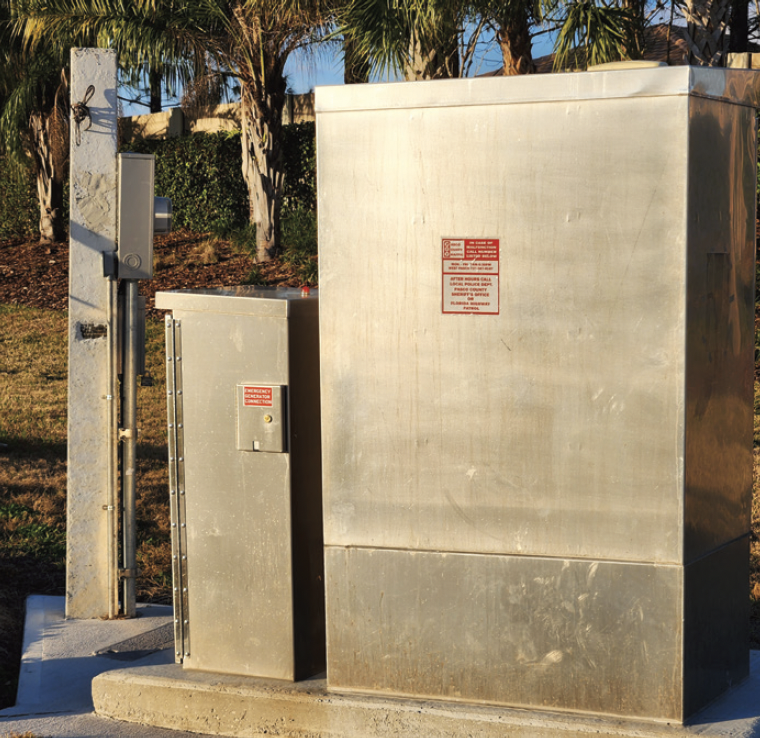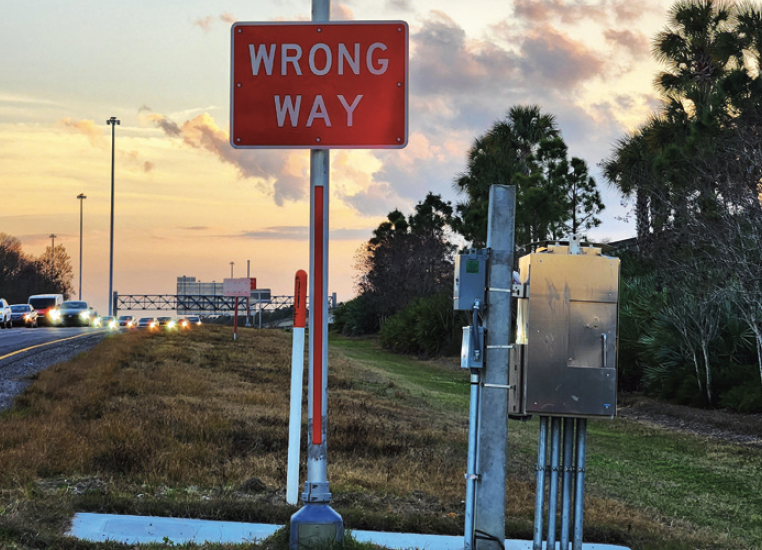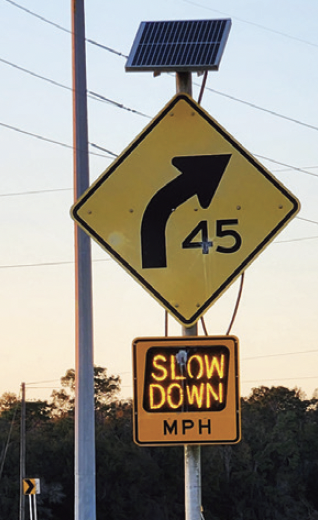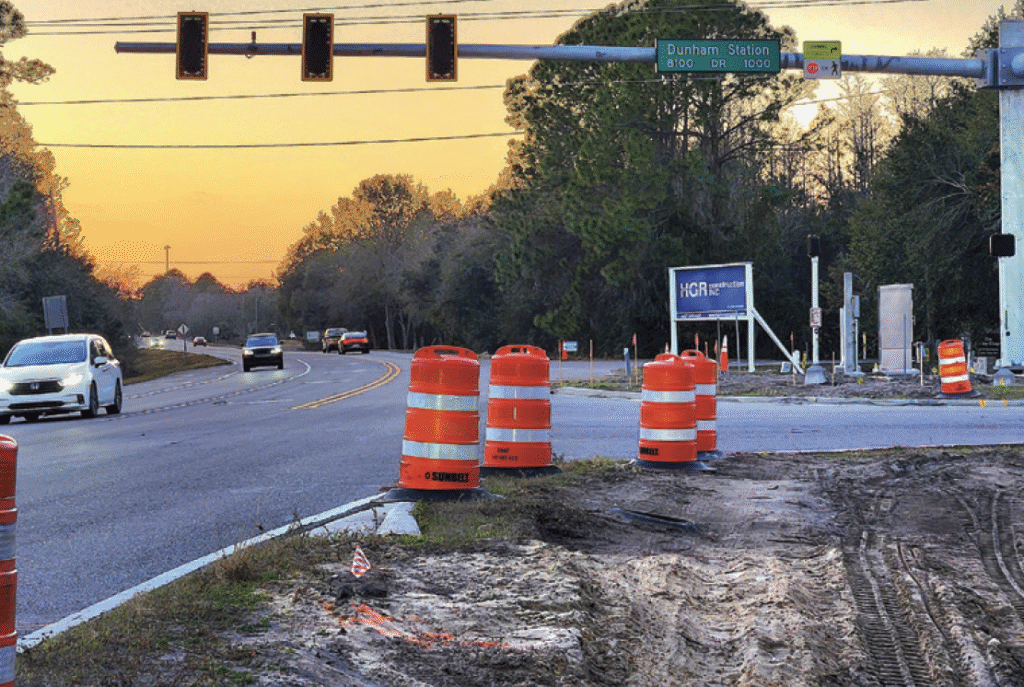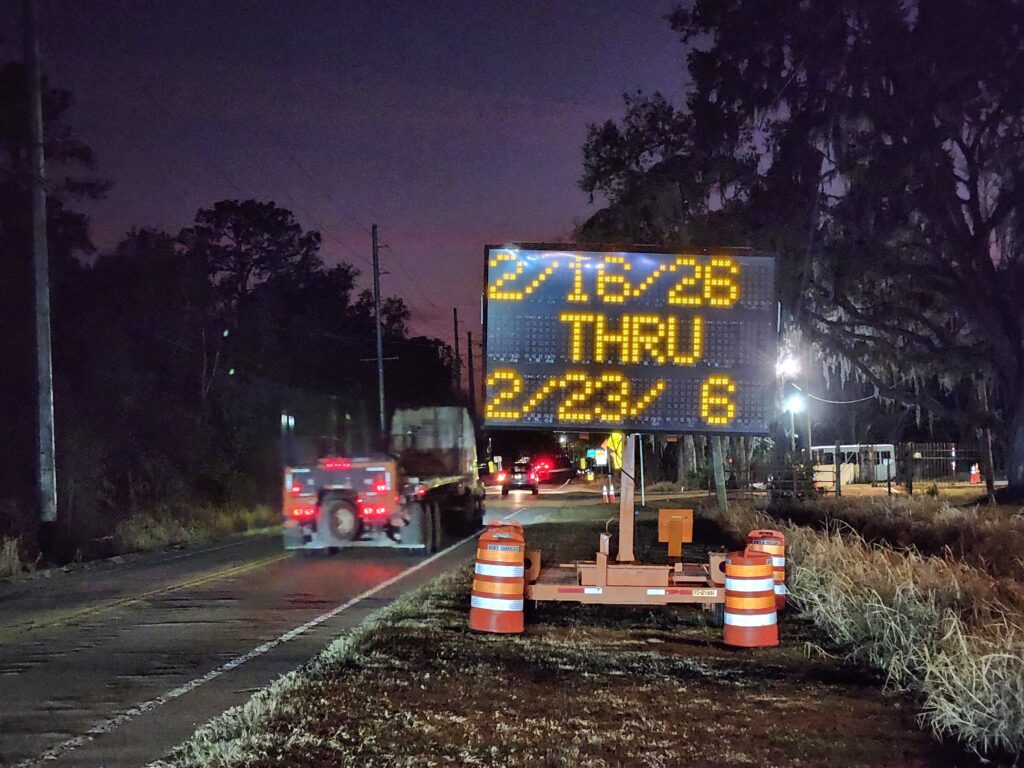
Construction at the intersection of K-Bar Ranch Pkwy. at MB Rd. (Photo by Joel Provenzano)
If it feels like Morris Bridge Rd. (MB Rd.) has been in a constant state of change lately, youâre not imagining it. From New Tampa through Wesley Chapel, this important northâsouth corridor, once considered little more than a two-lane country road, has seen closures, construction crews, and long-awaited reopenings â with even more changes on the horizon.
As Neighborhood News has reported over the past several years, MB Rd. is gradually transforming from a quiet rural connector into a critical link between several fast-growing communities in Hillsborough and Pasco counties.
Hereâs a closer look at whatâs recently been completed, whatâs under way, and whatâs still to come â with a focus on three intersections that are shaping the future of the MB Rd. corridor.
MB Rd. At Future K-Bar Ranch Pkwy.
As we first reported in April 2024, the final phase of K-Bar Ranch in Hillsborough County is more than just another residential expansion â itâs a long-planned transportation connection that will finally open all of K-Bar Ranch to MB Rd., benefiting both New Tampa and Wesley Chapel residents alike. That vision is now becoming reality.
Construction is under way on the eastward extension of K-Bar Ranch Pkwy. past Easton Park to MB Rd. Once completed, this connection also will allow access from Wesley Chapel, including from Union Park and Meadow Pointe, via the planned Wyndfields Blvd. extension to the south and the existing Meadow Pointe Blvd. extension.
The map of the planned K-Bar Ranch Pkwy. extension we ran in Apr. 2024. (Source: NN)Â
Although the Neighborhood News first told our readers the story of this future connection about a year and a half ago (see map), crews are now actively building the new phase of K-Bar Ranch, and the collector road that will extend Wyndfields Blvd. south into the New Tampa development. For Union Park residents in particular, this means a new and more direct route into Tampa â and fewer bottlenecks on already-crowded roads.
Turn lanes are currently being added along MB Rd. at the future K-Bar Ranch Pkwy. intersection (top photo), and a traffic signal will follow. The signal is required under the developer agreement and will help manage the increased traffic once the road opens.Â
According to the K-Bar Ranch III CDD Preliminary Engineerâs Report (Jan. 2025), construction on the overall final build-out is planned to run from Mar. 2025 through December 2028, and is broken into two phases.
Phase 1 includes 471 single-family homes, followed by 188 townhomes in Phase 2. Based on issued permits and the pace of construction, itâs likely the road connection will be completed before Phase 2 even begins â possibly even this year.
In short, the long-anticipated direct connection between K-Bar Ranch, Union Park, Meadow Pointe and MB Rd. is now closer than ever.
MB Rd. At Bonnet Hole Dr.
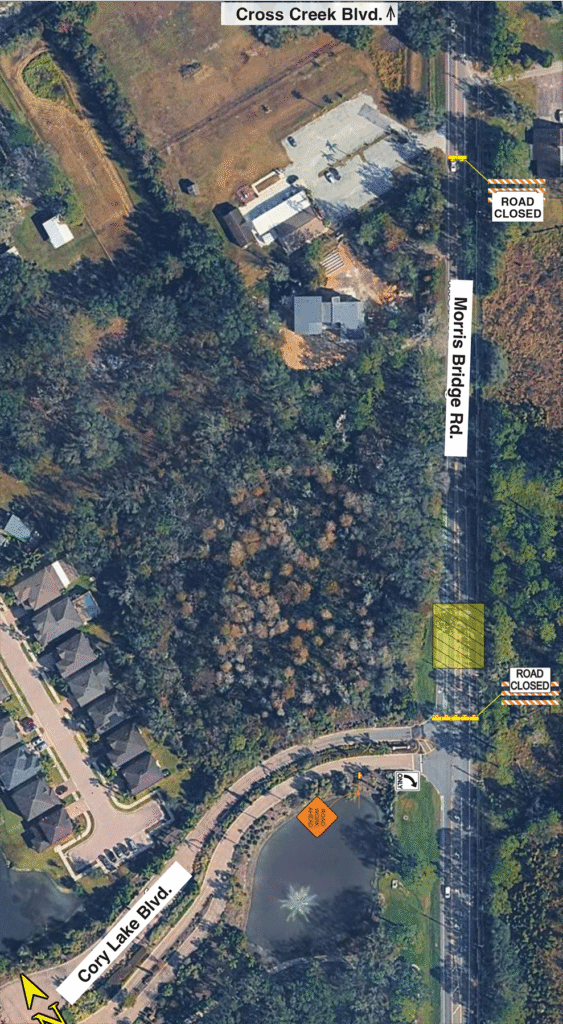
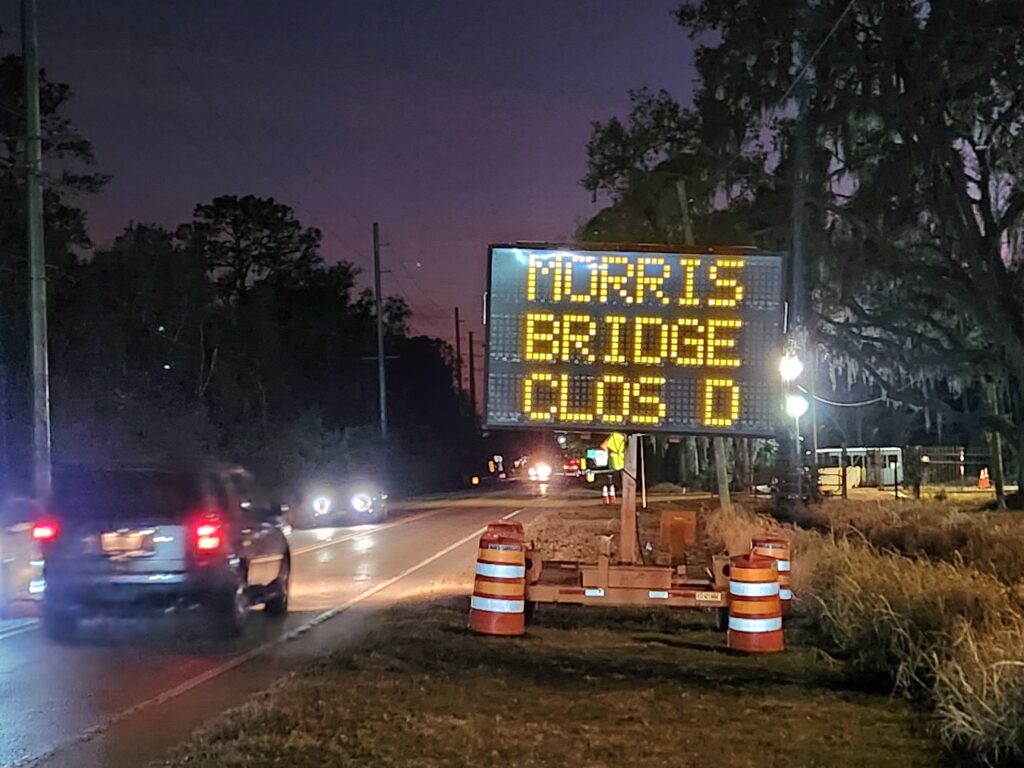
Just north of Cory Lake Blvd. (less than two miles south of Cross Creek Blvd.), the Hillsborough County section of MB Rd. reopened the week of Christmas after a full closure that frustrated many residents â particularly those still remembering the roadâs prolonged shutdown following Hurricane Milton in Oct. 2024.
The Dec. 8-Dec. 22 closure was necessary to complete stormwater drainage repairs between Apache Dr. and Bonnet Hole Dr., as Hillsborough County explained in a public release. To put it plainly â collapsing and aging culverts under the roadway had to be fully replaced.
Although only a small segment of MB Rd. was actually shut down, detours were lengthy due to the lack of alternative routes. During our communications, county officials acknowledged the inconvenience to residents.
Typically, fully closing the road allows crews to complete the work much faster than staged lane closures would have, especially on two-lane roads where itâs harder to shift traffic and breakup the digging into two phases, due to limited space.
Chris Wilkerson, senior media relations strategist for Hillsboroughâs Public Works Dept., told us this single stormwater project cost approximately $240,000. When asked if more closures are coming, Wilkerson confirmed that two additional stormwater-related closures are expected on MB Rd. in 2026 â one just north and one just south of the recent work area â so residents will need to keep an eye out for when those closures are announced.Â
MB Rd. at Chancey Rd. (Pasco)
Meanwhile, in Pasco County, the long-closed intersection of MB Rd. between S.R. 56 and Chancey Rd. finally reopened just before Christmas, ending months of detours and speculation about what went wrong.
Despite early rumors of the closure being caused by a âsinkhole,â Pasco officials clarified that the issue was actually a damaged, buried 16-inch water main. When the main failed, it washed away soil beneath the roadway, creating a large underground void that looked like a sinkhole, but was not a traditional limestone collapse.
The unexpected discovery of the water line â struck during routine work â complicated the repair. Replacement parts had to be specially ordered, delaying construction for months. Pasco officials had warned residents back on Sept. 19 that delivery and installation of the water main alone could take at least eight weeks, followed by another five to eight weeks to rebuild the road.
In the end, the project was completed almost exactly within that extended timeframe.
But, while the intersection is now open, some residents have been disappointed to see no new left-turn lanes added. According to Pasco officials, those improvements are part of a larger widening project that is still in development.
The countyâs current Capital Improvement Projects (CIP) list, adopted in June 2025, shows plans to widen MB Rd. to a four-lane divided roadway between S.R. 54 and S.R. 56. Construction is tentatively scheduled in two phases:
2028 – From S.R. 54 south through the Chancey Rd. intersection
2029 – From south of Chancey Rd. to S.R. 56
Of course, the project has already been delayed once and timelines could change again.
The Big Picture
Taken together, these three intersections tell the story of MB Rd. today â a corridor under pressure from rapid growth, environmental challenges and aging infrastructure â but also one thatâs steadily being improved.
Some work is finished, some is still under way and more is coming in the next few years. For residents of New Tampa and Wesley Chapel alike, the changes along MB Rd. promise better connectivity in the long run, even as the short-term disruptions unfortunately continue.
As always, the Neighborhood News will keep you updated with whatâs happening with the MB Rd. corridor â one closure, one construction zone and one reopening at a time.
Some Neighbors In Meadow Pointe Adjacent To The New Development Have Concerns About Flooding, Noise & More
Photo provided by Judy JohnsonÂ
Introduction by Gary Nager
Story by Joel Provenzano
Although some locals still firmly believe that the area needs a Trader Joeâs market even more, thereâs no doubt that the beginning of construction of our areaâs first and only Whole Foods market is among the most hotly anticipated new developments in Wesley Chapel.
Some of the long-term residents who live in the adjacent Meadow Pointe I community, however, arenât necessarily as excited. Theyâre wondering, when it comes to development, how close is too close?
With Whole Foods now under construction, some of those neighbors are voicing their concerns to the Neighborhood News.
These neighbors in The Savannahs subdivision of Meadow Pointe I are asking a number of questions, including one big one:
If a man-made retention pond was built as an original feature of a communityâs design and has been part of your backyard since 1992, donât you have the right to assume that the pond was there to stay?
Why would anyone assume otherwise? In our area, it is virtually unheard of that ponds near established community homesites would end up being removed.
But, there is a pond located behind the homes on Openfield Loop that is being removed for this new commercial development â despite multiple failed previous attempts to develop the 16-acre property located north and east of the intersection of Aronwood Blvd. and Bruce B. Downs (BBD) Blvd. into a full-fledged commercial site â and the fact that no previous developer had proposed removing the pond.
All of the neighbors we spoke with understood that the land would eventually be developed into a neighborhood commercial site, as it has been zoned for that purpose since before their homes were built adjacent to it.
What these homeowners could not have anticipated, however, was that the latest developer (SJC Ventures) would propose moving that development even closer to their backyards by eliminating the natural buffer the pond provided â anywhere from 50-200 feet, depending upon which lot your house was located.
And that, the homeowners told us, is where the true concern lies: the edge of the parking lot would now only be 15â from some of their backyard property lines â close enough to throw a paper airplane and hit a parked car.
The expansive pond buffer â along with the previously approved 20-foot landscape buffer for the southernmost home, as shown in an earlier plat â are being eliminated. In its place, a standard white vinyl fence (possibly) and a uniform 15-foot buffer would directly separate six homes (see map below) from a 160,000-sq.- ft. commercial center, while the views of an additional four homes would be indirectly impacted.
Put plainly, the pond would be removed to make room for approximately 90 of the developmentâs 881 proposed parking spaces.
That said, the removal of existing man-made ponds for site reconfiguration does occur â just not typically in a young, rapidly growing area like Wesley Chapel, where fresh commercial developments are still popping up all over.
This type of development change normally takes place in older areas where outdated commercial developments are torn down, ponds are removed and new drainage facilities are put in place â whether that be in the form of relocated new ponds, or below-ground âvaultsâ to provide for more building area or parking.
Itâs crazy to think that at 33 years old, and without any aged commercial development, that this parcel fits that criteria, as it is one of the oldest commercial lots (per zoning) in Wesley Chapel.
At its core, this issue reflects the broader tensions that accompany growth and development â where long-held expectations about how things were, or were meant to remain, collide with the sometimes unfortunate realities of change. It is a familiar struggle, one that increasingly places evolving commercial developer interests at odds with those of existing residents â a dynamic we have found ourselves reporting on with growing frequency.
Can more compromise and common ground be found, so everyone still gets whatâs important to them?
The Developerâs Goal
The site plan showing the locations of Whole Foods & Lifetime Fitness on developer SJC Venturesâ site plan. We donât yet have info as to exactly where, or even in which buildings, the other businesses mentioned in the story will be located. (Site plan source: Pasco County)
The goals of neighborhood commercial development are to provide needed services and jobs for nearby residents and, of course, to make money. Having options of where to shop, where to eat and where to get health care can make an area more desirable and more enjoyable as a place to live, because people generally appreciate having proximity, freedom of choice and variety.
The affected homeowners we spoke with understand this, and wanted to make it clear that theyâre not against the commercial development now under construction from SJC Ventures, but they do have some concerns.
Meanwhile, most everyone who isnât directly abutting the property has taken to social media to let everyone know how happy they are that the area is getting the major anchor tenant:
Whole Foods â The 35,518 sq.-ft. modern grocery store owned by Amazon. As mentioned earlier, only a Trader Joeâs might have caused more excitement, but unfortunately, we spoke with Trader Joeâs corporate, which said the company currently still has no plans for a Pasco location. Many Amazon Prime members, however, are rejoicing, because of the benefits and deals offered by Whole Foods to Prime members.
Lifetime Fitness â The club is to be the second (and larger) standalone tenant. Lifetime is a slightly more upscale full-service gym that will offer everything â including two large outdoor swimming pools. Some of the homeowners we spoke with said the pools will cause additional noise and lighting at night (the Lifetime gym on Harbour Island stays open until 10 p.m. on weeknights and until midnight on weekends) that might not have been necessary if everything was fully indoors.
As gyms go, Lifetime Fitness will be quite large, offering two levels and nearly 84,500 sq. ft. of indoor floor space, plus the outdoor pools. Anyone familiar with gyms understands that this means a very large amount of parking is needed.
The Lifetime building will have a maximum height of 45â, according to the site plan. The edge of the gym building will be 92â from the closest residential property.
The remaining property will be 40,450 sq. ft. of strip-style shops and restaurants and will include the following tenants:
PopUp Bagels â A highly rated bagel shop with existing locations in Carrollwood and the Westshore business district. Pop-Up Bagels serves hot, whole bagels with a variety of rotating shmears (cream cheeses). Itâs a place for bagel purists.
CAVA â A popular quick-service Mediterranean restaurant that serves healthy food fast (ordered and made at the counter), a chain that is quickly spreading across Tampa Bay, with 10 current locations.
Naked Farmer â A very highly rated American-style âfarm-to-tableâ quick service restaurant (ordered and made at the counter; like a more upscale Fresh Kitchen) with flavorful, healthy options. Naked Farmer has two existing locations in South Tampa, including one in the Water St. area of downtown Tampa.
Petfolk â Veterinary & Urgent Care with multiple locations across Florida.
The Tox â A popular wellness and detox spa with a highly rated location in South Tampa.
Nail Salon â Tenant TBD.
According to an SJC Ventures release, thereâs still roughly 15,000 sq. ft. available. Health, wellness and wholesomeness seem to be the overarching themes for this development, with SJC expecting to have these businesses start opening in the 2nd quarter of 2027.
Digging Deeper
The map of the area showing where the development (outlined in red) will be located. Please note that the location of the red line is approximate and is not intended to provide an exact location of the boundaries of the project. (Inset photo) The flooding on Openfield Loop caused by Hurricane Milton. (Map source: Google maps modified by Neighborhood News)
We had a chance to meet with many of the affected homeowners in person, and speak with them as a group. Theyâre all long-time residents in one household each in The Savannahs:
⢠Judy Johnson (8-year resident)
⢠Laura Knight (name she asked us to use, a 17-year resident)
⢠Jill McDaniel (32-year resident)
⢠George Ryan (32-year resident)
Each had a chance to share what they felt were their important personal issues with the project, and a few common themes emerged:
1. Flooding
2. Privacy/Security/Noise
3. Lighting
4. Setbacks/Buffers
We reached out to SJC Ventures through its general contractor (VCC Construction), and although SJC has been responsive to the homeowners, the company did not respond to our inquiry (at least not by this issueâs deadline).
However, both Pasco County and the Engineer of Record for the developerâs project, David Fauxan, did speak with us to provide some clarity about the development codes and practices being called into question by the homeowners, as well as our own technical questions.
Fauxan also has been an engineer on the original Meadow Pointe project since its conception in the early 1990s.
Amanda Hunter, a public information officer for Pasco County, says that, âThe county is aware of the homeowner concerns and has attempted to address those.â However, the homeowners told us they were not impressed with the countyâs communication and that no one from the county had visited with them in person, to see their concerns first hand, including:
Flooding â For the residents, the proposed removal of the pond has created concerns about flooding, especially considering that flooding during Hurricane Milton left water coming literally right up to their doorsteps (see inset photo above). The residents fear that if the pond wasnât there, that water would have come right into their homes.Â
Hunter responded to the flooding concerns with the following statement: âThe developer is retaining storage for stormwater under the parking lot, via a vaulted system, instead of an open stormwater pond.â
Fauxan added that the vault system would provide just as much, if not greater retention, than the pond to be removed. We confirmed that the plans do show an extensive vault system under most of the parking lot.
âHonestly, the whole site could have been a pond, and it still would not have fixed the issue,â Fauxan says about last yearâs flooding. Ironically, he mentioned that the adjacent Trout Creek watershed, which goes all the way up to S.R. 54, has been strained by development over the years, changing the flood plain from what it used to be.
He added, âThe flood elevation used to be âXâ back in 1992 (when the homes were built). But now, itâs âXâ + 4 feet,â meaning that the flood zone boundary actively shifted from where it used to be. âWeâre raising the [project] site elevation [by up to] 2 feet because the new buildings need to be 1 foot above that new flood elevation.â
Homeowner George Ryan confirmed what Fauxan explained, saying that his home, which was previously in Flood Zone X, is now in Zone AE âper the revised boundary,â so he has to have flood insurance for the first time in the 32 years heâs lived there â and that occurred before the SJC development ever broke ground.
What does all this mean for the homeowners? Allegedly, if the area sees another Milton-like storm, which dumped 15â of rain, the water will rise again to exactly where it was after the hurricane, regardless of the pond. But, only time will tell if all of those calculations are correct.
Fauxan explained that one small improvement is planned to address existing conditions. Once a more detailed survey of the area between the residential and commercial properties has been completed, the developer intends to grade the commercial site to actively collect any water that falls near the shared property line â close to the existing wall â and redirect it into the siteâs stormwater management system.
The retention pond to the left of this wall will be removed under the SJC Ventures development plan. (Photo by Joel Provenzano)Â
Privacy/Security â Since the pond was previously supposed to act as a natural buffer, the community only built the roughly 6-foot-tall brick wall (photo) up to the first home at the pondâs edge, where it abruptly ends. This means that three other homes will have no physical separation between them and the developmentâs parking lot, other than the planned landscaping.
Fauxan said that the developer intends to install a white vinyl fence to mitigate this concern, stating that the fence was shown in the developmentâs landscaping plans.
However, the homeowners said that, based on what they were told, the fence would be at the developerâs discretion, and a review of the August landscaping plans showed only trees and hedges along the property line, but no fence.
Itâs possible the latest landscaping plans were not uploaded to the permit site.
Lighting â With a building and parking so nearby to their homes, the homeowners are concerned about lighting spilling into the properties, but we were not able to locate a light plan or a lighting analysis, so itâs difficult to analyze what those levels may be. Trees and shrubs in the buffer should help to reduce the light pollution.
Setbacks/Buffers â According to Fauxan and Pasco County, all of the projectâs buffers meet the current code. But, while itâs within the acceptable threshold, is it still too close?
When we asked the county why a 30â setback wasnât used or why the 20â buffer from the previous plat was reduced to 15â, the county responded: âThe plat in [that question] is a reference to an older project that was not pursued. Per Table 905.2-D of the land development code (LDC), a type âBâ buffer is required between commercial and residential uses. A type âBâ buffer is 15 feet wide. Note â a landscape buffer and its width are different than a building setback, per our Zoning Code in Chapter 500 of the LDC, which is what youâve referenced.â
In addition, âAs a note, this project meets the building setback requirement. Itâs not a construction setback, but a setback from a structure. The structures are set back appropriately and in accordance with the land development code.â
This means that while commercial structures must be set back at least 30â from the adjacent residential property line, parking is permitted to be within 15â of it, underscoring how technical compliance does not always equate to neighborhood comfort. Paper airplanes away!
(Above, left & right) The Hueland Pond Blvd. extension, which will be called Maggie Hill Blvd., is shown in the maps of two new planned communities in Wiregrass Ranch. (Map source: Pasco County)
The Wiregrass Ranch area north of S.R. 56 is about to get another major connector road â with construction anticipated to start very soon.
Since it was first built in 2016, Hueland Pond Blvd. (see maps) has ended at a large T-intersection with S.R. 56. That will soon change, as the Wiregrass Ranch development submitted final engineering plans with Pasco County on Oct. 14 to extend Hueland Pond Blvd. further to the north by about a mile, past S.R. 56 and through the cow fields, intersecting with another recently extended corridor â the east-west Chancey Rd.
The new Hueland Pond Blvd. extension will be known as Maggie Hill Blvd and will connect and align exactly where the new back gate for the 55+ community of Esplanade at Wiregrass Ranch is located.
The extension of Hueland Pond Blvd. is being designed to serve a couple of upcoming communities and will be a 4-lane divided roadway with 10â-wide sidewalks on both sides, making it very pedestrian-friendly.
Flanked by the 76 gas station on the east side and Florida Cancer Specialists on the west, the intersection of Hueland Pond Blvd. with S.R. 56 will become yet another major roadway for Wiregrass Ranch, as development continues around it.
These road improvements were approved nearly 20 years ago under the original Wiregrass Ranch Master-Planned Unit Development (MPUD) plan, and since that time, Maggie Hill Blvd. always been shown on the master development map as a critical future road, being placed in a sweeping âS-shape,â almost exactly where the old cattle ranch service path (above photo) exists today.Â
Per the development agreement with the Florida Department of Transportation (or FDOT), Wiregrass Ranch will be responsible to construct a traffic signal on S.R. 56 once traffic volumes at the intersection warrant one. The intersection will eventually feature dual left turn lanes in each direction.
All of this will probably come sooner rather than later, because plans have also been submitted for two new communities (pictured in the two maps) to be constructed on the north side of S.R. 56, both taking advantage of the upcoming extension of Hueland Pond/Maggie Hill Blvd.
The first one will be a 225 single-family-home community with access directly off of Maggie Hill Blvd, and the other one will feature 111 single-family homes with access off of Chancey Rd. â both on the west side of the proposed Hueland Pond/Maggie Hill extension.
Unfortunately, no builder info has been announced yet, nor do either of the planned communities yet have a name, but preliminary plans have been submitted that are being reviewed by Pasco County.
This photo (above) is looking south from Chancey Road across the cow fields toward S.R. 56, at the point of future connection of Hueland Pond/Maggie Hill Blvd.Â
Ziggiâs Coffee Drive-Thru has updated its permit application, which previously announced that the growing coffee chain was going to open on Mansfield Blvd.
But, new plans now show that Ziggiâs will instead open on Hueland Pond Blvd., just south of S.R. 56 and the 76 gas station and Daybreak Market (see map, left).Â
The new permit application announcing this different location was just submitted last month. Preliminary site engineering plans have been submitted for Pasco Countyâs review, which say:
âThe project proposes the development of a new 1,800+/- sq. ft. coffee shop with a drive through, associated parking and drainage improvements.â
Ziggiâs Coffee currently has about 100 locations in 18 U.S. states, but only one other location â in St. Augustine â currently open in Florida . The company is in a rapid growth phase, however, with more than 200 additional Ziggiâs Coffee locations now in development. For more info, visit ZiggisCoffee.com. â Joel Provenzano & GN
Parents Frustrated With Delays While The District Is âDesperate For Warm Bodiesâ To Fill Bus Driver Vacancies
This school bus arrived late to Wiregrass Ranch High on Oct. 16, which is part of a Pasco School District-wide problem with late buses. (Photo by Joel Provenzano)
If your child rides a school bus to and from school, they may be arriving to school well after the late bell, and you may not even know. Or, you may be like many other parents who are aware of the issues with late buses â picking up late in the morning, dropping off late at school, or being dropped off late in the afternoon when coming home â and feel like there isnât much that can be done about it.
We have spoken with Pasco County School District officials, concerned parents and current and former students, and reviewed online community posts â including some posts directly from the bus drivers themselves â and even observed the buses ourselves. All of this has opened our eyes to some significant issues with Pasco County Schoolsâ Transportation Services for the schools located in Wesley Chapel.
But, we also have found that all of this is a symptom of a much bigger problem â one the District is aware of and actually acknowledges.
Pasco Schools public information officer Jessica Meek says, âOur district continues to feel the impact of the ongoing bus driver shortage, and we are constantly taking steps to address this nationwide challenge….we have a strong and ongoing focus on reducing transportation delays and ensuring our routes run as efficiently as possible.â
So, just how short of drivers is the District? How many additional drivers are needed District-wide? School District officials say that shortfall number is 59. Thatâs a pretty significant shortage â almost exactly 20% â considering the total number of operational (running) buses in the fleet is 297, with the District stating that, â[Thereâs] no shortage of vehicles, just drivers.â
But, just how bad is it exactly? One local driver of nearly 25 years (whose employment we verified but decided not to name them for this article) put a comment out on social media last month stating that there was, â..desperation for warm bodies…â regarding the Districtâs ongoing efforts to recruit and retain drivers. The driver also implied that not all drivers they currently have may be best suited for the job, or compatible with the kids theyâre driving around.Â
One local Wesley Chapel parent, Dr. Lorraine Tracey, says she has been feeling the effects of driver shortages on a nearly daily basis. In regards to the late buses, she believes, âIt really is a problem, with no solutions in the works, except trying the same thing over and over, and making no progress.â
Lorraine works a full-time career in clinical development, for the treatment of life-threatening diseases, and has a son and a daughter who attend two different local schools â one who is at John Long Middle School and the other who attends Wiregrass Ranch High. Both ride the bus.
She forwarded to us all of the emails between her and the School District. Like many local parents, Lorraine is frustrated with the situation. âIt feels like no matter what I do, or what I say, Iâm just banging my head against a wall.â
How The 2025-26 School Year Started
Transportation problems are typically worse at the beginning of the school year for everyone, and thatâs because the Districtâs Transportation Services Department faces the Herculean task of coordinating the logistics to get 33,000 students (the latest total number of student bus riders, according to the School District) across Pascoâs 868 square miles, with buses originating from six different bus compounds.
And, just like the rest of us, buses have to deal with traffic, especially the traffic getting into and out of the schools themselves.
Lorraine believes that many of the school bus drivers were being set up to fail early on by being given impossible routes. She looked at the number of stops, how far apart they were, and where they had to come from, in order to be on time to her sonâs stop â and told us that, âunless the bus driver figured out how to fly the bus, they were never going to be on time.â
She said that itâs ironic, because at the beginning of the school year, a message was sent out to all parents from Pascoâs Superintendent of Schools Dr. John Legg that stated, in part, âEvery minute of instructional time matters.â Lorraine feels that due to the busing issues, the School District and School Board members are not living up to their promises to the students, and she sent detailed emails to all of them explaining that.
Those emails from the beginning of this school year stated that her sonâs bus (Route Z520A) was consistently late showing up to his stop, often running as much as an hour (or possibly more) behind. She even compiled a chart (right) to document the delays.
And, Lorraine wasnât alone either. Numerous local community Facebook groups were ripe with posts about parents having to take their kids to school because buses were getting to stops extremely late â 30 minutes, 40 minutes, an hour even…which has been going on for many years, from what we could find.
Michael Santus, the manager of Transportation Services for Pasco Schools, replied to Lorraineâs email with this boilerplate response:
âAs ridership patterns stabilize, route timing naturally adjusts. For example, during the first two weeks of school, buses stop at every designated location. After this initial period, stops without riders are removed to streamline the route. This is one of the many ways our routing team works to enhance overall efficiency.â
A later email he sent specifically about Lorraineâs sonâs bus stated, âIt appears that ridership is beginning to stabilize. The bus arrived at the stop at 8:09 am this morning and arrived at school at 8:17 a.m. While it was still late, it is 7 minutes late vs. 25 minutes yesterday and 39 minutes the day prior. I will continue to monitor its progress for you.â
Lorraine told us, âWhat made it worse was that I had to frequently call the school and fill out an âabsentâ form each day for two weeks, until the school figured out some solution, because his tardiness was causing him to not show up at attendance.â
While she acknowledges that there has been some improvement since the beginning of the year, in regards to the recurring late pick-ups (she says her sonâs bus does show up to the morning stop on time now), but that there are still issues with the frequent late drop-offs at Wiregrass Ranch High, and that those havenât improved, even at this point, two full months into the 2025- 26 school year.
She worries that this is having a negative impact on education. âHis first period is Spanish 3 Honors,â she says. âItâs an important class, and he canât really make up that time.â
Dealing with all of the issues with her sonâs bus, Lorraine was surprised, on the morning of Sept. 19, when she got a text from her daughter stating that her bus for John Long hadnât shown up, and she didnât know what to do. Lorraine wasnât available, and neither was a close family friend who lived nearby. An older sibling of a fellow John Long student that Lorraine didnât know offered to drive the students to the school, and she accepted, since there wasnât much other choice.
According to the Districtâs response, when we independently confirmed the record of this incident, they explained that the bus did get there that morning, but it was well over an hour after it was supposed to arrive. Officials further explained that, âThere should be no circumstances where a bus does not show up, just delayed.â No explanation was offered as to why the bus was that late.
When hearing of the Districtâs official response, Lorraine responded to us, âYep, letâs leave middle schoolers on the side of the road for [more than] an hour.â
The Studentsâ Perspective
Our initial research quickly uncovered that this was likely a much bigger, District-wide, systemic problem, where if it affected one family this much, there were likely many more families affected in exactly the same way.
We wanted to understand what this looked like inside the school â get an idea of how many buses and kids were coming in late â so we separately interviewed a current and a former student of Wiregrass Ranch High, both of whom asked not to be named.
The current student (a freshman) said that in their first period class, â4 to 5 students per day are late, getting to class at least 5 minutes, and up to 15 minutes [after the bell].â They explained that the majority are âtardiesâ caused by the buses.
Meanwhile, the former student said that last year, during their first period class (when they were a freshman), there were â8 to 9 per day, mostly due to the bus, who came in 10 to 20 minutes [after the bell].â
They further explained that, âThey would hand you [the late students] a tardy slip as you got off the bus to give to the teacher. This had become a normal thing, so much so that the school needed to start doing them in different colors each day, …green, pink, orange, purple, so as not to be reused by the students.â
Our response to all of this info? âWow.â
Even though neither of these students is riding the bus this year â which would have given them an even more accurate idea of the tardies â because these two students were always in class before the late bell rang, they said it was such a common problem, almost every student knows how bad it is, whether they are bus riders or not.
We followed up and asked the Transportation Services officials specifically: âHow many tardies (roughly) of your students are a direct result of busing issues? This could be a number, a general range or even an estimated percentage.â
They apologized and stated that it would take too long to pull and compile that data before our story deadline, but that it is publicly available data for anyone who wants it by filling out a âPublic Records Request Formâ on the School Districtâs website.
However, the officials did also verify the need to have staff manage bulk late student arrivals, responding: âThere have been some small revisions to accommodate for student supervision (in other words, modifying duty schedules)â when we asked if the individual schools had to make direct adjustments to their operations to compensate for busing issues.
What We Discovered First-Hand
With the students explaining to us how many of their peers were late daily to first period, we decided that we had to see first-hand for ourselves what that translated to, in terms of the buses.
We found that most buses do get to the schools with plenty of time to spare, arriving anywhere between 10 to 20 minutes before the late bell. But, the number of late buses was surprising, at least at the two schools we chose to look into â John Long Middle and Wiregrass Ranch High.
We picked a random Thursday this month â Oct. 16 â to go out and directly observe the buses entering the school properties (from the adjacent public right-of-way). We saw multiple buses arriving to the school properties after the late bell had already rang.
For each one we observed, we wrote down the bus number and the time they crossed onto the property. We then sent those bus numbers to the District, to ask them what time their records showed that those buses arrived. They confirmed down to within 1 minute of accuracy that our observations were consistent with their records.
We found that two buses arrived late to John Long and at least three buses full of students (there was one discrepancy with a fourth) arrived late to Wiregrass Ranch.
When we asked if there are any proactive steps the schools are taking to make the bus drop-off and pick-ups smoother or less time-consuming, the District officials told us that, âAll administrators look at the systems they have in place each year to ensure it is the most efficient procedure for their campuses.â
Knowing the Wiregrass Ranch campus is especially overcapacity (with 2,183 students enrolled this year, it is at 140% of its capacity), we asked if this would cause any efficiency issues with busing.
The District replied that, âThe routes get reevaluated each year, to accommodate for student growth. The issues with busing are a direct result of bus driver shortages, not capacity issues.â
We did observe one clever trick that the buses going to the middle school were doing to avoid traffic and save time â one that was perfectly safe and legal (for the buses), but that we arenât going to explain, so other drivers donât try to replicate it â but it was a very unique ârouteâ that shows they are trying to be ingenious in at least one way to save time.
There have been some other improvements, too. At least one Pasco parent that we reached out to, who also had significant complaints about busing last year, stating that her son was often arriving back home more than two hours after school ended. That parent told us that, âItâs a lot better this year,â when asked for a comment.
The âWheres The Bus?â App
A relatively new GPS-enabled bus tracking system, a phone app fittingly called (and misspelled) âWheres the Bus?â (left) at least allows parents to see exactly where the school bus is on a map, and actively track it. This app was launched in 2023 for Pasco and is available for parents to download from Google Play or the Apple App Store â but there may be an issue with it.
We asked the District, when a bus is arriving late to a school, and drops off students past the late bell time, does the âWheres the Bus?â app notify parents of the late drop off, or are parents notified any other way of the late drop off?
They responded, âIf a parent is using the parent app, and their child signs in and out [when getting on and off the bus] they can track this specific information, but there is not a separate notification. However, parents should be getting notifications through MyStudent if a bus is going to be late picking up or dropping off their child.â
Lorraine stated that while she does get notifications on her phone about late morning pickups, itâs not always that accurate, saying that the times shown might be a little off, but she explained that as far as tracking the times when her son gets on and off the bus (to verify his late arrival to the school), when she goes into the app, it only shows the times for that day, which resets the following day, and she hasnât been able to find the historic data anywhere in the app.
This means that some parents may not even know that their children are arriving late to school, unless their child tells them, or they actively go into the app to view the live map showing the location of the bus, or review the pick-up and drop-off times for that day themselves, on that specific day.
The Desperate Need For Drivers
Lorraine told us that she felt slightly insulted when she was emailing the District about her serious concerns, because in a response she received from Nichole Schreiber, a field service specialist with the Districtâs Transportation Services Dept., Schreiber said, âIf you know anyone who would like to join the transportation staff, we would greatly appreciate it!â
In other words, Lorraine says, instead of the District coming up with solutions, âIt shifts the burden to parents by suggesting that we need to help recruit staff, which is neither our responsibility nor a practical solution to ensuring timely and reliable transportation in the immediate term.â
She also joked with us that they must be really desperate if they want her to drive a bus.
But, District officials admit that the ARE desperately trying to recruit help, almost any way they can, and theyâre definitely not shy about it. But, are these efforts to the potential detriment OR enhancement of public safety and service?
Back in 2021, Pascoâs former Superintendent of Schools Kurt Browningâs staff suggested using the National Guard to help with the bus driver shortage. It was ultimately turned down because there was no formally declared state of emergency.
The District has organized multiple hiring events, some upcoming, to try to recruit drivers. The next one will be on Thursday, November 6, 4 p.m.-6 p.m., at the District Office (7227 Land OâLakes Blvd., Land Oâ Lakes, FL 34638).
Pasco Schools Transportation Services advertises the benefits they offer to drivers as:
⢠Free health insurance
⢠Paid time off
⢠Paid holidays
⢠Retirement plans
⢠Paid CDL (commercial drivers license)
prep course
⢠$18.15/hour starting pay
The website says that the District guarantees at least 6 hours of work per day in a split shift, but that most routes are longer than 6 hours.
The Pasco Schools Transportation Services Dept. can be reached during business hours Monday-Friday at (813) 320-2562 to take your questions, comments and/or complaints.