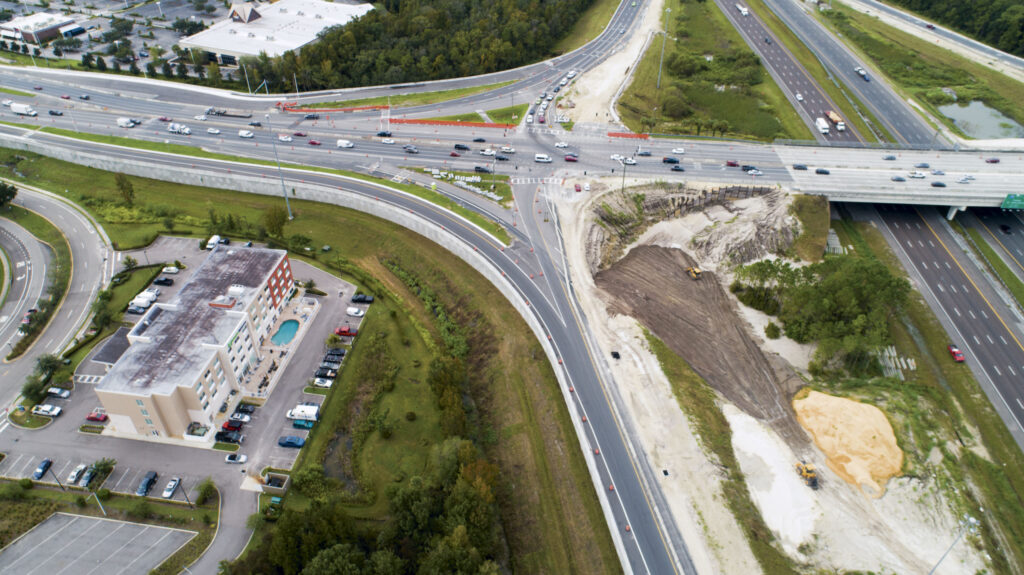
Construction crews, large machinery and those all-too-familiar bright orange cones have returned to the intersection of S.R. 56 and I-75, as work on the much-anticipated Diverging Diamond Interchange (DDI) has finally and officially resumed.
Superior Construction Company Southeast, LLC, was chosen by the Florida Department of Transportation (FDOT) and surety bond companies to replace D.A.B. Constructors, which defaulted on the project on July 1 and went out of business shortly thereafter.
D.A.B. defaulted on six other projects in Pasco, Hernando and Citrus counties, including the S.R. 54 widening project from east of Curley Rd. to east of Morris Bridge Rd.
D.A.B. told FDOT on July 28 it could not afford to complete the S.R. 54 widening, due in part to penalties incurred by missing benchmarks on the DDI project.
Superior began work to complete the $36-million DDI on Sept. 13, which included mobilization of labor, equipment and materials, erosion control, survey, jobsite cleanup of debris and office setup. Full maintenance responsibility was transferred to the new contractor on Sept. 20.
The project, originally scheduled for completion before the end of 2021, is now expected to be finished within 10 months, likely in the summer of 2022, said FDOT spokesperson Kris Carson in an email.
Superior also currently is working on the realignment of S.R. 52 in eastern Pasco County. Pasco Commissioner Mike Moore represents District 2, where the DDI is located, and he said he was happy with the choice.
“I’ve heard great things about them,” Moore said. “And they are actually ahead of pace on the S.R. 52 project, so that’s a good sign.”
Stepping into a new project that already was more than halfway finished is unusual but not unprecedented in the construction business, especially considering the effect that Covid-19 and staffing issues have had on the entire construction industry.
“While this process is not how a typical FDOT project is executed, there are procedures in place for replacing a contractor,” Carson said. “It will take the new contractor some time (a few weeks) to clean up items from the previous contractor in order to complete the new work items. The new contractor evaluates the remaining work items and prices the items that are left to complete. Superior has already mobilized a staff and are in the process of mobilizing crews to complete the work.”
Meanwhile, the surety company put out an advertisement for bids for completion contractors on Sept. 9 for the $42.5 million S.R. 54 widening project, and were expecting to receive bids by the end of the month.
A subcontractor, Southern Precision, has been taking care of the S.R. 54 site in the meantime, with mowing, little control and filling potholes. Last week, work began on milling driveways and side streets, as well as some paving.
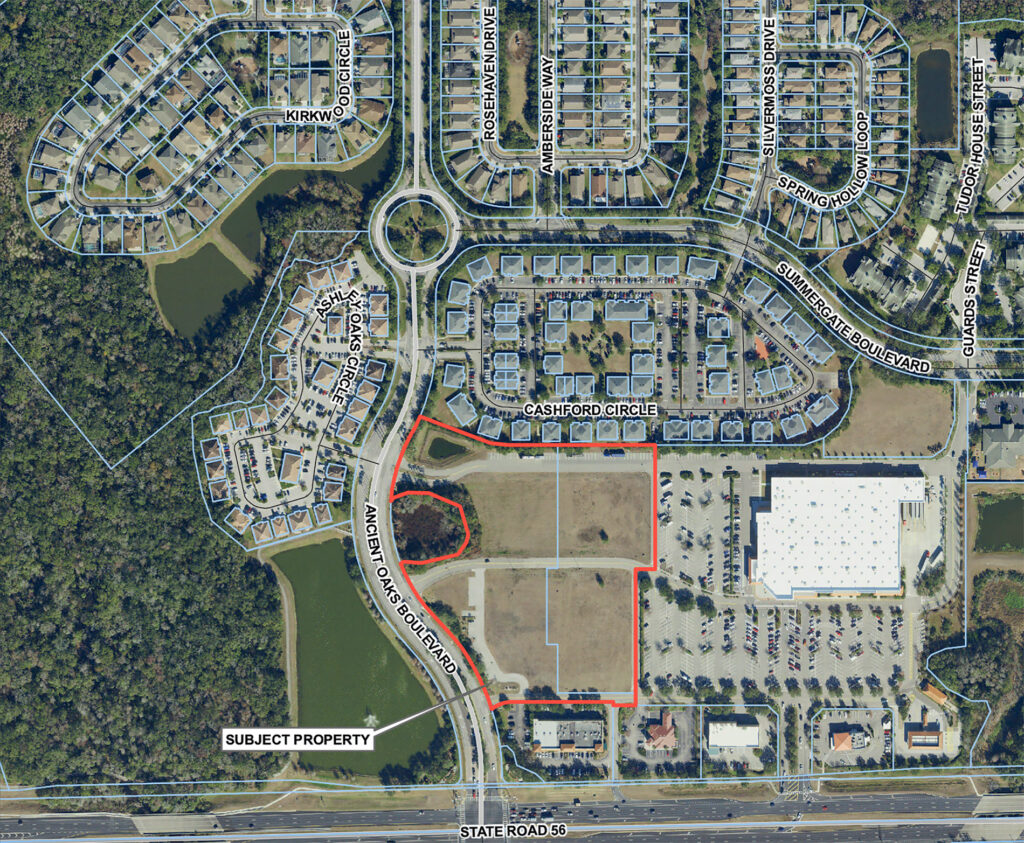
County planners say the lone remaining property in the parcel above (outlined in red) should be preserved for retail and office space, not more apartments.
In a sign that developers in Pasco County may be facing a new uphill battle when it comes to rezoning property in order to build apartments, the county’s planning staff and Planning Commission rejected an effort to do just that in the Seven Oaks development, just off S.R. 56 and Bruce B. Downs (BBD) Blvd.
First, the county’s planning staff recommended denying a substantial modification to the Seven Oaks MPUD Master Planned Unit Development (MPUD) Master Plan, and then, by a 3-1 vote on Sept. 8, Pasco’s Planning Commission voted down the plan to rezone 86,000 square feet of retail and office space for a 320-unit apartment complex.
Chris Williams, the director of planning for the Pasco School Board, had to leave before the Planning Commission vote but did voice his support for the developer’s plans.
Roberto Saez, MBA, CGC, AIA, a 14-year Seven Oaks resident, made the motion to deny. Saez formerly served as a senior construction project manager for Pasco County, and while he noted that the project was impressive, and something needed in the county, “this is not the right location.”
The proposed apartments would be located on a 10-acre parcel, currently zoned for commercial and retail development, adjacent to the Sam’s Club on S.R. 56. Ancient Oaks Dr. serves as the western boundary of the parcel, BBD as the eastern boundary and S.R. 56 as the southern boundary.
The proposed apartment complex would include a pool, a dog park and open space for gatherings in the southern portion of the complex.
But, opponents of the project note that there already are two apartment complexes in that area of Seven Oaks — Windsor Club at Seven Oaks to the east and Colonial Grand at Seven Oaks to the west. And, the Enclave at Wesley Chapel and Bonterra Parc apartments are both located right across the street, on the south side of S.R. 56. The residents also raised concerns about traffic issues on Ancient Oaks Blvd.
Joel Tew, the attorney for the developer DD/SR 56 LLC and Walmart, refuted each argument, and claimed the decision to recommend denying the rezoning appeared to be driven by politics, a reference to the county’s current multi-family moratorium.
Politics Or Public Benefit?
Pasco’s Board of County Commissioners, led by District 2 commissioner and Seven Oaks resident Mike Moore, issued a moratorium on accepting any new apartment applications back in May, after debating for months whether the county, and specifically most of the Wesley Chapel area, was facing too much of a glut of multi-family development.
While the Seven Oaks application was submitted prior to the moratorium going into effect, the political headwinds were still felt, Tew says.
“At the pre-app (meeting), staff told us that there was no problem with this application,” Tew said. “Staff said it was a great spot for this. It’s only now, due to a political directive, that staff at the last minute was told to oppose this application. That’s unfortunate.”
The county’s Planning and Development Department wrote that the project, as proposed, “is inconsistent with Comprehensive Plan Policy FLU 1.8.7, Economic Development, and Policy FLU 1.8.10, Preservation of Capacity for Employment-Generating Uses.”
“I “In a normal world, if this project came in, it would be on (the) consent (agenda). You wouldn’t think twice about it. You’d be thanking the developer for building exactly the mixed-use project that this county has begged all developers to build.” — Attorney Joel Tew
Nectorios Pittos, the director of planning and development for Pasco, said an independent third-party analysis that was conducted concluded that the proposed 320-unit rental apartment development would generate $188,375 in annual county revenue over a 10-year average, but the current MPUD entitlements for nearly 90,000 square feet of commercial use would generate $743,375 in annual county revenue.
The county, Pittos said, is placing a high priority on county revenue- and employment-generating land uses, which he says the current project would not do.
However, Tew, who complained he received the third-party analysis days before the hearing, disputed it by showing a chart of other similar multi-family projects and their tax bills. Extrapolating those numbers to the proposed 320 units, Tew said the proposed Seven Oaks project’s tax bill actually would generate $850,000 yearly, which, over 30 years, which would mean a $25-million windfall for the county’s coffers — and more revenue than the $22.3 million that a commercial project would generate over the same time period.
“I don’t know where they came up with those (lower) numbers,” Tew said.
Without the political overtones, Tew said, the proposed multi-family project would be a slam dunk.
“I ask that you look past the politics,” he said. “In a normal world, if this project came in, it would be on (the) consent (agenda). You wouldn’t think twice about it. You’d be thanking the developer for building exactly the mixed-use project that this county has begged all developers to build.”
Three Seven Oaks residents spoke against the project at the meeting, which was held at the Dade City Courthouse, while two others called in, also in opposition. John Thompson, one of those residents in attendance, said the project was like “fitting a square peg in a round hole” and that the area needed more room for small businesses, not more apartments.
County planners did offer another option for committee action — a continuance to the Nov. 4 Planning Commission meeting to allow the Planning & Development Department to “develop and include conditions of approval for vertically integrated mixed use building(s) that have commercial and office entitlements on the ground floor and multi-family entitlements on the upper stories.”
Tew rejected the alternative motion, saying the developer said there was “no viability” or market for such a project.
“Ironically, when I bring new clients in to meet with staff, this is exactly the kind of project they ask my clients to build,” Tew said. “When we find a hole in the donut that has everything around it, all of a sudden it’s not acceptable.”
Moore and the rest of the county commissioners will hear Tew’s apartment proposal in the coming weeks.
The county’s six-month moratorium, which went into effect May 4, has been extended another six months. Part of the plan is to determine exactly how many multi-family projects already exist in the county, and study whether the county, especially in areas like Wesley Chapel, has reached its saturation point.
Moore says he is not opposed to multi-family projects, just the efforts to rezone parcels approved for commercial and retail projects to build apartments. He says that there already is plenty of land with entitlements for multi-family projects, and cited a number of projects currently in progress.
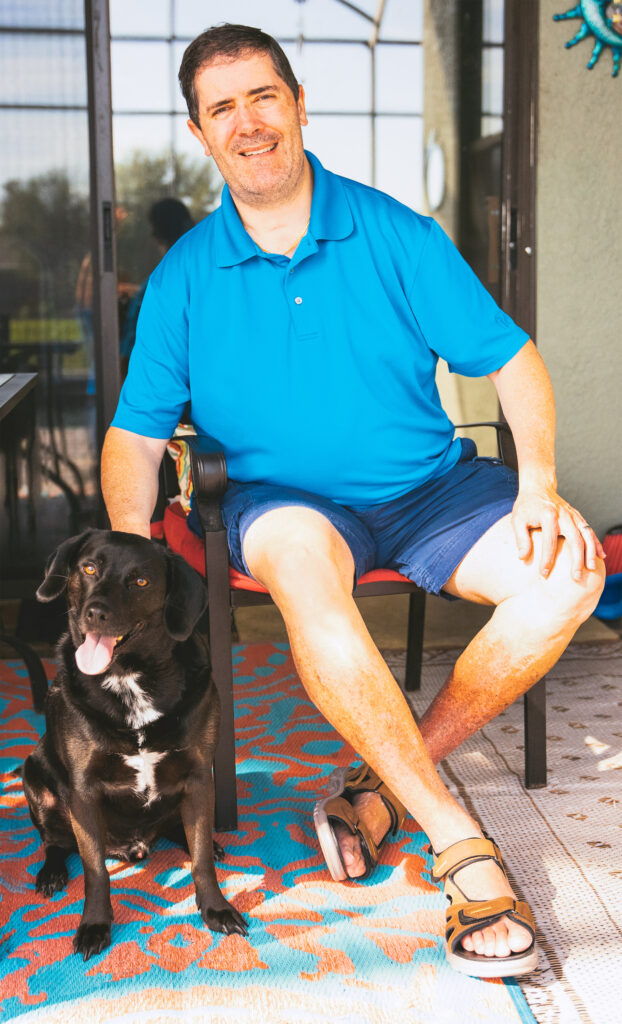
K-Bar Ranch resident Pete Radigan has a story to tell, and he’s been waiting 20 years for people to read it.
On Oct. 4, Tragedy to Triumph: The Story of Tom’s Heart will be officially released for sale by Red Penguin Books.
“Oh my God, I can’t wait,” says Radigan, who moved from New Jersey to K-Bar Ranch in 2019. “If there was ever a made-for-TV (story), this book is it.”
Decades in the making, it is the personal story of Radigan’s battle with his health, his life-saving heart transplant and Jan Mauk’s healing from the loss of her son Tom, the teen whose heart keeps Radigan alive, and the rare relationship between the parent of a donor and the donor recipient.
Radigan says he and Jan have talked about writing the book for many years. Radigan, who had kept a journal during his long hospital stays while waiting for a transplant, had written his version of it years ago, and Jan surprised him with her version at Christmas in 2018.
A friend of Radigan’s, writer Jim McGrath, weaved it all together.
“Over the last 10 years, when was the last time you heard of a major story about organ donation?,” Radigan asks. “They are few and far between. This book talks about what the experience is like from the view of the mother of a deceased donor — how she felt and went through the grieving process — and also about the recipient and what they go through together. It’s the first time something like this has been catalogued in a book. I feel like it’s a healing guidebook for those on both sides of the organ donation process.”
Born on Staten Island, NY, in 1965 and raised in East Windsor, NJ, Radigan’s story certainly is unique.
In 1987, he was first diagnosed with hypertrophic cardio myopathy, which is an enlargement of the heart. It was later discovered he was actually suffering from Emery Dreifuss muscular dystrophy, which affects the heart.
By age 30, Radigan’s health had deteriorated to the point where he was having difficulty walking up stairs. He says he was teaching a corporate class in Orange County, CA, and couldn’t even wear shoes because his feet hurt so much. He was unknowingly already in end-stage heart failure.
“I thought, ‘When did I get in such bad shape?,’” he recalls. “I was embarrassed.”
Radigan returned to the east coast and underwent a battery of tests that made it official. He needed a heart, or, his doctors told him, he was going to die.
That led to months in the hospital. His first transplant was canceled after Radigan, surrounded by his family, had been prepped for the surgery. The heart he was to receive, doctors said, was damaged.
A week later, at 7:15 p.m. on Aug. 4, 1997, a new donor heart had been found, and Radigan received his heart at the New York Presbyterian Medical Center.
Just two days earlier, 16-year-old Tom Mauk was driving his motorcycle when a car struck him and sent him flying more than 150 feet.
Jan says she struggled for a day with the decision to donate Tom’s organs, but knew that was what her son would have wanted.
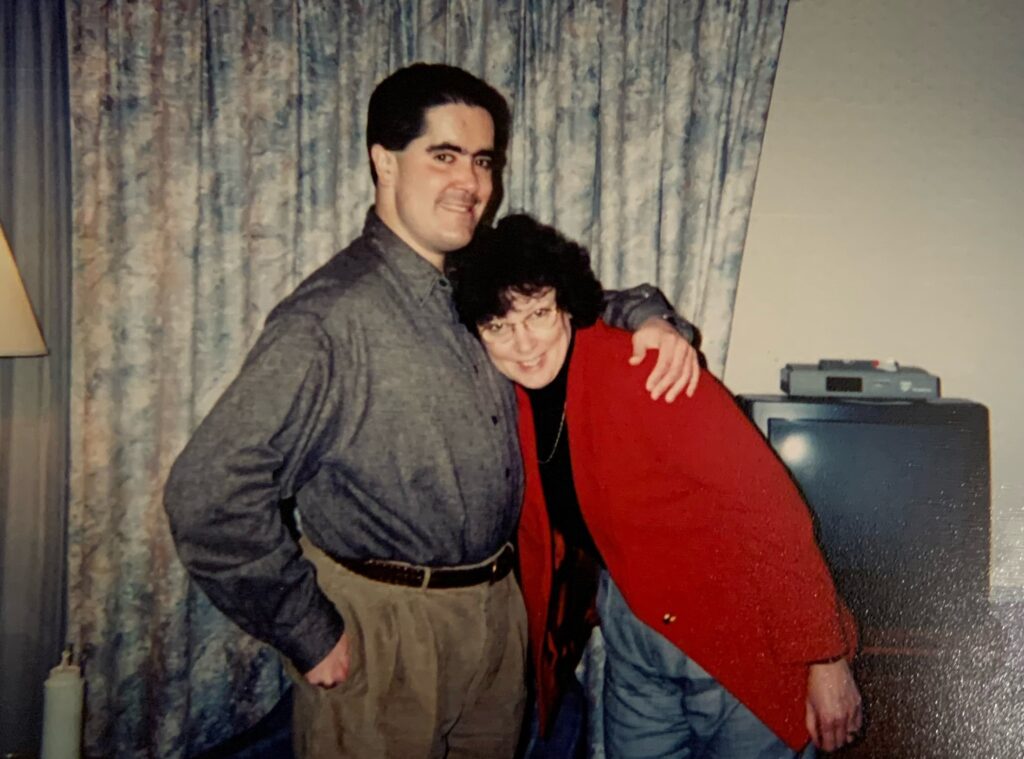
Jan listening to her son’s heart. Pete described the moment as one of the most emotional of his life.
On Sept. 13, Radigan walked out of the hospital with a cane and a new lease on life.
Jan mourned.
That’s the tragedy. The triumph came more than a year later, when, after a few letters back and forth, Pete and Jan agreed to finally meet on Feb. 5, 1999, in Niagara Falls in Toronto.
Radigan says it was one of the most emotional moments of his life. He brought Jan flowers and asked her if she wanted to listen to her son’s heart. She leaned in and pressed her ear to his chest.
“It was not like listening to the quality, rhythm, or rate of a heartbeat or detecting arrhythmias, which I practiced as a nurse,” she wrote. “Listening to his heart brought a connection to Tom, joy to my soul, in contrast to the previous sadness, as tears formed in my eyes….The sound of his heartbeat was a melody to my ear, as I wanted to permanently affix my head to (Pete’s) chest to hear it continually. It brought comfort to me.”
Radigan says that the last third of the book details their friendship, and includes the letters and emails they wrote to each other over the years.
“When I asked Jan what made her want to write the book, her answer was pretty simple: ‘It gave me the opportunity to leave a legacy for my son, the man he was and the gifts he provided,’” says Radigan.
For Pete Radigan, it was another chance to say “thank you.”
To purchase the book or for more information on donor and tissue donation, visit TragedyToTriumph.net. Tragedy to Triumph will also be available from Amazon, Barnes & Noble and Google Books.
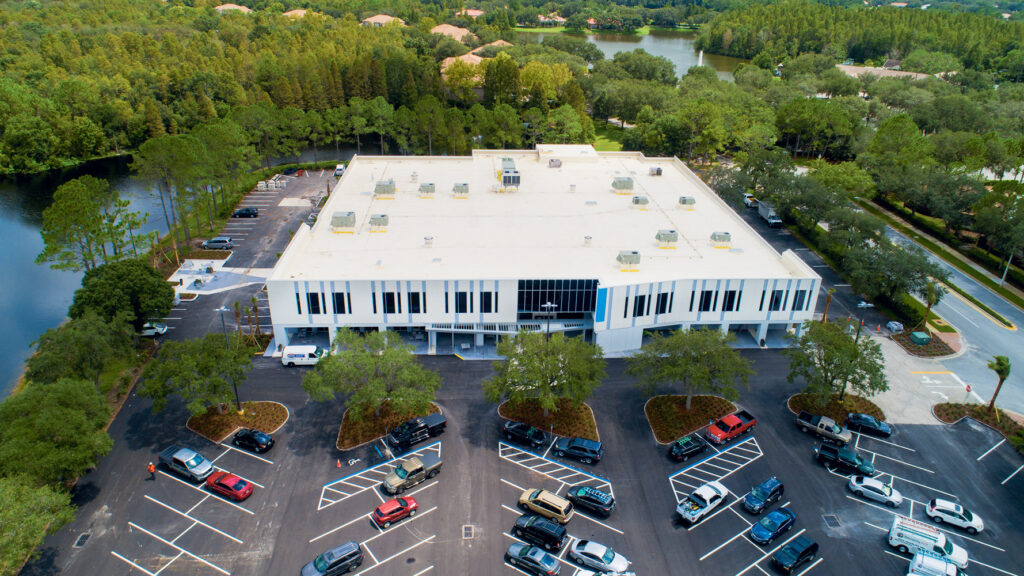
The 50,000-square-foot AdventHealth Care Pavilion at Hunter’s Green is now open in the former LifePoint Church building on Bruce B. Downs Blvd. at Hunter’s Lake Dr. (Drone photo by Charmaine George)
Going to the doctor may never be described as a fun experience. From the dreary waiting room to being shuffled in for the poking and prodding to the inevitable stop at the pharmacy on the way home or, even worse, a separate trip to another dreary waiting room at an imaging center or somewhere else for more tests, it’s an experience many people aren’t thrilled to go through.
However, AdventHealth Care Pavilion is opening on Sept. 14, and is happy to try and change some of that.
Located on Bruce B. Downs (BBD) Blvd. at Hunter’s Lake Dr. in front of Hunter’s Green, the area’s newest facility also is its most innovative. The emphasis was on taking everything that patients find most frustrating about going to see a doctor and improving it.
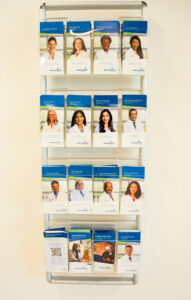
That means easier and more convenient registration, modern waiting rooms and in addition to being home to eight primary care physicians, there will be no need for additional trips elsewhere in most cases because the new facility boasts in-house labs, imaging for x-rays and MRIs to name a few, and even a pharmacy.
“We tried to think through some of the little things that make it easier and more convenient and comfortable for people,” says John Johannessen, senior executive officer for non-acute services in the West Florida division of AdventHealth. “That’s the mindset of what a care pavilion is. We make it easier, make it comfortable and add a higher level of service so it’s just simply a destination location that you want to come to for your care and to stay healthy.”
Johannessen says AdventHealth is so serious about making it a pleasant experience, they hired a longtime Disney hospitality employee who will be specifically dedicated to the building’s consumer experience.
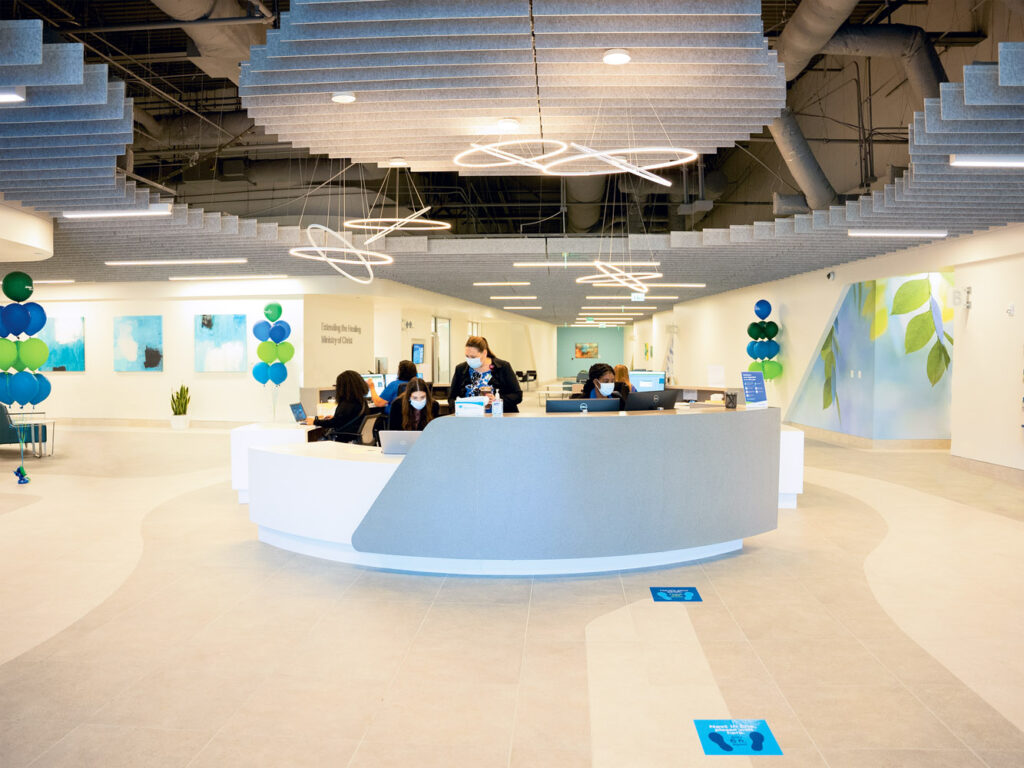
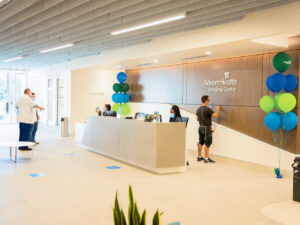
In fact, Johannessen doesn’t call it a reception desk that greets you upon entering, he says it’s more of a concierge-level welcome center.
“Obviously nobody likes registering,” he adds. “You register for the doctor and then when you have to go for the lab, you have to register for the lab, and then when you need to go get an image you have to register for the imaging. It’s a nightmare. It’s easy for people to say, ‘Why don’t you already have this information, why do I have to tell you this 10 times?’”
In addition to primary care, there will be other offerings, like subspecialties offered, such as cardiology, gastroenterology, obstetrics and general surgery. By the end of the year, Johannessen expects to have a pediatrician on staff as well.
While it is not labeled as an urgent care, the pavilion will accept walk-ins and can provide emergency care.
The facility is roomy, going more for an open-air mall type of feel than your traditional doctor’s office. A lot of thought has been put into the light, the music and even the colors, according to Johannessen, so a better mood and tone can be set.
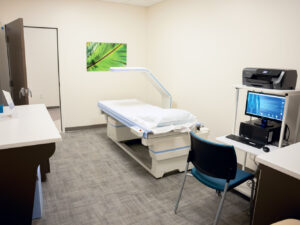
When you are brought to your exam room, that’s where everything, even bloodwork, will happen.
When you are brought to your exam room, that’s where everything, even bloodwork, will happen (unless you need an X-ray, which is just a short walk away).
The focus is on connecting services for the convenience of patients.
Another convenience – a kids club for families who have children and can’t find a babysitter. The hours at the Advent Health Care Pavilion are Monday-Friday 7 a.m.-7 p.m., and 8 a.m.-5 p.m. on Saturday, so parents have flexibility and don’t have to schedule their doctor visits around childcare or work.
‘We try to make it easy,” says Johannessen , who adds that the pavilion will initially be closed Sundays but the goal is to add enough to make it a seven-days-a-week facility.
The pavilion also offers a café, although it won’t be ready on day one at the New Tampa location. But, until it is ready, there will be a refreshment center.
The on-site Imaging Center will offer a separate women’s suite, focused on services that are important to them, like mammograms.
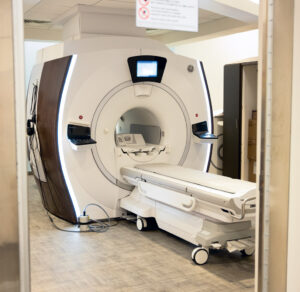
Imaging also has a large-bore MRI, which is the same as a traditional MRI but has a larger bore opening that adds more comfort and less stress for those who may suffer from claustrophobia.
“We tried to think through (many) of the little things that make it easier and more convenient,” says Johannessen.
The Hunter’s Green location actually is the second Care Pavilion center opened by AdventHealth. The first one opened in Westchase in June, to great response , according to Johannessen. But, the New Tampa location, which is roughly 50,000-sq.-ft. compared to its 20,000-sq.-ft. counterpart across the county, has more room to offer and room for expansion as well.
AdventHealth had been looking for a site somewhere along BBD for a year, and had all but settled on one when the previous owners of the property, which was most recently home to LifePoint Church (and Winn-Dixie before that) elected to sell.
The new site was perfect — close to an intersection, linked to a large community like Hunter’s Green, and was the right size with plenty of parking. “It checked all our boxes,” Johannessen says.
And, that is exactly what he hopes the AdventHealth Care Pavilion at Hunter’s Green will do for those looking for quality, innovative and easy-to-navigate healthcare.
The AdventHealth Care Pavilion at Hunter’s Green (8702 Hunter’s Lake Dr.) is now open. For more information, call (813) 467-4700 or visit AdventHealthCarePavilion.com.
When City of Tampa Mayor Jane Castor presented her $1.8-billion fiscal year 2022 budget to the Tampa City Council on August 5, it did not include any money for one of Council member Luis Viera’s sought-after projects — the repaving of Tampa Palms Blvd.
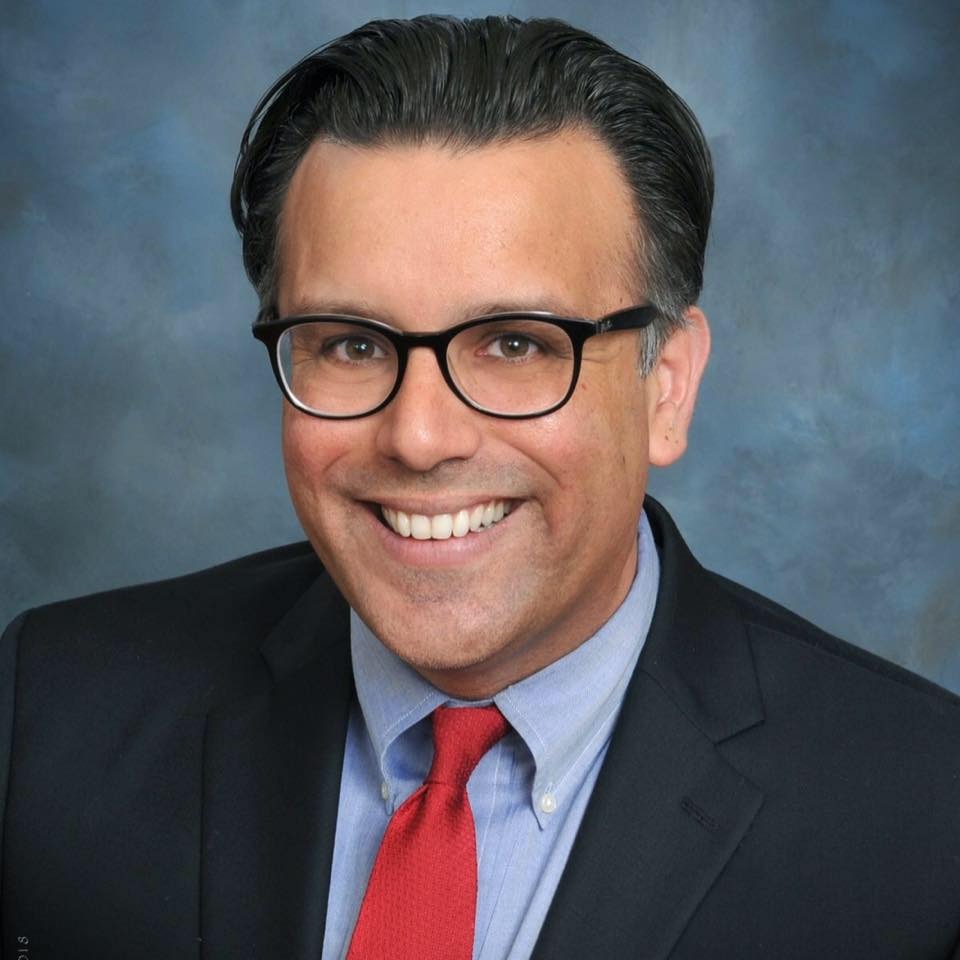
Viera, who represents District 7 (which includes most of North Tampa and all of incorporated New Tampa), was crestfallen. But, while he understood some of the budget constraints, he didn’t give up hope.
With the urging of community activists and Tampa Palms residents — many of them the same folks who fought for the funding for the New Tampa Recreation Center (NTRC) a few years ago — as well as plenty of Viera’s own door pounding, Mayor Castor announced on August 24 that an additional $3.3 million would be added to the budget to repave and rejuvenate Tampa Palms Blvd.’s south loop.
“That is a really, really, really big thing,” Viera says. “It’s a big win for our area.”
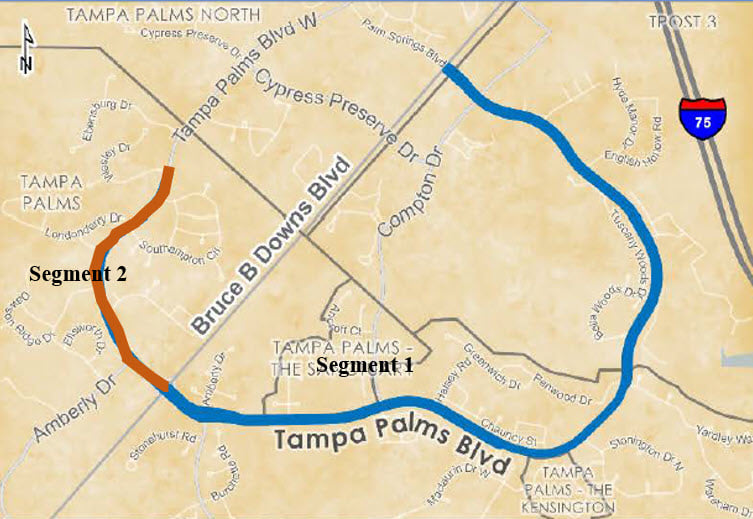
For the south loop, or segment 1, the price tag is $2.3 million. The north loop, which runs from Bruce B. Downs (BBD) Blvd. to Ebensburg Dr., will cost is $1 million.
The final public meeting on the budget is scheduled for Tuesday, September 28.
Luis Viera
Money for the Tampa Palms Blvd. repaving was originally expected to come from the $500 million raised via the All for Transportation one-cent surtax. However, the penny surtax was struck down by the Florida Supreme Court in February, ironically a day after Viera met with Tampa Palms residents at a town hall.
“I promised the residents that night that if the penny sales tax failed that I would fight really hard for it in this year’s budget,” Viera said. “Flipping it into the budget when it wasn’t originally there was a big ask.”
Viera pushed for the money, with an assist from local activists — who made phone calls and sent emails to Mayor Castor.
One Tampa Palms resident, Mike Marlowe, wrote to Castor on Aug. 21 that his community had been promised repaving of the road “which now looks like a quilt instead of a roadway” — last year. He added that in 22 years of living in New Tampa, he has “never seen the road this bad.”
A week later, Brandie Miklus, the city’s infrastructure and mobility program coordinator, responded to Marlowe with the good news — that the city’s mobility department was moving forward with resurfacing plans.
In her address to the City Council, Castor seemed determined not to let the Florida Supreme Court decision freeze her efforts to improve the city’s infrastructure needs.
“I won’t sugar coat how big a blow it was to lose the All for Transportation money that was so overwhelmingly supported by our constituents,” Mayor Castor said. “I will provide a path to forge ahead on our own, one that includes a citywide mobility plan.”
Castor’s budget includes $22 million for road safety and maintenance. “We’ve all heard the calls from our community to make our streets, sidewalks and trails safe and to improve our road maintenance,” she said.
A refreshed Tampa Palms Blvd., which Viera says is presently “a failed road,” is currently in the design phase (the money for which was in last year’s budget), with actual construction occurring in two phases and expected to begin within the next year.
According to Miklus, it will include resurfacing, multimodal and safety improvements, traffic calming, enhanced crosswalks with Rectangular Rapid Flashing Beacons (RRFBs) and separated bicycle lanes.
After years of complaints about being ignored by the City of Tampa, this could be a year in which New Tampa’s cup runneth over, as a number of New Tampa projects are in the city’s plans to receive money. In fact, after the first public hearing on Sept. 13, Viera was pleased enough to say this year’s budget could be the best for New Tampa in recent memory, if not ever.
The budget has $1.67 million scheduled for the long-awaitd inclusive playground, which will have play elements, wheelchair access and autism-friendly features, to be built near the New Tampa Recreation Center (NTRC).
The FY 2022 budget also includes $650,000 to begin the planning and design of Tampa Fire Rescue Station No. 24, which will be located in the K-Bar Ranch area. Another $11.5 million is expected to be allocated in the FY 2023 budget for construction of what would be New Tampa’s fifth fire station.
Until then, Viera says he also is working on the construction of a possible road off Morris Bridge Rd. that would allow for quicker access into K-Bar Ranch to help reduce some of the response times of the two fire stations on Cross Creek Blvd., both of which rank among the slowest in the entire Tampa Bay area.
Viera also said the budget includes $50,000 to design New Tampa Blvd.’s future renovation ($50,000), hopefully leading to its repaving in the next year or two. Like Tampa Palms Blvd., New Tampa Blvd. was initially slated for improvements using All For Transportation money.
As backers of the NTRC know, just because the money is in the budget for a project doesn’t mean it can’t be moved or taken out.
The budget has to be approved by Friday, October 1.