Commissioners Talk Affordable Housing After Vote Opting Out Of ‘Live Local’ 

What the vote means for two Wesley Chapel properties & what Pasco County’s affordable housing plans are moving forward 

The Tapestry at Cypress Creek apartments, located at the intersection of Wesley Chapel Blvd. and S.R.s 54 & 56, is one of two existing apartment communities that have applied to greatly reduce their property taxes under Florida’s “Live Local” law. (Source: TapestryCypressCreekApartments.com) 

When the Pasco County Board of Commissioners (BOC) voted unanimously on May 21 to opt out of a portion of the state’s recently revised “Live Local” law that was originally passed last year, it didn’t stop the BOC from continuing to look to find other ways to bring affordable or “workforce” housing to the county. 

“We all agreed that although those in the workforce need more affordable housing,” says District 2 Commissioner Seth Weightman, “Live Local just did not seem to accomplish that goal.” 

To that end, Pasco’s senior assistant county attorney David Goldstein made a presentation to the commissioners at their May 21 BOC meeting which summarized the reasons why the county was choosing to opt out of the provision of the Live Local law (pushed by Senate President Kathleen Passidomo during the 2023 State Legislative session) that was modified towards the end of the 2024 session to allow local jurisdictions the opportunity to “opt out.” 

Pasco, led by Comm. Weightman, was at the forefront of the fight to get the law changed during this year’s session, as one of the two properties that applied for the Live Local tax break — the Tapestry at Cypress Creek apartments (where Jannah and I have lived the past five years, since the complex first opened), where Wesley Chapel Blvd., S.R. 54 and S.R. 56 meet — is located in his district. I can personally vouch for what Comm. Weightman said at the May 21 meeting: 

“That complex has been around for a number of years and was never intended to be an affordable housing project. It’s Class A multifamily living with amenities, right next to Wesley Chapel and the Outlet Mall.” 

Goldstein outlined the conditions that will allow the county to opt out of the 80%-120% of Average Monthly Income (AMI) provision of Live Local for 2025, although both Tapestry and a complex in the Trinity area both already have applied — but neither one had yet been granted that exemption by county property appraiser Mike Wells at our press time — for 2024. 

The 80%-120% provision allows rental communities to receive the Live Local tax exemption if their units rent for 80-120% of the AMI for an individual in Pasco County, which Goldstein said worked out to rents averaging about $2,000 per month. “These $2,000-per-month rents are not what our school teachers, county employees, firefighters and law enforcement officers can afford,” Goldstein told the commissioners. “It doesn’t make sense to give large tax exemptions essentially to complexes that are charging market rate rents with no charitable purpose.” 

He added that Pasco also has a large surplus of apartments in that 80-120% range. 

“Our deficit is only in rental units charging less than 80% of AMI, which is truly affordable or workforce housing,” he said. “But, we don’t have any communities offering rents under that 80% AMI range coming before you for approval.” 

Goldstein also noted that even with the changes to the Live Local law, Pasco is still grouped with Hillsborough, Pinellas and Hernando counties in the Tampa Bay Metropolitan Statistical Area (MSA), which is what is being used to determine if a community already has a surplus or a deficit in the number of rental units in the 80-120% AMI range, “So although our MSA has a surplus of 3,994 units at present, even if Pasco has a surplus in the future, but Hillsborough or Pinellas has a large enough deficit to more than offset our surplus, we might not be allowed to opt-out of Live Local in the future. I’m hoping the law will be refined again in the next legislative session.” 

He also said he hoped that other counties in MSAs with surpluses of the 80-120% AMI units will follow Pasco’s lead and opt out of the law. 

Pasco County’s senior assistant county attorney David Goldstein provides information about the changes to the state’s Live Local law to the county’s Board of Commissioners prior to the BOC’s vote to opt out of a portion of the state law regarding affordable housing. (Photo: Screenshot from Pasco BOC meeting) 

Goldstein also told the commissioners that counties that still qualify under the provisions of the law will have to opt out every year, and that the apartment complexes trying to receive the tax breaks also will have to apply for those breaks every year. 

“Fortunately, we only have the two complexes who may be able to receive the tax break this year,” he said, “but even just for this year, the county would lose 75% of the $1.7 million the two complexes paid in taxes last year (or more than $1.275 million combined)” if Wells does allow them to receive the Live Local tax break for 2024. “But, we can only opt out of Live Local for county taxes,” he added. “I have drafted a letter to the Pasco School Board, Mosquito Control District and the cities in the county instructing them to also opt out of the 80-120% AMI provision of Live Local for 2025.” 

Goldstein also mentioned that there are flaws in the way the data that would allow Pasco and other jurisdictions to opt out of Live Local is being used. 

“We can only opt out if the latest University of Florida Shimberg (Center for Housing Studies) Report, which uses American Community Survey data (based on the Census) shows that our Tampa Bay MSA has a surplus of rental units in the 80-120% AMI range,” he said. “But, that does not include recent construction — it’s always two years behind. If we have a recent apartment complex — and we have a lot of recent apartment complexes being built — it’s not counting those in the surplus inventory. We did raise that as a concern and we’re hoping it’s something else that can be refined during the next Legislative Session. The problem is that the Shimberg Report could show we have a deficit when we actually have a surplus on the ground.” 

He also noted that of all of the large counties in the state, only Broward and Miami-Dade counties have large deficits of units in the 80- 120% AMI range, “So it seems like this state law was enacted only to help southeast Florida. The law really should only be applied to those areas.” 

Goldstein also noted that the change in the law for 2025 only applies to tax breaks for existing communities, “So we’re hoping to get the land use part of the law changed during next year’s session. If we don’t have a deficit of those units, why should we have to give up job-creating commercial and industrial properties in the future to have more of them?” 

Pasco’s five commissioners — including new Dist. 4 Comm. Lisa Yeager in her first BOC meeting since being appointed to fill the seat of the late Comm. Gary Bradford by Gov. Ron DeSantis — voted unanimously to approve opting out of the tax portion of Live Local. 

Even so, at the insistence of Dist. 5 Comm. Jack Mariano — despite the fact Goldstein said it wasn’t necessary to do so — the BOC also voted 5-0 to draft a letter to the property appraiser asking him to not grant the exemption to the two rental communities that applied for it for 2024. “I’ve been in constant contact with Mr. Wells’ attorney’s office,” Goldstein said. “They’re well aware of how we feel about this.” 

Talking Affordable Housing 

Following their regular BOC meeting, the commissioners held a workshop on what Pasco can do to provide more affordable housing options for those in the workforce — county employees and others — especially after Goldstein noted during the regular BOC meeting that Pasco does indeed have a shortage of affordable units for those whose monthly incomes are below the 80% of the county’s AMI. 

The workshop was led by Cathy Pearson, Pasco’s assistant county administrator for public services, who said she was discussing affordable housing with David Lambert, the chairman of the Pasco Housing Authority and the Executive VP and general manager of the Withlacoochee River Electric Cooperative, “And we both said we have never had an affordable housing plan for Pasco County. David took me to his Pasco Housing Authority Board and convinced the Board to pay for this study for us,” Pearson said. “How wonderful.” 

She also said that for the year-long study, “affordable housing was defined as housing that costs less than 30% of a household’s income.” For someone earning Pasco’s average median income of $63,187 per year, an affordable rent would be $1,579 per month, although starting teachers and many other workers only earn about 80% of that median income, so those workers could only afford rents of $1,263 per month or less. 

Among the options put forth by the study to help increase affordable housing options in Pasco include legalizing “accessory dwelling units,” sometimes called backyard homes or “granny flats,” adding duplexes or even quadraplex units in existing single-family communities, the possibility of requiring developers to include or pay for affordable housing in their unit totals to receive approval for those developments, as well as expanding some kinds of public rental or home-buying assistance. Goldstein also noted that the county already has reduced mobility and impact fees for developments that include affordable housing. 

Pasco Planning & Economic Growth director David Engel says the county is expected to add more than 101,000 workers to fill the jobs in the projects that are already under design or that the Board has already approved. 

“So we’re going to have a tremendous need for housing in the future for that workforce.”

MPO Discusses The ‘Innovate Pasco 2050’ Transportation Plan At Chamber Meeting 

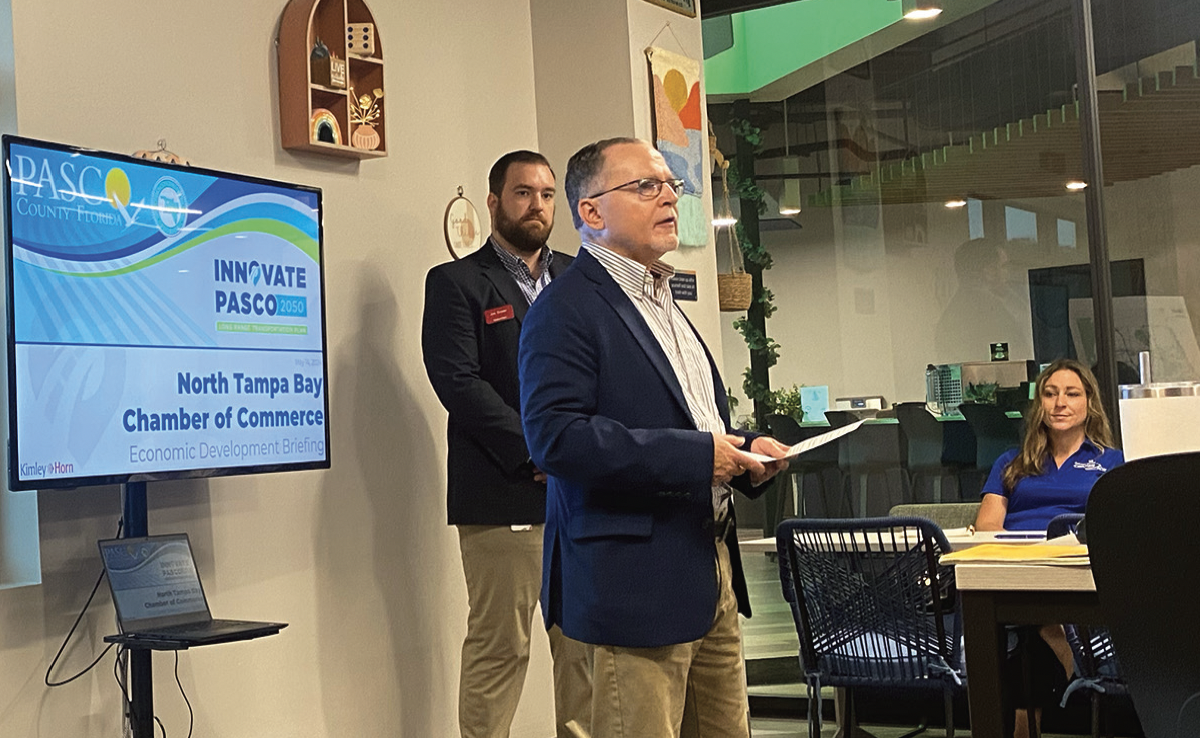
Pasco MPO principal transportation planner Scott Ferry (front) and Joe Crozier of Kimley-Horn, discuss the “Innovate Pasco 2050” Long-Range Transportation Plan with members of the North Tampa Bay Chamber. 

Even with all of the transportation improvements completed over the past few years, there’s no doubt that the roads in Pasco County in general — and the Wesley Chapel area in particular — are a lot more crowded today than they were before those improvements were finalized. Without a long-term transportation plan in place 20, 30, or even 50 years ago, however, our traffic situation would unquestionably be far worse. 

To that end, representatives from (and the private firm working with) the Pasco Metropolitan Planning Organization, or MPO (the county’s federally-funded primary transportation planning entity), have been making the rounds throughout the county to ask people what planned road improvements should be prioritized between 2025 and 2045. 

The MPO’s long-term transportation plan, dubbed “Innovate Pasco 2050,” was presented to about 25-30 North Tampa Bay Chamber (NTBC) members at the Chamber’s monthly Economic Development Briefing on May 14 at its Suncoast Office off S.R. 54 in the Bexley community of Land O’Lakes. 

“The MPO’s mission is to find out what the transportation needs are for the county and develop solutions for those needs,” said Scott Ferry, the Pasco MPO’s principal transportation planner. “One of the ways that we accomplish this mission is by meeting with the public throughout the county, which is what we are doing here today.” 

Ferry also explained that the MPO is governed by a nine-member Board which is “comprised of the five Pasco County commissioners and four municipal representatives (from the cities of Dade City, New Port Richey, Port Richey and Zephyrhills). “This MPO Board meets on a regular basis to discuss and make decisions about transportation policies and issues in the county.” 

He said that when the plan is adopted, “it’s going to serve as a guide and a blueprint for county transportation planning for the next five years (2025-29). We’re here to engage with you and see what you believe the transportation priorities should be for the county.” 

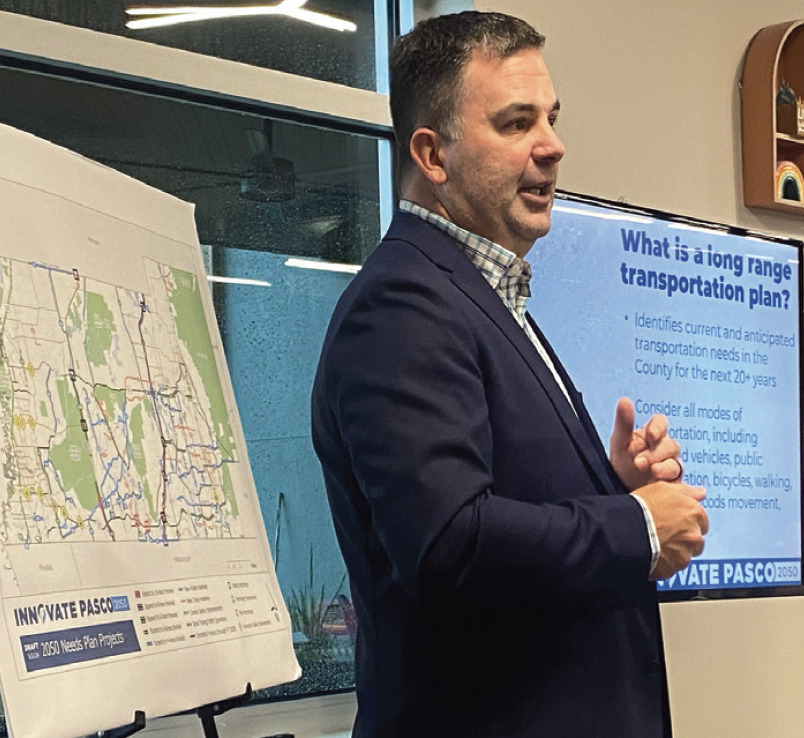
Jonathan Whitehurst of Kimley-Horn explains what a long-range transportation plan is and why it’s important.

He then introduced Jonathan Whitehurst and Joe Crozier of private transportation planning consulting firm Kimley-Horn & Associates, which has been retained by the MPO to assist with the “Innovate Pasco 2050” planning process. 

Whitehurst, a North Carolina resident whom Ferry said has 18 years of experience helping develop transportation plans throughout the country, and Crozier — a life-long Pasco County resident — then explained the process by which MPOs create not only their long-rang plans but also the short-term (five-year) Transportation Improvement Plan (also known as the “work plan”) so planned improvements can be funded by the various government entities, whether state/ federal, local (county and city), or a combination of funding sources. 

“We’re starting with the 2045 plan to see what’s different and what’s changed,” Whitehurst said, “and the short answer is that in the last five years, a lot has changed in Pasco County, which makes our job a little bit harder because we first have to find that baseline condition as to where things are now so we can start to predict where things are going to be in the future.” 

Whitehurst also mentioned that although the primary discussion in MPO plans is usually about roadways, traffic, safety and congestion, “We look at all modes of transportation, including bike facilities, pedestrian facilities, transit, freight and even a little bit of air travel, so it truly is a multimodal transportation plan.” 

He also noted that the MPO and Kimley- Horn started working on the plan in Oct. 2023 and hope to have it finished sometime this month, “so we’ve got quite a bit of work to do to get it done. The plan itself will be adopted later this year. As soon as the MPO adopts the plan, that five-year cycle starts over.” 

He said that where the planners are now is “at the very end of the ‘Needs’ plan, which identifies the universe of possible projects. We took a look at how we think Pasco is going to grow between now and 2050, where our facilities are now, where we have already-funded projects in the future and we said, ‘OK, where are the problem areas?’ And, we found that there are a lot of problem areas. So, the needs plan is trying to address as many of those problem areas as possible, trying to say that if these are the potential problem areas, these are the projects and solutions we are going to need to solve them.” 

Whitehurst noted, however, that there is always, “a big list of projects, but we only have a small amount of money. So then, we have to figure out what are the priorities among the projects that we’ve identified, so that’s where the project prioritization process comes in. We put all of the needed projects on a spreadsheet and see which ones rise to the top.” 

And, speaking of money, Whitehurst said that, “Concurrent with that, we have to see how much money we have to spend on transportation projects, so we take that prioritization list, compare it with the money and see how far down the list we can make it. That’s what we call the cost-feasible plan.” 

Crozier then explained that for the purposes of the study, the county was divided into three sections — west of the Suncoast Pkwy., between the Suncoast and I-75, and east of I-75. And, although the growth in Pasco previously has been on the west coast, the central and eastern areas are now growing faster, “but all of Pasco is growing and all of that growth requires infrastructure.” 

Crozier and Whitehurst also noted that because Pasco continues to add homes and businesses, part of the study looked at the different types of jobs that are coming — especially in the greatly expanding medical field in our area and how those different types of jobs also impact the transportation needs differently. 

And, Crozier admitted that despite the best-laid plans of previous planners, because the county has grown so quickly, “we’re actually hitting now many of the previous projections for 30 years from now. A lot of the growth models, especially after Covid, are just not accurate anymore” and all of that has made the prioritization process a lot more complicated. 

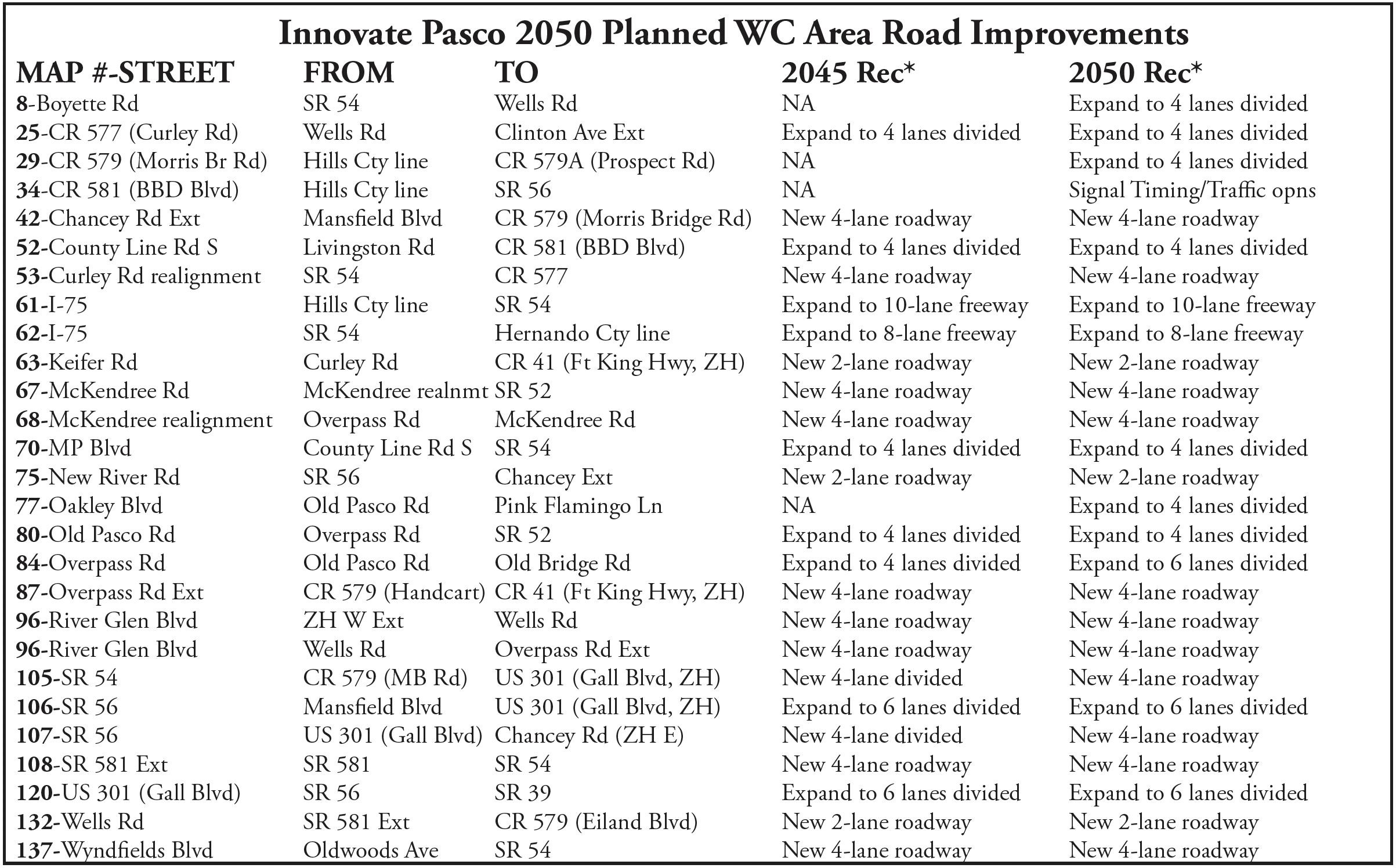
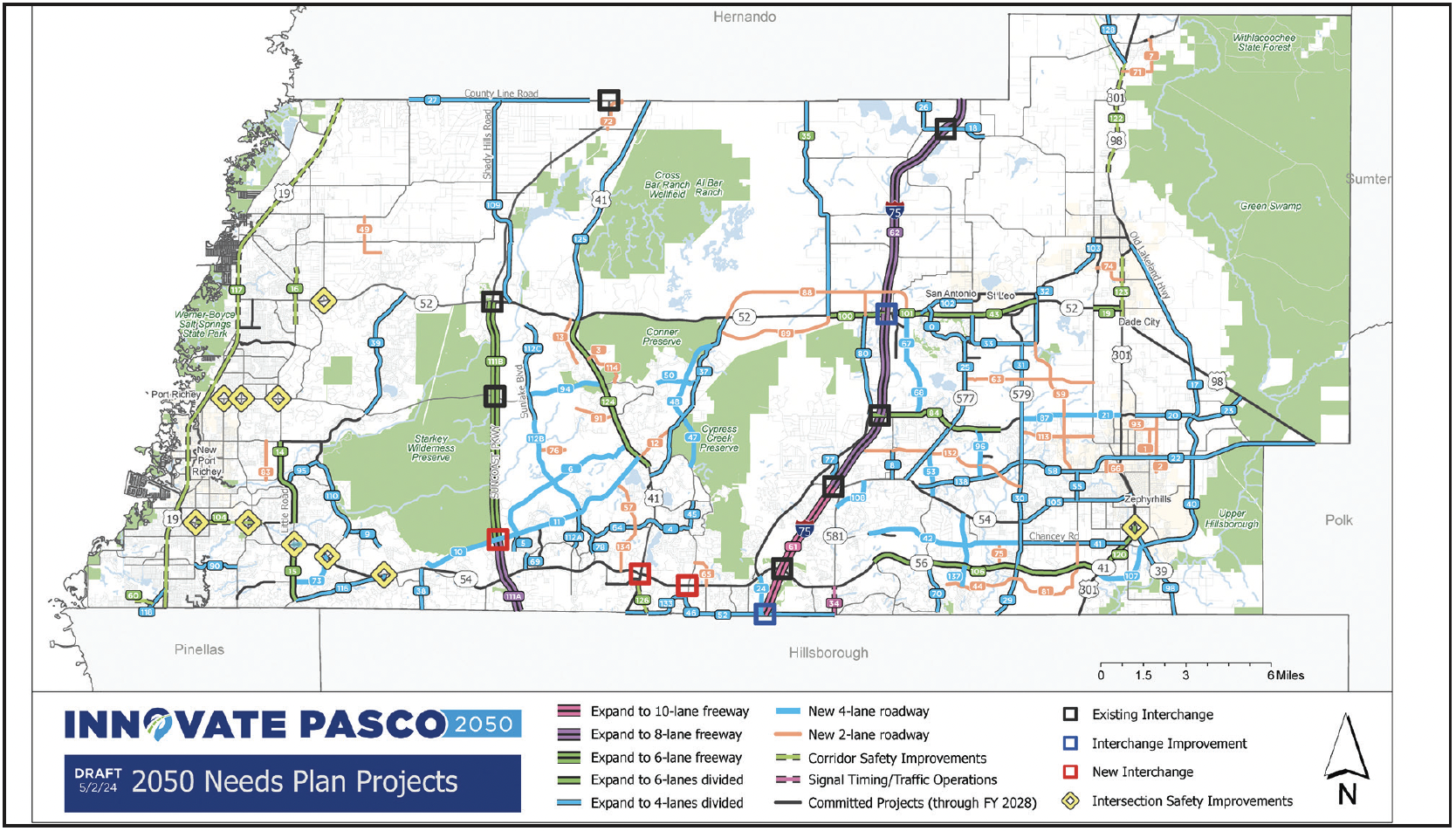
The Pasco MPO’s “Innovate Pasco 2050” long-range transportation plan includes 27 roadway projects for the years 2045-50 that are either in Wesley Chapel or directly adjacent to Wesley Chapel. The “Map #s” shown above correspond to locations on the map at the top of the next page. (Source: Pasco County MPO) 

Although Whitehurst and Crozier presented a countywide list of more than 120 transportation projects that are planned to be funded, we have only shown the 27 planned improvements that either are located in Wesley Chapel, or at least border directly on Wesley Chapel, in the chart on this page. The problem, Whitehurst said, is that “While we would love to have enough money to pay for all of these projects, at the end of the day, we still don’t have enough money.” 

He said that if you want to learn more and provide input on the plan, go to InnovatePasco.com, which has both the complete list of planned projects and the map on the next page in an interactive format that will allow you to zoom in on the areas of the map that might be most important to you and drop ‘pins’ on the map and provide us with comments about those needs and the plan itself. 

“Please spread the word, too, because the more people we can get involved in the website, the more info we can collect.” He noted that earlier this year, there were more than 1,100 people who already had left comments on the website. 

Meeting attendees were given the opportunity to ask questions and make comments following the presentation, and there was agreement that the Diverging Diamond Interchange at S.R. 56 and I-75 has been the most impactful recent transportation improvement and that Wesley Chapel Blvd. is the most-needed improvement in our area. Other complaints expressed at the meeting are the length and lack of synchronization of traffic signals and that it seems like road improvements are always behind development.

Upcoming Events — Commissioner Ken Hagan Hosts Town Hall, Fireworks For the 4th & More! 

Although the graduation events for both Freedom and Wharton high schools will already have been held by the time this issue reaches your mailbox, we wish all of our graduating seniors success in their future endeavors at the Summer of 2024 officially begins. In the meantime, there are some fun and some informative events on the upcoming docket. 

Monday, June 10, 6 p.m.- 8 p.m. — Town Hall Meeting with Dist. 2 Hillsborough County Commissioner Ken Hagan. At the New Tampa Performing Arts Center (8550 Hunter’s Village Rd.). Join Commissioner Hagan for an informative evening of information and an opportunity to ask the Commissioner your questions. 

Wednesday, June 19, 9 a.m.-10:30 a.m. — Coffee Social at the Sara Vande Berg (SVB) Tennis & Wellness Center (6585 Simons Rd., Zephyrhills), hosted by SVB’s Che Sara restaurant. Free coffee, networking & light bites. 

Friday, June 28, 4 p.m.-6 p.m. — NTBC’s “Final Friday” at Main Event (2839 Creek Grass Way, Lutz). Free networking event open to the public. Complimentary appetizers will be served. 

Saturday, June 29, 7 p.m.-11 p.m. — Jazz Night at The KRATE at The Grove Container Park. See story below.

Avalon Park Wesley Chapel off S.R. 54 will again host the only professional 4th of July fireworks show in Wesley Chapel. (File photo: Captured by Arlene) 

Saturday, June 29, 5 p.m.-??? — One-Year Anniversary Party for Azteca D’Oro. Our readers’ 2023 Favorite Mexican Restaurant in New Tampa & Wesley Chapel celebrates its one-year anniversary with a music performance by DJ RicoSmooth at Azteca’s outside bar. This free event also will feature drink specials & giveaways. 

Thursday, July 4, 5 p.m.-9 p.m. — 4th of July Celebration. At Avalon Park Wesley Chapel (4424 Friendly Way., off S.R. 54). Featuring a patriotic bake-off, bike parade (the deadline to register your child and their bike for the parade is July 3), bounce houses, food trucks, community performances & vendors,Wesley Chapel’s only professional fireworks show for the 4th is open to the public and is free to attend. For registration & more info, visit AvalonParkWesleyChapel.com. 

Community Gives Blood In Memory Of Gabriel Hassan 

 Dozens Of Units Of Blood Were Donated To Honor The Wharton Grad Who Died From Leukemia 

Sophia, Mahmoud & Lily Carolyn Hassan, with Gabriel’s Boy Scout uniform at the OneBlood drive on May 10. 
(Photos by Charmaine George) 

 A little more than three months after he passed away from leukemia caused by a rare ailment he had from birth called Shwachman-Diamond Syndrome (or SDS), the family of Wharton High graduate Gabriel “Gabe” Hassan held a community blood drive on what would have been Gabe’s 18th birthday — May 10 — at the Islamic Society of New Tampa’s Masjid Daarusalam on Morris Bridge Rd., just north of Cross Creek Blvd. 

There were three OneBlood Bloodmobiles on hand (photo) at the blood drive, which began a few hours before the regular services at the New Tampa Mosque. 

Dozens of Muslim worshipers, plus members of Gabe’s Boy Scout Troop 148 and fellow Wharton students, as well as District 7 Tampa City Council member Luis Viera and District 67 State Rep. (and House Minority Leader) Fentrice Driskell donated blood in Gabe’s honor and memory on his birthday. 

Gabe’s mom Lily Carolyn (below left photo) and dad, Mahmoud (right photo), were among the 65 people who donated blood on their son’s birthday. Lily Carolyn, who shared her private writings about Gabe and his favorite things with us (see below), said it was the first time she had ever donated blood. 

Lily Carolyn was appreciative of all of the support the blood drive received. “It’s been really difficult with the loss of Gabe,” she told me. “He was the little guy that knew how to light up the room.” 

She noted that the Wharton High PTSA also previously held its own OneBlood drive, where 40 units were donated. 

“My wish for his birthday was to equal or best it,” Lily Carolyn said. “God is great. We beat it by 25 units.” She also noted that the 65 units of blood collected could help save 195 adults or 390 babies. 

“I also ordered 18 mini red velvet bundt cakes from Nothing Bundt Cakes for those who came early to the blood drive to celebrate Gabe’s birthday. It was his favorite.” 

Speaking Of Favorites… 
The first page of the journal Lily Carolyn has been keeping in memory of her son and his favorite things. 

Since the day he passed, Lily Carolyn has been making entries in a journal to keep the memory of Gabe alive. “This journal has all your loves and dislikes,” she wrote. “You were supposed to bury me. You were becoming the young man your daddy and I were starting to see. You wanted to go to USF and go into the field of biomedical engineering and help daddy with billing on the side.” 

The next several pages are filled with Gabe’s loves and dislikes, including: 

Favorite Foods — Pad Thai noodles, sweet sticky rice, sushi and poké bowls (especially from Bonefish), Ford’s Garage mushroom burger w/onion rings, calzones from Anthony’s NY Pizza, Panera tomato soup, Cinnamon Toast Crunch, Chick-fil-A spicy chicken sandwich, cinnamon bun w/ vanilla glaze, Mom’s pancet w/mushrooms, Star Wars edge of the galaxy green shakes from Luke’s aunt…and many more. 

Favorite Movie He Can Watch Over & Over Again — “Mario Bros. 2023” 

Something He Has Done With The Hassan Family That He Will Never Do Again — Scuba diving 

Other Favorites — Hanging with family & friends, eating at restaurants, hanging with his birds (Georgio, or “Gremlin,” Sim Sim & Flappy), going to Best Buy and going to movies with Popa Greg. He loved the Boy Scouts and hanging with his fellow Scouts, helping with service projects, food pantry/distribution… Gabe loved learning and was curious of the world. He loved life & his family. 

Least Liked Merit Badge He Completed — Fishing, “Which is funny, as he loves eating fish. He just didn’t like the process of gutting & cleaning it out.” 

Lily Carolyn also shared that SDS, which ultimately caused Gabe’s leukemia, afflicts only one person in 80,000. It also stunts normal growth as its victims age, “Even before he died, Gabe was only 4’-10” tall, shorter than his sister Sophia (Gabe called her ‘Soph Soph’), who is 5’-4” at only 12 years old.” 

She also noted that in the photo above she sent me, Gabe and Sophia volunteered at Ronald McDonald House, “Not knowing we were going to be on the other side…the recipients. We taught them young the important value of giving back to the community.” 

Thank you for this info, Lily Carolyn. 

Upcoming Events — Graduation Ceremonies, ‘Final Friday’ & More!

The end of the 2023-24 school year brings not only separate graduation events for each of Wesley Chapel’s three local public high schools, but also the start of the Summer of 2024 for all local students. 

You’d think that the calendar of events for our area would slow down as the summer kicks off, but there is still plenty to do in and around Wesley Chapel.

Saturday, May 25, 7 p.m.-11 p.m. — Jazz Night at The KRATE at The Grove Container Park.  

Friday, May 31, 4 p.m.-6 p.m.. — The North Tampa Bay Chamber presents “Final Friday.” This free networking event will be held at the Hilton Garden Inn Tampa- Wesley Chapel (26640 Silver Maple Pkwy.). 

For more information, visit NorthTampaBayChamber.com 

Friday, May 31, 4 p.m. — Cypress Creek High Graduation Ceremony. At the USF Yuengling Center. 

Friday, May 31, 7 p.m.-11 p.m. — R&B Night at The KRATE at The Grove Container Park. See story on next page. 

Saturday, June 1, 5 p.m. — Wesley Chapel High Graduation Ceremony. At the USF Yuengling Center. 

Monday, June 3, 5 p.m. — Wiregrass Ranch High Graduation Ceremony. At the USF Yuengling Center. 

Friday, June 7, 5:30-9:30 p.m. — The Market Elaine. At the Village at The Grove, with 150+ vendors, free admission & free parking. For info, visit TheMarketElaine.com