Talking Impact Fees With New North Tampa Bay Chamber Chair Tony Benge

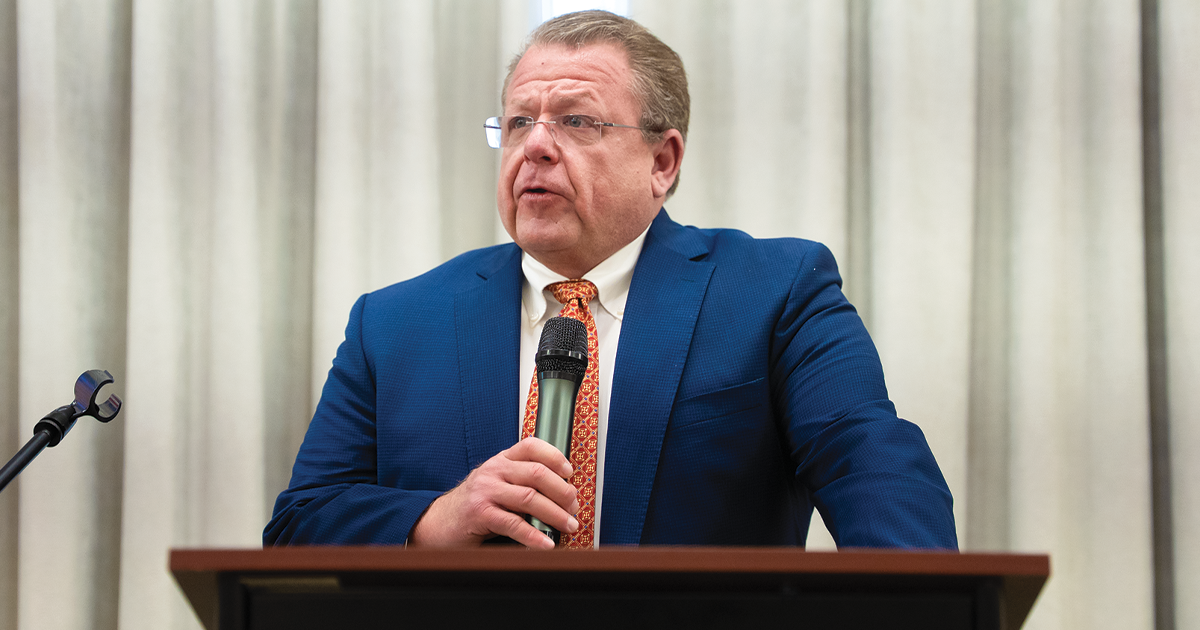
NTBC Board chair Tony Benge

The first time I ever met new North Tampa Bay Chamber (NTBC) Board chair Tony Benge was at the NTBC’s annual meeting back in December, when he was sworn in with the rest of the NTBC’s 2026 Board of Directors and we were introduced to each other by NTBC president and CEO Hope Kennedy. 

At that time, Mr. Benge and I agreed that we should sit down to discuss his vision for his tenure as the new Chamber Board chair, as well as his primary role as the president of Benge Development Corp., which has been based in Orlando since 1994, but also has one current development project in Pasco County and recently had its original Pasco development plan denied by the Board of County Commissioners. 

Although neither of those projects is located in Wesley Chapel, the denied “Fletcher Project” (more on that below) was located at the intersection of S.R. 52 and U.S. Hwy. 41 in Land O’Lakes, immediately adjacent to the Moffitt Speros campus we told you about last issue. 

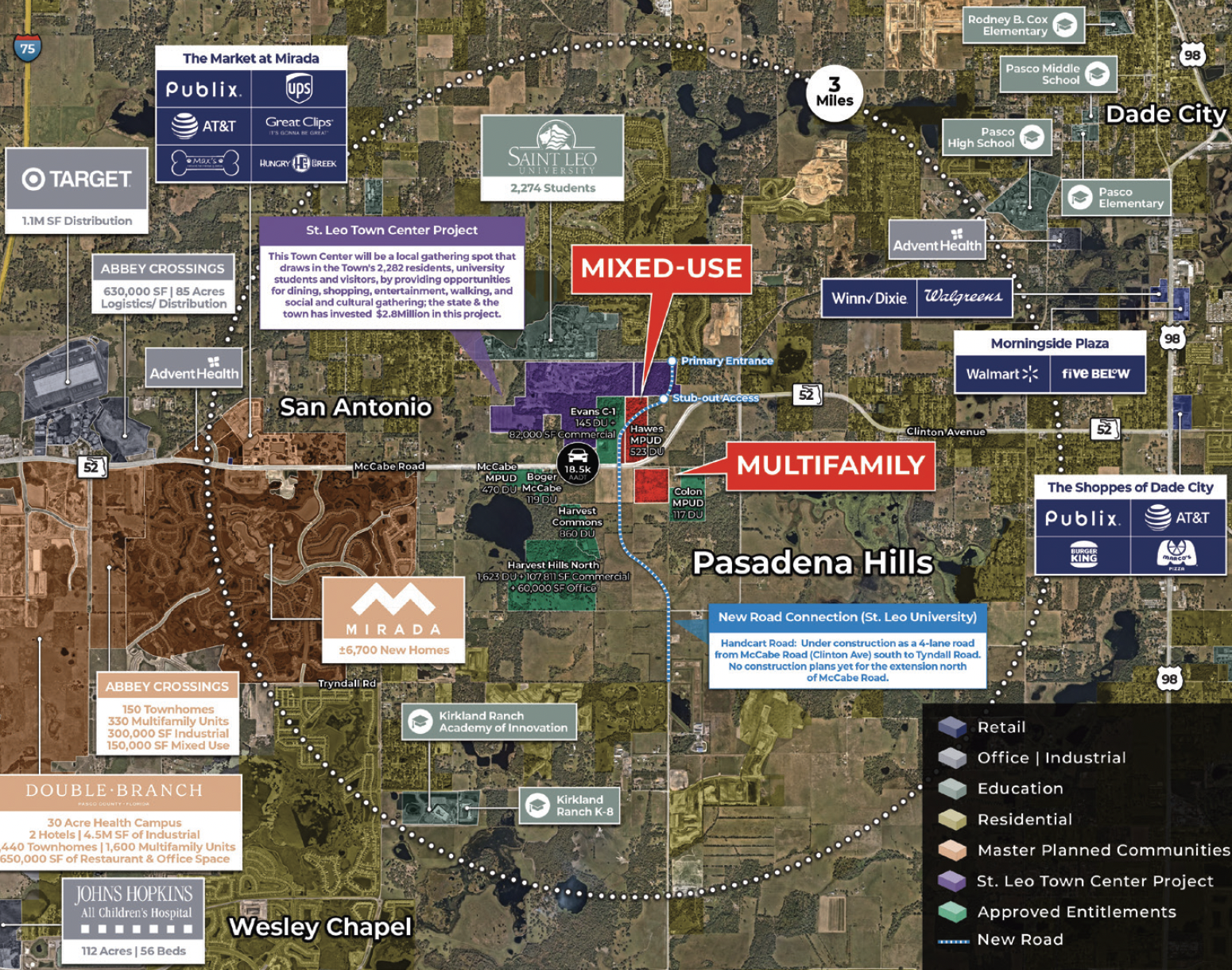
The other project, called the Hawes MPUD, which is moving forward, sits north of Wesley Chapel and east of the Mirada development. both north and south of S.R. 52, east of Handcart Rd. in San Antonio, and is approved for up to 523 multi-family units (see map below). 

His Benge Development Corp. has developed more than 30 large-scale projects, mainly in Orlando and Apopka, FL. 

Benge, who introduced Florida’s Lieutenant Governor Jay Collins at the NTBC Business Breakfast on Feb. 3 (see story on page 8), also asked Lt. Gov. Collins about mobility and school impact fees, subjects Benge knows a lot about because his company has to pay them every time he develops a new project. 
“Impact fees have started to cripple a lot of the [development] industry,” he said to Collins. “For a typical residential unit, as an average, $30,000 per unit is now being levied. When they were originally passed, [these fees] were specifically to be limited to incremental new capacity for things like schools, roads, sewer and water treatment plants. But, we’ve paid into this now for a decade and there’s been no accountability. You can’t get any information from these counties, which seize the money, in essence. And yet, they have no new schools or anything else to point to. How do we get accountability for this?” 

Collins responded, “It’s got to be statewide legislation. It can’t be executive action. It has to go through the legislature and it’s got to be codified into law. There has to be some form of accountability in that system.” 

He added, however, “But, valid impact fees? I think we all agree that valid is a good word. We can do that, but the accountability has to be there. I don’t think DOGE ( (the Dept. of Government Efficiency) is something we should just do once and walk away from. I think sustained accountability and predictability for our people matters. We’re going to have to implement that.” 

State Senator Danny Burgess, of course, presented a different solution when he was the guest speaker at an NTBC “Coffee & Connections” event two years ago, before DOGE even existed, saying that he wanted to see an audit of every county regarding impact fees. 

Benge agreed that an audit showing how much impact fee money has been collected and what that money was spent on would be a good way to hold counties accountable for the impact fees they collect. 

He says that although Pasco’s impact fees are among the highest in the state, “Osceola County’s are actually the highest. They’ve really become insane, literally. The night [Osceola] did the most recent increase, there were probably 20 developers in the audience, representing hundreds of millions of dollars in projects. I told them, ‘If you pass this, just throw our application in the trash.” 

He added that for a typical 300-unit apartment complex, the developer has to pay $9 million in impact fees to get a building permit. 

“I mean, we’re already building all of the roads, improvements… we’re having to do turn lanes, traffic signals, water, sewer, bus stops, all of that. And we still have to pay regular taxes and everything else.” 

Benge also told me that impact fees first started back in 2000, with something called the “Martinez Doctrine,” which was named after former Orange County Chair and U.S. Sen. Mel Martinez, who served as Secretary of Housing & Urban Development under U.S. President George W. Bush. The Martinez Doctrine attempted to limit school overcrowding by requiring local developers to address school capacity issues before breaking ground. 

“The idea was that growth should have to pay for itself, which makes sense,” Benge said, “But the trade-off was supposed to be that we will always have utilities and roads and services available to go along with this. 

“So when these impact fees first started, I don’t know who came up with the numbers, but they’re so abominably disproportionate. We’ve actually tracked some of the apartment communities, which might have kids in only 20% of the complex’s units. So, on 300 units, I’d have maybe 60 units that have kids, I paid $6 million in impact fees for the construction of new schools, which is basically 1/3 of a whole [700-student) schoolhouse for 60 kids. And, I’m still paying taxes every year, too. These fees were supposed to only be used for new school construction, but they never gave me any data.” 

Benge also said he decided to go about it a different way. “Let’s just track how many homes and apartments were built from, let’s say, 2015 through 2025. So, I made up a number, let’s say 100,000 units were built. Each one paid $14,000 per unit. Where’s that $1.4 billion? Or, list me out the new schools that’ve been built with that money, with the budget you spent on each one. 

“A K-8 school right now costs $18-$20 million, a high school is upwards of $50 million, and that would house, in Orange County, up to 5,000 students. By our estimation, there should have been around 84 new schools built during that time — and they only have three. 

“So, where’s all that money? [Counties aren’t] allowed to use it for [their] general funds. You can’t use it to pay more administrators. This money should be segregated out and if it’s not, this is a big issue.” 

He added that many of the assumptions used by counties to set their school impact fees, “are horribly flawed. If I build a 300-unit apartment complex and a third of those units are one-bedroom units, how many kids live in one-bedroom apartments? Historical precedence says that only unless someone is building a house that isn’t ready yet, one-bedroom units don’t generate any kids, yet I still have to pay the same school impact fees for those units. It’s crazy.” 

Speaking of crazy, Benge said that his Fletcher Project — named for the family that owned the 100-acre property — was originally planned in Aug. 2024 for 350 multi-family units, about 160 townhomes and 25,000 sq. ft. of commercial uses and had been through more than a year of meetings and plans when Pasco’s commissioners voted last year to deny it. 

“The big pushback was the private, never-permitted airstrip from the 1950s next door, which would have prevented us from building anything on 1/3 of the property. We agreed to not build on that portion, but we asked to have the same density on the rest of the property. So, we wouldn’t build as [many total units], and they turned us down. We started with Plan A and were up to Plan Q, and they still turned us down.” 

Despite that setback in Pasco, Benge Development is moving forward with its plan for the Hawes MPUD (marked in red on map below). The project will extend Handcart Rd. to the north, with 396 multi-family units on the south side and 127 townhomes on the north side and some neighborhood commercial (grocery store, etc.) entitlements. The Hawes project was approved in 2023, but Benge has not yet begun building at that site. 

Benge also is building Jonathan’s Landing, the first adult autistic facility in the U.S., in Lake Nona, FL. “It will have 5,000 beds and bring 5,000 jobs to that area,” Benge said. “My friend, Jason Eichenholz, has a son named Jonathan who is an adult with autism. This will help so many adults because state support for [developmentally disabled] people ends at age 18.” 

Look for more info about Tony Benge and his vision for the NTBC in our next issue. 

Bahama Breeze Also Going To Close

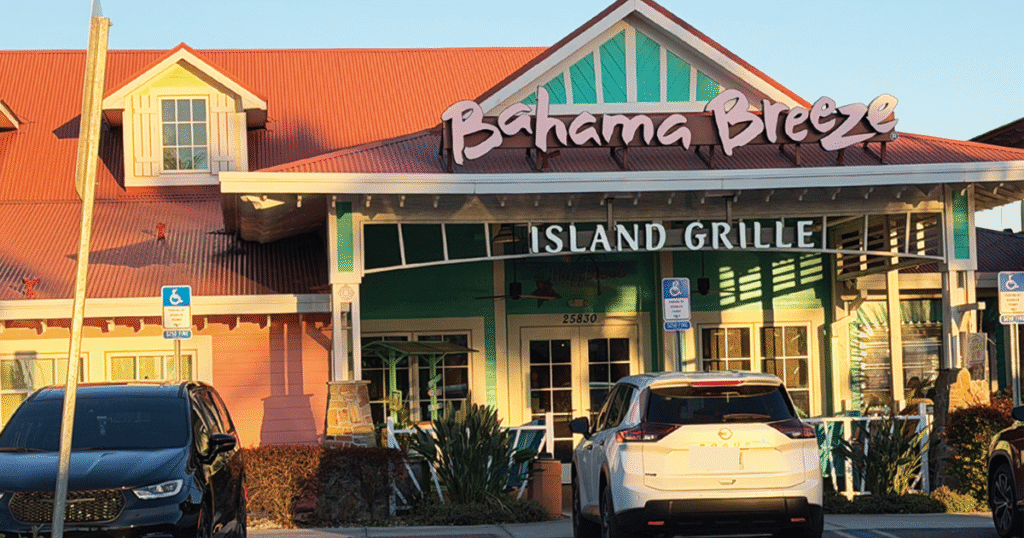
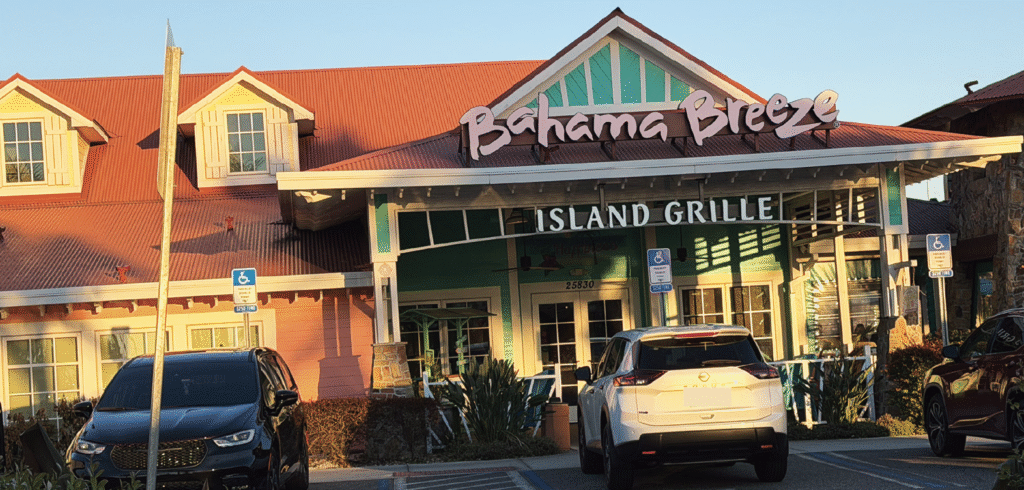
All of the remaining links in the Bahama Breeze Island Grille chain are either completely shutting down or will be converted to other Darden Restaurants brands — including the Bahama Breeze located at 25830 Sierra Center Blvd. (across S.R. 56 from the Tampa Premium Outlets) (photo). 

All 28 remaining Bahama Breeze locations across the U.S. are closing, according to a Feb. 3 Darden news release, after previously shuttering a third of its locations in 2025. 

As mentioned above, half of those remaining Bahama Breeze locations — including the one in Lutz/Wesley Chapel — will be converted to other Darden eateries (see below), although it was not disclosed in the press release which locations would be converted into which brands. 

The other 14 Bahama Breezes will close permanently on April 5. The 14 that are remaining open — including ten of the 14 in Florida, where the brand first opened in the 1990s — will remain open for the next 12-18 months, although there will likely be some temporary closures along the way, as needed for the locations to be converted. 

The list of the Darden brands still operating include a number of more upscale eateries that many locals — after first reading about this news on social media — are hopeful will find a home at the location on S.R. 56. 

Here is that list of possible Darden brands that our Bahama Breeze could become: 

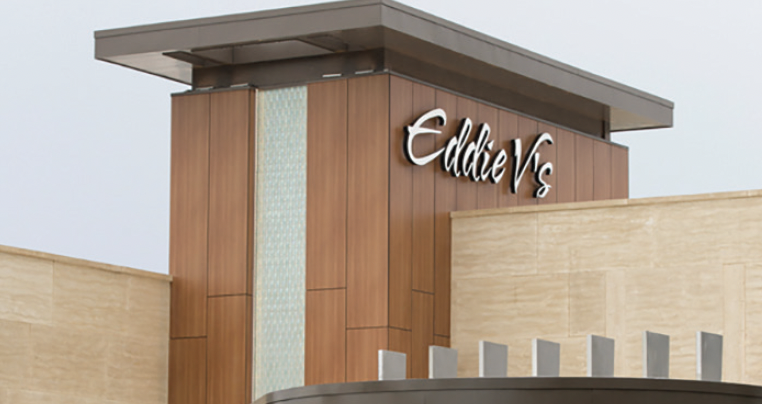
• Eddie V’s Prime Seafood 

• Ruth’s Chris Steak House 

• The Capital Grille 

• Seasons 52 

• Yard House 

• Olive Garden Italian Kitchen 

• Cheddar’s Scratch Kitchen 

• Longhorn Steakhouse 

• Chuy’s 

Of course, Cheddars, Longhorn and Chuy’s all already have locations on S.R. 56 and a previously undeveloped parcel on Wesley Chapel Blvd. to the east of Chick’n Fun is now under construction and may include Olive Garden, although we were unable to get official confirmation as to whether or not Olive Garden is still coming to 27391 Centerline Dr., just west of Gateway Blvd. — the plans for which were apparently submitted way back in Aug. 2025 — or whether that location would preclude another Olive Garden being opened in the former Bahama Breeze spot. 

Obviously, the first four or five (as most people would probably also be OK with Yard House) Darden brands on the list would be the most desirable to locals, but we will keep you posted on any such announcements. — GN 

O’Brien’s Irish Pub & Bahama Breeze Both Closing Local Locations

Anytime businesses — especially restaurants — go out of business in (or near) our distribution areas, I do feel their pain a little — although some more than others. 

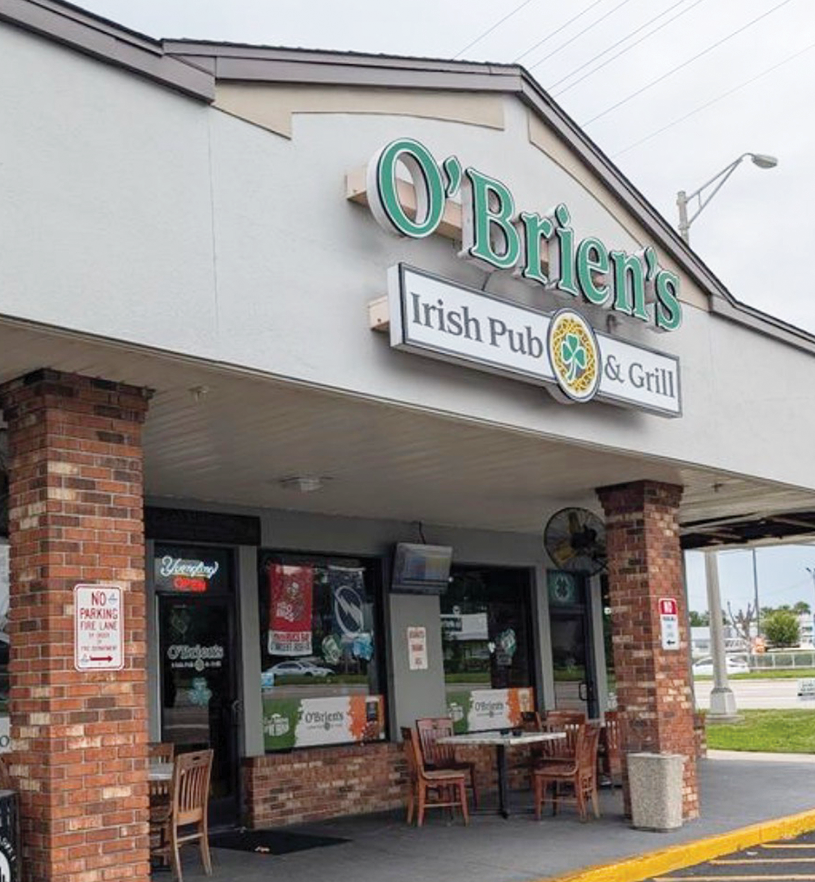
Case in point: Over the past couple of weeks, both the Bahama Breeze Island Grille (above) located at 25830 Sierra Center Blvd. (across S.R. 56 from the Tampa Premium Outlets) and the O’Brien’s Irish Pub & Grill at 5429 Village Market announced they were closing, albeit for different reasons. 

Bahama Breeze, which is owned by Darden Restaurants, is closing all 28 of its remaining locations across the U.S., according to a Feb. 3 Darden news release, after previously shuttering a third of its locations in 2025. 

Half of those remaining locations — including the one in Lutz/Wesley Chapel — will be converted to other Darden brands (see below), although it was not disclosed which locations would be converted into which brands. 

The other 14 Bahama Breezes will close permanently on April 5. The 14 remaining open, including ten of the 14 in Florida, where the brand first opened in the 1990s, will remain open for the next 12-18 months, although there will likely be some temporary closures along the way, as needed for them to be converted. 

The list of Darden brands still operating include a number of more upscale brands that many locals, after first reading about this news on social media, are hopeful will find a home at the location on S.R. 56. Here is that list of possible Darden brands our Bahama Breeze could become: 

• Eddie V’s Prime Seafood 

• Ruth’s Chris Steak House 

• The Capital Grille 

• Seasons 52 

• Yard House 

• Olive Garden Italian Kitchen 

• Cheddar’s Scratch Kitchen 

• Longhorn Steakhouse 

• Chuy’s 

Of course, Cheddars, Longhorn and Chuy’s all already have locations on S.R. 56 and many of us saw announcements that an undeveloped parcel on Wesley Chapel Blvd. to the east of Chick’n Fun already is supposed to be an Olive Garden. At our press time, however, we were unable to get confirmation as to whether or not Olive Garden is still coming to 27391 Centerline Dr., just west of Gateway Blvd., the plans for which were apparently submitted in Aug. 2025, or whether that location would preclude another Olive Garden being opened in the former Bahama Breeze spot. 

Obviously, the first four or five (as most people would probably also be OK with Yard House) Darden brands on the list would be the most desirable to locals, but we will keep you posted on any such announcements. 

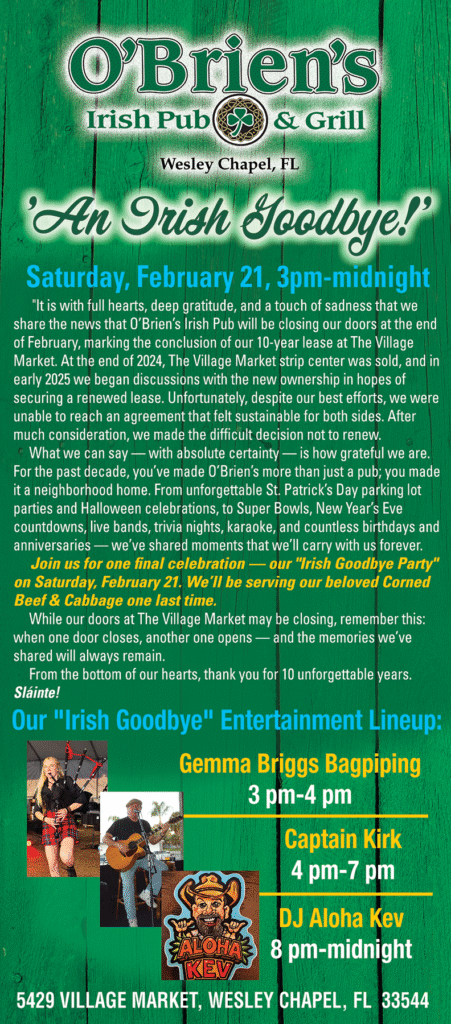
Meanwhile, in a Facebook post released on Feb. 2, Randy and Mike Goodwin, the owners of the O’Brien’s location in the Village Market (left) for right about 10 years, said that they will be hosting “An Irish Goodbye” party on Saturday, February 21, after which that O’Brien’s location would close permanently, “at the conclusion of our 10-year lease.” 

The Facebook post said, “It is with full hearts, deep gratitude, and a touch of sadness that we share the news that O’Brien’s will be closing our doors [by] the end of February…At the end of 2024, the Village Market strip center was sold, and in early 2025, we began discussions with the new ownership (JBL Asset Management) in hopes of securing a renewed lease. Unfortunately, despite our best efforts, we were unable to reach an agreement that felt sustainable for both sides. After much consideration, we made the difficult decision not to renew.” 

There has been a huge outpouring of support for O’Brien’s, which has been the only full-band live music venue in Wesley Chapel pretty much since the day it opened, so I’m hoping that hundreds of those supporters will come out to say goodbye to Mike, Randy and their wonderful staff. 

The event will feature O’Brien’s “beloved corned beef & cabbage,” as well as bagpipe music from Emma Briggs, Irish music from Captain Kirk and DJ Aloha Kev closing out the event — and the restaurant. It’ s just a shame we couldn’t get one final O’Brien’s St. Patrick’s Day event this year. 

For more info about the O’Brien’s “Irish Goodbye” party, see the ad below.-GN 

Who Actually Pays For Our Roads? A Primer On Pasco’s Mobility/Impact Fees

Editor’s note — The motivation for writing this story came from a post by Kelly Gilroy on her outstanding Pasco County Development & Growth Updates Facebook page. Former Florida Department of Transportation engineer — and, of course, Neighborhood News correspondent Joel Provenzano agreed that it was worth a deeper dive into what Kelly so perfectly presented. — GN 

If you’ve driven around Wesley Chapel lately, you don’t need a traffic study to know one thing: Pasco County is growing fast. New neighborhoods, shopping centers, hospitals and medical offices and industrial parks seem to pop up overnight. With all of that growth comes an obvious question: 

Who actually pays for the roads, sidewalks, and transportation infrastructure we all use? 

The simple answer, of course, is “all of us,” but one of the biggest pieces of that answer is something called “mobility” (aka “impact”) fees. 

Mobility fees are one-time charges paid by developers each time a new building permit is issued. These fees help pay for the transportation improvements needed to support new growth, such as: 

• New or widened roads 

• Turn lanes and intersections 

• Sidewalks and bike paths 

• Other transportation facilities tied to development 

In simple terms: new development helps pay for the new infrastructure it requires — and Pasco County has some of the highest impact fees of any county in Florida. 

These fees don’t replace gas taxes or sales taxes, but they work alongside them to fund transportation 

It’s also important to note that mobility fees are just one type of impact fee charged on new development in Pasco County. New construction is also subject to school impact fees, which help fund new schools and classroom capacity. And, park impact fees are used for land acquisition and creating new recreational facilities. 

Together, transportation, school and park impact fees make up the bulk of the one-time charges paid when new homes and commercial projects are built. When combined, Pasco County’s total impact fee burden is often cited as among the highest in the region, reflecting both its rapid growth and the scale of infrastructure needed to support that growth 

Construction costs have skyrocketed in recent years. Roadway materials, labor and engineering costs have all increased — often sharply. Because of this, mobility fees have to be periodically updated to reflect the real cost of building roads today, instead of the costs from ten years ago. 

Pasco County is allowed to update its mobility fee schedule every four years, and those updates are reviewed and recommended by the county’s Planning Commission, which looks at growth projections, construction costs and long-term transportation needs. 

According to the county, Pasco is projected to add approximately 330,000 new residents over the next 20 to 25 years, requiring roughly 950 new lane miles of roads. Even with existing revenue sources, projected funding falls short of the need —which is why mobility fees matter. 

Here’s a concrete example that helps put things in perspective: 

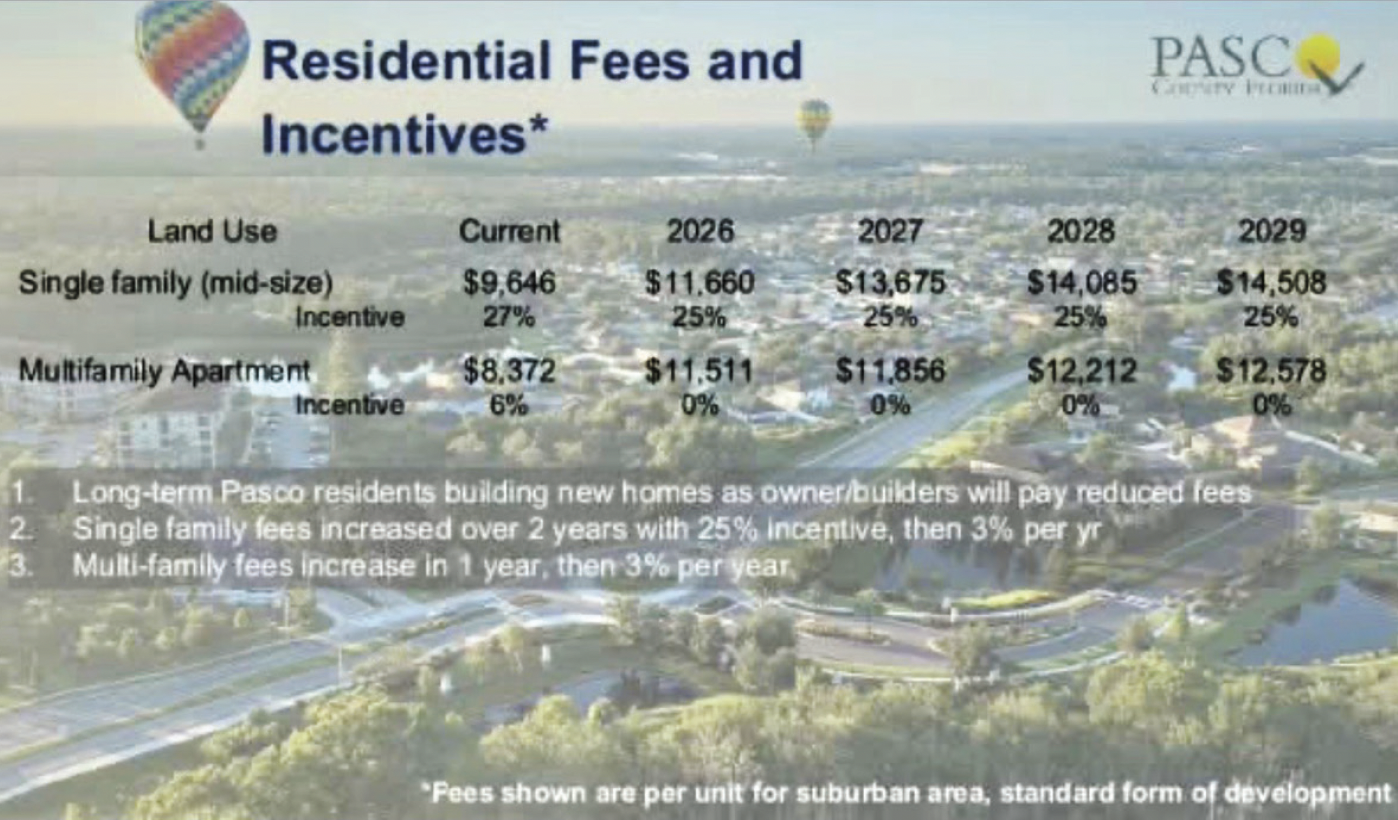
• A single-family home built in Pasco in 2026 will carry a one-time mobility fee of $11,660 that is paid by the builder. 

• That money goes into county coffers for roads, sidewalks and transportation facilities. 

The fee is paid once — not annually, and not by the homeowner directly at tax time. A common question is whether mobility and other impact fees on new homes are ultimately passed along to homebuyers. While opinions vary, there is little evidence this is happening in today’s market. 

In many cases, new-construction homes in Pasco are priced equal to — or even less than —c comparable resale homes, which carry no such fees. Builders are also routinely offering substantial incentives, including covering large portions of closing costs and providing builder-financed mortgages with rates currently as low as 3.99% for 30 years. 

Based on current pricing trends and transaction data, impact fees do not appear to be quietly “added back” elsewhere in the deal. As a result, despite these one-time development fees, new construction remains one of the most competitive and accessible options for buyers today. 

This is where things get nuanced — and are often misunderstood by homeowners. 

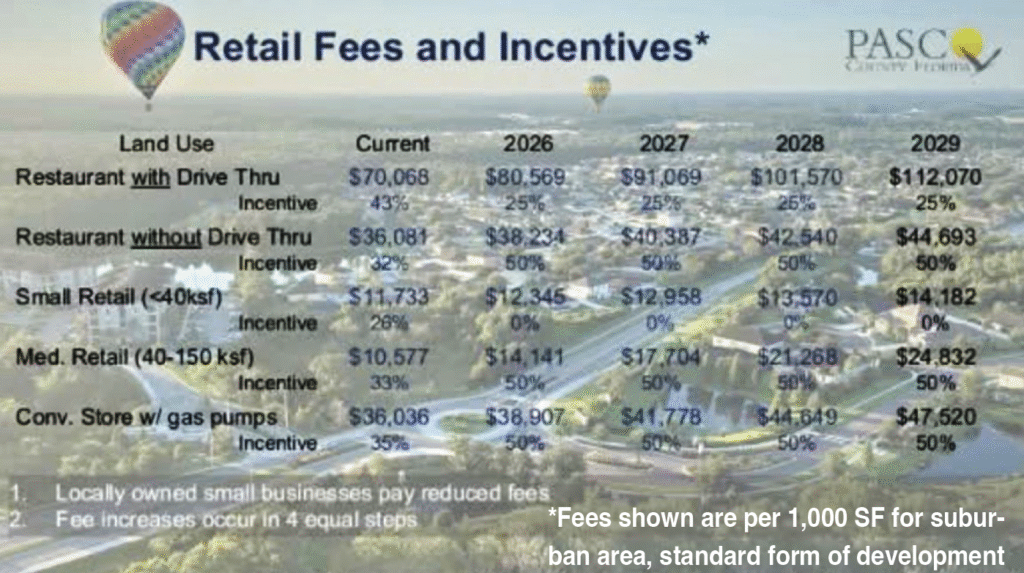
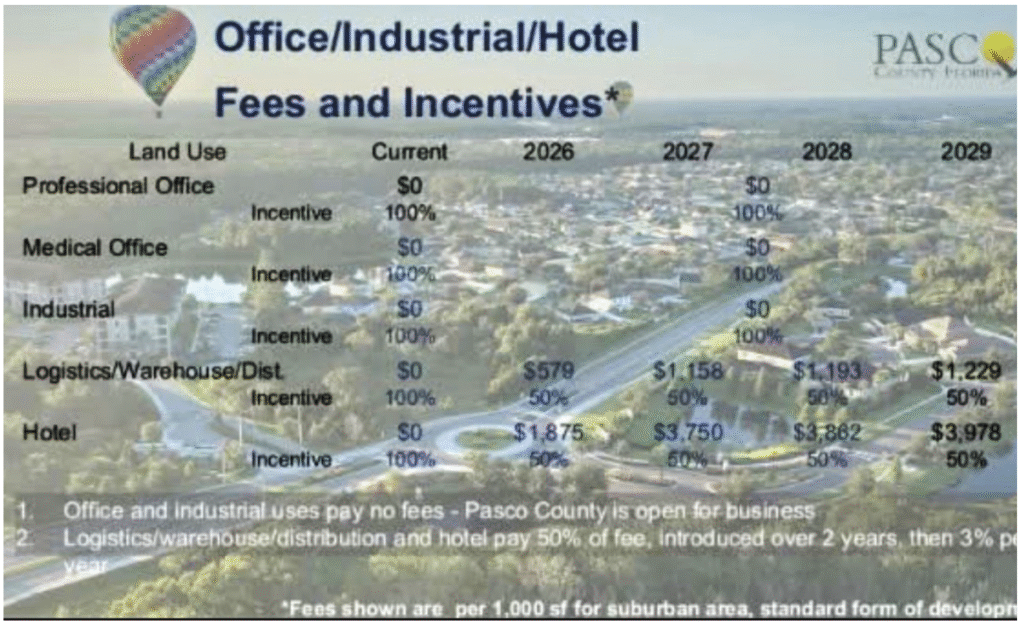
Pasco County doesn’t charge the same mobility fees to every type of development. Instead, it offers incentives to encourage certain kinds of businesses that bring higher-paying jobs and long-term economic growth, including medical & professional offices, industrial, logistics, warehouses, distribution centers and hotels 

These uses currently receive a 100% incentive, meaning they pay $0 in mobility fees. 

On the other hand, a fast-food restaurant with a drive-through might be charged a mobility fee of around $80,569, because it receives only a 25% incentive. 

Why the difference? County officials have been clear about their goal: “Pasco is open for business,” especially for industries that diversify the tax base and bring higher-wage jobs to the county. 

This is where something called Tax Increment Financing (TIF) comes in. 

TIF is often mentioned alongside mobility fees, but they work very differently: 

• Mobility fees are one-time payments made upfront by developers. 

• TIF uses future property tax growth to fund infrastructure over time. 

Pasco County, “locks in” property tax values at a base year (2012 for unincorporated Pasco). As development happens and property values rise, the increase in tax revenue — the “increment” — is set aside. 

About 33% of that increment is dedicated specifically to transportation improvements. 

Those TIF funds are then used to “buy down” mobility fees for targeted developments like offices, industrial sites and hotels. In other words, the county — and its taxpayers — still funds the roads, but with future tax growth instead of charging those businesses up front for them. 

Mobility fees aren’t the only way roads and infrastructure come online: 

• Developers often build roads, turn lanes and/or sidewalks themselves as part of their residential or commercial projects and dedicate them to the county. 

• If those improvements benefit more than just the residents of those developments, the developers can apply for mobility fee credits. 

• Some communities (including many in Wesley Chapel) are built with Community Development Districts (CDDs) — quasi-governmental entities that maintain roads, sidewalks and landscaping within the developments themselves, rather than the county taking on that responsibility long-term. 

This approach shifts some maintenance costs away from the county and onto the developments that directly benefit from them. 

At the end of the day, mobility fees are about matching new growth with new infrastructure — and making sure existing residents aren’t left paying the full bill for new development. 

Mobility fees are imperfect, complex and often controversial. But without them, Pasco County would face even larger funding gaps, even slower road improvements and even more pressure on general taxes. 

As Pasco continues to grow, understanding how these fees work can help you better engage in conversations about development, transportation and the future of our community. 

The growth is coming, no matter what. The real question is how we plan and pay for it. 

And, most people sitting in traffic every day in Wesley Chapel believe that they are the ones paying for it — and that whatever money is coming in isn’t either not enough or not being spent fast enough to keep up — and no, they’re not wrong. 

Wesley Chapel’s Tesla Dealership Is Open, Bringing Sales & Service Closer To Home!

(Above) The Tesla dealership off I-75 Exit 279 in Wesley Chapel has quietly been open since Oct. 2025. (Photos by Joel Provenzano) 

When the Wesley Chapel Tesla dealership and service center was first announced, it generated plenty of curiosity. But, when it actually opened, there were no balloons, banners, or hoopla. In fact, many local residents are just now realizing that the location has been open on Eagleston Blvd. in Seven Oaks, just east and south of the Wesley Chapel Blvd. exit (Exit 279) off I-75 (between I-75 and Blue Heron Senior Living), next to the new Verve apartments, since October of last year. 

According to Tesla representatives, that low-key approach is intentional. There’s no need for fanfare — people will find the brand. 

Unlike traditional car dealerships, Tesla locations are entirely corporate owned and operated. There’s no pressure sales model, no commission-driven tactics and no need to lure customers in with promotions. 

Everything — from browsing inventory to purchasing a vehicle — is standardized and handled online through Tesla’s website or app. Staffers are on hand primarily to answer questions, guide customers through the digital buying process and offer test drives, including demonstrations of Full Self-Driving for those who are feeling adventurous. 

That approach has resonated with local resident Michele Curtin, Broker/Owner of Shells Florida Realty in New Tampa, Michele says the Wesley Chapel location is a welcome addition. “The Tampa location was fine, but the traffic made it a hassle,” Michele says. “Having one so close is a big deal.” 

Michele purchased her first Tesla, a Model Y, in 2021. She upgraded to a newer Model Y in June 2025 and says the improvements are noticeable. “Everything that was an issue with my earlier model has been fixed in the latest generation,” she says. 

Just a few weeks ago, Michele and her husband Frank added a striking new vehicle to their collection — a Cyberbeast, Tesla’s top-of-the-line Cybertruck. The couple test drove it at the Wesley Chapel location and decided to place their order on site with the help of sales representative Sohil Desai. 

“Fantastic service,” Frank says. “It was a great experience.” 

Shortly after delivery, the Cyberbeast needed a minor factory repair. Frank brought it back to the dealership and says that the work was completed quickly while he waited. For longer repairs, Tesla offers loaner vehicles. 

Service is where the Wesley Chapel location truly stands out. Customers drive directly into a fully air-conditioned building, pulling up next to the service desks to hand over their vehicles — no heat, no rain and no parking lot shuffle. 

Behind the scenes is a massive service and detailing area equipped with 24 lifts and space to accommodate roughly twice as many vehicles at once. Inside, a comfortable lounge helps waiting customers pass the time. 

While Michele admits that Teslas may not match the luxury feel of brands like Lexus — which she was loyal to for years — she says the driving experience and technology more than make up for it. “It’s more utilitarian,” she says, “but the acceleration is unbeatable. It makes pulling into traffic effortless.” 

She’s also a fan of Tesla’s Full Self-Driving feature, which she subscribes to for $99 a month. “I could buy it outright (for $8,000),” she says, “but I don’t keep vehicles that long.” For buyers who want to own the feature, Tesla also allows it to be rolled into their financing. 

Even more surprising, it can be activated or deactivated by owners — simply by using the app. 

Most of Michele’s interactions with Tesla happen through the app, which she says has improved significantly since 2021. “I go through the app for most everything,” she explains, noting the live chat support and smoother service experience. She also has a Tesla wall charger at home. “It’s amazing,” she says. “I plug in at night, and no more gas stations.” 

Like many new EV owners, Michele says she did experience a learning curve, especially on longer trips. 

“At first,” she says, “I ignored the car when it told me where to stop for charging. I had plenty of charge, but it was planning ahead for me.” 

After a few tense moments, she learned just how precise Tesla’s trip estimator is. 

“It’s scary accurate,” she laughs, adding that she now trusts it completely. 

For those considering a Tesla for the first time, the Wesley Chapel dealership offers Model 3s starting at around $36,000 and Model Ys starting near $40,000. The top-of-the-line Cyberbeast AWD sells for $117,235. 

Financing options currently include interest rates as low as 0%-2% on select models. Lease terms also are available for 24-36 months. 

Tesla prides itself on a straightforward, no-pressure buying experience, a claim backed up by hundreds of customer reviews. Staffers don’t “need” to sell anything, locals say — they’re there to answer your questions, encourage visitors to sit inside the vehicles, explore the technology and imagine what driving might look like in the future. 

The Wesley Chapel Tesla dealership and service center is located at 4980 Eagleston Blvd. It is open Mon.-Fri., 10 a.m.-8 p.m., 9 a.m.-7 p.m. on Sat. & noon-6 p.m. on Sun. For more information, call (813) 953-4467 or visit Tesla.com