Lt. Gov. Jay Collins Makes His Pitch For Becoming Governor

“Leadership Has A Cost…Your Own Self Interest. Rise Above It, Lead From The Front & Get Things Done.” 
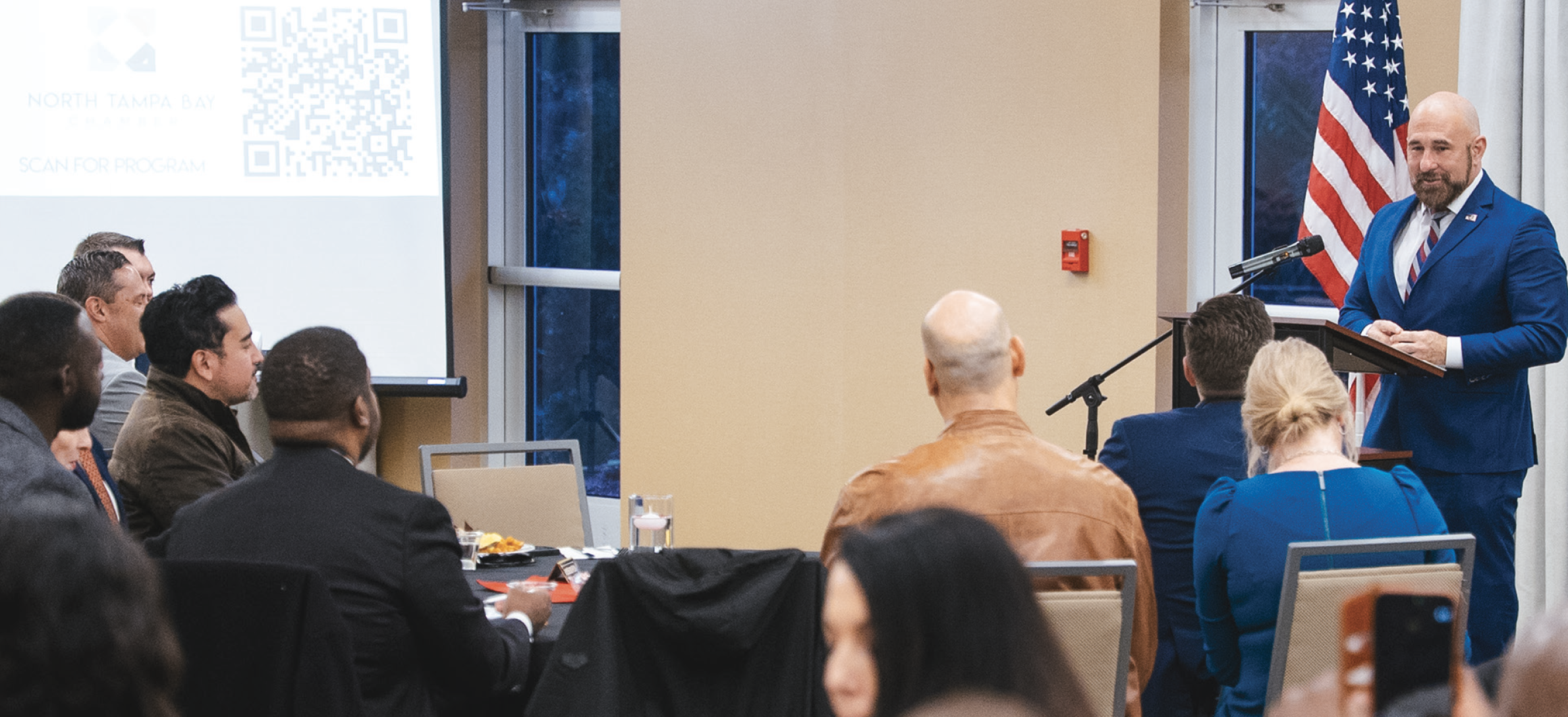
Florida’s Lieutenant Governor Jay Collins spoke about his plans to run for Governor in Nov. 2026 to a packed house of more than 100 people at the North Tampa Bay Chamber’s Business Breakfast on Feb. 3, at the Hilton Garden Inn Tampa-Wesley Chapel. (Photos by Charmaine George) 

No matter which side of the political aisle you may be on, if you sit and listen to Florida’s 49-year-old Lieutenant Governor Jay Collins speak, you can’t help but be impressed with him. He has had a 23-year career in the U.S. Army and has served as a medic and parachutist in the Army’s elite Special Forces Green Berets corps twice — qualifying the second time after having his leg amputated. 

He’s been shot, “which I do not recommend,” performed surgery on himself on the battlefield, has been awarded a Purple Heart, a Bronze Star and numerous other military medals and his story — and his life — could have ended with his military service, during which he met his wife Layla, who had a 20-year military career as a counterintelligence agent. 

Instead, he entered Florida’s political scene four years ago, when he was elected to Florida Senate District 14, defeating the incumbent Democrat Janet Cruz for the seat. 

The father of two boys ages 13 and 10 served for almost three years in the State Senate and passed 55 bills during that time. “I passed more bills in three years than many in the State Legislature do in eight,” he told an enthusiastic crowd of more than 100 North Tampa Bay Chamber (NTBC) members at the NTBC Business Breakfast on Feb. 3, at the Hilton Garden Inn Tampa-Wesley Chapel. 

Then, in August 2025, Governor Ron DeSantis appointed him as Florida’s 21st Lieutenant Governor, replacing Jeanette Nuñez, who had resigned in May. Collins may not be the favorite to win the Republican nomination for Governor of Florida in the upcominh 2026 midterm elections — he currently trails far behind Rep. Byron Donalds (who recently received U.S. President Donald Trump’s endorsement) and Gov. DeSantis’ wife Casey (who has not yet declared she is running) — but with more than a third of registered Republicans still undecided (and more than half undecided if Casey DeSantis ends up choosing not to run), it’s still anyone’s race. But, whether he has a chance to win the nomination or not, Collins definitely captivated that room.

He spoke confidently about his plans to improve upon the record of DeSantis, who he said, “has led the nation. He has put a lot of things together. While other states have raised taxes, over-regulated businesses and chased jobs away, Florida has chosen a different path. He’s focused on freedom, responsibility and opportunity. Florida is now the strongest state economy in the country. We lead the nation in new business formation. Our workforce continues to grow. Families and employers are choosing Florida and that success is especially visible right here in this region. People want to be here because we have opportunity. You’ve got the government out of the way as much as possible.” 

Even so, Collins acknowledged, “That doesn’t mean we’re exactly where we need to be, but we’re on the right path.” 

He said he had recently attended the opening of a health care innovation lab in downtown Bradenton that is doing implants that get rid of metal and use absorbable material, “so it goes right in and grows bone — safe, not causing scabs or abscesses. That’s going to change people’s lives by eliminating the need for at least one surgery. 

“The number one killer of people in health care is sepsis. The less you have to open somebody up, the less susceptible they are to sepsis. If we can stop that, we stop or lower health care costs, and some of the frivolous or excessive lawsuits at the back end, further dropping health care costs.” 

Collins added that he shared that story, “because that was one person who had a dream to build something great, came here to Florida, started a business and will now inject hundreds of millions and, at some point, billions of dollars into our local economy. 

“And that is what each and every one of you do every day. It just takes one moment for something to catch like wildfire and change how we do everything.” 

He then moved on to one of this year’s most discussed proposals being considered by the state legislature — reducing or eliminating property taxes. 

“Show of hands,” he said, “how many of you would like to have your homesteaded property free and clear of property tax?” (Everyone raised their hands.) 

“But now,” he continued, “how many of you have concerns about how that would affect our education, our roads, our firefighters and our law enforcement?” (Again, most hands went up) 

“Well, let me tell you something,” Collins said, “in this state, we are not going to put at risk our law enforcement or our firefighters. I would rather jump in front of a moving car than hurt the people who serve our communities. I would give my last full measure to protect our people. We will stand with our men and women of law enforcement and fire. We will not allow our cities or counties to underfund or cut that. It’s the same with roads and education.” 

He noted that although people usually assume his kids go to private school, “My kids go to public school in Hillsborough County, just down the road from my house. A rising tide floats all boats. 

“We have school choice in Florida because we understand that the money should follow the kids. It’s not the government’s money. It’s the people’s money being utilized to help provide something common to all — and we hold them accountable for those reasons. But, I also know that 85% of people will almost always go to public schools. And the right thing for my kids is that school just down the road, where they have their friends. I want my kids to be successful. I want them to have every opportunity to blow what I’ve done out of the water, to make my name irrelevant. That is what I dream on. So believe me, we’re going to protect those exact things.” 

The thing Collins said that raised the most eyebrows was about just how much of Florida’s property tax revenue comes from homesteaded properties. “Less than 30% of the money that comes from property tax comes from homesteaded properties,” he said. “That’s a shockingly low number. Now, some counties are higher, some are significantly lower — and I’m sure you can probably formulate which ones go that way, but that’s manageable. It’s solvable.” 

He then asked, “How many of you have seen your property value go up every year, from a tax standpoint? Has anybody had theirs go down repeatedly? I’ve never had anyone who said that and I’ve asked it a hundred times. 

“How many of you have had millage rate increases as well?,” Collins added. “You’re getting hit twice. It’s getting wider, because you’re paying more, and it’s getting taller because of the millage increase. 

“Now, ask yourself this simple question. Have you seen that exponential increase over the last ten years positively impact your education, roads, fire or law enforcement? Do they have more time, tools and training? 

“If the answer is decidedly ‘no’ — which it has been everywhere I’ve gone — where did that money go? 

“Friends, I am not here to pay more taxes. Lord knows, I put in time for what I get. I probably get about seven cents an hour as Lieutenant Governor — and I am grateful to do it. Please don’t think I’m whining. I’m just making fun of the system we’re in sometimes. 

“It’s fascinating. We have to solve that — hold people accountable. What we’re doing with DOGE (the Dept. of Government Efficiency) in Florida is significant, but we have to lock that in and make sure the (city and county) governments follow through, that we’re holding them accountable.” 

He also said that, “I’m frustrated that we have allowed the affordability conversation to focus just on saving our way to success. 

“Friends, this is America, this is Florida. I expect us to lead, to dream boldly, to draw in more life-changing industry — to raise our salaries as part of that story. I don’t want my kids to make what I made someday. I want them to have so much more. We have to be dedicated to that. 

“We can talk about property tax, but we have to draw in more businesses and get the government out of the way.” 

Collins was a little surprised that only a couple of people in the audience, including NTBC Board chair Tony Benge (see pg. 3) — who introduced Collins — were in real estate development. 

“How many of you who are in development deal with impact fees? How about permitting? How many of you have bought or built homes and had a permitting crisis you had to deal with? 

“There are two things right now that I believe we can lever and fix when it comes to home affordability. One is impact fees. They seem to just be levied left and right. Some counties are really great at it and some are less than stellar. 

“Either way, it’s going right back to the consumer. We have to reward people and let those fees come back the appropriate way, but there’s got to be a lot of commonality and common sense. 

“When it comes to permitting, I’ve gone through this as a business leader. I’ve gone through this personally when I built my home, but there has to be clarity and accountability in how that’s done. 

“We have a building code that works. I worked in disaster management for many years. I was there everywhere lives were impacted by hurricanes and I would see a slab, a slab and then three homes almost completely unfazed by the same hurricane. [That means] our building code works, if we can get them there. We, as a state, have to do more from a resiliency, a power side, without spending ourselves into oblivion. 

“Your individual amount that you owe to state debt is about $200. But, let’s compare that to the federal government, where it’s $126,000 per person. We have paid down 50% of our debt as a state over the last six years. We are balancing and lowering our budget every single year. Our reserves are maximized and yet, we’re still dropping them down more and more. That is what fiscal leadership and prudency looks like as a state. We have to maintain what we do.” 

Before opening his appearance up to the floor for questions, Collins closed with, “In our state, I don’t believe the past is our best. I think the best lies ahead of us. I’m an optimist. I believe in our people. I believe in getting government out of the way so businesses can thrive and more opportunities can exist.” 

And finally, Collins asked a question of his own: “Tell us what you see, what your problems are. The simple fact is that, as a leader, I can’t solve what I don’t know. I listen to Ronald Reagan a lot. I love how he spoke to the people and he solved problems. I love his approach. 

“To paraphrase him, ‘If the government thinks they have a solution, you should be afraid…very afraid.’ 

“Please work with us. We need business leaders from the Chamber and from the community, to help us understand where the rubber meets the road. How that impacts lives and how we can solve [problems], to really create solutions. 

“And, as a former legislator, I can tell you that, of the 55 bills I passed, probably three quarters of them came from the community in some way, shape or form, because we worked with them. We solved those functional problems on the ground and they improved. That’s good work. That’s good government. That’s how we work together.” 

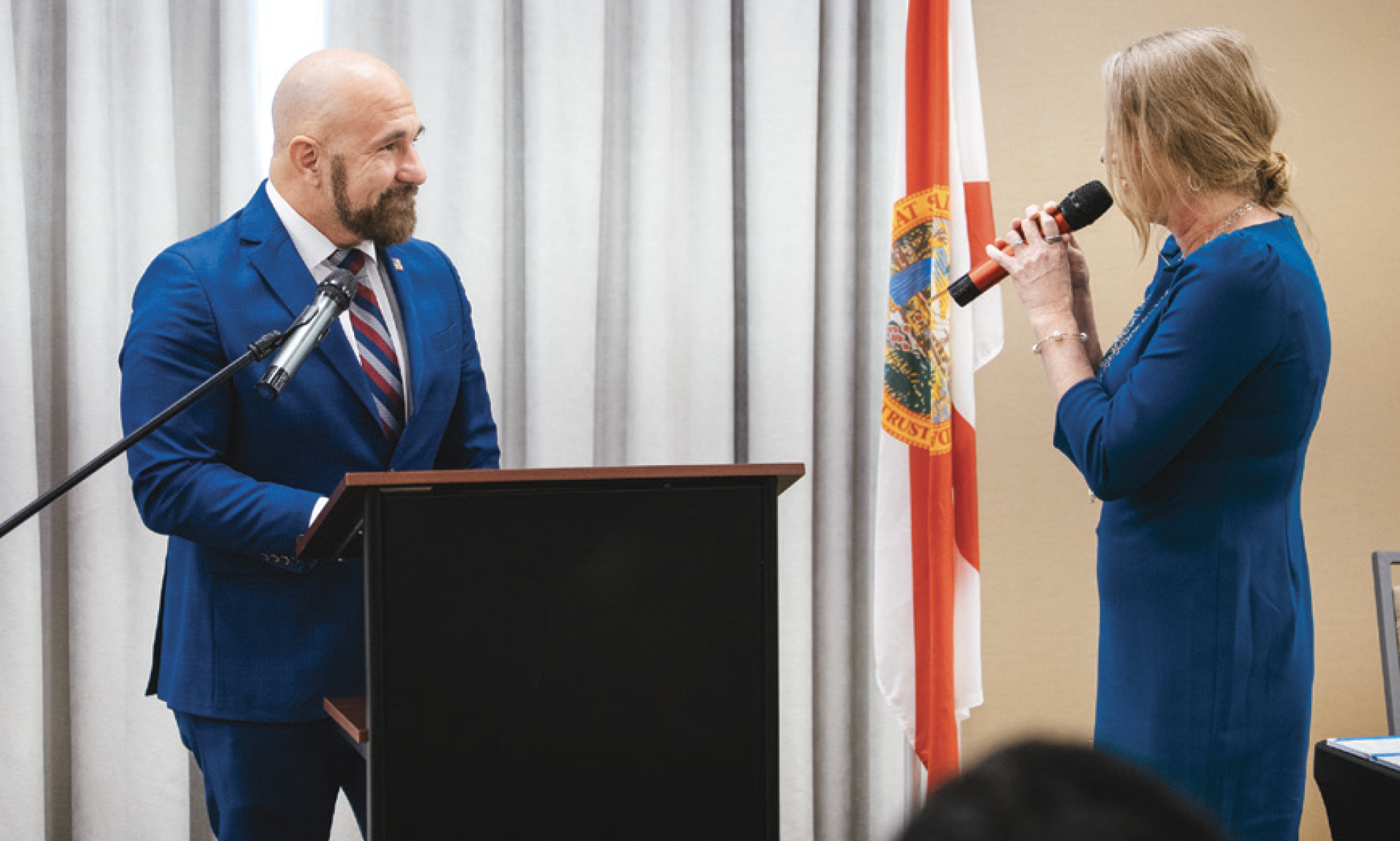
Florida Lt. Gov. Jay Collins & NTBC president & CEO Hope Kennedy.

Collins then took a number of questions, the first from Ryan Quattlebaum, the CEO of AdventHealth Wesley Chapel, who asked, “As we continue to hire, recruit and retain doctors into the state of Florida, what do you see you can do to help us continue to attract and retain physicians to Florida?” 

Collins responded that Florida, “needs more medical schools. I also know that every doctor we talk to says they are hemorrhaging people at the three-to-five-to-seven-year mark because they’re tired of litigation. They’re tired of the games. They’re tired of being told to write their SOAP (Subjective, Objective, Assessment, and Plan) notes in a specific way to fit into an insurance algorithm. Those are systemic issues we have to solve.” 

Next up was NTBC Board member Jamie Hess, the owner of Computer Emergency Room, who told Collins that the Chamber was looking into incorporating Wesley Chapel as its own city, “but we put it on hold because of the property tax issue. What do you think, realistically, is the forecast to get the homestead property tax reduced or eliminated this year?” 

Collins responded, “If I were Governor, I’ll tell you what I would do. I would call a Special Session so you have everybody there. I do think you can get full property tax relief for homestead properties [because] the math plays out. 

“But, for those who may not know how the system works, you’ve got to pass identical bills — within a 98% margin — in both the House and the Senate, and then have the Governor sign it. 

“And, because [incorporation] would have to be a constitutional amendment, it’s then got to go on the ballot and it’s got to get 60% of the people to vote for it. 

“Friends, there are times when it’s hard to get people to agree that we should even have a 60% level. It’s going to cost, at a minimum, $15- $25 million of advertising to understand what its going to look like. 

“But again, on property taxes, if there’s more than one thing on that property tax [bill], it’s 100% going to fail. But, I think it’s pretty likely that we get this, but where it ends up on the spectrum, that variability, I think you’ll know, probably within a month or so. But yes, it’s very doable, very manageable. 

“I know the Governor pretty well and, when he lays out his plan, it will be very detailed. You have to get ahead of the system to make sure people don’t move the money, don’t revenue taxes, and don’t just create another bureaucracy, instead of solving a problem. 

“I know pretty well where the Governor is at on this and I will not be part of anything that’s going to cut services. I will not do it.” 

Collins also answered a question from Primrose School of Wesley Chapel owner Rob Fitzpatrick about Florida’s insurance crisis and one from yours truly about holding private schools that accept school vouchers to the same standards as public schools. He also addressed a question from Benge about the lack of accountability on the part of local governments regarding impact fees (see the Editorial on pg. 3 for more on this topic). 

Very interesting stuff, Mr. Collins! 

Charlene Joyce Files To Run For State House District 54 Seat Against Randy Maggard

Local Realtor and registered nurse Charlene Joyce is a conservative Republican running in Nov. 2026 for the Florida House District 54 seat currently occupied by Rep. Randy Maggard. (Photo by Charmaine George)

Charlene Joyce has filed to run in the Nov. 2026 mid-term elections for the State House District 54 seat which covers parts of Pasco County, including Dade City and some of Wesley Chapel, and is currently held by fellow Republican Randy Maggard. 

Charlene is a conservative Republican who lives in Dade City and says she disagrees with legislation Rep. Maggard filed in November to prohibit counties and cities from adopting their own rules related to water quality, wetlands, and pollution control. 

“The State House is trying to put more emphasis on [its own] power,” Charlene says, “rather than trying to let the people make the decisions for where they live.” 

She says overdevelopment is a big issue, and that Pasco County needs smarter ways to grow. “It shouldn’t take an hour to get somewhere that’s 20 minutes away,” she says. 

And, while she says she has nothing personally against Maggard, “God put it on my heart that I need to try to make a change, and make a difference in the lives of others.” 

Charlene says it’s important to her to listen to her future constituents, and to maintain the beauty of Pasco County. 

“I listen more than I talk,” she says. “I want to ask people questions, [find out] what’s important to them, keeping it grassroots, conservative, and helping others protect their rights as parents and landowners.” 

Charlene grew up in Wesley Chapel and is a single mom of two children, ages 6 and 3. She attends Life Church in Wesley Chapel, and says faith is central to her campaign, which she sees as a calling. 

She also is a licensed registered nurse and obtained her R.N. degree through Rasmussen College in Tampa in 2018. She is the health care administrator for a residential facility in Hillsborough County for the Department of Juvenile Justice (DJJ), where she cares for female residents, ages 12 to 18. 

“One of my pushing points for running was when I started working at DJJ,” she says. “I saw a lot of things that could be implemented through legislation and a lot of loopholes that could be closed.” 

For example, she says, while DJJ employees are drug tested before they are hired, there is no Florida statute that requires testing throughout employment. 

“I’ve encountered people who came to work smelling like marijuana,” she says, “and that’s unacceptable in a place with youth.” 

However, she says, since residential facilities are contracted out to third party providers, they stick closely to legal requirements. 

“They do what they have to do,” she says, “but not anything extra, because it’s money out of their pocket.” 

She says her experience working with the youth in the facility where she works has been moving. On the weekends, she volunteers there with a team from a ministry called Set Free out of Pinellas County. 

For kids who want to participate in the Set Free program, Charlene and the team bring Christian music and Bible teaching. She says she brings hope to the youth in her facility, most of whom have experienced trauma such as physical, sexual and emotional abuse. 

“No one is hopeless,” she says. “God always finds a way, letting them know they are loved and valued. It’s so important for a child to thrive and to walk a different path. These children may have made some bad decisions that put them in a position that might alter their lives for the worse, but I want to take that opportunity to change it for the better.” 

Charlene also is a licensed real estate agent who obtained her Florida real estate license in 2024. 

She says she is looking forward to the election, which will be held on Tuesday, November 3, 2026. 

For more information about Charlene’s campaign for State House, visit CharleneforStateHouse54.com, or follow her on Facebook or Instagram @CharleneforStateHouse54. She can be contacted at (813) 333-8612. For more info about Charlene’s real estate business, visit CJoyceHomes.com.

Stephanie Vazquez To Challenge Seth Weightman For Dist. 2 Commission Seat 

District 2 Pasco County Commission candidate Stephanie Vazquez and her family. (All photos for this story were provided by Stephanie Vazquez) 

The next election for the Pasco County Board of County Commissioners (BCC) isn’t until November of 2026, so why is Wesley Chapel resident Stephanie Vazquez already declaring that she is going to run as a Democrat to oppose current Republican District 2 Pasco Commissioner Seth Weightman? Stephanie is the first candidate to throw a hat into the race to unseat Weightman for the Dist. 2 seat. Here’s why: 

If you’re unfamiliar with Pasco County government or new to the area, Pasco is divided up into five districts, with District 2 including a large portion (but not all) of Wesley Chapel, as well as about half of Land O’ Lakes, and small (but important) portions of unincorporated Zephyrhills and Lutz. 

Vazquez, who has been a resident of District 2 since 2013 (there will be more on this later in this story), moved to our area from Pittsburgh, PA. Like many northerners, she primarily wanted to escape the snow. 

With Wesley Chapel being the fastest-growing area of not just Pasco, but also one of the most quickly expanding areas of Florida and the entire nation, Vazquez believes that the time is now for a change in county leadership. 

“I’ve thought about running for several years,” she says, adding that even though she’s new to politics, her background has prepared her for leadership and, “The time is now.” 

Vazquez currently works as a remote marketing manager for Northeastern University in Boston, MA, but she also is enrolled as an online student at the school, as she is working towards her second Master’s degree, this one in Public Administration, and expects to graduate in 2026. She believes that degree is helping to prepare her for the job she’s now seeking. 

She earned her first Master’s degree, for Entrepreneurship in Applied Technologies, in 2016 from the University of South Florida and she previously earned her Bachelor of Science degree in Behavioral Sciences from Bellevue University in Bellevue, NE, in 2010. 

But, Vazquez says, her decision to run is about a lot more than just her educational background. Most of her recent work experience, beginning with her service in the U.S. Air Force as a Senior Airman, working in airfield management, both in the states and overseas in Germany, is about public service. When she left the military, she says she wanted to continue fighting, but on two different kinds of battlefields most people never see. 

Vazquez (second from left) appearing on “10 News” WTSP-TV as a panelist on a discussion about human trafficking. 

The first was her seven-year service as an Advisory Board member for the Post 9/11 Veterans Corp., a 501(c)(3) nonprofit organization that focuses on, “providing a platform, a starting point, and a place of belonging, where veterans are encouraged to integrate into their local communities and inspire through actions.” 

The more recent battle was against Human Trafficking. As a vice president of the U.S. Institute Against Human Trafficking and a Board member of both the Pasco County Commission on Human Trafficking and the NISSI Project (which provides housing for verified adult female victims of human trafficking) for six years, Vazquez says she helped build these national and local programs to tackle exploitation at its roots: opening a safe house, building recovery programs and training thousands to recognize and stop injustice. 

She later honed her public speaking and writing skills while holding a public servant government position as a public information officer for the City of Zephyrhills. 

Vazquez says she hasn’t had it easy, explaining that growing up poor helped build her character, not just once, but twice in her life. Born in Flint, MI, her dad was a young Marine veteran who worked part-time at a local drug store while also going to college part-time to try to earn a basic degree. Meanwhile, her mother was a stay-at-home mom, but both of her parents’ families came from generational poverty, so between her dad’s paycheck and essential government services like food stamps, she said it was barely enough to keep them from going hungry. 

She remembers growing up having to “do without” most of the time, as her family stretched everything they had, often having to eat the same one meal multiple times in row. 

“The most disgusting thing was the powdered milk, mixed with water,” she says, “because real milk was too expensive for us. I can still taste it.” 

Years later, Vazquez found herself in a similar situation, just out of a relationship that wasn’t working. As a single mom of three, she moved to Florida, with kids who were 4, 3, and 3 months old. She was unable to afford child care or find a job that paid enough to put them in daycare, so she found herself below the poverty line, receiving government assistance. 

“I used to take my kids to Walmart so they could play with toys,” she says, “because we couldn’t afford to buy any.” But, these struggles forced her to develop the ability to get by, and evolve, leaning on her experience from the military. She says that when you’re poor and struggling, “you don’t think about politics, you think about how to survive.” That experience makes her want to stand up for working class families. 

“Pasco deserves better than business as usual,” she says. “Our families are paying the price while a handful of insiders cash out. I’m not a politician. I’m a veteran, a mom and a community advocate who believes Pasco should work for the people who live here, not for the powerful few calling all the shots.” 

But, why should people vote for her? 

“The incumbent was hand-picked by insiders, and swept-in through a closed primary,” Vazquez says, adding that the current commissioners, including her opponent, continue to vote to allow more and more growth, “before the county is ready for it. But, I’m not part of the county political machine, I’m part of this community.” 

She says that Weightman was, “a strategically chosen candidate” by the local powers that be. “But, I want clean government, not back-rooms deals, with decisions made in the open, with transparency and accountability.” 

Here are the issues Vazquez says her campaign her campaign will be about: 

• Fixing broken roads, drainage and outdated storm systems. 

• Preparing for future challenges like flooding and climate change. 

• Establishing term limits to break the cycle of insider control. 

• Curbing reckless growth that strains neighborhoods and schools. 

She and her husband Yamani Vazquez Martinez have built their life in Pasco, raising a blended family of six children. All of their kids have either graduated from, or currently attend, Pasco’s public schools and Yamani currently is serving as an assistant principal at Cypress Creek Middle School. 

Vazquez believes strongly in the power of education, and personally feels that new large-scale developments should be required to include school sites, so that the children living in those communities can go to schools in or near their own neighborhoods, as well as to keep class sizes appropriate and have fewer portable classrooms throughout the district. Vazquez says that overcrowding of classrooms can be avoided through, “proper, thoughtful planning. If the population is increasing, we need to prioritize schools, and developers need to pay their fair share.” 

But, speaking of paying their fair share, Vazquez says, “In August 2024, Commissioner Weightman was the only Pasco commissioner to vote against raising school impact fees, which are one of the few ways to hold developers accountable and fund schools as costs rise. He chose developers over Pasco‘s kids.“ 

Vazquez also has posted a video to her social media opposing House Bill 5101 — legislation that would reduce public school funding statewide. The video, which breaks down the bill’s potential impact on local classrooms, has garnered more than 40,000 views and hundreds of comments from educators, parents and concerned voters. 

“I’ve spent years fighting for people who have been overlooked or outright ignored — including our teachers,” Vazquez says. “I didn’t expect the video to take off, but I think it hit a nerve. People are tired of watching public education be gutted while our kids and teachers are left behind.” 

She acknowledges that if she was to be elected, there may not be much she can do to directly help increase teacher salaries, which are controlled by the Pasco School Board, but says that helping to fund schools with BCC-controlled development impact fees would be her top priority, with #2 being funding for new and improved roads, and #3 being flood mitigation and drainage projects. 

These school issues hit close to home for Vazquez, because Yamani has been an educator for 15 years. Education, administration and school athletics are important to him, as he previously was the head coach of Wiregrass Ranch High’s softball team for eight years. 

Stephanie Vazquez says it’s time for a change in Pasco County leadership.

Vazquez wants voters to know that she is NOT anti-development. She just wants the BCC to consider three important questions: 

“Do we need it? Does it put the people of Pasco first? Are we ready for it?” 

She feels that these questions would help the county avoid the “Gold Rush Mentality,” where developers just want to make money and then leave, sticking taxpayers with gridlocked roads, overcrowded schools and neighborhoods that flood with every storm. She says that this type of reckless development, which seems to be running rampant in Pasco, “favors insiders over families. But, enough is enough.” 

As for what she envisions District 2 to look like 10 years from now, Vazquez she says that our area already is becoming the hub for health care in Pasco County and should continue to do so, with more new hospitals and medical offices continuing to be added to the local landscape. She sees this medical hub being surrounded by thriving communities, with schools, walkable green spaces and family-centered resources. She also believes that Pasco, and by proxy District 2, as “Florida’s Sports Coast” is a good idea and that she, “would love to see that continue to grow.” 

“That would include more year-round sports people can play, facilities that offer good-paying jobs and more options for youth sports programs,” as some in our area (like the Wesley Chapel Athletic Association’s youth baseball and softball programs) can’t handle all of the kids who want to play. She believes that the Wesley Chapel District Park is at maximum capacity, saying that although it’s a great facility, parking and traffic “can be challenging.” 

“We need more [sports] options in the District. The Wiregrass Ranch Sports Campus has been fantastic,” but its primary function is to provide a location for sports tourism. “What we need are more green spaces and fields throughout the area.” 

She says that if proposed large-scale developments are unwilling to include parks and school sites in their communities, she would, “Vote No!” She believes that the BCC is responsible for the over-development of Pasco County and Wesley Chapel in particular. “Yes, a lot of people have been moving here, and leadership has been swept up in that,” she says, but the commissioners should have tried harder to control Pasco’s growth. 

For Vazquez, this race isn’t really about politics. “It’s personal,” she says. “I’m not backed by big money. I’m not here to make deals behind closed doors. I’m here to fight for every family who feels like their voices have been drowned out. Pasco belongs to all of us, it’s time to take it back.” 

She adds, however, that she knows it won’t be an easy fight to win. 

“Since there is currently a Republican majority, not only in Pasco County, but in Florida and the Federal Government,” she says, “I know it can feel like we’re just little blue dots in a sea of red, but the truth is, there are more of us than we realize. And I’m not just talking about Democrats. Voters with no party affiliation, independents and even longtime Republicans are starting to move away from the noise and division and toward something better: people over party, progress over politics and community over chaos. We all want the same basics — strong schools, safe neighborhoods and honest leadership. And those aren’t red or blue issues. They’re people issues. Win or lose, I’m proud to be fighting for that.” 

When asked about working across the aisle, with an otherwise red majority, Vazquez says that her background proves she’s capable of doing just that. “I worked with (District 1 Commissioner) Ron Oakley successfully for many years when I was with the Pasco County Commission on Human Trafficking. It’s about the work we’re doing and who we’re doing it for.” 

She adds, “I listen to everyone, regardless of who they voted for, and what political leanings they have.” In other words, she says, “Many issues are by-and-large nonpartisan,” she says. “So, if you want different, vote for me!” 

But, considering that the seat Vazquez is eyeing has not seen Democratic representation yet in this millennium, the stage is set for what could be one of Pasco County’s most closely watched commission races — especially in light of the fact, Vazquez says, that Weightman won his first election, even though he may have been living outside the district in which he was elected, which would be a violation of a Florida Constitution mandate. 

“Commissioner Weightman bought a property with a mobile home in District 2 during his campaign, but a lot of people in Pasco say he doesn’t actually live there, and that he still lives at his longtime home in Dade City, which is outside the district. It’s raised real concerns about whether he’s truly representing the community he was elected to serve and that he may be violating residency requirements for holding the seat.” 

If you’d like to meet Vazquez, she will officially launch her campaign at a public kickoff event on Tuesday, May 20, 6 p.m., at Meals on Wheels, 38112 15th Ave., Zephyrhills. The program will begin at 6:30 p.m. and attendees are encouraged (but not required) to bring nonperishable food donations to support Meals on Wheels. 

At the event, Vazquez said she will have what she describes as a “Vision Board” — not something with her vision, but a blank board where attendees can write how they envision a better Pasco County. “I like public feedback,” she says. 

If you’re not able to attend that event but would like to hear Vazquez’s viewpoints and opinions on certain topics, search “Stephanie Vazquez Pasco” on Instagram, where she posts often. Or, scan the QR code (left) to access her campaign kickoff event page. 

Luis Viera Remembers A Special Person & Provides Updates On His Next Election Plans 

On January 14, 2025, a special woman passed: Kendra Kay Holden (right photo). If you ever went to the New Tampa Panera Bread, you probably saw Kendra there. Kendra worshiped at St. James United Methodist Church, worked as a teaching assistant at Hunters Green Elementary and served as a Best Buddies Ambassador representing people with intellectual disabilities. 

Her obituary read in part: “Kendra loved God, Days of Our Lives, General Hospital, Vera Bradley Bags, Sonny’s BBQ, Olive Garden, outlet malls, Christmas movies, Cracker Barrel, unicorns, butterflies, Coke Zero and colorful bands for her Apple Watch.” 

Every time I walk into that Panera Bread, I will think of dear Kendra. She was a special child of God. 

Speaking of those who are differently abled, I recently got to see our friends in The Penguin Project perform their most recent show, “Seussical Jr.” 

I can not tell you how proud I am of this group from the New Tampa Players. This effort allows people with intellectual disabilities to take part in a first-rate production play with the help of their artist peers. 

I always get emotional seeing the plays – because I think of my brother, Juan, who is intellectually disabled, and how I would see him as a young person at church plays or in the Special Olympics. I am proud of Juan. And I know that the moms and dads in the audience are so proud of their young people participating in the Penguin Project. 

I have worked to have Tampa give $150,000 to this special New Tampa project. That is money well spent. 

Here in New Tampa, we are a diverse community. We are one community of Americans – but with different faiths and cultures. That is New Tampa and that is America. 

Go to Arlington National Cemetery and take a look at the graves of our heroes – especially in Section 60. You will find Christian crosses. You will find Stars of David for our Jewish friends. And you will find the crescent moon and star for our Muslim friends. 

I will always stand for the idea of the Family of Tampa. That includes the American Jewish family that fled Europe in the 1930s to come to this new country. That includes the refugee Muslim family in New Tampa with anxiety for their loved ones in Afghanistan. That includes members of the Sikh faith, the Hindus, Buddhists, evangelical Protestants and Roman Catholics. 

We all do better when we all do better. And we all do better when we all belong. I will stand for that always. I have and will continue to take political “hits” for that ideal gladly — because it is the right thing to do and that is America to me. 

I have represented District 7 on the Tampa City Council since 2016, but all good things must come to an end — per the City of Tampa’s Charter. I am term limited out of this office in 2027. 

It’s no secret that I love my 33647 constituents. I work hard for you because I see public service as a blessing. 

As Neighborhood News editor Gary Nager reported in an online post on Feb. 16, I plan on making a decision soon on what I will do next. That will not, however, include running for Mayor of Tampa. If I choose to try to succeed my dear friend, Florida House District 67 Representative Fentrice Driskell (who has said that her reelection last year will be her final two-year term in office), I will have big shoes to fill. 

But, I will do what I have done here locally: work hard, build bridges and fight for what I believe in. 

You guys know me well. You know my values. You know my work ethic. And you know not only where I stand, but that I stand. 

While introducing District 7 Tampa City Council member Luis Viera, who was the guest speaker at the North Tampa Bay Chamber of Commerce (NTBC)’s monthly Business Breakfast on Feb. 4, NTBC president & CEO Hope Kennedy mentioned that she had heard Viera might be considering a run for Mayor of Tampa. 

But (as it says earlier in his column on the previous page), Viera said he was more interested in a run for the District 67 State House seat currently occupied by House Minority Leader Fentrice Driskell, or a possible Hillsborough County Commission run in 2026. 

Since that Feb. 4 meeting, Viera says he has been approached by multiple media outlets about his plans going forward. He also says he is mulling over the possibility of running not only for Driskell’s Dist. 67 State House seat, but also for one of the three County Commission seats up for election in 2026. 

“I haven’t made a decision yet,” Viera says. “But, once I announce which of those offices I will choose to run for, I will have to give up my City Council seat before my term ends.” 

Even though he is a registered Democrat (City of Tampa elections are all nonpartisan), the 47-year-old Viera also discussed (at the Chamber breakfast) his ability to work with other political office holders — including reaching across the political aisle — in Hillsborough and Pasco counties, as well as with Rep. Driskell, Dist. 20 State Senator Danny Burgess and with Dist. 15 U.S. Congresswoman Laurel Lee. 

He also talked about New Tampa’s status as the “Alaska” of the City of Tampa, zip code 33647’s cultural diversity, as well as what he has accomplished in the nine years since winning his first election — by 65 votes in the two-candidate Special Election runoff in Nov. 2016 — over fellow New Tampa resident Dr. Jim Davison. 

Among the accomplishments he listed at the breakfast were securing funding to expand the New Tampa Rec Center, add Tampa’s first All- Abilities Park, for Tampa Fire Rescue Station No. 23 on Cross Creek Blvd. (and his ongoing efforts to put an additional fire station in K-Bar Ranch), road repaving in Tampa Palms and for the new park (and possible cricket pitch) in K-Bar Ranch. — Chamber breakfast recap by Gary Nager

Viera Interested In County & State Races for 2026!

District 7 Tampa City Council member and New Tampa resident Luis Viera says he hasn’t made a decision yet, but he is looking at either a State House of Representatives or Hillsborough County Commission run in 2026, before his current City Council term expires in March of 2027.

While introducing Viera, who was the guest speaker at North Tampa Bay Chamber of Commerce’ (NTBC)’s monthly Business Breakfast on Feb. 4, NTBC president & CEO Hope Kennedy mentioned that she had heard Viera might be considering a run for Mayor of Tampa, but Viera said he was more interested in a run for the District 67 State House seat currently occupied by House Minority Leader Fentrice Driskell, who will reach her term limit with the Nov. 2026 election.

Since that Feb. 4 meeting, Viera says he has been approached by multiple media outlets about his plans going forward. He says he is mulling over the possibility of running not only for Driskell’s Dist. 67 State House seat, but also for one of the County Commission seats up for election in 2026. “I haven’t made a decision yet,” Viera says. “But, once I announce which of those offices I will choose to run for, I will have to give up my City Council seat before my term ends.”

Even though he is a registered Democrat (City of Tampa elections are all nonpartisan), the 47-year-old Viera also discussed his ability to work with other political office holders — including reaching across the political aisle —  in Hillsborough and Pasco counties, as well as with Rep. Driskell, Dist. 20 State Senator Danny Burgess and with Dist. 15 U.S. Congresswoman Laurel Lee.  He also talked about New Tampa’s status as the “Alaska” of the City of Tampa, was well as zip code 33647’s cultural diversity, as well as what he has accomplished in the nine years since first winning election — by 65 votes in the two-candidate Special Election runoff in Nov. 2016 — in his first election over fellow New Tampa resident Dr. Jim Davison.

Look for a full recap of Councilman Viera’s Chamber breakfast chat, and more information about his political plans, in the March 4 New Tampa Neighborhood News Issue #5-25.