Tom and Ann Wade’s first Christmas tree was made of chicken wire shaped into a cone, with pinecones hanging as ornaments.
After 53 years of marriage, the Tampa Palms residents’ tree now towers over them, covered with garland and lights and ornaments designed to fill you with the Christmas spirit, but with a modern tech-twist that plays whatever Christmas song you ask it to.
The tree is the centerpiece of one of New Tampa’s most elaborate home-decorated winter wonderlands.
“The ornaments on the tree (are my favorite),” Tom says. “There are pictures of our kids when they were small, anniversary pictures…essentially the history of our family.”
Inside the Wades’ two-story, five-bedroom home is a trip to old-time Christmas, if you’re lucky enough to be a friend or relative (or nosy reporter) and get an invitation past the gateway of outside lights and garland wrapped around two Colonial columns, seasonal music and a striking nativity scene above the door of their residence in the Cambridge subdivision.
No laser lights and inflatable snowmen for the Wades. The look is traditional, and people still stop when passing by to snap a quick picture.
Christmas may be over as you’re reading this, but you might still able to get a look at the lavish outside decorations. But hurry, because after this year, Tom, who is now 76 years old, says he finally plans to scale back.
“I’m getting kind of old, and I don’t need to be getting up on the roof anymore,” he says, with a chuckle.
The Wades were co-founders of the Rotary Club of New Tampa (our area’s original, morning Rotary) — Ann is the current president, as well — but it is not a misnomer to also call them the first family of Tampa Palms Christmas decorations.
In 1988, Tampa Palms developer Ken Good decided to hold a home-decorating contest to celebrate the Christmas season (and market New Tampa’s growing and largest master-planned community).
It was extravagant, as a huge crowd took part in a celebratory party, with horse-drawn carriages and some of the best decorations in an area not yet called New Tampa.
The Wades were chosen the winners of that contest by a panel of judges and awarded the first place prize — a 35-inch Mitsubishi television, worth roughly $3,000 at the time (or $5,258, adjusted for inflation).
“We didn’t know there even was a prize,” Ann says. “That was a pretty big TV back then.”
The Wades have gone all out for Christmas every year since then, even sponsoring the contest in 1997 with their own money when the original fizzled out.
Their Christmas collection, inside and out, has only grown bigger since they won that first contest. Ann says she recently counted 50 boxes of Christmas decorations, and the job of prepping the house for the holidays takes them four days, mostly with Ann working inside and Tom handling the outside.
“We just love Christmas,” Tom says.
Their dining room looks as if old Saint Nick himself has been invited over for dinner. The meticulously decorated room and table settings for hosting holiday parties with their fellow churchgoers, Rotary Club members and neighborhood friends.
But mostly, they keep doing it for their family. This year, like every year, they hosted their three children — Amy, Nathan and Laura — plus their 10 grandchildren and in-laws. “There’s 18 of us,” Ann says. “It can get wild.”
As usual, Santa showed up while the family slept. Gifts were exchanged, dinner was served Christmas night, and pictures were taken.
Who knows, one of those pictures might just end up hanging from the Christmas tree next year.
When it came to opening a new business in Wesley Chapel, Michael and Alicia Esenwein (photo) could have taken a nice, safe route.
Maybe a nice little coffee shop, a cozy family restaurant, or even a charming retail hot spot.
But no.
They chose…axe throwing?
“It’s kind of a weird story,” Mike says. “It wasn’t ever really a long-range plan…I’m not sure anyone ever plans (something like this).”
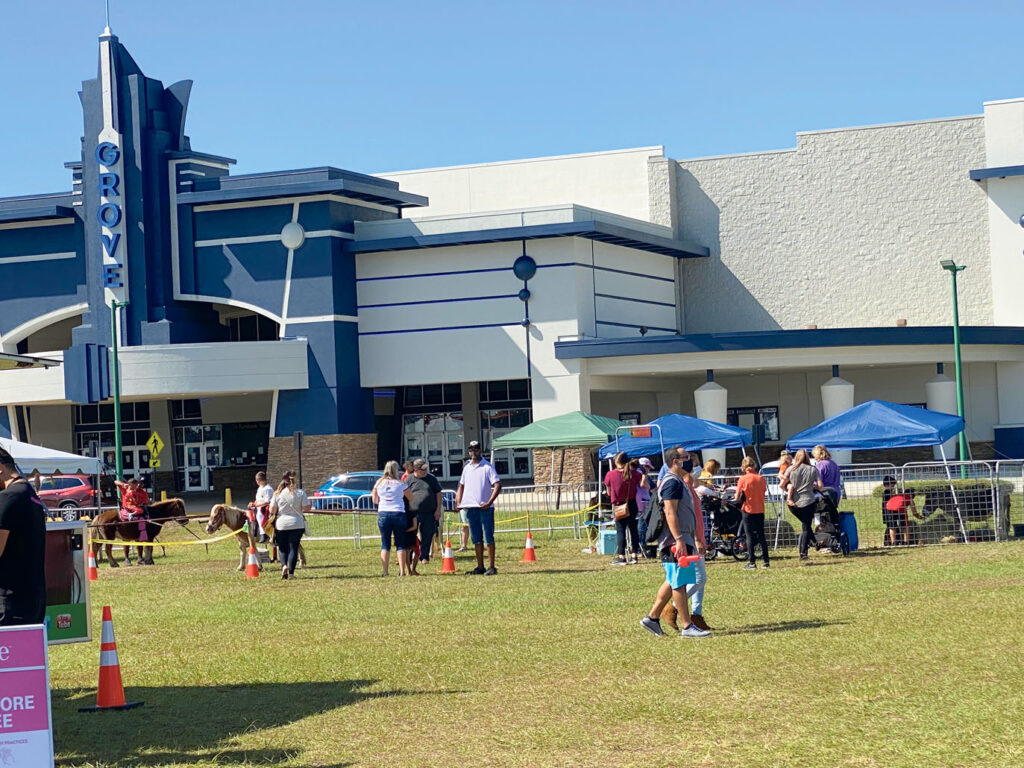
Once you talk to Seven Oaks residents Mike and Alecia, though, the story of The Kilted Axe — which will be a combination of a hip bar and hangout for axe-throwing enthusiasts when it opens on Saturday, January 18, 5 p.m., in The Grove — actually makes perfect sense.

After all, this is a couple that three years ago sold everything they owned — except for a Christmas tree Alicia says she couldn’t get rid of — and, with three young kids in tow, traveled the world for 18 months, with stops in Indonesia, Thailand, Italy and Costa Rica.
So naturally, the Esenweins’ adventurous spirit would lead to owning an axe-throwing business.
“We were living in North Carolina temporarily, and were looking for something to do and there were like 10 locations on the east coast there that had axe throwing,” Mike says. “Most of it was in barns, or a rugged setting, but there was one place in Wilmington that was upscale and had a bar and a restaurant. We just loved it. It was a cool place to hang out.”
It wasn’t until a few years after returning from North Carolina, after running some successful Under Armour flag football leagues as well as doing a little teaching — Mike was an online computer science professor for the University of Virginia and American Public University — that Alicia became restless.
“I want to do something,” she told Mike, and soon the idea for The Kilted Axe had flowered. It had been, after all, the one thing she had been asked about most by friends when they returned from North Carolina, thanks to some of her Facebook pictures.
They passively started looking at barns and warehouses for a site, but were also looking to buy a house, so they decided to put the business idea on hold until 2020.
A trip to The Grove, however, changed everything. Remembering it as a moribund center lacking zip, they drove by when they heard developer Mark Gold had bought it.
Gold, the high-charged developer with a big vision for his property, happened to be standing outside. They chatted. And Gold, who has axe-throwing places at some of his other properties, insisted they start their business as soon as possible.


“Most people wouldn’t rent a space like this for axe throwing,” Mike says. “They want restaurants. Mark knows, though. He loved the idea.”
After meeting some of the other business owners who had already signed leases with Gold, they were sold.
Axe throwing is a trendy, growing sport. The International Axe Throwing Federation (IATF) says there are more than 6,000 league members in more than 100 cities and six countries. It is a staple in lumberjack competitions and has been televised on ESPN.
Mike and Alicia compare it to throwing darts; it’s just a matter of getting the technique down.
The Kilted Axe will have three throwing lanes, all safely fenced in and manned by “Axeperts” there to help.
There also will be a lounge and balcony to hang out and have a few drinks or host an event. “Kind of like an old school pool hall feel,” Mike says.
And, because you have to be wondering — yes, mixing beer, wine and axe throwing can be safe.
“If you show up intoxicated and ready to throw axes, well, guess what? It’s not going to happen,” Mike says.
There will be men’s and women’s leagues, co-ed leagues, and even events for kids. Mike and Alicia have three kids — Jason, 14; Hailey, 12, and Hannah, who is 4. They all think axe throwing is pretty cool.
Alicia says she can’t wait for The Kilted Axe to open. Any fear that they were rushing into a crazy idea dissolved when they posted the news on Facebook, which lit up with enthusiasm.
More than 3,700 people say they are interested in attending opening night. Almost 300 say they are going for sure. A dozen or so people have signed up for leagues, a few nights are already booked for corporate events, and it’s one of the more buzzworthy new places set to open in Wesley Chapel.
“It was a crazy response,” Alicia says. “We’re anxious. Believe me, we’re anxious!”
For more information, visit TheKiltedAxe.com, or search for “Kilted Axe” on Facebook.
Kids squealed with delight upon arriving at the brand-new inclusive playground designed for those with virtually any type of disability at the Wesley Chapel District Park. There were swings and tubes and things to sit and spin on, a soft, cushioned floor to walk on and roll over and lots of bright colors.
It was all theirs.
The glee in their faces was contagious, and it was exactly the moment Pasco County Board of County Commissioners chair Mike Moore had envisioned when he first pitched the idea to the county’s Parks and Recreation department.
The kids weren’t the only ones overwhelmed.
“I’ll be honest with you, when the kids first came out here, I was watching and I had to walk away because it was a little overwhelming,” Comm. Moore said. “I had a couple of tears in my eyes, I really did. This is a miracle.”
***
On December 4, a large gathering of overjoyed kids, dedicated caregivers and teachers, Pasco County government dignitaries and generous donors from the Wesley Chapel Rotary Club, the Lennar Foundation and AdventHealth Wesley Chapel took a few snips at the ribbon cutting, officially opening Pasco’s first-ever inclusive playground.
It was a perfectly sunny day, with a slight chill in the air. But, most everyone there had their hearts warmed by the excitement of the kids, most of whom arrived on a bus from the Exceptional Student Education (ESE) programs from John Long Middle School and Wiregrass Ranch Elementary.
“I’m having a ball,” shouted Eric Piburn, a terminally ill 13-year-old in glasses, gloves, a knit cap and a face mask. Piburn, who needs a heart and double lung transplant, excitedly described his experience as he swung back and forth from a disc swing (that looked like an over-sized basket), the tube from his oxygen tank swaying along with him.
“I’ve loved swings since I was little,” he exclaimed. “I never ever ever ever ever ever want to leave. Ever.”
Another Long student walked around giving everyone a hug. Others wide-eyed but trepidatiously wandered from ride to ride, looking to find something they enjoyed.
“This is really cool,” said Deborah Collin, assistant principal in charge of ESE services at Long. “I keep saying to myself, where can we get some of this stuff?”
****
For every 1,000 children in Pasco County, there are 85 who have some type of special needs. Countywide, the Pasco County School District says there are about 16,000 children with special needs. Collin says there are 55 children in the ESE program at her school, spread over three different classifications of disability, with five teachers and eight instructional aides.
While they have adaptive physical education for the students, it is confined to a room.
“It’s still not enough movement or variety,” she said.
Which is why the playground is such a gamechanger for children with disabilities.
“This is huge,” said Barbara Hayes, a physical therapist with Pasco County Schools for 22 years. “There aren’t a lot of areas for those children to access. You can see the smiles on their faces. This gives them an opportunity to play with children more at their developmental level. This is a wonderful thing and very well done.”
Collin said one of her students, seventh grader Zakyla McKenzie, spends a lot of time playing with a plastic bottle. It fulfills some of her sensory needs, with its texture and the sound it makes when squeezed. But, it’s been the only exercise she usually gets each day.
At the inclusive playground, however, Zakyla was able to find something she liked more.
“She was having such a good time on the swing, she did not want to get off,” said Nellie Reilly, a behavioral specialist at Long who seemed as overjoyed as many of the students.
****
While many area parks may be compliant with Americans with Disabilities Act (ADA) guidelines, few truly meet the standards of what proponents consider to be inclusivity. To do so requires wider pathways and easier-to-navigate surfaces, activity panels that are at ground height, larger swings with more back support and sensory elements that include touch and music.
There are multiple swing sets on the playground, an inclusive spinner that allows kids in wheelchairs to have a merry-go-round experience with their friends, a tube to crawl through — “I like to pretend I’m a cat!” said Eric — and four springy chairs. The surface throughout the playground is made of rubber and, combined with the spread-out rides, allows easy access for wheelchair-bound kids to move around and interact with others.
In the spring, a butterfly garden, which will be tended to by the Rotary Club of Wesley Chapel, should be in full bloom.
“I didn’t see anybody that didn’t find something that worked for them,” Collin said.
****
The inclusive park is the first of its kind in Pasco County and one that Moore said he hopes to replicate in other places. It was not, however, your typical project for the county — it was introduced, funded, approved, designed and built in less than five months, which is light speed by traditional governmental standards.
As a volunteer coach at the District Park for a variety of sports, Moore had for many years seen kids who could run fast, jump high and were able to revel in what the park had to offer.
However, he also had seen the kids who couldn’t, those relegated to the sidelines because of a disability. The park wasn’t for everyone, he realized, and he said the thought bothered him and prompted him to try and change that situation.
After a few months of research, Moore introduced the idea to Keith Wiley, Pasco’s director of Parks and Recreation, earlier this year. Wiley had been thinking similarly — he already had been planning some special needs camps for the county.
****
To fund the project, since it wasn’t in the county’s budget, Moore turned to the 53-member Rotary Club of Wesley Chapel — of which he is an honorary member — which just happened to be looking for a big project, and the club agreed to donate $50,000 for the playground.
Chris Casella, the Rotary Club’s current president, told the ribbon-cutting ceremony crowd of roughly 100 that he was motivated by his own experiences as a kid, and the times spent at the park with friends and family.
“Today,” he said, “this can be a reality for so many families from this area that are going to be able to bring children to this park and have memories that will last a lifetime.”
The Lennar Foundation, the homebuilder’s charitable arm, donated another $50,000, and Advent Health Wesley Chapel chipped in another $25,000.
In August, the county commission voted 5-0 to approve roughly $215,000 in public funding to cover the rest of the project. Ground was broken in September. The ribbon was cut in December.
It was money well spent. As the kids slowly filed back to their school bus, and the adults headed back to work, Eric Piburn continued to rock back and forth on the disc swing, still planning to never ever ever ever ever ever ever ever leave.
As holiday breaks approach for all of our local schools, Wharton’s band, orchestra and choir programs will get together to make music in a somewhat unexpected style that has become an annual tradition.
Called “Prism,” it will feature every large performing ensemble in the school’s music department, which includes the band, orchestra and chorus.
“The concert runs in a non-traditional, continuous or circular format,” explains Justin Swaim, music department chair, “with varying performing locations throughout the concert hall.”
So, when one ensemble finishes performing, the spotlight will instantly move to another area of the auditorium and the next piece will begin.
It might go from a vocal solo of a popular holiday song to a string quartet playing a classical piece. Then, the entire orchestra may appear on stage, while the jazz band sets up in the back corner.
Swaim says Prism is a fast-paced, fun and somewhat unexpected evening.
Groups scheduled to perform include Wharton’s Wind Ensemble, Philharmonic Orchestra, Symphonic Band, Wildcat Orchestra, Jazz Band, Lady Catz Choir, Mixed Choir, Percussion Ensemble and smaller ensembles.
The school’s marching band, called Wharton Regiment, will fill the auditorium in a unique way. Typically, its sounds are reserved for outdoor football fields.
But, during Prism, the Wharton Regiment brings a modified version of this season’s halftime show, which scored straight superiors (the highest possible score) at its MPA (Music Performance Assessment) competition last month and features music from Marvel Studios’ “The Avengers.”
From quiet to loud, classical to contemporary, Swaim says that at Prism, “there is always something for all ages and all musical tastes.”
Prism will be held on Friday, December 13, at 7 p.m. in the Wharton High School auditorium, located on the south side of the school (closer to Walmart) at 20150 Bruce B. Downs Blvd.
Admission is $5 for adults and free for students with student ID and children ages 12 and under. All proceeds from admission will go directly to supporting the students participating in the Wharton High music department.
For questions regarding the concert, please email Justin Swaim at justin.swaim@sdhc.k12.fl.us. — CM
Wharton High is home to two of riflery’s sharpest shooters, and both have Olympic aspirations.
When Matt Sanchez signed his college athletic scholarship papers with West Virginia University on Nov. 14, it didn’t make the nightly sports news, but it was a big deal.
It was as big as a high school football player signing a college scholarship to compete at Alabama or Ohio State. Or a basketball player signing with Kentucky or Duke.
It was history.
Sanchez and his Wharton teammate, Ben Salas, who signed with North Carolina State University in Raleigh, are believed to be the first high school kids in Tampa Bay to sign scholarships for rifle, a varsity college and Olympic sport.
While Salas is going to join a young, growing riflery program, Sanchez will be joining arguably the best shooting school in the country.
The Mountaineers have won 19 NCAA national team championships, producing 25 individual NCAA championships, 65 All-Americans and 13 Olympians.
Sanchez hopes to No. 14.
Sanchez has already made a name for himself in the world of Olympic-style shooting.
At just 17 years old, the Heritage Isles resident has spent the last year traveling the world to compete in World Cups and World Championship competitions as a member of the USA Shooting national team. Because of his age, Sanchez currently is part of the junior national team.
“Most recently, I competed in September in Rio de Janeiro, Brazil, in the World Cup,” says Sanchez, “and I’ve also been to Germany and Austria four times each, and Switzerland, Korea and China.”
Sanchez participates in two types of competitions. One is smallbore, which is shooting a .22 caliber rifle in three positions — standing, kneeling and prone.
The other is shooting an air rifle, which is a type of pellet gun, taking 60 shots while standing.
Jayme Shipley, who represented the U.S. in the 1996 and 2000 Summer Olympic games, placing sixth in the 2000 Olympics in the women’s air rifle competition, is Sanchez’s coach. A resident of Naples, she coaches a handful of high school aged precision shooters throughout the state, and Sanchez is one of her best students.
In the smallbore event, he participated in the first round of Olympic Trials in October, where he finished in 11th place. However, a second round of competition will be held next spring “to make sure they don’t get someone who just has one good day,” Shipley says.
Only two men will make it onto the Olympic team in each event, but Shipley says Sanchez is currently in contention, and his chances are probably better to make the team in the air rifle event, where he often shoots scores that rank well among not just his teammates on the juniors, but also among the adult men.
Those trials begin December 6 at the Olympic Training Center in Colorado Springs, CO, with a second portion of competition happening in February.
Shooting has been an event in the Olympics since the first modern games in 1896. In fact, the first medal given out at every Olympics is in shooting.
“When I first started working with Matt almost 5 years ago, we looked at the 2024 Olympics as a goal,” says Shipley. “But, he’s excelled so fast that he has a really good chance with this one.”
* * *
Incredibly, when Sanchez attends the Olympic Trials for air rifle, he won’t be the only Wharton High senior to compete.
Salas, a 17-year-old Live Oak Preserve resident, will compete as well.
While Salas hasn’t made the national team and didn’t compete in the Olympic trials for smallbore, he also trains with Shipley and also has his eyes on an Olympic prize someday.
Salas has only been shooting precision rifle since last October, but has progressed quickly enough to earn the opportunity to compete in the Olympic trials for air rifle.
Ben Salas (left) and Matt Sanchez
A relative newcomer, Salas’ growth as a shooter has been accelerated in part due to working alongside Sanchez, a veteran of the sport.
Sanchez began shooting with his dad when he was only 10 years old. The family lived in Orlando and went to a rifle club on weekends, just for fun. Sanchez entered a few competitions at the club, noticing that others showed up in some “weird” gear. He says he started to realize there were things he could improve on and excel at, so he started getting his own gear and working on his technique.
“I started to win little competitions, which led to state championships,” he says. “Being able to win stuff really piqued my interest.”
At 13, Sanchez began to take the sport seriously. In 2017, his dad’s job change brought him to Wharton for the beginning of his sophomore year.
“When I got here, I saw they had a rifle team in NJROTC,” says Sanchez, referring to the high school’s Navy Junior Reserve Officer Training Corps program. “It gave me more time to shoot during school and made things a lot easier, training-wise.”
His presence has transformed the school’s program.
“Matt has been a mentor to our whole team,” says Chief Wayne Boknevitz, a Naval sciences instructor who also coaches the school’s rifle teams. “He got our whole precision team up and running and has elevated the entire marksmanship team.”
Boknevitz says the school previously had “sporter” level rifle teams, but not “precision” level. Sanchez worked with Boknevitz to get a team together, recruiting other students to invest in the expensive gear, while Boknevitz borrowed guns from another school.
“Matt took time from his own practice to help everyone else with form and micro-adjustments to the guns,” explains Boknevitz. “The knowledge he shared allowed us to go to Navy nationals last year.”
* * *
Unlike Sanchez, Salas was first an NJROTC cadet, interested in pursuing a military career. He joined the school’s rifle team for fun. On the sporter team, Salas set a school record, and Boknevitz encouraged him to join the school’s new precision team.
At first Salas was reluctant – he says his parents weren’t sure they wanted to spend the money on gear – but Sanchez encouraged him, explaining that precision shooting is a sport that can actually lead to a scholarship at a university. Salas says at that point, his parents were in.
“I was hoping to get into a Division II school, but my personal records kept going up very fast in a very short period of time,” says Salas.
He says it was earlier this year when he saw how well he was placing around peers who have been shooting much longer than him and wanted to take it a step further.
“I realized I could probably make the Olympics if I practice hard enough,” he says. “I’m really shooting for 2024.”
Salas is happy to give a lot of the credit to Sanchez.
“Before he came to our school there was no precision team, so if he had gone to another school, I would have stayed on the sporter team and all of this never would have happened,” Salas says.
For the past year, the pair have trained together before and after school at Wharton using paper targets, and at home using highly sensitive Olympic-style electronic targets.
They travel once or twice a month to a specialized range – of which there are very few in the state and none locally – typically going to one in south Hollywood in South Florida, where they spend seven or eight hours a day practicing their sport with Shipley.
“The two of them together are great friends and they are great training partners,” says Shipley. “They push each other. Plus, they’re both a joy to be around, just the funniest kids ever.”
* * *
While their eyes may be temporarily set on the Olympic prize as the Trials draw near, both boys say their more immediate goal has been getting a prized college scholarship.
“Most guys who make the (Olympic) team are in their 20s and some top shooters are in their mid-30s, so you can do it for a long time and have a long career,” explains Shipley. “When they’re so young, my goal as a coach is to get them into school with a scholarship, because school is expensive, and the sport is expensive.”
Both Wildcats hit the bullseye when it came to receiving scholarships.
Sanchez can play a hand in restoring WVU to the top of the college ranks. The Mountaineers 19 titles is No. 1 all-time, but they haven’t won one since capturing their fifth straight title 2017.
Salas will follow in the footsteps of his grandfather, who played football at NC State. He will be a big part of getting the Wolfpack on the college rifle map.
“At first, the program was just a club,” Ben says. “But, they just got a new coach and she’s really stepping up and making the program bigger and proving that NC State is a good shooting school. I’m really happy to go there and help them.”
There are only 30 universities that give scholarships in shooting, but none in Florida, although Shipley says USF used to have one of the best shooting teams in the country, with three Olympians.
Boknevitz says that to his knowledge, it’s the first time in Hillsborough County that any student has been signed to an NCAA shooting team and participated in signing day, taking pride that Wharton had not one, but two, students sign.
One way or another, both Wildcats have bright futures.
“I’m really excited for the Olympic trials, because I’ve seen what scores I can put up if I shoot my best,” Salas says. “But I’m more excited for college because I know that’s a guarantee.”