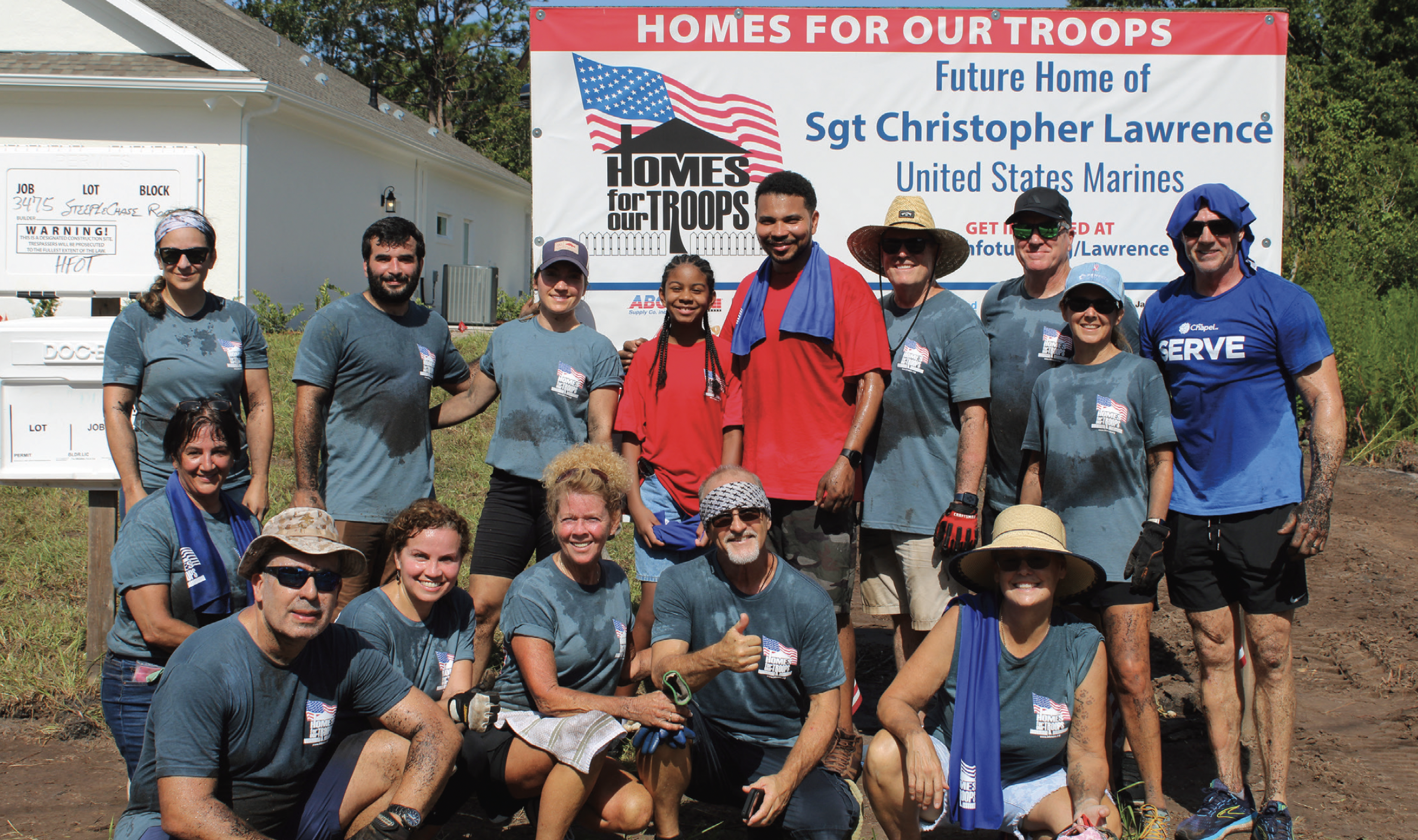
Sgt. Christopher Lawrence & his daughter DeliaMarie (both in red) pose with several of the 100+ volunteers who helped landscape (bottom pics) their future home in Wesley Chapel.
“We don’t have a lot of family or friends here in Florida,” said retired Marine Sgt. Christopher Lawrence during the super-hot “Volunteer Day” (July 26) at his family’s future “Homes for our Troops” (HFOT) home in Wesley Chapel, where about 10,000 sq. ft. (25 pallets) of sod was unloaded and dozens of plants were used to landscape the front and side yards at the home on Steeplechase Rd. “But today, we feel like we have a lot of new family members.”
You could see the appreciation and joy Sgt. Lawrence, his wife Michelle (Chelley) and daughters DeliaMarie and Cristiana felt as they helped more than 100 volunteers beautify the outside of the Kent Custom Home the family expects to move into by around the end of this month.
Sgt. Lawrence raised the HFOT flag during the volunteer event (above).
Partner Nathan Pratt explained how to place the sod and plant the plants and said how proud he was to have two more Kent Custom Homes — for Sgt. Lawrence and Army Sgt. Quincy Lopez, who, like Sgt. Lawrence, lost his right leg to an improvised explosive device blast in Iraq. (Note-Sgt. Lopez’s Volunteer Day will be this Saturday, August 9, at 9 a.m.) — in Wesley Chapel, bringing the total Kent has specially adapted and built for Post-911 recipients designated by Homes for our Troops here in Central Florida up to nine.
Homes for our Troops is a national 501(c) (3) military nonprofit that continues to spend 90 cents of every dollar the organization raises to build more than 400 custom homes (and growing) across the country since its inception in 2004.
In addition to the landscaping on July 26, volunteers also sold HFOT hats and accepted cash donations to help HFOT continue to provide these homes at no cost to our severely injured military men and women.
To make a donation or for more information about HFOT, visit hfotusa.org or call (866) 787-6877. — GN
The Lawrence family can’t wait to move into their new home. Nathan Pratt of Kent Custom Homes thanks the volunteers & gives them instructions.
This construction entrance on Elam Rd. for a new townhome community in Epperson North is now expected to become a full entrance for townhome residents once the development has been completed, which is a compromise for those living on Abby Brooks Cir. (homes in the distance) in Epperson Ranch II.
Although we hadn’t yet received, at our press time, confirmation that the deal has been finalized, it appears that Metro Development Group and Pasco County have come to an agreement that hopefully will help protect the safety of the residents of Abby Brooks Cir. (ABC), Lily Arbor Way and Swift Wind Dr. in the Epperson Ranch II Community Development District (CDD).
As we reported back in May, a new development of 186 townhomes in the Epperson North CDD is slated to open adjacent to those single-family homes in the Epperson Ranch II CDD — on property that was originally intended to be a school, with an entrance on Elam Rd.
When Pasco County rezoned the property for the townhomes, the entrance on Elam Rd., which currently is being used as a construction entrance (see photo), was eliminated, which meant the only entrance and exit to and from the new townhomnes would be from Epperson Blvd. through ABC, adding an estimated 400 daily trips through the quiet neighborhood by people who wouldn’t live in the neighborhood nor in Epperson II at all.
A large group of concerned Epperson II residents attended the May 6 Pasco Board of County Commissioners (BCC) meeting to complain, and the commissioners, to their credit, agreed that not having an Elam Rd. entrance for the townhomes was a mistake. They also said, however, that they didn’t think anything could be done about it, but had the group meet with the county’s Planning Dept. director David Engel and Development Services Dept. director David Allen while the May 6 BCC meeting was still in session. Engel and Allen said they would talk to Metro to see if the developer would agree to at least allow the entrance on Elam Rd. to be built as a full second entrance/exit, as an alternative to ABC.
On July 8, Metro VP of marketing & communications Lisa Gibbings sent me an email with the following update:
• Construction of the Elam Rd. entrance will begin when the county completes final review and approval of the plan modification.
• The entrance is expected to be completed at the same time as the completion of the overall townhome project, or by the end of 2025.
• While it is currently an active construction zone, access is not permitted for use by the public until the entrance and overall townhome project have been completed.
• To the best of our knowledge, there is no agreement in place nor one being discussed between Epperson Ranch II CDD and Epperson North CDD regarding the entrance. On May 13, 2025, the developer and Pasco County staff met with and shared the proposed (new) entrance plan to representatives of the Epperson Ranch II CDD and residents of the [Epperson II] neighborhood that attended. The proposed plan was well received, and the developer is currently working with the county for final construction plan review and approval.
• It is our understanding that during the Epperson Ranch II CDD meeting on July 3, 2025, the Chair of the Board of Supervisors indicated the entrance road matter is essentially resolved.
• “Metro is excited to partner with Pasco County to bring this entrance to the new townhome community within Epperson. We hope this adds another layer of convenience and safety for residents while reducing congestion within the [ABC] community.”
The Epperson II residents would not comment until the agreement was finalized.
As we all remember all too vividly, Hurricane Milton, which was a Category 5 tropical cyclone when it made landfall near Siesta Key on Oct. 9 of last year, was the first hurricane in decades (or maybe ever) to make a direct hit on the Wesley Chapel area later that day and cause widespread damage and flooding.
The after-effects of Milton continued to be felt for many weeks and, among the casualties of that storm were dozens of roadway signs that were knocked down and/or destroyed — some of which still have not been replaced now nearly 10 months later (highlighted in red in both pictures, above).
Pasco County Media Relations & Communications public information officer Sarah Andeara says, however, that the county’s Traffic Operations & Public Works departments, “have repaired all damages and replaced all signage on county roads that were damaged by Hurricane Milton. Traffic Operations replaced approximately 40 overhead signs and traffic signals, noting that each overhead illuminated street name sign costs approximately $3,700.”
At our press time, Andeara did not know how many post-mounted signs were fixed via the Public Works department, but said that for any missing signs on state roads — including S.R.s 56 and 54 — the Florida Department of Transportation (or FDOT)’s District 7 is ultimately responsible for the replacement of those signs.
It’s also important to note that, unlike traffic signal “heads,” each of the signs — which are important for tourism, emergency response and local businesses — has to be custom-designed.
FDOT transportation engineer Megan Arasteh says, “The Department has inventoried the damaged signs through field visits, and designed the new signs if as-builts were not available, and is in the process of securing the funds for manufacturing the signs.”
Arasteh also noted that, “The estimated timeframe to complete sign replacements throughout District 7 is approximately one year. It takes FDOT about one hour to design each sign if as-builts are not available. The manufacturing process requires a minimum lead time of four months, and each sign installation takes approximately three hours.”
As for how many signs FDOT needs to replace in our area, Arasteh says, “A minimum of 16 signs will be replaced in Wesley Chapel, nineteen signs total in Pasco County, and 203 signs total in all of District 7,” which also includes New Tampa.
Arasteh also notes that, “FDOT recently completed the process of acquiring federal funds to replace these signs. The Federal Highway Administration (FHWA) requires a Detailed Damage Inspection Report (DDIR) for approval of funding. FDOT began the process in December 2024. The report included details of the hurricane damage and pictures. FHWA approved the funds this month. As you can imagine with the extent of the damage due to Hurricane Milton, FHWA has had a very large number of DDIRs to review and approve, [and] they have been a great resource to work closely with the Department throughout this process. Dist. 7 Traffic Operations is now working on a new contract that will advertise for bids in about two months for sign replacement.”
As for cost, Arasteh says, “The cost varies to replace each sign. Based on FDOT’s statewide averages for signs, the cost is approximately $7,500, not including design, maintenance of traffic and mobilization. A vendor will manufacture the signs on behalf of FDOT and Pasco County will install the signs.
Now, two months into the 2025 hurricane season, the hope here is that the work will be completed before our area takes another major hit.
So, which is our readers’ favorite fried chicken place in the Wesley Chapel area?
We’re still nowhere close to the answer to that question, but as the publisher and editor of the Wesley Chapel Neighborhood News, I’m proud to say that after months of effort and roughly 50 total volunteers who said they wanted to be judges, the contest is at least under way. Round 1 was completed on July 23 and Round 2 is taking place on July 30, or the Wednesday after this issue was printed. The Grand Finale, where our nine judges will finally get to pick their favorite mild and spicy chicken, hopefully will be completed before school goes back in session on August 11.
Picking the nine judges was not an easy task. Of the 50 people who volunteered, I originally planned to only have five judges. But then, I thought, what would happen if more than one of the people we picked ended up not being able to be there for Rounds 2 and 3? I decided that a couple more couldn’t hurt — it would even allow us to employ Olympic-style scoring where we could throw out the high and the low and just use the other seven scores for each restaurant, if I wanted.
At any rate, the nine people selected, from left to right in the top left photo, were: Bill Johnston (aka Colonel Sanders himself!) and his wife Suzanne Reno of Quail Hollow, Aaron “Dion” Rocha of New River Township, Cindy Cooley of Tampa Palms, Dion’s wife Suzanne Rocha, the father-daughter duo of Joshua & Zoe Paine of Heritage Isles and the son-&-father team of Karson (the self-proclaimed & costumed “King Chicken Wing” and Jason Centeno of Live Oak Preserve (and yes, a certain editor is in there, too).
The first round was a blast for yours truly, the judges and even for Jannah, whose unenviable job it was to go and pick up the chicken from the first five restaurants. I thought we were going to split the number of places into one group of 5 and one group of 6, but I forgot to include one chicken place that recently added tenders to its menu, so Round 2 will now have the mild and spicy chicken tenders from seven places being sampled. A few other things I have to mention:
1) Because we are bringing the chicken from multiple locations to one central location, the judges know that none of the chicken will be as hot or as moist as it would be at each of the places.
2) None of the chicken was served with sauces for fear that the judges would figure out whose chicken was whose too easily. But again, it also keeps each place’s chicken from tasting its best.
3) I have to thank president & CEO Hope Kennedy and office administrator Darlene Hill of the North Tampa Bay Chamber for allowing us to use the board room in the Chamber’s beautiful, new office in The Shops at Wiregrass for all of the rounds of the contest.
4) I also have to thank our photographer/videographer Charmaine George for not only shooting still pictures, but also videotaping all of the proceedings. When we’re ready to announce the winning restaurants, we will do so as the premiere episode of our “Neighborhood Newsmakers” podcast. Look for updates about that event on our “Neighborhood News” Facebook page.
5) Yours truly didn’t sample all of the chicken nor did I try to influence the judges in any way.
I was excited to see a sign posted next to Fine Ink Studios (the former location of Pinot’s Palette) that Haraz Coffee House was “Brewing Soon” at 1722 Bruce B. Downs Blvd., in the Publix-anchored Shoppes at New Tampa of Wesley Chapel plaza.
I’ll admit that I’d never heard of Haraz before, but any coffee shop that isn’t Starbucks that opens in our area is definitely worth a try and Haraz’s website says that the brand and founder Hamzah Nasser are “on a mission to share the rich heritage of Yemeni coffee with the world. By sourcing the finest beans and honoring traditional craftsmanship, we bring the bold, authentic flavors of Yemen to every cup. As we expand across the U.S., we’re committed to creating unforgettable coffee experiences that connect communities and celebrate culture.”
Since starting off in Detroit in 2021, Haraz has grown to 31 locations in 13 states (with the closest one to us, and the only one in Florida, in Orlando), with 185 more “in the pipeline.”
Whether you like traditional lattes or cappuccinos or prefer Turkish, Saudi, French Press or cold brew coffee, or even coffee with cardamom, ginger or other spices, Haraz has got you covered.
There’s also hot chocolate, green and matcha tea and pistachio and saffron lattes. Haraz also features milk cakes, cheesecake & cinnamon rolls, and sells items like coffeemakers and bulk coffee.
I called the Orlando location but they said the Wesley Chapel shop is owned by another franchisee, so they had no idea when our Haraz is expected to open. Of course, we’ll keep you posted, both in these pages and on our Facebook page.