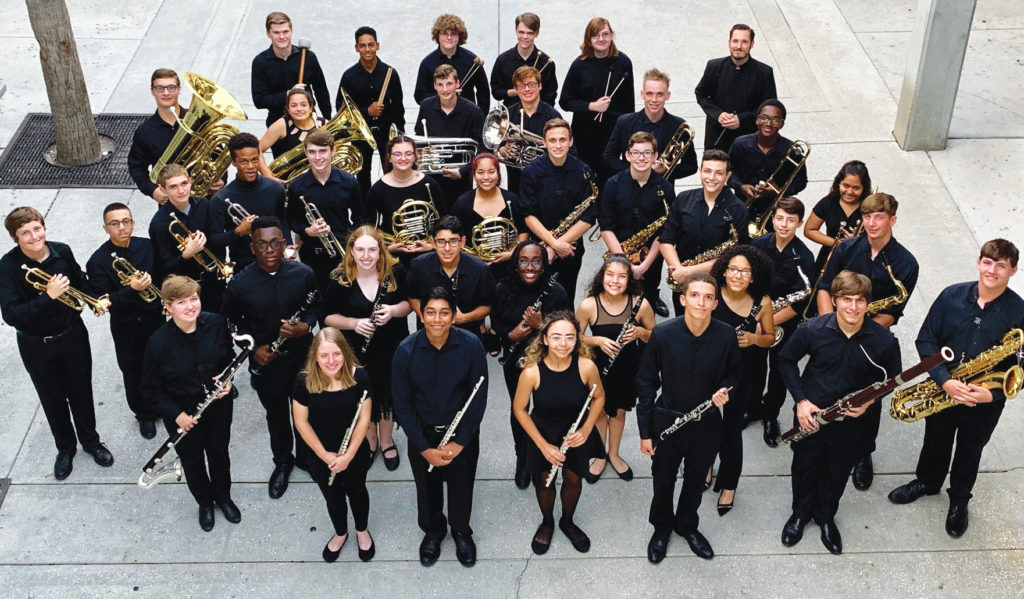
As holiday breaks approach for all of our local schools, Wharton’s band, orchestra and choir programs will get together to make music in a somewhat unexpected style that has become an annual tradition.
Called “Prism,” it will feature every large performing ensemble in the school’s music department, which includes the band, orchestra and chorus.
“The concert runs in a non-traditional, continuous or circular format,” explains Justin Swaim, music department chair, “with varying performing locations throughout the concert hall.”
So, when one ensemble finishes performing, the spotlight will instantly move to another area of the auditorium and the next piece will begin.
It might go from a vocal solo of a popular holiday song to a string quartet playing a classical piece. Then, the entire orchestra may appear on stage, while the jazz band sets up in the back corner.
Swaim says Prism is a fast-paced, fun and somewhat unexpected evening.
Groups scheduled to perform include Wharton’s Wind Ensemble, Philharmonic Orchestra, Symphonic Band, Wildcat Orchestra, Jazz Band, Lady Catz Choir, Mixed Choir, Percussion Ensemble and smaller ensembles.
The school’s marching band, called Wharton Regiment, will fill the auditorium in a unique way. Typically, its sounds are reserved for outdoor football fields.
But, during Prism, the Wharton Regiment brings a modified version of this season’s halftime show, which scored straight superiors (the highest possible score) at its MPA (Music Performance Assessment) competition last month and features music from Marvel Studios’ “The Avengers.”
From quiet to loud, classical to contemporary, Swaim says that at Prism, “there is always something for all ages and all musical tastes.”
Prism will be held on Friday, December 13, at 7 p.m. in the Wharton High School auditorium, located on the south side of the school (closer to Walmart) at 20150 Bruce B. Downs Blvd.
Admission is $5 for adults and free for students with student ID and children ages 12 and under. All proceeds from admission will go directly to supporting the students participating in the Wharton High music department.
For questions regarding the concert, please email Justin Swaim at justin.swaim@sdhc.k12.fl.us. — CM
Wharton High is home to two of riflery’s sharpest shooters, and both have Olympic aspirations.
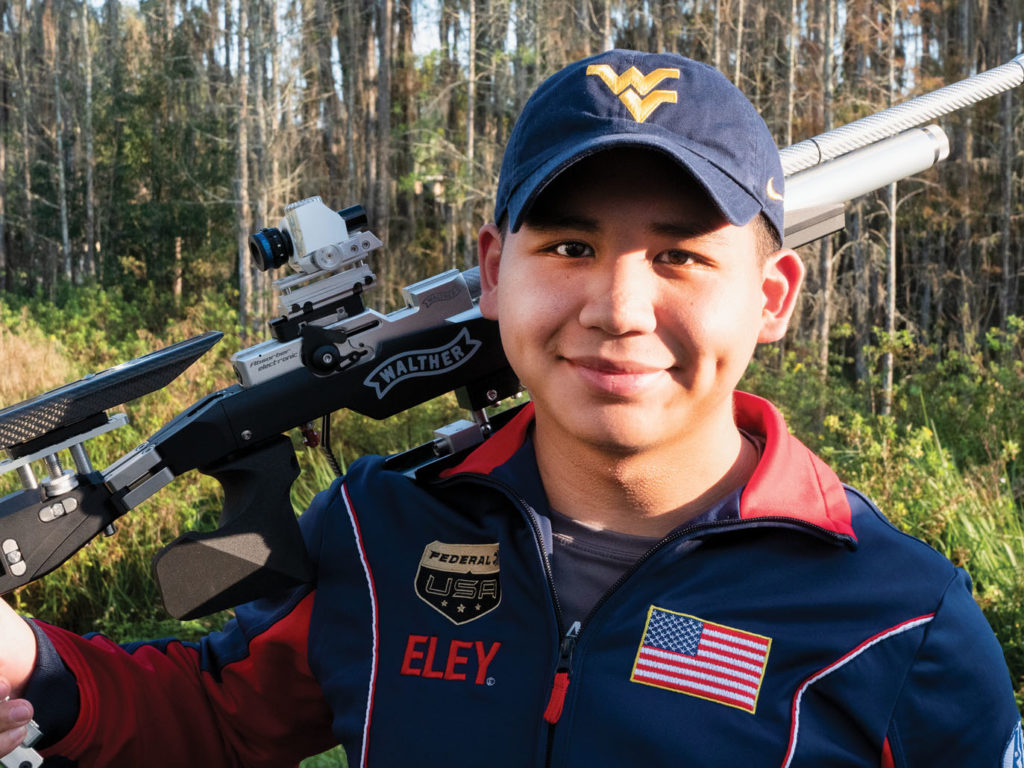
When Matt Sanchez signed his college athletic scholarship papers with West Virginia University on Nov. 14, it didn’t make the nightly sports news, but it was a big deal.
It was as big as a high school football player signing a college scholarship to compete at Alabama or Ohio State. Or a basketball player signing with Kentucky or Duke.
It was history.
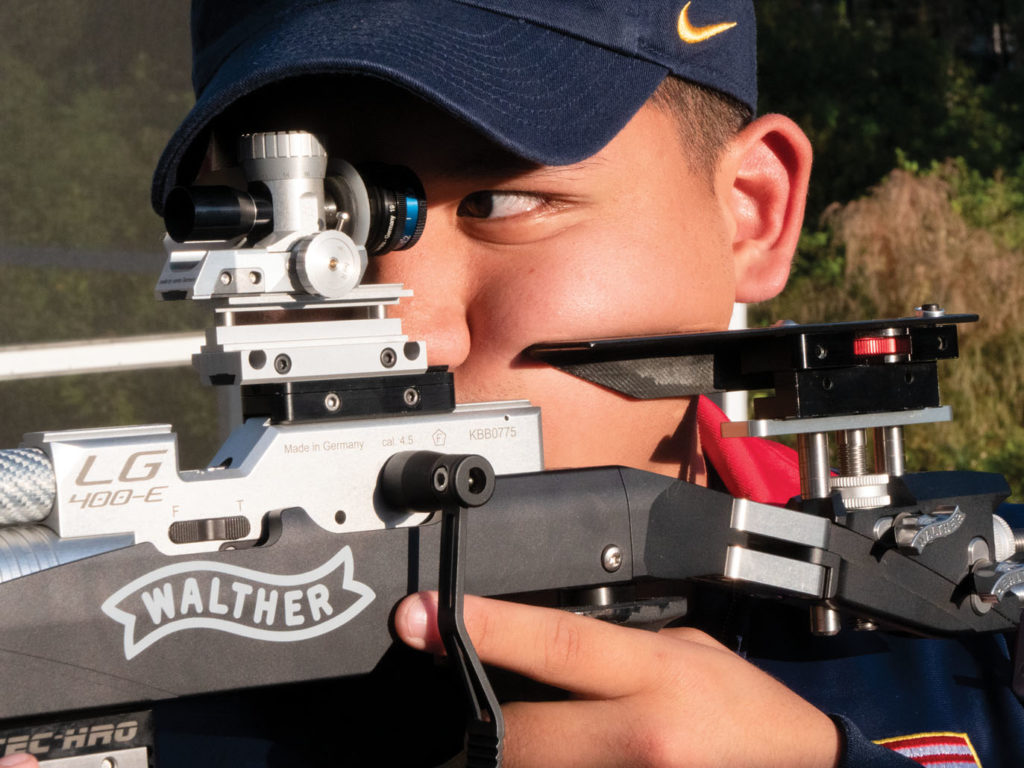
Sanchez and his Wharton teammate, Ben Salas, who signed with North Carolina State University in Raleigh, are believed to be the first high school kids in Tampa Bay to sign scholarships for rifle, a varsity college and Olympic sport.
While Salas is going to join a young, growing riflery program, Sanchez will be joining arguably the best shooting school in the country.
The Mountaineers have won 19 NCAA national team championships, producing 25 individual NCAA championships, 65 All-Americans and 13 Olympians.
Sanchez hopes to No. 14.
Sanchez has already made a name for himself in the world of Olympic-style shooting.
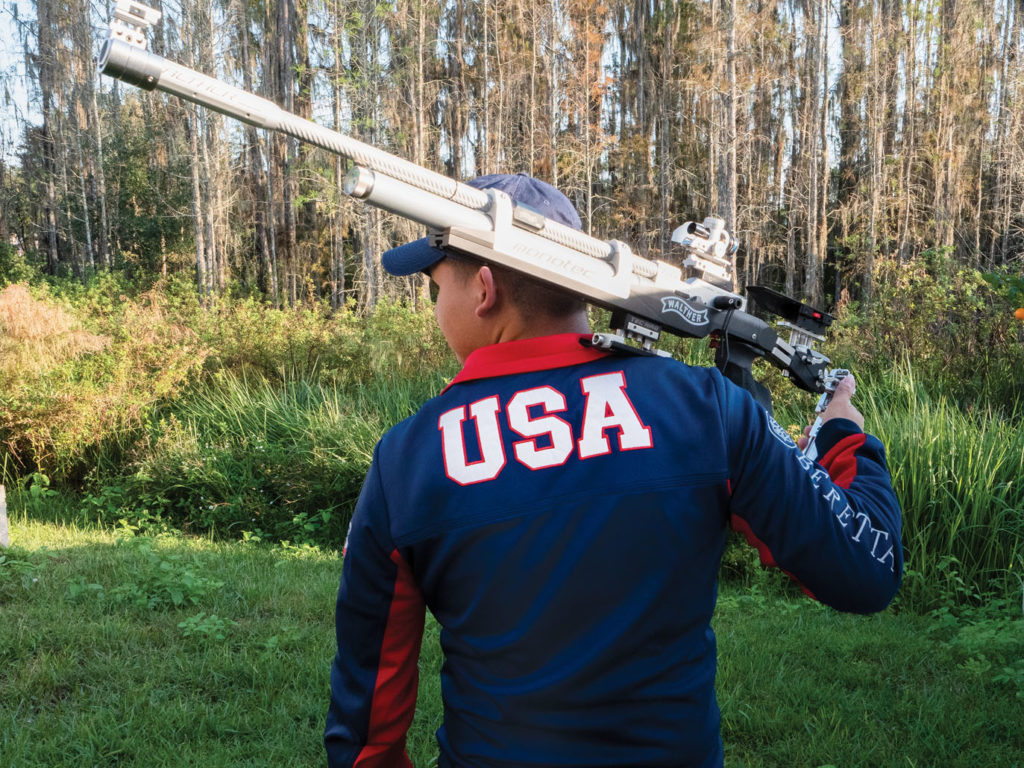
At just 17 years old, the Heritage Isles resident has spent the last year traveling the world to compete in World Cups and World Championship competitions as a member of the USA Shooting national team. Because of his age, Sanchez currently is part of the junior national team.
“Most recently, I competed in September in Rio de Janeiro, Brazil, in the World Cup,” says Sanchez, “and I’ve also been to Germany and Austria four times each, and Switzerland, Korea and China.”
Sanchez participates in two types of competitions. One is smallbore, which is shooting a .22 caliber rifle in three positions — standing, kneeling and prone.
The other is shooting an air rifle, which is a type of pellet gun, taking 60 shots while standing.
Jayme Shipley, who represented the U.S. in the 1996 and 2000 Summer Olympic games, placing sixth in the 2000 Olympics in the women’s air rifle competition, is Sanchez’s coach. A resident of Naples, she coaches a handful of high school aged precision shooters throughout the state, and Sanchez is one of her best students.
In the smallbore event, he participated in the first round of Olympic Trials in October, where he finished in 11th place. However, a second round of competition will be held next spring “to make sure they don’t get someone who just has one good day,” Shipley says.
Only two men will make it onto the Olympic team in each event, but Shipley says Sanchez is currently in contention, and his chances are probably better to make the team in the air rifle event, where he often shoots scores that rank well among not just his teammates on the juniors, but also among the adult men.
Those trials begin December 6 at the Olympic Training Center in Colorado Springs, CO, with a second portion of competition happening in February.
Shooting has been an event in the Olympics since the first modern games in 1896. In fact, the first medal given out at every Olympics is in shooting.
“When I first started working with Matt almost 5 years ago, we looked at the 2024 Olympics as a goal,” says Shipley. “But, he’s excelled so fast that he has a really good chance with this one.”
* * *
Incredibly, when Sanchez attends the Olympic Trials for air rifle, he won’t be the only Wharton High senior to compete.
Salas, a 17-year-old Live Oak Preserve resident, will compete as well.
While Salas hasn’t made the national team and didn’t compete in the Olympic trials for smallbore, he also trains with Shipley and also has his eyes on an Olympic prize someday.
Salas has only been shooting precision rifle since last October, but has progressed quickly enough to earn the opportunity to compete in the Olympic trials for air rifle.
Ben Salas (left) and Matt Sanchez
A relative newcomer, Salas’ growth as a shooter has been accelerated in part due to working alongside Sanchez, a veteran of the sport.
Sanchez began shooting with his dad when he was only 10 years old. The family lived in Orlando and went to a rifle club on weekends, just for fun. Sanchez entered a few competitions at the club, noticing that others showed up in some “weird” gear. He says he started to realize there were things he could improve on and excel at, so he started getting his own gear and working on his technique.
“I started to win little competitions, which led to state championships,” he says. “Being able to win stuff really piqued my interest.”
At 13, Sanchez began to take the sport seriously. In 2017, his dad’s job change brought him to Wharton for the beginning of his sophomore year.
“When I got here, I saw they had a rifle team in NJROTC,” says Sanchez, referring to the high school’s Navy Junior Reserve Officer Training Corps program. “It gave me more time to shoot during school and made things a lot easier, training-wise.”
His presence has transformed the school’s program.
“Matt has been a mentor to our whole team,” says Chief Wayne Boknevitz, a Naval sciences instructor who also coaches the school’s rifle teams. “He got our whole precision team up and running and has elevated the entire marksmanship team.”
Boknevitz says the school previously had “sporter” level rifle teams, but not “precision” level. Sanchez worked with Boknevitz to get a team together, recruiting other students to invest in the expensive gear, while Boknevitz borrowed guns from another school.
“Matt took time from his own practice to help everyone else with form and micro-adjustments to the guns,” explains Boknevitz. “The knowledge he shared allowed us to go to Navy nationals last year.”
* * *
Unlike Sanchez, Salas was first an NJROTC cadet, interested in pursuing a military career. He joined the school’s rifle team for fun. On the sporter team, Salas set a school record, and Boknevitz encouraged him to join the school’s new precision team.
At first Salas was reluctant – he says his parents weren’t sure they wanted to spend the money on gear – but Sanchez encouraged him, explaining that precision shooting is a sport that can actually lead to a scholarship at a university. Salas says at that point, his parents were in.
“I was hoping to get into a Division II school, but my personal records kept going up very fast in a very short period of time,” says Salas.
He says it was earlier this year when he saw how well he was placing around peers who have been shooting much longer than him and wanted to take it a step further.
“I realized I could probably make the Olympics if I practice hard enough,” he says. “I’m really shooting for 2024.”
Salas is happy to give a lot of the credit to Sanchez.
“Before he came to our school there was no precision team, so if he had gone to another school, I would have stayed on the sporter team and all of this never would have happened,” Salas says.
For the past year, the pair have trained together before and after school at Wharton using paper targets, and at home using highly sensitive Olympic-style electronic targets.
They travel once or twice a month to a specialized range – of which there are very few in the state and none locally – typically going to one in south Hollywood in South Florida, where they spend seven or eight hours a day practicing their sport with Shipley.
“The two of them together are great friends and they are great training partners,” says Shipley. “They push each other. Plus, they’re both a joy to be around, just the funniest kids ever.”
* * *
While their eyes may be temporarily set on the Olympic prize as the Trials draw near, both boys say their more immediate goal has been getting a prized college scholarship.
“Most guys who make the (Olympic) team are in their 20s and some top shooters are in their mid-30s, so you can do it for a long time and have a long career,” explains Shipley. “When they’re so young, my goal as a coach is to get them into school with a scholarship, because school is expensive, and the sport is expensive.”
Both Wildcats hit the bullseye when it came to receiving scholarships.
Sanchez can play a hand in restoring WVU to the top of the college ranks. The Mountaineers 19 titles is No. 1 all-time, but they haven’t won one since capturing their fifth straight title 2017.
Salas will follow in the footsteps of his grandfather, who played football at NC State. He will be a big part of getting the Wolfpack on the college rifle map.
“At first, the program was just a club,” Ben says. “But, they just got a new coach and she’s really stepping up and making the program bigger and proving that NC State is a good shooting school. I’m really happy to go there and help them.”
There are only 30 universities that give scholarships in shooting, but none in Florida, although Shipley says USF used to have one of the best shooting teams in the country, with three Olympians.
Boknevitz says that to his knowledge, it’s the first time in Hillsborough County that any student has been signed to an NCAA shooting team and participated in signing day, taking pride that Wharton had not one, but two, students sign.
One way or another, both Wildcats have bright futures.
“I’m really excited for the Olympic trials, because I’ve seen what scores I can put up if I shoot my best,” Salas says. “But I’m more excited for college because I know that’s a guarantee.”
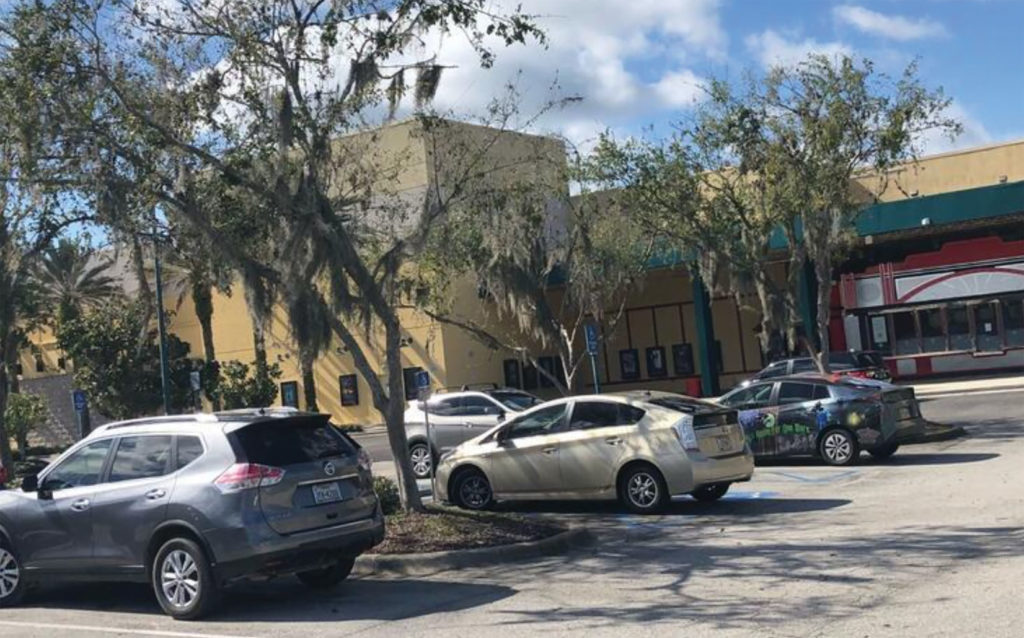
These photos were taken by Dist. 7 Tampa City Council member Luis Viera. They show the wear on the AMC 20 movie theater’s facade, as well as overgrown trees in the parking lot.
Tampa City Council member Luis Viera has said from the very beginning of his current term that cracking down on blight in New Tampa would be one of his priorities, and he has not been shy about sic’ing code enforcement on those he feels aren’t keeping the District 7 area he represents up to a certain standard.
His latest target is the AMC Highwoods 20 movie theater on Highwoods Preserve Pkwy., off Bruce B. Downs (BBD) Blvd.
Viera sent a letter to AMC Corporate headquarters in Leawood, KS, on Nov. 12 requesting to speak with someone about the condition of its movie theater in the heart of New Tampa.
According to Viera’s letter, he has received a number of calls and emails from residents that the building’s facade looks run down and dirty and the surrounding vegetation is not being maintained.
Luis Viera
Viera wrote that the condition of the property was “not properly reflecting the exterior standards of New Tampa” and that it was in “desperate need of attention.”
At our press time, Viera said he had not received a response.
“I don’t think we’re asking for a lot,” Viera says. “This isn’t an onerous regulation. Just take care of the exterior of your building and the landscaping. These are basic steps. We aren’t asking them to put in new seating and start serving Dom Perignon.”
Alicia Kanhai, who lives in Richmond Place, says she is glad Viera wrote the letter. She lives right down the street from the AMC 20, and says it is apparent that the theater management has let the building and the surrounding area deteriorate unabated in recent years.
The theater started out as a Muvico theater until being purchased by Carmike Cinema in 2013 for roughly $32 million.
In 2017, AMC bought Carmike for $1.1 billion.
“Every time we go for a walk, we pass it, and it’s gotten pretty bad,” says Kanhai, who is married with 12- and 13-year-old boys. “We used to love going there, but we can’t handle it.”
It appears Kanhai isn’t alone. Viera posted his letter, as well as two pictures of the area, on the community message board NextDoor.com, and it received more than 100 responses.
Many online posters complained about the exterior, but they were also unhappy about the conditions inside.
While the theater might be showing its age in an era of large reclining seats and in-theater food service, some wrote that things like outdated seating, sticky floors and dirty bathrooms keep them away. Others used stronger wording, calling the conditions “vile” and “disgusting.”
Many posters said they would rather drive 20 minutes to see a movie at The Cobb Grove 16 in Wesley Chapel, which features many of the amenities now more common in theaters across the country.
But some, while stopping short of defending the movie theater, said other buildings in New Tampa were just as bad, if not worse. Namely, the abandoned old Sweetbay grocery store next to Home Depot, which is in far greater disrepair than the AMC 20, was cited by some as a greater concern.
Mostly, however, the prevailing response on NextDoor.com and people Viera says have emailed him is that the movie theater has seen better days, and he hopes his letter nudges management to give the theater a little TLC.
“How much can a couple cans of paint cost?,” Viera asks.
A recent Forbes.com story said that AMC Theaters reported that second quarter revenues in 2019 were up 4.4-percent, and 97 million tickets were sold during the quarter, an all-time record for the company.
The article also said that the company has added premium recliner seating to some of its 639 U.S. movie theaters.
“We can go to other places, but I don’t want to go to the Cobb, I want to go here,” Kanhai says. “This is my neighborhood. I want to go to the theater here. But, if they want people to keep coming, they are going to have to do some upkeep to keep it an attractive place.”
Jamie Hess was as excited as he could be when he jumped headfirst into a pool built — and filled with hope and dreams — by developer Mark Gold.
Within days of Gold’s $62.7-million purchase of The Grove shopping complex, Hess (and his brother Joe) was one of the first local business people to sign a lease which will allow his idea of bringing a non-chain restaurant and dueling piano bar to Wesley Chapel to come to fruition.
Hess wasn’t alone in his excitement, apparently. When it came to naming his place, Hess turned to four area Facebook pages, including the popular Wesley Chapel Community and Wesley Chapel Network pages, and turned it into a contest.
The result: 1,830 entries, more than a thousand more than he says he expected.
So, welcome to Wesley Chapel, Treble Makers.
“The response has been unbelievably overwhelming,” says Hess, who has owned Gadget Repair in the New Tampa Commons plaza near the Shops at Wiregrass since January. “It has definitely exceeded expectations.”
The credit for coining the name Treble Makers goes to Wesley Chapel’s Rodney Beuno, who was the first of three Facebook posters to suggest it.
He will be rewarded with VIP entry at the Treble Makers grand opening, with free food and free drinks, and will also receive a $500 bar and restaurant tab.
Sara Brinkley and Mara Mroz, both of Wesley Chapel, also chose the same name, and will each receive a free VIP experience for their efforts.
With the name out of the way, Jamie is now focusing on bring the piano bar to life. He will apply for his permit on Nov. 26, he says, and has been ordering kitchen equipment while the designs are being finalized.
“Once that permit comes, we’re running,” he says.
Treble Makers will be located in “The Village,” as Gold now calls it, which is the long-dormant retail/office plaza located across the parking lot from the big box stores in The Grove, closer to I-75.
Jamie and Joe will be located right across a parking lot from the new Double Branch Artisanal Ale brewpub, which is hoping to open by the end of the year.
“That whole area was a ghost town, but they (Gold and his Mishorim Gold Properties) are shaking it up,” Jamie says.
Jamie also says that Treble Makers will be a full menu restaurant serving American cuisine from salads to steaks and everything in between.
On most weeknights during dinner hours in the 6,000-sq.-ft. restaurant, a single pianist will be featured. And, on the weekends, dueling pianists — adults only, Jamie says — will take over. There also will be other forms of live entertainment, with karaoke and trivia nights sprinkled in.
Treble Makers will be surrounded by a number of ethnic-themed restaurants, and a short walk from a container park that already is drawing massive interest. Being a part of The Grove was a big deal for Jamie when he signed his lease three weeks ago.
“I’m a big believer in the Wesley Chapel community,” Jamie says. “This is really an exciting time, and I think Wesley Chapel needs something like The Grove. Downtown Tampa is great and nice, but we need a place like that at home.”
The Wiregrass Wobble Turkey Trot continues to grow, from roughly 1,400 runners in its inaugural year of 2013 to a total of 2,263 last year.
Will that number be topped again in 2019?
This year’s 5K (3.1 mile) race is scheduled for Thanksgiving morning — Thursday, November 28, 7:30 a.m., with a 1-mile family walk starting at 8:40 a.m.
Since the Wobble began, more than 14,000 people have come out to take on the 5K course that winds around the mall and down Paseo Dr. to kick off Thanksgiving morning.
In that time, more an $170,000 has been raised and distributed to area charities by sponsors The Rotary Club of New Tampa, AdventHealth Wesley Chapel Foundation and FitNiche charities.
AdventHealth Wesley Chapel Foundation put its Wiregrass Wobble Turkey Trot 2018 proceeds to work by providing the needed medical/hygiene supplies for Pioneer Medical Group Foundation’s second annual Health Fair. The fair will be at Perry Harvey Park in downtown Tampa and will serve the homeless and underserved.
There is still time to register for the race at WiregrassWobbleTurkeyTrot.com, which also offers registration for team competitions for families, corporation and schools.
The registration fee is $35 in advance, or $40 on race day.
All runners will receive a tech shirt, with awards for the top three finishers in each 5K age group.
There will be finisher medals for the 1-Mile Fun Run, and post-race festivities and awards from 8:15 a.m.-10 a.m.