Homes For Our Troops Introduces Community To Future Wesley Chapel Residents 

The speakers at the Apr. 5 introduction of Marine Sgt. Christopher Lawrence and his family to the Wesley Chapel community by the military nonprofit Homes For Our Troops (HFOT) included (l.-r.) Tampa City Councilman Luis Viera, Pasco County Commissioner Seth Weightman, Jerry Custin of Congressman Gus Bilirakis’ staff, Jocelyn Phipps of HFOT, Sgt. Lawrence, his wife Chelley, their daughters Cristiana & DeliaMarie Lawrence, HFOT Exec. Dir. Bill Ivey & previous HFOT home recipient Sgt. Russell Carter. (Photos by Charmaine George)

On September 11, 2001, Christopher Lawrence was only in the ninth grade in Wisconsin, but he decided shortly after the tragedy that day that he wanted to serve in the U.S. military. 

By 2005, Christopher was a U.S. Marine. Only two years into his stint, in August of 2007, he was Sgt. Christopher Lawrence, a fire team leader with the 3rd Assault Amphibian Battalion, 1st Marine Division, when both of his legs were severely damaged in an improvised explosive device (IED) explosion as the battalion was crossing a bridge in Al Anbar, Iraq. He also suffered damage to his left arm, had internal injuries, tinnitus and a traumatic brain injury. He was in a coma for a week, after being evacuated first to Al Asad Air Base and then to Landstuhl, Germany. After being returned to the U.S., he underwent numerous surgeries and extensive rehabilitation to save his legs and arm. 

But, while military doctors were able to save his left leg, his right leg was amputated at the knee in March of 2008 and the toes on his left foot were amputated in August of the following year. 

Way too many of our military service men and women have stories like Christopher’s and many of their stories don’t end well. 

The Lawrence family is about to arrive at Pinecrest Academy. 

But, Homes For Our Troops (HFOT), a 501(c)(3) military nonprofit, is doing its part to help these brave former soldiers, Marines and other injured military veterans by building specially adapted homes to help them be able to perform everyday activities those of us who haven’t suffered these types of injuries take for granted — like going to the bathroom, taking a shower or bath, cooking for themselves, etc. 

According to its executive director Bill Ivey, since its inception in 2004, HFOT has completed 407 such homes in 45 states, including as many as five here in Pasco County, with at least two others already completed in Wesley Chapel. 

“The Tampa Bay area has been a popular choice for the vets we build homes for,” said Ivey during the special recognition “kickoff” ceremony on Apr. 5 held at the Pinecrest Academy of Wesley Chapel on S.R. 54 for Sgt. Lawrence, his wife Michelle (Chelly) and their young daughters DeliaMarie and Cristiana. Within the next six months to a year (depending upon weather and other factors), they will all move into their new Wesley Chapel home. 

The family has been living in Southern California, where Sgt. Lawrence has continued to serve as a member of the San Diego Police Department. Christopher, who grew up in a foster family, said he chose Wesley Chapel for his HFOT home by Kent Custom Homes because he has a brother who lives “not too far away” in Jacksonville and, especially, for the climate and proximity to the renowned James A. Haley Veterans Hospital in Tampa. 

The event at Pinecrest Academy itself was spectacular, as an escort of Pasco fire trucks (photo above), Sheriff’s Office and Florida Highway Patrol vehicles and a motorcycle motorcade led the Lawrence family to the entrance to the school, where they were greeted by a cheering, adoring crowd of local residents all waving American flags. Once inside, HFOT’s Jocelyn Phipps first asked anyone in attendance who had served in the U.S. military to stand to be recognized. Phipps then introduced the Wiregrass Ranch High color guard and Autumn Rae Estes, who sang a stirring rendition of our national anthem, followed by Sgt. Lawrence’s daughter DeliaMarie leading the 100+ attendees in the Pledge of Allegiance. 

Jerry Custin give Sgt. Lawrence a Certificate of Congressional Recognition.

Then, Phipps introduced the program’s speakers. The first was Jerry Custin of U.S. Congressman Gus Bilirakis’ staff, who gave Sgt. Lawrence and his family a properly folded American flag and a Certificate of Congressional Recognition (top photo). Next up was Pasco County Commissioner Seth Weightman, who mentioned that he and Sgt. Lawrence were only a year apart in school on 9/11 and how they went on diverging paths after that terrorist attack on our country. Weightman was followed by Tampa City Councilman Luis Viera, who thanked Sgt. Lawrence for standing up for his country and “for facing significant challenges for all of us.” 

Also speaking were long-time HFOT supporter and Vietnam veteran Leo Eineker, previous HFOT home recipient Sgt. Russell Carter (his HFOT home is in Lithia), Chelley Lawrence, Ivey and a clearly moved and appreciative Sgt. Lawrence himself. Also on hand was another HFOT home recipient, Army Master Sgt. Christopher Blauvelt, whose wife Bernadette owns B Creative Painting Studio in The Grove. Their HFOT home also is in Wesley Chapel. 

After the shedding of many tears and the shared camaraderie of everyone on-hand, Jeff and Crista Dean of Bubba’s 33 served delicious sandwiches and salad. It was a wonderful event. 

On a personal note, I know there are a lot of charities out there you can support with your hard-earned money, but as Ivey said so poignantly during his remarks, “Homes For Our Troops isn’t a charity. We are a military nonprofit, but we believe that what we’re doing by building these homes is doing the best we can to pay back these veterans who risked everything and sacrificed so much for all of us. And, nearly 90 cents of every dollar we raise goes directly back to support the veterans, which not too many nonprofits can say.” 

He also noted that HFOT does not receive any governmental assistance and that 65 cents of every dollar the organization raises comes from private donors, with the other 35 cents coming from corporate sponsors. “We don’t spend big money on TV commercials,” Ivey added. “Our mission is to provide these deserving injured veterans with a home where they can raise a family (the average size of an HFOT home is about 2,800-sq.- ft.) and live as independently as possible.” 

To make a donation or for more information about Homes For Our Troops, visit HFOTUSA.org. 

Bloomin’ Blinds Brings Custom Window Treatments — & Repairs — To You! 

Mariana and Michael Imses, the owners of the local Bloomin’ Blinds franchise serving New Tampa, Wesley Chapel and other areas, are happy to bring their mobile showroom to your home. (Photo by Charmaine George) 

If you’re in the market for new window treatments — anything from plantation shutters and blinds to shades or drapes — local franchise owner Michael Imses says you should consider Bloomin’ Blinds, which offers a lifetime guarantee on its products, and also provides repairs. 

“Our warranty is great,” Michael says. “With us, customers don’t have to worry about if anything breaks because we always repair or replace our products for free.” 

Michael and his wife Mariana own the Bloomin’ Blinds franchise that serves homeowners in New Tampa, Wesley Chapel and surrounding areas such as Lutz, Land O’Lakes, Tampa and South Tampa. 

Bloomin’ Blinds is a 25-year-old company that started in Dallas, TX, and began franchising within the last decade. There are now about 75 locations across the nation, including nine in the Sunshine State. 

About six years ago, Michael and Mariana, who are both accountants, decided that they wanted to own their own business. They searched for a franchise that would be a good fit for them and found Bloomin’ Blinds. Michael says they purchased the franchise at about the same time their only daughter was born. 

Michael and Mariana like that the company offers high-quality products, backed by a guarantee, so customers can have peace of mind about the investment they make in their homes. 

For window coverings such as roller shades, cellular shades, plantation shutters or blinds, Bloomin’ Blinds provides custom treatments direct from the factory, so the quality is much better than what you would buy off the shelf at a big box or home improvement store. 

Michael says Bloomin’ Blinds sells Norman shutters, Graber window treatments, and Alta window fashions, among other brands and yes, motorized, smartphone-operated shades also are available. 

“The automated systems are becoming more popular, because you can operate them from anywhere in the world,” Michael says. “And the prices for them have started to come down.” 

Kerry Estevez says she found Bloomin’ Blinds on an online community group when she built a new house in the Esplanade at Wiregrass Ranch. 

After the builder completed her home, she brought in a line of contractors to finish everything from customizing closets to crown molding and, of course, window coverings. 

“Bloomin’ Blinds was the only one where nothing went wrong,” Kerry says. 

She also says the best thing about hiring Bloomin’ Blinds was the professionalism and quality of customer service that came with working directly with the local franchise owner. 

“Dealing with the owner of the company directly and having him in the house, the communication was flawless,” Kerry says, adding that she appreciated that when Michael came to her home for a free consultation, he took his time and she never felt rushed. She considers herself to be particular, but says Michael was even more so. 

“He noticed things I didn’t even notice,” Kerry says. “I would recommend him to anyone for his attention to detail.” 

In fact, she says, he was accommodating in working on timelines of other contractors and that, when it came to installation, he personally completed the job, along with one of his employees. 

While some other companies she called would have taken months to even come out for a consultation, Bloomin’ Blinds was able to complete the consultation, order custom plantation shutters for every window in her home and have them manufactured and installed before she moved in. 

Kerry says the prices she paid at Bloomin’ Blinds were great, too. “I highly recommend Michael,” Kerry says. “I tell my neighbors if they’re getting estimates to definitely call him. I think once they get an estimate from Michael, I don’t know how people can’t hire him.” 

In fact, she adds, she’s hiring Bloomin’ Blinds again, to come back and add drapes in her home, too. 

Michael says Kerry’s not the only customer who has told him that they appreciate how accessible he is. 

“We’re not a big corporation where people have to call and call and wait on the line for a long time to be transferred to someone who can help you,” Michael says. “We’re a small, family-owned local business and people love that we’re easy to communicate with.” 

He says they also love the parent company’s warranty and that they don’t have to worry if anything breaks. While Bloomin’ Blinds will replace anything that needs to be replaced, Michael and his crew can often make repairs on the spot, or come back soon if a part needs to be ordered. 

In fact, if you have another company’s window treatments you already love in your home, and something breaks, such as a slat or a tilter, Bloomin’ Blinds will come out to provide a free estimate for the repair. 

The first step is to schedule an appointment for a free estimate in your home. This allows Michael to show you the available products in your own environment, so that colors and styles can be best matched to your existing dĂŠcor, and you can see exactly what it all will look like in your space. 

Michael says he can help you, even if you have absolutely no idea what you want. New products are often available, and he’s happy to spend time going over all the options you may not even know about. “We bring all the samples and colors to our customers, help them pick out what would work best, and share all that we’ve learned from our experience.” 

Another advantage of Bloomin’ Blinds always coming to you is that the business doesn’t have a lot of overhead expenses so, Michael says, “We can give our customers a better price.” 

While in your home, he will measure every window to ensure that any product you buy is custom fit to each of those exact specifications. 

“We don’t have anything stored [in a warehouse or their home] or any standard sizes,” he explains. “That way, if your windows are slightly different sizes — even off by a portion of an inch — you won’t have gaps on the sides, especially with a shade or blinds.” 

He says plantation shutters currently are the most popular choice, although many clients also have been choosing roller shades. 

“Roller shades are a more modern product,” he says, “and they are much improved now, including using a smooth, easy-to-use cordless system.” 

Because these cordless systems are becoming more popular — now that regulatory bodies in the window treatment industry require that anything sold in the U.S. has to either be cordless or have inaccessible cords, because of the safety hazards they pose to children, the systems are continually being improved and also are becoming more affordable. 

Michael says he usually can install your new window coverings just three to four weeks after you order them, although shutters may take just a little longer. 

Bloomin’ Blinds comes to you & offers a free in-home estimate. You can schedule an appointment by calling (813) 444-5536, or get more information by visiting BloominBlinds.com. 

Johns Hopkins All Children’s Hospital Wesley Chapel Breaks Ground! 

Photos by Charmaine George

I can honestly say I’ve never attended a groundbreaking ceremony quite like the Mar. 27 groundbreaking for the Johns Hopkins All Children’s Hospital (JHACH) now beginning construction on the northwest corner of Overpass Rd. and McKendree Rd. in the “Connected City” in Wesley Chapel. 

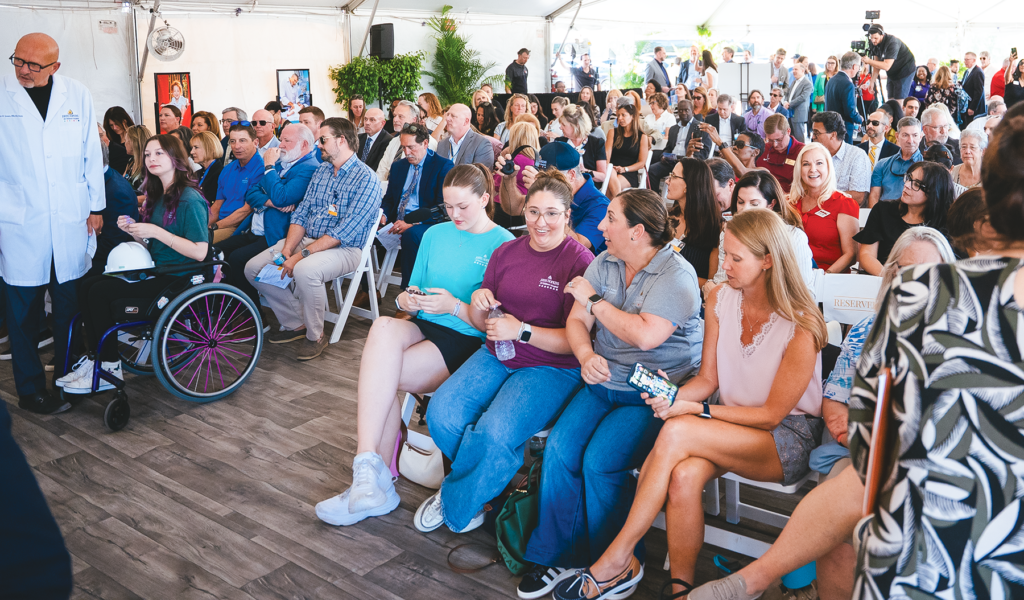
With maybe 200 people in attendance (photo left), hospital president K. Alicia Schulhof introduced many of the principals involved in the Johns Hopkins Health System and All Children’s Hospital, a few of whom (including Schulhof herself) brought along young people who had previously been treated at JHACH. It turned the groundbreaking from something that might have been “just another” ceremony into something that not only tugged at your heartstrings but also clearly demonstrated how wonderful and important having a world-class pediatric hospital in Wesley Chapel will be. 

Adding to the joy you couldn’t help but feel that day was the fact that the brown dirt pile usually dug into at these events was replaced with seven piles of brightly colored sand (top photo on this page) to match the seven colors in the JHACH logo, with not only the hospital principals turning shovels full of the sand but also the kids themselves. It was electric! 

Schulhof opened the event, accompanied by former JHACH patient Xavier and his younger brother Zander (photo below). 

“Today, we are not just breaking ground for a new facility,” Schulhof said, “we are laying a foundation for a healthier future for our community, our patients and generations to come.” 

Before she introduced Zander (with microphone), Schulhof said, “These brothers are quite familiar with our hospital and services, so we look to them and our other kids and families in our care so we can hear directly about their experiences and their children’s hospital.” 

Young Zander spoke on behalf of his older brother. “I think it’s nice and great,” Zander said of JHACH. “I think [the new hospital] will help other children feel better…so they can go out and look into the actual future and…be able to love each other.” He added that, to him, the best thing about JHACH was, “How the nurses help kids feel better.” 

Schulhof then thanked all of the dignitaries in attendance (including Dist. 2 Pasco County Commissioner Seth Weightman), as well as the members of the Wiregrass Ranch High orchestra, who provided the music for the event. 

She also noted that Pasco County is among the fastest growing regions in the Tampa Bay area (as well as in the state and the nation) , with pediatric growth of 12% expected between 2023 and 2032, and that 93% of patients living in Pasco, Hernando and Citrus counties have to travel outside of their market for pediatric specialty care. 

“That’s why we purchased this beautiful 112 acres we’re all sitting on, to build a 56-bed hospital with 16 rooms for emergency services and room to grow,” Schulhof said. “The complex will begin with four imaging rooms and four operating rooms and support services. The Wesley Chapel hospital will not only enhance our ability to deliver cutting-edge medicine and treatments, but also foster an environment where patients feel supported, cared for and respected.” 

She then turned the mic over to Kevin Sowers, the president of the Johns Hopkins Health System and his special guest, Aubrey (photo below). In addition to Aubrey, Sowers brought with him, “Greetings from our 45,000 employees across the states of Maryland and Florida, and from Washington, D.C., and our colleagues ‘across the pond,’ too, where we also have relationships.” 

Sowers also mentioned that the clinical care at JHACH is, “the intersection of where we bring education for the next generation of providers and the research that creates the foundation of what Johns Hopkins has been for more than 125 years that is about to come to your community.” (Note-JHACH was ranked as the #1 pediatric hospital in Florida by a 2024-25 U.S. News & World Report survey.) 

He then introduced Aubrey, whom Schulhof said has been a JHACH patient since she was two years old. “I’m glad you’re going to become a nurse, but Aubrey also serves on our Teen Advisory Council, which has been actively engaged in the development of this facility.” He then asked Aubrey about the role she has played in that development. 

“I’ve gotten to view some of the mock-ups of the rooms and make changes to some of the interiors and exteriors. For example, when you’re in the hospital, it can feel very isolating, so the Teen Council wanted places for the patients to be able to go outside, with a garden, flowers and things to do. We also got to add color-changing LED lights to all of the patient rooms….There also will be a sensory room, in one of the rooms downstairs.” 

Sowers also noted that All Children’s joined Johns Hopkins in 2011 and the name was changed to JHACH in 2016. “And, during the 100th anniversary of Johns Hopkins in 2027, we will open the doors to your hospital in your community.” 

Congratulations! We can’t wait ‘til you open! 

For more information about Johns Hopkins All Children’s Hospital Wesley Chapel, visit HopkinsMedicine.org. 

 ‘Connected City’ Developer Responds To Critics 

Metro Development Group Principal Kartik Goyani Says The Unique Community’s 50-Year Plan Is Right On Track In Year 8 

 With Wesley Chapel already growing by leaps and bounds, the area known as the Connected City (CC) — conceived by Metro Development Group as a partnership with Pasco County and approved by the State Legislature as a “special planning area” pilot program for the State of Florida — is something completely unique. 

Rather than just another collection of developers building nothing but more of the same subdivisions that Pasco seemingly will continue to approve until there is no more vacant land within the county’s nearly 750 total square miles, Metro Development principal Kartik Goyani says that, when it comes to CC, there is a 50-year plan in place to be more than just another series of individual developments of single-family homes, apartments and retail strip centers. 

Despite what some critics are claiming, Goyani says that CC, — aka the “First Smart Gigabit Community in the U.S.,” which was approved in 2015 and began development with Metro’s Epperson community in 2017 — is only in year eight of that 50-year plan and, in his estimation, the 7,800- acre CC development is indeed proceeding according to plan. 

Before we get into the discussion of what is or isn’t happening in CC, here are some geographical facts, many of which may not be 100% clear from the map (above), which was provided to us by Metro. 

The orange lines on the map indicate the boundaries of what is called CC, of which only the western boundary follows a specific roadway — I-75. 

The northern boundary extends to a little north of S.R. 52 in San Antonio, with several important commercial developments and yet another (as yet unnanounced) AdventHealth hospital to be located in this northernmost section. Goyani says AdventHealth has owned that property since 2019 or 2020. 

Curley Rd. forms most of the CC’s eastern border, although a portion of it extends east of Curley — between Elam Rd. to the north and just north of the eastern portion of Overpass Rd. to the south. It is worth noting that the Watergrass community, which includes property both north and south of that eastern extension of Overpass Rd., is not part of CC. 

And, speaking of Overpass Rd., everything north of it from I-75 to the entrance of Epperson is within the CC boundary, but that boundary also extends south of Overpass to include all of the Epperson development, but not the pre-existing Palm Cove or Bridgewater communities. 

Of course, knowing the boundaries of CC doesn’t really give you any insight into why Metro Development decided to create a massive employment center where people could live, work and play in a portion of Pasco County that was super-rural, not even suburban, when Metro first proposed the idea of the CC to the county and the state in 2014. 

According to Goyani, it all started with internet speed. He says that before the Covid- 19 pandemic hit in 2020, the last economic slowdown was in 2008, but as business started to pick back up in 2009-10, Pasco County’s goal was to transform the county from a sleepy bedroom community, with thousands of residents leaving the county to work in Tampa, into a thriving self-sustaining economic center of its own. 

And, even though other developers may not have been thinking about how to plan for a better future, Goyani says, “We knew from our own experience during the 2008-09 downturn, that before the next downturn hits, we wanted to offer something that it seemed no one else was even interested in — faster internet. So, in 2014, we launched Ultrafi (Metro’s own bundled internet and cable service with ultra-fast internet speeds, up to 10 Gigabits per second) in our Park Creek community in Riverview and planned to include it in Epperson (the first development in CC).” 

He says that “everyone asked us ‘Why are you focusing on something that technology companies should do? No one’s asking us for faster internet, because they only have one connected device at home.” 

Goyani’s response is that, “We knew that to retrofit a community for faster internet would be very expensive. So, we laid fiber lines everywhere that could get insanely fast speeds at prices we all can afford. We talked to Google fiber (which wasn’t interested in Pasco County), AT&T, Verizon…and they all said no one wants faster speeds, so we did it ourselves.” 

He adds, “Could we use technology for the greater good? Could we create a new community from the internet up?” 

In other words, although Metro’s intent, when the CC pilot program was approved by the state in 2015, was to also have the CC connected by walkways and multimodal transportation opportunities, the developer’s primary focus was the internet. “From a fundamental standpoint,” he says, “counties and developers usually focus on the physical infrastructure — roads, water lines, waste water, electrical — because you can’t have a community without those, but no one else was working on the digital infrastructure. That’s how this story ended up evolving.” 

But, speaking of physical infrastructure, Goyani says that when CC began development, no other developers were interested in improving S.R. 52 or creating an Overpass Rd. interchange off I-75. 

“But, by bringing the CC to Pasco, S.R. 52 is now vastly improved and the Overpass Rd. intersection is open, meaning that the physical infrastructure for the CC is now in place. That is a big reason why we have been able to attract so many employment centers to this development.” 

He also notes that while most large-scale developments at that time were offering huge 10,000-20,000-sq.-ft. clubhouses or “amenity centers” that were intended to provide the community’s “social infrastructure,” Metro saw that during the last economic downturn, “people had to decide between being able to afford their mortgage or paying for the maintenance of a 20,000-sq.-ft. clubhouse for the use of the residents only. That just didn’t make sense to me.” 

Goyani says he wanted to create something that could benefit the entire region, “that’s why we put the first Metro LagoonÂŽ in the U.S. in our Epperson community. Nobody was putting these lagoons in a community. We felt that connecting the digital, physical and social aspects — and the ‘Wow’ factor of the lagoons — would help put Pasco County on the map.” 

He also says that Metro didn’t even own all of Epperson. “We only own the southern half,” he says. “But we did own Mirada, where we put the second CC lagoon amenity (that is roughly twice the size of the lagoon in Epperson, and the largest such lagoon in the U.S.; photo above right).” He also said that the two lagoons in CC have attracted 1.2 million people combined since they opened. 

One of the problems for Goyani and Metro is that the 900-acre Epperson community, with roughly 3,000 residences at buildout, and the 2,000-acre Mirada development with 4,5000 residences, represent less than 40% of the 7,800 acres and only about 20% of the planned residences in the CC, so a lot of the CC plan approved by the state and county is not under Metro’s control. 

Putting the number of residences aside, among the things Goyani is most proud of with the CC is the amount of new non-residential square footage that is planned, especially when it comes to health care. 

“Back when we started planning the CC,” Goyani says, “we looked at the amount of new commercial construction for all of Pasco County and I believe the total amount from east to west at that time was only 3000,000 sq. ft. So, as we started planning for the future, the county administrator told us that he wanted to see at least 3 million sq. ft. of commercial over the 50-year plan for the Connected City. Back then, I thought that was unreasonable, with only 300,000 sq. ft. under construction for the whole county, but I agreed that if we’re going to create an economic engine for Pasco, we have to look forward.” 

He adds, “We started talking to the stakeholders in the area and said, ‘This is a 50-year plan and we need to set up large areas where we can get people both living and working and over time, that 50-year goal went from 3 million sq. ft. to 12 million. And, if we could get that done by 2065, everyone would probably be happy, right? But, do you know how many sq. ft. of non-residential is already under development in CC? How does 8 million sq. ft. sound? And, it’s all already approved, having groundbreakings…with real dollars being spent, in 2025.” 

I’ll admit that number shocked me. It includes not only the Johns Hopkins All Children’s Hospital that just broke ground in the Wildcat-Bailes property in CC’s southwest corner, but also the aforementioned, not-yet-announced AdventHealth hospital just north of S.R. 52, as well as a large BayCare medical office complex that will not only help staff the expandable BayCare Wesley Chapel Hospital a few miles south of CC, but also focus on wellness to help people live healthier and longer. 

Another major commercial project within the CC is the Double Branch/Pasco Town Center, a 965-acre mixed-use project just east of I-75 at S.R. 52 that is already under development that will include up to 4.5 million sq. ft. of industrial space at its build-out. Phase 1 of the project, which is expected to begin delivering finished buildings later this year, includes three industrial buildings totalling nearly 500,000 sq. ft. There also are plans for 1 million sq. ft. of office space, a 1.6.-million-sq.-ft. distribution center and a 400,000-sq.-ft. “cross-dock facility,” which is a logistics hub designed for the rapid transfer of goods to minimize storage time. Double Branch is being developed by Columnar Investments, which also is planning to have 500,000 sq. ft. of retail uses, 3,500 residential units and 200 acres of parks and trails. 

Some of the other privately owned portions of CC also have commercial entitlements (or are asking for them from the county), such as the Abbey Crossings/Park 52 Logistics piece that will bring 500,000 sq. ft. of light industrial uses to north of S.R. 52 and neighborhood commercial and a hotel to south of 52. 

Goyani says that, “Other smart people have seen what we’re doing within the CC boundary, so why not buy land outside of CC for less money and bet on the success of that project in the future? And people quickly gobbled up pieces of that land,” including Target, which bought a large chunk for a distribution center just north of CC. 

Also located on the outskirts of CC is the Kirkland Ranch Academy of Innovation (photo), which started in 2022 with a high school and now has grades K-8. Two years earlier, Innovation Preparatory Academy (aka InPrep), a charter school, opened for the 2020-21 school year and Prodigy at Epperson Early Learning Center is now open south of the CC border just south of InPrep. 

“None of the CC land owners were at the table telling the Pasco School District, ‘take my land for a school,’ or ‘take my land for a park,’ Goyani said. “In fact, I was told that those property owners all said ‘No’ and we had no control over that.” 

And, Goyani, who said he comes from a very poor family in India, is a big believer in education. His parents shipped him off to the U.S. with a $500 one-way ticket at age 21 to find a way to pay to get a Master’s degree, which he did, in Construction Management, in the School of Engineering, from prestigious Purdue University, even though, he claims, “I wasn’t really a smart kid. But, I am very passionate about education and my goal is to have one of the best universities in the country, either in CC or in [Metro’s other Pasco development in Land O’Lakes] Angeline (more on Angeline below).” 

Goyani also said that last year, Metro commissioned a study by PFM Financial Advisors LLC out of Orlando, which showed that Pasco County is now “the fastest growing commercial corridor in Florida. There is now 30-plus million sq. ft. of non-residential uses in different stages, which is more than any other county in the state of Florida, and I’m like, ‘Wow, that is exciting. Maybe we’re onto something here. If I were to bet, I’d say we’re going to run out of commercial entitlements throughout the Connected City because I think more is still going to happen, based on the plans.” 

A big part of that 30 million sq. ft. is Angeline, which Goyani says was created as our round two of turning Pasco into an economic engine, with the Moffitt Cancer Center owning 775 acres (to be called Speros FL), with plans to build 16 million sq. ft. of lab, medical offices manufacturing and clinical space that will be twice the size of downtown Tampa. “We also ave a working farm in Angeline that is open to the public, and plans for a 150-acre regional park,” Goyani says. “Instead of only developing for people living in a community, we open important elements of our projects to the public, to create a more regional impact. I don’t know any other developers who do that.” 

Goyani also is aware that CC as a whole has its detractors, especially the Facebook group known as “Pasco Connected City Residents Group (PCCRG),” which was started by RealtorÂŽ and CC resident Michael Pultorak, whom we have featured in these pages before. Pultorak’s group quickly built up to 1,600 members, as he and the group members have consistently appeared at Pasco Board of County Commissioners (BCC) and Planning Commission meetings to ask questions and/or complain about the way CC is being developed, even though many of the concerns expressed have been about the development plans of some of the land owners other than Metro in CC. Pultorak has already met with four of the five Pasco commissioners to discuss his concerns, the first three of which below do also revolve around Metro’s portions of the development: 

• The open space & recreational areas detailed in the CC Master Plan have been moved to east of Handcart Rd. (outside of the CC boundaries) 

• The walking/jogging trails promised to Mirada and Epperson residents were not delivered and the trails were not placed in the engineering plans nor created in the execution of the development 

• The innovative lagoons are private and for-profit amenities 

But, Goyani says that between 2015, when the CC was approved by the state, through 2017, when Metro began building Epperson, there were more than a dozen public meetings held with stakeholders and local residents to discuss the CC plan — “Some had upwards of 300 people attending,” Goyani says — and any concerns about the CC plan was taken into account “to plan for a better future.” 

Other concerns of the PCCRG include: 

• There are no promised cultural facilities or libraries of any kind planned in CC 

• Stormwater concerns at the head of the Cypress Creek watershed with upcoming CC development applications 

• King Lake (a 263-acre lake and the largest body of water in CC) flooding issues for current CC residents. (Note – Pultorak says that King Lake has been beyond flood stage since Metro began digging the nearby Epperson lagoon) 

• Planned roadways within CC that topographical maps show will be under water 

• No schools actually located within the CC boundaries (Goyani says that InPrep and Prodigy actually are within the CC boundaries) 

• The large park planned to be within CC has been moved to the adjacent Villages of Pasadena Hills special planning area 

• Multi-family apartments and townhomes being approved by the Pasco BCC that are in portions of CC that, according to the Master Plan approved by the state, should not be allowed 

• The approved plan for the five Special Planning Area (SPA) Zones within CC has not been adhered to by Pasco, especially with regards to approvals for multi-family apartments 

“We are not against responsible growth & development,” Pultorak says. “However, developers need to be held accountable to the residents of Pasco County to fulfill the promises they make before they take profits and move on or, unexpectedly cause flooding of existing residents and communities. That’s why we formed this group.” 

Many of the concerns outlined above were presented in our recent story (in our Jan. 21 edition) about CC, when the Planning Commission first voted to send the Tall Timbers MPUD on to the BOC for final approval. After giving the nod to Tall Timbers 4-3 on Jan. 9, however, the Planning Commission then voted 6-1 at the same meeting to put a one-year moratorium on all future CC development agreements, site approvals, building permits and zoning changes. 

But, since the Planning Commission is only an advisory panel, the final say on both Tall Timbers and any possible CC moratorium still lies with the BCC. Those votes were originally supposed to be held at the BOC meeting on Feb. 11, but the discussions and votes have now been continued twice — first to Mar. 11 and now until the BCC meeting on Tuesday, May 6. On Apr. 9, however, the county staff was set to provide the CC presentation requested since 2023 by Commissioners Seth Weightman and Board chair Kathryn Starkey. Unfortunately, that workshop took place after we went to press and was not open to public comment. We will update this story with any new information after we attend that meeting. 

Even if the BCC does vote for a CC moratorium, however, it would have pretty much nothing to do with Metro’s ongoing development of Epperson and Mirada, since those communities are both already fully approved with hundreds of residents already living in each and the two lagoons themselves already in place. 

And, while Goyani can’t speak to what the other CC land owners are doing, his primary response to most of the complaints is that, “We are only still in year eight of a 50-year plan. We knew before we started that it would be hard to make everyone happy with this unique development but we believe — and we are proud — that we are helping to put Pasco County on the map with CC.” 

PeppaJak Is Already Open In Former Bacon Boss HQ Spot At The KRATEs 

We were saddened to see that The Bacon Boss HQ, one of the original — and most popular — restaurants to open in the KRATE at The Grove container park (at 5888 Grand Oro Ln., #112), had closed on March 30. 

In their Mar. 20 announcement on the Best of Wesley Chapel Facebook page, however, owners Christy and Joshua Norland did say that the Bacon Boss food truck will “continue to grow” and be available and that a new chicken concept food truck called Cluckology (photo left) also is in the planning stages, so at least the delicious burgers, hot dogs, fries, tots, chicken sandwiches and mac & cheese options so many of us have come to know and love will still be available now that the Bacon Boss HQ has closed. 

I did visit The Bacon Boss HQ one last time a few minutes before it opened on the day before it closed and there already was a family and two other people, all of whom said they were “fans” who were already waiting to order. 

At our press time, however, PeppaJak, a similar burger-&-chicken concept, was starting its soft opening in the former Bacon Boss space. 

Owned by my new friends Alex and Ashley, PeppaJak is the “Jak of All Kravz,” and based on my first visit, I think it’s an accurate description! 

Alex and Ashley also own an extremely popular PeppaJak location in Riverview, which also features “kravz” like Philly cheesesteaks, and steak Philly and Southwest chicken eggrolls. 

But, while not all of those menu items are available (at least, not yet) at the PeppaJak KRATE, the cheeseburger shown above was thick and juicy and the skin-on fries were crispy and not over-seasoned. Alex then gave me a small sample of two of the menu items that are available at the new location — crispy and delicious mac-&-cheese bites and some super-yummy boneless chicken tenders. I told Alex I don’t really do spicy (and they are available plain), but I really liked the sweet-&-spicy sauce he suggested! 

Alex says a new online ordering system should be available by the time this issue hits your mailbox, “and we’ll also have a new phone number for this location by then, too!” 

For more info about The Bacon Boss and Cluckology, visit “The Bacon Boss” on Facebook or call (813) 922-9290. For PeppaJak, visit PeppaJak.com or call (813) 374-5846. — GN