Shell Pillow Aids In Recovery

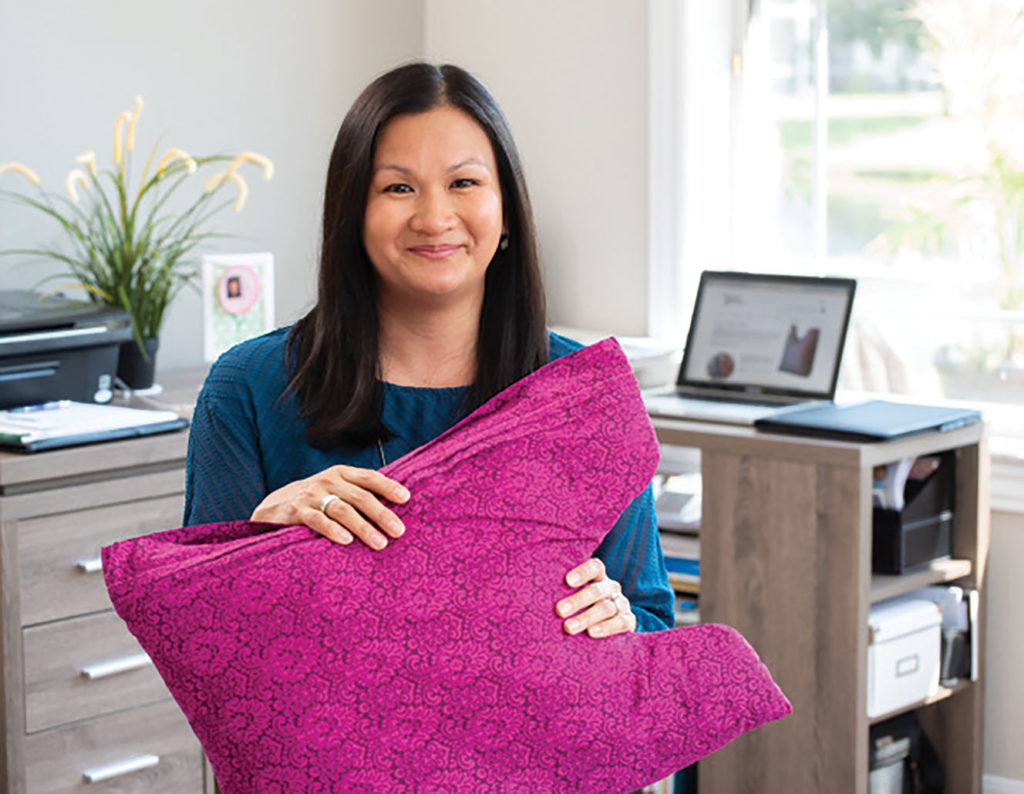
Mary Glassman considered what to name the Shell Pillow, and ultimately settled on a tribute to her dear friend who first inspired it, Shelley Archbold. (Photo courtesy of Bob Thompson)

It was one week after her wedding, when she was just 28 years old, that Shelley Archbold discovered a lump in her breast that turned out to be cancerous.

Through radiation and chemotherapy, her friend from college, Wesley Chapel graphic artist Mary Glassman (photo), sat by Shelley’s side.

Several years later, after Shelley gave birth to a son, she underwent genetic testing and decided to have a double mastectomy to reduce her risk of having a future recurrence of the disease.

Mary wanted to give Shelley a meaningful, useful gift. Searching the internet, she found that many women use a mastectomy pillow, but she didn’t find one she thought looked very comfortable — or sanitary, for that matter.

“I’m kind of a germophobe,” says Mary, who squirmed at the thought of a pillow up against a body recovering from surgery that couldn’t be washed. “My mom taught me to sew when I was very young, so I thought I could sew her something.”

Mary says she made a quick pattern, cut it out, and fashioned the first pillow. Since Shelley had a double mastectomy, Mary made two pillows so she would have one for each side.

“It turned out that her gift was by far the most useful thing that I didn’t know I would need,” says Shelley. “A lot of times when you’re sick, people want to help and they don’t really know how. Mary took it to the next level trying to think of what really would be the most comforting and helpful. She’s brilliant.”

Because Shelley liked the pillow so much, when Mary’s aunt had a mastectomy, Mary made her pillows, too. A couple of friends and neighbors asked her to make them for friends who had the procedure, too.

Mary, who lives in Seven Oaks with her husband and two kids, considered how many people could benefit from her pillows. She knew she couldn’t personally sew enough to make the pillows by hand, so she researched and found a company to manufacture the pillows.

Mary considered what to name the pillow, and ultimately settled on a tribute to her dear friend who first inspired it. 

She named it, “The Shell Pillow.”

Her first production run has been completed and is currently being shipped. Once the pillows arrive, they will be ready for sale.

Mary says The Shell Pillow is better than others on the market because it is longer, offering more comfort.

While it was designed for those recovering from a mastectomy, it can be used by anyone recovering from breast or shoulder surgery who would benefit from being able to rest their arms away from their body.

And, of course, there’s that washable cover. “They have an aesthetic appeal and don’t look like a medical device,” Mary says. “You’d be comfortable having them out on the couch or on your bed.”

While Mary is both excited about launching her business and a bit nervous about the unknowns of undertaking something she’s never done before, she said she’s mostly looking forward to making the recovery process more comfortable for any women facing recovery from a mastectomy.

“I saw my friend and aunt suffer through it,” Mary says. “It’s difficult. If it could let them rest a little easier, ultimately that’s my goal, to give people comfort.”

Her friend Shelley believes The Shell Pillow will make a difference.

“I was really honored that she named it after me,” says Shelley. “I hope others find comfort the way I did, and know that it came from a friend helping a friend. Her reason to make these came from the heart.”

The Shell Pillow currently is available for pre-order and is expected to be available for purchase later this month. For more information or to purchase The Shell Pillow, visit TheShellPillow.com.

In pursuit of pythons

Did you know Florida’s Burmese python problem is spreading north? Former Cory Lakes Isles resident and Wharton High grad Kevin Reich is helping to make sure that doesn’t happen.

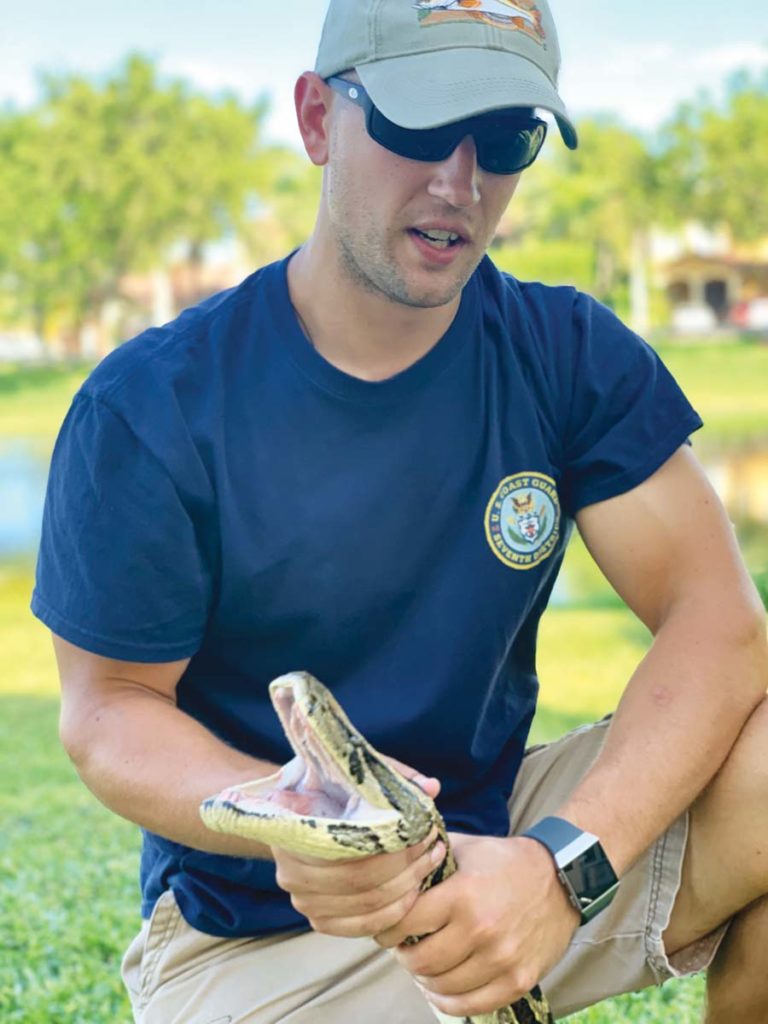
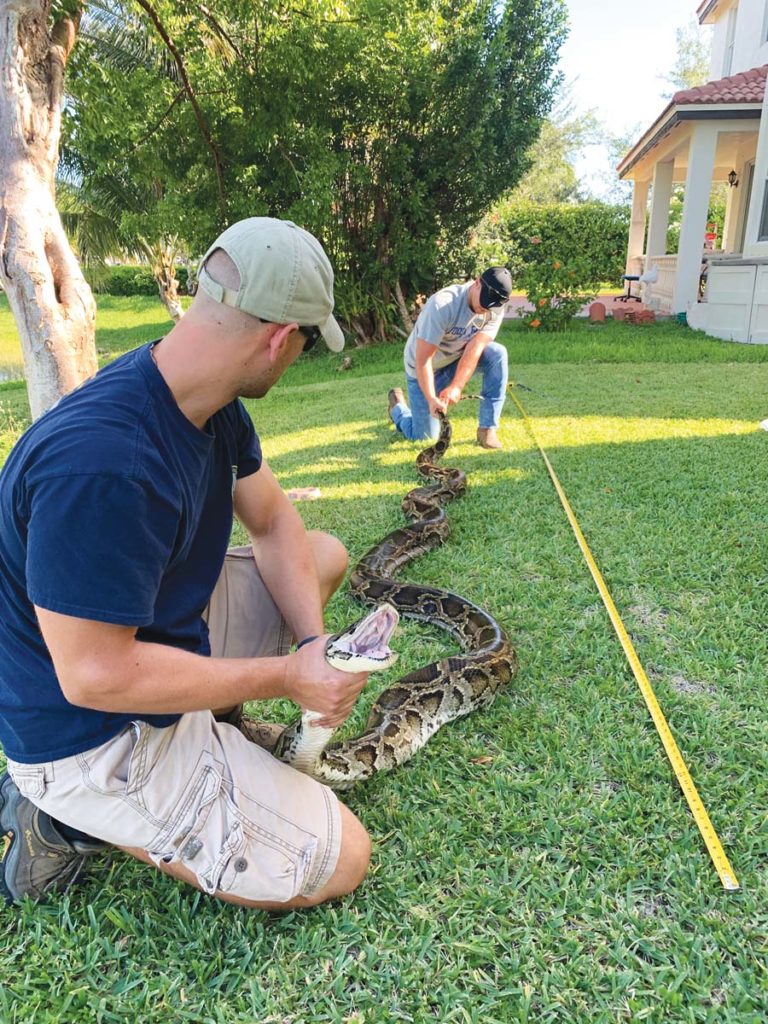
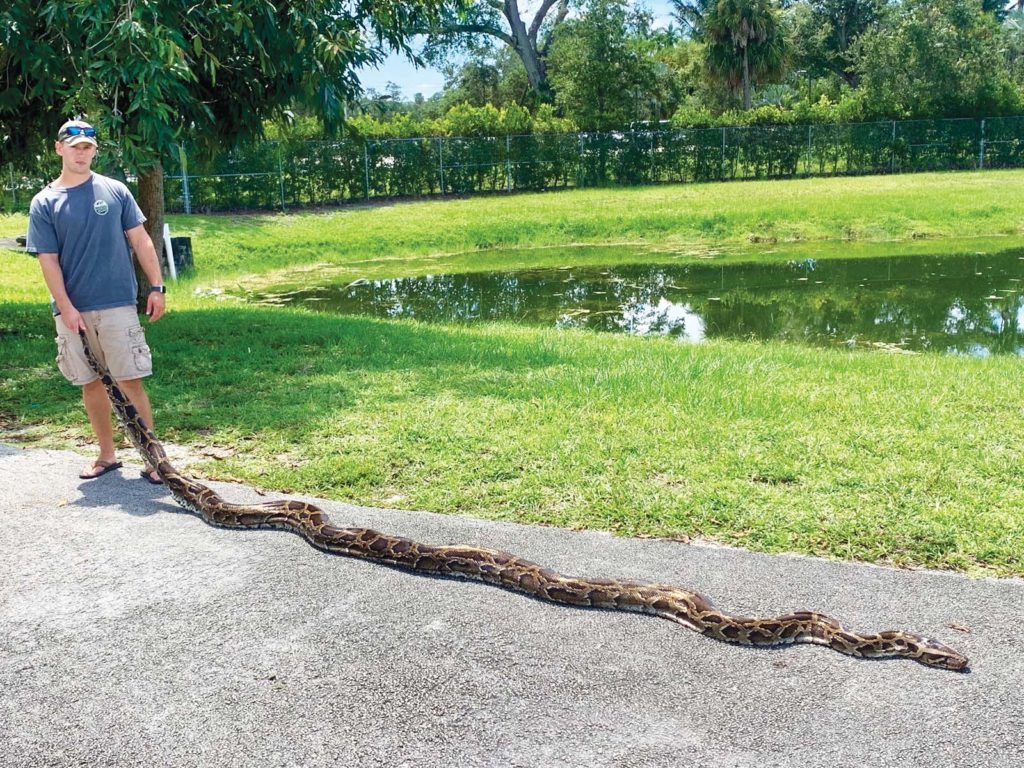
Kevin Reich caught and bagged this nearly-18-foot Burmese python back in July.

Kevin Reich was driving through the Grand Cypress National Preserve in Ochopee, FL, one evening back in late July, and was about to give up and head home when the tail of a Burmese python caught his eye.

“Just by the tail, I knew it was going to be a big one,” Kevin says.

So, he did exactly the opposite of what you might expect — but something perfectly normal for him — he parked his car on the side of the road, hopped out and walked up to the snake.

Armed only with his bare hands, Kevin grabbed the tail and dragged the python out, the two dancing a slithery dance, as he deftly avoided attempts by the python, which are non-venomous constricting snakes, to wrap itself around him. 

After 15 minutes, the snake was tuckered out. Kevin grabbed it by the neck and victoriously bagged it.

He was right about the size, too: it checked in at a goosebump-inducing 17-feet, 9 inches long, and weighed in at 83 pounds, 12 ounces. 

At the time, it was the second-longest ever caught by a member of the Python Action Team.

“I knew it was going to be a challenge and a bit of a battle,” Kevin says. “Big snakes don’t come along much. It was a very big, very strong animal. When it started to lose its steam, I just went in for its head and got a hold of it. I could tell it was still very strong. It was trying to turn its jaw around to bite me. The hardest thing sometimes is getting them in the bag.”

While Kevin’s full-time job is in the U.S. Coast Guard, he finds plenty of time to do his part to help the Florida Fish and Wildlife Conservation Commission (FWC) try to tame the ever-growing population of Burmese pythons in the Florida Everglades and surrounding areas. The FWC created the Python Action Team in 2017, to combat the invasive species, and has captured nearly 1,000 pythons since.

Still, Kevin says that in certain areas, where racoons, rabbits and opossums should be bountiful, there too often is nothing, due to the spread of the Burmese python.

He says he knows what animals do and don’t belong in a certain area. Growing up in Cory Lake Isles, he says he was your typical Florida outdoor boy, exploring his nature-rich community.

“There isn’t one little portion of those lakes or islands that I don’t know,” he says. “I fished on that lake every day. It’s where I learned a lot about the outdoors in Florida.”

Kevin joined the Coast Guard in 2016, after graduating from Wharton in 2012.

He was stationed in Miami, which was a perfect fit, in part because it allowed him to explore the Everglades. It was while doing so with a buddy that he caught his first Burmese python — a freshly hatched 2-footer.

By the way, his second catch was a 15-and-a-half foot python.

He became a certified volunteer Burmese python hunter, before the FWC and Southwest Water Management District began programs that contracted people to help rid the area of pythons.

“It’s awesome,” Kevin says. “You get paid to go out in these places in the Everglades and explore and help remove these snakes.”

Python Action Team members make just $8.46 an hour, plus $50 for each snake measuring 4 feet, and $25 for each additional foot beyond that. So, a 17-foot Burmese python would net the hunter $375.

That’s a nice bonus for something Kevin confesses he would do for free just to help. He says that 95 percent of contractors do not euthanize pythons on site. Instead, they bag them and hand them over to the FWC for research, as the wildlife commission tries to figure out a way to more effectively  remove the snakes. 

Since he began trapping pythons, Kevin says he has captured well over 100 of them. He has been bitten numerous times, and has been sprayed with the snake’s musk, which he says leaves one the foulest odors he has ever smelled. He says he keeps Lysol disinfectant wipes in his equipment bag to wipe off his arms anytime he gets tagged.

The longest python ever caught in Florida was 18-feet, 8-inches (in 2013), and the longest ones caught by the Python Action Team are 18’-4” (in September) and 18’ (last December). 

“Most of the folks that know me are not at all surprised that I do this,” Kevin says. “It’s definitely a challenge and something I enjoy. I know what animals do and don’t belong, and some of these places just don’t have any small mammals or birds left. These snakes are everywhere. I’m doing my part to help and preserve the area.”


Frances Brassey Celebrates 107th Birthday

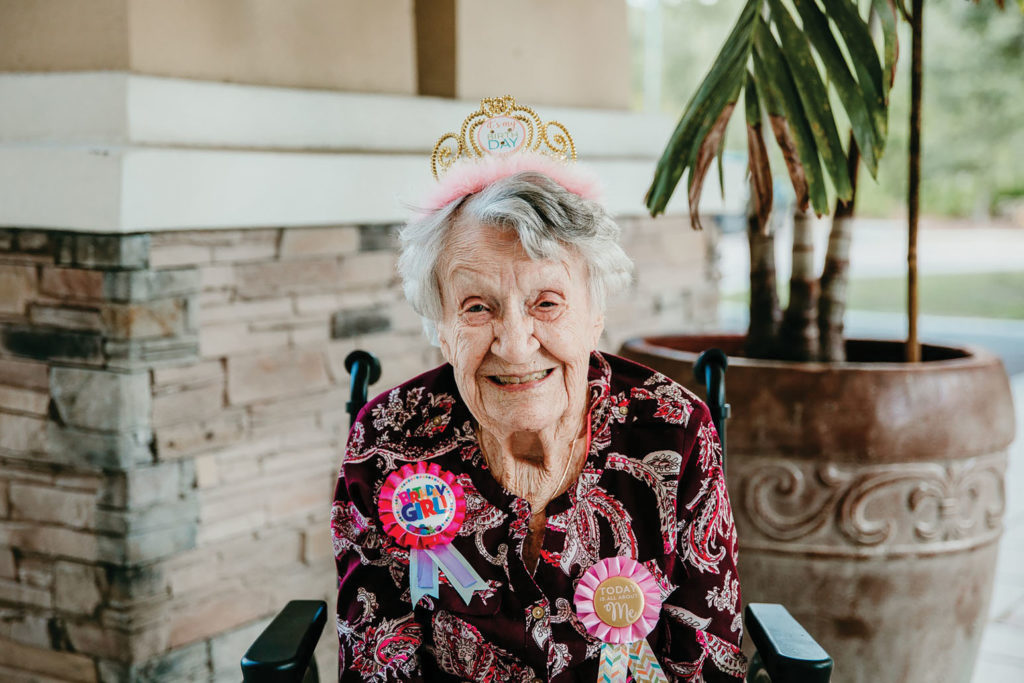
Frances Brassey. (Photos courtesy of Ashley Victoria Photography)

As far as birthday parties go, this one may take the cake.

The guest of honor was Frances Brassey, celebrating her 107th birthday on October 4, at a party hosted by the Legacy at Highwoods Preserve, a New Tampa assisted living facility where Frances is one of 52 residents.

Since Frances was born in 1912 in Harlowton, Montana, she has seen more than 10 decades of changes in the world around her. The staffers at The Legacy say she is the oldest of their 52 residents by more than 10 years, and they believe she is likely the oldest resident in Tampa.

Her days typically begin when her private caregiver helps her to get dressed and eat breakfast. She prefers to drink a Coca-Cola with her breakfast, lunch and dinner, and keeps Coke in a mini-fridge in her residence, too.

Lifestyle director Ashley Gunter says the staff often tries to steer her toward water or cranberry juice, which she will drink, but it’s not her preference. “She’ll give us a look that says, ‘That’s not what I asked for,’” Ashley says.

After breakfast, Ashley says Frances loves to participate in morning stretches with the other residents. She eats lunch with her caregiver and often enjoys entertainment during happy hour.

Frances’s son Wayne (pictured above with Frances) lives with his wife in Arbor Greene. They come by to see her two or three times a week.

“We take her to get frozen yogurt at the yogurt shop,” he says.

Wayne says that Frances doesn’t communicate much anymore, but she always has a smile on her face. At 107, she doesn’t hear well and doesn’t see well, “but our bodies just weren’t made to live this long,” Wayne says.

When asked what has kept his mother alive for nearly 11 decades, he laughs, “If I knew the answer to that question, I would be talking through my attorneys and publicist.”

In her younger days, Frances and her husband, Edward, moved from Wyoming, where Wayne was born, to Louisiana, then to Panama, where they lived for 25 years.

“She was a pretty good square dancer,” Wayne remembers, saying she and Edward enjoyed dancing together.

Edward worked for an oil company, while Frances “was head of a couple of women’s clubs,” says Wayne.

“She was always a strong lady,” he adds.

In the 1980s, experiencing symptoms of Alzheimer’s, Edward retired to Clearwater, where he eventually passed away in 1985. Frances continued to live in Clearwater for three decades. She kept her mind sharp by playing bridge and enjoyed bridge tournaments.

Wayne would visit her, and eventually noticed she needed some extra help. He was retired, so he moved in and helped her for several years, until she needed additional care.

Her mind was still sharp, says Wayne, but she would sometimes wake up in the middle of the night and try to navigate the stairs. Fearing she might fall, he began to look for a safer environment for her.

In 2015, Wayne got married and moved to New Tampa, moving Frances into The Legacy as one of its very first residents.

For her birthday, though, Wayne was away due to a family emergency, so The Legacy staff took over, ensuring she was pampered and cared for on her special day. They touched up her hair and nails, which had been done in the on-site salon, affixing a birthday tiara and pins.

To kick off the celebration, local entertainer Ralph Espinosa crooned “Sixteen Candles,” then the gathered staff and residents sang “Happy Birthday.”

“We sang it twice because she really liked blowing out the candles,” says Ashley.

Wayne’s visited her a few times since her birthday.

“We try to do the best we can for her,” he says. “She’s not going to go to the movies every night or run track, so we make her as comfortable as we can.”

With a smile on her face, she enjoys those simple pleasures, including her Coca-Cola, frozen yogurt and time spent with her son.

93-LOVE

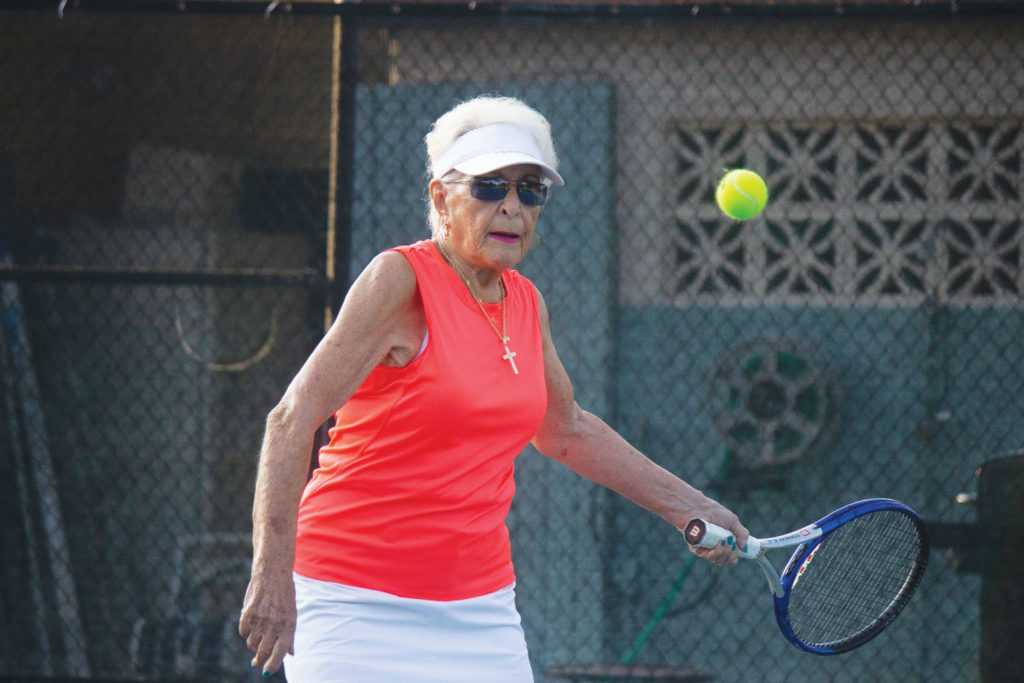
Williamsburg resident Francesca Caravella is 93 years old, but that doesn’t stop her from playing tennis 3-4 days a week and whipping up on the young‘ns.

Three times a week, and sometimes more, Francesca Caravella slings her tennis bag over her shoulder and trudges across the grass from her home just a few hundred yards away in search of competition.

She arrives at the court each morning, and effortlessly reaches down like a gymnast stretching for a routine to remove little plastic bags from her shoes, her protection against the morning dew.

Here at Williamsburg, one of Wesley Chapel’s oldest communities where she has lived since 1983, Francesca is tennis royalty. The 93-year-old left-handed racquet-wielding spitfire also is something of a freak of nature.

“You wouldn’t know she’s that old, the way she plays,” says Glenn Dimiccio, who maintains the courts at Williamsburg and also is one of the community’s top players.

Dimiccio is warming her up on this day, and it is brutally hot and humid. And yet, Francesca is moving side-to-side, hitting backhands and forehands undaunted. 

She had her left meniscus surgically repaired a few years ago, ending her singles career, and her right knee is bone-on-bone and can get quite sore, but Francesca is remarkably agile for someone her age. She still cracks a steady forehand and will liberally mix in high lobs to keep her opponents off the net.

“You gotta do what you gotta do,” she is fond of saying. 

In matches, Francesca lets her partners do the work at the net. She was once smacked so hard in the face by an overhead, “I had to spend thousands of dollars on new dentures.”

Francesca definitely knows the game of tennis. She is picky about her racquets and tennis gear and she watches the game closely on the Tennis Channel. 

Her friends at Williamsburg have asked her why she doesn’t get an official USTA ranking. The USTA holds national events in all age groups, including 90+, and her teammates and opponents are almost certain she is one of the best 90-year-olds in the country.

“I don’t want to travel far to play people,” she says. “Being number one is just not that big a deal for me.”

The daughter of immigrants who hailed from Messina, Sicily, Francesca grew up in Brooklyn, NY, where she says exercise was always a way of life.

She played handball in junior high and stickball in the streets. She says she joined a gym at 16 years old, and after meeting her husband Sal at age 18, learned to ballroom dance. After she had children, she would exercise along with Jack LaLanne on television.

It wasn’t until she moved to Florida in 1985 that she picked up a tennis racquet.

“Nobody ever gave me a lesson,” Francesca says. “Not one. I picked up things by watching players on television. I remember watching (Bjorn) Borg, (Andre) Agassi and (Pete) Sampras. I learned the basics by watching them.”

After tennis, Francesca heads back home to shower, and then it’s off to the New Tampa YMCA for some cardio and yoga. When her workout is over, she will spend many afternoons on her Ÿ-acre lot, tending to her gardens.

Francesca takes her tennis seriously. She keeps a journal and a log of every potential player. She plans matches at least two weeks in advance. And, if you don’t show up to play when scheduled, you will learn something else about Francesca.

“She is feisty,” Dimiccio says.

The two became fast friends, after DiMiccio moved to Williamsburg long after Francesca had already established herself as the Queen of the Courts in the tight-knit community.

Dimiccio had just started playing tennis again after putting away his racquet decades ago, and he says “she was kicking my butt.”

The two are now inseparable mixed doubles partners. Dimiccio is more advanced, with a high 4.0 USTA rating, while Francesca is more of a 3.0. He serves as her unofficial coach and protector, and they make an ideal pair.

“I promised her I’ll play with her every Friday as long as she’s around,” DiMiccio says, then jokingly adding, “but now it looks like she just might bury me.”

Special thanks to Wes Henagan for his help on this story.

Moffitt’s Partnership With AdventHealth WC Just The Beginning

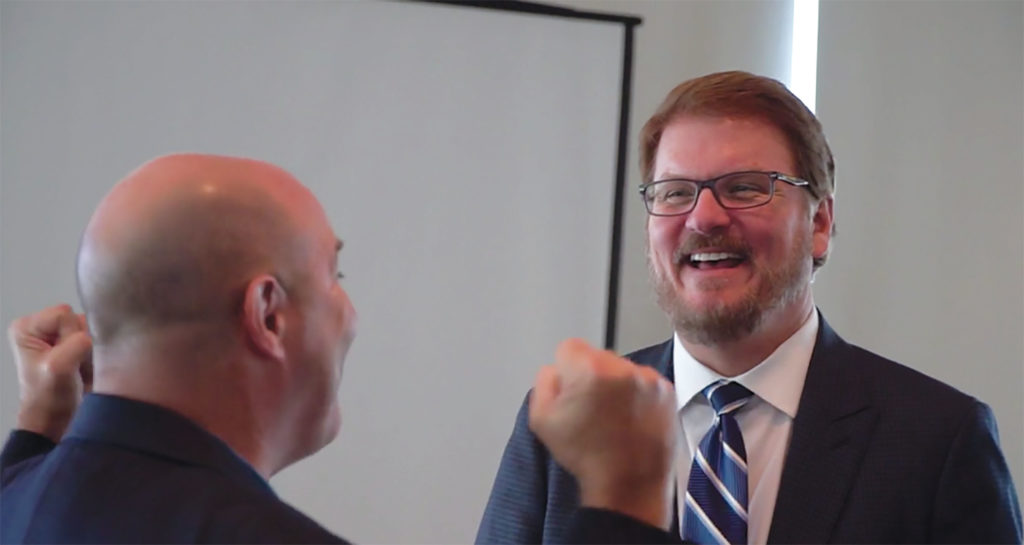
Moffitt Cancer Center VP of government affairs Jamie Wilson (right) asked Jim Engelmann & the other North Tampa Bay Chamber members in attendance at the NTBC’s Sept. 26 Economic Development Briefing for their support of Moffitt’s efforts to receive more funding the state’s cigarette tax revenue. 

Moffitt Cancer Center VP of government affairs Jamie Wilson (right) asked Jim Engelmann & the other North Tampa Bay Chamber members in attendance at the NTBC’s Sept. 26 Economic Development Briefing for their support of Moffitt’s efforts to receive more funding the state’s cigarette tax revenue.

The Moffitt Cancer Center, which recently forged a new partnership with Advent Health Wesley Chapel, could be making an even bigger footprint in Pasco County, with talk of a massive research center at the intersection of S.R. 52 and the Suncoast Pkwy.

But to do so, Moffitt will need money.

Jamie Wilson, the vice president of government affairs for Moffitt, spoke to local business leaders at the North Tampa Bay Chamber (NTBC)’s Economic Development Briefing at Hunter’s Green Country Club on Sept. 26.

Wilson’s presentation is part of a more aggressive effort by Moffitt to convince the state legislature to raise the cancer center’s share of Florida’s annual cigarette tax.

“We have grown from a small cancer hospital with 409 employees in 1986 to 2019, where we now have 6,500 employees serving more than 68,000 patients a year,” Wilson said. “The demand continues to grow. We’re asking our legislature to partner with us again, and groups like this Chamber to support our (request).”

Wilson told the NTBC members in attendance that Moffitt, as the state’s only Comprehensive Cancer Center, is asking to increase its share of the cigarette tax from 4.04 percent this year to 7 percent next year and 10 percent in 2023. Each increase would produce an additional $11 million in annual revenue.

The existing Moffitt Cancer Center on the University of South Florida (USF)’s Tampa campus off Bruce B. Downs (BBD) Blvd. and E. Fowler Ave., is 33 years old, and Wilson said there is no space available for growth in cancer research or treatment there. He said there were 130,000 people diagnosed with cancer last year in the state of Florida — and that number is expected to continue to grow.

“There is more and more demand every year,” he said. “We are seeking additional assistance from the cigarette tax so we can accommodate that growth by building new, state-of-the-art treatment and research facilities.”

The additional revenue would be used to expand Moffitt’s local footprint. That likely would include a new hospital on McKinley Dr. (aka N. 40th St.) in Tampa, about a mile from the existing hospital on the USF campus, and potentially, a new research campus in Pasco County, which has already approved the zoning and land-use changes for the massive proposed development near the Suncoast Pkwy. that also could include homes, hotels and other commercial enterprises.

Wilson said that a facility such as that would be a huge boon for Pasco County, as it would bring thousands of high-paying jobs to the area as well.

“I think we all know or have been touched by someone dealing with cancer,” said District 2 County Commissioner Mike Moore. “I think something like that would be great for Pasco County, but I think the good it would do for everyone, here and around the world, would be tremendous.”

Moffitt already has a new and innovative partnership with AdventHealth, which was announced earlier this year.

Back in May, AdventHealth Wesley Chapel (AHWC) and Moffitt broke ground on a new $44-million outpatient center to treat cancer patients from a new medical office building on the AHWC campus.

The three-story, 100,000-sq.-ft. medical office on the hospital’s campus will fill a pressing need for cancer treatment here. The outpatient center will offer medical and radiation oncology services and will be designed to accommodate oncologists to deliver chemotherapy, immunotherapy and radiation therapy to patients. It is expected to open next fall.

Moffitt and AdventHealth also teamed up recently to bring early-phase clinical trials for patients who have run out of other treatment options to AdventHealth Celebration near Orlando.

It is that kind of forward-thinking that Wilson said proves Moffitt has been worth every penny it has received from the cigarette tax, and an increase would help it do more.

“I think the return on investment has been great,” he said, adding later, “Moffitt is doing some pretty great stuff.”