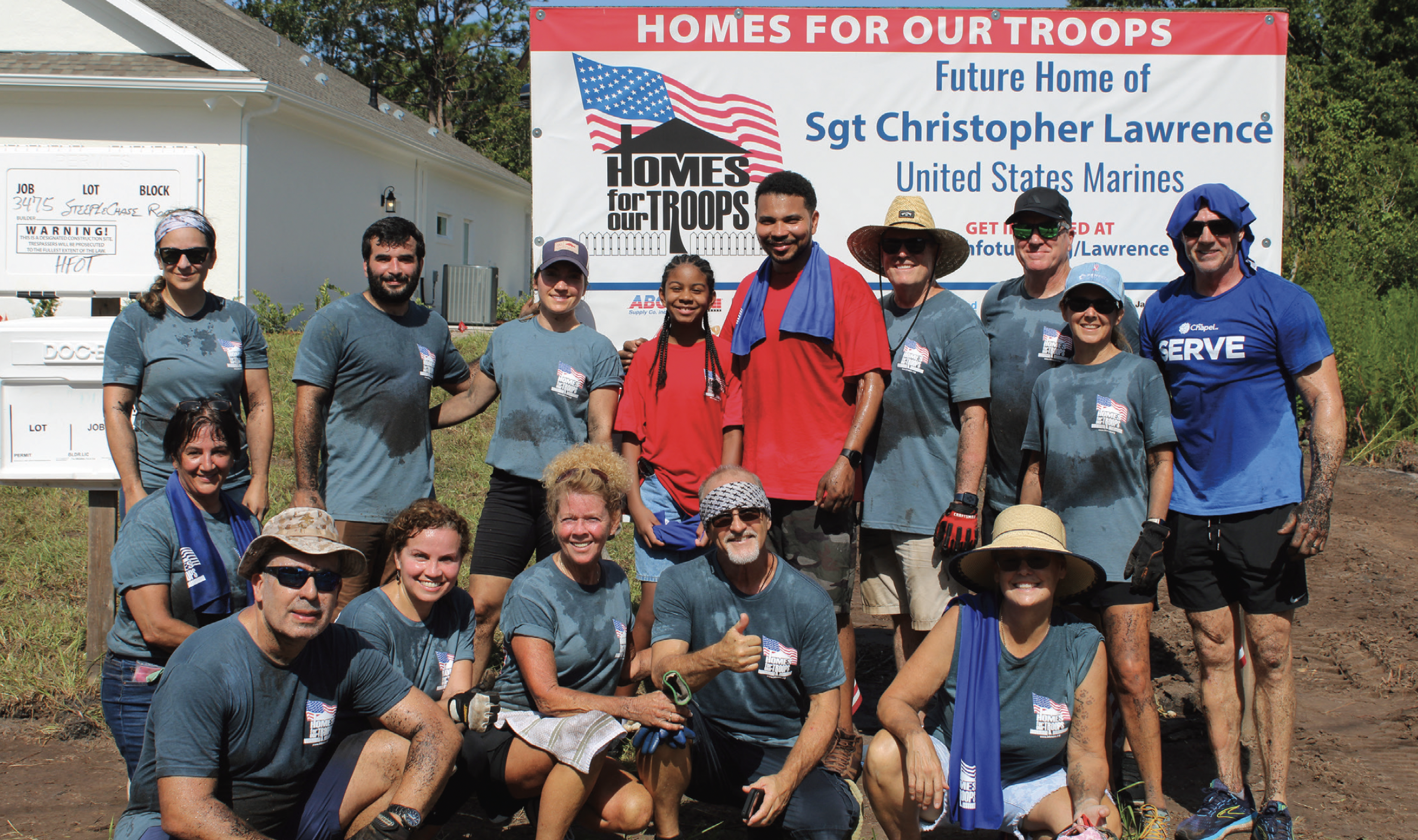
Sgt. Christopher Lawrence & his daughter DeliaMarie (both in red) pose with several of the 100+ volunteers who helped landscape (bottom pics) their future home in Wesley Chapel.
“We don’t have a lot of family or friends here in Florida,” said retired Marine Sgt. Christopher Lawrence during the super-hot “Volunteer Day” (July 26) at his family’s future “Homes for our Troops” (HFOT) home in Wesley Chapel, where about 10,000 sq. ft. (25 pallets) of sod was unloaded and dozens of plants were used to landscape the front and side yards at the home on Steeplechase Rd. “But today, we feel like we have a lot of new family members.”
You could see the appreciation and joy Sgt. Lawrence, his wife Michelle (Chelley) and daughters DeliaMarie and Cristiana felt as they helped more than 100 volunteers beautify the outside of the Kent Custom Home the family expects to move into by around the end of this month.
Sgt. Lawrence raised the HFOT flag during the volunteer event (above).
Partner Nathan Pratt explained how to place the sod and plant the plants and said how proud he was to have two more Kent Custom Homes — for Sgt. Lawrence and Army Sgt. Quincy Lopez, who, like Sgt. Lawrence, lost his right leg to an improvised explosive device blast in Iraq. (Note-Sgt. Lopez’s Volunteer Day will be this Saturday, August 9, at 9 a.m.) — in Wesley Chapel, bringing the total Kent has specially adapted and built for Post-911 recipients designated by Homes for our Troops here in Central Florida up to nine.
Homes for our Troops is a national 501(c) (3) military nonprofit that continues to spend 90 cents of every dollar the organization raises to build more than 400 custom homes (and growing) across the country since its inception in 2004.
In addition to the landscaping on July 26, volunteers also sold HFOT hats and accepted cash donations to help HFOT continue to provide these homes at no cost to our severely injured military men and women.
To make a donation or for more information about HFOT, visit hfotusa.org or call (866) 787-6877. — GN
The Lawrence family can’t wait to move into their new home. Nathan Pratt of Kent Custom Homes thanks the volunteers & gives them instructions.
This construction entrance on Elam Rd. for a new townhome community in Epperson North is now expected to become a full entrance for townhome residents once the development has been completed, which is a compromise for those living on Abby Brooks Cir. (homes in the distance) in Epperson Ranch II.
Although we hadn’t yet received, at our press time, confirmation that the deal has been finalized, it appears that Metro Development Group and Pasco County have come to an agreement that hopefully will help protect the safety of the residents of Abby Brooks Cir. (ABC), Lily Arbor Way and Swift Wind Dr. in the Epperson Ranch II Community Development District (CDD).
As we reported back in May, a new development of 186 townhomes in the Epperson North CDD is slated to open adjacent to those single-family homes in the Epperson Ranch II CDD — on property that was originally intended to be a school, with an entrance on Elam Rd.
When Pasco County rezoned the property for the townhomes, the entrance on Elam Rd., which currently is being used as a construction entrance (see photo), was eliminated, which meant the only entrance and exit to and from the new townhomnes would be from Epperson Blvd. through ABC, adding an estimated 400 daily trips through the quiet neighborhood by people who wouldn’t live in the neighborhood nor in Epperson II at all.
A large group of concerned Epperson II residents attended the May 6 Pasco Board of County Commissioners (BCC) meeting to complain, and the commissioners, to their credit, agreed that not having an Elam Rd. entrance for the townhomes was a mistake. They also said, however, that they didn’t think anything could be done about it, but had the group meet with the county’s Planning Dept. director David Engel and Development Services Dept. director David Allen while the May 6 BCC meeting was still in session. Engel and Allen said they would talk to Metro to see if the developer would agree to at least allow the entrance on Elam Rd. to be built as a full second entrance/exit, as an alternative to ABC.
On July 8, Metro VP of marketing & communications Lisa Gibbings sent me an email with the following update:
• Construction of the Elam Rd. entrance will begin when the county completes final review and approval of the plan modification.
• The entrance is expected to be completed at the same time as the completion of the overall townhome project, or by the end of 2025.
• While it is currently an active construction zone, access is not permitted for use by the public until the entrance and overall townhome project have been completed.
• To the best of our knowledge, there is no agreement in place nor one being discussed between Epperson Ranch II CDD and Epperson North CDD regarding the entrance. On May 13, 2025, the developer and Pasco County staff met with and shared the proposed (new) entrance plan to representatives of the Epperson Ranch II CDD and residents of the [Epperson II] neighborhood that attended. The proposed plan was well received, and the developer is currently working with the county for final construction plan review and approval.
• It is our understanding that during the Epperson Ranch II CDD meeting on July 3, 2025, the Chair of the Board of Supervisors indicated the entrance road matter is essentially resolved.
• “Metro is excited to partner with Pasco County to bring this entrance to the new townhome community within Epperson. We hope this adds another layer of convenience and safety for residents while reducing congestion within the [ABC] community.”
The Epperson II residents would not comment until the agreement was finalized.
As we all remember all too vividly, Hurricane Milton, which was a Category 5 tropical cyclone when it made landfall near Siesta Key on Oct. 9 of last year, was the first hurricane in decades (or maybe ever) to make a direct hit on the Wesley Chapel area later that day and cause widespread damage and flooding.
The after-effects of Milton continued to be felt for many weeks and, among the casualties of that storm were dozens of roadway signs that were knocked down and/or destroyed — some of which still have not been replaced now nearly 10 months later (highlighted in red in both pictures, above).
Pasco County Media Relations & Communications public information officer Sarah Andeara says, however, that the county’s Traffic Operations & Public Works departments, “have repaired all damages and replaced all signage on county roads that were damaged by Hurricane Milton. Traffic Operations replaced approximately 40 overhead signs and traffic signals, noting that each overhead illuminated street name sign costs approximately $3,700.”
At our press time, Andeara did not know how many post-mounted signs were fixed via the Public Works department, but said that for any missing signs on state roads — including S.R.s 56 and 54 — the Florida Department of Transportation (or FDOT)’s District 7 is ultimately responsible for the replacement of those signs.
It’s also important to note that, unlike traffic signal “heads,” each of the signs — which are important for tourism, emergency response and local businesses — has to be custom-designed.
FDOT transportation engineer Megan Arasteh says, “The Department has inventoried the damaged signs through field visits, and designed the new signs if as-builts were not available, and is in the process of securing the funds for manufacturing the signs.”
Arasteh also noted that, “The estimated timeframe to complete sign replacements throughout District 7 is approximately one year. It takes FDOT about one hour to design each sign if as-builts are not available. The manufacturing process requires a minimum lead time of four months, and each sign installation takes approximately three hours.”
As for how many signs FDOT needs to replace in our area, Arasteh says, “A minimum of 16 signs will be replaced in Wesley Chapel, nineteen signs total in Pasco County, and 203 signs total in all of District 7,” which also includes New Tampa.
Arasteh also notes that, “FDOT recently completed the process of acquiring federal funds to replace these signs. The Federal Highway Administration (FHWA) requires a Detailed Damage Inspection Report (DDIR) for approval of funding. FDOT began the process in December 2024. The report included details of the hurricane damage and pictures. FHWA approved the funds this month. As you can imagine with the extent of the damage due to Hurricane Milton, FHWA has had a very large number of DDIRs to review and approve, [and] they have been a great resource to work closely with the Department throughout this process. Dist. 7 Traffic Operations is now working on a new contract that will advertise for bids in about two months for sign replacement.”
As for cost, Arasteh says, “The cost varies to replace each sign. Based on FDOT’s statewide averages for signs, the cost is approximately $7,500, not including design, maintenance of traffic and mobilization. A vendor will manufacture the signs on behalf of FDOT and Pasco County will install the signs.
Now, two months into the 2025 hurricane season, the hope here is that the work will be completed before our area takes another major hit.
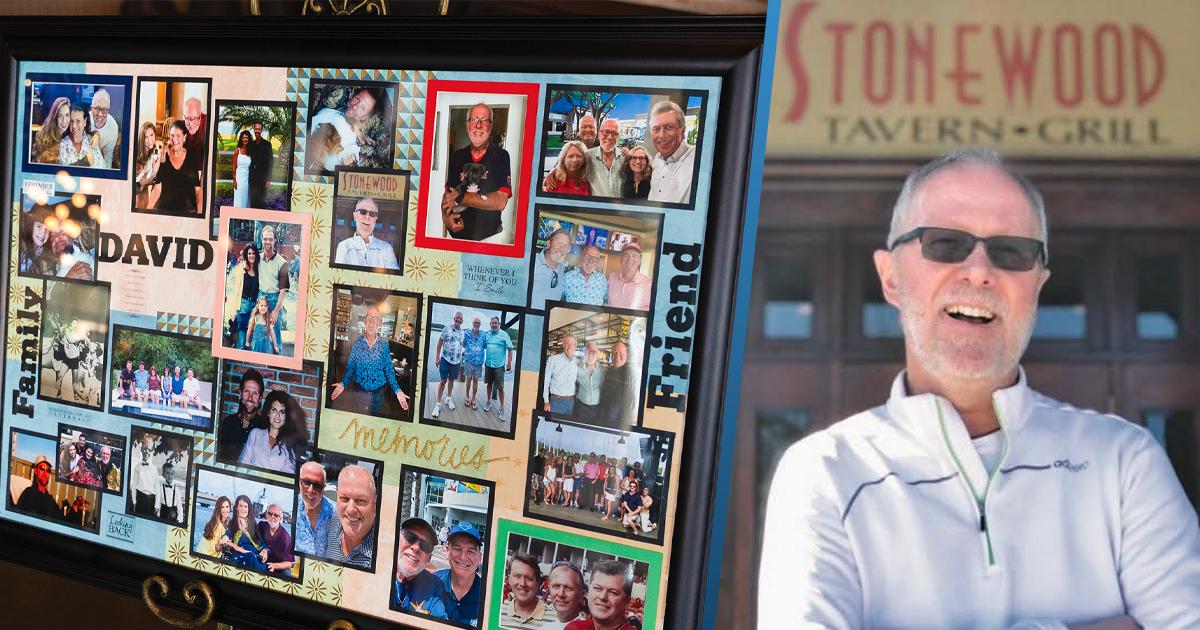
The memory board of Dave displayed during the celebration of Life
Join Us When The Former Proprietor Also Will Be Celebrated At Stonewood Grill On Monday, July 28, 1 P.M.-???
Even though I had met David (“Dave”) Rathbun when he managed the Carrabba’s Italian Grill on N. 56th St. in Temple Terrace, I didn’t really get to know him until 2002, when he opened the first Stonewood Grill & Tavern in the Tampa Bay area.
There weren’t a lot of great restaurants in our area at that time — heck, there weren’t a lot of restaurants, period — but Stonewood became New Tampa’s favorite restaurant pretty much from the day it opened and there’s no doubt that Dave had as much to do with it as the restaurant’s steaks and seafood.
The way Dave seemed to remember everyone’s name after one or, at the most, two times meeting them, the way he made sure his instant slew of regulars always got their favorite table or seat at the bar — literally everything about the guy was warm, funny and genuine. He was the very definition of the word “hospitable” in the hospitality industry.
(L.-r.) Emily Barreira, Gina & Dave Rathbun (Photo provided by Emily Barreira)
I didn’t know that Dave’s wife Gina was suffering from amyotrophic lateral sclerosis (ALS, better known to many as “Lou Gehrig’s Disease”) for the first several years she was stricken with it, and it wasn’t because Dave didn’t talk about Gina. It was because he constantly talked about how wonderful she was, what a great mom she was to her daughter (and Dave’s beloved stepdaughter) Emily and what a talented artist Gina was. The first time I found out Gina was ill was when Dave asked if I could publish an article about her in the paper to show some of her art, which I did and I wish I could’ve found the issue with that story before I went to press with this issue.
Now, mind you, Dave Rathbun never asked me to write anything about Stonewood. He literally had never asked me for anything until that day. And, for the first time ever, I saw pain behind his ever-present, infectious smile.
When Dave left Stonewood, a lot of people were heartbroken. There were some who told me that they couldn’t keep going to their favorite place if Dave wasn’t there anymore.
The next time I heard from Dave was in 2023, when he had accepted a position as a manager at Bella Brava New World Trattoria in The Hub at Bexley (off S.R. 54 in Lutz) , which opened a few months later. He introduced me to general manager Tina Stormer and made sure the Neighborhood News was on-hand for Bella Brava’s “Friends & Family” pre-opening and introduced us to co-owner Thomas Sanborn, who was the original chef at Stonewood when Dave opened it.
Dave seemed to thrive in his new position at Bella Brava, but in April, he was diagnosed with an autoimmune disease that affects the kidneys. Suddenly, after years as Gina’s primary caregiver, Dave was receiving dialysis treatments three days a week for several weeks.
In June, Dave decided to work a full shift at Bella Brava, even though Emily — who is a nurse with two degrees — was concerned that her stepdad wasn’t fully recovered from his weeks of dialysis treatment. He just loved the work.
But, when Dave got home, he told the caregiver that he wasn’t feeling well. He went to sleep…and never woke up.
At only age 69, the man who loved his wife for 28 years and had taken care of her for the last 17 years as she struggled with ALS, was gone.
Tiny quickly organized a Celebration of Life in Dave’s honor and memory on July 14 and an estimated crowd of 300-400 people showed up to hear his family and closest friends talk about what a wonderful husband, father, brother, friend and manager of people he was. Here are a few excerpts from the speeches given about Dave that day:
Dave’s stepdaughter Emily Barreira & her mom & Dave’s wife Gina Rathbun (Photos by Charmaine George)
Gina (Emily read a letter from her Mom to her husband Dave): “From the moment David came into our lives, he became a second father figure to Emily, loving her as if she were his own. He was endlessly dedicated and loyal not just to me, but to our whole family. He showed his love through his strength and unwavering support by always putting us first. David, you carried your confidence and kindness with you. Wherever you went, your compassion touched countless lives, and your love will always remain alive in the hearts of everyone who had the privilege to know you. But, you left me so fast and unexpectedly. I love you more than you will ever know, and I will miss your radiant smile everyday. Your love is the lasting legacy you left with me and your family. Your kindness was a true gift to everyone who had the chance to know you.”
Emily: “David always had a favorite story that he love to share. When I was four years old, I was sitting out in the living room with him watching TV. My mom came over and reminded me that it was time to go to bed. I looked up at her and said, ‘No, mommy, I can’t go to bed. I’m watching baseball with my ‘little stepdaddy.’ From that day on, that’s what he was to me… my little step daddy. He instantly became my bonus dad at a very young age and supported me throughout the rest of my life.”
Dave’s brother Paul Rathbun
Paul (Dave’s brother): “When I was 16 years old, and we lived in Boston. David, John myself and Dave’s friend Tim took us to see the Trammps, a disco band in the seventies, and they were pretty hot at the time. There were a lot of problems with that evening, not the least of which was that four of us were under age. The five of us were invited on stage to sing the finale, “Disco Inferno” with the group. It was amazing. Okay, it was the seventies. Dave loved his family, He loved the restaurant. He loved the people he worked with. He loved his customers. He just loved people.
“Dave loved reading his devotionals. A recent one he shared was, ‘He’s Preparing a Place for You.’ Jesus promised that he’s preparing a place for us, a place where we will be with him forever. It’s not the size of the room or how fancy it is. It’s about being in his presence, where there’s joy, peace and love that never ends. Dave, you have fought the good fight. You finished the race. You have kept the faith. Well done, my brother.”
Dave’s brother John Rathbun
John (Dave’s brother): “He and I talked about the power of positive thinking — in the things you do, the things you say, the things you think — it all determines your destiny and the energy you give off to people. Dave greatly valued his family, connecting with his creator, and mentoring his coworkers. He loved his customers and obviously, his friends, and many of his customers became his friends.
“The French have a phrase “‘Joie de vivre,’ which means “the joy of life.” I think Dave possessed that. He put a lot of effort into his relationships with his coworkers and his customers. and he brought a lot of joy to you guys and, to be honest, you brought a lot of joy to him, too.”
Dave’s close family friend Tim
Tim (Dave’s long-time friend): “Dave had gone to school for physical education but when he moved here, he was going to nursing school and he was working in an Italian restaurant (Lorenzo’s). And I would come down from Tennessee to visit and you could just tell that he loved it. I soon realized that he all the things that he could do as a P.E. teacher, he could do in the restaurant business.
“He mentored so many people and was a great coach. He was so inspirational to so many people. I’ll never forget that we were working on a paint crew here in Florida. I was going to school, and I’m borrowing money to go to school and I didn’t know what I wanted to do. And I was really beating myself up and I had one conversation with Dave and he said to me, ‘Timmy, don’t worry about it. Don’t put so much pressure on yourself. You’re smart, you’re a hard worker and people like you. Just focus on doing the best that you can every day and treat people around you the way you want to be treated, and you’ll be successful.”
Dave’s friend Kelly Barnett
Kelly (another long-time friend): “I worked at the Olive Garden in New Tampa, right across the parking lot from Stonewood. Dave and I had worked together like 30 years before that, and we end up working right next to each other. So, one day I was eating there and I’m just watching him.
“I knew what he was like, but I never got old to watch him work a dining room. He knows everybody by name. And he knows something about each of them. It’s not like he’s just out there saying, ‘Hey, how’s your dinner?’ And the person I was with was also in the restaurant business. And they said, ‘Oh my God, he’s like the Mayor of Stonewood!”
Bella Brava Bexley GM Tina Stormer (with Emily & her husband Ryan Barreira)
Tina (Bella Brava GM): We closed the restaurant today so all of our employees could be here to celebrate Dave. He was the definition of hospitality at its best. They called him ‘Diamond Dave’ for a reason. If he didn’t know who you were when you walked in, he would definitely know you by the time you left.”
Please join us for a second Celebration of ‘Dimond Dave’ Rathbun’s life on Monday, July 28, 1 p.m., at Stonewood Grill & Tavern.
(l-r) Dave’s brother Mark Rathbun, his sister Martha Peddle (with Paul) & his sister Mary DeSantis
Grand Hampton residents Diane Royer and her father and former WWII Buffalo Soldier Roy Caldwood
Editor’s note — One week after I interviewed Cory Lake Isles resident and retired U.S. Army Brigadier General Remo Butler — the first-ever Black General of the U.S. Special Forces — on the same day Gen. Butler attended the celebration of the 250th birthday of the U.S. Army in downtown Tampa on June 14 , I interviewed former U.S. Army vet, “Buffalo Soldier” and Grand Hampton resident Roy Caldwood, who took a very different path to becoming the true American hero he is today.
Gen. Butler and Army PFC (private first class) Roy Caldwood were both honored during that June 14 celebration and the two have become friends over the past couple of years, thanks in no small part to an introduction of the two by District 7 Tampa City Councilman Luis Viera.
Although I was hoping to tell Roy’s story in the same edition as Gen. Butler’s, I wasn’t able to schedule both interviews before I had to go to press with that June 24 issue, so the first half of Roy’s own amazing story appears in this issue instead. — GN
The first time I met World War II veteran and Grand Hampton resident Roy Caldwood, his 101st birthday was being celebrated at Grace Episcopal Church in Tampa Palms (the church Roy and his daughter Diane Royer attend) in Aug. 2023.
After that encounter, I told Roy I was excited to buy his book entitled Making The Right Moves: Rikers Island & NYC Corrections; Being Calm in the Storm about his harrowing experience as an assistant deputy warden who was held hostage during a riot at the notorious Rikers Island prison in his native New York City in 1972 (more than two decades after he completed his military service).
I also said that the next time I interviewed Roy, I wanted to talk about not only the two Rikers Island riots he survived but also his experiences as a “Buffalo Soldier” during WWII. In fact, today Roy may be the last surviving member of that 92nd Infantry Division, which was the only Black regiment that saw combat during the war.
I say “may be” because, according to the AI response I received during a Google search, the last surviving Buffalo Soldier was a man named Robert Dixon, who passed away in Nov. 2024 at the age of 103 — the same age Roy Caldwood is today. (So, for those of you who believe everything AI tells you, try doing some research on your own sometimes.)
But, Roy is not only still very much alive, he is a vibrant man who can still do “probably 40” pushups (although he says 20-30 is his usual limit) and who loves recounting his stories of the Second World War and his century-plus-long lifetime of amazing stories. If you ever get the chance to meet him, ask him to tell you one story and you will end up being regaled by many tales of bravery, heroism and true evidence of why the members of the American military who fought in — and ultimately won —WWII have been dubbed “The Greatest Generation.”
From Humble Beginnings
Roy J. Caldwood was born in New York City on July 10, 1922. Although his parents never divorced, he says they were separated because his mother, a devout Christian, could not deal with his father’s gambling.
“My father didn’t live very far from us,” Roy says. “He worked as an elevator operator and when I became a teenager and wanted to take a young lady on a date, I would visit my father at work and he’d give me a dollar. But I was raised without a father and the discipline that many of my buddies had growing up.”
In fact, Roy says, when he was picked on by bullies at school — which happened a lot because he was small and slight — he had to run home to get his “sister” (actually a cousin that Roy’s mother raised) to help him fight his battles. “If I went home and got my sister,” he laughs, “those boys would be scared.”
Eventually, a much larger classmate at the Parochial school he attended, “even though we weren’t Catholic,” took pity on him, “and taught me how to box. After a couple of lessons, I didn’t need my sister to fight my battles for me anymore.”
He admits that the nuns at the Catholic school were the only ones who ever really disciplined him. “If our teacher left the room and came back, she’d ask, ‘Who was talking while I was out?’ and some of the kids would rat on each other,” which could cause them to get whacked on the knuckles by a ruler. “That was enough to keep me from getting out of line too often.”
He also recalls an incident where, “I guess I did something bad. I don’t remember exactly what I did, but one thing I’ll never forget was that the nuns called for a bigger guy, an older student, and he picked me up and stuffed me in the dumbwaiter. I’ll never forget that. But, it was actually good for me. I learned how to control myself.”
On To The Army
After high school, Roy says he went to his draft board and mentioned that he was interested in medicine. “They put me in the Army, with 16 other Black guys, and said they were going to put us in a medical outpost or something, but they sent us to Camp Patrick Henry in Virginia and we formed a basketball team. And we were good. But then, I heard about this guy they called ‘Sweetwater’ Clifton, and I said, ‘We gotta this guy,’ so we drafted him and we played against colleges in the south…and beat the hell out of them.” (Note-Nat “Sweetwater” Clifton went on to become one of the first Black players in the then-fledgling NBA after serving in WWII from 1942-45.)
When they weren’t shooting hoops, Roy says that all he and his basketball buddies did at Patrick Henry was kill mosquitoes, “and we all hated it. But then, I read an article in Stars & Stripes magazine that the 92nd Infantry Division was badly in need of more help, so I got two of my buddies to go with me and we were sent off to Fort Huachuca in (southeast) Arizona,” which was the base of operations for the Buffalo Soldiers of the 10th Regiment from 1913-33 and was home to 25,000 soldiers during WWII.
“So, they put me and my two buddies in the medical unit and we had to pass a test to become Army medical/surgical technicians, and we all passed, no problem.”
But then, Roy says he got diarrhea and ended up in the hospital. He says the Army was “breaking down Black combat outfits and making them into labor battalions. They had already done that with the only Black division that they had before — the 93rd — and they sent them to the Pacific. They were going to do the same thing with the 92nd, but the Black leaders fought them. So, they came to a compromise. They said, ‘We’ll allow one infantry unit to go to Italy and go into combat and see how they do. In the meantime, I’m in the hospital trying to get out, and they wouldn’t let me out, so I just left.”
Roy says he went to the Day Room and spoke to the clerk there, who said, “Well, you have to pass the ‘Fit to Fight’ test, so you can qualify if the 92nd Infantry Division does go overseas.”
But, even though he had just left the hospital, “I’m dragging, you know, but I still passed. The only problem was that they made my two buddies corporals, but not me. They made me a private.”
Off To War
So the 370 Regiment (which participated in the Allied assault on the Gothic Line, including the capture of Lucca, Italy, as part of the 92nd Infantry Division) did just fine in battle.
“But, you read nothing about us in the American papers, while the European papers were full of news about the ‘Buffalos.’ But they said, ‘O.K., the rest of the 92nd division can go over.”
In 1944, as the European campaign was winding down (Note – In Sept. 1943, Italy was no longer allied with Germany, after fascist dictator Benito Mussolini was ousted), Roy says he and the rest of the 92nd went in zigzag on a boat, “because the Germans were right there and, as we were approaching Italy, the boat tried to stop at one island, but they asked , ‘Do you have Blacks on board?’ They said, ‘Yes,’ so they said, ‘Well, then you can’t stop here.’”
But then, the boat pulled up into Naples, where there were a lot of black longshoremen, “and oh, were they happy to see us,” Roy says. “They said, we are having a horrible time here because of the ‘Ugly Americans.’ The Italian longshoremen called White Americans ‘Ugly” because they looked down their noses at every other country. So, they were happy as hell to see us and they said, ‘We’ve been following you guys, so you won’t be having any problems anymore.’”
After spending that one night in Naples, the 92nd proceeded on to Viareggio.
“I think it was maybe the first morning, and I hear us firing our mortars,” Roy says. “I go outside and I see the lieutenant and the squad, and they’re practicing their mortars. They say, ‘If the Germans come, they can come two ways — over the mountain, and we have a platoon up there, and we’re protecting down below.’”
Roy says he said to himself, “They should be warning the people where these mortars are falling. And then, I hear the sergeant say, ‘I think we hit one of their mules.’ I wanted to do something to warn the people in the village, but I can’t tell the lieutenant what to do. I’m just a medic. But, I can go warn these people myself. So, I said to the sergeant, ‘I am going over there to tell the people that we’re practicing our mortars and it’s a dangerous area, so they should take precautions — go in their houses and safeguard their animals.’
“The sergeant said to me, ‘You can go over there, but I am not going to stop firing the mortars.’ So, I said to him. ‘I’m going over there. You can keep on firing those mortars over there. But, if you don’t kill me, do not be here when I come back.’”
He adds, “Then, the lieutenant says to me, ‘You don’t talk to my sergeant like that.’ I said, ‘OK, fine.’ But, I still went over there to warn them and came back and nobody said anything.”
But then, over the next couple of days, one of the soldiers came to Roy and said he had a rash on his back. “I looked at it and said, “I’m sending you back to the rear. You need treatment. I can’t help you here [on the front lines].
“But, the lieutenant said, ‘Private, I don’t have enough soldiers up here now. You can’t send anybody back to the rear.’
“But, I didn’t pay him any attention,” Roy says. “I sent [the soldier] back to the rear anyway. I knew when he was supposed to be going out on patrol. And, when that day came, I picked up a rifle and took off my gear and I took his place. The lieutenant was surprised.
“But, that started it. From then on, any suggestion I made to the lieutenant, he’d say, ‘O.K.’ And yes, I made all kinds of suggestions.”
For example, Roy got the lieutenant to agree to allow the soldiers to have a dance — “Even the lieutenant danced the night away — because I said I thought it would be a good idea for morale, and it was. That was the first of many ‘O.K.s’ I got from him.”
The ‘Purple Heart Stretch’
As the American troops were moving through Viareggio, they were notified about a dangerous stretch of road known as the “Purple Heart Stretch.”
“When we got into this village,” Roy says, “the lieutenant called for a meeting of the townspeople and told them, ‘You will not be allowed to leave this village for any reason whatsoever. Nobody leaves this village.’ And this guy, he’s like the mayor of the village, or whatever, says to the lieutenant, ‘We have not been able to buy food. I don’t know why. And we are all really getting hungry. We need food very badly.’
“But then, the lieutenant says, ‘I told you, nobody leaves!’ But, I’m always trying to solve problems and I’m thinking, ‘I gotta help these people,’ but what can I say? The captain already gave the lieutenant his orders — ‘Nobody leaves the village.’ So, what can I say?”
So, Roy says to the lieutenant,“What if I escorted them myself, since I speak Italiano. And again, the lieutenant says, ‘O.K.’ So now, he’s defying his captain’s orders, and he’s gonna listen to a private — me — instead!
“I said, ‘O.K., but I’ll have to take two volunteers with me. And right away, guys are saying, ‘I’ll go.’ I say ‘We leave in the morning.’ But, next morning. No stores. I know, great. That takes care of that. But, I hear a lot of noise — we were upstairs and there’s a lot of noise downstairs. And I say, ‘The women are there. My guys are there. I gotta be there. I cut downstairs and I said, let’s go. We’ll let the women lead the way. I didn’t want it to look like I’m walking behind these women’s skirts, so I let them walk way ahead. We weren’t walking very long when I looked where we were and I damn near fainted. I said, ‘We’re on the Purple Heart Stretch!’
“The Germans can look down from the mountain and see us. They can kill us right now. I gotta make a decision what the hell to do. I’m not gonna try to run out of there. I have to convince the Germans that we’re humanitarians — that we’re trying to help people who are starving. I gotta convince them. That’s my only hope. I’m gonna walk with my head straight up, like I don’t give a damn. Like I don’t care if I die. I said, ‘Let’s go’ to my two guys. It’s a good little walk but we get to the store. The women went in. And, when I went in, I saw the store was in complete blackness. I can’t see anything. I said, ‘There’s no getting any food in here. There’s nothing.’ So now, I walked the Purple Heart Stretch for no food, nothing.”
He adds, “Now we gotta go back. So we started off. We got maybe a little more than halfway there and a mortar drops. Boom! So now, I’m lying in the mud there ‘cause they had rain. And I said, ‘It looks like I made a big mistake, but I’m not gonna be able to apologize to these people because I’m gonna be dead.’”
But, Roy says he realized, “Germans don’t generally miss with their mortars — they’re very accurate. So, I’m lying there, waiting for the next one to finish me off, but nothing. So I raise my head up, I look around and I see a partial stone or cement wall and I said to my guys, ‘We’re gonna get behind that cement wall’ and I hollered to the group of women up ahead, ‘To the wall! To the wall!’ And they all get up and they start running and my guys are running. So then, I get up and I run. And, when I get behind the wall, the women had their prayer books and their Rosary beads out and they’re all just crying.
“Just as I made it to the wall, the Germans increased the mortars. They must’ve thrown 30 or 40 of them, and they’re going ‘Boom, Boom, Boom!’ It looked like the more the women prayed, the worse it got. I said to myself, ‘Maybe I should tell them that it isn’t helping. Stop praying.’ But of course, I said nothing to them.
“So then, I’m lying on the ground there, and the mortars are still dropping. And I said to myself, ‘Wait a minute. These mortars are not even falling close enough to kill us. They’re not trying to kill us. They’re talking to us! They’re telling me something.’
“So, I start trying to interpret the mortars. I figured out that the Germans are telling me that they figured out that I’m a humanitarian. I’m actually deciphering what this all means. It’s like they said, ‘We had decided earlier that we will fight to the death.’ But then they said, “Now, we’re not going to kill you.’ So, I said to everyone there, ‘They’re not gonna kill us. I am going to move outside very quickly. If I got it right, I’m alive. If I got it wrong, I’m dead.’
“So I moved outside, and I stood there. And suddenly, no mortars. That’s the God’s honest truth. So I said, ‘Let’s go back.’ And my guys and the women came out, and we all headed back.”
Then, when Roy and his group went back, he says, “The lieutenant was standing outside up there waiting for me. When I met him, he told me, ‘The Germans sent a detachment to the village. They wanted to find out what the hell you were doing there — and our outpost saw them.’
“The men called the lieutenant and told him, ‘We see Germans coming into the village.’ The lieutenant called his captain who told him, ‘I want you to establish new quarters in the town.’ And, the lieutenant, said, ‘I can’t leave now because the doctor’s not here yet.’ So, the captain said to the lieutenant, ‘Don’t bother those Germans. Leave them completely alone.’ ‘Cause he knew if they did, me and my group were dead. The captain says, ‘When he gets back, then you reestablish.’
“So now, I’m back with the lieutenant and we’re hurrying to get to the new quarters down below. So, we get down below and we moved right in because we believed that the Germans were coming to peacefully surrender to us. So, we had to hurry.”
The Surrender Of The Germans
“So now, were back in the house, and we walk in the front room and one of our soldiers yells out to us, ‘The Germans are peacefully surrendering to us!’ So, he and I are running now to help with whatever. I see the lieutenant and the German soldiers lined up in twos, with no Americans standing guard over them. We don’t even have enough guys. They’re busy upstairs processing the other guys…the other Germans… that are still coming. It’s just one big, long line. And I can see what the Germans are saying.
“They said, ‘We have to thank that man for what he is doing. He’s a humanitarian. He has saved our lives. We were going to fight to the death. But now, we are not fighting to the death anymore. We owe our lives to that man now, because we are going home and we are going to do humanitarian work, just like he’s doing.’
“It was like 40 or 50 German soldiers and we only had twelve. All we had was just one platoon. There may have been others behind us, but we didn’t know for sure. And, I don’t really know how many guys the Germans had, but they believed they were gonna die. They said, ‘We have him to thank. He has saved our lives.’
“So now, they’re all lined up and what I want to see now is the guy in charge who didn’t kill me. The one responsible for me still being alive. I just wanna see him. And, as I walk down the line looking, I hear some talking and I’m listening and there are two guys speaking English. And, you know what they’re saying? ‘There he is!’ A couple of times. I could look at them, I could even go over and shake hands with them. But, I said to everybody, ‘Right now, things are going a hundred percent. The Germans are cooperating. There’s nothing I could do now to make this situation any better. I could mess it up by saying or doing something wrong, but I’m not gonna do it.’ We didn’t even have enough guys to stand there and watch them. The lieutenant is saying, ‘I don’t have enough men,’ which was true. The captain knew he didn’t have enough men. So, the lieutenant called for an Italian civilian, a guy who helped us with our supply mules. ‘We need Joe,’ the lieutenant said. ‘I want Joe to escort these prisoners.’
“The Germans had plenty of men and ammunition. More American and allied forces for sure would have died if the Germans had decided to fight to the death. But, one or two days after that, the Army issued an announcement saying that, ‘The Italian campaign is over.’
On Celebrating The Army’s 250th
U.S. Army Brigadier Gen. (ret.) Remo Butler (left) & Roy Caldwood at the U.S. Army 250th Birthday Celebration Ball. (Photo: PamElla Lee Photography)
On June 15, Roy posted on his Facebook page, “So grateful for being honored and invited to the 250th Army Anniversary Ball by Gen. Butler. An awesome evening of giving a toast, cutting the official Army cake and sitting in the Army war jeep behind the steering wheel.”
He adds, “I had no idea how I would be received and my friend, General Butler, also said he had no idea. He said, ‘Roy, you’ve got so many people here!’
“It was great — Generals, their wives…All sitting at the same table! General Butler’s wife was sitting next to me.”
Roy says if he never moved to Florida, he probably would never have met Gen. Butler.
Diane agrees, although she also credits Viera with making the introduction.
“Councilman Viera is who really made the connection. It was at least a year or two in the making. Luis kept saying, ‘Oh, Roy — I’ve got to connect you with the General. And it’s been a fantastic bond and relationship and like a love without them ever knowing each other before.”
As to why the native New Yorker made the move to the Sunshine State, Roy says, “I ended up moving to Florida because my wife, Muriel, was very sick, and we moved in with my daughter, Diane. It was the best move I ever made.”
Diane adds, “They were being considerate of my husband (Donald) and myself, because we moved to Tampa in 2001 and we were having to travel back to New York every time to check on them, even though they were very independent. And then came the pandemic. They decided to move here at the end of 2020 for our sake.”
In our Aug. 19 New Tampa issue, I’ll tell you about Roy’s 21-year career in corrections, including his book about being held hostage on Rikers Island. Thank you, Roy & Diane!