The residents of Meadow Pointe II (MPII) and Meadow Pointe III (MPIII) have been down this road before. A gate went up on Wrencrest Dr., the main thoroughfare through the Wrencrest communities which exist in both MPII and MPIII back in 2020 and Pasco County ended up telling MPII that the gate had to come down because it wasn’t properly permitted.
The residents of MPIII thought that the discussion of a gate at the entrance to MPII on Wrencrest Dr. from the MPIII side was over, but it clearly was not.
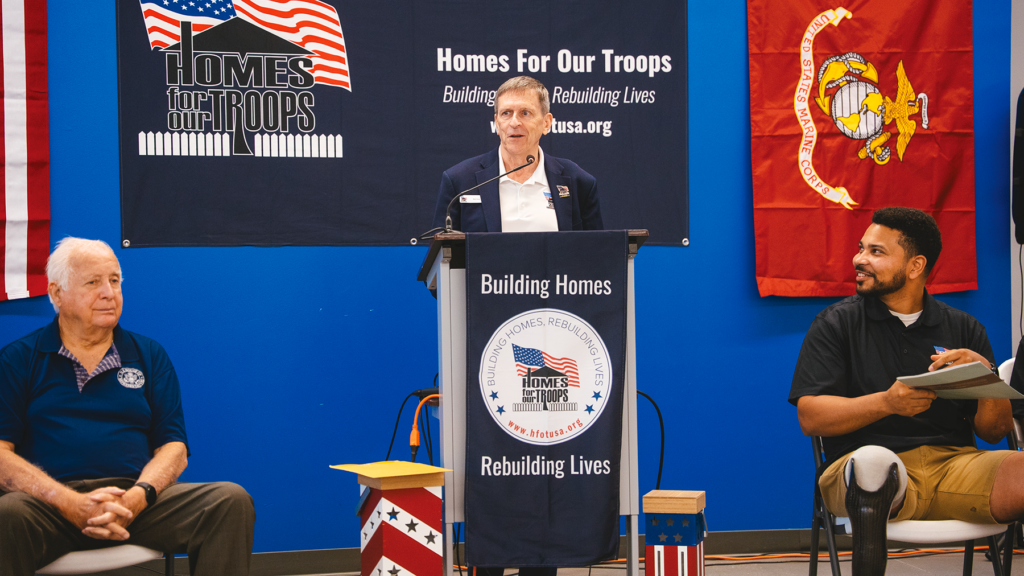
On Apr. 23, the MPII Community Development District (CDD) hosted a “Neighborhood Meeting” at the MPI clubhouse on County Line Rd. — “a neutral location with a much larger meeting room than the rooms at either MPII or MPIII,” according to MPII CDD district manager Jayna Cooper of Inframark Community Management (at microphone in photo above) — where the idea of erecting a new gate, similar to the one where Kinnan St. in New Tampa meets Mansfield Blvd., also in MPII, was again the main topic of discussion.
“This is not a CDD meeting,” Cooper told those in attendance as she read the following statement, “Meadow Pointe II’s goal in going through this process is fully focused on safety enhancement and the security of all residents, including in both MPII and MPIII. The goal in submitting an application to the county is to receive approval to construct an emergency gate on Wrencrest Dr. between Blanchard Ct. and Rensselaer Dr. (see photo below) to cut down on the excessive traffic and the speedway this road has become. The road was never intended as a regional framework roadway for regional transportation uses. The policy goal is instead to return its use to as a neighborhood internal roadway we are all paying for as residents while still allowing for emergency access for emergency services.”
Cooper then introduced Jerry Whited of BDI Engineering, who said, “We did do a traffic study that confirms our findings and proposal that a large volume of the traffic that is coming to the west side of Wrencrest is traffic coming from the MPIII side but also from traffic that is accessing MPIII from outside of the community. It’s being used as a major cut-through for residents who are coming from MPIII who should be accessing Mansfield Blvd. via Beardsley Dr., which is a much more pertinent roadway to be using for this type of vehicular traffic. It is a larger roadway, less narrow and has less pedestrian traffic and no driveways, while there are hundreds of driveways on Wrencrest Dr.”
Roughly two dozen speakers, mostly from MPII but some from MPIII, were given three minutes each to speak.
And, while there were a couple of MPII speakers who acknowledged that speeding is happening in both neighborhoods and agreed that installing strategically-spaced speed tables along the full length of Wrencrest Dr. might be just as, if not more effective, most of the MPII speakers mentioned the two MPII Wrencrest residents who were seriously injured and had to be airlifted because of speeders and said that installing the gate was the only real solution to the problem.
MPII Wrencrest resident Kathy Jimenez read a moving statement written by her neighbor Ray Quinones, who was one of those airlifted after being hit by a car that had passed fellow neighbor Marla Mitchell “doing at least 45 mph” and both expressed sadness over how Quinones had suffered since the accident, writing, “The worst part is the memory loss. Chunks of my life are gone.”
But, almost all of the MPIII residents who spoke at the meeting said that adding speed tables, narrowing the road and even adding trees along the portions of Wrencrest Dr. with no homes would be a much more effective way to slow down the traffic in both communities.
In fact, MPIII Wrencrest resident Michael Jenkins said, “It makes no sense to think that the best way to solve the problem is to cut off the community from the main thoroughfare. We can do better than this. The members of the boards of both MPII and MPIII have allowed this to become a spiteful, back-and-forth match between the two CDDs.”
Updates from the MPII legal counsel were expected to be provided at the MPII CDD Board meeting scheduled for May 7, or two days after this issue went to press, but our phone call to Cooper to ask if the MPII CDD Board would actually vote on the issue at that meeting was not returned before we went to press.
Even if the MPII CDD Board votes tonight to move forward with approving the gate between the Wrencrest neighborhoods in Meadow Pointe (MP) II & MP III, the final decision would still be in the hands of the Pasco County Board of County Commissioners (BCC), which would have to add the vote to a BCC agenda at a future date.
Editor’s Note – The original version of this story appeared in our Apr. 15 Wesley Chapel issue, which went to press before Metro Development Group and the Pasco County Planning Department staff held a presentation for the Pasco Board of County Commissioners (BCC) at the BCC’s regular meeting on Apr. 9.
The purpose of that presentation was to update the commissioners on the progress of both the 7,800-acre Connected City (CC) development — which Metro calls “The First Smart Gigabit Community in the U.S.” — and the adjacent Villages of Pasadena Hills (VOPH) planning area.
And, despite what some critics are claiming, Metro principal Kartik Goyani says that CC, which was approved as a Pilot Program for the entire state and by Pasco in 2015 and began development with Metro’s Epperson community in 2017 — is only in year eight of a 50-year plan and, in his estimation, the CC development is proceeding according to plan.
Goyani provided an overview of the overall CC project — how it came to be, Metro’s part in it and the progress of the project itself — for the commissioners.
“I’m here to represent everyone who’s part of the Connected City planning area,” Goyani said as he began his presentation. “Your staff said to me, ‘Why did we even create the [CC]? Well, that was 10 years back, so maybe it’s time to go back and see what was the goal and was it a good idea all along? I don’t have all the answers, so I’m going to do my best to walk you through the journey we went on…and the thinking behind it.” He also said that the need for the presentation to the BCC started, “with the chatter online” (more on this below).
How It All Got Started
Goyani first showed the boundaries of the Connected City planning area (see map). The orange lines on the map, which Metro provided to me for my original version of this story, indicate the boundaries of what is called CC, of which only the western boundary follows a specific roadway — I-75.
The northern boundary extends to a little north of S.R. 52 in San Antonio, with several important commercial developments and yet another (as yet unnanounced) AdventHealth hospital to be located in this northernmost section. (Note-Goyani told me when I interviewed him for the original version of this story that AdventHealth has owned that property since 2019 or 2020.)
“But, it wasn’t the S.R. 52 we drive on today,” Goyani told the commissioners. “It wasn’t the four-lane divided highway. It was two lanes, undivided and it kind of jogged, [and that part is now] C.R. 52.”
Curley Rd. forms most of the CC’s eastern border, although a portion of it extends east of Curley — between Elam Rd. to the north and just north of the eastern portion of Overpass Rd. to the south. It is worth noting that the Watergrass community, which includes property both north and south of that eastern extension of Overpass Rd., is not part of CC.
And, speaking of Overpass Rd., everything north of it from I-75 to the entrance of Epperson is within the CC boundary, but that boundary also extends south of Overpass to include all of the Epperson development, but not the pre-existing Palm Cove or Bridgewater communities.
Goyani also reminded the commissioners that there was no exit off I-75 at Overpass Rd. when CC first started and Curley Rd. was just two lanes. “And, at that time, the discussion kept coming up, mostly led by the then-county administrator (Michele Baker), based on an Urban Land Institute (ULI) study that the county had commissioned during the last downturn in 2008, which was, ‘We need jobs in Pasco County,’ which at that time, was a bedroom community (for Tampa), with ULI estimates of 70,000 cars heading south every day — and something needed to change.”
He added, however, “There was only one problem at that time. We only owned 900 acres in Epperson (with 3,000 residences), and 2,000 acres in Mirada (with 4,500 residences), which is only about 40% of the land and 20% of the planned residences in [CC}. And, just to set the stage — we had our entitlements and approvals already. We could have just built a regular community, with the cookie-cutter housing which none of you like. Or, we could change.”
He then noted that the “Connected City” name is just a placeholder, but the idea was, “Why don’t we create a new town from the internet up that becomes an economic engine that attracts the jobs and gets the healthcare and the fiber connectivity. And, the $14 billion [transportation] funding shortfall that everyone is talking about…maybe ask those private guys to pay up a little bit more than what they were paying in impact fees. Great idea, but no one is going to come to this area unless we put it on the national and international map.”
And, Goyani said, “Everyone we met with said, ‘Why do something only for two projects — meaning the land we had?’ Let’s do something bigger, which is what led to creating this 7,800-acre ‘Special Planning Area.’ The county had laid the foundation for this type of area, having already approved a long-term plan for [VOPH} to the east of [CC].”
In other words, Goyani said that although Metro’s intent, when the CC pilot program was approved by the state in 2015, was to have the CC connected by both high-speed internet and walkways and multimodal transportation opportunities, the developer’s primary focus was the internet.
“From a fundamental standpoint,” he said, “counties and developers usually focus on the physical infrastructure — roads, water lines, waste water, electrical, because you can’t have a community without those — but no one else was working on the digital infrastructure. That’s how this story ended up evolving.”
As for CC’s physical infrastructure, Goyani said that when CC began development, no other developers were interested in improving S.R. 52 or creating an Overpass Rd. interchange off I-75. “But, by bringing [CC] to Pasco, S.R. 52 is now vastly improved and the Overpass Rd. intersection is open, meaning that the physical infrastructure for [CC] is now in place. That is a big reason why we have been able to attract so many employment centers to this development.”
Regarding parks and trails, Goyani told the BCC, “I can only speak to the parks and trails that we do in our communities. But, we worked with [county] staff to create the 50-year master plan with the goal being that people [other developers in CC] are going to carry this thinking forward and hopefully make it better.”
And, although some current CC residents (see below) say it’s not enough, Goyani showed the BCC photos of golf carts, jogging paths and tot lots for kids. He also noted that the Wesley Chapel District Park already existed at that time just to the south of CC and the county had set aside land for its 300-acre “Superpark” in VOPH, just east of CC.
“The Board made the great decision at that time to take all of the funds for parks in [CC} and put it towards the Superpark to create a truly regional destination.”
He also said that the average home in CC pays $4,687 in additional impact fees for infrastructure, schools and technology, and those fees have raised “a total of more than $30 million in additional impact fees to date.”
The Commercial Pieces
Goyani also mentioned, both to me and at the Apr. 9 meeting, that, “Back when we first started planning [CC ] in 2013, we looked at the amount of new commercial construction for all of Pasco County and I believe the total amount from east to west at that time was only 300,000 sq. ft.
“So, as we started laying out the goals for our 50-year plan. Our goal was to see at least 3 million sq. ft. of commercial over the 50-year plan for the Connected City,” Goyani said. “But, as we started talking, we felt that was too small of a goal, so why not plan to do something — in one small area — that’s 50 times what the entire county does in one year? That’s how we ended up with a goal of 12.8 million square feet. “
He also said that last year, Metro commissioned a study by PFM Financial Advisors LLC out of Orlando, which showed that Pasco is now “the fastest growing commercial corridor in Florida. There is now 36+ million sq. ft. of non-residential uses in different stages, which is more than any other county in the state of Florida, and I’m like, ‘Wow, that is exciting. Maybe we’re onto something here. If I were to bet, I’d say we’re going to run out of commercial entitlements throughout the Connected City because I think more is still going to happen, based on the plans.”
Another major commercial project within CC is the Double Branch/Pasco Town Center, a 965-acre mixed-use project just east of I-75 at S.R. 52 that is already under development and will include up to 4.5 million sq. ft. of industrial space at its build-out. Phase 1 of that project, which is expected to begin delivering finished buildings later this year, includes three industrial buildings totalling nearly 500,000 sq. ft. There also are plans for 1 million sq. ft. of office space, a 1.6.-million-sq.-ft. distribution center and a 400,000-sq.-ft. “cross-dock facility,” which is a logistics hub designed for the rapid transfer of goods to minimize storage time. Double Branch is being developed by Columnar Investments, which also is planning to have 500,000 sq. ft. of retail uses, 3,500 residential units and 200 acres of parks and trails.
Some of the other privately owned portions of CC also have commercial entitlements (or are asking for them from the county), such as the Abbey Crossings/Park 52 Logistics piece that will bring 500,000 sq. ft. of light industrial uses to north of S.R. 52 and neighborhood commercial and a hotel to south of 52.
Health Care & Education
I’ll admit that the non-residential CC numbers shocked me. They include not only the Johns Hopkins All Children’s Hospital that just broke ground in the Wildcat-Bailes property in CC’s southwest corner (see separate story on pg. 8), but also the not-yet-announced AdventHealth hospital just north of S.R. 52, as well as a large BayCare medical office complex that will not only help staff the expandable BayCare Wesley Chapel Hospital a few miles south of CC, but also focus on wellness to help people in CC live healthier and longer.
Also located on the outskirts of CC is the Kirkland Ranch Academy of Innovation, which started in 2022 with a high school and now also has grades K-8. Two years earlier, Innovation Preparatory Academy (aka InPrep), a charter school, opened for the 2020-21 school year and Prodigy at Epperson Early Learning Center is now open south of the CC border just south of InPrep.
Goyani ended his presentation to the BCC citing the following figures:
“The 2065 (50-year) goal for residences in CC was 37,345, with more than 19,000 (51%) already built. The non-residential goal was 12.8 million sq. ft., and nearly 12 million of that (93.5%) has already been approved. There also is another 1.7 million sq. ft. of commercial in areas adjacent to CC.”
County Staff’s Presentation
The county’s presentation on Apr. 9 started with William Vermillion of the Planning & Economic Growth department. Vermillion, who oversees MPUDs in Pasco, said that a recent study by the county found that there are still 44% of the single-family detached home entitlements left in the Connected City.
“Even though you were told a couple of years ago that there were no more single-family entitlements left,” Vermillion said, “there actually are still about 4,400 remaining [of the 10,583 SF homes originally approved for CC]. We also have about 50% of the multi-family, which includes townhomes and garden-style homes for the higher density areas. We also still have roughly 37% of our commercial left and 75% of the office. Industrial entitlements are shown as 0% remaining because of the Double Branch development, which originally opted out of [CC] because they wanted more industrial entitlements than what was originally contemplated. And, we have roughly 26% of the land remaining.”
Dist. 2 Comm. Seth Weightman told me that although he was shocked the staff had been giving the commissioners the wrong figures, he didn’t believe the “mistake was intentional on anyone’s part. We’ve had a lot of turnover in our staff. But no, I would not have voted for the conversions from single-family to multi-family in Connected City had I known the correct figures.” He remembered saying that one of the conversions he voted for, “felt like chewing on a mouthful of sandspurs.”
Vermillion also showed an SPA (Special Planning Area) checklist for CC with green check marks next to the items that are proceeding according to the CC’s comprehensive plan and red dashes for those that aren’t, in each zone.
“We can see that the North Innovation Zone is accomplishing what was set out in the comprehensive plan,” Vermillion said, “including commercial, retail and single-family detached, hotels, medical and civic uses.”
Moving on to the South Innovation SPA Zone, Vermillion said, “The dash mark next to the high-density multi-family in that zone is only speaking to the fact that the comprehensive plan for [CC] doesn’t directly prescribe what, in fact, high-density multi-family is. There is already multi-family approved in MPUDs within the South Innovation Zone. However, because the [CC] comprehensive plan doesn’t prescribe the density range for that high-density, we felt it was worth noting that to the Board.”
As for the Community Hub SPA zone, Vermillion said, “There are two red dash marks, the first being for cultural. It’s worth noting that, in both the Tall Timbers MPUD that’s going to be coming before you next month and in the Kenton Rd. MPUD, there are conditions of approval which encourage public art that can serve that focus that’s spoken to by the Community Hub. And, that dash by “Civic” uses, while there are no currently approved civic uses within the Community Hub zone, just to the south, within Watergrass, we did allocate a 7-acre library site which can accommodate those residents for that civic use.”
And finally, Vermillion said that in the two highest density and intensity SPA zones — the Business Core and Urban Core zones — the [CC] comp plan is being met and “Mr. Kartik did a great job of addressing all of the non-residential land uses within these two SPA zones.”
Vermillion also noted a county study from 2023 of the volume of traffic on S.R. 52. “That explosion happened once we finally started having development within [CC], post-Covid, from 2020 until now, but despite that spike, no road [in CC] exceeds the current [volume] threshold acceptable by the county. In other words, the infrastructure is keeping up with the number of entitlements that are being approved within [CC].”
As for CC’s current Park Service Areas, Vermillion said if you combine “all of the parks in [CC], there are 115 acres of neighborhood parks already built, not inclusive of the VOPH Superpark or the Wesley Chapel District Park.”
But, Weightman noted that the 240-acre VOPH Superpark, “isn’t going to be as ‘super’ as we anticipated. We’re going to fall short on a few areas of uses, and, with the age of the people moving to the area growing younger, I really feel we need to revisit the diverting [of CC] funds to the VOPH Superpark. With the District Park already at capacity, we need to find a way to have a similar style park within [CC] and whether we reallocate funds from the shortfall that the Superpark is going to have, or we restructure the way that funding mechanism works, I think it needs to be done because [CC] is here today. The youth and their parents are demanding that we have field space now for a variety of sports. The people are here now, so the 40 acres we have in the site we [Pasco] already own…that footprint needs to be doubled and we need to figure out the funding between VOPH and CC because something needs to happen sooner than later in the [CC} corridor.”
Pasco Parks Dept director Keith Wiley then responded that Comm. Weightman was correct.
“And, the question is,” Wiley said, “Where should we locate the other park facilities in [CC]? We’d have to ‘swap’ projects in order to have a district park, since a community park doesn’t really get it done. We’d have to decide which of the 21 capital projects identified need to be removed.”
Board Chair & Dist. 3 Comm. Kathryn Starkey said she would like Wiley to look into using the site Pasco owns near the future Town Center Hub, either for a land swap or to build a District Park on property that had originally been slated for a utilities maintenance area.
Wiley added, however, that the county’s Master Parks Plan was done more than a decade ago and could be updated, “rather quickly” to see if there are locations within CC that could accommodate a District Park.
Dist. 1 Comm. Ron Oakley, whose district includes CC, cautioned, however, that the entire county needs more ball fields, not just the [CC], “and we can’t build more parks without having the money to maintain them.”
But, What About…
Prior to the Apr. 9 meeting, I also spoke with Realtor® and CC resident Michael Pultorak, whom we have featured in these pages before. Pultorak created the Facebook group known as the “Pasco Connected City Residents Group (PCCRG).” The group quickly built up to 1,600 members, as he and the group members have consistently appeared at Pasco BCC and Planning Commission meetings to ask questions and/or complain about the way CC is being developed, even though many of the concerns expressed have been about the development plans of some of the CC land owners other than Metro.
Pultorak has already met with four of the five commissioners to discuss his concerns, some of which below do also revolve around Metro’s portions of the development. And, some of these concerns were addressed on Apr. 9, but others were not:
• The open space & recreational areas detailed in the CC Master Plan have been moved to east of Handcart Rd. (outside of the CC boundaries)
• The walking/jogging trails promised to Mirada and Epperson residents were not delivered and the trails were not in the engineering plans nor created in the execution of the development
• The innovative lagoons are private and for-profit amenities
• There are no promised cultural facilities or libraries of any kind yet planned in CC
• Stormwater concerns at the head of the Cypress Creek watershed with upcoming CC development applications
• King Lake (a 263-acre lake and the largest body of water in CC) flooding issues for current CC residents. (Note – Pultorak says that King Lake has been beyond flood stage since Metro began digging the nearby Epperson lagoon)
• Planned roadways within CC that topographical maps show will be under water
• No schools actually located within the CC boundaries (Goyani said that InPrep and Prodigy actually are within the CC boundaries)
• The large park planned to be within CC has been moved to the adjacent VOPH
• Multi-family apartments and townhomes being approved by the Pasco BCC that are in portions of CC that, according to the Master Plan approved by the state, should not be allowed
• The approved plan for the five Special Planning Area (SPA) Zones within CC has not been adhered to by Pasco, especially with regards to approvals for multi-family apartments
“We are not against responsible growth and development,” Pultorak said. “However, developers need to be held accountable to the residents of Pasco County to fulfill the promises they make before they take profits and move on or unexpectedly cause flooding of existing residents and communities. That’s why we formed this group.”
Where It Is Now
Many of the concerns outlined above were presented in our previous story about CC, when the Planning Commission first voted to send the Tall Timbers MPUD on to the BCC for final approval. After giving the nod to Tall Timbers 4-3 on Jan. 9, however, the Planning Commission then voted 6-1 at the same meeting to put a one-year moratorium on all future CC development agreements, site approvals, building permits and zoning changes.
But, since the Planning Commission is only an advisory panel, the final say on both Tall Timbers and any possible CC moratorium still lies with the BCC. Those votes were originally supposed to be held at the BCC meeting on Feb. 11, but the discussions and votes have now been continued twice — first to Mar. 11 and now until the BCC meeting on Tuesday, May 6.
But, while Goyani still can’t speak to what the other CC land owners are doing, his primary response to most of the complaints is that, “We are only still in year eight of a 50-year plan. We knew before we started that it would be hard to make everyone happy with this unique development but we believe — and we are proud — that we are helping to put Pasco County on the map with [CC].”
The speakers at the Apr. 5 introduction of Marine Sgt. Christopher Lawrence and his family to the Wesley Chapel community by the military nonprofit Homes For Our Troops (HFOT) included (l.-r.) Tampa City Councilman Luis Viera, Pasco County Commissioner Seth Weightman, Jerry Custin of Congressman Gus Bilirakis’ staff, Jocelyn Phipps of HFOT, Sgt. Lawrence, his wife Chelley, their daughters Cristiana & DeliaMarie Lawrence, HFOT Exec. Dir. Bill Ivey & previous HFOT home recipient Sgt. Russell Carter. (Photos by Charmaine George)
On September 11, 2001, Christopher Lawrence was only in the ninth grade in Wisconsin, but he decided shortly after the tragedy that day that he wanted to serve in the U.S. military.
By 2005, Christopher was a U.S. Marine. Only two years into his stint, in August of 2007, he was Sgt. Christopher Lawrence, a fire team leader with the 3rd Assault Amphibian Battalion, 1st Marine Division, when both of his legs were severely damaged in an improvised explosive device (IED) explosion as the battalion was crossing a bridge in Al Anbar, Iraq. He also suffered damage to his left arm, had internal injuries, tinnitus and a traumatic brain injury. He was in a coma for a week, after being evacuated first to Al Asad Air Base and then to Landstuhl, Germany. After being returned to the U.S., he underwent numerous surgeries and extensive rehabilitation to save his legs and arm.
But, while military doctors were able to save his left leg, his right leg was amputated at the knee in March of 2008 and the toes on his left foot were amputated in August of the following year.
Way too many of our military service men and women have stories like Christopher’s and many of their stories don’t end well.
The Lawrence family is about to arrive at Pinecrest Academy.
But, Homes For Our Troops (HFOT), a 501(c)(3) military nonprofit, is doing its part to help these brave former soldiers, Marines and other injured military veterans by building specially adapted homes to help them be able to perform everyday activities those of us who haven’t suffered these types of injuries take for granted — like going to the bathroom, taking a shower or bath, cooking for themselves, etc.
According to its executive director Bill Ivey, since its inception in 2004, HFOT has completed 407 such homes in 45 states, including as many as five here in Pasco County, with at least two others already completed in Wesley Chapel.
“The Tampa Bay area has been a popular choice for the vets we build homes for,” said Ivey during the special recognition “kickoff” ceremony on Apr. 5 held at the Pinecrest Academy of Wesley Chapel on S.R. 54 for Sgt. Lawrence, his wife Michelle (Chelly) and their young daughters DeliaMarie and Cristiana. Within the next six months to a year (depending upon weather and other factors), they will all move into their new Wesley Chapel home.
The family has been living in Southern California, where Sgt. Lawrence has continued to serve as a member of the San Diego Police Department. Christopher, who grew up in a foster family, said he chose Wesley Chapel for his HFOT home by Kent Custom Homes because he has a brother who lives “not too far away” in Jacksonville and, especially, for the climate and proximity to the renowned James A. Haley Veterans Hospital in Tampa.
The event at Pinecrest Academy itself was spectacular, as an escort of Pasco fire trucks (photo above), Sheriff’s Office and Florida Highway Patrol vehicles and a motorcycle motorcade led the Lawrence family to the entrance to the school, where they were greeted by a cheering, adoring crowd of local residents all waving American flags. Once inside, HFOT’s Jocelyn Phipps first asked anyone in attendance who had served in the U.S. military to stand to be recognized. Phipps then introduced the Wiregrass Ranch High color guard and Autumn Rae Estes, who sang a stirring rendition of our national anthem, followed by Sgt. Lawrence’s daughter DeliaMarie leading the 100+ attendees in the Pledge of Allegiance.
Jerry Custin give Sgt. Lawrence a Certificate of Congressional Recognition.
Then, Phipps introduced the program’s speakers. The first was Jerry Custin of U.S. Congressman Gus Bilirakis’ staff, who gave Sgt. Lawrence and his family a properly folded American flag and a Certificate of Congressional Recognition (top photo). Next up was Pasco County Commissioner Seth Weightman, who mentioned that he and Sgt. Lawrence were only a year apart in school on 9/11 and how they went on diverging paths after that terrorist attack on our country. Weightman was followed by Tampa City Councilman Luis Viera, who thanked Sgt. Lawrence for standing up for his country and “for facing significant challenges for all of us.”
Also speaking were long-time HFOT supporter and Vietnam veteran Leo Eineker, previous HFOT home recipient Sgt. Russell Carter (his HFOT home is in Lithia), Chelley Lawrence, Ivey and a clearly moved and appreciative Sgt. Lawrence himself. Also on hand was another HFOT home recipient, Army Master Sgt. Christopher Blauvelt, whose wife Bernadette owns B Creative Painting Studio in The Grove. Their HFOT home also is in Wesley Chapel.
After the shedding of many tears and the shared camaraderie of everyone on-hand, Jeff and Crista Dean of Bubba’s 33 served delicious sandwiches and salad. It was a wonderful event.
On a personal note, I know there are a lot of charities out there you can support with your hard-earned money, but as Ivey said so poignantly during his remarks, “Homes For Our Troops isn’t a charity. We are a military nonprofit, but we believe that what we’re doing by building these homes is doing the best we can to pay back these veterans who risked everything and sacrificed so much for all of us. And, nearly 90 cents of every dollar we raise goes directly back to support the veterans, which not too many nonprofits can say.”
He also noted that HFOT does not receive any governmental assistance and that 65 cents of every dollar the organization raises comes from private donors, with the other 35 cents coming from corporate sponsors. “We don’t spend big money on TV commercials,” Ivey added. “Our mission is to provide these deserving injured veterans with a home where they can raise a family (the average size of an HFOT home is about 2,800-sq.- ft.) and live as independently as possible.”
To make a donation or for more information about Homes For Our Troops, visit HFOTUSA.org.
New Tampa has long felt that, for a growing area, with such a large tax base, we do not get our fair share of parks. So, when I was elected, I worked to build on past successes for more park equity in New Tampa.
The first step was a nearly $3-million expansion of our New Tampa Recreation Center in Tampa Palms. That same year, I got into the city budget design funding for the New Tampa All Abilities Park – the first of its kind in Tampa funded entirely by city dollars.
Not long thereafter, we got funding for that All Abilities Park — a fully accessible park for people with sensory and physical challenges. We would then work with the Hillsborough County School District for a seven-figure expansion of (and improvements to) the basketball court at Liberty Middle School.
But, there was one promise I made to a group of New Tampa residents that I would be hard-pressed to forget about.
At one of my earliest town halls, New Tampa residents asked about the roughly 65 acres of land at K-Bar Ranch saved for a community park. Among those residents were my friends Nagesh Nayak and Prahlad Madabhushi, who asked about space for cricket — a sport which is very popular in India and with a large number of local residents.
I promised these constituents that, by the time I left office, I would get the ball rolling permanently on this project.
I like to think that I am a man of my word. In last year’s budget, I was able to secure $750,000 in the city budget for the K-Bar Ranch park design. This gets us to first base on creating this much-desired park and cricket pitch.
So, what is next for this park?
We will have a number of public meetings on park design. I already had one on August 6 of last year for initial public input. In attendance was park booster, State House Minority Leader and Dist. 67 State Rep. Fentrice Driskell — and there will be more such meetings.
It is anticipated that by Spring of this year, vendor submittals for design will begin and this will last into this summer and be completed with the execution of a contract to design the park. Once this contract is in place, the consultant will conduct the public meetings. It is during this part of the process that design elements with community input and interest will be done.
In other words, now is the time for you to think about your proposals for this park, with regard to density and lighting. Think about amenities for this park and what accommodations the community will need and will want to see included in this park, which is being funded by the Community Investment Tax (CIT).
We are now therefore in the design stage. This park is likely include a playground, trails, fields and a conservation area. Residents should begin to think of what they want in this park. The design is anticipated to include an all-purpose athletic field that is adaptable for cricket. For many of our Indian-American friends, I know this is a remarkable passion –it is a passion I share and will fight for. A cricket space would not only be a real win for our area, but it would be an impressive symbol of New Tampa’s rich cultural diversity.
Much of the K-Bar Ranch leadership has spoken out in favor of the cricket field — a symbol of the solidarity residents have with one another and how we are all Americans. K-Bar Ranch Homeowners Association president Patrick Leduc always speaks proudly of the cultural diversity of this community.
Every development — including parks — goes through analysis from various city departments, including Fire, Police, Mobility, Stormwater, etc. If you have concerns about any of these areas, please let us know.
If you have ideas for this park, please email me at luis.viera@tampagov.net.
And, please know that, no matter your politics, where you come from or who you are, what a real pleasure it is to be able to represent you in office.
I can honestly say I’ve never attended a groundbreaking ceremony quite like the Mar. 27 groundbreaking for the Johns Hopkins All Children’s Hospital (JHACH) now beginning construction on the northwest corner of Overpass Rd. and McKendree Rd. in the “Connected City” in Wesley Chapel.
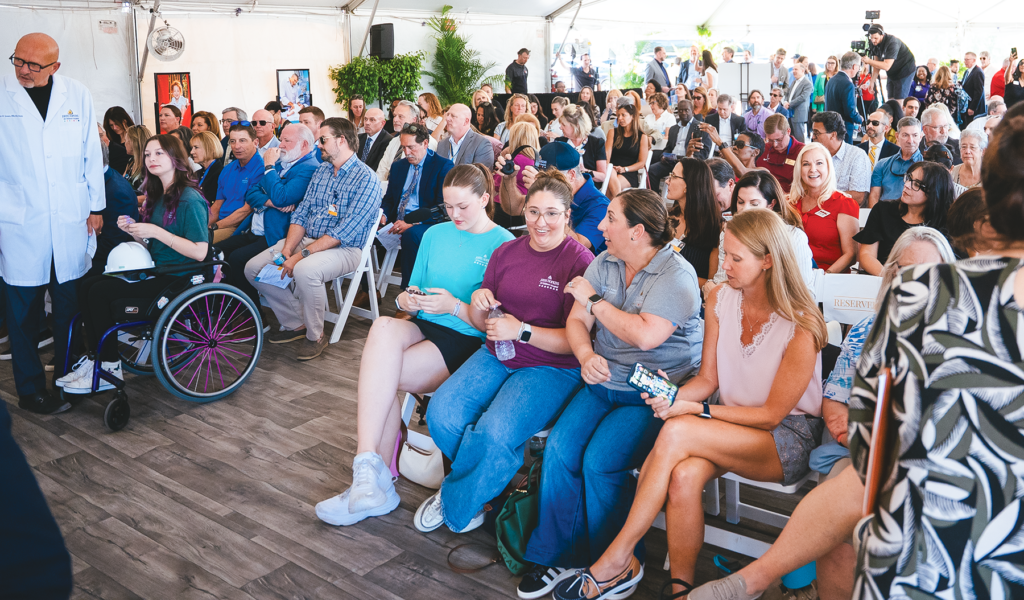
With maybe 200 people in attendance (photo left), hospital president K. Alicia Schulhof introduced many of the principals involved in the Johns Hopkins Health System and All Children’s Hospital, a few of whom (including Schulhof herself) brought along young people who had previously been treated at JHACH. It turned the groundbreaking from something that might have been “just another” ceremony into something that not only tugged at your heartstrings but also clearly demonstrated how wonderful and important having a world-class pediatric hospital in Wesley Chapel will be.
Adding to the joy you couldn’t help but feel that day was the fact that the brown dirt pile usually dug into at these events was replaced with seven piles of brightly colored sand (top photo on this page) to match the seven colors in the JHACH logo, with not only the hospital principals turning shovels full of the sand but also the kids themselves. It was electric!
Schulhof opened the event, accompanied by former JHACH patient Xavier and his younger brother Zander (photo below).
“Today, we are not just breaking ground for a new facility,” Schulhof said, “we are laying a foundation for a healthier future for our community, our patients and generations to come.”
Before she introduced Zander (with microphone), Schulhof said, “These brothers are quite familiar with our hospital and services, so we look to them and our other kids and families in our care so we can hear directly about their experiences and their children’s hospital.”
Young Zander spoke on behalf of his older brother. “I think it’s nice and great,” Zander said of JHACH. “I think [the new hospital] will help other children feel better…so they can go out and look into the actual future and…be able to love each other.” He added that, to him, the best thing about JHACH was, “How the nurses help kids feel better.”
Schulhof then thanked all of the dignitaries in attendance (including Dist. 2 Pasco County Commissioner Seth Weightman), as well as the members of the Wiregrass Ranch High orchestra, who provided the music for the event.
She also noted that Pasco County is among the fastest growing regions in the Tampa Bay area (as well as in the state and the nation) , with pediatric growth of 12% expected between 2023 and 2032, and that 93% of patients living in Pasco, Hernando and Citrus counties have to travel outside of their market for pediatric specialty care.
“That’s why we purchased this beautiful 112 acres we’re all sitting on, to build a 56-bed hospital with 16 rooms for emergency services and room to grow,” Schulhof said. “The complex will begin with four imaging rooms and four operating rooms and support services. The Wesley Chapel hospital will not only enhance our ability to deliver cutting-edge medicine and treatments, but also foster an environment where patients feel supported, cared for and respected.”
She then turned the mic over to Kevin Sowers, the president of the Johns Hopkins Health System and his special guest, Aubrey (photo below). In addition to Aubrey, Sowers brought with him, “Greetings from our 45,000 employees across the states of Maryland and Florida, and from Washington, D.C., and our colleagues ‘across the pond,’ too, where we also have relationships.”
Sowers also mentioned that the clinical care at JHACH is, “the intersection of where we bring education for the next generation of providers and the research that creates the foundation of what Johns Hopkins has been for more than 125 years that is about to come to your community.” (Note-JHACH was ranked as the #1 pediatric hospital in Florida by a 2024-25 U.S. News & World Report survey.)
He then introduced Aubrey, whom Schulhof said has been a JHACH patient since she was two years old. “I’m glad you’re going to become a nurse, but Aubrey also serves on our Teen Advisory Council, which has been actively engaged in the development of this facility.” He then asked Aubrey about the role she has played in that development.
“I’ve gotten to view some of the mock-ups of the rooms and make changes to some of the interiors and exteriors. For example, when you’re in the hospital, it can feel very isolating, so the Teen Council wanted places for the patients to be able to go outside, with a garden, flowers and things to do. We also got to add color-changing LED lights to all of the patient rooms….There also will be a sensory room, in one of the rooms downstairs.”
Sowers also noted that All Children’s joined Johns Hopkins in 2011 and the name was changed to JHACH in 2016. “And, during the 100th anniversary of Johns Hopkins in 2027, we will open the doors to your hospital in your community.”
Congratulations! We can’t wait ‘til you open!
For more information about Johns Hopkins All Children’s Hospital Wesley Chapel, visit HopkinsMedicine.org.