
New Signal Underway at Cypress Creek Rd. & County Line Rd.; Design Approved for Meadow Pointe Blvd.

By Joel Provenzano

Two key intersections are moving forward in Pasco County’s short-range efforts to improve traffic flow and safety, with one signal now under construction and another entering its design phase. 

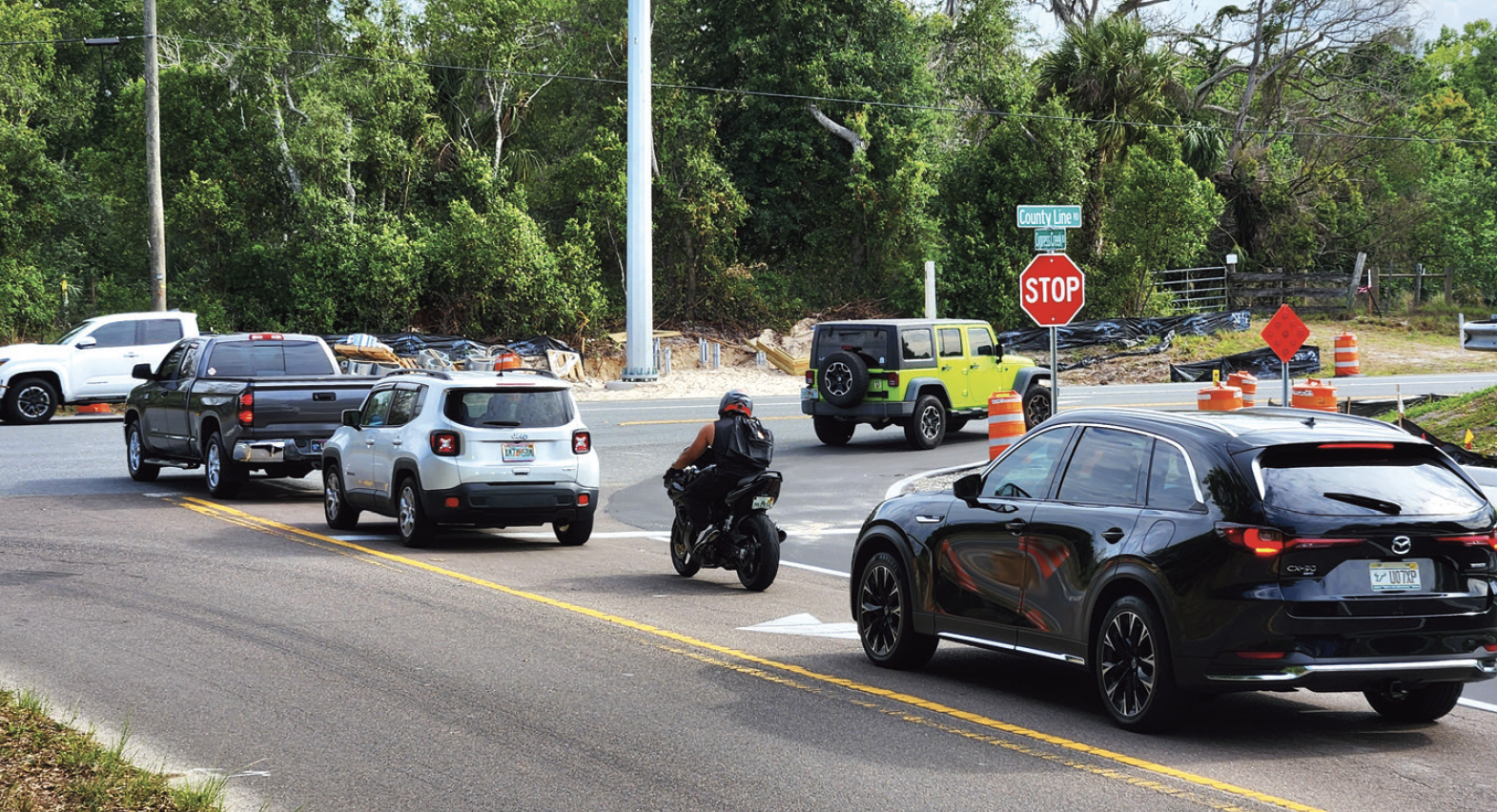
Cypress Creek Rd. & County Line Rd. (photo above): Signal Construction Begins

As previously reported in March, in connection with the Mater Academy signal project in front of Grand Hampton, Pasco County had placed the long-anticipated signal at the dangerous intersection of Cypress Creek Rd. and County Line Rd. in its 2026 work plan. Construction officially began in April. 

The start of work followed completion of a key roadway improvement: the southbound approach on Cypress Creek Rd. was widened to include a dedicated right-turn lane onto County Line Rd. Before formal improvements began, that approach had become an informal, dirt-and-pothole right turn path created by steady driver use. 

This intersection serves as an important connector between County Line Rd. and S.R. 54 (just west of where it becomes S.R. 56), supporting traffic from Oak Grove, Carpenter’s Run and the Lantower at Cypress Creek apartments. 

It is especially congested during peak hours, with drivers often struggling to find safe gaps in both directions of traffic before entering. 

According to the latest plans, the new signal will feature a single diagonal span wire mounted between two steel poles, and pedestrian crosswalks across both roadways. 

Once complete, it is expected to significantly improve both safety and traffic flow at this heavily used junction. 

The project is anticipated to be finished and operational by this summer. 

Meadow Pointe Blvd. & Country Point Blvd.: Signal Moves Into Design Phase 
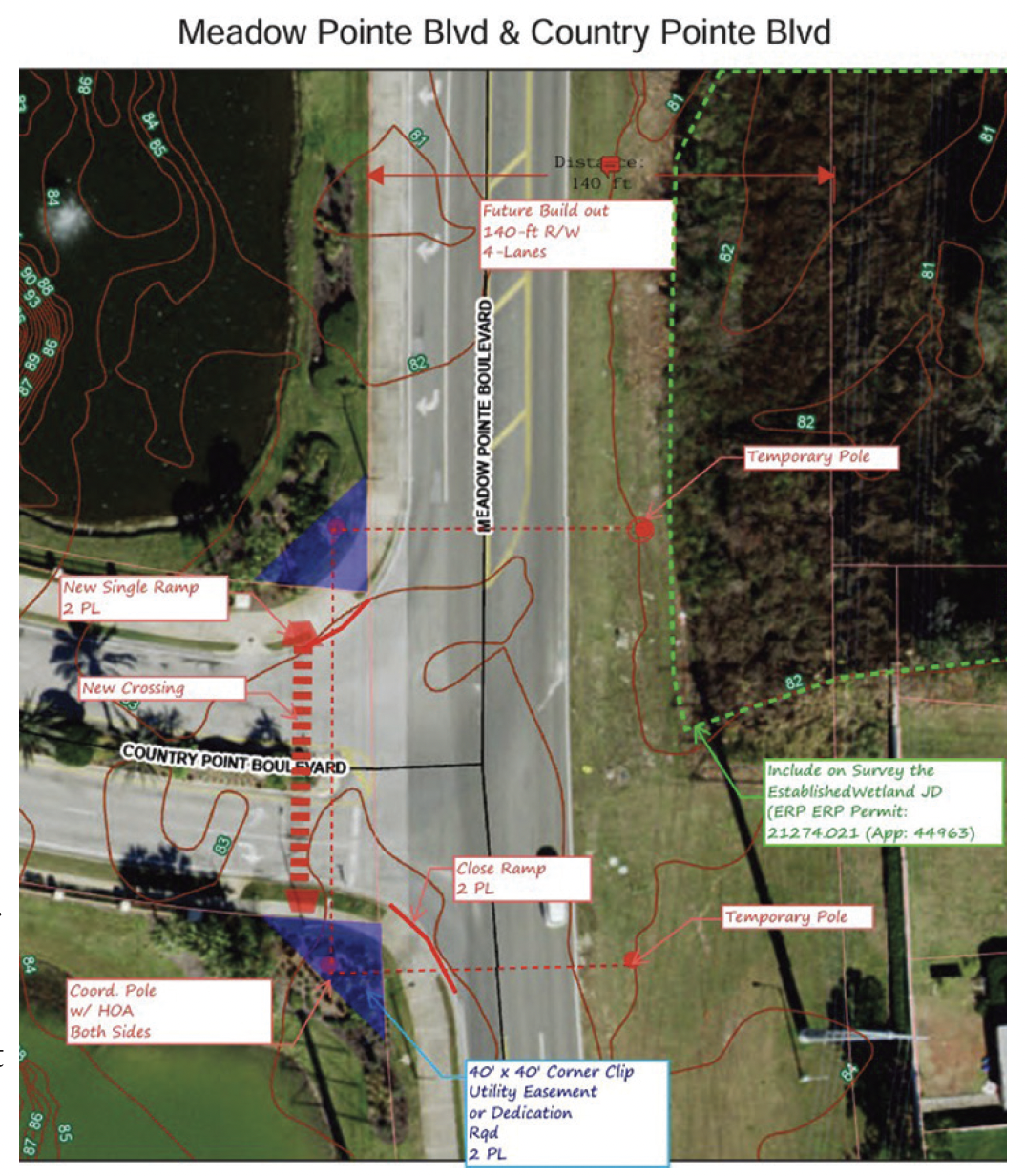
More than two decades after the Country Walk community first started taking shape, a traffic signal is finally moving forward at Meadow Pointe Blvd. and Country Point Blvd. (rendering, right). 

Pasco County officially approved the signal’s design funding during the March 24 Board of County Commissioners (BOC) meeting. 

This intersection serves as the only entrance and exit for the Country Walk community. 

Although the roadway currently includes dedicated left- and right-turn exit lanes, residents have long experienced challenging conditions, particularly during morning peak hours when outbound traffic competes with commuters heading toward S.R. 54 and nearby schools. 

The project was first formally shared with residents at the Country Walk CDD meeting in June 2025, where it was noted that the county also would make modifications to the median nose to accommodate an updated crosswalk location. 

At this time, construction is shown to take place sometime in the county’s 2027 adopted work plan. 

Both projects reflect continued efforts by Pasco County to address long-standing congestion points in the rapidly growing communities of Wesley Chapel and Lutz, although residents in Meadow Pointe and Country Walk will need to wait longer for relief compared with the soon-to-be-finished Cypress Creek improvements. 

Cheers & Jeers For Grand Hampton’s Main County Line Rd. Entrance Signal 

Grand Hampton residents hail the new traffic light as a much-needed safety improvement; while others complain about its timing. 

The map shows the new traffic signal at the main entrance to the Grand Hampton community on County Line Rd., the location of the Grand Hampton back gate & the existing traffic signals at Northwood Palms Blvd., Bruce B. Downs (BBD) Blvd., Imperial Oak (IO) Blvd. & Aronwood Blvd. (Google map modified by NN) 

Back in the spring of 2004, left and right turn lanes were constructed on County Line Rd, leading into the then-brand-new, 600-acre community of Grand Hampton. Even back then, news reports talked about the delays and “bothersome” lane closures along County Line Rd to accommodate these changes, and the “rapid growth” of the area was causing inconvenience for a few long-time locals. Sounds like some things never change, right? 

Well, some 20 years later, the residents of Grand Hampton (which today has a little more than 1,000 homes) got something new out front on County Line Rd. — a traffic signal. The signal was recently constructed, and then put into full operation on July 30. The county put it in “flash mode” for a week prior, and put up temporary electronic signs to alert motorists to the change in the traffic pattern. 

When the new signal became fully operational, some local residents on social media expressed their frustration with it — citing long initial backups. Others, especially people living in Grand Hampton, countered that they saw the new signal as a necessary safety improvement and defended the county’s decision to put one up at that location. 

Several local residents said that there have been serious crashes at that intersection over the years, and with the growing population in the new and existing communities along County Line Rd., including Woodside Trace and Belle Chase (see map), plus The Hammocks townhomes and the North Tampa Christian Academy and Creative Times Academy of Wesley Chapel, that risk would just continue to grow with an increasing number of cars passing the intersection everyday. 

A signal was first installed less than a mile down the street at Northwood Palms Blvd., at the entrance to the Northwood community (in early 2015), which helped in the interim, because when that signal turned green for the Northwood side street, it would create some gaps in the westbound traffic in front of Grand Hampton. 

That was important, because in order to find a gap to make a left turn out into traffic at the Grand Hampton Dr. entrance to the community, both the east and west approaches have to be clear at the same time, and that can be challenging and tricky for motorists to safely judge on a busy two-lane “rural” road. That’s why the engineering signal warrants for a two-lane undivided road are traditionally lower, than say for a four-lane divided road that might have a median opening cars can pull into, pause, and check if the other direction is clear is safely proceed. 

As more support businesses have been getting constructed to the west, including places like the Tampa Premium Outlets, Costco, Aldi, etc., residents began making more lefts out at Grand Hampton Dr. than they used to, gradually changing the traffic pattern over time, reducing the effectiveness of the “down stream” signal at Northwood Palms Dr. to provide relief. This also increased the through volumes on County Line Rd. 

Traffic does back up on County Line Rd. at the new Grand Hampton Signal. (Photo by Charmaine George)

In 2018, in an effort to try and help make it a little easier to get out of Grand Hampton, the county reduced the speed limit along the corridor from 55 miles per hour to 45 mph. This was around the same time that the North Tampa Christian Academy finished construction. 

But, even with those improvements, the corridor still retained its original high speed rural characteristic; as a two-lane undivided road with narrow lanes, no shoulders, no curb and gutter and, most critically, no sidewalks or bike lanes. Unfortunately, because the road still “felt” the same, speeds stayed on the higher side, and even though it’s been six years, some online commenters joked (at least we hope they were joking) that they didn’t even know the speed limit was ever reduced to 45 mph. 

Accordingly, those who live in Grand Hampton had been reaching out to Hillsborough County for years about adding a signal for themselves, due to growing and continual concerns. And in his June 10 town hall meeting at the New Tampa Performing Arts Center (as we reported in our June 25 New Tampa issue), County Commissioner Ken Hagan said he was pleased that he was able to get funding for that need and mentioned that construction (of the now active signal) would be completed at the end of June. 

Although County Line Rd. serves both Pasco County and Hillsborough, any issues or problems with the new signal can be reported to Hillsborough County, the entity that is responsible for monitoring and adjusting the signal’s timing and detection.