Wesley Chapel’s overall voter turnout for the Aug. 18 Primary Election (18.7%) was even lower than Pasco County’s overall 21.5%, so despite all of the anti-incumbent online chatter we read, our area did nothing to buck the county’s trend of unseating any Republican incumbents, at least not in the primaries. It remains to be seen if any of the incumbents moving forward to the General Election on Tuesday, November 3, will lose. Meanwhile, the District 1 & District 3 School Board races will both be decided in runoffs on November 3.
Please note that all of the State candidates listed below who won in both Wesley Chapel & in Pasco also won statewide — except that Darren McCauley received more votes in both Wesley Chapel and Pasco County for U.S. Senator than Kimberly Overman, who actually won the Democratic nomination statewide, where she will face incumbent Republican Ashley Moody. The results shown are just how Pasco voted countywide vs. how the voters in Wesley Chapel voted:
Voter Turnout:
Pasco County – 21.5%
Wesley Chapel – 18.7%
U.S. Senator – Republican – Wesley Chapel
Chris Gleason – 12.9%
Asley Moody – 80.4%
Neelam Taneja Perry – 1.9%
Ernest “Ernie” Rivera – 4.7%
U.S. Senator – Republican – Pasco County
Chris Gleason – 14.1%
Asley Moody – 80.2%
Neelam Taneja Perry – 1.6%
Ernest “Ernie” Rivera – 4.1%
U.S. Senator – Democrat – Wesley Chapel
Angie Nixon – 60.3%
Alex Vindman – 39.7%
U.S. Senator – Democrat – Pasco County
Angie Nixon – 53.7%
Alex Vindman – 46.3%
Representative In U.S. Congress, District 12 – Democrat – Wesley Chapel
Darren McAuley – 50.1%
Kimberly Overman – 49.9%
Representative In U.S. Congress, District 12 – Democrat – Pasco County
Double Branch & The Adjacent Abbey Crossings To Bring New Residential, Retail, Restaurants & More To Just North Of Wesley Chapel
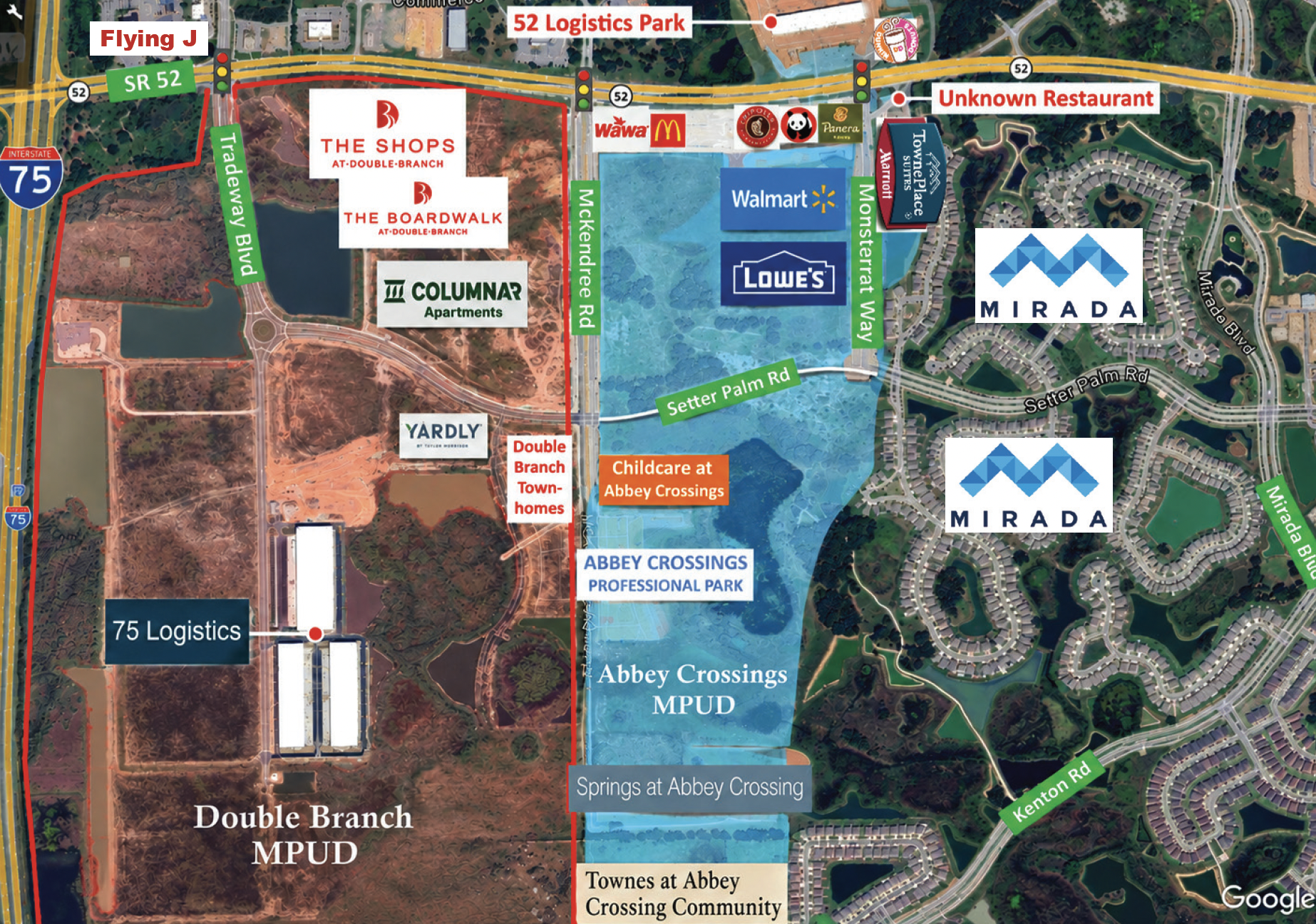
The map of the Double Branch & Abbey Crossings Master Planned Unit Developments. (Google map modified by Joel Provenzano)
The first shells of customer-facing businesses in two new “Connected City” developments are rising from the construction sand nearly a year after the completion of the first warehouses in Double Branch and Abbey Crossings — or what seemed like an eternity in this local development climate.
The Double Branch (and we’re not talking about the Double Branch Elementary most Wesley Chapel residents are familiar with; this is a completely different location with an entirely different purpose) and Abbey Crossings Master Planned Unit Developments (MPUDs) are beginning to really take shape.
These two separate, yet conjoined, MPUDs are sandwiched together along S.R. 52, in the space between I-75 and the massive Mirada housing development — immediately north of Wesley Chapel (see map).
The address for all of these new properties? Surprisingly, San Antonio, FL.
The northern boundary of Epperson marks the end of Wesley Chapel’s 33545 zip code, putting both of these developments in San Ann’s 33576 zip code, although both are actually located (as is Mirada) in unincorporated Pasco County, outside the tiny city limits of San Antonio, which covers only 1.2 sq. miles.
So while Double Branch (DB) and Abbey Crossings (AC) aren’t technically in Wesley Chapel, the information in this story is still helpful for readers who live along the northern edge of Wesley Chapel, where these two MPUDs — and their new dining, shopping, entertainment and employment options — will be closer to the residents of Epperson than many of the other areas of Wesley Chapel.
And if you’re like us, you’re probably just nosy about what’s being built nearby.
The Basics
Both of these large developments (roughly 1,300 acres combined) have been talked about for several years now as important mixed-use developments for Pasco County and the so-called “Connected City,” and will both feature restaurants, retail, offices, industrial, warehouses, residential, healthcare, medical and entertainment.
A good majority of the roads, intersections and roundabouts (at least for the initial phase) in both developments are pretty much done.
And, three newer traffic signals are now up along S.R. 52 to serve these developments — the first was installed off the corner of the longstanding Flying J truck stop at Tradeway Blvd. (formerly Pasco Rd., which is being realigned to go under I-75), the second is at McKendree Rd., and the third serves the new warehouses located to the north at Montserrat Way.
Double Branch: What’s Already Built?
– 75 Logistics (completed): These warehouse/industrial spaces were the first buildings to be completed in either development. Visible from I-75, the space is made up of three initial buildings: approximately 200,000 sq. ft., 155,000 sq. ft., and 125,000 sq. ft. All of the buildings still appear to sit unoccupied at the time of our writing, even though they were completed a year ago.
What’s Under Construction In DB?
– DB (for Double Branch) Townhomes (utilities in, foundations next): Currently, there’s still no official name, but it’s being referred to as the Pasco Town Center Lot E Rear Load Townhomes (w/ Amenity Center) in the permit.
The project consists of 174 townhome lots, an amenity center with a pool and cabana, and a portion of Double Branch Pkwy. This project is within the greater Pasco Town Center master planned community inside of Double Branch and is the first of what will be two townhome communities in that immediate area, the other being Yardly Double Branch (upcoming).
“Rear Load” means that the garages will be in the back of the units in alleyways, and some (but not all) of the units will have on-street parking in the front. The home builder is not known at this time.
What’s Coming Soon To DB?
– Yardly Double Branch (plans just submitted): This rental community will feature 140 multi-family residences on around 11 acres. For those unfamiliar with the “Yardly” concept, it’s Taylor Morrison’s rental development concept, where each unit (4 units to a building) has, you guessed it, a small fenced-in yard.
About half the units will have attached garages, but others will not. Standard parking spaces are provided throughout the community in front of each unit for guests and residents.
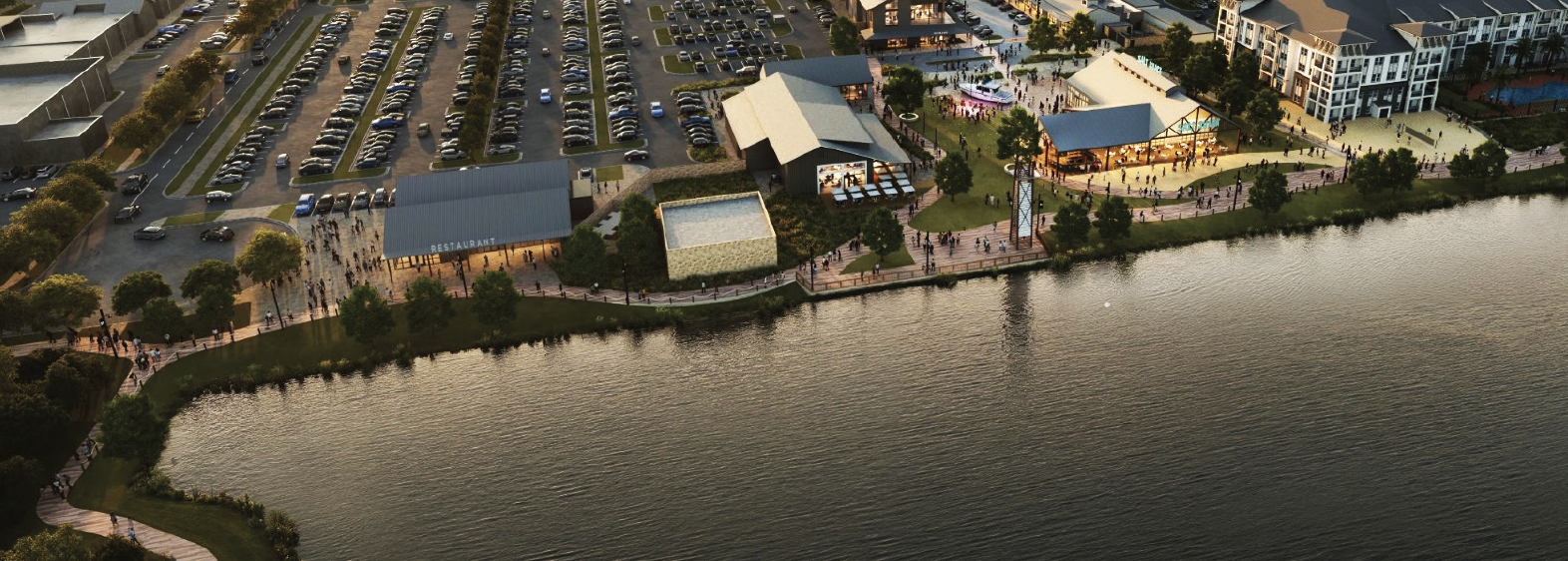
This rendering shows The Boardwalk at Double Branch wrapping around the lake. The Shops are on the far left & the Columnar Apartments are on the far right. (Source: SRS Real Estate Partners)
– The Shops & The Boardwalk (plans submitted): This is going to be Double Branch’s much-anticipated retail zone located against S.R. 52. The concept brings something that has really been lacking from the area to take advantage of our amazing sunsets — unobstructed west-facing water views from a restaurant. This plan brings not just one, but four potential (and still unnamed) restaurants waterside along a boardwalk looking west over a huge 12-acre lake.
Initial plans have been submitted for both The Shops and The Boardwalk; however, no specific tenants have yet been announced. In addition to restaurants, the plans also show build-out spaces for a 40,000 sq. ft. fitness center, 25,000 sq. ft. grocery store, 25,000 sq. ft. retailer, along with a host of smaller spaces and even entertainment venues.
– Columnar Apartments (plans submitted): Located immediately south of The Boardwalk shops area, this 300-unit apartment complex will continue the boardwalk along the shore of the lake, providing a scenic walking space for its residents and direct connectivity to the adjacent retail center.
Abbey Crossings: What’s Already Built?
– 52 Logistics Park (completed): This warehouse/industrial park is comprised of five buildings of different sizes that total roughly 500,000 sq. ft. The main entrance was aligned with Montserrat Way to the south to give this development direct access to the brand-new traffic signal.
These warehouses also have been sitting empty for months; however, plans were just submitted to the county in Aug. for interior build-outs, signaling that tenants are coming soon.
What’s Under Construction In AC?
– Panera Bread (exterior walls are up):
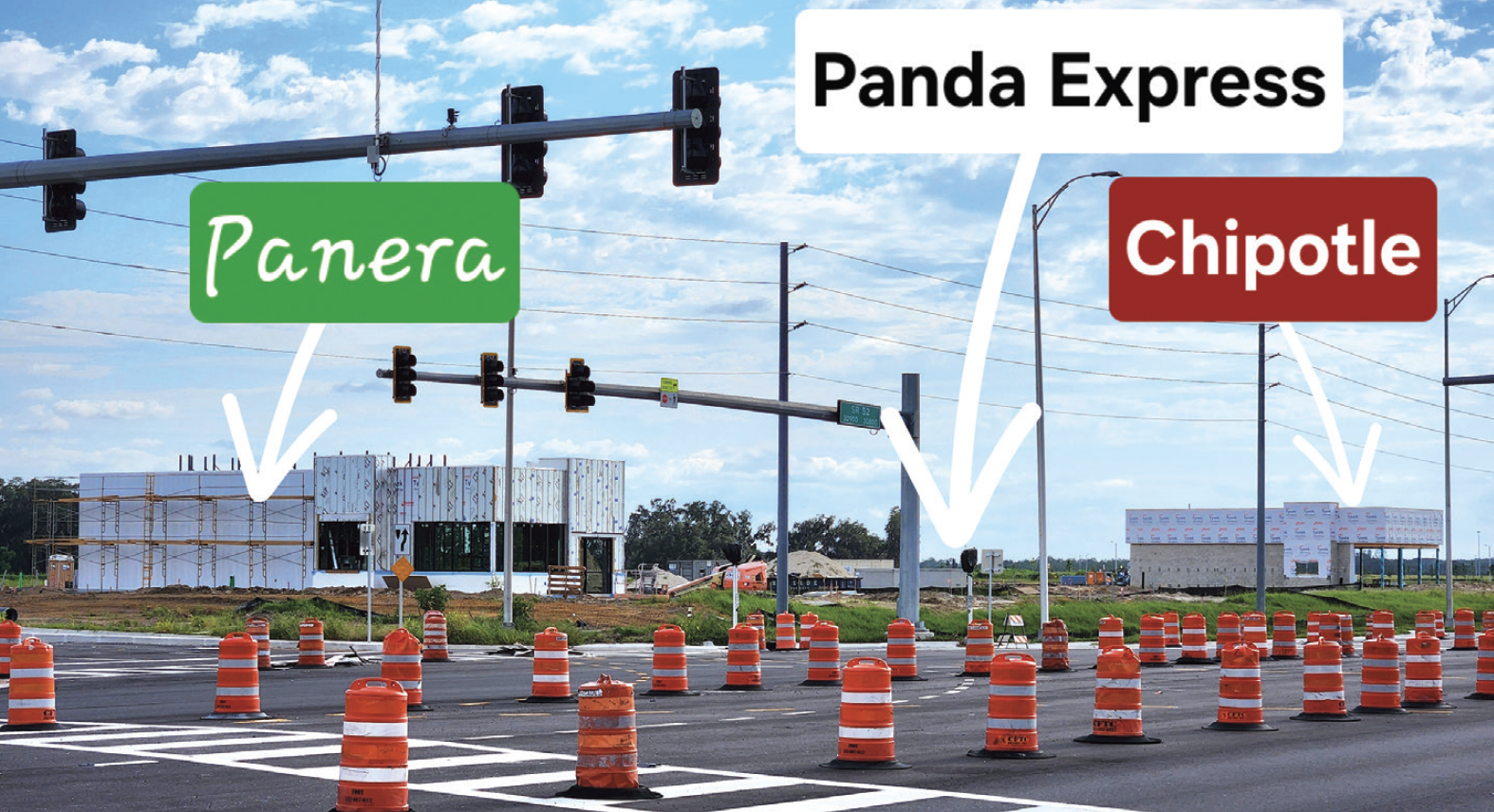
Panera, Panda Express & Chipotle are all under construction in Abbey Crossings. (Photo by Joel Provenzano)
This is being built on the SW corner of the signal with Montserrat Way. This familiar national chain will bring a free-standing store that will be smaller than what most customers are used to, at only 2,500 sq. ft., but it will have a drive-through. This is Panera’s shift to a more suburban-style prototype with smaller indoor dining areas.
– Chipotle (exterior walls are up): Further to the west along S.R. 52 will be another national favorite that also is a free-standing location that also will feature a drive-through window, which the company calls “Chipotlanes.”
These drive-through lanes work differently than most fast food restaurants because they’re digital-only. This means that you cannot roll up and order at a speaker board. Customers must place their order in advance using the Chipotle Mobile App or website. Because food is prepaid and pre-made, cars generally spend less than 30 seconds at the window.
Chipotlanes have become highly successful for the brand, and they expect 80% of all newly built locations to feature a drive-through.
– Dunkin’ Donuts (exterior walls are up): This free-standing store with a drive-through is going up at the NE corner of SR 52 and Montserrat Way, adjacent to the signal. The familiar favorite is being positioned so that residents can easily get their coffee on the way out to I-75.
– Abbey Crossings Professional Park (exterior walls are up): These are being advertised by Waterford Construction & Development as ‘Custom Free-standing Offices’ that will be both for sale and for lease. The park will be comprised of 23 free-standing, single-story office and medical/dental professional buildings. Individual office spaces are planned around 3,000-5,500 sq. ft. max per building, with the ability to divide.
What’s Coming Soon To AC?
– Wawa (plans submitted): Plans have been approved for a new Wawa to be built at the southeast corner of S.R. 52 and McKendree Rd., adjacent to the newer traffic signal. The gas station will feature 16 fueling positions and be one of the largest stores in the area at over 5,600 sq. ft., which will serve I-75 travelers well.
– McDonald’s (plans submitted): McDonald’s and Wawa will share a driveway onto S.R. 52. The McDonald’s also is anticipated to be a larger size than what most customers are used to at nearly 3,900 sq. ft. and will feature a long double-stack drive-through queue that can easily accommodate around 25 cars, something more commonly seen with a Chick-fil-A than with a McDonald’s.
– Panda Express (plans submitted): This American Chinese food favorite will be located directly between the Panera Bread and Chipotle. The stand-alone 2,700 sq. ft. building will feature double order boards and two queue lanes for the drive-through window, something we’ve never seen before at a Panda Express.
– Townplace Suites by Marriott & Restaurant (plans submitted): Suncoast Hotels LLC has submitted a site plan application package for the Abbey Hotel & Restaurant development, which is planned to be a Marriott by info found on the Suncoast Hotels website.
The project will be at the southeast corner of the signal with Montserrat Way, and consists of the construction of a 63,284-sq.-ft. hotel and a 10,000-sq.-ft. restaurant (no name announced yet) on a 5.7 acre parcel.
– Walmart (plans submitted): A new Walmart is planned in Abbey Crossings just south of the new signal, directly behind where the new Panera Bread and Chipotle are being built.
For those who are having déjà vu and remember our recent article about another new Walmart planned to be built in Wesley Chapel, this one will be considerably farther away — 15 miles from the one at S.R. 56 & Morris Bridge Rd., and 9 miles from the existing store at C.R. 54 & Wiregrass Ranch Blvd.
In our article about that Wesley Chapel Walmart, we mentioned that the retailer likes to space its stores approx. 8-9 miles apart in populated areas, so this new store continues that trend to the north.
– Lowe’s (plans submitted): Just south and immediately adjacent to Walmart, along Montserrat Way, is a proposed Lowe’s home improvement store.
What’s odd here is that San Antonio is going to be getting a Lowe’s before Wesley Chapel does. Those who follow our development news may remember that both of the previously proposed Wesley Chapel Lowe’s locations — one at C.R. 54 & Curley Rd. and the other at S.R. 56 & Morris Bridge Rd. (where the new Walmart is going), were withdrawn.
– Childcare at Abbey Crossings (plans just submitted): Being done by Momentum Childcare LLC, this 12,000-sq.-ft. facility is planned to be constructed on the east side of McKendree Rd., just south of Setter Palm Rd. The site will feature considerable outdoor fenced space consisting of two playgrounds, an outdoor theater, a garden and an outdoor classroom.
– Springs at Abbey Crossing (plans submitted): Located fairly far south down McKendree on the east side, this proposed 20-acre apartment complex will consist of 330 units and will feature a few more amenities than normally seen in an apartment complex, including a pool, pet playground area, pickleball court, cornhole court, bocce ball area, fire pit and hammocks to just lay under the sun or stars.
– Townes at Abbey Crossing (platting complete): Located immediately south of the Springs at Abbey Crossings apartments, on the east side of McKendree Rd., the Townes will consist of 150 townhomes, with Lennar Homes as the builder.
What’s No Longer Coming To AC?
– Del Taco (withdrawn): Del Taco was previously proposed and announced on the northwest corner of the Montserrat signal across from the Dunkin’ Donuts. Plans were submitted exactly a year ago but were withdrawn by the developer last December, unfortunately canceling the project.
Del Taco doesn’t currently have a presence in Tampa Bay, with the closest location being in Spring Hill. Customers describe Del Taco as a fresher alternative to Taco Bell. A recent review of Pasco permits does not show any other proposed locations at this time, so we’ll have to wait and see if Del Taco decides to add a store somewhere else.
Like many of you, I have been waiting to see what restaurant was going to replace the former Rice N’ Beans Express located at 24726 S.R. 54 in Lutz for some time.
Well, the wait is over, as owner Kumaravel (he goes by Kumar) Chinnthambi opened his second location of Bhimavaram Ruchulu (BR) Indian Cuisine in late July at that location and photographer Charmaine George and I have found it be excellent, following our first visit.
Kumar, who is from the southern part of India, opened his original location of BR at 10938 N. 56th St. in Temple Terrace more than a year ago, and has now brought his sizable menu of (mostly) southern Indian cuisine to a beautifully redecorated restaurant closer to Wesley Chapel.
Charmaine and I started our meal with two appetizers, the very spicy (Kumar admits that most of his food is on the spicier side, which pretty much what South Indian cuisine is mostly known for ) Gobi 65 (Hyd, or Hyderabad style) fried cauliflower (left), and the only semi-spicy (but also semi-sweet) Chicken Manchurian (top photo), which is coated in a thick, ginger-garlic soy gravy that we agreed was truly delicious. The chicken stayed nice and crisp, too.
We followed that up with the dish we both agreed was our favorite of the day, the creamy and delicious Paneer (Indian cheese) Tikka Masala (right), which had only a hint of spice. We also tried both the Chili Garlic (bottom photo) and Garlic Naan bread and we agreed that we preferred the only medium-spicy Chili Garlic version, especially dipped in the tomato-rich Tikka Masala sauce.
And, of course, we had to try the not-overly-spicy BR Special Boneless Chicken Biryani (below right), which has most of the tasty shreds of chicken hidden near the bottom of the bowl.
We didn’t try any of BR’s Tandoor oven specialties (like the Tandoor whole white fish; left), but Kumar says BR Indian Cuisines is known for its freshly ground authentic South Indian spices and traditional recipes. “We proudly prepare a wide variety of authentic vegetarian and non-vegetarian South Indian dishes using fresh ingredients and time-honored cooking techniques. We also specialize in catering for large parties, family gatherings, corporate events, weddings and other special occasions”
All I can tell you is that the food is delicious, the place is really pretty inside and we will be back! For more info about Bhimavaram Ruchulu in Lutz, call (813) 388-5972. For the Temple Terrace BR, call (813) 280-9698. Or, visit BRIndianCuisines.com. — GN; all photos (except the whole fish) by Charmaine George
Hilton Garden Inn Celebrates ‘Christmas In July’ With Food, Santa & Fun!
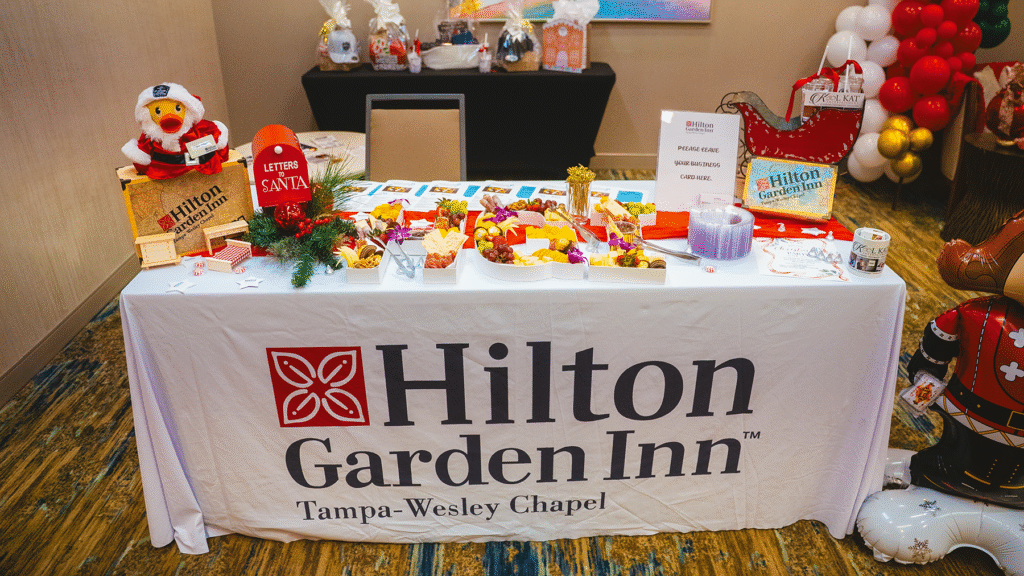
Congratulations to Lisa Moore (to Santa’s left), Bradley Sandler and everyone at the Hilton Garden Inn Tampa-Wesley Chapel (26640 Silver Maple Pkwy., off S.R. 56), for hosting a super-successful (and FREE!) “Christmas in July” event.
“The whole idea was to let the community know that we have great rooms where we can host your next business or family holiday party,” Moore said during the event, “and a large catering menu with a wide selection of delicious food that we make in-house and everything else you need to make your party special.”
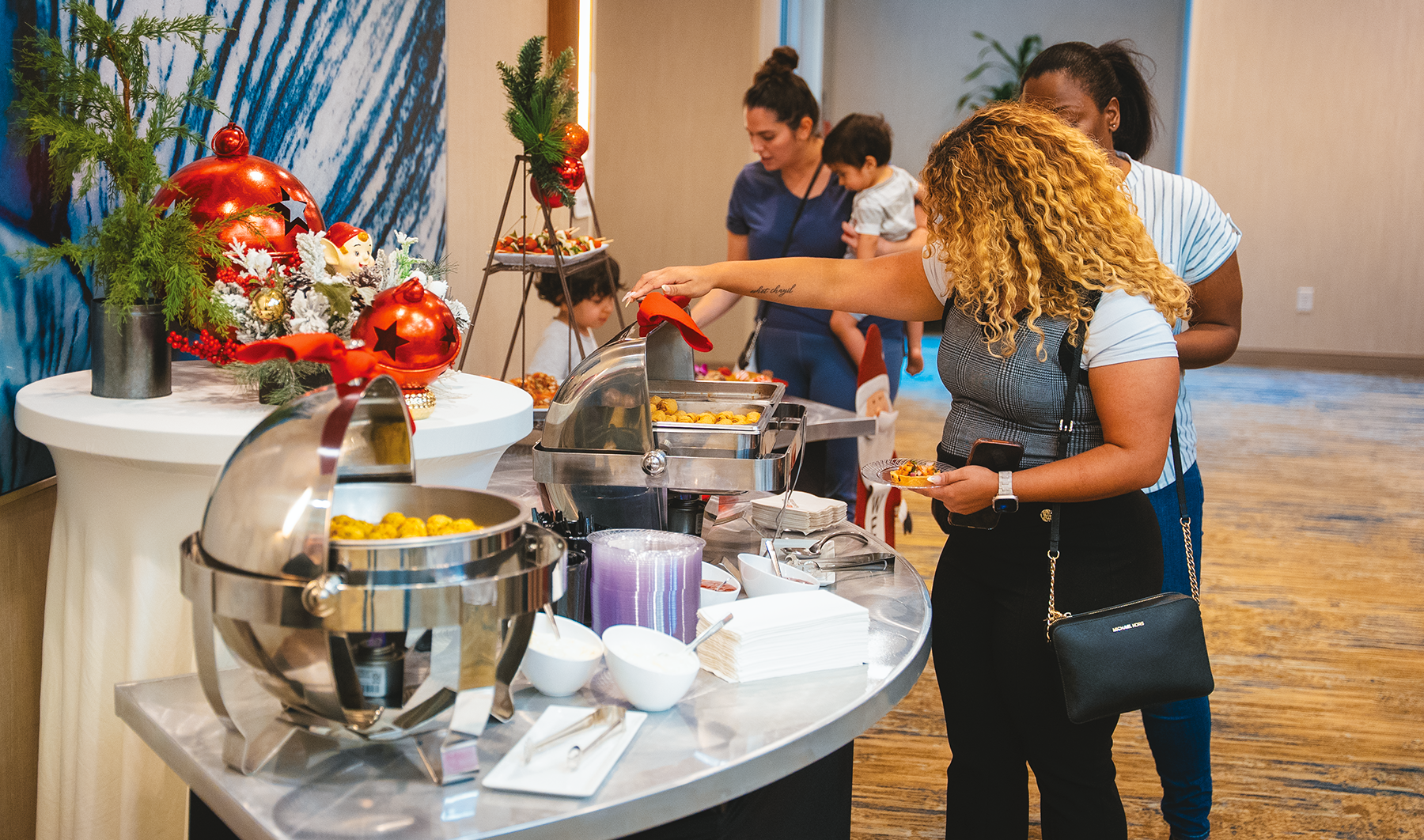
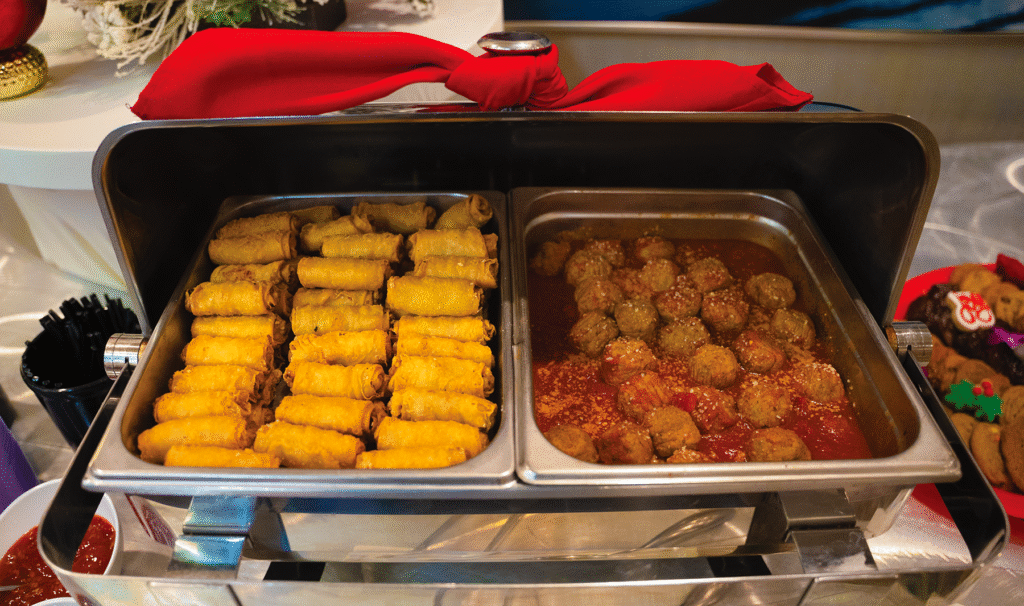
The Christmas in July event had Santa Claus himself, DJ music, a premium liquor bar, lots of great raffles prizes, a charcuterie table (below), fresh fruit and hot appetizers like mini egg rolls and crab cakes, meatballs and more.
To book your next party, call Moore at (813) 591-6930 or email her at lisamoore2@ hilton.com. Or, call Sandler at (813) 591-6907 or email him at bradley.sandler@hilton.com. — GN, all photos by Charmaine George
Hyatt Place Hotel Also Gets Into The Christmas Spirit With Its ‘Jingle Mingle’
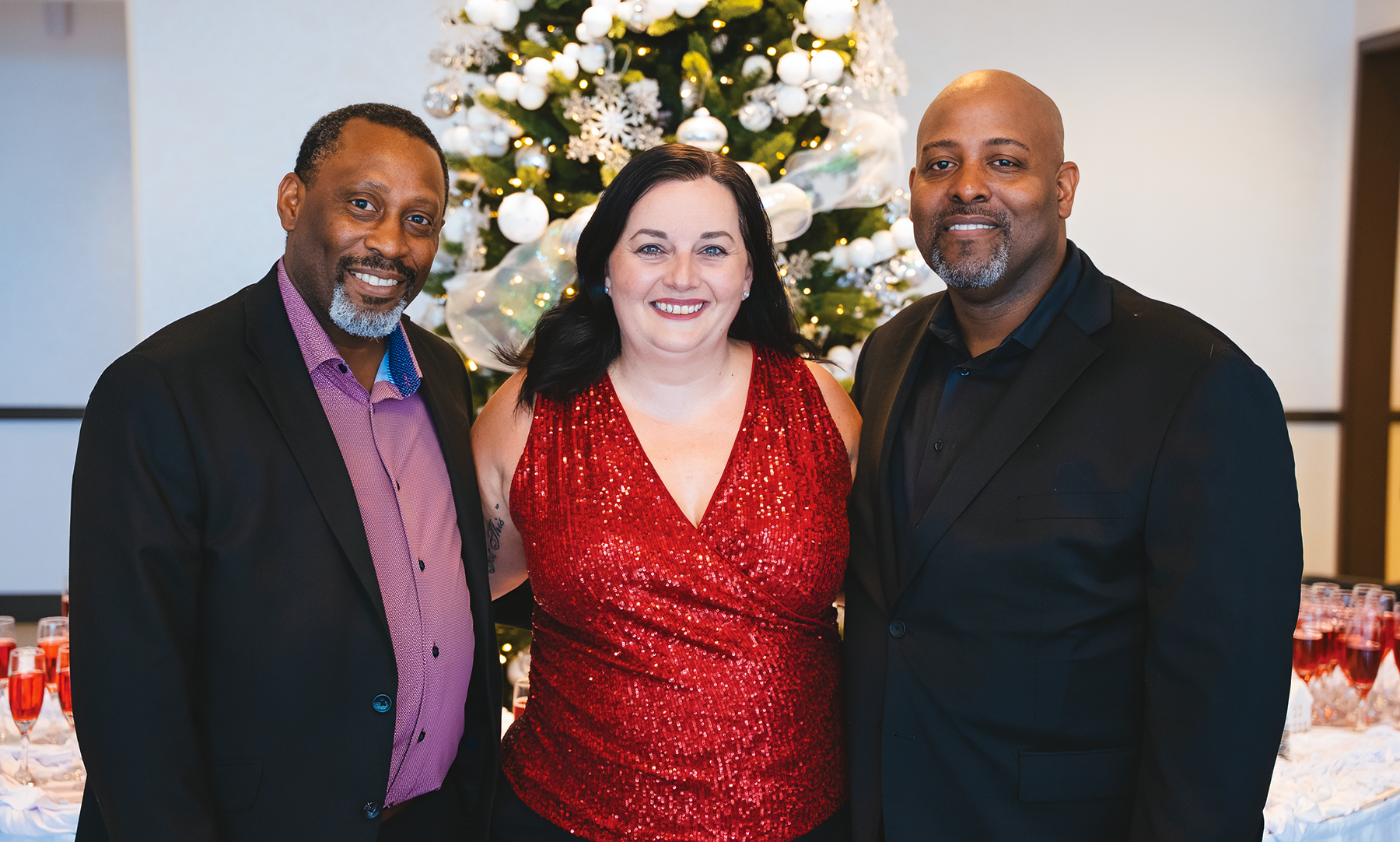
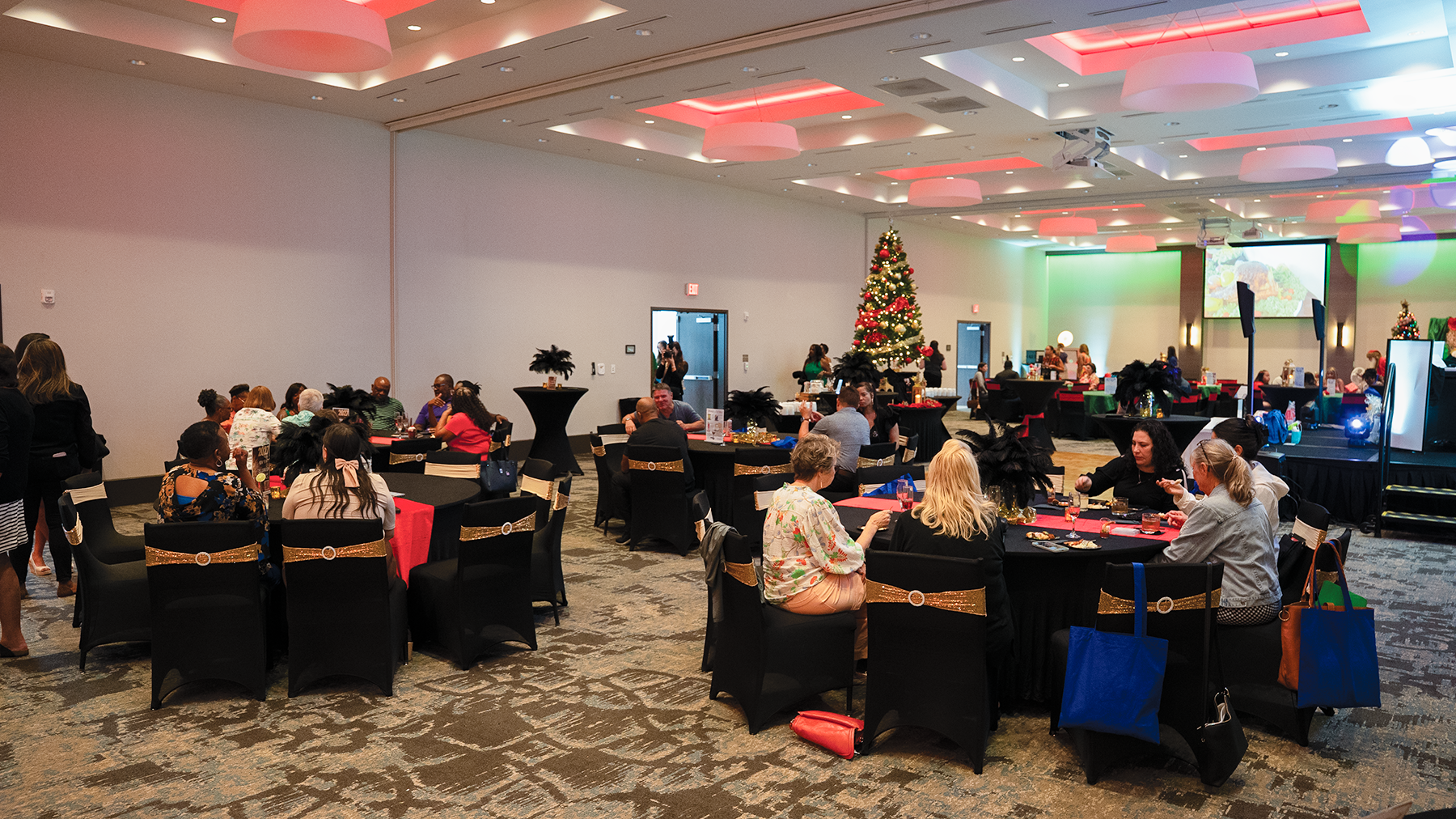
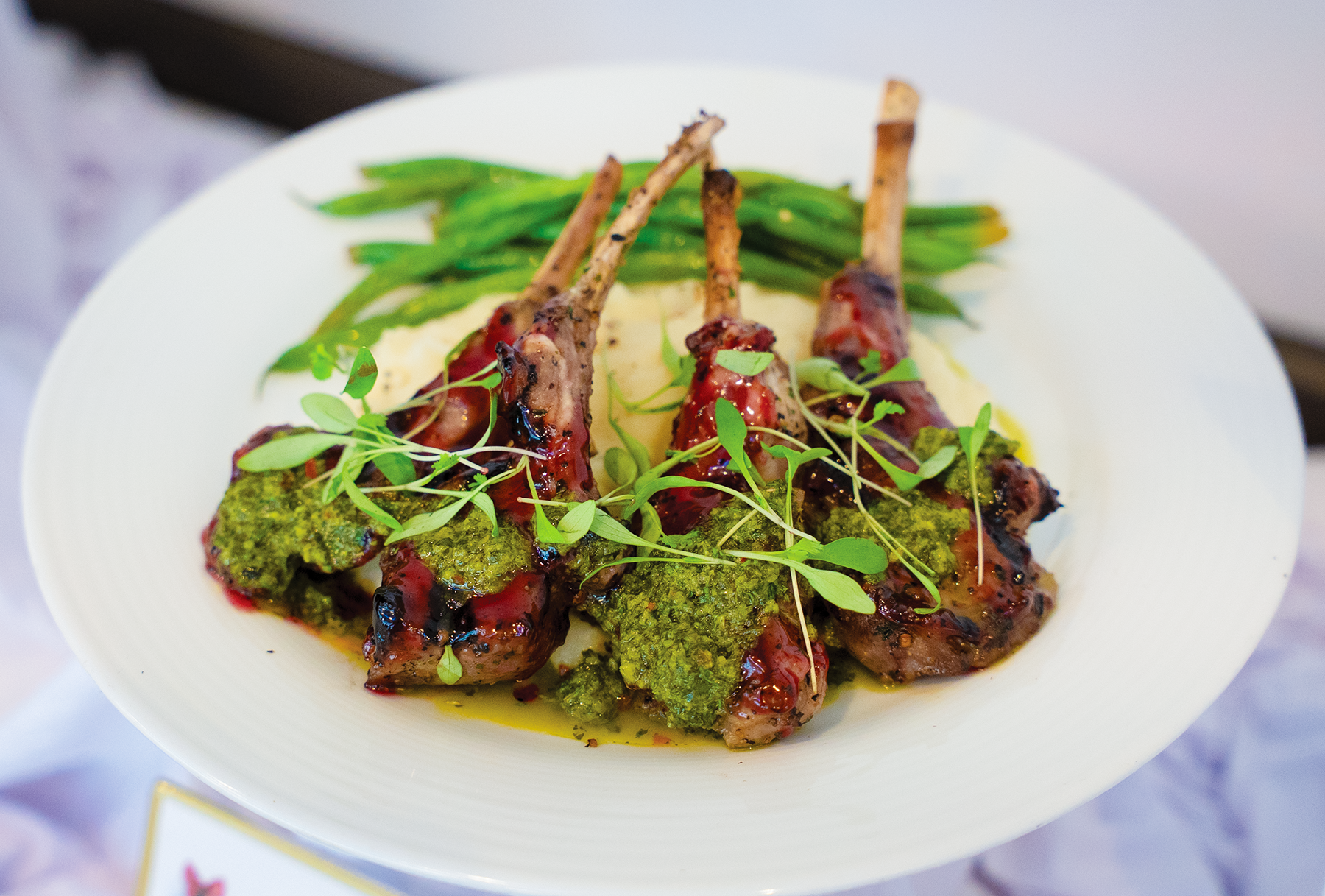
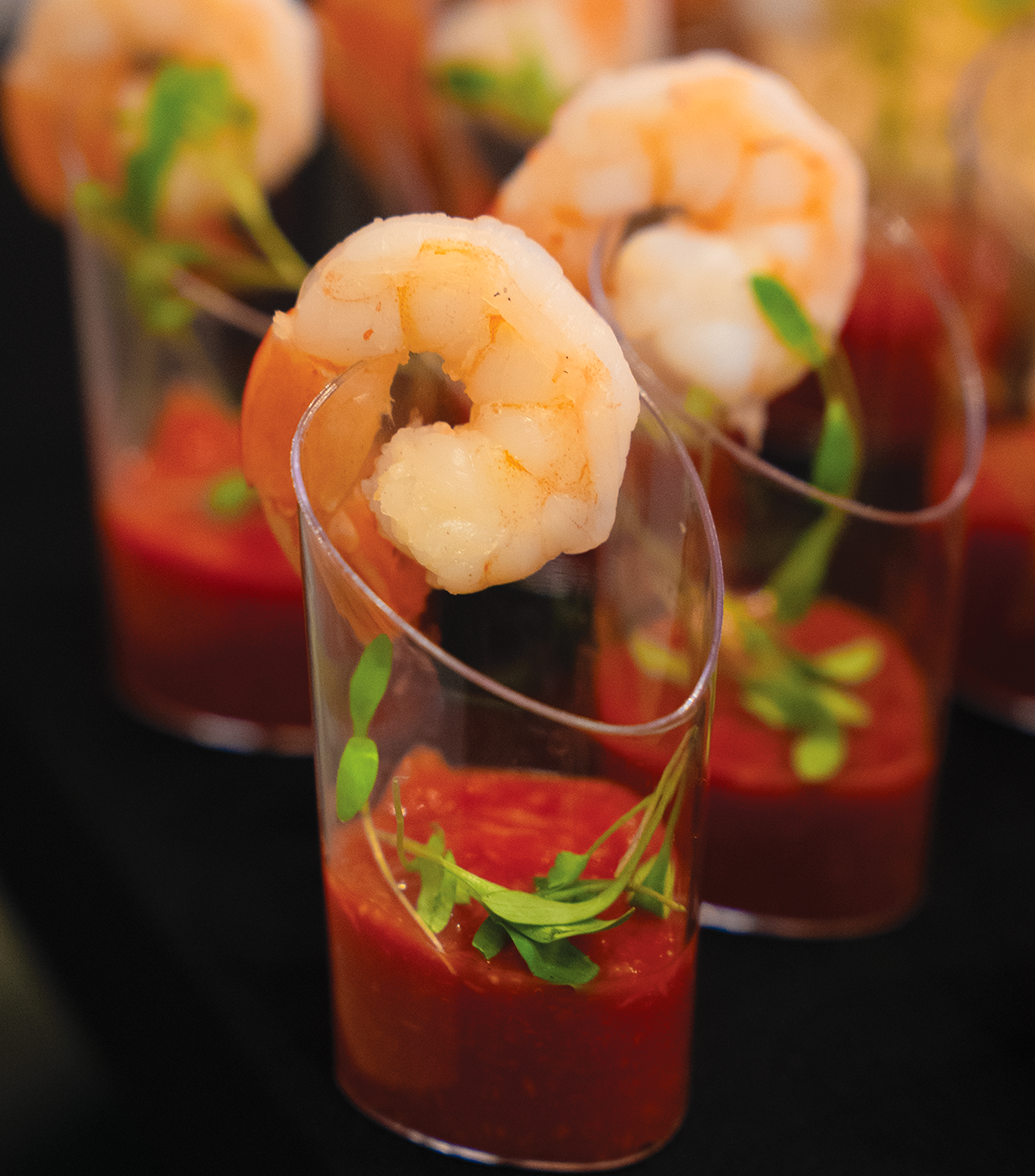
We also give kudos to (l.-r. in photo right) assistant GM Brian Jackman, director of sales Lorna Petchey and GM Gerald Mandosia of the Hyatt Place Hotel Tampa-Wesley Chapel (26000 Sierra Center Blvd., Lutz) for its impressive (also FREE) “Jingle Mingle,” which featured amazing samples of foods you can get from the hotel’s in-house catering department — like pomegranate-glazed, mint chimichurri lamb chops (below right), extra large shrimp cocktail (bottom right), mini-beef Wellingtons and mini-crab cakes, a S’mores station — plus holiday-themed cocktails (The Grinch, Mrs. Claus Punch & more), a DJ and both Santa and Mrs. Claus (above) in the hotel’s beautiful Sierra Conference Center ballroom that you can — and should — reserve for your upcoming holiday party.
For more info, call Lorna Petchey at (813) 803-5600. — GN
If you like both Mediterranean cuisine and crafting your own Chipotle-style bowls and wraps, you now have two options in the Wesley Chapel area. We told you online a few weeks ago that the first of two Wesley Chapel-area CAVA locations had opened in the former location of MOD Pizza on the south side of S.R. 56, but the new Hummus Republic also is now open at 26962 Halter Loop (off Wesley Chapel Blvd.), in the still-developing The Hub at Lexington plaza.
The Neighborhood News crew has now sampled nearly the entire menu at Hummus Republic, a California-based company founded in 2012 by Nir Giat which features tasty bowls, pita and wrap sandwiches, spicy crispy chicken and veggie “burgers” and more. There literally are so many base, protein, veggie and topping options that you never have to have the same meal twice!
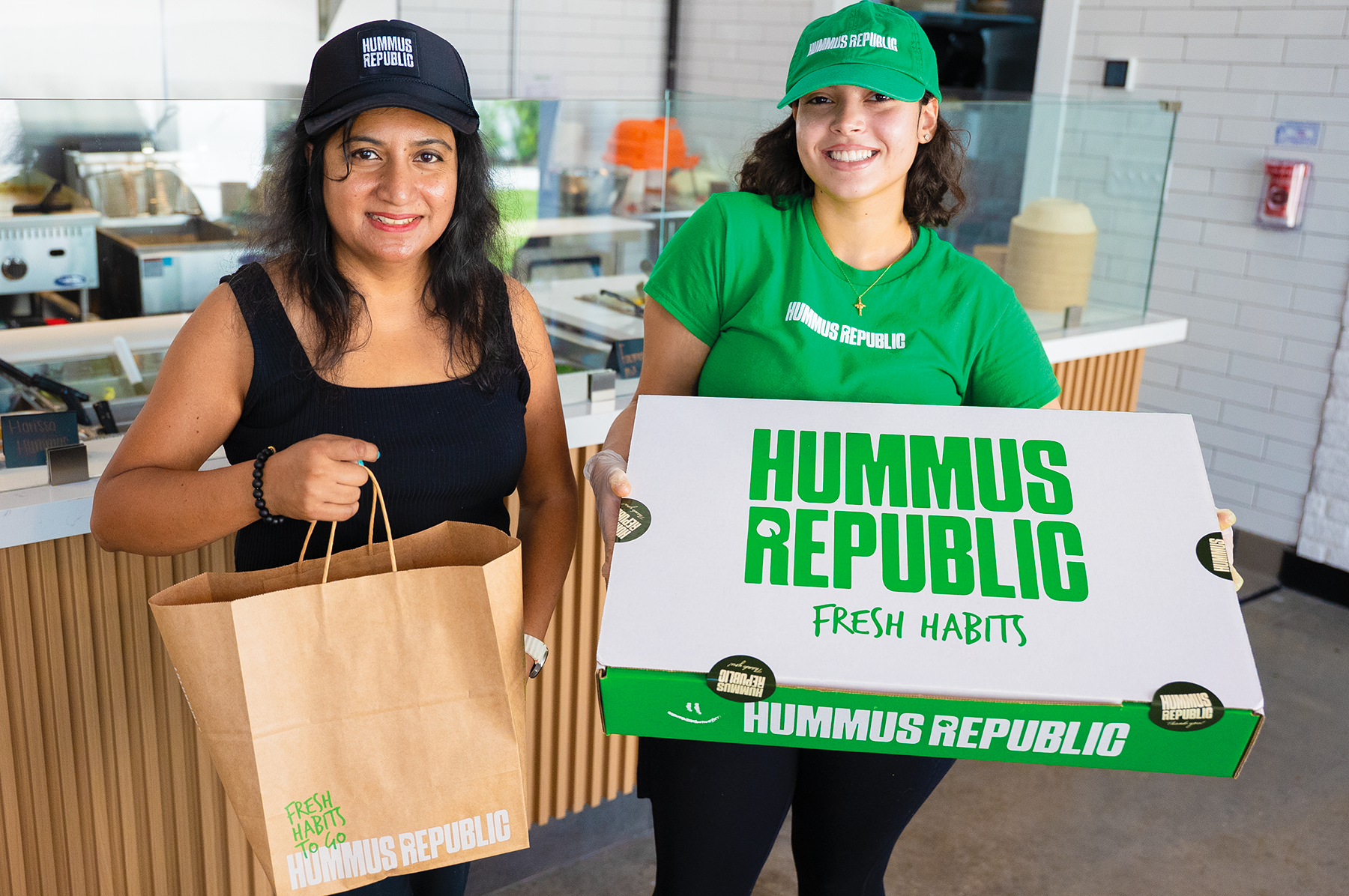
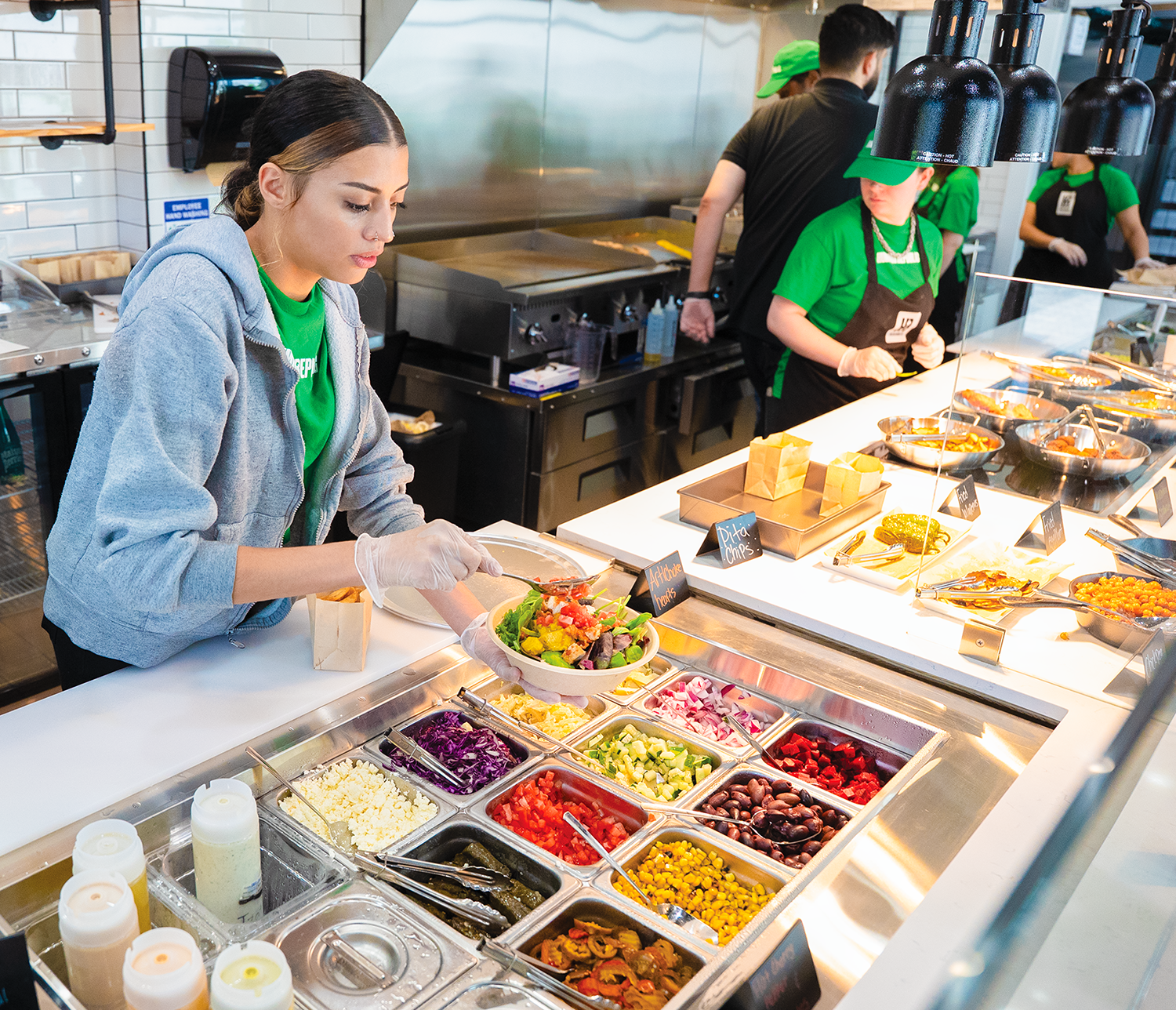
Owners Annu (at left in top photo, with shift lead Milaika Perez) and her husband Ashish (Ash) Kumar opened their Hummus Republic franchise (now one of 50+ locations in 17 states) on July 20 and Jannah, photographer Charmaine George and I have already dined there three times.
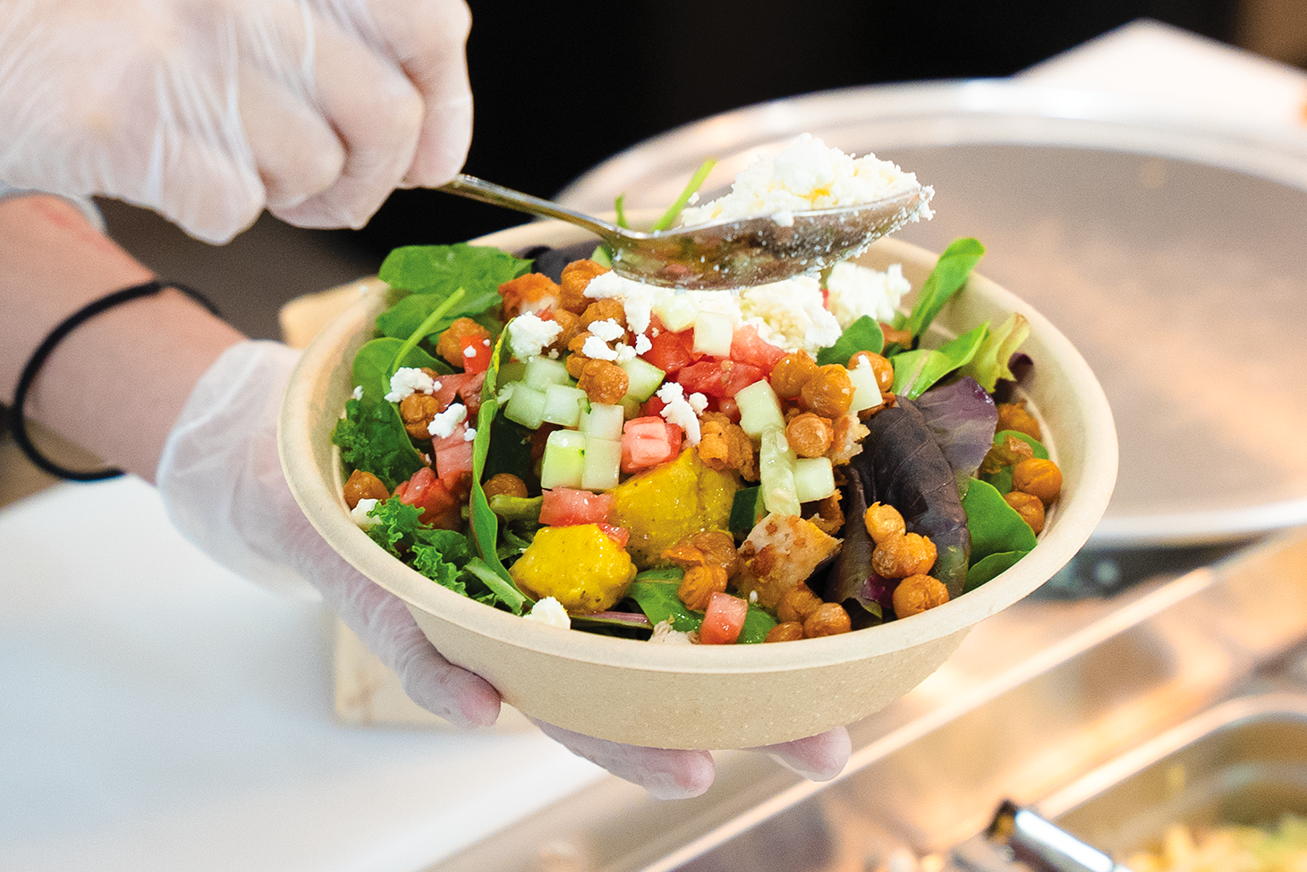
Jannah’s favorites are the bowls (right). She has gotten a mix of the available bases both times, including kale, spinach and a “Farmers Mix” of different leafy veggies. You also can choose Mediterranean couscous, warm garbanzo beans (aka chick peas) and my favorite base, tasty yellow rice, to start off any bowl or sandwich.
Jannah also has tried both the lemon chicken and crispy chicken for her bowls, although you also can choose chicken shawarma or beef & lamb gyro meat, falafel (ground, fried spiced chickpeas), shitake mushroom shawarma or a “Street Mix” of fried onions, olives and jalapeños as your protein. You can choose up to two of these proteins for your bowl, pita or wrap, but I suggest getting one at a time because the portions of proteins aren’t particularly large.
You can even add up to three different types of hummus and other spreads and I will say that I have enjoyed the traditional and roasted eggplant hummus options the most, but there’s also harissa (which adds fiery and smoky chili paste to the traditional blend of mashed chickpeas, tahini, garlic, lemon juice and olive oil) and Kalamata olive hummus and a “Zesty Feta” spread that Annu says has been most of her early customers’ favorite, even though it costs $1.25 extra to add it to your creation.
There are 16 available toppings and you can add an unlimited number of them. These include chopped tomatoes, cucumbers and red onion toppings, as well as red or white cabbage, beets, corn, hot cherry peppers, artichoke hearts, fried eggplant, fried jalapeños and Jannah’s favorites — the crumbled feta and unique chickpea croutons. (Note-Some of these do come with a $0.50 upcharge). You also can add a side of two dolmades (grape leaves stuffed with rice, herbs & spices) for $1 more.
There also are six different dressings and you can add any two of them without an upcharge. My favorites so far are the creamy tzatziki and garlic jalapeño tahini, but there also are two different hot sauces, plus traditional tahini and a lemon & olive oil sauce.
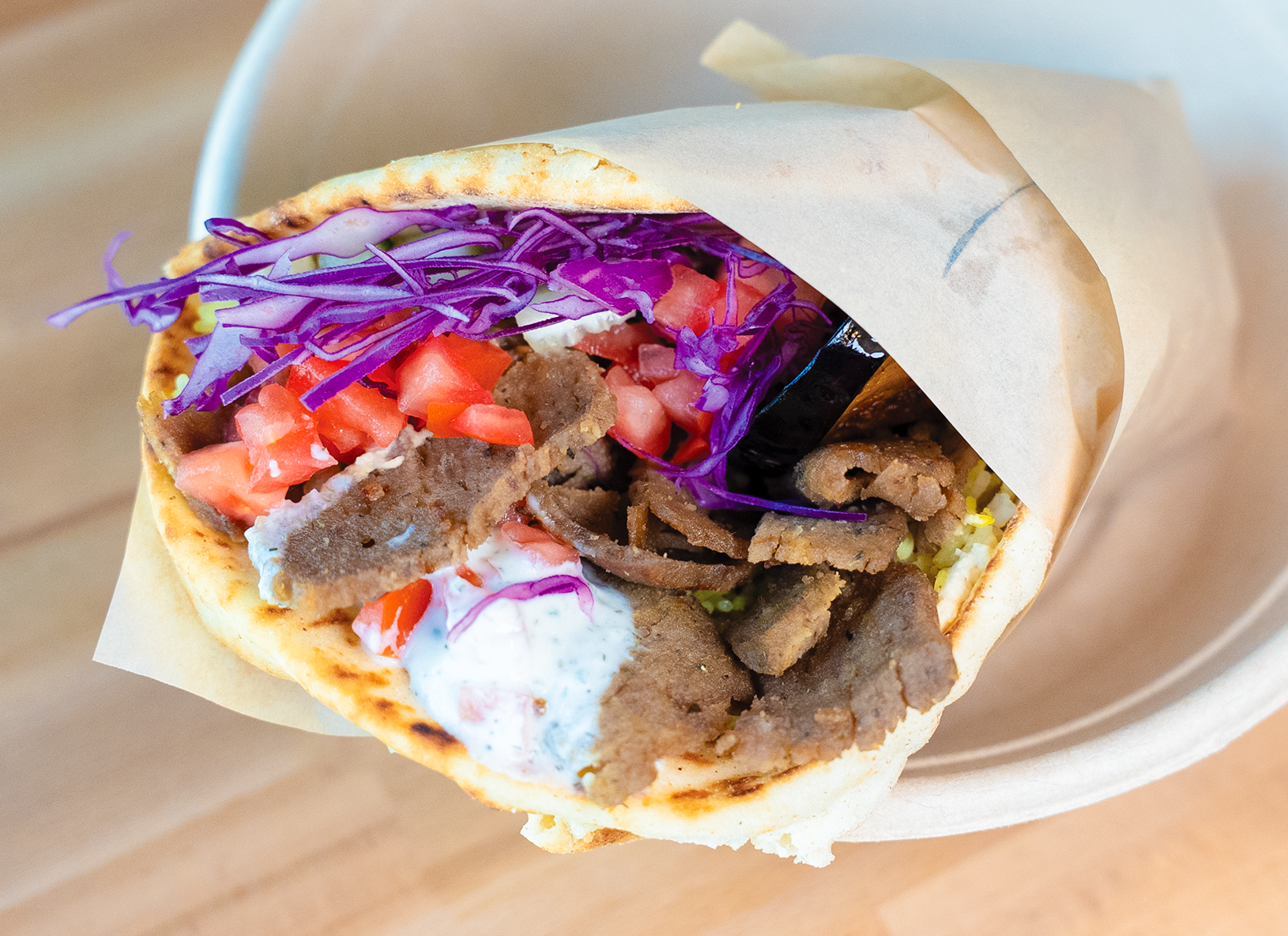
I have tried both a pita (above right) and a wrap and I am definitely partial to the beef & lamb gyro meat, although I did also enjoy the delicately spiced chicken shawarma.
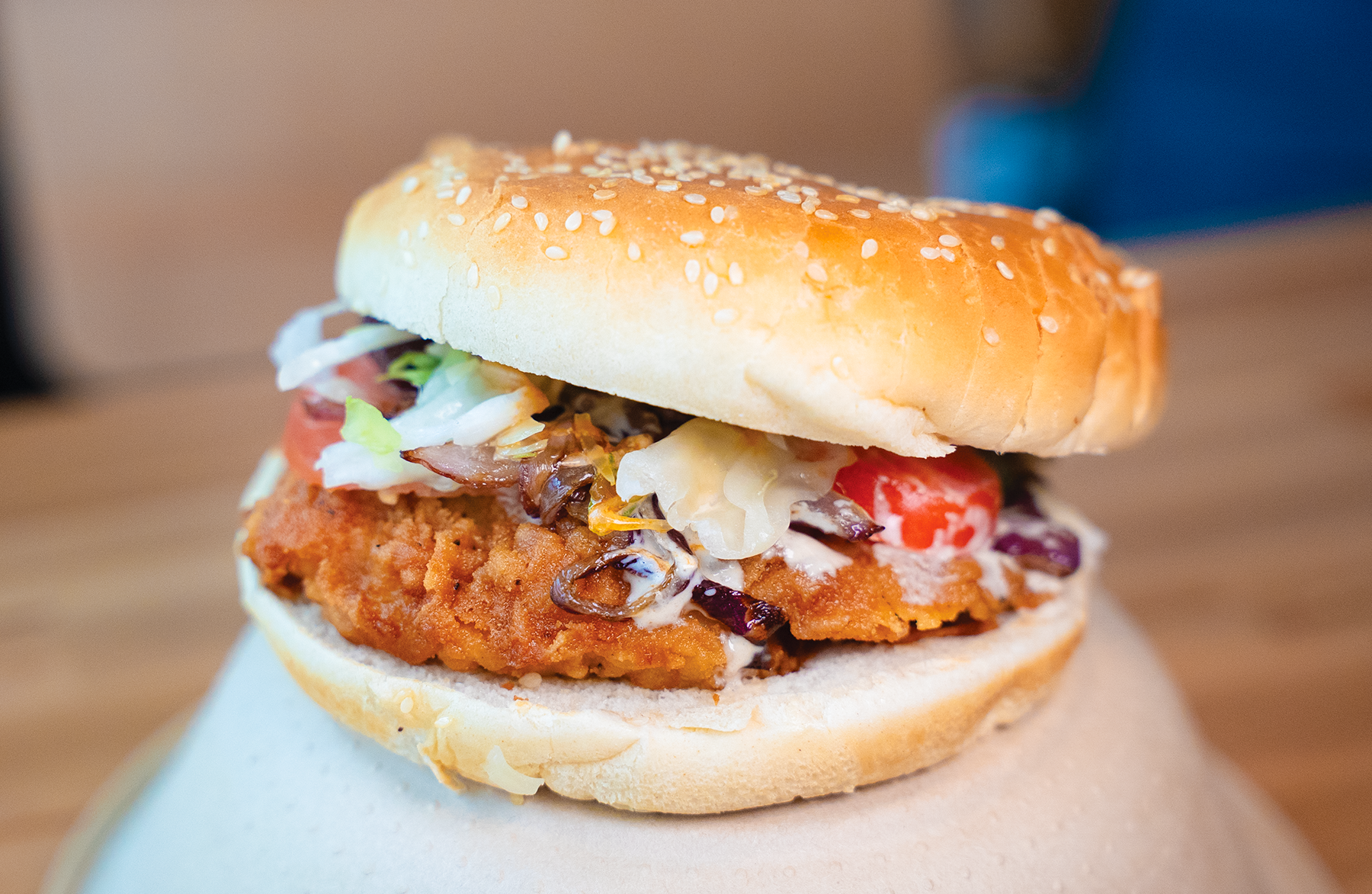
Charmaine’s favorite so far has been the chicken burger (left), which comes with sliced tomatoes, white cabbage, Street Mix, tahini and Moroccan hot sauce. There’s also a Greek (beef & lamb gyro) sandwich and the “Earth Burger,” which is made with a crispy falafel patty. All of these sandwiches are served with your choice of waffle-style sweet potato fries or Jannah’s favorite — the pita chips.
Hummus Republic also has specials like pita nachos, pita chips & hummus and “street style” sweet potato fries, as well as a side of up to five hummuses and spreads. Beverages include a chocolatey tahini shake blended with vanilla ice cream and almond milk, plus a variety of lemonade flavors, including pomegranate, ginger turmeric and strawberry lychee and more.
To place an order or for more info, visit TheHummusRepublic.com or call (813) 388- 2998 and please tell Annu and her friendly crew that Gary from the Neighborhood News sent you! — GN, all photos by Charmaine George