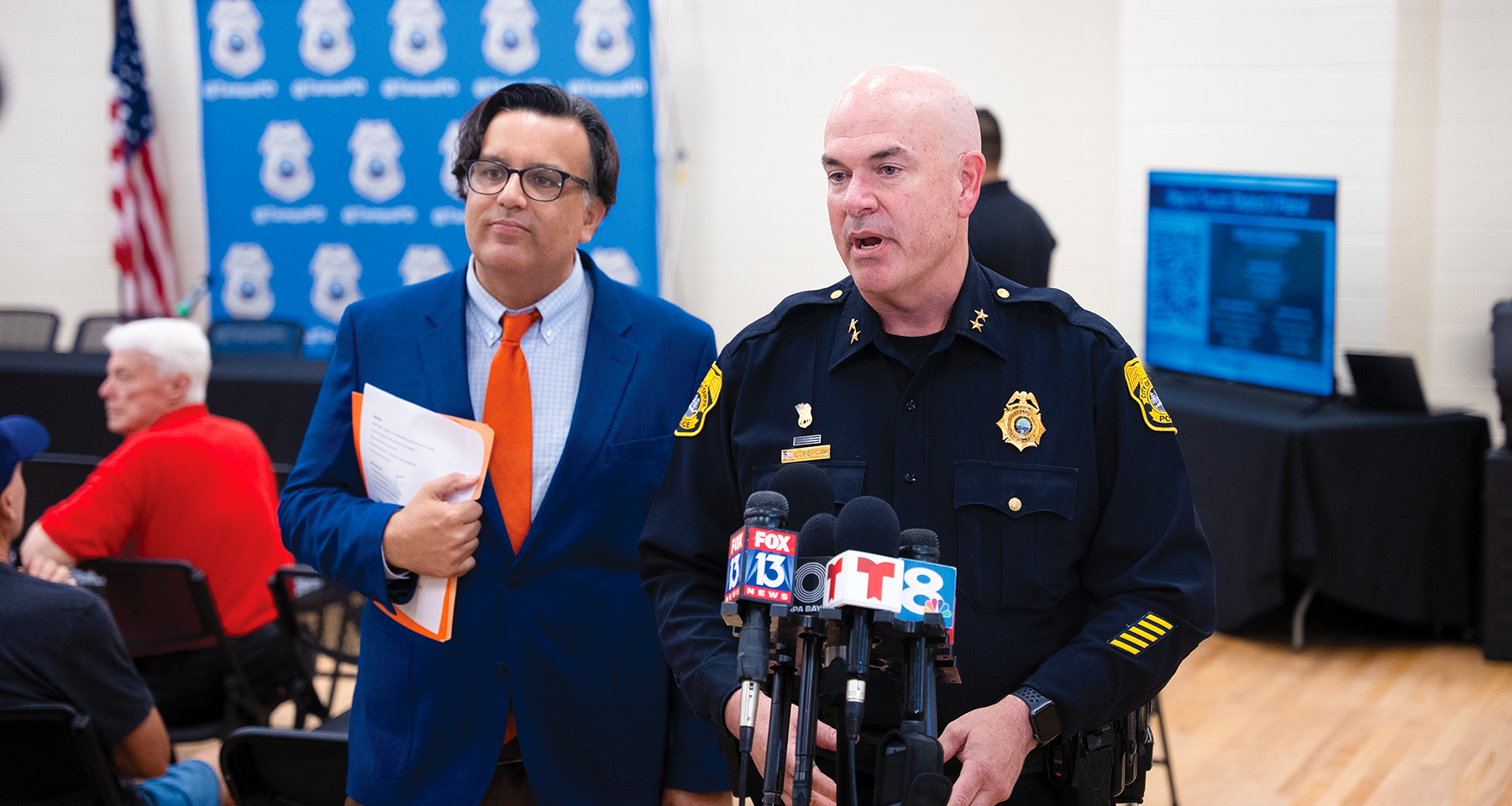
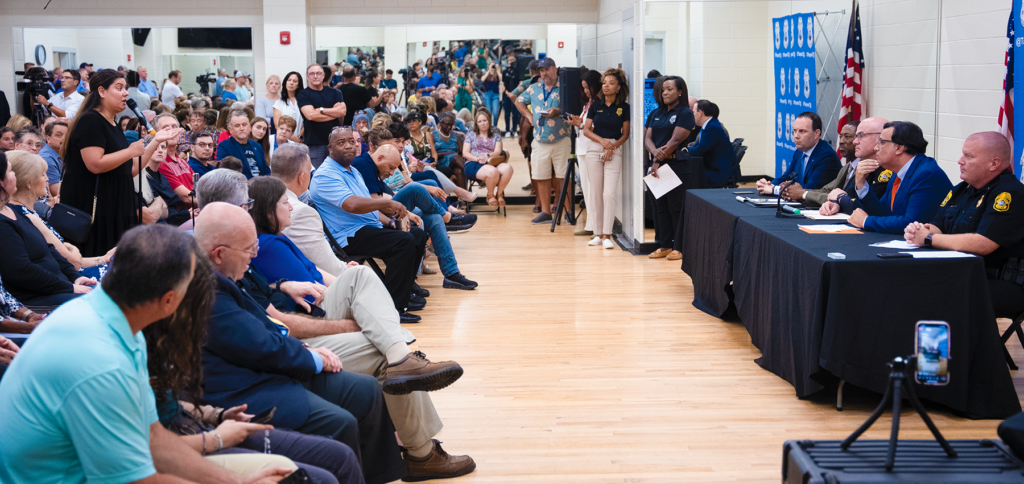
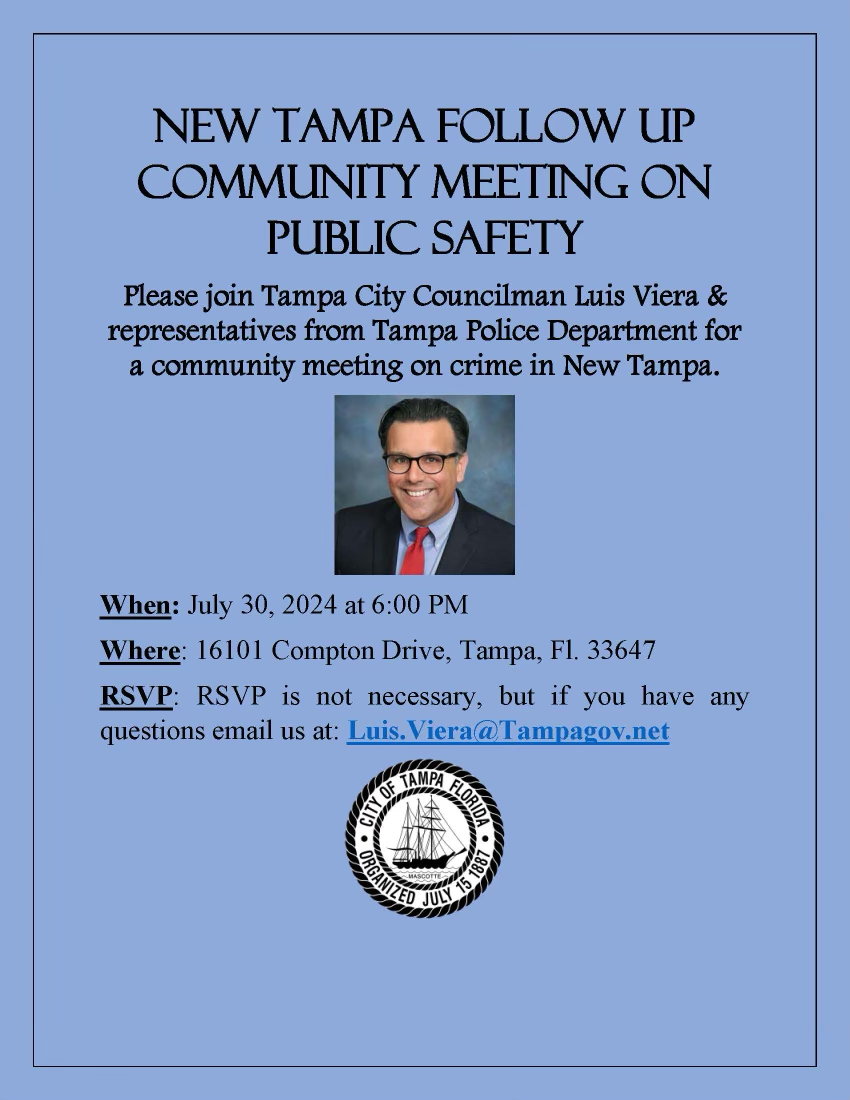
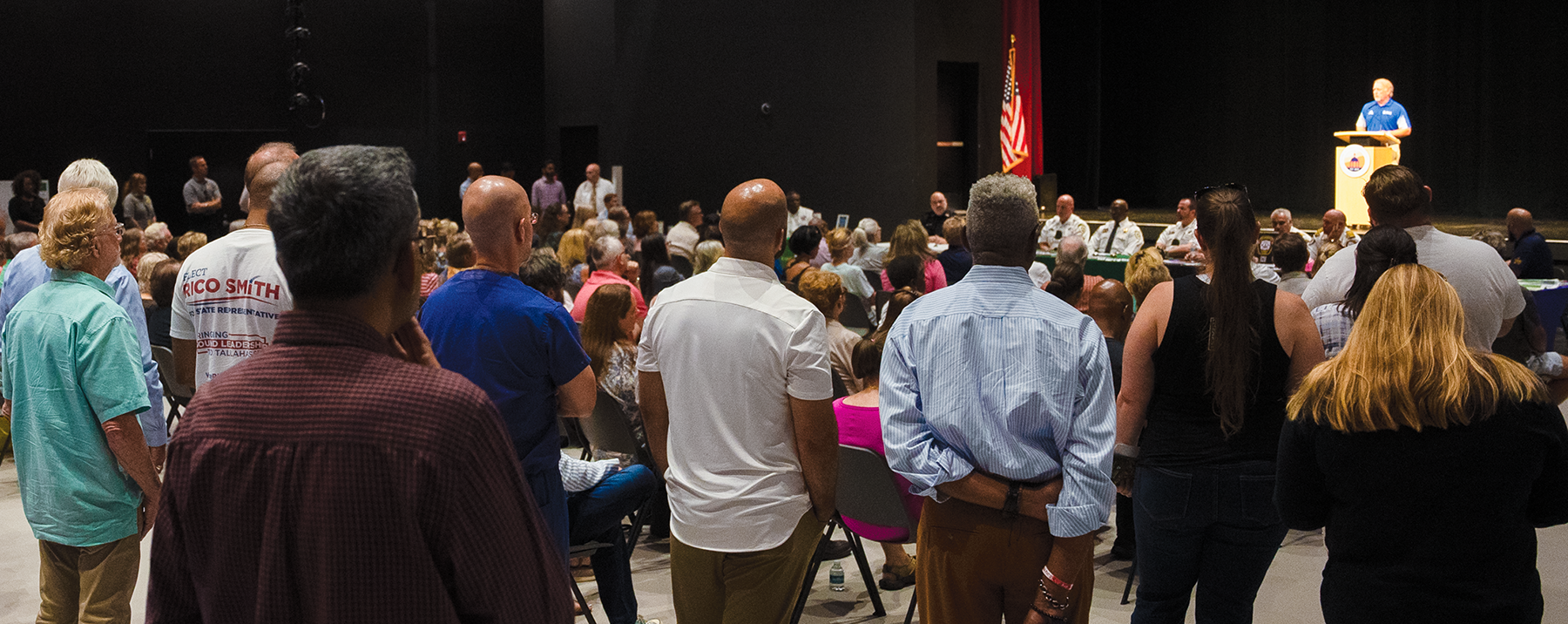
Tampa Police Dept. Chief Lee Bercaw & City Councilman Luis Viera co-hosted a packed Town Hall meeting on June 24 at the New Tampa Recreation Center in Tampa Palms to provide updates on the two recent shootings within a few days of each other in New Tampa. No suspects have been arrested yet in either case, but TPD wanted to assure the public that the two shootings were both targeted, but not related to each other, and that there is no threat to the community. TPD and the Hillsborough County Sheriff’s Office are working together to find the shooters, so anyone with any information about the incidents should call 813.231.6130. There also are multiple ways to provide anonymous tips online. Viera now has announced a second Public Safety Town Hall on Tuesday, July 30, at 6 p.m., at the Compton Park clubhouse in Tampa Palms (16101 Compton Dr.) to provide additional updates. Look for more details about the Town Halls in the July 9 Wesley Chapel and July 23 New Tampa issues of Neighborhood News and on our Facebook page.
New Parks, The Pebble Creek Golf Course & Sidewalks Were Among The Many Topics Covered At The NTPAC
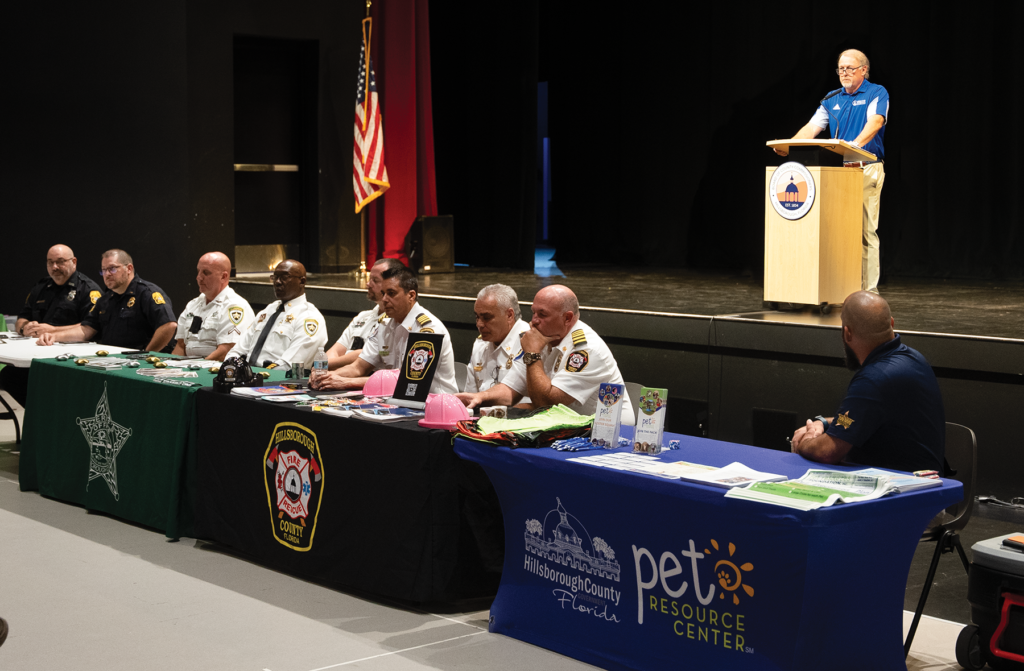
Hillsborough County Commissioner Ken Hagan (at podium in upper right) addresses about 200 New Tampa residents at his standing-room-only Town Hall meeting on June 10 at the New Tampa Performing Arts Center. Hagan brought along representatives of pretty much every county department to help answer questions he couldn’t during his 90-minute question-and-answer session. (Photo by Charmaine George)
Even though signs were posted throughout the New Tampa area for several weeks leading up to it, neither District 2 Hillsborough County Commissioner Ken Hagan nor New Tampa Performing Arts Center (NTPAC) manager Keith Arsenault expected the standing-room-only crowd of more than 200 people who showed up at Comm. Hagan’s Town Hall meeting on June 10 at NTPAC.
“I want to thank everyone for coming out tonight,” Hagan said as he stood behind the podium on the NTPAC’s stage. “I know there’s a million things you could be doing with your time but the fact that you took time out of your schedules to join us is very much appreciated. This is a heck of a crowd. I expected a pretty good turnout but I had no idea it would be to this extent.”
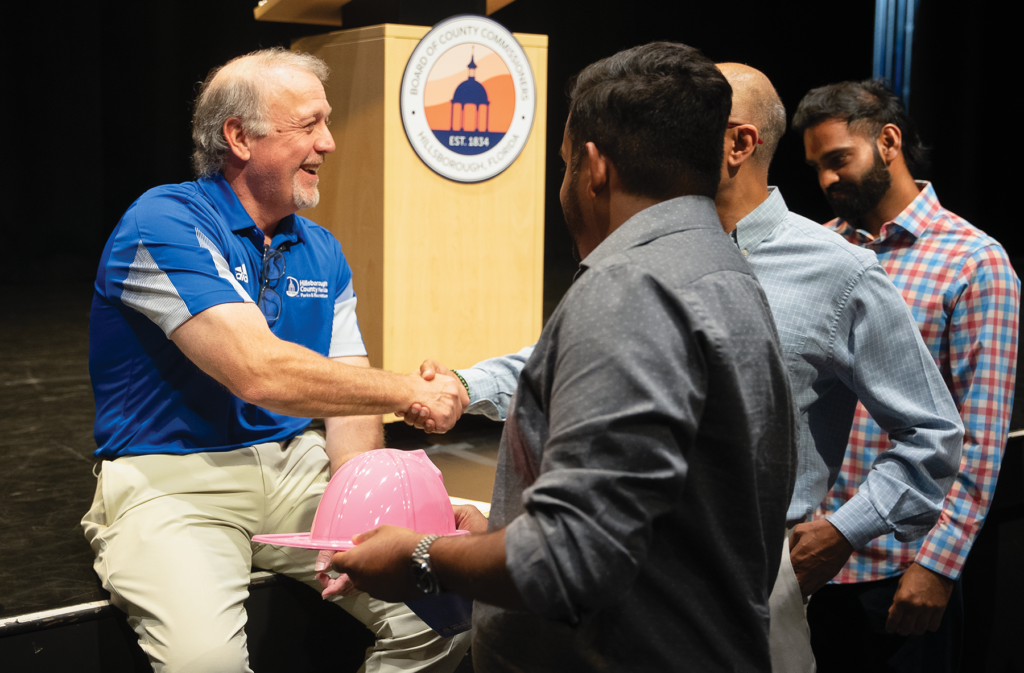
Before he began the Town Hall, Hagan said he had a few “housekeeping” issues he wanted to get to, including an announcement about “New Tampa’s own Bruhat Soma, who recently won the Scripps National Spelling Bee. We invited him here tonight, but as you can imagine, he’s been to the White House, to California…we will be formally recognizing him at a future County Commission meeting, but what a tremendous accomplishment! I still remember the word that I misspelled in third grade… it was ‘grammar.’ To this day, I still think about that, but I wanted to honor this young man.”
Hagan then mentioned that if people in attendance were like him, “You’re probably tired of seeing my picture on signs all around the neighborhoods. Well, those signs have all now been removed.”
The Reason For The Town Hall
“The purpose of this meeting tonight is to bring the county government to you,” Hagan said. “New Tampa is a wonderful community, as I know first-hand, having lived here for 15 years. It’s also a very unique community, as most of New Tampa is located in the City of Tampa, but you have certain neighborhoods — Cross Creek, Pebble Creek and Live Oak — that are in unincorporated Hillsborough.”
Hagan then noted that, “Most of the main roads in New Tampa are county roads — Bruce B. Downs, Morris Bridge, Kinnan Street and you’ve got Cross Creek (Blvd.), with parts in the city, parts in the county. One of the first things I did, many moons ago, when I lived in Cross Creek, was to widen Cross Creek Blvd. to four lanes and to get a traffic signal at Kinnan — and that’s when I realized the challenge, because it was divided.”
He added that, “The good thing is that we have a wonderful relationship with the City of Tampa, which makes things move a lot better. I know when I lived here, sometimes it felt like there were two New Tampas — south of I-75 and north of 75, which I know because I lived for nine years in Tampa Palms and six years in Cross Creek.”
Hagan also said that he recognized that, “New Tampa is quite a bit aways from downtown Tampa, where the government offices are, and most folks up here are working or are busy with day-to-day activities and don’t have the opportunity to come down to attend a County Commission or City Council meeting. That’s why I wanted to have a forum, where we would bring the various county departments here to answer your concerns.”
He also made sure that people in the audience understood that, “We’re here tonight to discuss New Tampa issues. We’re not here to discuss energy policy, geopolitical issues, presidential or any other elections. There also are some folks signed up asking questions about some issues related to New Tampa that I’m not going to touch on tonight (because there were 75+ people signed up to speak and less than 90 minutes before the meeting had to end), but if you provided your contact information, someone from my office will contact you and we will provide you with an update”
Introducing The Departments
Hagan then introduced the 50 or so people in attendance from the various city and county departments — City of Tampa Police (TPD), Hillsborough County Sheriff’s Office (HCSO), Hillsborough Fire Rescue (HFR), Pet Resources, Code Enforcement, Library Services, Tax Collector, Property Appraiser, Clerk of the Court, Supervisor of Elections, Affordable Housing, Homeless Services, Public Works, Conservation & Environmental Lands Management, County Parks & Recreation, City Parks & Recreation, Water Resources, Development Services, Children’s Services and the county’s Office of Emergency Management. Hagan thanked Arsenault and his NTPAC staff for hosting the meeting and noted what an amazing addition it already has been to the New Tampa community.
And Away We Go!
As Hagan scrolled his way through the sign-up sheets, he decided to start the actual town hall with an update on the improvements to Branchton Park.
“When I lived in Cross Creek, I would often take Morris Bridge Rd. to get home and I would drive by this beautiful, but underutilized, park at the corner of Morris Bridge and Cross Creek,” Hagan said. “I said to myself that this would be a real opportunity to create a wonderful park that would be a true destination.”
He then noted that several years ago, the county purchased 22 acres surrounding the existing park, “So now, we have a total of 42 acres. And what I wanted was to find out what the community, what amenities you wanted for this park, so we did an online survey to which more than 500 people responded and we incorporated nearly all of those suggestions into the park’s design.”
Hagan then said that the county broke ground on the on the $9.5 million in improvements to Branchton Park, “about a year and a half ago. Phase 1 will have a new playground, splash pad, shelters, pickleball courts, a dog park and we’re looking for a private partner to provide the county’s first zip line. It’s going to be something really cool.” He added that he’s hopeful to have a ribbon cutting for Phase 1 sometime in September of this year.
Speaking of parks, Hagan next gave an update on the Cross Creek Park Recreation Center, located adjacent to Pride Elementary.
“This 17,000-sq.-ft. gymnasium and rec center is fully funded at a little over $9 million,” he said, “It also will have walking trails, a new playground and parking. It will provide much-needed after-school and summer programs for children, as well as senior and adult programming during the day. It will have indoor basketball, volleyball, pickleball..plus a fitness room and multi-purpose room.”
He also said the next phase at the rec center will include an outdoor pavilion and a shade structure for the outdoor basketball court. “The current status is that the bidding is under way and closes this month (June) and we’re hoping to break ground on this recreation center in August or September.”
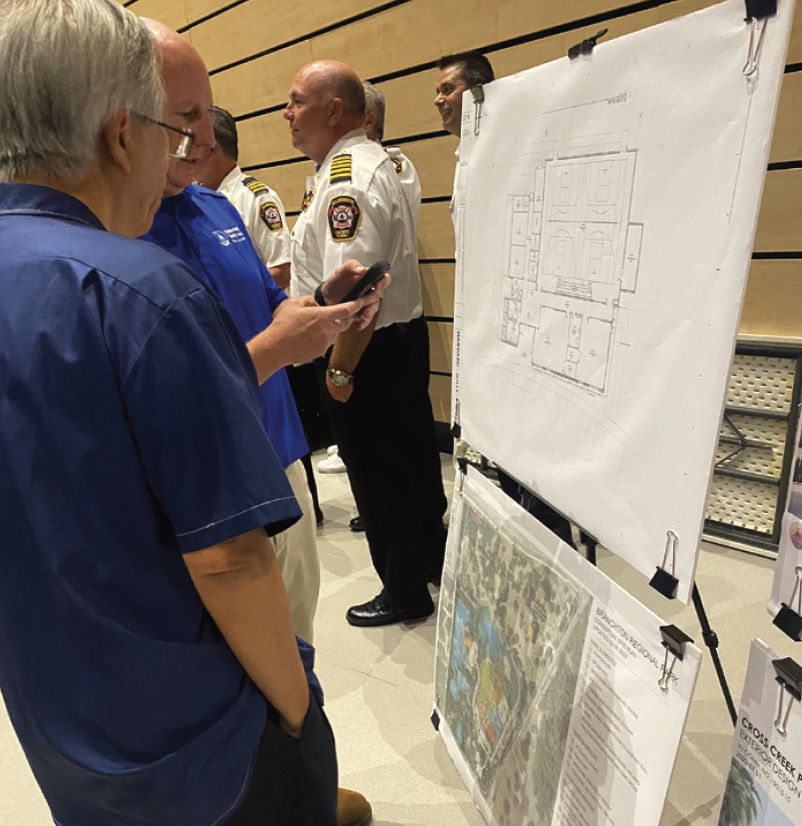
Many local residents checked out the plans for the expansion of Branchton Regional Park. (Photo by Gary Nager)
Hagan then recognized Cheryl Pahl, a retired 20-year teacher at Hunter’s Green Elementary and Pebble Creek resident for 30 years, who gave a prepared speech about incorporating a ceramics/ pottery art studio somewhere in New Tampa.
“I have been teaching pottery at the Carrollwood Cultural Center,” Pahl said, “and I’m here tonight to advocate for the arts in New Tampa. This wonderful venue (the NTPAC) provides a road map to remove gaps to other types of art instruction in New Tampa outside of regular K-12 school instruction. We could provide pottery, painting and drawing instruction for all ages at this facility (the Cross Creek rec center). All art classes will have registration and other fees, so it could be self-sustaining after the initial outlay.”
Pahl also mentioned that she and a group of volunteers circulated a petition around New Tampa and had collected, “close to 300 signatures.”
Hagan responded that he fully supports creating an art and ceramics studio and, “I’ve had preliminary discussions with our parks director Rick Valdez to discuss potential options.” He added that the Parks Dept. has “eliminated kiln (ceramics oven) studios in our parks facilities, but based on the interest you’ve garnered, I want to make this a reality. An art and kiln studio will most likely be located in a dedicated room at the Cross Creek park or here (at NTPAC) in Phase 2, with Cross Creek a better chance to have it sooner. But, we’re going to make this happen.”
Next, Maggie Wilson from the Tampa Palms Owners Association thanked Hagan and the county for repairing some sidewalks along BBD in Tampa Palms North “very quickly.”
Also speaking on sidewalks was Diane Campbell from The Hammocks off County Line Rd., who began asking seven years ago for a sidewalk from in front of Grand Hampton to the stores on both sides of County Line & BBD, such as Target and LA Fitness.
“Pasco put in a sidewalk on their side of County Line from Target to the entrance to Northwood” she said, “so we would just need one from Grand Hampton to Northwood. You said Public Works would look into it, so I’m wondering if there’s an update on it.”
Hagan responded that sidewalks and road resurfacing, “are the biggest unfunded needs we face. We have hundreds, if not thousands, of unfunded sidewalk repairs, in addition to new sidewalks that you’re referencing right now. We also heard from many in the community about adding a traffic signal on County Line (at the entrance to Grand Hampton) and I’m very pleased that I was able to get the funding for that signal. Your sidewalk project is on the list of needs, but it’s currently unfunded for, I believe, $1.9 million. Should the (one-cent) Community Investment Tax (CIT) renewal — which is on the ballot this November) — pass again, then we will be able to get that sidewalk completed.”
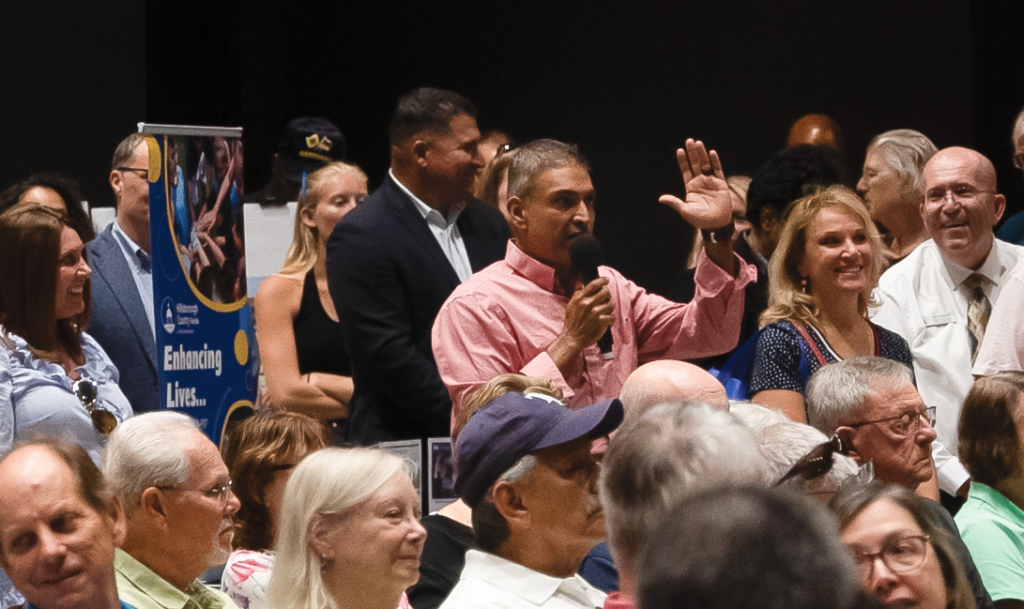
Via Italia restaurant owner and Live Oak Preserve resident Sunny Patel asks about a possible Kinnan St.-Mansfield Blvd. connection.
Next up was Sunny Patel, the twelve-year Live Oak resident who also recently became the new owner of Via Italia restaurant. Patel said he was thankful the county built the NTPAC, but that he is hoping that one day, the Kinnan St.-Mansfield Blvd. connection that is now paved will one day be open to vehicular traffic.
Hagan said, “You say you’ve lived here for twelve years, but I’ve been working on this issue even longer. The obstruction to making the connection is the Pasco County Board of Commissioners. I actually had an agreement with the county administrator, three administrators ago, that once Mansfield was connected to 56, they would open up Kinnan to Mansfield, but that never transpired. To show you how far back this goes, I was on the front page of the (now defunct) Tampa Tribune quoted as saying that there should be a toll booth on Bruce B. Downs (at the Pasco County line) because 60-70% of the traffic on BBD emanated from Pasco County.”
He added, “The frustrating thing is that the Pasco County staff, their MPO, have all agreed that making the connection makes sense. The emergency and bicycle access at that location is a step in the right direction, but come hell or high water, one of these days, that’s going to happen under my watch.”
Hunter’s Green resident Ed Killborn then raised a very popular topic — the timing of the traffic signals along BBD. “Since BBD was widened, the timing of the traffic signals has actually increased traffic tremendously,” Killborn said. “You sit at one red light, then the next red light and the next…and people are speeding like crazy trying to get through the lights before they change. There are two lights at BBD and I-75 and I defy you to get through those two lights going 45 miles per hour (the posted speed limit). My question is, why can’t we do something about reasonable timing of the lights at 45 miles per hour?”
Hagan responded, “First of all, I agree with you. I’m pretty certain I ran one of those lights on my way here.” He also said that he would have Josh Bellotti from Public Works, who was in attendance at the Town Hall meeting, get with Killborn to discuss the timing of the signals on BBD.
Several speakers were on hand simply to thank Hagan and his fellow commissioners for building the NTPAC. Tampa Palms resident Blake Hamilton was one of those but he also asked that the county find the money to expand the facility. Hagan recapped his efforts to make the dreams of Graeme Woodbrook and the late Doug Wall a reality.
“The county bought this land as part of the BBD widening project,” Hagan said, “and some in the county wanted to ‘surplus’ it, meaning that it would’ve ended up as more houses or apartments, and I said, ‘Hell no, this is an unbelievable opportunity, in the middle of this community, to do something really special here. It took a lot longer than it should have, but I’m very proud that it’s here. But, to answer your question, it was designed with the ability to expand, so it’s 20,000 sq. ft. now and we can expand it by another 10,000 sq. ft., which is included in the CIT list of eligible projects.”
Another local resident asked why the power lines between Pebble Creek and Cross Creek aren’t buried, “because we lost power during the last big storm when it seemed everyone else in New Tampa still had power.” Hagan said the last he heard was that TECO (Tampa Electric Co.) had a plan in place and a route selected for burying those power lines, “but that isn’t expected to start until next year.”
New Tampa resident Suzie Marie then asked why there seems to be a lot more Tampa Police officers patrolling New Tampa than there are Hillsborough Sheriff ’s deputies, to which Hagan responded that, “Our Sheriff’s Office, led by Sheriff (Chad) Chronister, does a great job, and crime is down around the county, but the county is always below the national average for deputies per 1,000 population. But, what I sill tell you is that a substation will be located at Branchton Park, which will increase the Sheriff’s Office presence in New Tampa.”
Next up was Leslie Green of the Save Pebble Creek group, who thanked Comm. Hagan for voting against rezoning of the now-vacant Pebble Creek golf course and asked if the county would consider buying it to make it a county public golf course.
Hagan said that the county has looked into it and the most likely scenario would be for the Tampa Sports Authority to buy it, “but we’d have to have a willing seller, and he would have to come down from his current number. But absolutely, we’re interested.”
He added that he has not yet seen any attempt to re-zone the property for affordable housing under the state’s new Live Local act, “and Adam Gormly with our Development Services department tells me that the golf course would not qualify for Live Local.”
Long-time Cory Lake Isles resident Sid Shaw expressed concerns about safety on Morris Bridge Rd. from Cross Creek Blvd. south to I-75 (at the Fletcher Ave. exit). Hagan responded, “Morris Bridge is extremely dangerous. Last year alone, there were 33 crashes and three fatalities. A couple of months ago, we approved $2 million for safety improvements, including no-passing vertical delineators, reflective and profiled lane line markings, speed feedback signs, flashing beacons, curb warnings, back plates, electrical conduits, bike lane safety enhancements, bridge bike lane signs, milling and resurfacing, wildlife signs and more. Morris Bridge will be made a much safer road.”
Hagan also mentioned that he is working to get the Bay Chapel Food Pantry on BBD $10-$15,000 to help them get a new freezer and that the work on the Grand Hampton traffic signal on County Line Rd. had begun and could be completed by the end of June. He also responded to a question about resurfacing the side roads in Pebble Creek now that Pebble Creek Dr. and Regents Park Dr. are finished. “That’s about a $6 million project and we will need the CIT to pass for that to be funded.” As for the expansion of the New Tampa Regional Library, Hagan said the plan is to expand the library by an additional 5,000 sq. ft. at a cost of about $700,000.
After the meeting, Hagan and his aide Rich Reidy responded to my question about the $500 million in overturned transportation tax money, about half of which will go back to county for “major road improvements by July 1,” according to Reidy. “But we wanted it to improve neighborhood roads.”
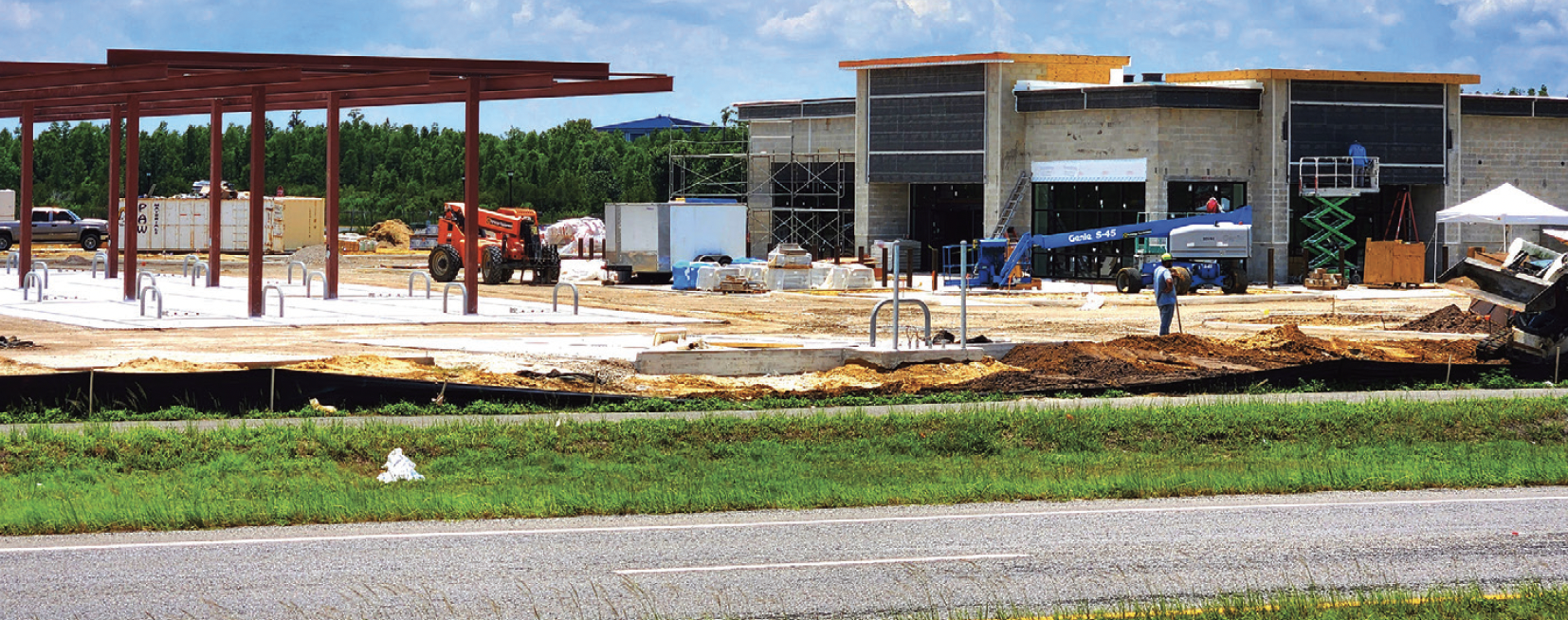
The current state of construction at Daybreak Market Wiregrass. (Photo by Joel Provenzano)
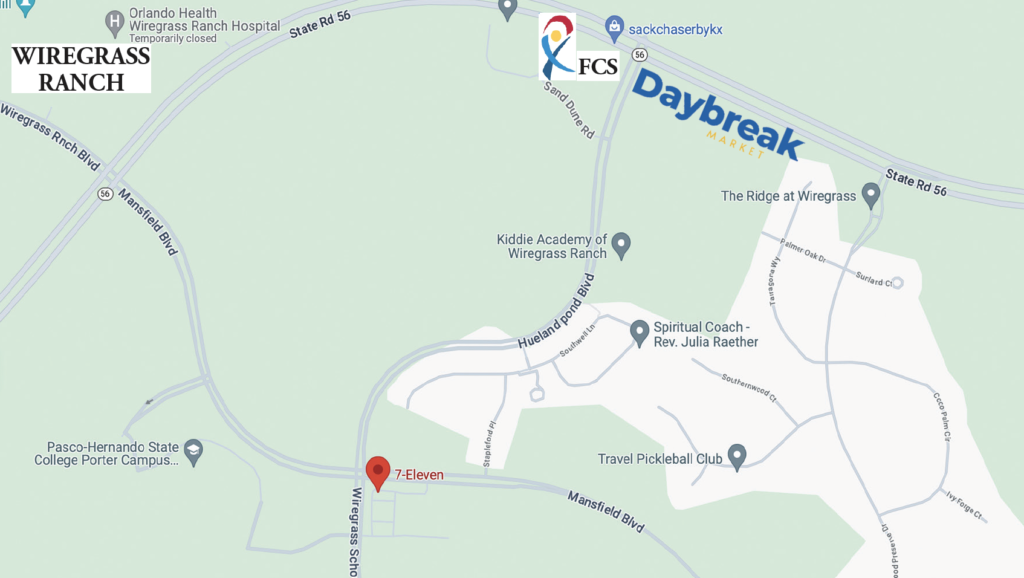
On the SE corner of S.R. 56 at Heuland Pond Blvd., something is coming that many of us haven’t seen in this area or may not be familiar with at all — Daybreak Market at Wiregrass which will sell “76®” branded gasoline.
Daybreak Market (see map) is a new convenience store concept where some of the things the company touts include $0.99 any-sized coffee or fountain drinks (with even lower Grand Opening prices), a beer cave called “The Ice Box” and indoor/ outdoor seating and tables for food time, plus fully digital touch screen fuel pumps.
According to the company’s social media page, Daybreak Market opened three new locations in Florida just last year and there are nine locations in Florida, including three in Port Charlotte. The closest one to our area was just opened this year at the corner of S.R. 54 at South Branch Blvd. (near the Suncoast Pkwy.) in Odessa, where oddly, the pumps and store face away from the main road.
The map shows the locations of Daybreak, FCS and 7-11 (Google map modified by NN)
The 1.73-acre corner parcel in Wesley Chapel has most of its major vertical construction already completed, as the reinforced concrete fuel pad area, canopy supports and convenience store building have all taken shape. The store will be just under 5,000 sq. ft. but there will be a lot more pumps/fueling positions than at any other gas station in our area, which according to the plans we reviewed and our visit to the site, appears to be up to 24 regular fueling positions (gas nozzles).
If that number is correct, Daybreak Market & Fuel will easily be the biggest gas station in Wesley Chapel, as even the RaceTrac down the street and Costco near the Tampa Premium Outlets each only have 18 fueling positions total, and it would be double Sam’s Club’s 12.
Originally, there was a Circle K that was going to be on the other side of Heuland Pond Blvd. (between S.R. 56 and Sand Dune Rd.) years ago, but the permits for that project expired at the end of 2017.
Instead, Daybreak Market Wiregrass will be just the second gas station in the Wiregrass Ranch development, as the 7-Eleven at the intersection of Mansfield Blvd. and Wiregrass School Rd., which opened last year, was the first.
And now, there’s a new medical office building under construction in the previously planned Circle K location by Florida Cancer Specialists & Research Institute (labeled as FCS on map). See page 16 for that story.
What the vote means for two Wesley Chapel properties & what Pasco County’s affordable housing plans are moving forward
The Tapestry at Cypress Creek apartments, located at the intersection of Wesley Chapel Blvd. and S.R.s 54 & 56, is one of two existing apartment communities that have applied to greatly reduce their property taxes under Florida’s “Live Local” law. (Source: TapestryCypressCreekApartments.com)
When the Pasco County Board of Commissioners (BOC) voted unanimously on May 21 to opt out of a portion of the state’s recently revised “Live Local” law that was originally passed last year, it didn’t stop the BOC from continuing to look to find other ways to bring affordable or “workforce” housing to the county.
“We all agreed that although those in the workforce need more affordable housing,” says District 2 Commissioner Seth Weightman, “Live Local just did not seem to accomplish that goal.”
To that end, Pasco’s senior assistant county attorney David Goldstein made a presentation to the commissioners at their May 21 BOC meeting which summarized the reasons why the county was choosing to opt out of the provision of the Live Local law (pushed by Senate President Kathleen Passidomo during the 2023 State Legislative session) that was modified towards the end of the 2024 session to allow local jurisdictions the opportunity to “opt out.”
Pasco, led by Comm. Weightman, was at the forefront of the fight to get the law changed during this year’s session, as one of the two properties that applied for the Live Local tax break — the Tapestry at Cypress Creek apartments (where Jannah and I have lived the past five years, since the complex first opened), where Wesley Chapel Blvd., S.R. 54 and S.R. 56 meet — is located in his district. I can personally vouch for what Comm. Weightman said at the May 21 meeting:
“That complex has been around for a number of years and was never intended to be an affordable housing project. It’s Class A multifamily living with amenities, right next to Wesley Chapel and the Outlet Mall.”
Goldstein outlined the conditions that will allow the county to opt out of the 80%-120% of Average Monthly Income (AMI) provision of Live Local for 2025, although both Tapestry and a complex in the Trinity area both already have applied — but neither one had yet been granted that exemption by county property appraiser Mike Wells at our press time — for 2024.
The 80%-120% provision allows rental communities to receive the Live Local tax exemption if their units rent for 80-120% of the AMI for an individual in Pasco County, which Goldstein said worked out to rents averaging about $2,000 per month. “These $2,000-per-month rents are not what our school teachers, county employees, firefighters and law enforcement officers can afford,” Goldstein told the commissioners. “It doesn’t make sense to give large tax exemptions essentially to complexes that are charging market rate rents with no charitable purpose.”
He added that Pasco also has a large surplus of apartments in that 80-120% range.
“Our deficit is only in rental units charging less than 80% of AMI, which is truly affordable or workforce housing,” he said. “But, we don’t have any communities offering rents under that 80% AMI range coming before you for approval.”
Goldstein also noted that even with the changes to the Live Local law, Pasco is still grouped with Hillsborough, Pinellas and Hernando counties in the Tampa Bay Metropolitan Statistical Area (MSA), which is what is being used to determine if a community already has a surplus or a deficit in the number of rental units in the 80-120% AMI range, “So although our MSA has a surplus of 3,994 units at present, even if Pasco has a surplus in the future, but Hillsborough or Pinellas has a large enough deficit to more than offset our surplus, we might not be allowed to opt-out of Live Local in the future. I’m hoping the law will be refined again in the next legislative session.”
He also said he hoped that other counties in MSAs with surpluses of the 80-120% AMI units will follow Pasco’s lead and opt out of the law.
Pasco County’s senior assistant county attorney David Goldstein provides information about the changes to the state’s Live Local law to the county’s Board of Commissioners prior to the BOC’s vote to opt out of a portion of the state law regarding affordable housing. (Photo: Screenshot from Pasco BOC meeting)
Goldstein also told the commissioners that counties that still qualify under the provisions of the law will have to opt out every year, and that the apartment complexes trying to receive the tax breaks also will have to apply for those breaks every year.
“Fortunately, we only have the two complexes who may be able to receive the tax break this year,” he said, “but even just for this year, the county would lose 75% of the $1.7 million the two complexes paid in taxes last year (or more than $1.275 million combined)” if Wells does allow them to receive the Live Local tax break for 2024. “But, we can only opt out of Live Local for county taxes,” he added. “I have drafted a letter to the Pasco School Board, Mosquito Control District and the cities in the county instructing them to also opt out of the 80-120% AMI provision of Live Local for 2025.”
Goldstein also mentioned that there are flaws in the way the data that would allow Pasco and other jurisdictions to opt out of Live Local is being used.
“We can only opt out if the latest University of Florida Shimberg (Center for Housing Studies) Report, which uses American Community Survey data (based on the Census) shows that our Tampa Bay MSA has a surplus of rental units in the 80-120% AMI range,” he said. “But, that does not include recent construction — it’s always two years behind. If we have a recent apartment complex — and we have a lot of recent apartment complexes being built — it’s not counting those in the surplus inventory. We did raise that as a concern and we’re hoping it’s something else that can be refined during the next Legislative Session. The problem is that the Shimberg Report could show we have a deficit when we actually have a surplus on the ground.”
He also noted that of all of the large counties in the state, only Broward and Miami-Dade counties have large deficits of units in the 80- 120% AMI range, “So it seems like this state law was enacted only to help southeast Florida. The law really should only be applied to those areas.”
Goldstein also noted that the change in the law for 2025 only applies to tax breaks for existing communities, “So we’re hoping to get the land use part of the law changed during next year’s session. If we don’t have a deficit of those units, why should we have to give up job-creating commercial and industrial properties in the future to have more of them?”
Pasco’s five commissioners — including new Dist. 4 Comm. Lisa Yeager in her first BOC meeting since being appointed to fill the seat of the late Comm. Gary Bradford by Gov. Ron DeSantis — voted unanimously to approve opting out of the tax portion of Live Local.
Even so, at the insistence of Dist. 5 Comm. Jack Mariano — despite the fact Goldstein said it wasn’t necessary to do so — the BOC also voted 5-0 to draft a letter to the property appraiser asking him to not grant the exemption to the two rental communities that applied for it for 2024. “I’ve been in constant contact with Mr. Wells’ attorney’s office,” Goldstein said. “They’re well aware of how we feel about this.”
Talking Affordable Housing
Following their regular BOC meeting, the commissioners held a workshop on what Pasco can do to provide more affordable housing options for those in the workforce — county employees and others — especially after Goldstein noted during the regular BOC meeting that Pasco does indeed have a shortage of affordable units for those whose monthly incomes are below the 80% of the county’s AMI.
The workshop was led by Cathy Pearson, Pasco’s assistant county administrator for public services, who said she was discussing affordable housing with David Lambert, the chairman of the Pasco Housing Authority and the Executive VP and general manager of the Withlacoochee River Electric Cooperative, “And we both said we have never had an affordable housing plan for Pasco County. David took me to his Pasco Housing Authority Board and convinced the Board to pay for this study for us,” Pearson said. “How wonderful.”
She also said that for the year-long study, “affordable housing was defined as housing that costs less than 30% of a household’s income.” For someone earning Pasco’s average median income of $63,187 per year, an affordable rent would be $1,579 per month, although starting teachers and many other workers only earn about 80% of that median income, so those workers could only afford rents of $1,263 per month or less.
Among the options put forth by the study to help increase affordable housing options in Pasco include legalizing “accessory dwelling units,” sometimes called backyard homes or “granny flats,” adding duplexes or even quadraplex units in existing single-family communities, the possibility of requiring developers to include or pay for affordable housing in their unit totals to receive approval for those developments, as well as expanding some kinds of public rental or home-buying assistance. Goldstein also noted that the county already has reduced mobility and impact fees for developments that include affordable housing.
Pasco Planning & Economic Growth director David Engel says the county is expected to add more than 101,000 workers to fill the jobs in the projects that are already under design or that the Board has already approved.
“So we’re going to have a tremendous need for housing in the future for that workforce.”
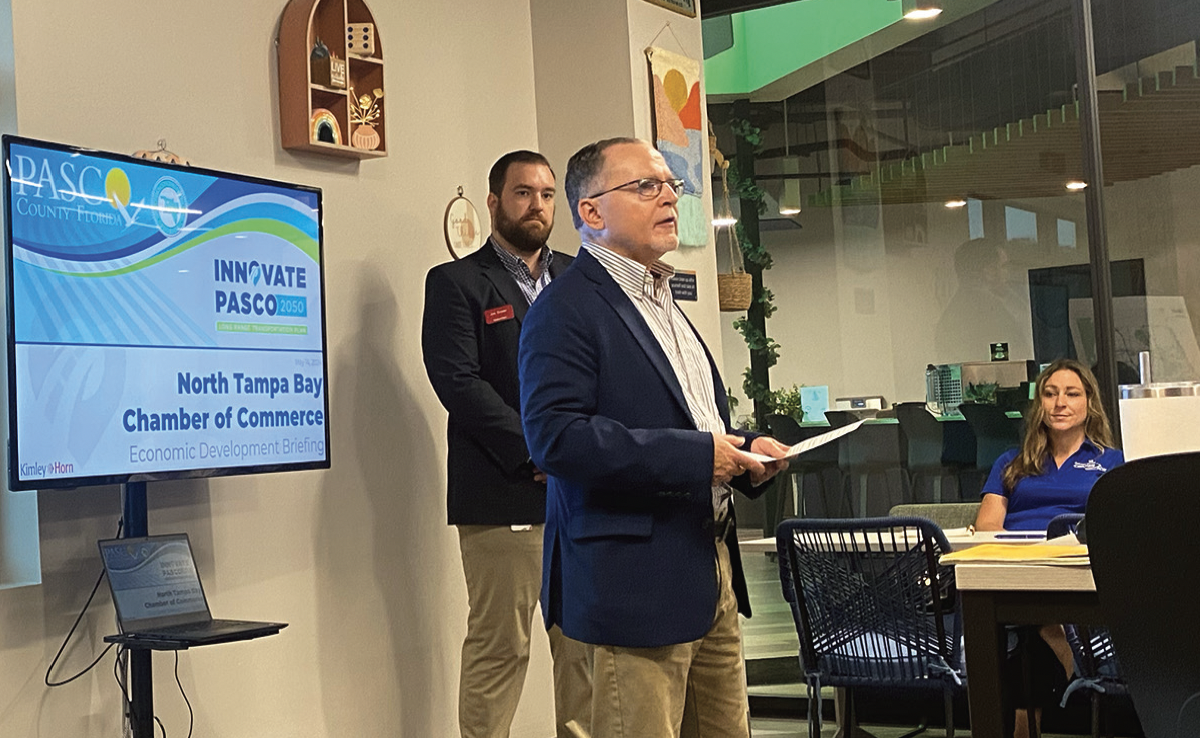
Pasco MPO principal transportation planner Scott Ferry (front) and Joe Crozier of Kimley-Horn, discuss the “Innovate Pasco 2050” Long-Range Transportation Plan with members of the North Tampa Bay Chamber.
Even with all of the transportation improvements completed over the past few years, there’s no doubt that the roads in Pasco County in general — and the Wesley Chapel area in particular — are a lot more crowded today than they were before those improvements were finalized. Without a long-term transportation plan in place 20, 30, or even 50 years ago, however, our traffic situation would unquestionably be far worse.
To that end, representatives from (and the private firm working with) the Pasco Metropolitan Planning Organization, or MPO (the county’s federally-funded primary transportation planning entity), have been making the rounds throughout the county to ask people what planned road improvements should be prioritized between 2025 and 2045.
The MPO’s long-term transportation plan, dubbed “Innovate Pasco 2050,” was presented to about 25-30 North Tampa Bay Chamber (NTBC) members at the Chamber’s monthly Economic Development Briefing on May 14 at its Suncoast Office off S.R. 54 in the Bexley community of Land O’Lakes.
“The MPO’s mission is to find out what the transportation needs are for the county and develop solutions for those needs,” said Scott Ferry, the Pasco MPO’s principal transportation planner. “One of the ways that we accomplish this mission is by meeting with the public throughout the county, which is what we are doing here today.”
Ferry also explained that the MPO is governed by a nine-member Board which is “comprised of the five Pasco County commissioners and four municipal representatives (from the cities of Dade City, New Port Richey, Port Richey and Zephyrhills). “This MPO Board meets on a regular basis to discuss and make decisions about transportation policies and issues in the county.”
He said that when the plan is adopted, “it’s going to serve as a guide and a blueprint for county transportation planning for the next five years (2025-29). We’re here to engage with you and see what you believe the transportation priorities should be for the county.”
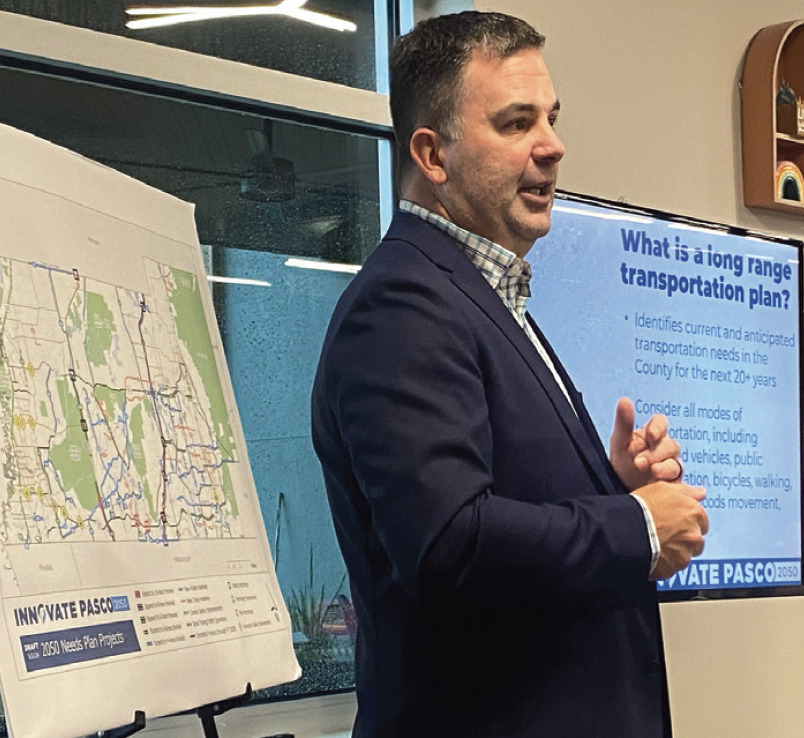
Jonathan Whitehurst of Kimley-Horn explains what a long-range transportation plan is and why it’s important.
He then introduced Jonathan Whitehurst and Joe Crozier of private transportation planning consulting firm Kimley-Horn & Associates, which has been retained by the MPO to assist with the “Innovate Pasco 2050” planning process.
Whitehurst, a North Carolina resident whom Ferry said has 18 years of experience helping develop transportation plans throughout the country, and Crozier — a life-long Pasco County resident — then explained the process by which MPOs create not only their long-rang plans but also the short-term (five-year) Transportation Improvement Plan (also known as the “work plan”) so planned improvements can be funded by the various government entities, whether state/ federal, local (county and city), or a combination of funding sources.
“We’re starting with the 2045 plan to see what’s different and what’s changed,” Whitehurst said, “and the short answer is that in the last five years, a lot has changed in Pasco County, which makes our job a little bit harder because we first have to find that baseline condition as to where things are now so we can start to predict where things are going to be in the future.”
Whitehurst also mentioned that although the primary discussion in MPO plans is usually about roadways, traffic, safety and congestion, “We look at all modes of transportation, including bike facilities, pedestrian facilities, transit, freight and even a little bit of air travel, so it truly is a multimodal transportation plan.”
He also noted that the MPO and Kimley- Horn started working on the plan in Oct. 2023 and hope to have it finished sometime this month, “so we’ve got quite a bit of work to do to get it done. The plan itself will be adopted later this year. As soon as the MPO adopts the plan, that five-year cycle starts over.”
He said that where the planners are now is “at the very end of the ‘Needs’ plan, which identifies the universe of possible projects. We took a look at how we think Pasco is going to grow between now and 2050, where our facilities are now, where we have already-funded projects in the future and we said, ‘OK, where are the problem areas?’ And, we found that there are a lot of problem areas. So, the needs plan is trying to address as many of those problem areas as possible, trying to say that if these are the potential problem areas, these are the projects and solutions we are going to need to solve them.”
Whitehurst noted, however, that there is always, “a big list of projects, but we only have a small amount of money. So then, we have to figure out what are the priorities among the projects that we’ve identified, so that’s where the project prioritization process comes in. We put all of the needed projects on a spreadsheet and see which ones rise to the top.”
And, speaking of money, Whitehurst said that, “Concurrent with that, we have to see how much money we have to spend on transportation projects, so we take that prioritization list, compare it with the money and see how far down the list we can make it. That’s what we call the cost-feasible plan.”
Crozier then explained that for the purposes of the study, the county was divided into three sections — west of the Suncoast Pkwy., between the Suncoast and I-75, and east of I-75. And, although the growth in Pasco previously has been on the west coast, the central and eastern areas are now growing faster, “but all of Pasco is growing and all of that growth requires infrastructure.”
Crozier and Whitehurst also noted that because Pasco continues to add homes and businesses, part of the study looked at the different types of jobs that are coming — especially in the greatly expanding medical field in our area and how those different types of jobs also impact the transportation needs differently.
And, Crozier admitted that despite the best-laid plans of previous planners, because the county has grown so quickly, “we’re actually hitting now many of the previous projections for 30 years from now. A lot of the growth models, especially after Covid, are just not accurate anymore” and all of that has made the prioritization process a lot more complicated.
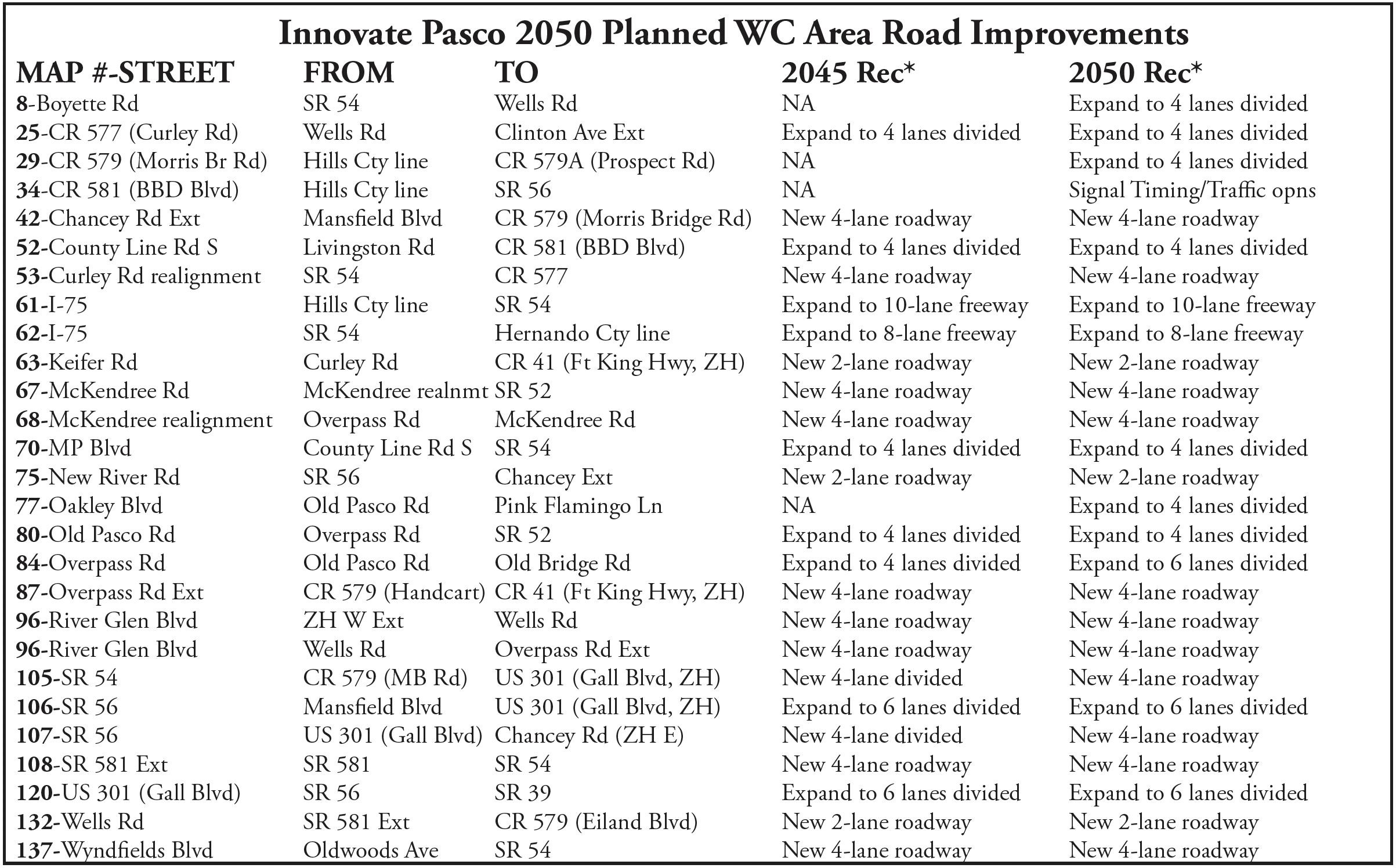
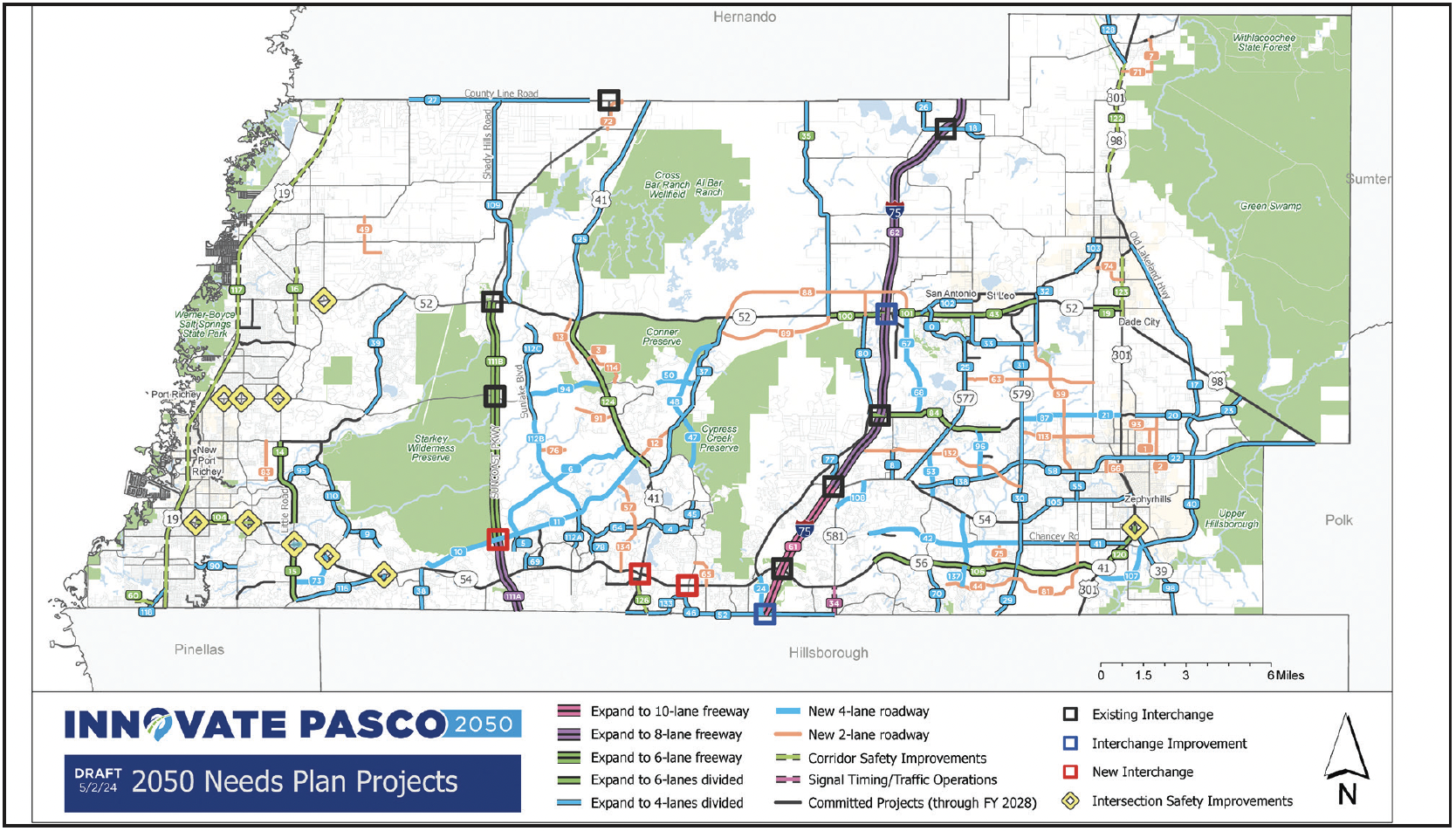
The Pasco MPO’s “Innovate Pasco 2050” long-range transportation plan includes 27 roadway projects for the years 2045-50 that are either in Wesley Chapel or directly adjacent to Wesley Chapel. The “Map #s” shown above correspond to locations on the map at the top of the next page. (Source: Pasco County MPO)
Although Whitehurst and Crozier presented a countywide list of more than 120 transportation projects that are planned to be funded, we have only shown the 27 planned improvements that either are located in Wesley Chapel, or at least border directly on Wesley Chapel, in the chart on this page. The problem, Whitehurst said, is that “While we would love to have enough money to pay for all of these projects, at the end of the day, we still don’t have enough money.”
He said that if you want to learn more and provide input on the plan, go to InnovatePasco.com, which has both the complete list of planned projects and the map on the next page in an interactive format that will allow you to zoom in on the areas of the map that might be most important to you and drop ‘pins’ on the map and provide us with comments about those needs and the plan itself.
“Please spread the word, too, because the more people we can get involved in the website, the more info we can collect.” He noted that earlier this year, there were more than 1,100 people who already had left comments on the website.
Meeting attendees were given the opportunity to ask questions and make comments following the presentation, and there was agreement that the Diverging Diamond Interchange at S.R. 56 and I-75 has been the most impactful recent transportation improvement and that Wesley Chapel Blvd. is the most-needed improvement in our area. Other complaints expressed at the meeting are the length and lack of synchronization of traffic signals and that it seems like road improvements are always behind development.