Yard House Unconfirmed But Now Rumored To Be The Front Runner To Replace Bahama Breeze On S.R. 56
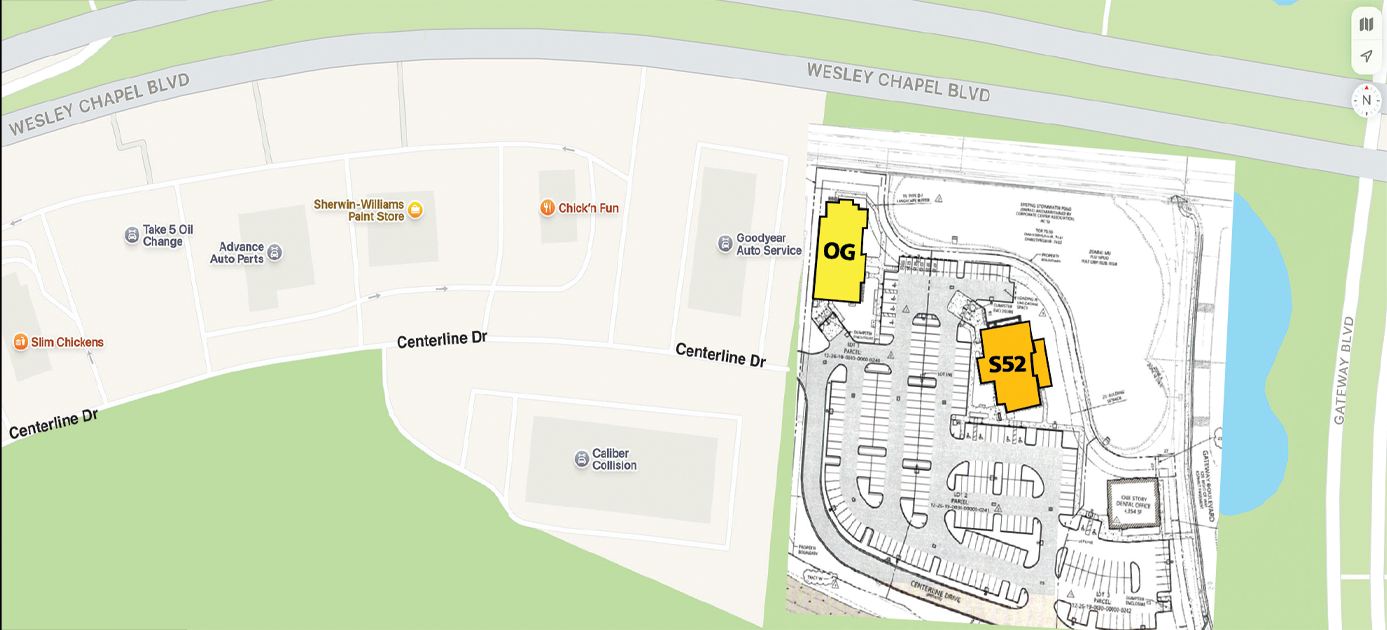
Above is an absolutely not-to-scale NN composite map showing the existing businesses on the south side of Wesley Chapel (WC) Blvd. between Old Pasco Rd. & Gateway Blvd., with the site plan for the now-under-construction Gateway Plaza Retail Center superimposed to show the approximate location of Olive Garden (believed to be “Restaurant #1” on map) and Seasons 52 (believed to be “Restaurant #2”). The project also will include a dental office that will have its entrance off Gateway Blvd. The map shows Centerline Dr., which starts behind Slim Chickens, intersecting with the new plaza, but does not properly show where WC Blvd. & Gateway Blvd. connect to it. (NN-created map sources: Google Maps & Pasco County)
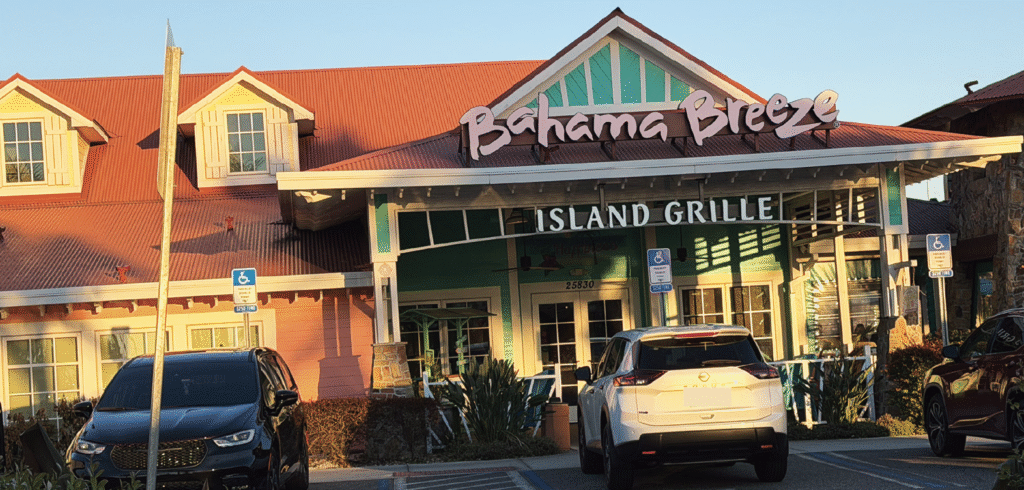
The restaurant rumor mill in the Wesley Chapel area has been swirling even more recently, with the previously announced planned closure and rebranding of the Bahama Breeze Island Grill on the north side of S.R. 56.
At almost the same time, the previously announced Olive Garden restaurant, located at the intersection of Wesley Chapel Blvd. (aka S.R. 54), Gateway Blvd. and Centerline Dr. (see map), began clearing the land for the Gateway Plaza Retail Center with Olive Garden, a dental office and a second previously unnamed restaurant.
After reading on one of the local Facebook groups that the second restaurant was going to be Seasons 52, I then had my research guy and correspondent Joel Provenzano look into the development plan and Joel did find that Seasons 52 is indeed the second restaurant coming to that site — even though Seasons 52 also was announced as one of the Darden Restaurant brands that could replace Bahama Breeze on S.R. 56.
We will keep you posted on the progress of Olive Garden and Seasons 52, but having those two Darden Brands now coming to Wesley Chapel Blvd. less than 5 miles from Bahama Breeze, seems to have narrowed even further the possible options to replace the island-themed eatery across from the Tampa Premium Outlets.
The Wesley Chapel area’s existing Darden Brands already include Longhorn Steakhouse, Chuy’s, Cheddars Scratch Kitchen and now Olive Garden and Seasons 52.
That leaves only Darden’s most upscale restaurants — Eddie V’s Prime Seafood, Ruth’s Chris Steak House and The Capital Grille, plus Yard House sports pub, with Yard House rumored (also in online chat we’ve seen) to be the front runner. But, with Bahama Breeze still 12-18 months from being repurposed and no official announcement yet forthcoming from Darden, all we can say is we’ll keep you posted.
If you happened to be driving down County Line Rd. a few weeks ago, just past Grand Hampton, you might have done a double take. We sure did. There, seemingly out of nowhere, was a brand-new traffic signal (photo below) going in at Dunham Station Dr. Curious enough on its own — but what really caught our attention was why it was being installed…especially since it didn’t appear anywhere on Pasco County’s latest comprehensive transportation projects map.
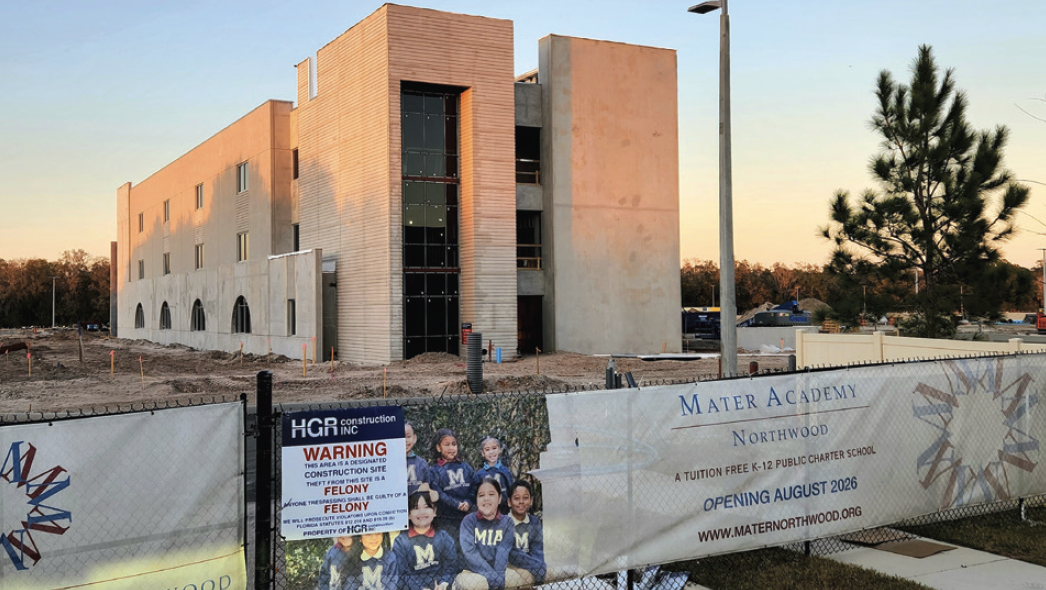
As it turns out, the signal isn’t random at all. It’s there to serve a huge, previously-under-the-radar K-12 public charter school quietly rising (top photo) at the south end of Wesley Chapel, about a mile west of Northwood.
And when we say “quietly,” we actually mean very quietly.
The school is called Mater Academy at Northwood, a tuition-free K-12 public charter school slated to open in August 2026. Until recently, most residents — including us — had no idea it was coming. Its Facebook page has had just nine followers since November, and there’s been almost no public chatter about it online.
Honestly, if it weren’t for that new traffic signal on County Line Rd., we might not have even known about the Mater Academy until it opened its doors.
The site is impressively hidden. When we drove back there out of sheer curiosity (and, of course, our ongoing commitment to nosy neighborhood journalism), we fully expected to find yet another three-story, climate-controlled self-storage facility being built.
Instead? Thankfully…a school. In Wesley Chapel. Actual, real-deal education infrastructure.
Though to be fair, that spot would have been the perfect place for self-storage. No one would have ever seen it back there.
Where Exactly Is This Located?
Mater Academy at Northwood is being built on a 15-acre site at the northern end of Dunham Station Dr., tucked behind the Woodside Trace townhomes, just north of County Line Rd. It’s barely visible from the main road.
That detail matters, because Dunham Station Dr. also serves as the second, residents-only entrance and exit for Grand Hampton. This means many Grand Hampton residents are probably thrilled about the new signal — especially since it’s just 0.3 miles west of Grand Hampton’s main entrance signal, which only first went live in July 2024.
Yes, two signals. Less than a third of a mile apart. On already-packed County Line Rd.
Déjà Vu On County Line Rd.
If this sounds familiar, it should. This story is very much a sequel to our 2024 “Cheers & Jeers” story about the new Grand Hampton entrance traffic signal. Back then, residents were split — some cheering a long-overdue safety improvement, others grumbling about backups and timing issues.
That article also pointed out what long-time locals already know: Two-lane County Line Rd. may still feel rural, but it hasn’t been truly rural for a long time. With growing neighborhoods, schools, townhomes and commercial development, traffic volumes — and turning movement times — have steadily increased.
The new Dunham Station Dr. signal continues that trend. And unlike the Grand Hampton signal, this one comes with a new westbound right turn lane (from the Pasco side) and full pedestrian crosswalks, clearly designed to manage the traffic that a large school inevitably brings.
But, will County Line Rd. ever get proper, full- length arterial sidewalks? That’s still to be determined— maybe when (or if) it ever gets widened to four lanes. But, with the North Tampa Christian Academy and a brand new Primrose School (as we reported last issue) already adding traffic on this two-lane roadway, there’s no doubt that another 700-2,500 students is not going to make traveling on County Line Rd. any easier.
How Big A School Is It?
Big. Like, really big. (See rendering right)
According to construction plans dated September 2025, the school will be built in seven total phases:
• Phase 1 includes a 3-story, 38,000-sq-ft classroom building at the entrance, currently under construction
• Phases 2-4 will add three more 3-story standalone classroom buildings and a gym, bringing the total to five buildings and 139,000 sq. ft. overall
• Phase 5 adds outdoor basketball courts and playgrounds
• Phase 6 adds a full-size sports field and an additional baseball diamond
• Phase 7 includes the 12,000-sq-ft, one-story gymnasium at the rear of the site
In total, the school is planned to serve up to a maximum of 2,500 students — 1,200 elementary, 600 middle and 700 high school.
Each student body will have 30-minute staggered start and end times. Current plans show:
• Elementary starting first at 7:30 a.m.
• High school ending last at 3:30 p.m.
Those details will likely evolve as construction progresses and subsequent phases get built-out.
Parking, Pick-Up & The ‘Shuffle’
The site includes 269 parking spaces and a three-lane-wide car drop-off and pick-up loop for most of the property, narrowing to two lanes at the end. If it operates like other charter schools, don’t be surprised if that triple-wide drop-off doubles as overflow parking during events.
It’s still unclear how many students will be accommodated in Phase 1 — although the building’s size indicates a likely maximum of 700 students in that Phase 1 building.
We also couldn’t reach anyone who could tell us whether or not all grade levels will open immediately. However, the school’s online “Student Interest Form” already lists all grades as options in the pull-down menu.
What Is Mater Academy?
Mater Academy is a Miami-based charter school network that, according to its website — MaterAcademy.org— serves 29,000+ students in 44 charter schools in Florida, Nevada and Ohio. The company’s mission statement reads:
“Mater provides a safe learning environment where academics are facilitated by teachers, administrators, parents and the community which enables students to become confident, self-directed learners in a technologically-rich, college preparatory environment through rigor, relevance and relationships.”
The Takeaway
So yes — the new traffic signal on County Line Rd. is about traffic. But, it’s also the first visible sign of a major new educational development quietly taking shape just out of sight in Wesley Chapel.
Motorists should also expect another new signal to start taking shape soon— two miles to the west at Cypress Creek Rd., as this one is shown in the county’s work plan for 2026.
So, between these new signals, growing communities, and now a massive K-12 charter campus, one thing is clear: County Line Rd. is continuing its slow transformation from “sleepy connector” to full-blown growth corridor.
And apparently, sometimes the traffic light really is the source of the news.
Parents interested in learning more about the new Mater Academy can find some information, as well as the “Student Interest Form” at MaterNorthwood.org. We did not know at our press time about any application deadline for the 2026-27 school year.
The first time I ever met new North Tampa Bay Chamber (NTBC) Board chair Tony Benge was at the NTBC’s annual meeting back in December, when he was sworn in with the rest of the NTBC’s 2026 Board of Directors and we were introduced to each other by NTBC president and CEO Hope Kennedy.
At that time, Mr. Benge and I agreed that we should sit down to discuss his vision for his tenure as the new Chamber Board chair, as well as his primary role as the president of Benge Development Corp., which has been based in Orlando since 1994, but also has one current development project in Pasco County and recently had its original Pasco development plan denied by the Board of County Commissioners.
Although neither of those projects is located in Wesley Chapel, the denied “Fletcher Project” (more on that below) was located at the intersection of S.R. 52 and U.S. Hwy. 41 in Land O’Lakes, immediately adjacent to the Moffitt Speros campus we told you about last issue.
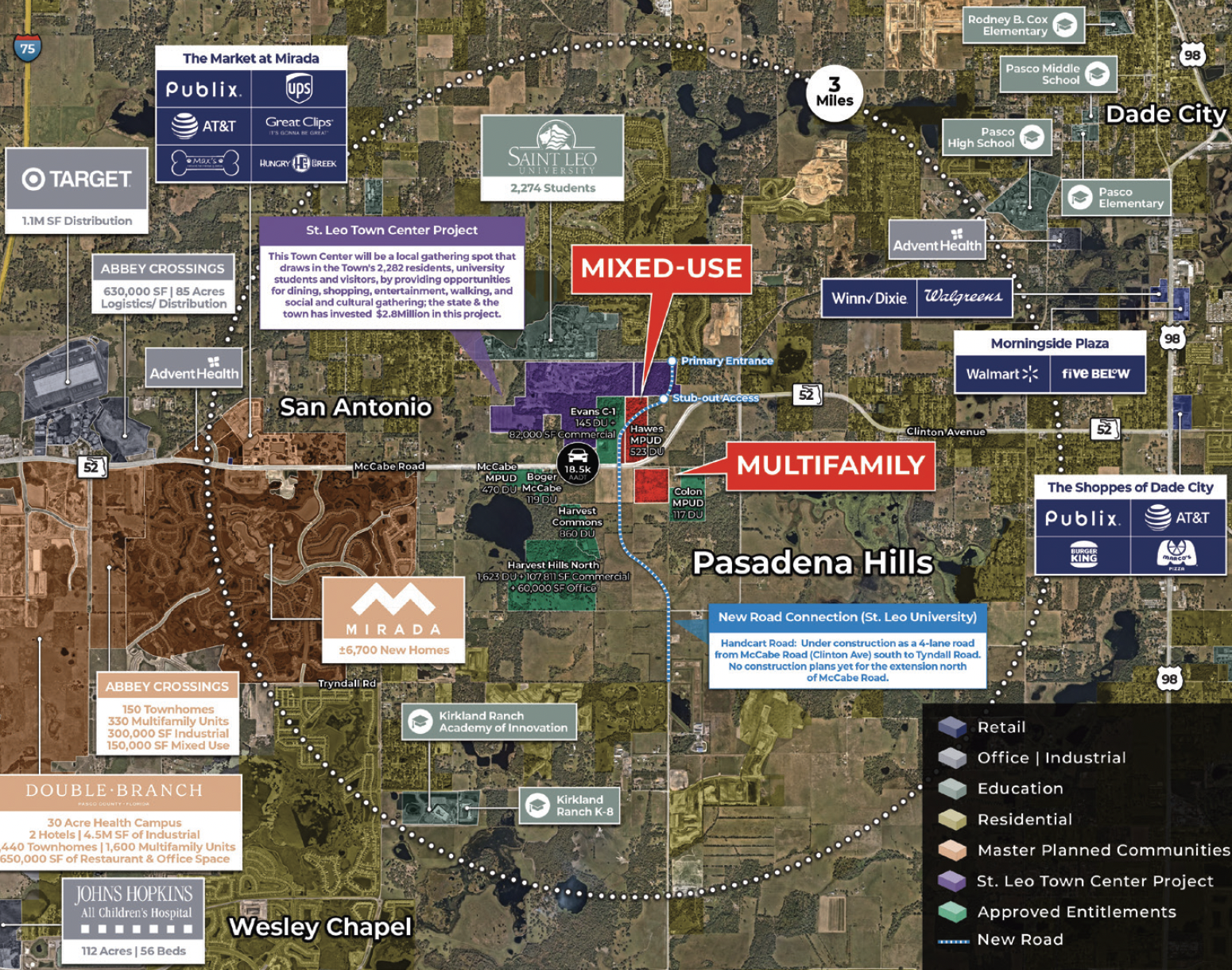
The other project, called the Hawes MPUD, which is moving forward, sits north of Wesley Chapel and east of the Mirada development. both north and south of S.R. 52, east of Handcart Rd. in San Antonio, and is approved for up to 523 multi-family units (see map below).
His Benge Development Corp. has developed more than 30 large-scale projects, mainly in Orlando and Apopka, FL.
Benge, who introduced Florida’s Lieutenant Governor Jay Collins at the NTBC Business Breakfast on Feb. 3 (see story on page 8), also asked Lt. Gov. Collins about mobility and school impact fees, subjects Benge knows a lot about because his company has to pay them every time he develops a new project.
“Impact fees have started to cripple a lot of the [development] industry,” he said to Collins. “For a typical residential unit, as an average, $30,000 per unit is now being levied. When they were originally passed, [these fees] were specifically to be limited to incremental new capacity for things like schools, roads, sewer and water treatment plants. But, we’ve paid into this now for a decade and there’s been no accountability. You can’t get any information from these counties, which seize the money, in essence. And yet, they have no new schools or anything else to point to. How do we get accountability for this?”
Collins responded, “It’s got to be statewide legislation. It can’t be executive action. It has to go through the legislature and it’s got to be codified into law. There has to be some form of accountability in that system.”
He added, however, “But, valid impact fees? I think we all agree that valid is a good word. We can do that, but the accountability has to be there. I don’t think DOGE ( (the Dept. of Government Efficiency) is something we should just do once and walk away from. I think sustained accountability and predictability for our people matters. We’re going to have to implement that.”
State Senator Danny Burgess, of course, presented a different solution when he was the guest speaker at an NTBC “Coffee & Connections” event two years ago, before DOGE even existed, saying that he wanted to see an audit of every county regarding impact fees.
Benge agreed that an audit showing how much impact fee money has been collected and what that money was spent on would be a good way to hold counties accountable for the impact fees they collect.
He says that although Pasco’s impact fees are among the highest in the state, “Osceola County’s are actually the highest. They’ve really become insane, literally. The night [Osceola] did the most recent increase, there were probably 20 developers in the audience, representing hundreds of millions of dollars in projects. I told them, ‘If you pass this, just throw our application in the trash.”
He added that for a typical 300-unit apartment complex, the developer has to pay $9 million in impact fees to get a building permit.
“I mean, we’re already building all of the roads, improvements… we’re having to do turn lanes, traffic signals, water, sewer, bus stops, all of that. And we still have to pay regular taxes and everything else.”
Benge also told me that impact fees first started back in 2000, with something called the “Martinez Doctrine,” which was named after former Orange County Chair and U.S. Sen. Mel Martinez, who served as Secretary of Housing & Urban Development under U.S. President George W. Bush. The Martinez Doctrine attempted to limit school overcrowding by requiring local developers to address school capacity issues before breaking ground.
“The idea was that growth should have to pay for itself, which makes sense,” Benge said, “But the trade-off was supposed to be that we will always have utilities and roads and services available to go along with this.
“So when these impact fees first started, I don’t know who came up with the numbers, but they’re so abominably disproportionate. We’ve actually tracked some of the apartment communities, which might have kids in only 20% of the complex’s units. So, on 300 units, I’d have maybe 60 units that have kids, I paid $6 million in impact fees for the construction of new schools, which is basically 1/3 of a whole [700-student) schoolhouse for 60 kids. And, I’m still paying taxes every year, too. These fees were supposed to only be used for new school construction, but they never gave me any data.”
Benge also said he decided to go about it a different way. “Let’s just track how many homes and apartments were built from, let’s say, 2015 through 2025. So, I made up a number, let’s say 100,000 units were built. Each one paid $14,000 per unit. Where’s that $1.4 billion? Or, list me out the new schools that’ve been built with that money, with the budget you spent on each one.
“A K-8 school right now costs $18-$20 million, a high school is upwards of $50 million, and that would house, in Orange County, up to 5,000 students. By our estimation, there should have been around 84 new schools built during that time — and they only have three.
“So, where’s all that money? [Counties aren’t] allowed to use it for [their] general funds. You can’t use it to pay more administrators. This money should be segregated out and if it’s not, this is a big issue.”
He added that many of the assumptions used by counties to set their school impact fees, “are horribly flawed. If I build a 300-unit apartment complex and a third of those units are one-bedroom units, how many kids live in one-bedroom apartments? Historical precedence says that only unless someone is building a house that isn’t ready yet, one-bedroom units don’t generate any kids, yet I still have to pay the same school impact fees for those units. It’s crazy.”
The Fletcher Project
Speaking of crazy, Benge said that his Fletcher Project — named for the family that owned the 100-acre property — was originally planned in Aug. 2024 for 350 multi-family units, about 160 townhomes and 25,000 sq. ft. of commercial uses and had been through more than a year of meetings and plans when Pasco’s commissioners voted last year to deny it.
“The big pushback was the private, never-permitted airstrip from the 1950s next door, which would have prevented us from building anything on 1/3 of the property. We agreed to not build on that portion, but we asked to have the same density on the rest of the property. So, we wouldn’t build as [many total units], and they turned us down. We started with Plan A and were up to Plan Q, and they still turned us down.”
Hawes MPUD
Despite that setback in Pasco, Benge Development is moving forward with its plan for the Hawes MPUD (marked in red on map below). The project will extend Handcart Rd. to the north, with 396 multi-family units on the south side and 127 townhomes on the north side and some neighborhood commercial (grocery store, etc.) entitlements. The Hawes project was approved in 2023, but Benge has not yet begun building at that site.
Jonathan’s Landing
Benge also is building Jonathan’s Landing, the first adult autistic facility in the U.S., in Lake Nona, FL. “It will have 5,000 beds and bring 5,000 jobs to that area,” Benge said. “My friend, Jason Eichenholz, has a son named Jonathan who is an adult with autism. This will help so many adults because state support for [developmentally disabled] people ends at age 18.”
Look for more info about Tony Benge and his vision for the NTBC in our next issue.
Anytime businesses — especially restaurants — go out of business in (or near) our distribution areas, I do feel their pain a little — although some more than others.
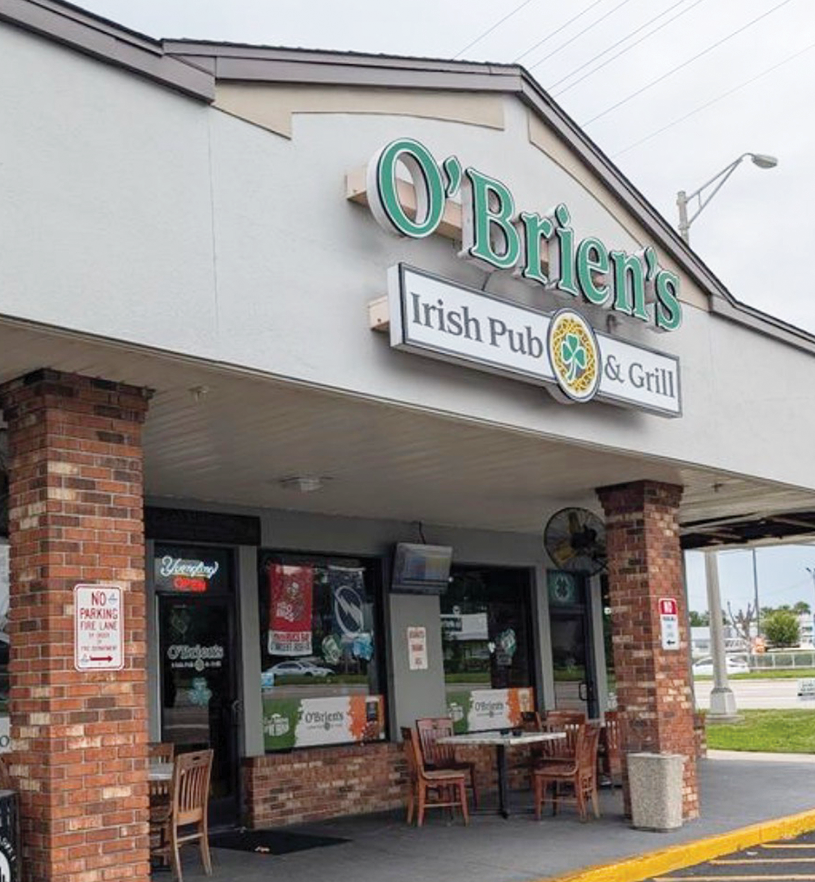
Case in point: Over the past couple of weeks, both the Bahama Breeze Island Grille (above) located at 25830 Sierra Center Blvd. (across S.R. 56 from the Tampa Premium Outlets) and the O’Brien’s Irish Pub & Grill at 5429 Village Market announced they were closing, albeit for different reasons.
Bahama Breeze, which is owned by Darden Restaurants, is closing all 28 of its remaining locations across the U.S., according to a Feb. 3 Darden news release, after previously shuttering a third of its locations in 2025.
Half of those remaining locations — including the one in Lutz/Wesley Chapel — will be converted to other Darden brands (see below), although it was not disclosed which locations would be converted into which brands.
The other 14 Bahama Breezes will close permanently on April 5. The 14 remaining open, including ten of the 14 in Florida, where the brand first opened in the 1990s, will remain open for the next 12-18 months, although there will likely be some temporary closures along the way, as needed for them to be converted.
The list of Darden brands still operating include a number of more upscale brands that many locals, after first reading about this news on social media, are hopeful will find a home at the location on S.R. 56. Here is that list of possible Darden brands our Bahama Breeze could become:
• Eddie V’s Prime Seafood
• Ruth’s Chris Steak House
• The Capital Grille
• Seasons 52
• Yard House
• Olive Garden Italian Kitchen
• Cheddar’s Scratch Kitchen
• Longhorn Steakhouse
• Chuy’s
Of course, Cheddars, Longhorn and Chuy’s all already have locations on S.R. 56 and many of us saw announcements that an undeveloped parcel on Wesley Chapel Blvd. to the east of Chick’n Fun already is supposed to be an Olive Garden. At our press time, however, we were unable to get confirmation as to whether or not Olive Garden is still coming to 27391 Centerline Dr., just west of Gateway Blvd., the plans for which were apparently submitted in Aug. 2025, or whether that location would preclude another Olive Garden being opened in the former Bahama Breeze spot.
Obviously, the first four or five (as most people would probably also be OK with Yard House) Darden brands on the list would be the most desirable to locals, but we will keep you posted on any such announcements.
O’Brien’s To Close February 21!
Meanwhile, in a Facebook post released on Feb. 2, Randy and Mike Goodwin, the owners of the O’Brien’s location in the Village Market (left) for right about 10 years, said that they will be hosting “An Irish Goodbye” party on Saturday, February 21, after which that O’Brien’s location would close permanently, “at the conclusion of our 10-year lease.”
The Facebook post said, “It is with full hearts, deep gratitude, and a touch of sadness that we share the news that O’Brien’s will be closing our doors [by] the end of February…At the end of 2024, the Village Market strip center was sold, and in early 2025, we began discussions with the new ownership (JBL Asset Management) in hopes of securing a renewed lease. Unfortunately, despite our best efforts, we were unable to reach an agreement that felt sustainable for both sides. After much consideration, we made the difficult decision not to renew.”
There has been a huge outpouring of support for O’Brien’s, which has been the only full-band live music venue in Wesley Chapel pretty much since the day it opened, so I’m hoping that hundreds of those supporters will come out to say goodbye to Mike, Randy and their wonderful staff.
The event will feature O’Brien’s “beloved corned beef & cabbage,” as well as bagpipe music from Emma Briggs, Irish music from Captain Kirk and DJ Aloha Kev closing out the event — and the restaurant. It’ s just a shame we couldn’t get one final O’Brien’s St. Patrick’s Day event this year.
For more info about the O’Brien’s “Irish Goodbye” party, see the ad below.-GN
Siyana Khan (left) & Nicole Huynh started “Hydrating for Hope” to help vulnerable Florida residents better deal with the upcoming summer heat. (Photos provided by Siyana Khan)
While some Floridians grew tired of the prolonged cold we experienced in the early weeks of 2026, Wiregrass Ranch High (WRH) sophomores Siyana Khan and Nicole Huynh know the heat is coming. Soon. Fast. Difficult for those without air conditioning and, especially, proper hydration, to survive.
As student athletes, Siyana and Nicole have both experienced some of the consequences of dehydration. “I’ve had sunburns, heat exhaustion and even strong nausea from not hydrating myself completely,” says Nicole, who is a member of the WRH color guard.
Siyana had lived in New Jersey for 10 years and wasn’t used to the heat, so playing flag football in Florida proved to be overwhelming for her. “When I moved to Florida, I wasn’t hydrating properly,” Siyana says. “I actually passed out and had to go to the ER, and was diagnosed with orthostatic hypotension (abnormally low blood pressure) because of dehydration.”
The girls teamed together and used their shared experiences to consider how others may need help when Florida’s heat takes hold.
“We created ‘Hydrating for Hope,’” Siyana explains. “It’s a local community service initiative dedicated to hydrating and serving those around us. Many vulnerable communities around Tampa Bay suffer in this hot environment, making them more susceptible to [several] heat-related illnesses.”
They began collecting heat-related essentials and also raised $1,260 through GoFundMe to purchase additional supplies.
Their efforts have allowed them to purchase nearly 1,200 items, including bottles of water, reusable water bottles, Gatorade, sunglasses, hats and portable electric and paper fans.
These items will be donated to homeless shelters and organizations that help vulnerable populations, such as Better Together, a Naples, FL-based nonprofit organization with a Tampa Bay-area chapter that is focused on preventing foster care by supporting families in crisis.
“I was genuinely moved by [Siyana and Nicole’s] passion for serving their community,” says Joy Harris, executive director of Better Together. “It was clear in our conversation that this initiative is coming from a place of deep compassion and a desire to make a tangible difference for others.”
Siyana and Nicole also worked with 100 students, including their peers at WRH and some at John Long Middle School, as well as The Learning Experience of New Tampa, to create 140 handwritten cards (above) for family members who are being served by Better Together.
The recent Hydrating for Hope event at WRH.
“Their efforts not only provide encouragement to those receiving the cards,” Joy says, “they also inspire others to step up and look for ways to support their neighbors. I am grateful for the opportunity to partner with students like these and for the chance to see the next generation lead with such heart and intentionality.”
The girls have become close friends through their time at the WRH Future Business Leaders of America (FBLA) club. They plan to enter a statewide FBLA competition for community service projects this summer. They also are considering creating their own 501(c)(3) nonprofit organization to be able to continue doing the work they’ve started through their Hydrating for Hope project.
“We hope to hold more events, like when we held an event to write cards,” Siyana explains, “and also make bracelets or other crafts, too.”
They hope their initiative will not only help those who are vulnerable, but will also provide awareness of heat-related problems for all of those living in Florida.
To learn more about Hydrating for Hope, visit Hydrating4Hope to link to its Instagram, GoFundMe, donation list on Amazon and more.