O’Brien’s Irish Pub & Bahama Breeze Both Closing Local Locations

Anytime businesses — especially restaurants — go out of business in (or near) our distribution areas, I do feel their pain a little — although some more than others. 

Case in point: Over the past couple of weeks, both the Bahama Breeze Island Grille (above) located at 25830 Sierra Center Blvd. (across S.R. 56 from the Tampa Premium Outlets) and the O’Brien’s Irish Pub & Grill at 5429 Village Market announced they were closing, albeit for different reasons. 

Bahama Breeze, which is owned by Darden Restaurants, is closing all 28 of its remaining locations across the U.S., according to a Feb. 3 Darden news release, after previously shuttering a third of its locations in 2025. 

Half of those remaining locations — including the one in Lutz/Wesley Chapel — will be converted to other Darden brands (see below), although it was not disclosed which locations would be converted into which brands. 

The other 14 Bahama Breezes will close permanently on April 5. The 14 remaining open, including ten of the 14 in Florida, where the brand first opened in the 1990s, will remain open for the next 12-18 months, although there will likely be some temporary closures along the way, as needed for them to be converted. 

The list of Darden brands still operating include a number of more upscale brands that many locals, after first reading about this news on social media, are hopeful will find a home at the location on S.R. 56. Here is that list of possible Darden brands our Bahama Breeze could become: 

• Eddie V’s Prime Seafood 

• Ruth’s Chris Steak House 

• The Capital Grille 

• Seasons 52 

• Yard House 

• Olive Garden Italian Kitchen 

• Cheddar’s Scratch Kitchen 

• Longhorn Steakhouse 

• Chuy’s 

Of course, Cheddars, Longhorn and Chuy’s all already have locations on S.R. 56 and many of us saw announcements that an undeveloped parcel on Wesley Chapel Blvd. to the east of Chick’n Fun already is supposed to be an Olive Garden. At our press time, however, we were unable to get confirmation as to whether or not Olive Garden is still coming to 27391 Centerline Dr., just west of Gateway Blvd., the plans for which were apparently submitted in Aug. 2025, or whether that location would preclude another Olive Garden being opened in the former Bahama Breeze spot. 

Obviously, the first four or five (as most people would probably also be OK with Yard House) Darden brands on the list would be the most desirable to locals, but we will keep you posted on any such announcements. 

Meanwhile, in a Facebook post released on Feb. 2, Randy and Mike Goodwin, the owners of the O’Brien’s location in the Village Market (left) for right about 10 years, said that they will be hosting “An Irish Goodbye” party on Saturday, February 21, after which that O’Brien’s location would close permanently, “at the conclusion of our 10-year lease.” 

The Facebook post said, “It is with full hearts, deep gratitude, and a touch of sadness that we share the news that O’Brien’s will be closing our doors [by] the end of February…At the end of 2024, the Village Market strip center was sold, and in early 2025, we began discussions with the new ownership (JBL Asset Management) in hopes of securing a renewed lease. Unfortunately, despite our best efforts, we were unable to reach an agreement that felt sustainable for both sides. After much consideration, we made the difficult decision not to renew.” 

There has been a huge outpouring of support for O’Brien’s, which has been the only full-band live music venue in Wesley Chapel pretty much since the day it opened, so I’m hoping that hundreds of those supporters will come out to say goodbye to Mike, Randy and their wonderful staff. 

The event will feature O’Brien’s “beloved corned beef & cabbage,” as well as bagpipe music from Emma Briggs, Irish music from Captain Kirk and DJ Aloha Kev closing out the event — and the restaurant. It’ s just a shame we couldn’t get one final O’Brien’s St. Patrick’s Day event this year. 

For more info about the O’Brien’s “Irish Goodbye” party, see the ad below.-GN 

Wiregrass Ranch High Sophomores Help Vulnerable People Get Ready For The Heat

Siyana Khan (left) & Nicole Huynh started “Hydrating for Hope” to help vulnerable Florida residents better deal with the upcoming summer heat. (Photos provided by Siyana Khan) 

While some Floridians grew tired of the prolonged cold we experienced in the early weeks of 2026, Wiregrass Ranch High (WRH) sophomores Siyana Khan and Nicole Huynh know the heat is coming. Soon. Fast. Difficult for those without air conditioning and, especially, proper hydration, to survive. 

As student athletes, Siyana and Nicole have both experienced some of the consequences of dehydration. “I’ve had sunburns, heat exhaustion and even strong nausea from not hydrating myself completely,” says Nicole, who is a member of the WRH color guard. 

Siyana had lived in New Jersey for 10 years and wasn’t used to the heat, so playing flag football in Florida proved to be overwhelming for her. “When I moved to Florida, I wasn’t hydrating properly,” Siyana says. “I actually passed out and had to go to the ER, and was diagnosed with orthostatic hypotension (abnormally low blood pressure) because of dehydration.” 

The girls teamed together and used their shared experiences to consider how others may need help when Florida’s heat takes hold. 

“We created ‘Hydrating for Hope,’” Siyana explains. “It’s a local community service initiative dedicated to hydrating and serving those around us. Many vulnerable communities around Tampa Bay suffer in this hot environment, making them more susceptible to [several] heat-related illnesses.” 

They began collecting heat-related essentials and also raised $1,260 through GoFundMe to purchase additional supplies. 

Their efforts have allowed them to purchase nearly 1,200 items, including bottles of water, reusable water bottles, Gatorade, sunglasses, hats and portable electric and paper fans. 

These items will be donated to homeless shelters and organizations that help vulnerable populations, such as Better Together, a Naples, FL-based nonprofit organization with a Tampa Bay-area chapter that is focused on preventing foster care by supporting families in crisis. 

“I was genuinely moved by [Siyana and Nicole’s] passion for serving their community,” says Joy Harris, executive director of Better Together. “It was clear in our conversation that this initiative is coming from a place of deep compassion and a desire to make a tangible difference for others.” 

Siyana and Nicole also worked with 100 students, including their peers at WRH and some at John Long Middle School, as well as The Learning Experience of New Tampa, to create 140 handwritten cards (above) for family members who are being served by Better Together. 

The recent Hydrating for Hope event at WRH.

“Their efforts not only provide encouragement to those receiving the cards,” Joy says, “they also inspire others to step up and look for ways to support their neighbors. I am grateful for the opportunity to partner with students like these and for the chance to see the next generation lead with such heart and intentionality.” 

The girls have become close friends through their time at the WRH Future Business Leaders of America (FBLA) club. They plan to enter a statewide FBLA competition for community service projects this summer. They also are considering creating their own 501(c)(3) nonprofit organization to be able to continue doing the work they’ve started through their Hydrating for Hope project. 

“We hope to hold more events, like when we held an event to write cards,” Siyana explains, “and also make bracelets or other crafts, too.” 

They hope their initiative will not only help those who are vulnerable, but will also provide awareness of heat-related problems for all of those living in Florida. 

To learn more about Hydrating for Hope, visit Hydrating4Hope to link to its Instagram, GoFundMe, donation list on Amazon and more.

Who Actually Pays For Our Roads? A Primer On Pasco’s Mobility/Impact Fees

Editor’s note — The motivation for writing this story came from a post by Kelly Gilroy on her outstanding Pasco County Development & Growth Updates Facebook page. Former Florida Department of Transportation engineer — and, of course, Neighborhood News correspondent Joel Provenzano agreed that it was worth a deeper dive into what Kelly so perfectly presented. — GN 

If you’ve driven around Wesley Chapel lately, you don’t need a traffic study to know one thing: Pasco County is growing fast. New neighborhoods, shopping centers, hospitals and medical offices and industrial parks seem to pop up overnight. With all of that growth comes an obvious question: 

Who actually pays for the roads, sidewalks, and transportation infrastructure we all use? 

The simple answer, of course, is “all of us,” but one of the biggest pieces of that answer is something called “mobility” (aka “impact”) fees. 

Mobility fees are one-time charges paid by developers each time a new building permit is issued. These fees help pay for the transportation improvements needed to support new growth, such as: 

• New or widened roads 

• Turn lanes and intersections 

• Sidewalks and bike paths 

• Other transportation facilities tied to development 

In simple terms: new development helps pay for the new infrastructure it requires — and Pasco County has some of the highest impact fees of any county in Florida. 

These fees don’t replace gas taxes or sales taxes, but they work alongside them to fund transportation 

It’s also important to note that mobility fees are just one type of impact fee charged on new development in Pasco County. New construction is also subject to school impact fees, which help fund new schools and classroom capacity. And, park impact fees are used for land acquisition and creating new recreational facilities. 

Together, transportation, school and park impact fees make up the bulk of the one-time charges paid when new homes and commercial projects are built. When combined, Pasco County’s total impact fee burden is often cited as among the highest in the region, reflecting both its rapid growth and the scale of infrastructure needed to support that growth 

Construction costs have skyrocketed in recent years. Roadway materials, labor and engineering costs have all increased — often sharply. Because of this, mobility fees have to be periodically updated to reflect the real cost of building roads today, instead of the costs from ten years ago. 

Pasco County is allowed to update its mobility fee schedule every four years, and those updates are reviewed and recommended by the county’s Planning Commission, which looks at growth projections, construction costs and long-term transportation needs. 

According to the county, Pasco is projected to add approximately 330,000 new residents over the next 20 to 25 years, requiring roughly 950 new lane miles of roads. Even with existing revenue sources, projected funding falls short of the need —which is why mobility fees matter. 

Here’s a concrete example that helps put things in perspective: 

• A single-family home built in Pasco in 2026 will carry a one-time mobility fee of $11,660 that is paid by the builder. 

• That money goes into county coffers for roads, sidewalks and transportation facilities. 

The fee is paid once — not annually, and not by the homeowner directly at tax time. A common question is whether mobility and other impact fees on new homes are ultimately passed along to homebuyers. While opinions vary, there is little evidence this is happening in today’s market. 

In many cases, new-construction homes in Pasco are priced equal to — or even less than —c comparable resale homes, which carry no such fees. Builders are also routinely offering substantial incentives, including covering large portions of closing costs and providing builder-financed mortgages with rates currently as low as 3.99% for 30 years. 

Based on current pricing trends and transaction data, impact fees do not appear to be quietly “added back” elsewhere in the deal. As a result, despite these one-time development fees, new construction remains one of the most competitive and accessible options for buyers today. 

This is where things get nuanced — and are often misunderstood by homeowners. 

Pasco County doesn’t charge the same mobility fees to every type of development. Instead, it offers incentives to encourage certain kinds of businesses that bring higher-paying jobs and long-term economic growth, including medical & professional offices, industrial, logistics, warehouses, distribution centers and hotels 

These uses currently receive a 100% incentive, meaning they pay $0 in mobility fees. 

On the other hand, a fast-food restaurant with a drive-through might be charged a mobility fee of around $80,569, because it receives only a 25% incentive. 

Why the difference? County officials have been clear about their goal: “Pasco is open for business,” especially for industries that diversify the tax base and bring higher-wage jobs to the county. 

This is where something called Tax Increment Financing (TIF) comes in. 

TIF is often mentioned alongside mobility fees, but they work very differently: 

• Mobility fees are one-time payments made upfront by developers. 

• TIF uses future property tax growth to fund infrastructure over time. 

Pasco County, “locks in” property tax values at a base year (2012 for unincorporated Pasco). As development happens and property values rise, the increase in tax revenue — the “increment” — is set aside. 

About 33% of that increment is dedicated specifically to transportation improvements. 

Those TIF funds are then used to “buy down” mobility fees for targeted developments like offices, industrial sites and hotels. In other words, the county — and its taxpayers — still funds the roads, but with future tax growth instead of charging those businesses up front for them. 

Mobility fees aren’t the only way roads and infrastructure come online: 

• Developers often build roads, turn lanes and/or sidewalks themselves as part of their residential or commercial projects and dedicate them to the county. 

• If those improvements benefit more than just the residents of those developments, the developers can apply for mobility fee credits. 

• Some communities (including many in Wesley Chapel) are built with Community Development Districts (CDDs) — quasi-governmental entities that maintain roads, sidewalks and landscaping within the developments themselves, rather than the county taking on that responsibility long-term. 

This approach shifts some maintenance costs away from the county and onto the developments that directly benefit from them. 

At the end of the day, mobility fees are about matching new growth with new infrastructure — and making sure existing residents aren’t left paying the full bill for new development. 

Mobility fees are imperfect, complex and often controversial. But without them, Pasco County would face even larger funding gaps, even slower road improvements and even more pressure on general taxes. 

As Pasco continues to grow, understanding how these fees work can help you better engage in conversations about development, transportation and the future of our community. 

The growth is coming, no matter what. The real question is how we plan and pay for it. 

And, most people sitting in traffic every day in Wesley Chapel believe that they are the ones paying for it — and that whatever money is coming in isn’t either not enough or not being spent fast enough to keep up — and no, they’re not wrong. 

Another Morris Bridge Road Closure Ahead (Feb. 16–23)

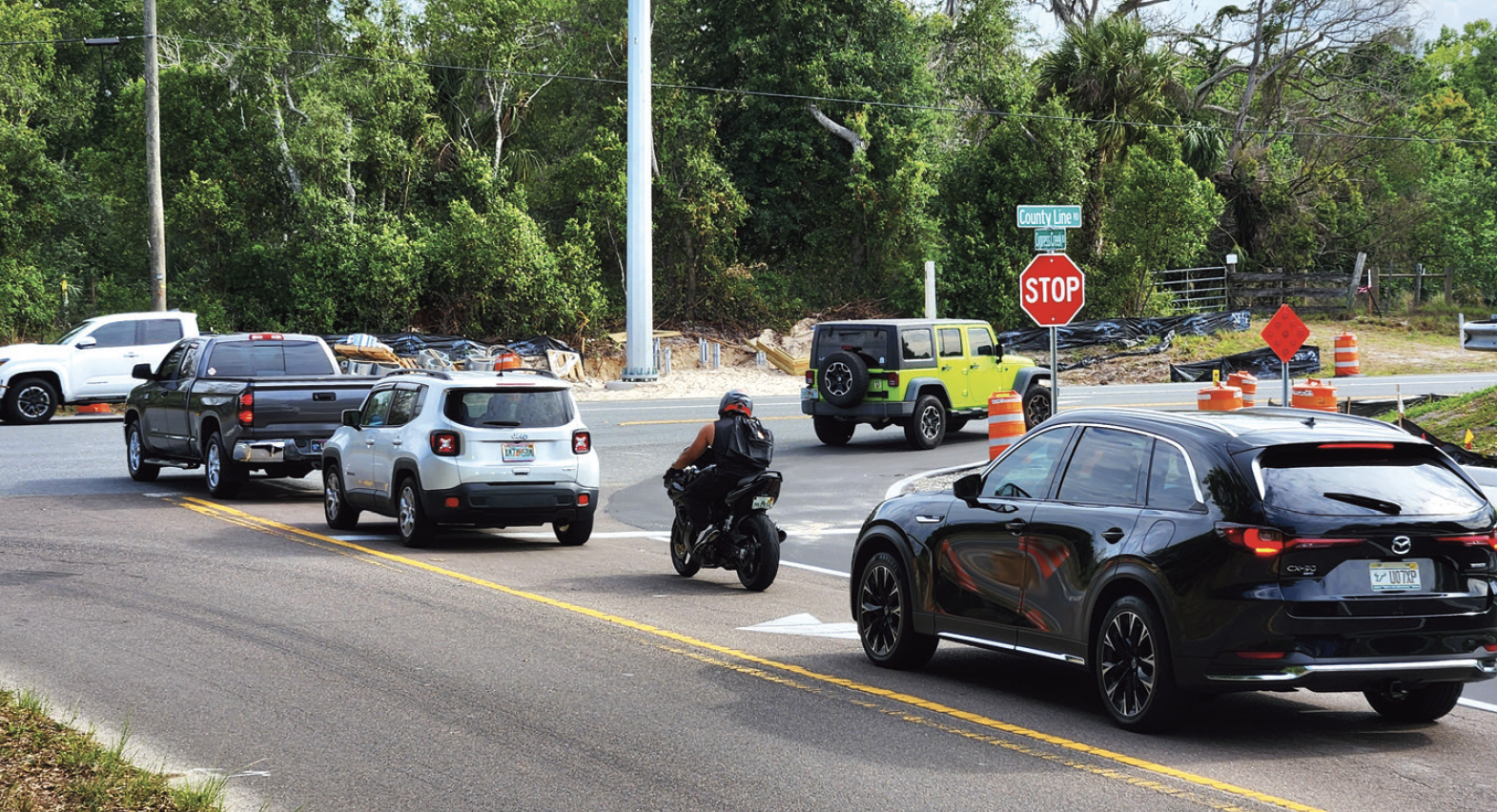
Residents and motorists who use Morris Bridge Rd. should prepare for another full road closure tomorrow — Monday, February 16 â€” as Hillsborough County continues stormwater repairs along the corridor.

According to electronic message boards already placed along the roadway, Morris Bridge Rd. will be closed from February 16 through Monday, February 23, to allow crews to replace an under-road culvert immediately north of Cory Lake Blvd. The culvert currently is covered by steel plates.

This closure follows the Dec. 8–Dec. 22 shutdown near Bonnet Hole Dr., discussed in our January issues, which frustrated many residents due to long detours and limited alternative routes. That work occurred roughly a quarter-mile north of the upcoming project area.

The current project involves removing and replacing an aging 30-inch reinforced concrete pipe (RCP), cleaning and sealing a nearby catch basin, replacing the end treatment and restoring pavement per county standards. The project budget totals $230,000, all allocated to construction.

Hillsborough County has emphasized that Morris Bridge Rd. is particularly vulnerable to flooding. In a December update on their website, the county noted what residents knew— that the roadway was compromised during a 100-year flood event when Hurricane Milton struck in 2024, underscoring the need for continued stormwater improvements.

The road runs through the Hillsborough River Watershed, one of the county’s largest, and contains multiple drainage systems beneath the pavement designed to move heavy rainfall toward the river. Its location within the floodplain — and its seven-mile stretch with few intersections — also explains why detours are unusually long whenever the road is closed.

During the closure:
• Morris Bridge Rd. will be fully shut down from Cory Lake Blvd. to approximately 800 feet north at Cedar Cove Dr.

• The eastern entrance to Cory Lake Isles — Cory Lake Blvd. — will remain accessible to traffic traveling to and from I-75.
• Only local traffic will be permitted southbound past Cross Creek Blvd.; non-local traffic will be detoured west toward Bruce B. Downs Blvd.

• All Hillsborough County parks along Morris Bridge Rd. located south of the construction zone will remain open, but access will be from I-75 only, with drivers required to return the same way.

County officials have previously stated that full closures allow work to be completed faster and more safely than staged lane closures on narrow, two-lane roads like Morris Bridge Rd.

As Hillsborough County continues stormwater repairs along this critical corridor, residents should expect additional periodic disruptions and plan extra travel time during closure periods. Additional stormwater-related work on Morris Bridge Rd. is anticipated later in 2026.

So, What Actually Qualifies Someone To Be An ‘Influencer?’

Before this past year, the only people I had ever heard of who were referred to as “influencers” were national and worldwide celebrities. 

But, as the months went by in 2025, it seemed that half the people I met whenever Jannah, Charmaine and I would visit a new restaurant for the first time were either calling themselves or, more often, being referred to by the owners of those restaurants as “influencers.” Several were actually invited to be there to help the restaurants announce their respective openings, while yours truly had to drive by the places months before they were set to open, write about them multiple times and follow up still more times in order to attend their soft openings, “Friends & family” pre-openings or the actual openings of the places. 

When I’ve asked some of these restaurant owners why they invited some of these influencers — many of whom I’ve had really nice chats with at these events; some of whom have even told me they’re “fans” of mine, the Neighborhood News or both — at least three or four restaurant owners have told me, “We always try to invite local influencers to help get the word out for us.” O.K. 

Hey, I know I’m old school, but I can see now why so many young people are iPhone-recording every moment of their lives in an effort to become influencers. But, since I didn’t have any idea how many of them actually qualify for the title — or what criteria actually makes them able to qualify for it — I decided to do a little Google/ AI searching to try to find out what those criteria are and whether or not I and the Neighborhood News already meet those qualifications. 

Here’s what I found: 

Key Characteristics of an Influencer: 

Authority/Expertise: They are seen as knowledgeable or an expert in a specific field. √ 

Audience & Reach: They have a dedicated following on platforms like Instagram, TikTok, YouTube, etc. (OK, not so much, at least not yet) 

Trust & Authenticity: Followers trust their recommendations & value their perspective. √ 

Niche Focus: They typically focus on a particular interest area (e.g.,New Tampa?) √ 

Content Creation: They consistently produce engaging, entertaining/informative content. √ 

Engagement: They actively interact with their community, building relationships. √ 

Impact: Their endorsements or opinions can sway followers’ behaviors and buying choices, making them valuable partners for brands. √ 

Types of Influencers by Follower Count: 

Nano Influencers – 1k-10k followers. Nano influencers have a following ranging from 1,000-10,000 followers and are considered to be mid-tier influencers. Influencers in this category can earn anywhere from $50 to $250 per sponsored post. (Ummm, no!) 

Micro Influencers – 10k-100k followers. Micro influencers are defined as having between 10k-100k followers. Despite having a larger following than nano influencers, they still manage to maintain a similar “relatability” or “authenticity” factor. Which, in turn, means they still have high engagement rates. Often, micro influencers fall into a particular niche or influencer category that can be specific to a particular location, job, or hobby. √ 

Most of the local influencers I’ve looked up fall into one of these first two categories. The difference between them and us is that they have more followers on TikTok or Instagram (IG) than we do, although our Facebook numbers (17,000+ followers) would put us in the “Micro” category — if Facebook even “counts.” We only started attempting to increase our Instagram following about four months ago, and we’ve increased our number of IG followers from about 100 at that time to more than 700 today 

At any rate, I’m proud that we had nearly 3 million views of our 350 Facebook posts in 2025, led by our top-10 posts of the year in this chart. 

And that doesn’t include the number of you who still read — and dare I say, are “influenced” by us the old-fashioned way — by holding our publications in your hands and reading them. 

You’re still the main reason so many advertisers are willing to spend money with us in a supposedly dead medium — so, thank you!