If you happened to be driving down County Line Rd. a few weeks ago, just past Grand Hampton, you might have done a double take. We sure did. There, seemingly out of nowhere, was a brand-new traffic signal (photo below) going in at Dunham Station Dr. Curious enough on its own — but what really caught our attention was why it was being installed…especially since it didn’t appear anywhere on Pasco County’s latest comprehensive transportation projects map.
As it turns out, the signal isn’t random at all. It’s there to serve a huge, previously-under-the-radar K-12 public charter school quietly rising (top photo) at the south end of Wesley Chapel, about a mile west of Northwood.
And when we say “quietly,” we actually mean very quietly.
The school is called Mater Academy at Northwood, a tuition-free K-12 public charter school slated to open in August 2026. Until recently, most residents — including us — had no idea it was coming. Its Facebook page has had just nine followers since November, and there’s been almost no public chatter about it online.
Honestly, if it weren’t for that new traffic signal on County Line Rd., we might not have even known about the Mater Academy until it opened its doors.
The site is impressively hidden. When we drove back there out of sheer curiosity (and, of course, our ongoing commitment to nosy neighborhood journalism), we fully expected to find yet another three-story, climate-controlled self-storage facility being built.
Instead? Thankfully…a school. In Wesley Chapel. Actual, real-deal education infrastructure.
Though to be fair, that spot would have been the perfect place for self-storage. No one would have ever seen it back there.
Where Exactly Is This Located?
Mater Academy at Northwood is being built on a 15-acre site at the northern end of Dunham Station Dr., tucked behind the Woodside Trace townhomes, just north of County Line Rd. It’s barely visible from the main road.
That detail matters, because Dunham Station Dr. also serves as the second, residents-only entrance and exit for Grand Hampton. This means many Grand Hampton residents are probably thrilled about the new signal — especially since it’s just 0.3 miles west of Grand Hampton’s main entrance signal, which only first went live in July 2024.
Yes, two signals. Less than a third of a mile apart. On already-packed County Line Rd.
Déjà Vu On County Line Rd.
If this sounds familiar, it should. This story is very much a sequel to our 2024 “Cheers & Jeers” story about the new Grand Hampton entrance traffic signal. Back then, residents were split — some cheering a long-overdue safety improvement, others grumbling about backups and timing issues.
That article also pointed out what long-time locals already know: Two-lane County Line Rd. may still feel rural, but it hasn’t been truly rural for a long time. With growing neighborhoods, schools, townhomes and commercial development, traffic volumes — and turning movement times — have steadily increased.
The new Dunham Station Dr. signal continues that trend. And unlike the Grand Hampton signal, this one comes with a new westbound right turn lane (from the Pasco side) and full pedestrian crosswalks, clearly designed to manage the traffic that a large school inevitably brings.
But, will County Line Rd. ever get proper, full- length arterial sidewalks? That’s still to be determined— maybe when (or if) it ever gets widened to four lanes. But, with the North Tampa Christian Academy and a brand new Primrose School (as we reported last issue) already adding traffic on this two-lane roadway, there’s no doubt that another 700-2,500 students is not going to make traveling on County Line Rd. any easier.
How Big A School Is It?
Big. Like, really big. (See rendering right)
According to construction plans dated September 2025, the school will be built in seven total phases:
• Phase 1 includes a 3-story, 38,000-sq-ft classroom building at the entrance, currently under construction
• Phases 2-4 will add three more 3-story standalone classroom buildings and a gym, bringing the total to five buildings and 139,000 sq. ft. overall
• Phase 5 adds outdoor basketball courts and playgrounds
• Phase 6 adds a full-size sports field and an additional baseball diamond
• Phase 7 includes the 12,000-sq-ft, one-story gymnasium at the rear of the site
In total, the school is planned to serve up to a maximum of 2,500 students — 1,200 elementary, 600 middle and 700 high school.
Each student body will have 30-minute staggered start and end times. Current plans show:
• Elementary starting first at 7:30 a.m.
• High school ending last at 3:30 p.m.
Those details will likely evolve as construction progresses and subsequent phases get built-out.
Parking, Pick-Up & The ‘Shuffle’
The site includes 269 parking spaces and a three-lane-wide car drop-off and pick-up loop for most of the property, narrowing to two lanes at the end. If it operates like other charter schools, don’t be surprised if that triple-wide drop-off doubles as overflow parking during events.
It’s still unclear how many students will be accommodated in Phase 1 — although the building’s size indicates a likely maximum of 700 students in that Phase 1 building.
We also couldn’t reach anyone who could tell us whether or not all grade levels will open immediately. However, the school’s online “Student Interest Form” already lists all grades as options in the pull-down menu.
What Is Mater Academy?
Mater Academy is a Miami-based charter school network that, according to its website — MaterAcademy.org— serves 29,000+ students in 44 charter schools in Florida, Nevada and Ohio. The company’s mission statement reads:
“Mater provides a safe learning environment where academics are facilitated by teachers, administrators, parents and the community which enables students to become confident, self-directed learners in a technologically-rich, college preparatory environment through rigor, relevance and relationships.”
The Takeaway
So yes — the new traffic signal on County Line Rd. is about traffic. But, it’s also the first visible sign of a major new educational development quietly taking shape just out of sight in Wesley Chapel.
Motorists should also expect another new signal to start taking shape soon— two miles to the west at Cypress Creek Rd., as this one is shown in the county’s work plan for 2026.
So, between these new signals, growing communities, and now a massive K-12 charter campus, one thing is clear: County Line Rd. is continuing its slow transformation from “sleepy connector” to full-blown growth corridor.
And apparently, sometimes the traffic light really is the source of the news.
Parents interested in learning more about the new Mater Academy can find some information, as well as the “Student Interest Form” at MaterNorthwood.org. We did not know at our press time about any application deadline for the 2026-27 school year.
The first time I ever met new North Tampa Bay Chamber (NTBC) Board chair Tony Benge was at the NTBC’s annual meeting back in December, when he was sworn in with the rest of the NTBC’s 2026 Board of Directors and we were introduced to each other by NTBC president and CEO Hope Kennedy.
At that time, Mr. Benge and I agreed that we should sit down to discuss his vision for his tenure as the new Chamber Board chair, as well as his primary role as the president of Benge Development Corp., which has been based in Orlando since 1994, but also has one current development project in Pasco County and recently had its original Pasco development plan denied by the Board of County Commissioners.
Although neither of those projects is located in Wesley Chapel, the denied “Fletcher Project” (more on that below) was located at the intersection of S.R. 52 and U.S. Hwy. 41 in Land O’Lakes, immediately adjacent to the Moffitt Speros campus we told you about last issue.
The other project, called the Hawes MPUD, which is moving forward, sits north of Wesley Chapel and east of the Mirada development. both north and south of S.R. 52, east of Handcart Rd. in San Antonio, and is approved for up to 523 multi-family units (see map below).
His Benge Development Corp. has developed more than 30 large-scale projects, mainly in Orlando and Apopka, FL.
Benge, who introduced Florida’s Lieutenant Governor Jay Collins at the NTBC Business Breakfast on Feb. 3 (see story on page 8), also asked Lt. Gov. Collins about mobility and school impact fees, subjects Benge knows a lot about because his company has to pay them every time he develops a new project.
“Impact fees have started to cripple a lot of the [development] industry,” he said to Collins. “For a typical residential unit, as an average, $30,000 per unit is now being levied. When they were originally passed, [these fees] were specifically to be limited to incremental new capacity for things like schools, roads, sewer and water treatment plants. But, we’ve paid into this now for a decade and there’s been no accountability. You can’t get any information from these counties, which seize the money, in essence. And yet, they have no new schools or anything else to point to. How do we get accountability for this?”
Collins responded, “It’s got to be statewide legislation. It can’t be executive action. It has to go through the legislature and it’s got to be codified into law. There has to be some form of accountability in that system.”
He added, however, “But, valid impact fees? I think we all agree that valid is a good word. We can do that, but the accountability has to be there. I don’t think DOGE ( (the Dept. of Government Efficiency) is something we should just do once and walk away from. I think sustained accountability and predictability for our people matters. We’re going to have to implement that.”
State Senator Danny Burgess, of course, presented a different solution when he was the guest speaker at an NTBC “Coffee & Connections” event two years ago, before DOGE even existed, saying that he wanted to see an audit of every county regarding impact fees.
Benge agreed that an audit showing how much impact fee money has been collected and what that money was spent on would be a good way to hold counties accountable for the impact fees they collect.
He says that although Pasco’s impact fees are among the highest in the state, “Osceola County’s are actually the highest. They’ve really become insane, literally. The night [Osceola] did the most recent increase, there were probably 20 developers in the audience, representing hundreds of millions of dollars in projects. I told them, ‘If you pass this, just throw our application in the trash.”
He added that for a typical 300-unit apartment complex, the developer has to pay $9 million in impact fees to get a building permit.
“I mean, we’re already building all of the roads, improvements… we’re having to do turn lanes, traffic signals, water, sewer, bus stops, all of that. And we still have to pay regular taxes and everything else.”
Benge also told me that impact fees first started back in 2000, with something called the “Martinez Doctrine,” which was named after former Orange County Chair and U.S. Sen. Mel Martinez, who served as Secretary of Housing & Urban Development under U.S. President George W. Bush. The Martinez Doctrine attempted to limit school overcrowding by requiring local developers to address school capacity issues before breaking ground.
“The idea was that growth should have to pay for itself, which makes sense,” Benge said, “But the trade-off was supposed to be that we will always have utilities and roads and services available to go along with this.
“So when these impact fees first started, I don’t know who came up with the numbers, but they’re so abominably disproportionate. We’ve actually tracked some of the apartment communities, which might have kids in only 20% of the complex’s units. So, on 300 units, I’d have maybe 60 units that have kids, I paid $6 million in impact fees for the construction of new schools, which is basically 1/3 of a whole [700-student) schoolhouse for 60 kids. And, I’m still paying taxes every year, too. These fees were supposed to only be used for new school construction, but they never gave me any data.”
Benge also said he decided to go about it a different way. “Let’s just track how many homes and apartments were built from, let’s say, 2015 through 2025. So, I made up a number, let’s say 100,000 units were built. Each one paid $14,000 per unit. Where’s that $1.4 billion? Or, list me out the new schools that’ve been built with that money, with the budget you spent on each one.
“A K-8 school right now costs $18-$20 million, a high school is upwards of $50 million, and that would house, in Orange County, up to 5,000 students. By our estimation, there should have been around 84 new schools built during that time — and they only have three.
“So, where’s all that money? [Counties aren’t] allowed to use it for [their] general funds. You can’t use it to pay more administrators. This money should be segregated out and if it’s not, this is a big issue.”
He added that many of the assumptions used by counties to set their school impact fees, “are horribly flawed. If I build a 300-unit apartment complex and a third of those units are one-bedroom units, how many kids live in one-bedroom apartments? Historical precedence says that only unless someone is building a house that isn’t ready yet, one-bedroom units don’t generate any kids, yet I still have to pay the same school impact fees for those units. It’s crazy.”
The Fletcher Project
Speaking of crazy, Benge said that his Fletcher Project — named for the family that owned the 100-acre property — was originally planned in Aug. 2024 for 350 multi-family units, about 160 townhomes and 25,000 sq. ft. of commercial uses and had been through more than a year of meetings and plans when Pasco’s commissioners voted last year to deny it.
“The big pushback was the private, never-permitted airstrip from the 1950s next door, which would have prevented us from building anything on 1/3 of the property. We agreed to not build on that portion, but we asked to have the same density on the rest of the property. So, we wouldn’t build as [many total units], and they turned us down. We started with Plan A and were up to Plan Q, and they still turned us down.”
Hawes MPUD
Despite that setback in Pasco, Benge Development is moving forward with its plan for the Hawes MPUD (marked in red on map below). The project will extend Handcart Rd. to the north, with 396 multi-family units on the south side and 127 townhomes on the north side and some neighborhood commercial (grocery store, etc.) entitlements. The Hawes project was approved in 2023, but Benge has not yet begun building at that site.
Jonathan’s Landing
Benge also is building Jonathan’s Landing, the first adult autistic facility in the U.S., in Lake Nona, FL. “It will have 5,000 beds and bring 5,000 jobs to that area,” Benge said. “My friend, Jason Eichenholz, has a son named Jonathan who is an adult with autism. This will help so many adults because state support for [developmentally disabled] people ends at age 18.”
Look for more info about Tony Benge and his vision for the NTBC in our next issue.
All of the remaining links in the Bahama Breeze Island Grille chain are either completely shutting down or will be converted to other Darden Restaurants brands — including the Bahama Breeze located at 25830 Sierra Center Blvd. (across S.R. 56 from the Tampa Premium Outlets) (photo).
All 28 remaining Bahama Breeze locations across the U.S. are closing, according to a Feb. 3 Darden news release, after previously shuttering a third of its locations in 2025.
As mentioned above, half of those remaining Bahama Breeze locations — including the one in Lutz/Wesley Chapel — will be converted to other Darden eateries (see below), although it was not disclosed in the press release which locations would be converted into which brands.
The other 14 Bahama Breezes will close permanently on April 5. The 14 that are remaining open — including ten of the 14 in Florida, where the brand first opened in the 1990s — will remain open for the next 12-18 months, although there will likely be some temporary closures along the way, as needed for the locations to be converted.
The list of the Darden brands still operating include a number of more upscale eateries that many locals — after first reading about this news on social media — are hopeful will find a home at the location on S.R. 56.
Here is that list of possible Darden brands that our Bahama Breeze could become:
• Eddie V’s Prime Seafood
• Ruth’s Chris Steak House
• The Capital Grille
• Seasons 52
• Yard House
• Olive Garden Italian Kitchen
• Cheddar’s Scratch Kitchen
• Longhorn Steakhouse
• Chuy’s
Of course, Cheddars, Longhorn and Chuy’s all already have locations on S.R. 56 and a previously undeveloped parcel on Wesley Chapel Blvd. to the east of Chick’n Fun is now under construction and may include Olive Garden, although we were unable to get official confirmation as to whether or not Olive Garden is still coming to 27391 Centerline Dr., just west of Gateway Blvd. — the plans for which were apparently submitted way back in Aug. 2025 — or whether that location would preclude another Olive Garden being opened in the former Bahama Breeze spot.
Obviously, the first four or five (as most people would probably also be OK with Yard House) Darden brands on the list would be the most desirable to locals, but we will keep you posted on any such announcements. — GN
If it’s been a while since you last ate at Señor Tequila, located on Bruce B. Downs (BBD) Blvd., in the Shoppes at New Tampa of Wesley Chapel plaza just south of S.R. 56, I suggest you try it again.
When I told assistant manager Samantha Lopez that Jannah and I noticed a definite increase in quality the last couple of times we ate at Señor Tequila, Samantha said, “The owner, Alvaro Mellado, brought in a new general manager, Norma Mellado (yes, they’re related) and a new chef and they have been working on the quality.”
It shows. Although I’ve never eaten at any of the other Señor Tequila locations (in Westchase, on N. Dale Mabry Hwy. in Carrollwood and in Winter Springs), I have been sampling the Wesley Chapel location since it first opened in 2021 and everything — from existing items like the sizzling chicken fajitas (top photo) and molcajete (left) to new menu additions, like the esquites (spicy, creamy, “street” corn off the cob, below right), tostones Mexicanos (bottom right), birria tacos (below left) and the Señor Tequila’s Favorite skirt steak (bottom right) — are all quality.
Samantha says the fajitas are still Señor Tequila’s top-sellers. Jannah and I often do a steak and chicken Fajitas Mexicanas combo (there’s also a Texas Fajitas combo with beef, chicken and shrimp), but since we were sampling some other beef dishes, we opted for all chicken this time. The chicken came out tasty and tender and the sizzling onions, bell peppers and tomatoes were all spot-on.
Samantha says she prefers the new esquites to the restaurant’s still-available street corn on the cob — and we agreed the large order of it was delicious, with mayo, cotija cheese, lime, tajin and cilantro.
Although I can’t eat shrimp, Charmaine said the tostones with ceviche-style shrimp, topped with pico de gallo, queso fresco, homemade chipotle sauce and guacamole may have been her favorite dish of the day.
And, although we all found the molcajete — another popular sizzling dish served in a lava rock bowl “heaped with beef strips, chicken, pork, chorizo sausage and shrimp (which we had them serve on the side for Charmaine) and topped with cheese, grilled cactus, avocado, peppers and onions — was too many different flavors in one dish for our taste, Samantha says that traditional Mexican lovers say it’s among their favorites. Like the fajitas, the molcajete is served with rice, creamy refried beans, lettuce, guacamole, pico de gallo, sour cream and flour tortillas — so it’s more than a meal just by itself.
Jannah’s favorite new dish was the trio of birria tacos, which feature tender shredded beef, onions and cilantro in obviously homemade corn tortillas shells and served with a savory beef broth consommé.
Charmaine and I both preferred the Señor Tequila’s Favorite steak, which also was extremely tender and topped with a zesty house-made chimichurri sauce and served with a side of perfectly grilled mixed veggies and Mexican rice.
So good!
And of course, Señor Tequila also has a popular queso dip, fresh guacamole (not made tableside), a sampler appetizer with beef nachos, chicken quesadilla, chicken flautas and stuffed jalapeños, plus favorites like burritos, chimichangas, chiles rellenos and enchiladas, as well as steak Monterrey (served with a poblano pepper stuffed with shrimp, peppers, onions and mushroom, topped with a creamy habanero pesto sauce), chicken & steak brochetas and much more.
What About Beverages?
If you check out the ad below, you’ll see that Señor Tequila offers a number of different drink specials, including Margarita Tuesday, when regular 16-oz. house margaritas cost only $5, Thirsty Thursday, when a 28-oz. sangria or sangrita (which has a bottom layer of frozen lime margarita topped with a layer of homemade sangria) for only $9. There’s also a great Happy Hour every Monday-Friday, 3 p.m.-6 p.m., with draft beers, house wines and house margaritas all 2-for-1.
In the photo above, the 16-oz. house margarita is on the left, the 28-oz. sangrita is in the middle and the rosarita, with Three Olives rosé vodka, instead of tequila) is on the right. Jannah also sampled a “skinny” margarita, which may have been her favorite of all the drinks.
Señor Tequila also has a huge assortment of upscale tequilas, mezcals, Mexican and domestic beers on draught and in bottles, and a gorgeous, full premium liquor bar.
And yes, there’s also a $10.99 kids menu, with everything from one cheese quesadilla, taco, burrito or enchilada (with rice or rice and beans), or chicken fingers or a cheeseburger (with French fries). All kids’ menu items also include a soft drink.
Señor Tequila is located at 1640 Bruce B. Downs Blvd. It is open Mon.-Thur., 11 a.m.-10 p.m., 11 a.m.-11 p.m. on Fri. & Sat. & 11 a.m.-9 p.m. on Sun. For more info, call (813) 428-5411, visit TheSenorTequila.com.
“Leadership Has A Cost…Your Own Self Interest. Rise Above It, Lead From The Front & Get Things Done.”
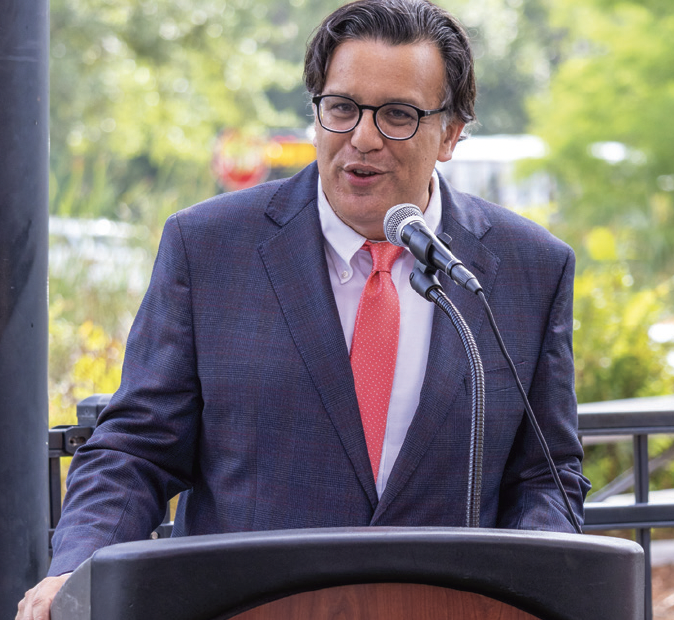
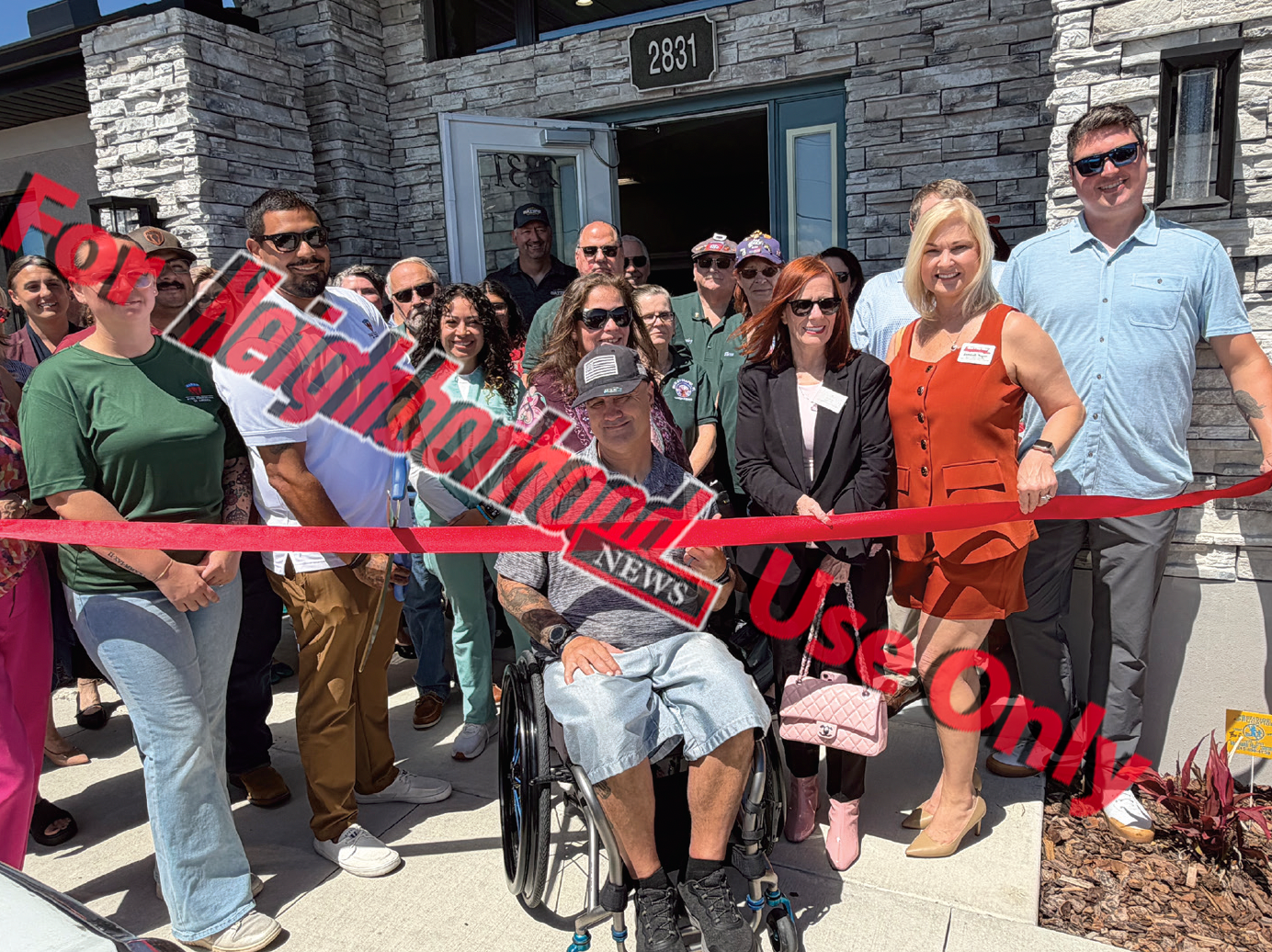
Florida’s Lieutenant Governor Jay Collins spoke about his plans to run for Governor in Nov. 2026 to a packed house of more than 100 people at the North Tampa Bay Chamber’s Business Breakfast on Feb. 3, at the Hilton Garden Inn Tampa-Wesley Chapel. (Photos by Charmaine George)
No matter which side of the political aisle you may be on, if you sit and listen to Florida’s 49-year-old Lieutenant Governor Jay Collins speak, you can’t help but be impressed with him. He has had a 23-year career in the U.S. Army and has served as a medic and parachutist in the Army’s elite Special Forces Green Berets corps twice — qualifying the second time after having his leg amputated.
He’s been shot, “which I do not recommend,” performed surgery on himself on the battlefield, has been awarded a Purple Heart, a Bronze Star and numerous other military medals and his story — and his life — could have ended with his military service, during which he met his wife Layla, who had a 20-year military career as a counterintelligence agent.
Instead, he entered Florida’s political scene four years ago, when he was elected to Florida Senate District 14, defeating the incumbent Democrat Janet Cruz for the seat.
The father of two boys ages 13 and 10 served for almost three years in the State Senate and passed 55 bills during that time. “I passed more bills in three years than many in the State Legislature do in eight,” he told an enthusiastic crowd of more than 100 North Tampa Bay Chamber (NTBC) members at the NTBC Business Breakfast on Feb. 3, at the Hilton Garden Inn Tampa-Wesley Chapel.
Then, in August 2025, Governor Ron DeSantis appointed him as Florida’s 21st Lieutenant Governor, replacing Jeanette Nuñez, who had resigned in May. Collins may not be the favorite to win the Republican nomination for Governor of Florida in the upcominh 2026 midterm elections — he currently trails far behind Rep. Byron Donalds (who recently received U.S. President Donald Trump’s endorsement) and Gov. DeSantis’ wife Casey (who has not yet declared she is running) — but with more than a third of registered Republicans still undecided (and more than half undecided if Casey DeSantis ends up choosing not to run), it’s still anyone’s race. But, whether he has a chance to win the nomination or not, Collins definitely captivated that room.
He spoke confidently about his plans to improve upon the record of DeSantis, who he said, “has led the nation. He has put a lot of things together. While other states have raised taxes, over-regulated businesses and chased jobs away, Florida has chosen a different path. He’s focused on freedom, responsibility and opportunity. Florida is now the strongest state economy in the country. We lead the nation in new business formation. Our workforce continues to grow. Families and employers are choosing Florida and that success is especially visible right here in this region. People want to be here because we have opportunity. You’ve got the government out of the way as much as possible.”
Even so, Collins acknowledged, “That doesn’t mean we’re exactly where we need to be, but we’re on the right path.”
He said he had recently attended the opening of a health care innovation lab in downtown Bradenton that is doing implants that get rid of metal and use absorbable material, “so it goes right in and grows bone — safe, not causing scabs or abscesses. That’s going to change people’s lives by eliminating the need for at least one surgery.
“The number one killer of people in health care is sepsis. The less you have to open somebody up, the less susceptible they are to sepsis. If we can stop that, we stop or lower health care costs, and some of the frivolous or excessive lawsuits at the back end, further dropping health care costs.”
Collins added that he shared that story, “because that was one person who had a dream to build something great, came here to Florida, started a business and will now inject hundreds of millions and, at some point, billions of dollars into our local economy.
“And that is what each and every one of you do every day. It just takes one moment for something to catch like wildfire and change how we do everything.”

He then moved on to one of this year’s most discussed proposals being considered by the state legislature — reducing or eliminating property taxes.
“Show of hands,” he said, “how many of you would like to have your homesteaded property free and clear of property tax?” (Everyone raised their hands.)
“But now,” he continued, “how many of you have concerns about how that would affect our education, our roads, our firefighters and our law enforcement?” (Again, most hands went up)
“Well, let me tell you something,” Collins said, “in this state, we are not going to put at risk our law enforcement or our firefighters. I would rather jump in front of a moving car than hurt the people who serve our communities. I would give my last full measure to protect our people. We will stand with our men and women of law enforcement and fire. We will not allow our cities or counties to underfund or cut that. It’s the same with roads and education.”

He noted that although people usually assume his kids go to private school, “My kids go to public school in Hillsborough County, just down the road from my house. A rising tide floats all boats.
“We have school choice in Florida because we understand that the money should follow the kids. It’s not the government’s money. It’s the people’s money being utilized to help provide something common to all — and we hold them accountable for those reasons. But, I also know that 85% of people will almost always go to public schools. And the right thing for my kids is that school just down the road, where they have their friends. I want my kids to be successful. I want them to have every opportunity to blow what I’ve done out of the water, to make my name irrelevant. That is what I dream on. So believe me, we’re going to protect those exact things.”

The Unknown Property Tax Fact
The thing Collins said that raised the most eyebrows was about just how much of Florida’s property tax revenue comes from homesteaded properties. “Less than 30% of the money that comes from property tax comes from homesteaded properties,” he said. “That’s a shockingly low number. Now, some counties are higher, some are significantly lower — and I’m sure you can probably formulate which ones go that way, but that’s manageable. It’s solvable.”
He then asked, “How many of you have seen your property value go up every year, from a tax standpoint? Has anybody had theirs go down repeatedly? I’ve never had anyone who said that and I’ve asked it a hundred times.
“How many of you have had millage rate increases as well?,” Collins added. “You’re getting hit twice. It’s getting wider, because you’re paying more, and it’s getting taller because of the millage increase.
“Now, ask yourself this simple question. Have you seen that exponential increase over the last ten years positively impact your education, roads, fire or law enforcement? Do they have more time, tools and training?
“If the answer is decidedly ‘no’ — which it has been everywhere I’ve gone — where did that money go?
“Friends, I am not here to pay more taxes. Lord knows, I put in time for what I get. I probably get about seven cents an hour as Lieutenant Governor — and I am grateful to do it. Please don’t think I’m whining. I’m just making fun of the system we’re in sometimes.
“It’s fascinating. We have to solve that — hold people accountable. What we’re doing with DOGE (the Dept. of Government Efficiency) in Florida is significant, but we have to lock that in and make sure the (city and county) governments follow through, that we’re holding them accountable.”
He also said that, “I’m frustrated that we have allowed the affordability conversation to focus just on saving our way to success.
“Friends, this is America, this is Florida. I expect us to lead, to dream boldly, to draw in more life-changing industry — to raise our salaries as part of that story. I don’t want my kids to make what I made someday. I want them to have so much more. We have to be dedicated to that.
“We can talk about property tax, but we have to draw in more businesses and get the government out of the way.”
Impact Fees & Permitting Issues
Collins was a little surprised that only a couple of people in the audience, including NTBC Board chair Tony Benge (see pg. 3) — who introduced Collins — were in real estate development.
“How many of you who are in development deal with impact fees? How about permitting? How many of you have bought or built homes and had a permitting crisis you had to deal with?
“There are two things right now that I believe we can lever and fix when it comes to home affordability. One is impact fees. They seem to just be levied left and right. Some counties are really great at it and some are less than stellar.
“Either way, it’s going right back to the consumer. We have to reward people and let those fees come back the appropriate way, but there’s got to be a lot of commonality and common sense.
“When it comes to permitting, I’ve gone through this as a business leader. I’ve gone through this personally when I built my home, but there has to be clarity and accountability in how that’s done.
“We have a building code that works. I worked in disaster management for many years. I was there everywhere lives were impacted by hurricanes and I would see a slab, a slab and then three homes almost completely unfazed by the same hurricane. [That means] our building code works, if we can get them there. We, as a state, have to do more from a resiliency, a power side, without spending ourselves into oblivion.
“Your individual amount that you owe to state debt is about $200. But, let’s compare that to the federal government, where it’s $126,000 per person. We have paid down 50% of our debt as a state over the last six years. We are balancing and lowering our budget every single year. Our reserves are maximized and yet, we’re still dropping them down more and more. That is what fiscal leadership and prudency looks like as a state. We have to maintain what we do.”
Before opening his appearance up to the floor for questions, Collins closed with, “In our state, I don’t believe the past is our best. I think the best lies ahead of us. I’m an optimist. I believe in our people. I believe in getting government out of the way so businesses can thrive and more opportunities can exist.”
And finally, Collins asked a question of his own: “Tell us what you see, what your problems are. The simple fact is that, as a leader, I can’t solve what I don’t know. I listen to Ronald Reagan a lot. I love how he spoke to the people and he solved problems. I love his approach.
“To paraphrase him, ‘If the government thinks they have a solution, you should be afraid…very afraid.’
“Please work with us. We need business leaders from the Chamber and from the community, to help us understand where the rubber meets the road. How that impacts lives and how we can solve [problems], to really create solutions.
“And, as a former legislator, I can tell you that, of the 55 bills I passed, probably three quarters of them came from the community in some way, shape or form, because we worked with them. We solved those functional problems on the ground and they improved. That’s good work. That’s good government. That’s how we work together.”
Answering Questions
Florida Lt. Gov. Jay Collins & NTBC president & CEO Hope Kennedy.
Collins then took a number of questions, the first from Ryan Quattlebaum, the CEO of AdventHealth Wesley Chapel, who asked, “As we continue to hire, recruit and retain doctors into the state of Florida, what do you see you can do to help us continue to attract and retain physicians to Florida?”
Collins responded that Florida, “needs more medical schools. I also know that every doctor we talk to says they are hemorrhaging people at the three-to-five-to-seven-year mark because they’re tired of litigation. They’re tired of the games. They’re tired of being told to write their SOAP (Subjective, Objective, Assessment, and Plan) notes in a specific way to fit into an insurance algorithm. Those are systemic issues we have to solve.”
Next up was NTBC Board member Jamie Hess, the owner of Computer Emergency Room, who told Collins that the Chamber was looking into incorporating Wesley Chapel as its own city, “but we put it on hold because of the property tax issue. What do you think, realistically, is the forecast to get the homestead property tax reduced or eliminated this year?”
Collins responded, “If I were Governor, I’ll tell you what I would do. I would call a Special Session so you have everybody there. I do think you can get full property tax relief for homestead properties [because] the math plays out.
“But, for those who may not know how the system works, you’ve got to pass identical bills — within a 98% margin — in both the House and the Senate, and then have the Governor sign it.
“And, because [incorporation] would have to be a constitutional amendment, it’s then got to go on the ballot and it’s got to get 60% of the people to vote for it.
“Friends, there are times when it’s hard to get people to agree that we should even have a 60% level. It’s going to cost, at a minimum, $15- $25 million of advertising to understand what its going to look like.
“But again, on property taxes, if there’s more than one thing on that property tax [bill], it’s 100% going to fail. But, I think it’s pretty likely that we get this, but where it ends up on the spectrum, that variability, I think you’ll know, probably within a month or so. But yes, it’s very doable, very manageable.
“I know the Governor pretty well and, when he lays out his plan, it will be very detailed. You have to get ahead of the system to make sure people don’t move the money, don’t revenue taxes, and don’t just create another bureaucracy, instead of solving a problem.
“I know pretty well where the Governor is at on this and I will not be part of anything that’s going to cut services. I will not do it.”
Collins also answered a question from Primrose School of Wesley Chapel owner Rob Fitzpatrick about Florida’s insurance crisis and one from yours truly about holding private schools that accept school vouchers to the same standards as public schools. He also addressed a question from Benge about the lack of accountability on the part of local governments regarding impact fees (see the Editorial on pg. 3 for more on this topic).