Beginning March 8 and running through March 29, the Tampa Water Department (TWD) is temporarily changing its water disinfection process from chloramine to chlorine to disinfect the water distributed to all TWD customers.
If you get your water from the TWD, you might notice a slight change in what you are tasting and smelling coming out of our faucets the next three weeks. However, chances are you won’t.
Your water is safe to drink and does not need to be boiled, according to the TWD. Customers who are sensitive to chlorine may notice. If so, it is recommended you run the tap for a few minutes before using, fill a pitcher of water and let it sit for a few hours to allow any residual chlorine to evaporate or consider installing a carbon filter on your faucets or replace existing filters with new ones.
The TWD uses chloramine (ammonia added to chlorine) to disinfect the water, but as a sustainable alternative to losing millions of gallons of drinking water by flushing the system, at least twice a year for three-week periods it switches to chlorine disinfection, which is stronger. TWD says the temporary change kills bacteria and ensures the water remains safe to drink as it travels through the water mains and service lines.
“We work closely with the Florida Department of Health (FDOH) to ensure that we comply with EPA guidelines for using chlorine and chloramine to disinfect Tampa’s drinking water,” it says on the TWD website.
Those who already take special steps to remove chloramine from tap water, such as dialysis centers, medical facilities and aquatic pet owners, should take the same precautions during the temporary switch to chlorine, says TWD.
For more information, contact City of Tampa Utilities at (813) 274-8811, Option 2, or visit tampa.gov/ChlorineDisinfection.
State Rep. Fentrice Driskell (top row, second from the left) picked the brains of some Wharton High students to formulate an environmental bill to try to pass at the upcoming state legislative session, which begins March 2.
If a bill gets passed during this upcoming State of Florida legislative session that helps eliminate food waste and, in the process, provides the Sunshine State with environmental benefits, you might just have some Wharton High students to thank for it.
During a Zoom class on Jan. 28 moderated by District 63 State Rep. Fentrice Driskell, the Wharton students were asked to debate three potential bills they had been given, and whichever one they found to be the most preferable, Rep. Driskell would take with her to Tallahassee when the 60-day legislative session begins March 2 and work to get it passed.
“This is a new initiative for me,” Rep. Driskell said. “I have heard of other members doing this, but I wanted to put my own spin on it.”
Each of the bills debated had a strong climate change component to them, something near to Driskell’s heart — before attending Harvard University and Georgetown Law School, she was an officer in the environment club at Lake Gibson High in Lakeland.
“We were setting out to save the world,” she told the class. “Never doubt that young people can save the world, and part of the reason we are having real conversation around climate change is because the younger generation is pushing us to do so.”
The students in the class of Mary Johnson (AP Environmental Science) and Chad Reed (AP U.S. Government) chose a version of the Rhode Island Refuse Disposal Act, which ensures that the organic-waste materials generated by educational facilities are recycled at an authorized composting facility or anaerobic digestion facility.
“There is a lot of food waste,” said Sarai Guzman, a senior, who added that since she moved to Tampa she has noticed excessive waste, especially in schools. “We need to help those who don’t get as much food.”
Zoe Craig, a junior, agreed. She said she has volunteered a lot in a local food pantry, and sees the need for food in the community.
Sonya Patel, also a junior, also voted for the food waste bill, stressing its environmental benefits.
“It would lead to less going to the landfill, and the less landfill, the less we burn, which (means) less greenhouse gas,” she said. “There is a whole chain of reactions involved with that.”
Senior Mark Johnson agreed that the gashouse effect of less waste would provide a large benefit to society.
The other bills presented for discussion included one dealing with testing for and eliminating lead in the water of schools and child daycare centers, and another focused on an energy security and disaster resilience pilot program to create solar energy storage systems at certain facilities which could provide needed power following natural disasters.
The Lead-Safe Schools and Daycares Act also was a popular choice of the class. Kylie Lewis said she thought the transparency of the bill — requiring testing results to be made available to district leaders and parents — was great, while senior Vlada Pitner said the safety issue was important.
“There have been a lot of problems in the district in Hillsborough County with lead being in the water,” Pitner said. “It’s a big issue and I feel like a lot of people overlook it. And, it affects the next generation, who we want to be healthy.”
Senior Jonathan Arms cast his vote for the solar energy bill, primarily because of the possibilities it could open up.
“If we could prove to the other states that solar energy is viable and can properly be used as a back up, then there is no real excuse it can’t be used as a primary source,” Arms said. “Maybe we can start using solar energy for big projects, maybe we start making, I don’t know, solar-powered cars. That would be kind of cool. I kind of like (what this bill could mean for the future).”
In a non-Covid world, Driskell says she would have liked to break off into groups for further debate. Instead, she put it to a vote, with 47 percent of the class picking the food waste bill. She called the experience a success.
“It went better than I expected,” Driskell said. “The kids were so impressive to me. They were engaged the whole time. I couldn’t have asked for it to go any better.”
Driskell said the class was the first of many she would like to do in New Tampa, and that she will approach other schools in the future. She chose Wharton for this one because of her relationship with principal Mike Rowan, whom she met in 2018 shortly after being elected for the first time.
She will now take the bill, rework the language in it, and work on getting it sponsored. It would then go into committee and, if deemed favorable by the House committee and by a House vote, it would be sent to the Senate floor for a final yes or no vote.
Driskell joked that she will tell the Senators that there would be some angry high school students calling them if the bill doesn’t pass, telling the Wharton students to be ready to go.
“I didn’t grow up knowing elected officials,” she said. “I had no sense of how accessible government is on the local and state level. I hope this sparks curiosity in the minds of these students. Maybe it gets them engaged at this level, at an early age, and they will want to stay engaged for the rest of their lives.”
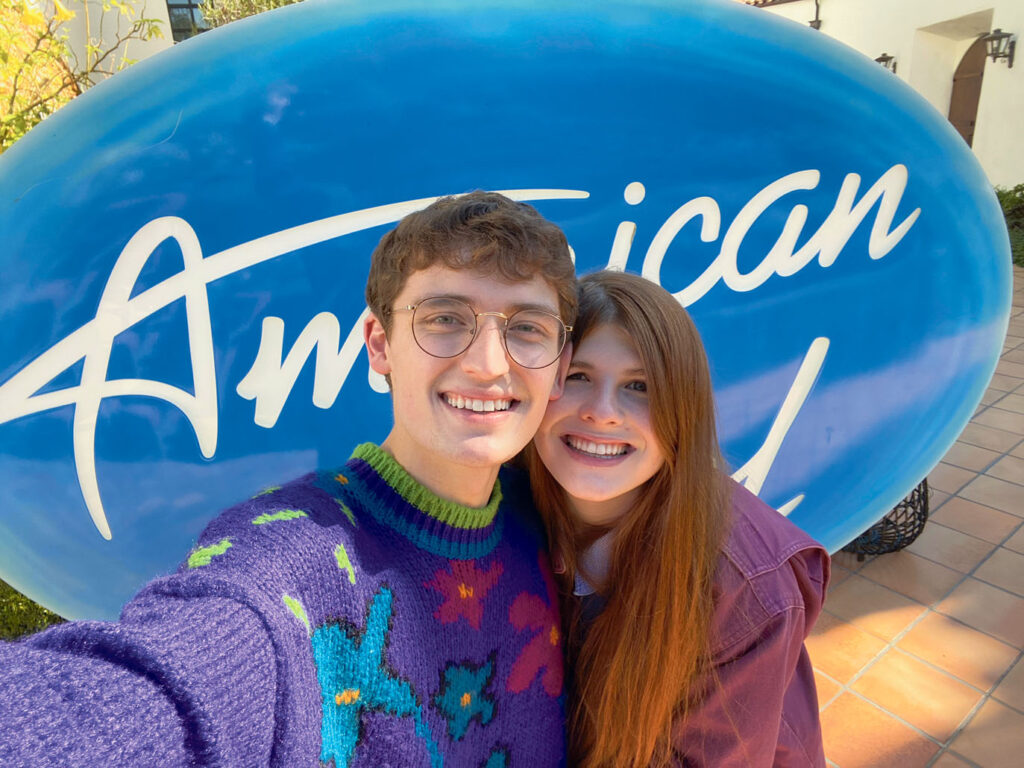
The kid that gave socks to the judges, danced with Katie Perry (see photo on next page) and then wowed with his voice — when it transformed from Kermit the Frog to Frank Sinatra to earn a golden ticket — is now older and wiser and back on the show.
The Wiregrass Ranch High graduate, who now attends Florida Southern College, will appear on the audition shows in the coming weeks. He did not appear in the season premiere, which aired locally on Feb. 14 at 8 p.m. on WFTS-TV, or the second episode. He hasn’t been told when his episode will air. But he did leave a teaser on his Instagram this weekend.
So, what happens this time? A lot.
But we can’t tell you.
Just like last time, Zach has been sworn to secrecy until the episode airs. His family, a good friend and his girlfriend know, and we are privy to a few of Zach’s twists and turns this time around, so we could tell you, but then we’d have to…well, you know how the saying goes.
Zach’s return to “Idol” actually began in August when he signed up for Zoom auditions. The producers instantly recognized him, and he sang “No Fire” by S. Grant Parker while playing the ukelele, and the following round, sang the same song and also played piano while singing “Places We Won’t Walk” by Bruno Major.
Zach wasn’t sure he had passed, especially when August passed, and so did September. Then, a friend received a rejection email, so Zach thought he might still be alive. In mid-October, he finally got word that he was headed to Ojai, CA — which is in Ventura County about 90 minutes northwest of Los Angeles — for live auditions the first week of November, and mum’s been the word ever since.
“It’s kind of fun keeping the secret,” Zach says.
Although it was his second time in front of judges Lionel Ritchie, Luke Bryan and Perry, Zach says he still felt a little trepidation about his second chance.
“I was pretty nervous seeing the judges again because it’s been so long,” he says. “When I walked out, they were like, ‘Oh, we know Zach.’” He sang “Golden Slumbers” by the Beatles.
“And, that’s pretty much all I can tell you,” he says, chuckling.
He returned to Wesley Chapel, won a few singing competitions, graduated from Wiregrass Ranch and was accepted into the University of South Florida, where he was going to study biomedical science and become a doctor one day.
But, “American Idol” had awakened something in him. He wanted to hone his singing skills. He wanted to help make music. He wanted to follow what had become his passion.
After one year at USF, Zach, now 20, transferred to Florida Southern and is now a music management major. He says he would like to manage artists one day, help them with auditions and, of course, cut his own first album.
“I think only reason I wanted to be a doctor was because they make a lot of money, but would that make me happy?,” Zach says. “(Being on) ‘American Idol’ made me happy. Singing made me happy. I liked the performing and talking to fans. So why not commit to music fully?”
Why not try “American Idol” again?
The last thing Zach told us in 2018 after his surprisingly quick end on the show was that he was encouraged by fellow contestants to try again — and he told them he would. And, that thought has always stuck in his head.
His girlfriend, Catie Turner, was on the show with Zach in 2018 and finished sixth. While she can’t compete again, she never stopped encouraging Zach to try.
“It’s always been kind of stuck in the back of my head that I would go back and try again,” Zach says. “It was inevitable. I want to prove to myself that I can do it again. My goal was to make it farther this time than last time.”
Zach says being in California during the pandemic was concerning, especially making the trip out there. But, with Covid-19 tests every other day, and the threat of being sent home if you tested positive, Zach says the auditions were smooth. Each contestant was encouraged to stay confined to their room.
“It was kind of like house arrest,” Zach jokes. “But I felt safe the whole time. Everyone wore masks. You won’t see people wearing them while on stage, but anyone who wasn’t singing at the time had masks on.”
Zach says people still recognize him in public as the “American Idol,” though most seem to remember his affinity for socks. But his “socks appeal” is gone, and this season’s version of Zach might be best described as “sweater late than never,” as he makes his return with a different style.
As for the rest, Zach says you’ll have to tune in on Sunday nights.
Yo Murphy (right) is hands-on when it comes to training athletes trying to get to the next level.
Llewellyn Murphy, Jr., better known as Yo to Tampa Bay Buccaneers’ fans, remembers tearing his quad muscle in 2001. But, with the help of a performance therapist and fitness coach, Murphy was able to get back to playing wide receiver in time to help the St. Louis Rams make it to Super Bowl XXXVI on Feb. 3, 2002, which the Rams lost to the New England Patriots, the first Big Game win for QB Tom Brady.
Murphy, who played seven games for the Tampa Bay Buccaneers in 1999 and was an electric kickoff returner, says he didn’t have a Plan B at the time, but the rehabilitation experience and how it helped him play four more seasons of professional football crystallized one for him.
“It showed me how much value that has, and how much impact you can have on someone’s life when you do this job and focus on what they need,” Murphy says. “I just fell in love with it.”
Murphy ended up becoming the only player ever to play seasons in the NFL, Candaian Football League (CFL), the XFL and NFL Europe. He also is the only player to suit up for the Super Bowl, Grey Cup and World Bowl championship games. Murphy is now a 15-year veteran of the performance training industry, and is expanding from his Westchase location to the Wiregrass Ranch Sports Campus of Pasco County.
Yo Murphy Performance should be up and running later this month.
At the 11,000-sq.-ft. Westchase location, 38 professional and professional-to-be athletes train as part of his clientele, including Washington Nationals outfielder Kyle Schwarber, Kanasas City Royals first baseman Carlos Santana, 2020 Heisman Trophy winner Devonta Smith (from the University of Alabama) as well as NFL hopefuls getting ready for the NFL combine, like Smith’s teammate at Alabama, DT Christian Barmore and speedy Auburn WR Anthony Schwartz.
While prepping professional athletes for a combine or upcoming season may be a specialty, Murphy says his training center also caters to a few hundred “corporate,” as well as more than 100 youth athletes.
“We treat the regular dude like a serious athlete,” Murphy says. “People get in ruts when they just go to the gym (to go). The only difference between the athlete and the regular dude is, while in the gym training, athletes have a start and an end date. We are good as humans when we have goals and we have deadlines and we have discipline involved. That’s what we focus on. We treat everyone the same.”
Murphy says he was alerted to the Wiregrass Ranch Sports Campus by his director of basketball, Darryl Hepburn, who Murphy says has held NBA combines but saw a need for a facility with more courts. Once Murphy visited, he saw the Wiregrass Sports Campus, with its 98,000-sq. ft. of indoor space to be “a perfect fit.”
Yo Murphy Performance caters to the serious athlete, whether professional or amateur. The Wiregrass Ranch location, he says, will offer memberships for adults, and even offer 1-on-1 training and combines for those corporate athletes.
Expect a fair share of professional athletes to be sharing that space as well. Murphy said NFL wide receivers like Diontae Johnson (Pittsburgh), Deon Cain (Baltimore) and Auden Tate (Cincinatti and a Wharton High in New Tampa graduate) all live near the facility and plan on training there in the offseason.
Murphy expects a more than two dozen NFL players to make Wiregrass Ranch their training home now that the Super Bowl LV is over.
For additional information about Yo Murphy Performance, visit YoMurphy.com.
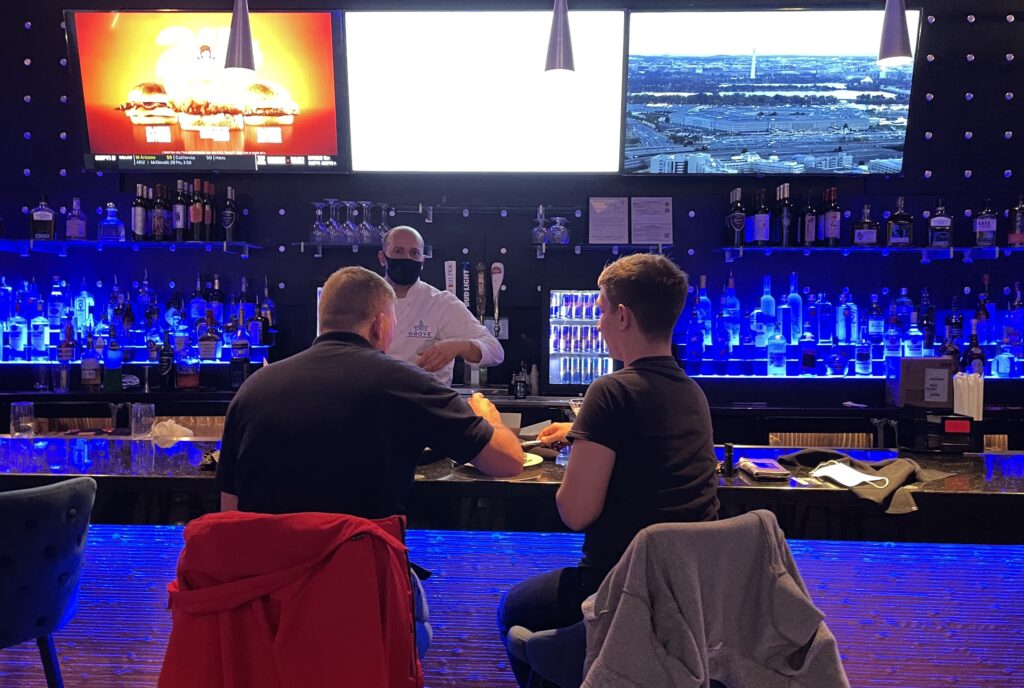
A full bar in available at the Grove Theater, Bistro & Entertainment for a pre-movie drink.
The Grove Theater, Bistro & Entertainment will have a spin room, children’s room, acting studio, a comedy club and more, but on Feb. 19, it finally opened to do what it was built to do:
Show movies.
After more than a year of renovations and redesign, the theater debuted its new reclining leather seats and bistro with a showing of movies like “Judas and the Black Messiah”, “Land” and “The Little Things.”
The former Cobb Theater was operating at limited capacity, with only 50 percent seating in checkerboard style, and no one sitting in front of, behind or next to other customers. Only some of the 12 screens were in use, and some of the showings were sold out.
The selection of movies also is limited, as Hollywood has held back on production and releases due to the Covid-19 pandemic.
The Bistro dining area, which The Grove Theater management refers to as “upscale,” was busy on the weekend nights, with a wide menu of dishes, featuring items like steak, shrimp macaroni and cheese, fish tacos and bruschetta, with crème brulee highlighting its desert options. The chicken parmesan was the most popular menu item, and all could be ordered at Bistro tables, as well as for in-movie dining.
Laron, Angel and English Hearst (eating the burger) of New Tampa enjoying a meal at the Grove Bistro.
A full bar serving drinks, as well as a sushi bar, are also part of the Bistro, and the main lobby has 45 video arcade games for pre-movie entertainment.
“People are ready to go back to the movies and we are proud to be able to provide them with a safe environment to enjoy a night out with their friends and family,” said Matheus Gold, vice president of operations. “We are operating at 50% capacity with checkerboard seating and sold out several showings our opening weekend. Our Bistro offers new dishes and the feedback we received is that we are back better than ever.”
The theater is taking lots of Covid-19 safety precautions, with temperature checks at the door and facial coverings required inside. However, with the limited seating, social distancing was easily manageable.
The two-floor, 85,000-sq.-ft. movie theater is being dubbed by developer Mark Gold as the future of how entertainment will be offered to attract families. His plans are for families to come for dinner, leave the kids in a converted-theater Kids Play Place room, and see a movie or comedy show at Side Splitters Comedy Club (which is expected to open this spring).
Then, families can then spend time together cruising the 200-acre complex, which will have a mini-golf course, the much anticipated KRATE by Gold Box container park and a “downtown village” area, all featuring other bars, restaurants and retailers.
The theater renovations are another part of a massive project at The Grove, which Gold’s Mishorin Gold Properties purchased in September 2019 for $62.7 million.
The Grove Theater, Bistro and Entertainment will be open Saturday and Sunday from 4-9:30 p.m., and Sundays noon-7 p.m. Tickets can be reserved at grovetheater.com.