
New Walmart Also Will Include S.R. 56/Morris Bridge Rd. Improvements

To the likely delight of many residents — and to the dismay of others — in Wesley Chapel, Zephyrhills and eastern New Tampa, plans for a second Walmart in Wesley Chapel are continuing to move forward, with construction expected to begin later this year. Here’s everything you need to know. 

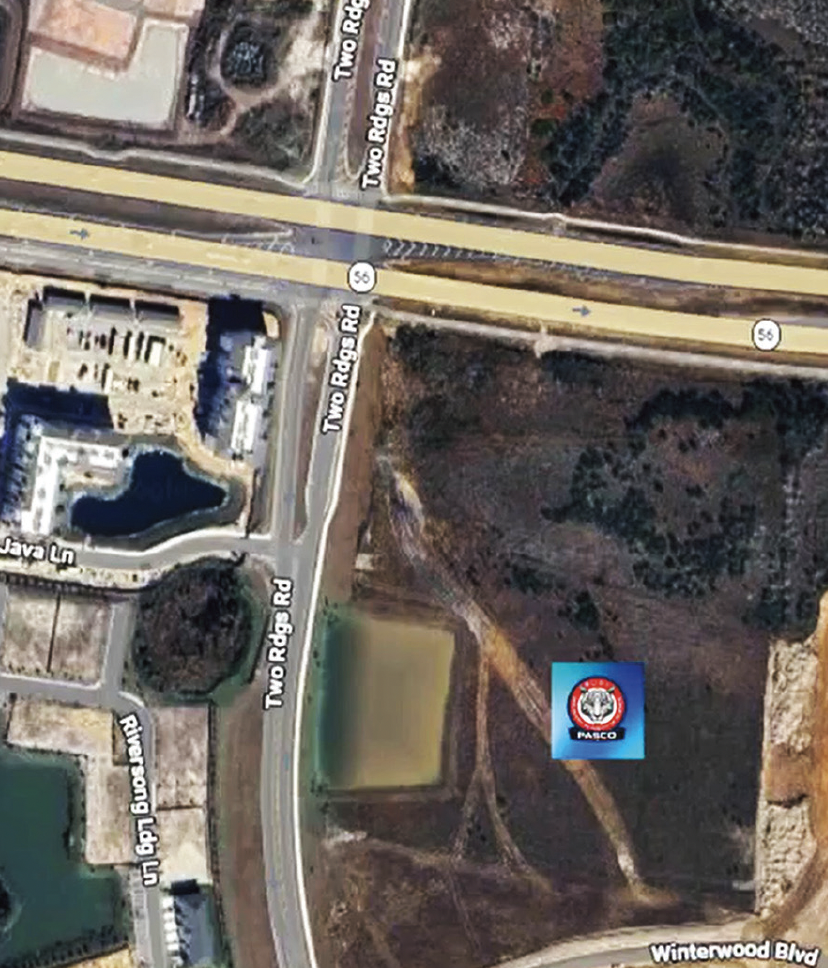
First reported in these pages in July 2025 as part of a Two Rivers development update, the new Walmart is planned for the southwest corner of S.R. 56 and Morris Bridge Rd., just inside the boundary of the River Landing Master Planned Unit Development (MPUD) and across Morris Bridge Rd. from the burgeoning Two Rivers community. 

Early rumors had suggested the site might become a Lowe’s Home Improvement store, but those plans have since been replaced — and all signs now point clearly to Walmart — despite a lack of markings on the county-approved renderings — and those approvals are helping it along. 

According to the latest site plan (left), the new Walmart will be slightly smaller than others in the area, totaling approximately 183,000 sq. ft. 

By comparison, most nearby Walmart Supercenters easily exceed 200,000 sq. ft. Despite the reduced footprint, the store is expected to include a full range of features, including a full liquor store, a drive-through pharmacy, a dedicated curbside pickup area, an auto care center and a large gas station with a 1,600-square-foot convenience store and up to 20 fueling positions located near the signal (as shown in plans from April). 

Notably, aside from the gas station, there will be no additional outparcels or standalone businesses on the Walmart site. 

Interestingly, none of the official permits or early plans explicitly state that the store will be a Walmart and no renderings were initially released — prompting some skepticism, even from us. 

Furthermore, the project is being developed by Stiles Corporation, a Ft. Lauderdale-based firm better known for building Publix-anchored centers and Costco developments, with no clear history of Walmart projects. That alone raised eyebrows. So we dug deeper. 

The confirmation came in an unexpected way: the curbside pickup parking signage shown in the plans (right) matched exactly with newly installed signage around the New Tampa Walmart — right down to the color specification labeled “Walmart Blue” (under “Pickup & Pharmacy”). 

That detail, combined with the overall site layout and operational features, provided the “smoking gun.” 

In other words, while the official “Walmart” storefront signage and announcement from corporate may come later, the parking lot plans already gave it away. 

Some residents have questioned the need for another Walmart in our area, but the reasoning largely comes down to spacing and demand. 

This new store will sit approximately: 

• 8 miles from the Walmart on S.R. 54 in Wesley Chapel 

• 9 miles from the Bruce B. Downs location in New Tampa 

• 9 miles from the Zephyrhills Walmart on Gall Blvd. (U.S. Hwy. 301) 

This creates a fairly typical “coverage triangle,” with an average spacing of about 8 miles between stores — a pattern Walmart has replicated across Florida. 

Equally important, this location will serve the southern portion of Zephyrhills, an area that currently relies heavily on the northern Zephyrhills store — and a store that many shoppers know can be overcrowded, with frequent inventory shortages and parking challenges. 

The new Walmart is clearly expected to help relieve that pressure while supporting the overall region’s continued population growth. 

The Walmart site falls within the 801-acre River Landing MPUD, which also includes the communities known as River’s Edge and Summerstone. River Landing has long-held entitlements for 250,000 sq. ft. of commercial/retail space and 150,000 sq. ft. of office space — and, to date, none of that commercial square footage has been developed, despite the residential portions of the MPUD being largely built out. The vacant corners at S.R. 56 and Morris Bridge Rd. — where the Walmart is planned — were always intended for this type of use. 

The only remaining residential component currently under construction (on the north side of S.R. 56) within River Landing is a 266-unit townhome development. 

As the Walmart project advances, so do plans to address traffic concerns along Morris Bridge Rd. On April 21, 2026, the Pasco County Board of County Commissioners approved a development agreement (DA) tied to the project that includes significant roadway upgrades: 

• Widening Morris Bridge Rd. from two lanes to four lanes between Colston Ave./Oldwoods Ave. and S.R. 56 

• Construction of a four-lane roundabout on Morris Bridge Rd. at the main southern development entrance 

• New turn lanes at the S.R. 56 intersection 

• Installation of 10-foot multi-use paths on both sides of Morris Bridge Rd. 

The Walmart developer will fund the design and construction of these improvements, with the county providing approximately $4.7 million in reimbursement because of the regional nature of the improvements.. 

While some residents voiced concerns about traffic and noise — particularly related to the Walmart — county officials emphasized that this DA strictly addressed roadway infrastructure, with commercial development details handled separately. 

With approvals in place and infrastructure planning under way, the long-anticipated Walmart appears to be on track to break ground soon. 

For an area experiencing rapid growth, the addition represents both a response to increasing demand and a continuation of the broader buildout of Two Rivers and surrounding communities. 

As always, the Neighborhood News will continue to follow updates as this project moves from planning to construction.

Dentistry Deja Vu? Telling A $6 Billion Tale Of Two Identical New Heartland Dental Offices

The under-construction Heartland Dental office located south of County Line Rd. and west of BBD Blvd. (Photo by Joel Provenzano)

What we first thought was just another routine addition to Wesley Chapel’s growing commercial landscape has turned into something far more intriguing. 

While reporting our last cover story — “Olive Garden & Seasons 52 Coming to WC Blvd. at Gateway Blvd.!”—we briefly noted a standalone dental office planned for the same development, although we didn’t honestly know the office’s name at that time, but now know that it is Heartland Dental. Whatever it was to be called, the dental office barely registered with us. 

Until we saw it again. A second, nearly identical building — same size, same name — quietly rising on the south side of County Line Rd., and west of Bruce B. Downs (BBD) Blvd., in the LA Fitness/Aldi plaza (photo above) in New Tampa. No signage yet, just a shell. But the plans we saw online confirmed that it is another Heartland Dental. 

Two brand-new, 4,260-square-foot dental offices, each large enough for up to 12 exam rooms. Same operator. Same footprint. Same timing. That’s when curiosity turned into a deeper investigation. 

At first glance, two identical dental offices might seem unusual, but in today’s New Tampa and Wesley Chapel — and world — honestly, maybe it shouldn’t be. 

Multiple locations of the same brand popping up in a concentrated area can actually be a lagging indicator of that area’s economic strength. In simple terms: chains don’t plant roots unless the data says the area is “ready.” 

And, while New Tampa has already “arrived,” Wesley Chapel is clearly arriving. 

But, the dentistry scene? That’s always felt different. More local. More personal. Less… corporate. Hmmm. 

Heartland Dental isn’t just another dental company — it’s apparently the largest “dental support organization” in the U.S. 

Founded in 1997 in Effingham, IL, Heartland Dental operates in 39 states and Washington, D.C., and supports 1,900+ offices and 3,000+ dentists. 

Rather than owning these practices outright in the traditional sense, Heartland usually operates behind the scenes — handling administration, staffing, billing, supplies and logistics — while the dentists the company serves retain clinical control. 

Think of it as a hybrid model where dentists focus on patients and Heartland handles everything else. But, that’s really just scratching the surface. 

At the center of this operation is Rick Workman, D.M.D., the founder and executive chairman of Heartland Dental — and, according to a recent Forbes magazine feature, the architect of a $6-billion empire. 

The March 26, 2026, article — entitled “Meet The Billionaire Dentist That Other Docs Want To Punch In The Teeth” — paints a picture of a controversial but undeniably effective industry “disruptor.” 

Dr. Workman (photo, right), who lives in the Orlando area, is an avid rare car collector, AND part owner of the Tampa Bay Rays. He built Heartland Dental on a simple but powerful idea: 

Let dentists be dentists — and treat everything else like a scalable business. And scale it, he has. 

Here’s where things get especially interesting — and particularly relevant to our area. 

Workman didn’t stop at managing dental practices. Early on, he created a separate real estate arm: WMG Development. 

WMG has developed $1.4 billion in real estate across 30+ states. The firm buys land, builds the buildings, and leases them to Heartland-supported practices. 

Sound familiar? That’s because we realized through a simple search that WMG is the site developer and land owner behind Wesley Chapel’s Gateway Plaza Retail Center project, which includes the future Heartland Dental office, Olive Garden and Seasons 52, all under a shell entity called Shoppes at Gateway, LLC. 

And, no big surprise here, WMG also is the developer of the upcoming New Tampa Heartland Dental location. That site’s land is owned by Southeast QSR, but the development ties back to the same network. 

In other words, this isn’t just expansion. It’s sheer vertical integration. 

An improved version of the map of the Gateway Plaza Retail Center that appeared in our last issue, still showing Olive Garden (OG) and Seasons 52 (S52), but also adding the Heartland Dental (HD) office, (Two maps provided by Pasco County were modified into one map by NN). 

If this model feels familiar, it should. 

Anyone who’s seen the movie “The Founder” (which is great, by the way) — the story of McDonald’s rise — knows that the global chain’s real money wasn’t really made in hamburgers. It actually was all about the real estate. 

Heartland is applying a similar strategy in its dental operations by controlling the real estate, standardizing the dental business’ operations and scaling rapidly. 

For an industry once dominated by small, independent practices — some even in home-based offices — this approach has been nothing short of revolutionary, and it was all Dr. Workman’s idea. 

Not everyone is celebrating, however. According to the Forbes article, Heartland’s structured systems include standardized clinical protocols, performance tracking across patient diagnostics and revenue-based compensation models. 

Heartland dentists typically earn a base salary, and begin earning about 25% of revenue after hitting certain production thresholds. The good news is that they average around $318,000 annually (vs. the dental industry average of about $208,000 per year). 

To supporters, this is efficiency and opportunity. To critics, of which there are apparently many, it raises important questions: Does standardization also influence treatment decisions and can corporate metrics coexist with personalized care? 

The debate is ongoing — and some dentists in our area are already part of it, similarly to what’s happened with other medical groups in other specialties. 

Heartland Dental already has a presence nearby, through supported practices like Somerset Dental Care in Tampa Palms, Watergrass Dental Care (on Curley Rd.), Dental Care at Quail Hollow and others. But these two upcoming Heartland locations definitely seem to be different. 

The “Heartland Dental” name apparently will appear directly on both of these new buildings. If that’s indeed what ends up happening, it could signal a shift toward more visible branding for Workman’s expanding company. 

In other words, this might mark a notable evolution in Heartland’s strategy. 

So, here’s the big question: 

Is our area truly ready for corporate dentistry at scale? 

On the one hand, we have strong population growth, rising household incomes and increasing national brand presence (especially in Wesley Chapel), where all signs point to “yes.” 

On the other hand, this could lead to higher base commercial rents, more competition and greater pressure on independent dental providers. Chains like Heartland could benefit from economies of scale, access to capital (including backing from firms like KKR, née Kohlberg, Kravis & Roberts) and control over both operations and real estate. 

For smaller, single-location dentists, that can be a tough playing field to navigate. 

In fact, it may simply reflect the next phase of growth for the Wesley Chapel area as a whole. The arrival of chains — whether in dining, retail, or now healthcare — does often signal maturity of a market. 

But, it also changes the landscape. 

The question isn’t whether Heartland Dental will succeed here. The real question is will — or how will — the local dental industry ecosystem adapt? 

Because what’s being built isn’t just two dental offices. It’s a new model — one that could reshape how dentistry is delivered in our community for years to come. 

Viera Still Hoping For A NT Police Substation; NT Blvd. Repaving Delayed & More

If you read this publication regularly, you know that District 7 Tampa City Council member and New Tampa resident Luis Viera will reach his term limits when Tampa’s Municipal Elections are held next March. 

You’re probably also aware that Viera is now actively campaigning to replace his friend (and current Florida House Minority Leader) Fentrice Driskell in the Dist. 63 State House seat in the November midterm elections. 

But, that doesn’t mean Viera is done fighting for the New Tampa community he calls home in City Council. Not by a long shot. 

Below are just a few of the items Viera has either recently gotten passed or is still working to bring to fruition: 

Morris Lopez Street Renaming — Although this one doesn’t directly benefit New Tampa, Viera has been lobbying for months to rename a street in Ybor City in honor of Tampa Police Officer Patrolman Morris Lopez, who was murdered on the streets of Ybor more than 75 years ago. Ofc. Lopez’s grandson, also named Morris Lopez, is not only a long-time New Tampa resident, but is also one of at least three people (Alan Cohn and Patricia Alonzo are the others, although only Lopez was listed at VoteHillsborough.gov as having officially filed his paperwork at our press time) to fill Viera’s soon-to-be-vacant seat. 

City Council is expected to have a first reading regarding the street renaming in Lopez’s honor at one of the May Council meetings. 

Viera says the honor for Patrolman Lopez is long overdue: “It’s just the right thing to do.” 

New Tampa Police Substation — Viera, who has been fighting for months for a TPD substation somewhere in New Tampa, said during the Apt. 7 City Council meeting that he “rejected” the memo he and the other City Council members received from Tampa Police Chief Lee Bercaw on Mar. 17 (right) that said, “Currently, however, the department’s most critical infrastructure priorities remain the construction of a new Forensic Facility and the development of a new Police Headquarters…Once progress is achieved on these critical projects, the department can better evaluate the need for future facility expansion opportunities, such as a New Tampa Substation, within a comprehensive long-term facilities plan.” 

“I’m not asking for a Taj Mahal big expenditure,” Viera says. “But all of the Tampa Police Officers I’ve spoken with in New Tampa support renting some small office in a strip center where the officers could meet with the community.” 

Viera’s motion for the City Council staff to look into what a substation office would cost and present a report to the Council, by the end of April or sometime in May, passed 5-0. 

New Tampa Blvd. Repaving — The funds allocated for this item were approved by Council months ago, and construction was expected to begin by sometime this month, but has been delayed until June or July of this year. In the meantime, almost all of the existing potholes on the 1.8-mile stretch of New Tampa Blvd. were recently filled in prior to the repaving (at left is one pothole that hadn’t been filled in at our press time). 

The City’s engineering department sent Viera the following memo: “The New Tampa Blvd project is ready to execute once the processing is complete of the 26-C-06 contract that council approved during the 3-26-2026 meeting. We are expecting paving to begin on New Tampa Blvd around June/July 2026, but this may vary to be sooner or later depending on the contractor’s schedule/availability.” 

Viera says, “You know I’ll be obnoxiously on this one until it’s done.” 

Nature Park All-Abilities Equipment Allocation — Viera also lobbied successfully for the City of Tampa to spend some of its surplus funds from the Fiscal Year 2025 budget on two pieces of All-Abilities equipment for the New Tampa Nature Park off Bruce B. Downs Blvd. 

The equipment is allocated to cost $175,000 of the $4.4-million of the surplus funds to be spent on parks throughout the city. 

Updates On Avalon Park Blvd. & Downtown Avalon Park Wesley Chapel Phase 2

(Above) The site map for Avalon Park Wesley Chapel, which shows the downtown area and the location of the new Avalon Park Blvd.  (Below) An aerial view of Avalon Park, which shows the completed Avalon Park Blvd. (Photo and map both provided to the Neighborhood News by Avalon Park Group)

Nestled in the heart of Downtown Avalon Park Wesley Chapel (WC), a new pedestrian-friendly road runs through the growing community, connecting it from nearby residential areas to where apartments, townhomes and new businesses are now under construction. 

Avalon Park Blvd. (see aerial photo below and map, above), located off S.R. 54 near Friendly Way, recently opened to drivers and pedestrians. 

The roughly 1-mile road cost about $7 million to build, according to president and CEO Beat Kähli of Avalon Park Group, the real estate development company behind the project. 

Kähli says that helping residents easily navigate to the businesses and schools in Avalon Park WC was a primary purpose of the Avalon Park Blvd. road project. 

“It is critical because it connects all of the residential homes,” Kähli says. “If you build a town…connectivity is very important.” 

The extension road runs alongside the developing downtown district, where the first phase of restaurants and retail spaces is already located beneath The Flats apartments. There also is an amphitheater beginning construction at one end of the Downtown Avalon Park WC’s Town Park, where live music performances and other events will eventually be held. Avalon Park Blvd. extends from S.R. 54 through the community, all the way to River Glen Blvd. in Hawthorne Village. 

But, the road is just the latest piece of a larger effort to develop Phase 2 of Downtown Avalon Park WC. 

Although Kähli did not provide additional specific details about the businesses coming to Phase 2, he says a grocery store, a hotel and more than 150 townhomes are expected in the downtown area. Phase 2 also will include two mixed-use buildings (similar to The Flats), with 50,000 square feet of commercial, office and retail space. “We have a waiting list of possible tenants,” Kähli says. 

Also currently under construction near (but not in) the downtown district are Hamlet Cottage Homes, a Dunkin’ restaurant and Pinecrest High School (there currently are high school students being taught at the original Pinecrest Academy K-8 school). 

As for the broader, 1,600-acre Avalon Park WC area, Kähli says that nearly two dozen phases are planned over the next several years. He adds that the additional phases will include more schools, a day care center, an age 55- plus community and at least 10 new restaurants. 

The community is designed around a “Live, Learn, Work & Play” model, with interconnected neighborhoods and tree-lined streets that give Avalon Park WC a small-town, yet modern, feel. 

The design encourages residents to stay within the community for their daily needs, from errands to entertainment. 

The downtown area already is serving as s a central hub for events — including “Absolutely Avalon,” “Avalon Aglow” and the Wesley Chapel area’s longest running open-to-the-public 4th of July fireworks display. As reported in the Neighborhood News, The Flats apartment complex and the first businesses in the downtown district opened nearly two years ago (in Sept. 2024). 

Avalon Park Group has a history of launching multiple communities, including its flagship development in Orlando. 

“We bought 1,800 acres in 1988,” Kähli says, “but we waited until the 2000s to start construction, We branded that community (which will have around 20,000 total residents at build-out) as [the first] Avalon Park.” 

“We continue to believe that people should live where they can eat, be entertained, work and play,” Kähli says. 

For more info about Avalon Park Wesley Chapel or visit AvalonParkWesleyChapel.com

Pasco Commissioners Unanimously Approve Stronger Tree Ordinance Rules

Zephyrhills, Pasco County Florida

The Pasco County Board of County Commissioners (BOC) is casting some “shade” on developers’ ability to remove trees from their respective properties, after approving changes to the county’s tree ordinance at the BOC’s Mar. 24 meeting. 

By a vote of 5-0, commissioners agreed to update the ordinance to shore up protections for Pasco’s “Heritage” trees — defined as live oaks 34 inches or larger in diameter or Southern magnolias 24 inches or larger — introducing new standards for tree canopy preservation and increasing both the fees for removal, as well as the credits for protection, of these trees. 

Under these new standards, developers would be required to preserve 20 percent of the existing tree canopy of their developments, or the uppermost layer of trees whose branches and leaves cover the ground when viewed from above. For upland trees, these are measured by the total number of inches of upland trees that measure 10 inches in diameter at breast height (known as DBH). 

DBH is a standard measurement to determine the diameter of a tree trunk, typically taken at an average adult’s chest height, which is roughly about 4.5 feet. Wetland trees are protected separately under state and local laws and require different levels of permits and regulatory consideration. 

The new ordinance also requires that tree removal be submitted as part of a developer’s overall development plan. 

When developers build out a new subdivision or apartment complex, they must pay a fee and either replace the trees or the fee goes into the Tree Mitigation Fund (TMF), which is funded by developers to allow the county to pay for a variety of tree canopy projects and is maintained separate from the county’s general revenue. 

Under this new ordinance, for each tree removed, developers will pay $75 per inch DBH (up from $50) for most trees, while the cost goes up to $150 per inch DBH for Heritage trees. When a developer preserves trees, it can receive a credit of $150 per inch for every non-Heritage tree 10 inches in diameter or larger they preserve, while they will receive a credit of $300 per inch for every Heritage tree preserved. 

A cap also was established for the maximum contribution to the tree mitigation fund equal to $10,000 per upland developable acre, along with a cap exemption for Heritage trees — and exemption that was advocated by District 2 Commissioner and Board vice chair Seth Weightman in order to incentivize their protection. 

During the meeting, Commissioner Weightman said that this was a “consequential vote.” And, in a statement since that meeting to Neighborhood News, he said that the proposed ordinance will keep forward momentum for the preservation of Pasco’s Heritage trees for future generations while improving the overall tree canopy throughout the county. 

“You can’t mitigate the destruction of Heritage trees,” Comm. Weightman said. “With this vote, we’re truly looking out for the health of our environment, our communities and future generations. I’m hopeful this will inspire developers to incorporate our Heritage trees into the design of our [Pasco’s] communities.” 

According to the county staff, there currently is roughly $12.7 million in Pasco’s TMF. Funds can be pulled by the county from the TMF to pay for approved projects that increase Pasco’s tree canopy on county-owned properties, along with redevelopment of designated areas of the county through the Economic Growth Landscaping Program, which helps both homeowners and those affordable housing projects serving residents earning 80% of area median income or below, as well as any School Board beautification projects on campuses across the county. 

Although the commission was supportive of the ordinance changes, some raised concerns that agricultural land owners looking to sell might be incentivized to clear cut their land before transferring the property to a developer, in order for the developer to avoid paying into the TMF once they acquire the property. 

“If you have a heavily wooded site and you want to sell it, the developer who wants to buy it is going to say ‘clear it first and then I’ll buy it,’” stated Dist. 3 Comm. Kathryn Starkey, “I am happy to protect ag all day long. I’m not happy to take ag and let them (developers) skirt around this tree protection ordinance.” 

Comm. Weightman also raised numerous concerns about House Bill 399 (which was passed during the 2026 State Legislative session and recently signed into law by Florida Governor Ron DeSantis) during the BOC meeting and echoed those concerns to the Neighborhood News about its impact for county planning, but also said that the county’s new tree ordinance can serve as a buffer to development. 

“What the tree ordinance does,” says Comm. Weightman, “is that it’s a quality control mechanism for the environment, for neighbors and for projects So [developers] are gonna have to run a pro forma to see, based on $10,000 per upland developable acre plus the additional cost for Heritage trees, if them just coming in and blitzkrieging a site under the new House Bill 399 rules pencils out for them.” 

House Bill 399 (see text of the bill below) immediately went into effect. Supporters of the new law say it will help with the housing and affordability crisis impacting the state but opponents say it’s another attempt to erode home rule and could make it harder for local governments to deny projects they deem incompatible. 

The law requires local governments to tie development fees to the actual cost of project review, while also adopting more objective standards for compatibility within the existing neighborhoods and the surrounding area. It also requires cities and counties to provide reasoning for why a project is denied. 

“It erodes the ability for local planning commissioners to have a say,” Comm. Weightman adds. “It’s another golden ticket for development. The fact that local governments can’t choose incompatibility to deny a project is absurd.” 

Some Pasco County residents appearing at the Mar. 24 BOC meeting also raised some concerns about the impact that so-called state preemption laws might have on the tree ordinance and others wanted to see the canopy preservation percentage further increased. 

“Due to the fact that the state preemption exemptions weaken the 20% canopy preservation standards, we need to increase that to 30 percent,” said Julia Bartunek of New Port Richey during public comment. 

However, many residents were supportive of the changes and were thankful that the county was at least attempting to tackle this issue. “I just want to thank you all for even the idea of a tree ordinance, I really praise you all for that,” said Linda Blake, also of New Port Richey.